
SERMONS
Archive
- July 2026
- June 2026
- May 2026
- April 2026
- March 2026
- February 2026
- January 2026
- December 2025
- November 2025
- October 2025
- September 2025
- August 2025
- July 2025
- June 2025
- May 2025
- April 2025
- March 2025
- February 2025
- January 2025
- December 2024
- November 2024
- October 2024
- September 2024
- August 2024
- July 2024
- June 2024
- May 2024
- April 2024
- March 2024
- February 2024
- January 2024
- December 2023
- November 2023
- October 2023
- September 2023
- August 2023
- July 2023
- June 2023
- May 2023
- April 2023
- March 2023
- February 2023
- January 2023
- December 2022
- November 2022
- October 2022
- September 2022
- August 2022
- July 2022
- June 2022
- May 2022
- April 2022
- March 2022
- February 2022
- January 2022
- December 2021
- November 2021
- October 2021
- September 2021
- August 2021
- July 2021
- June 2021
- May 2021
- April 2021
- March 2021
- February 2021
- January 2021
- December 2020
- November 2020
- October 2020
- September 2020
- August 2020
Maundy Thursday: This Is the Night
CONTENT
Good evening! My name is Chip Webb, and I'm a member [who serves as senior warden] here at Corpus Christi Anglican Church. [Before I begin, let us pray. Oh, Lord, may the words of my mouth and the meditations of all your peoples' hearts be acceptable in your sight, oh, Lord, our rock and our redeemer. Amen.]
This is the night, as we heard in our opening exhortations at the start of the service. This is the night, the most sobering night of the year, the most sobering night of the Church calendar for those of us who are Christians. It is not the most wondrous night—that would be Christmas Eve, when we all, like little children, like the little drummer boy, gawk at the baby lying in the manager, the wonder of our lord and savior Jesus Christ in his incarnation. It is not the most convicting night—that would be Ash Wednesday at the start of our Lenten journey, when we take stock of our lives in confessing and repenting of our sins that we commit both as individuals and collectively. It is not the most anticipatory night, for that would be the night of Holy Saturday, when we relive how all of creation and all of history strangely tingled in their uncomprehending anticipation of the new creation that would dawn with the resurrection of our lord and savior Jesus Christ the following morning. It arguably might be the most solemn night of the church year, but Christmas and Holy Saturday are stronger contenders for that title, and one could even make a case for Ash Wednesday. But this is the night, the most sobering night of the year in the events that it commemorates. This, of course, is the night of Maundy Thursday.
This is also the night of the first day of the Triduum. With tonight's service [as Fr. Morgan has mentioned], we are liturgically entering the three days of Holy Week that the one, holy, catholic, and apostolic Church provide us as a gift every year so that we can walk in the manner of Jesus's disciples through critical events in the life of our lord and savior Jesus Christ, and indeed of salvation history. Triduum is a Latin noun that comes from the word tres, for three, and dies, for days—Triduum, three days. Maundy Thursday, which we are observing now, Good Friday, tomorrow, and Holy Saturday, on Saturday make up the Triduum. And if we follow the disciples throughout these three days spiritually, observing the hours of each day by prayerfully meditating on what the disciples were doing at the approximate moments in time and seeking to place ourselves with them where they were, it can be an incredibly intense and beneficial spiritual experience. We'll be looking at examples of what that might mean a bit later, but for now, let's just keep in mind that these three days are a greater gift to us spiritually than we could ask or imagine.
Meanwhile, what about Maunday Thursday? When I first started attending an Anglican church three decades ago now, this service was an unknown to me. Maybe it has been to some of us before tonight. If so, welcome to the mystery—and tonight's service touches upon several mysteries! It's a joy to have you! This is the night when we most fundamentally follow the Church's history of holding a service showing the institution of the Holy Eucharist, which some Christian traditions instead call Communion or the Lord's Supper. We have evidence of a Maundy Thursday mass as far back as the Council of Hippo in 393 BC, according to the Dictionary of the Christian Church. Originally, there were several elements to the service, including the blessing of holy oils, which still continues in some Christian traditions today, and the reconciliation of penitents, which does not. There were originally several masses held on Maundy Thursday, but by the mid-20th century the number had reduced down to one evening liturgy. In understanding the word "maundy," it is probably easiest to think of the word "mandate," in other words, a command. Maundy Thursday is so named for the time not only when the institution of the Eucharist is commemorated, but when the Church recognizes the new commandment that our lord gave us that night: to love one another.
And I would like to suggest that there are three primary ways in which "this is the night." These three ways cover much of the same ground as the four opening exhortations at the start of the service, but they are more general and have broader implications than those exhortations. This is the night:
1. When the true nature of our lord and savior was revealed
2. When our lord and savior provided strength for every Christian's spiritual journey
3. When our lord and savior's ultimate struggle began
1. This is the night when the true nature of our lord and savior was revealed.
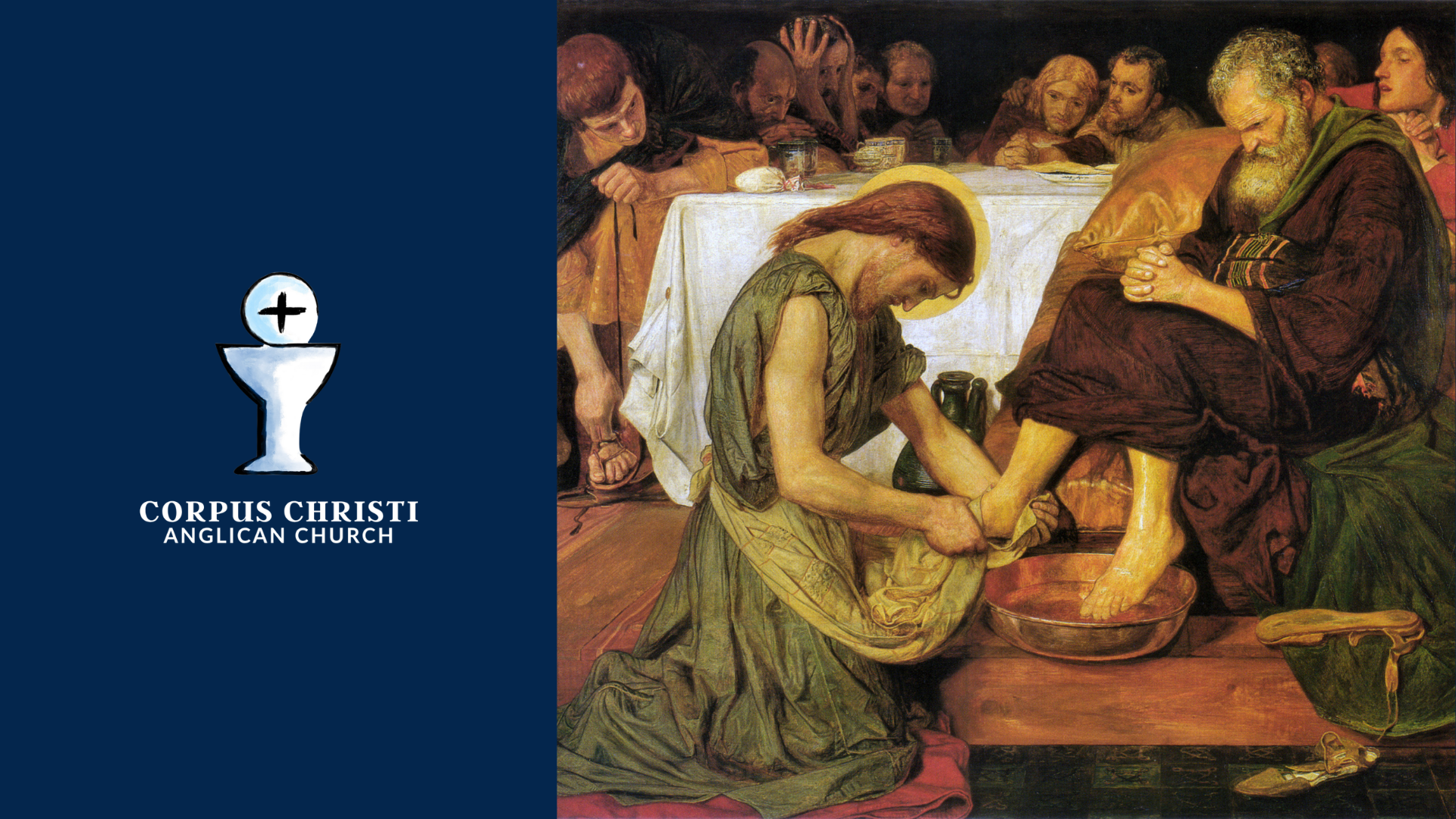
The apostles had known Jesus in many ways—as lord, master, teacher, and perhaps most of all, as the only one to whom they could go because he had the words of eternal life. On top of that, even if they didn't understand or fully comprehend him, they had heard him talk about himself as, and in some cases demonstrate himself as, the bread of life, the water of life, the light of the world, and the resurrection tand the life. And yet even with all of that—and perhaps because all of that—to see Jesus get up from their meal, take a towel, fill water into a basin, and apparently silently begin to wash their feet perplexed them. Here is the one who just a few days earlier had ridden into Jerusalem on the foal of a donkey to cries of "Hosanna," in accordance with Old Testament prophecy; who threw out the moneychangers from the temple; who had discussed weightier matters of the law with scribes, Pharisees and Sadducees; who had pronounced a series of woes upon the Pharisees that could not have helped their cause—and who now was stooping down to wipe off their dusty, sandy, possibly calloused feet. This did not make sense! Would-be messiahs didn't do that! Here is a mystery—and an offensive one, at least to Peter, and probably to a lot of the other apostles. I remember my first Maundy Thursday service, and while I was not offended by seeing foot washing enacted, it was something unfamiliar and new to me. And to the apostle John, it was so inexplicable that he could only define it as a supreme example of Jesus's love for them, in John 13:1.
And what about us in comparison with the apostles? With what we have revealed to us of Jesus in the Scriptures, on the other side of their Holy Spirit–inspired understandings of, and reflections on, Christ that developed after his death, we have more reasons to be astonished, and more cause to feel that we have entered a mystery. Jesus after all, is the one by whom, in whom, and for whom all things were created, as we read in Colossians 1:15–17. Let's tease this out a little bit. The very hands and fingers that set the stars in the sky and that even now, to use a 1970s catchphrase, holds the whole world in his hands, now took up a towel, filled a basin with water, and washed the feet of 12 people whom he had created. Wow! Let's take this a step further and make this personal: What does it mean to you, to me, to each one of us, that our creator would do that to each one of us—and for all we know, might do that to us one day when we see him face-to-face? Let's meditate on that; ponder that; take time to let that truth work its way into our hearts.
What this shows us fundamentally is that Jesus is at heart a servant. Jesus is at heart humble. And Jesus is at heart loving. The apostle Paul, in trying to explain this mystery, came up with a complex thought: "Have this mind among yourselves, which is yours in Christ Jesus, who, though he was in the form of God, did not count equality with God a thing to be grasped, but made himself nothing, taking the form of a servant, being born in the likeness of men" (Phil 2:5–8). There's a lot there, but at the most basic level, Jesus willingly chose to be a servant and gave up all of his privileges—the privileges of being God— to become incarnate here on Earth and serve humanity. By nature, he is God, but he chooses to serve, and that service goes against our understanding of what God should be like but is inseparable from his deity. Perhaps this servanthood helps explain how Jesus could tell his apostles later that evening that he no longer called them servants but friends. A creator who willingly gives up his privileges to come and live and die as one of us in the form of a servant willingly makes himself a friend. In any case, this is the night when the true nature of our lord and savior was revealed, and that nature is one of a God who is a servant out of love for all of humanity.
2. This is the night when our lord and savior provided strength for every Christian's spiritual journey.
The Church can be described in several ways, including as the organic body of Christ, where the Church is the people, and as the mystical bride of Christ. But perhaps a fairly unpopular way of viewing the Church today, given our societal distrust of institutions, is nonetheless a thoroughly biblical and Anglican one: as the institution designed by God for the provision of word and sacrament to humanity. God gave us the Word, Jesus, and we encounter Christ in one sense through the Scriptures, of which the Church is the guardian. Through its preaching and teaching, the Church provides word to humanity. And yet it also provides sacrament, and of the two dominical sacraments, the one we feed upon week after week after week is the Holy Eucharist, in the consecrated bread and wine. The Holy Eucharist is bread and wine for the journey of the Christian life, designed to give strength for the journey of the Christian life. In fact, a Latin term for the Eucharist, viaticum, means provision for the journey! John, interestingly, does not give us a direct account of that sacrament's institution in his gospel, but two other passages this evening either alluded to or described it. First, our psalm reading this evening from Psalm 78 gave us a picture of the prototypes of the bread and wine in God's supply of manna and water for the Israelites in the wilderness. In the life experiences of the Israelites, the apostles, and us, one major commonality is that the sustenance provided comes from God's initiative out of his grace; it is not anything that any of us do to earn it. This is again a sign of God's love for his people, that he would provide for human beings in the various wildernesses through which they travel. The second passage where we more directly read of the 3. of how Jesus instituted the Eucharist.
Now there's a lot that could be said about the Eucharist, and you can get quite a bit more from our introduction to Anglicanism class that is held once or twice a year, but even then you will barely scratch the surface. One thing important to point out is that for those of us who are Anglicans, unlike in some other Christian traditions, the Eucharist is not just a memorial of what Jesus did as outlined in 1 Corinthians and the gospels of Matthew, Mark, and Luke. Rather, it is a present intaking of sustenance by God's grace for the Christian journey in which we really do feed upon the real presence of Christ, and as a result we are by God's power strengthened in our faith as members of Christ's body, the Church. It is good to remember what Jesus did in the institution of the Eucharist; it is even better to actually feed upon him. In part, this is because, as the Anglican Puritan author Richard Sibbes wrote and other Anglican Christians have affirmed, "faith knoweth no difference of time" when we read or hear Scripture. In other words, the reader or hearer with faith experiences things described as being in the past or future in the Scriptures as if they are occurring in the present. This, in turn, means that we have a real connection with saints of the past and future when reading and hearing Scripture with faith. So we pray near the end of our Eucharistic liturgy, "We thank you for feeding us with the spiritual food of the most precious Body and Blood of your Son our Savior Jesus Christ; and for assuring us in these holy mysteries that we are living members of the body of your Son, and heirs of your eternal Kingdom" (BCP, 137). We find ourselves in Christ, and in his Church, as we partake of the Eucharist.
Fun fact here, for certain fiction readers and/or moviegoers: what popular and famous book and/or movie contains an intentional literary stand-in and parallel for the Eucharist? The Lord of the Rings. The bread lembas, which the hobbits receive from the elves of Lothlorien, is a bread "given to serve you when all else fails," as J. R. R. Tolkien wrote in The Fellowship of the Ring. So let's pause and reflect for a moment: What might it mean for any one of us to look at the Eucharist as an aid for when everything else fails? Or, if you prefer not to use Tolkien's appropriation of the idea, how can we better come to see the Eucharist as strength for our journey? Or, what does it mean to follow a savior who so loved us that he gave us such food to strengthen us? So this is the night both when the true nature of our lord and savior was revealed, and when he provided all Christians with strength for their spiritual journeys.
3. This is the night when our lord and savior's ultimate struggle began.
Our liturgy will end tonight with a reading of Psalm 22, during which we reflect on the opposition Christ through his various trials after he and the apostles left the upper room, culminating in his death. Often, we Christians think of our lord's sufferings on the cross and immediately beforehand; however, the late Christian author Fulton J. Sheen, who was a 20th century Roman Catholic bishop, notes in his book Life of Christ that "[i]t is very likely that his agony in the Garden [of Gethsemane] cost him far more suffering than even the physical pain of Crucifixion, and perhaps brought His soul into greater regions of darkness than any other moment of the Passion, with the possible exception of the one on the Cross when He cried: 'My God, My God, why hast thou forsaken Me?'"
It's not in our Scripture readings for this service, but let us briefly bring to mind that agony that our lord and savior suffered in the garden. Let us reflect upon the loneliness he felt at his three closest friends— Peter, James, and John—not being able to keep watch with him while he prayed. Let's remember the blood that fell from his forehead hours before he ever went to the cross or had a crown of thorns placed on his head. Christian songwriter Michael Card wrote in his song "In the Garden":
"Trembling with fear
Alone in the garden
Battle before the final war
Blood became tears
Alone in the garden
To fall upon the silent stone
There in the darkness the Light
And the darkness stood still
Two choices, one tortured will
And there once the choice had been made
All the world could be saved
By the one in the garden"
Brothers and sisters in Christ, let us think of what our savior suffered for you, for me, for everyone in the garden. Why does this matter? Why, oh why, does this matter? Because we will face unimaginable trials in our lives during which our lord and savior appears to be either absent or painfully inactive in helping us undergo things that even might threaten to destroy our faith in him. Can you think of such a time in your life? I know that I can. There are times when there is a horrible silence from God. As the late Rich Mullins wrote to Jesus in his song "Hard to Get,"
"Did you ever know loneliness? Do you ever know need?
Do you remember just how long a night can get
When you are barely holding on, and your friends fall asleep
And don't see the blood that's running in your sweat?
Will those who mourn be left uncomforted
While you're up there just playing hard to get?"
Those feelings that we experience or will experience are real. God does seem to play "hard to get" at times. They are not invalid and they are not wrong. Lament can be a powerful Christian discipline, rightly practiced. And still Gethsemane tells us that yes, Jesus knows what it is like. The same love that led him to become a servant for us and that led him to institute the life-giving bread of the Eucharist for us led him to suffer for us. And because Jesus has experienced silence from God himself, both in Gethsemane and on the cross, our faith can be strengthened.
And so Jesus the servant who has just instituted the Eucharist leaves the upper room for Gethsemane, where he will suffer and have to face the ultimate choice to submit to God's will and proceed to the cross. I hope that you can see from these reflections just how important Maundy Thursday is. This is the night when the true nature of our lord and savior was revealed. This is the night when our lord and savior provided strength for every Christian's spiritual journey. This is the night when our lord and savior's ultimate struggle began.
Well, this night is just the start of the Triduum. We can observe the hours the next few days, reflecting more on Gethsemane tonight, walking with Jesus and his apostles through his arrest and trials and then the cross tomorrow, and reflecting on what the apostles and other disciples must have felt on Holy Saturday. We can weep at times, if we feel moved to do so. We can think about whether we are more like Peter, in denying Christ; more like John, in observing things and reflecting on Jesus's love; more like Mary, at the foot of the cross—those are just some examples. But tonight, after the Eucharist, we will not take the Eucharist again until we celebrate our lord and savior's resurrection during the Easter vigil or on Easter morning. Just as he was separate from God, so we shall be separate from him as we know him in the body and blood. Live into that! And tonight, when the altar is stripped, let us experience it as if our souls are being stripped. Live into the desolations of the next few days, so that the consolations of Easter might be greater. This Triduum is a great gift that the Church offers us. Let us take advantage of it, to the benefit of our souls and of our faith.
In the name of the Father, and of the Son, and of the Holy Spirit. Amen.
Palm Sunday: Palms, Praises, and the Death of Tyranny
CONTENT
Introduction
We began our time together today shouting hosannas with the crowds and then moved quickly to the Passion reading which gives us a sense for how quickly this all took place. The great complexity in Matthew 21 is that the Hosannas are completely appropriate as praises even against the backdrop of the crucifixion and that the entry into Jerusalem would appear to be anything other than triumphant. And yet this is the way that leads to eternal life. God can honor the peoples’ good longings and desires while also seemingly saying ‘no’ to them in order to say ‘yes’ to something better; God is dealing with a problem far deeper than any of them comprehended through a story that no one anticipated.
As we look at Matthew 21, let me pray for us, “We praise you, Almighty God, for the acts of love by which you have redeemed us through your Son Jesus Christ our Lord. On this day he entered the holy city of Jerusalem in triumph, and was hailed as King by those who spread their garments and branches of palm along his way. Grant that we who bear these palms in his Name may ever hail him as our King, and follow Him in the way that leads to eternal life; who lives and reigns with you, in the unity of the Holy Spirit, one God, now and for ever. Amen.”
I. The paradox of Jesus’ kingship vv. 1-9
Jesus and other Galilean travelers from the north are heading to Jerusalem to celebrate the Passover festival. They are near the Mount of Olives, just over the Kidron valley, and Jerusalem begins to come into view.
There is a buzz and excitement about the ministry of Jesus. Is someone coming who will finally overthrow the political corruption that is ruining people’s lives and causing so much pain? Is there finally a king coming who will straighten out the factionalism that is exploiting people in the temple system in Jerusalem? Everyone has ideas about what the age to come will look like when Messiah reigns from Jerusalem.
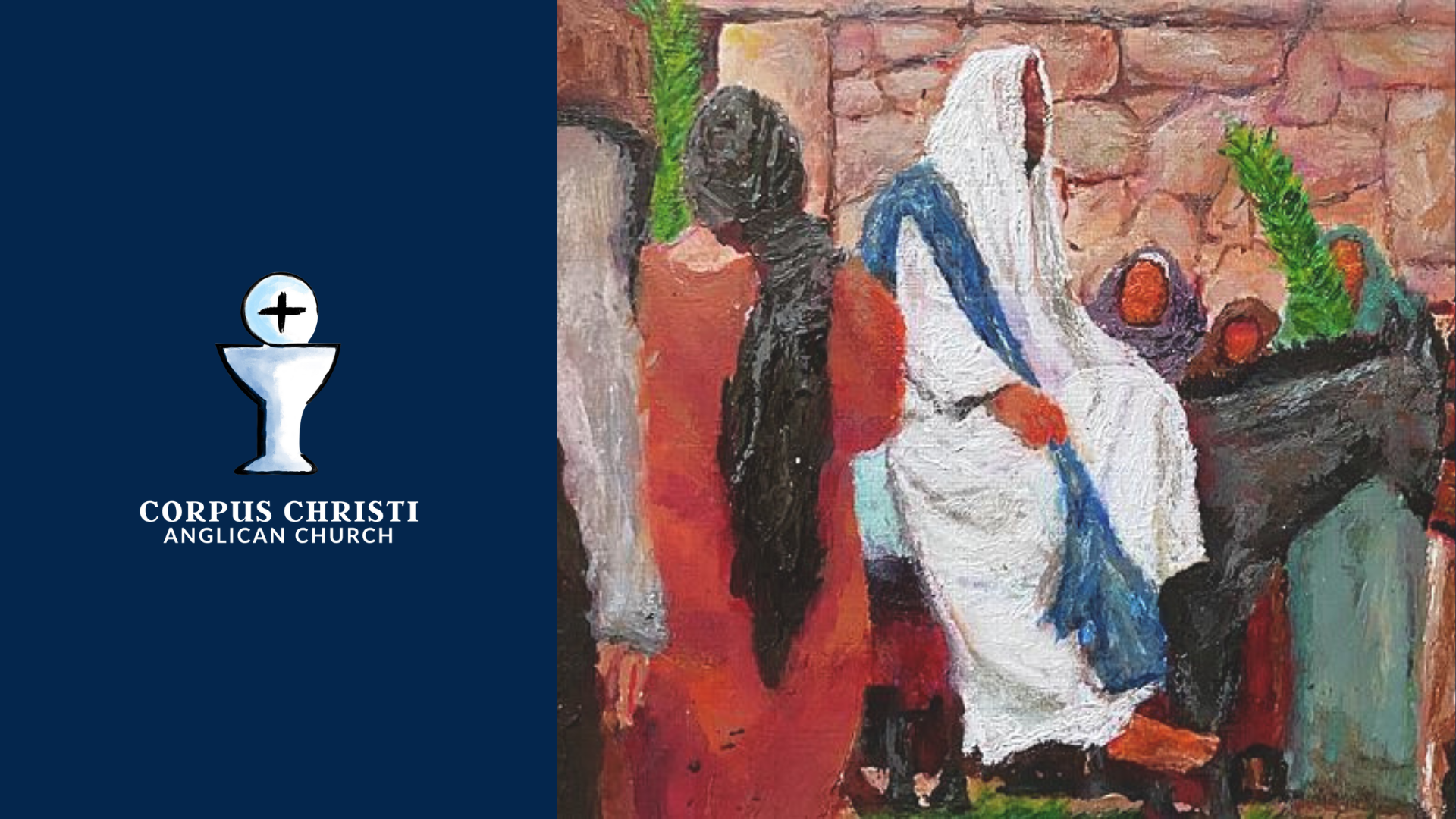
The disciples are asked to borrow a donkey for Jesus to ride on and they retrieve a young colt and its mother. Matthew says that this was to fulfill the prophecy of Zechariah, “Tell the daughter of Zion, ‘Look, your king is coming to you, humble, and mounted on a donkey, on a colt, the foal of a donkey.”[1] There are several allusions here: After David’s son, Absalom, had taken over the kingdom by rebellion and was later killed, David rides a donkey back into Jerusalem to reclaim the throne.[2] Solomon, who succeeds David, rides on David’s donkey to be anointed.[3] Just before the time of Jesus, Simon Maccabeus had cleansed the temple and Jerusalem and the Jews entered it with praise. Simon decreed that each year they were to celebrate the removal of Israel’s enemies with praise and palm branches.[4] If riding on a donkey shows the paradigm of a humble, davidic ruler, then the palms become the symbol to commemorate and anticipate God’s victory over his enemies.
While it is true that this rider on a donkey felt very Davidic, it is also very curious how the donkey-rider of Zechariah will be the one to overthrow the Roman Empire! Jesus did not ride the donkey into Jerusalem to be enthroned like David or like a Maccabean ruler, but to be killed on a pagan cross; but this enthronement was overthrowing a tyranny much deeper than the one they could see.
This reminds me a little of a car we used to have. We had a car that used to leak so much oil. I was buying motor oil in costco packs! Who should be buying that much oil? Mechanics — To use on many cars. You know who shouldn’t be buying that much motor oil? One person, for one car. I took the car to the mechanic and come to find out, the engine block was cracked. At the time I think they quoted me about $4k for parts and labor, which is about as much as we paid for the car! This spurred us on to getting something new. The leaky oil was an indicator — the problem was way deeper than an oil leak. There was no way to fix the surface problem without going in and replacing the whole engine.
Rome’s corruption was not actually the root problem. It was indicative of a deeper and more cosmic problem that had affected Jew, Gentile, and all creation! The answer was not merely the overthrow of a pagan nation. This cosmic problem required cosmic kingship to bring union to heaven and earth.
Jesus wasn’t riding a golden chariot, wearing expensive purple, a ruler who loved a good fight with other aspiring rulers or nations, someone who loved to boast about his accomplishments, who sought after war, or looked for a bloody battle to fight in. Instead, he is a friend of peace who rides a donkey in tranquility in the face of spiritual opposition.[5]
I think the way that Jesus subverts others’ expectations is instructive for us today. We all have dreams of what the age to come should look like right now. What this passage teaches is that those are good and God-given desires and longings. The way that God brings those things about is likely not what we’d expect. There is no glorious enthronement, no new creation, no kingdom, no resurrection, without the way of the cross. Jesus’ way to the cross was a slow dismantling of the kingdom of darkness as death itself was being destroyed.
Practically, what this means is that no family dysfunction, no empire, no individual brokenness gets the final word anymore. Jesus has conquered and will conquer. Rome was only a problem insofar as it was doing the work of death, but a foreign enemy was not the ultimate enemy. God is bringing about new life: the palms are promises and the Hosannas ring true; but it is in a more cosmic way than any of the Galileans would have anticipated. Our praises are never hollow, but we will often find ourselves in the midst of the process of salvation we don’t fully understand.
I see glimpses of new creation in your stories. As you follow Jesus, I love hearing your testimonies: Every time you tell me about a breakthrough in a conversation you’ve had with a spouse, every time you tell me about an answer to prayer, every time you tell me about a child who is doing hard things or helping others, every time you share how Jesus has shown up in your grief or in other unexpected ways. There might be ways that we want Jesus to show up, like “fix my marriage, or fix my job situation, or fix my child, or fix my finances, or fix this country”. We long for new creation in lots of places. These are good longings, but we cannot control the trajectory of how new creation comes about. The dysfunctions might just be the indicators that God is at work below the surface and deliverance might be something far deeper than we expected. These moments might be the road to the cross and ultimately the road to resurrection where we see the glory of Christ as the victorious king.
II. Power and the submission to enemies vv 10-11
In verses 10-11 Jesus comes nearer to Jerusalem. While the Galilean Jews are excited travelers who have come to know Jesus’ importance, Jesus remains less known and less trusted by the Jews in Jerusalem — up to, and including, the Jewish leadership in Jerusalem. We often think that the crowds who celebrated were the same that flipped and shouted ‘crucify him,’ but these were different Jewish communities from different regions. The Southern Judeans shared the apostle Nathanael’s original prejudice: “Can anything good come from Nazareth?”
Judea was under the rule of a Roman prefect whereas Galilee was under the Herodian dynasty at this point. Seeing this Galilean coming down south and claiming to be king may have felt like an overreach to impose authority over the southern district. The title of King of the Jews would be a very destabilizing claim. This is what would get brought up again at his trial. This is a threat to Roman rule, it is a threat to the temple religious system, and to the Sanhedrin. The folks in Jerusalem have every reason to be suspicious of this exuberant Galilean crowd bringing “their” prophet into Jerusalem with a royal procession.
Jesus’s kingship can certainly feel destabilizing, but the Jerusalemites and the Galileans give us two paradigms of how to receive it. We can either give God praise with an openness to what Jesus’ kingship might mean, or we can hold onto everything tightly no matter how broken it is and view Jesus with suspicion. The Galileans would have to continue to hold onto hope in the kingship of Jesus even as he is handed over to those who will crucify him. Those from Jerusalem would have to open their hearts to the idea that maybe God is doing more than what I can see right in front of me.
All of us struggle with wanting to control things to varying degrees. Sometimes it’s wise, but sometimes it’s a refusal of Jesus’s kingship. It can feel safer to hold onto what is broken or is hurting us than to hand it to Christ. We try to curate our lives on social media so that we can control what people think of us. We can try to control the situations our kids will encounter or keep them on a rigid routine to avoid feelings of parental guilt. We can occupy ourselves to death, using workaholism to mask the difficult realities we don’t want to talk about. As Jesus rides in, whether it is through reading Scripture, hearing someone speak hard truth, or a still small voice that is whispering “God is doing something better than this,” do we receive it with Hosannas, trusting in Christ as king to lead us to somewhere ultimately good? Or do we receive it with suspicion clinging too tightly to what is broken because we don’t trust that Christ’s kingship is better than the system we’ve propped up?
Conclusion
Palm Sunday invites us into into a week of walking the way of the cross with Jesus. This road to the cross is the humble road to kingship where the Son of David, the Son of God, will bring about new creation where sin is no more, and even death will die. Our temporal and earthly sorrows are indicators that the kingdom of darkness is still active in the world; yet the surprise of Jesus’ kingship is that his victory reaches to the depths of the cosmos even as it touches the human heart. Our deliverance from sin is a foretaste and deposit of the ultimate goodness that will reign over all things. The Hosannas remind us that a new day of salvation is dawning for those who follow the way of Jesus.
Let us pray:
Almighty God, whose most dear Son went not up to joy but first he suffered pain, and entered not into glory before he was crucified: Mercifully grant that we, walking in the way of the Cross, may find it none other than the way of life and peace; through Jesus Christ our Lord, who lives and reigns with you and the Holy Spirit, one God, for ever and ever. Amen.
[1] Zech 9:9
[2] 2 Sam 19.
[3] 1 Kings 1:38-40.
[4] 1 Macc 13:51.
[5] cf. an incomplete patristic work on Matthew: Manlio Simonetti, ed., Matthew 14-28 (Ancient Christian Commentary on Scripture; Downers Grove, IL: IVP, 2002), 125.
Lent 5: Seeds of Joy in the Soil of Sorrow
CONTENT
Introduction
Good morning friends. Today is Passion Sunday. It begins this two week time within Lent that includes Holy Week. If we have joined Jesus in the wilderness for 40 days, we are beginning to narrow down now to the road to the cross. This is why we veil the cross. As we look at the events that happen on the way to the cross, what will eventually be accomplished on the cross can be seen, but only dimly, as through a veil.
Today’s passage is all about God’s presence in our “if only” moments. We all have these “if only” parts of our stories: if only I could have said these or those words before my loved one had passed, if only I could have parented differently, if only I had understood my family system before I entered marriage, if only I had made better vocational choices, if only I had gotten married earlier or started trying for kids earlier, if only I had made better financial investments before now. All these “if only” parts of our story involve real grief and at the same time they are not the end of God’s will or goodness for us. They are the spaces we sow with tears where we can anticipate Jesus bringing a harvest of joy.
Today’s passage is what God does with “if only” moments. Jesus comes and raises Lazarus as a 7th and final sign in the Gospel of John. This story reminds us that Jesus is the resurrection and the life. In him death will be overcome and those “if only” moments are places of redemption where God’s good kingship will be known where we once saw them as a place where hope had failed. The raising of Lazarus will be the moment that Jesus will cling to to know that the Father hears him even as he is about to enter Jerusalem to meet death.
Let me pray for us as we look at St John’s Gospel: “In the name of God, the Father, the Son, and the Holy Spirit. Amen. Lord, may the words of my mouth and the meditation of our hearts be always acceptable in your sight, O Lord, our Rock and our Redeemer. Amen.”
17-27 Naming where we need Jesus to show up (If only....)
The scene opens in Bethany, which is a short distance from the city of Jerusalem. Mary, Martha, and Lazarus live there. This is a family that Jesus loves. They were well-known in the area. Jesus hears that Lazarus is ill, and yet he stayed two days longer in the place where he was. I’m sure he was praying for Lazarus and for God’s will, but in his decision to wait two days, Lazarus succumbed to his illness and dies.
When Jesus approaches Bethany, Lazarus had been dead for four days. Jesus missed the funeral. Mary is still in a period of grief for her brother and is remaining at home. Martha and Mary are upset. Martha does something about it, leaves the house and meets Jesus to get some answers. She essentially says, “Jesus, if only you had gotten here earlier; my brother would not be dead.” You can feel the tone of her question: “Jesus, where were you? I thought you cared?” The exchange between Jesus and Martha gets into the theological reason this story is included. Jesus tells her that her brother will rise again. Martha, like the Pharisees, believes that her Bible teaches a general resurrection of the faithful. She believed her brother would be a part of that, but that doesn’t give much comfort right now.
Jesus is not skipping past or bypassing her pain. When I lived in Dallas I had a 19 year old coworker who tragically took his own life after battling with mental health issues for a long time. I went to his funeral which was held at a megachurch that met in a mall-turned-church in one of their “side chapels”, which was an old movie theater. The pastor’s sermon felt so hollow. He basically told the congregation all the ways my friend lived such a full life and that we should be joyful that he is in the presence of Jesus. But his life had just begun. I would much rather have my friend back and figure out how to address his mental health challenges. Sometimes I also want to come to Jesus and say “Jesus, if you had been there my friend would not have died”. And it is also true that I can say that God has used the memory of this young man to help people: I’m sure he made an impact on people he knew, money was donated on his behalf to bless others, the few years I knew him have shaped how I view mental health, and I have so much more compassion for what it is like to be a lost 19 year old boy who is struggling to ask for help. Jesus didn’t make the situation better, but he was present to redeem a tragic end. This young man’s life and story have within them the redemption of resurrection life because Jesus is present.
Jesus is telling Martha that our hope is not just in some far off general resurrection. Our hope is in Jesus, who is the resurrection. The resurrection isn’t just a concept, it is a person — and that person is Jesus Christ. Martha believes that Jesus is the Messiah, the Son of God, the one coming into the world. Jesus brings the age to come into the present evil age. And the reason why this is our hope is that Jesus bore our griefs and carried our sorrows — and he triumphs over death. To enter into the age to come does not deny the reality of suffering and death. Jesus redeems suffering and death as the places of redemption where His kingship comes to be known.
28-37 Jesus bears our sorrows and knows our grief (Jesus wept...)
Martha calls for her sister Mary to come because the Teacher is calling for her. Jesus meets them outside the village and those who were mourning with Mary come with her to see Jesus. They thought she was heading to the tomb to go and weep there, so they follow her. This is part of early Judaism’s mourning rituals. There were family and friends who surrounded her to weep and they often hired professional mourners.
Notice that when Mary gets to Jesus she says the same thing “Lord if only you had been here my brother would not have died.” Jesus was moved very deeply at the sight of Mary crying and all those who were mourning with her. He asks where they have laid Lazarus. On the way to the tomb, verse 35 says Jesus began to weep. What was he weeping for? Jesus had just given sight to a man born blind! And Jesus knows what he’s about to do. And yet, I do think these are real tears. I love the explanation of the 4th century Potamius of Lisbon and I’ll summarize it: Jesus wept in fulfillment of this aspect of human love, offering sympathetic tears. He wept to moderate the grief of those mourning. He wept because of the extent to which humanity had fallen under the shadow of sin and death. He wept because God had given humanity every beautiful fruit and flower of the garden and they’d been cast out and exiled because of sin.
Jesus knows our tears and has borne our sorrows. In reflecting on this passage, NT Wright says, “The Word, through whom the worlds were made, weeps like a baby at the grave of his friend. Only when we stop and ponder this will we understand the full mystery of John’s gospel. Only when we put away our high-and-dry pictures of who God is and replace them with pictures in which the Word who is God can cry with the world’s crying will we discover what the word ‘God’ really means.” He is truly a man of sorrows and acquainted with grief. And while there is grief, the grief is productive and the sorrow is redemptive.
38-44 The Father hears us in the face of death (the Father hears...)
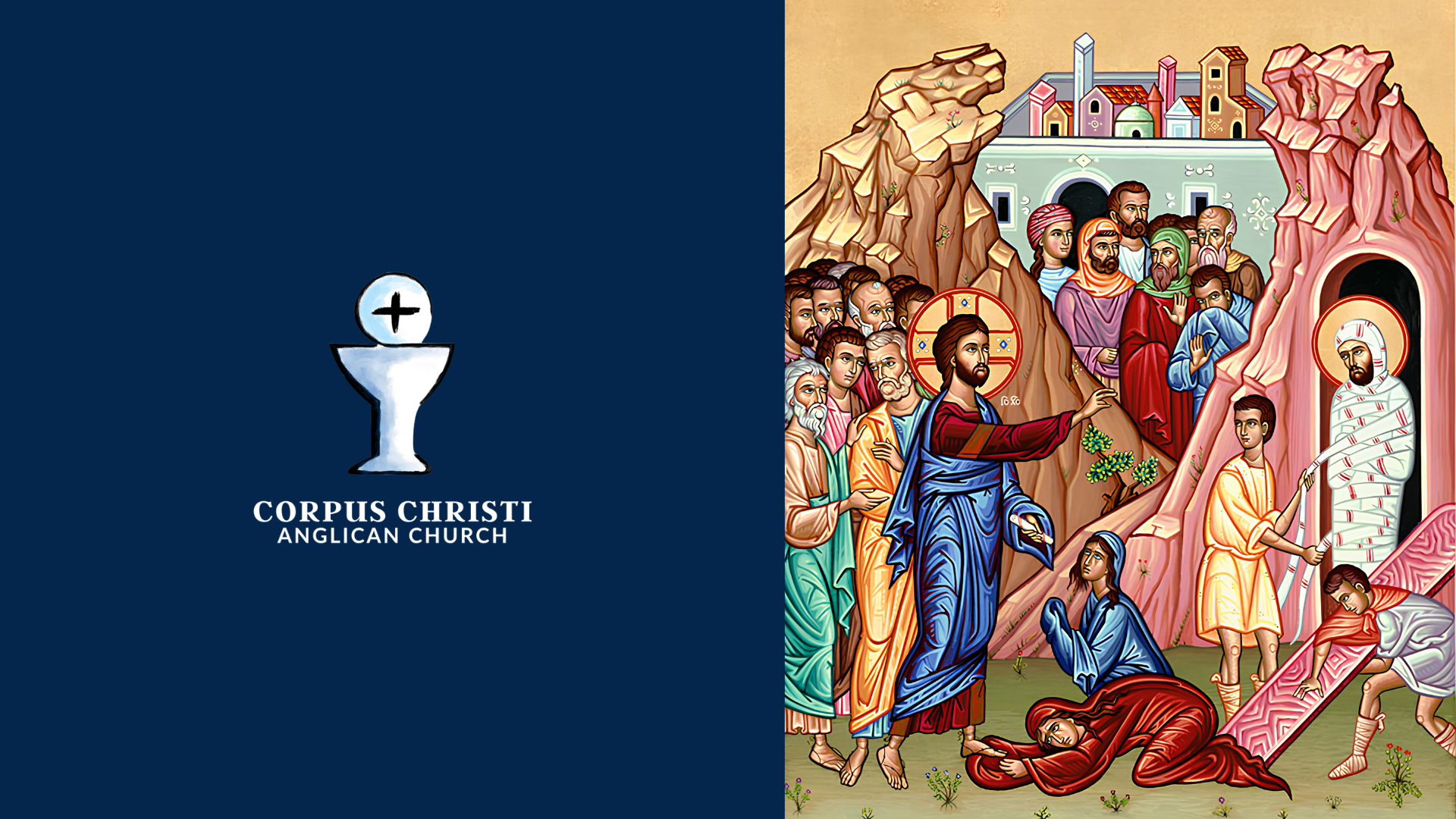
Jesus comes to the tomb and tells them to remove the stone. It’s been four days and people have no expectation that Lazarus will rise. In fact, they believe he has begun to decompose. However, in the days where he would have been decomposing, Jesus had been praying for this moment. Jesus reminds them that belief is the precursor to seeing the glory of God — much like the story of the man born blind who had to go and wash in the pool of Siloam. Jesus says something striking. Knowing what he is about to do he enters into prayer: “Father, thank you that you have heard me”. This is a moment he’d been praying about even though everyone thought he was two days too late. He was right on time. God hadn’t heard his prayer just for Lazarus to be raised, but for the right moment and opportunity for the glory of Jesus’ connection to the Father to be made known. He says “Lazarus, come out.” In a culture that knew about incantations, Jesus offers no spell. He names his friend and gives a simple command. Lazarus obeys his Lord and rises up out of the grave. This moment would be the sign that though Jesus enters our sorrows on the way to the cross, he would return them to us as the joys of redemption. The cross and resurrection are why the Psalmist can rightly say that those who sow with tears will reap with songs of joy.[1]
St. Ephrem says, “[Jesus’s] tears were like the rain, and Lazarus like a grain of wheat, and the tomb like the earth. He gave forth a cry like that of thunder, and death trembled at his voice. Lazarus burst forth like a grain of wheat. He came forth and adored his Lord who had raised him.”[2].
Conclusion
In this final sign Jesus has taken our moments of “Jesus if only you had been here”, then he weeps with us, and turns our griefs into moments of redemption where the Father hears us and his glory is made known. As we close, I want to pray the chorus from a song I love from the Porter’s Gate that summarizes what I’m saying. Please pray with me:
“The kingdom’s come // and built upon
wood and nails // gripped with joyfulness,
So send [us] out, // within Your ways
knowing that // the task is finished.
The dead will rise // and give You praise -
wood and nails // will not hold them down!
These wooden tombs, // we’ll break them soon
and fashion them // into flower beds,
The curse is done, // the battle won
swords bent down // into plowshares,
Your scar-borne hands, // we’ll join with them,
serving at // the table You’ve prepared.” Amen.[3]
[1] Psalm 126
[2] Commentary on the Diatessaron.
[3] From Work Songs, released October 6, 2017 . WOOD AND NAILS. By Keith Watts, Isaac Wardell, and Madison Cunningham; Vocals: Audrey Assad and Josh Garrels; Guitar: Isaac Wardell; Piano: Tyler Chester; Celesta: Orlando Palmer; Bass: Jay Foote
Lent 4 (Laetere Sunday): Light From the Dust
CONTENT
Introduction
Good morning friends. It is great to be with you this morning. Today is the fourth Sundxay of Lent, or Laetere Sunday, which means “rejoice”. It is a bit of reprieve that reminds us that hope, preparation, and penitence, can all sit together in the same space. The rose vestments also remind us that we’re nearing the end of Lent.
The questions raised in today’s Gospel are a warning not to search for someone to blame when it comes to others’ suffering. It doesn’t produce anything helpful. Christians don’t believe in Karma, but sometimes they can say things that feel like it. I remember hearing about someone who, when something negative happened to him, he turned to a religious interrogation of himself to try and find some sin that might be in his life that was the cause of his suffering. Imagine how cruel it is to apply this logic to the problems that arise in the birth of children and all that can go wrong in that process. It feels extraordinarily cruel. Jesus, the Good Shepherd, comes to a man born blind in John 9 and does not confront him with religious scrupulosity. He comes to address the man’s healing as a platform for God’s glory.
Instead of any hint of blame, this is actually an opportunity for new creation. Suffering is a reality we cannot avoid, nor can we explain in our narrow understanding of the world. The blind man ends up seeing more than the teachers of Israel, and like him, our good shepherd comes to bring new creation in our places of suffering.
1-7 The Light in the Darkness
Jesus and his disciples encounter this man born blind. The disciples look at this man and ask, “Who sinned, this man or his parents, that he was born blind?” Obviously the man could not have sinned since this blindness had been from birth. They are thinking about verses in the Bible about God visiting the iniquity of the parents on their children. If I could bless something in their question, it is that they don’t want to attribute this tragedy to God. But their explanation feels a bit like Job’s friends who keep asking Job to repent or figure out what he’d done to tick God off. It makes our relationship with God very transactional: If I do the right things, God will bless me, my family, and my country. If I sin, God will bring calamity to my life, the life of my household and my country. This isn’t true. And it is because of this logic that St. Augustine has to write the city of God. If Rome, a Christian empire, falls to the Goths, is Jesus still Lord of all? His answer to this question is yes, and the City of God fleshes that out.
Instead of answering questions of theodicy, God’s role in human suffering, Jesus comes with his presence as both Good Shepherd and Light of the World. The world and its systems are bound up with the kingdom of darkness. Because of this bondage, suffering will be a reality, and things will not always be as they ought to be.
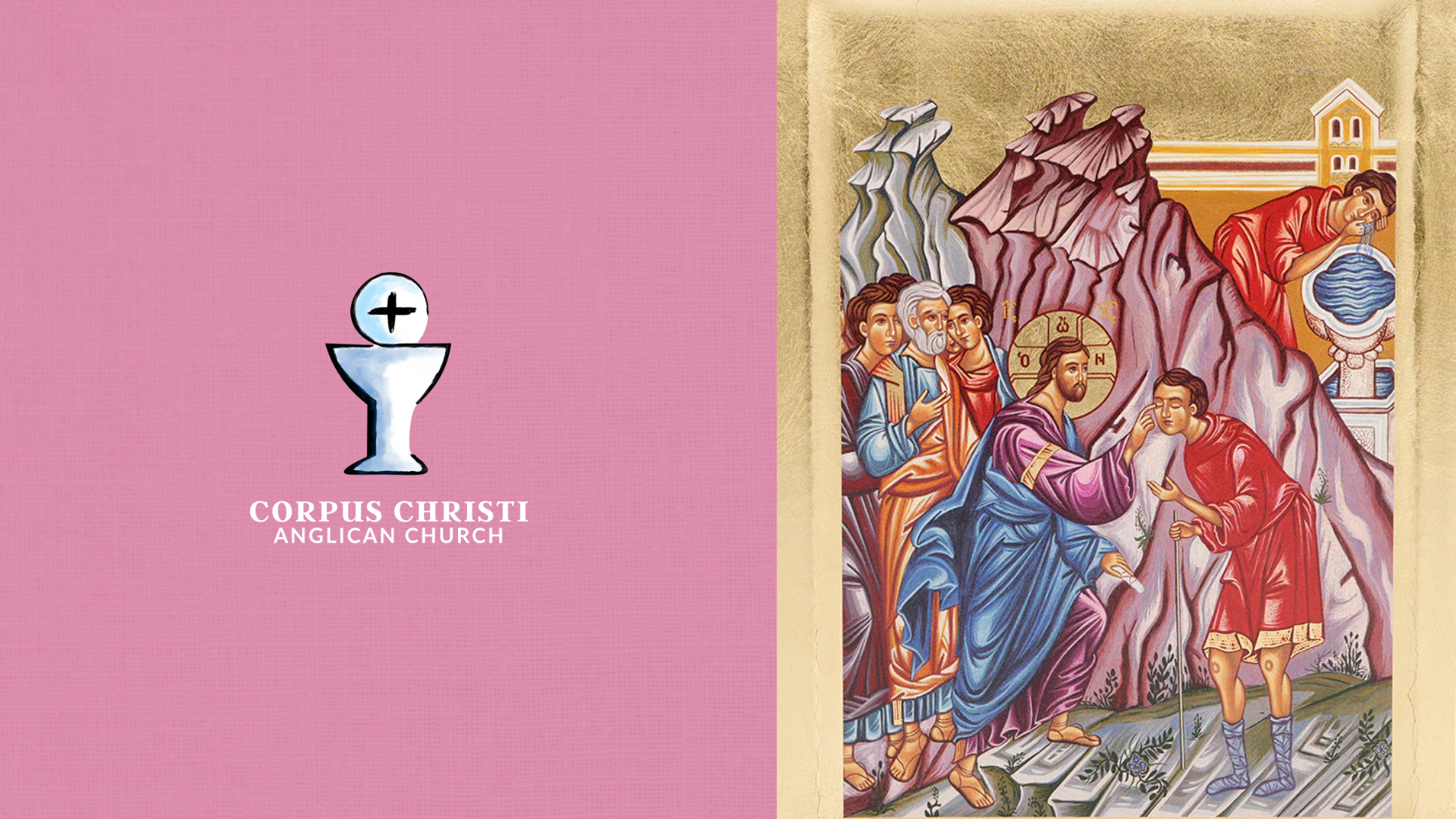
The blind man’s suffering and pain were not an opportunity for philosophical speculation, but an opportunity to anticipate new creation. Jesus brings light from dust: he spits on the ground, makes mud, wipes it on the man’s eyes, and tells him to wash in the pool of Siloam. St. Ephrem, in his commentary on this passage, says it this way: “And he brought forth the light from the dust, just as he had done in the beginning, when there was a shadow of the heavens. “Darkness was spread out over everything.” He gave a command to the light, and it was born from the darkness. Thus also here, he formed clay from his saliva, and he supplied was what lacking in creation, which was from the beginning, to show that what was lacking in nature was being supplied by his hand.”[1]
I love how small this man’s faith is and how great God’s work of new creation is. It does not take a great amount of faith to open ourselves up to the grace of God. This is a picture of what God wants to do in a newly created people. People who had been bound to spiritual blindness can now see and while they may not have all the answers, they do know that it is Jesus who is the one who makes all things new.
8-13 Jesus makes things new: Can this be the same person we knew before?
We see how Jesus is the light of the world who brings new creation where darkness had once reigned. Second, the response of the people is to wonder if this was even the same person they knew before. This is the kind of thing Jesus does. Not everyone has a momentary conversion story, but we all go through daily conversion. I’d encourage you to look at 3-4 major moments that shaped your life in Christ. There was likely some amount of suffering. How did Jesus bring light from dust? I can think back on a dinner that changed my life when I was 14, the death of grandparents, health crises within my family, the birth of our son, moments of financial instability, painful moments at the hands of church leadership, difficult and painful arguments with those close to me, and hard vocational decisions. I would not be who I am without Jesus being my Good Shepherd in these moments. The light of the world will make something new, heal what is broken, and rightly order what has been dis-ordered. People who knew us before these moments and then encounter us afterwards might say “Are you the same person”? And the answer is yes, but now I’m more myself than I was before because I have been with Jesus.
I want to be a church where we are constantly surprised by each others’ transformation because of being with Jesus; a place where we become more ourselves because of having been with Jesus and one another. This is the curiosity involved in discipleship. As you are in your formation groups or playdates, the teams you serve alongside on Sundays, or other times together, walk with one another, and be the presence of Jesus to each other, not providing explanation, but inviting Jesus to be present. Resist the temptation to interpret others’ experiences for them. And certainly don’t waste time on speculating on answers for why they’re suffering. To do that is to heap shame on an already broken heart. Come with a loving and curious presence, sometimes offering prayer, sometimes just offering a listening ear, but always offering an empathetic witness to your brother or sister’s pain and joys. As St. Paul says, “Rejoice with those who rejoice; mourn with those who mourn.”[2]
28-38 Hold onto Jesus in the face of darkness: The blind man becomes teacher and the teachers become blind
We have seen how Jesus is the light of the world who brings new creation where darkness had once reigned. Second, the response of the people is to wonder if this was even the same person. Finally the blind man becomes the teacher to spiritually blind teachers. The Jewish leaders had decided that anyone who confessed Jesus is Lord would be put out of the synagogue. The parents of the blind man had been put out as a result of the blind man just saying that Jesus helped him see. In verse 28, where our reading picked up, the leaders reviled the blind man saying that they were followers of, and disciples of, Moses. They were all out of logical arguments, and when civic discourse broke down, they resorted to exclusion, dehumanization, and violence. This is what the leaders of the synagogue had done and it is what happens today.
You can see this in children. When they are mad, and start to get hostile, they punch, kick, bite, or use words like “I hate you” and “your not my mom or dad”. What they mean is “I am angry and I can’t think clearly and I don’t have the right words right now and I need to get this energy out and then I need a hug”. I would expect to find this paradigm in the world, but God help the church to be different. I would love to see the church become a place where following Jesus means that we are self-aware enough to name things accurately within us and outside us and to bless other image-bearers with our words, holding disagreement with compassion; or if cursing occurs, that we would repent and make amends quickly.
Here the healed man takes on this sardonic tone; he may sound slightly cynical, but his aim in the text is to invite the leaders to open themselves to the work of Jesus. The healed man is amazed that these people did not know what to do with Jesus, but he experienced something no one has ever heard of — that someone born blind has been healed. The only conclusion to draw is that this man is from God. The man is not yet a disciple of Jesus, does not even quite know who exactly Jesus is, but his testimony alone was so threatening that he is thrown out of the community.
Then once he is thrown out, Jesus comes after him like a good shepherd. After hearing that he’d been driven out, verse 35 says that Jesus went and found him. It’s at this point that Jesus follows up and tells the man that He is the Son of Man. The healed man believes and worships Jesus. Then we get to the punch line of the story. There are Pharisees nearby who overhear the conversation and say “Surely we aren’t blind, are we?” The story began with people asking if family sin had resulted in a man’s blindness. The story ends with those who seem to have it all together becoming spiritually blind with the result that sin reigns. The cause and effect is reversed. Sin does not cause the blindness; spiritual blindness keeps us bound to the darkness of sin.
Conclusion
Today’s passage fits the theme of “rejoicing”/Laudete, because it is all about the light of the world bringing about new creation to anticipate what is to come. He is the one who works in us to bring about the goodness of new creation in the face of darkness around us. He is the Good Shepherd who comes to us when others have cast us aside. We cling to him in worship and hope as we share our stories of what Jesus has done in us. This is a story of the God who brings light from dust; He may not give us answers, but he gives us his presence as the troubles of this world become a platform for the Glory of His new creation. We become more fully human because we have been with Jesus.
Let us pray:
O God of unchangeable power and eternal light: Look favorably on your whole Church, that wonderful and sacred mystery; by the effectual working of your providence, carry out in tranquility the plan of salvation; let the whole world see and know that things which were cast down are being raised up, and things which had grown old are being made new, and that all things are being brought to their perfection by him through whom all things were made, your Son Jesus Christ our Lord; who lives and reigns with you, in the unity of the Holy Spirit, one God, for ever and ever. Amen.
[1] Ephrem, Commentary on Tatian’s Diatessaron 16.28.
[2] Rom 12:15
Lent 2: Jesus Answers What We Haven't Yet Thought to Ask
CONTENT
Introduction
Good morning friends. It is great to be with you on this second Sunday of Lent. Over the next several weeks we will look at snippets from the Gospel of John. These different vignettes challenge some of the assumptions that people had about the Messiah. Today we encounter Nicodemus coming at night to speak with Jesus. He thought he was solving one problem, but in the discussion he learned about a problem greater than he understood. Jesus then solves for the problem that Nicodemus didn’t even know he was asking about.
Like a good spiritual director, Jesus pointed out how Nicodemus needed more than what he was asking for. In our life with Christ, this is a helpful paradigm for prayer. We come to God with our sincere questions, but fully ready to embrace an answer to a question much deeper than the one we we’re asking.
As we look at John 3, let me pray for us. “In the name of God, the Father, the Son, and the Holy Spirit. Amen. Lord, may the words of my mouth and the meditation of my heart be always acceptable in your sight, O Lord, my rock and my redeemer. Amen.”
I. 1-2 Naming the problem
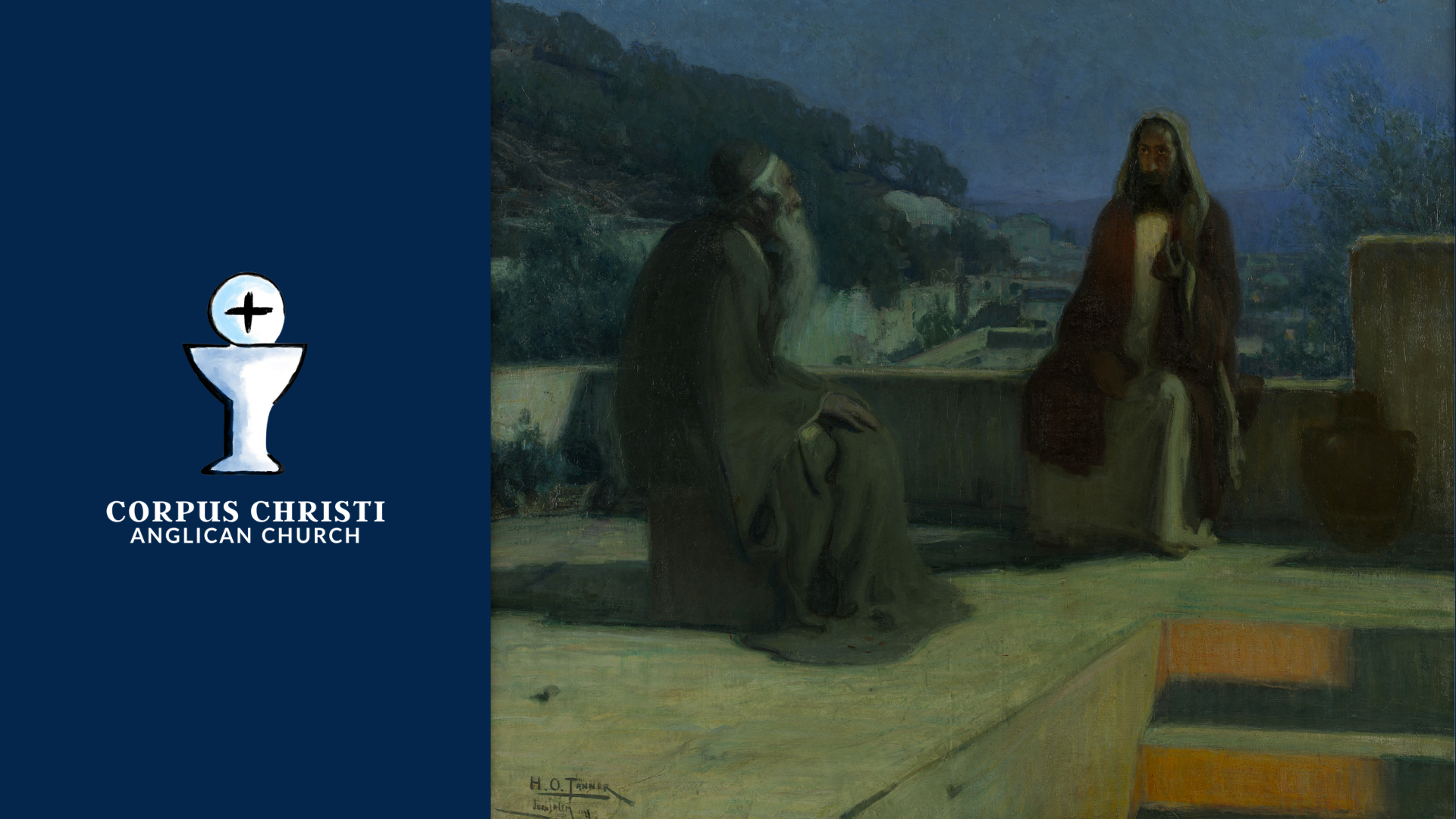
This motif of light and darkness is all throughout the Gospel of John. This week we encounter Jesus meeting with a religious leader in the dark. He comes in spiritual darkness to the light of the world; he also comes under the cloak of darkness because of the risk to being associated with Jesus. John 3 calls Nicodemus a leader of the Jews which I take to mean he was likely a member of the Sanhedrin. This is sort of like a small-scale coalition government. This was made up of different parties that were at odds with one another. Nicodemus knew about Jesus’ cleansing of the temple in John 2 and as a Pharisee, he probably wouldn’t have been bothered that much about it; he may have even cheered him on. Only the Sadducees benefited from the economics of the temple system.
Nicodemus is risking something by coming to Jesus in this way. I’m sure the Sanhedrin has had discussions about Jesus. Jesus is a threat to one group because he is trying to overthrow well-established religious systems in the temple. He is a threat to another group because he claims to be a king and son of God. He is a threat to another group because he claims to be the rightful interpreter of Moses. Yet there is something in Nicodemus that is so curious about Jesus that he is willing to come and find answers for himself.
Nicodemus meets Jesus and says, “Rabbi, we know that you are a teacher who has come from God; for no one can do these signs that you do apart from the presence of God.” Jesus doesn’t have a famous teacher He followed and He doesn’t really fit anyone’s paradigm for what a teacher in Israel should look like; nonetheless, Nicodemus recognizes that there is something about Jesus’ ministry that comes from God. I wonder what he was hoping to discover? Was he hoping to discover someone who could tell him the future, or innovative hot takes on the law, or a plan to overthrow Rome, or justification that his political faction was right amidst the coalition group of the Sanhedrin? I can’t help but wonder if there were some mixed motives? Yes, he wanted to know more about Jesus, but I also wonder if he wanted to know more about how Jesus viewed his particular tribe. We cannot be certain.
We all come to Jesus with good desires clouded by mixed motivations. I think it is encouraging to see Jesus’ posture. He doesn’t turn Nicodemus away, but invites him into a better question. You and I will come to Jesus with very good longings and desires to see something of the kingdom of God. And sometimes, and maybe often, those good desires are clouded by all kinds of unhelpful beliefs, values, and misguided assumptions. Jesus doesn’t say “come back when you’re a bit more grown up spiritually.” He blesses the desire with a question to help us see the kingdom more deeply.
II. 3-13 The Spirit’s Deconstruction and Reconstruction — Problematizing the problem
Jesus tells Nicodemus that no one can see the kingdom unless they are first born from above. Some translations will say “born again”, but there is some intentional ambiguity in the Greek word that allows for both. I think the emphasis lies more on being born from above. Nicodemus asks Jesus how it is possible to be born from above. We cannot crawl back into our mothers wombs!?! This concept of being born from above is a new category for our friend Nicodemus. It doesn’t compute.
Jesus then mentions the Holy Spirit, comparing the Spirit’s work to the wind which blows where it wishes. In our house, when it gets to be about 65-70 degrees, I love to open up our door to our backyard and open up our window to the front yard to get the cross breeze to blow through our house. The problem is that the wind will blow through our nice, tidy piles of papers on the desk or artwork from our son. When the wind blows, those piles go everywhere!! I remember one day I had the windows open and the wind blew everything. I started putting the piles back together and I found a few important papers that I’d been looking for. I like thinking about the Holy Spirit in this was as a gentle disruptor, taking down our neatly stacked ways of being for the purpose of illuminating something we’d forgotten about or lost.
Nicodemus was an older man with an air-tight theology — until he met Jesus. It wasn’t about which tribe of Judaism got it right. It wasn’t about being in the right family, or among the physical children of Abraham. God was doing something new. The need was deeper than a correct interpretation of Moses, or a just sacrificial system, or the overthrow of foreign aggression. The need went to the darkness of the human condition as an invitation to all peoples to experience the light of the world. It’s an invitation to become what God has made us to be as his image-bearing children. And when this is true, some amount of deconstruction has to take place. And the Holy Spirit is a gentle and wise disrupter.
We all have places that need to get reconstructed. When I was in an evangelical and very baptist seminary in Dallas, I remember being very curious about this Anglican tradition. I had some questions and my pastor at the time connected me with a friend of his who was an Anglican priest. When I met him, he very kindly gave me a Book of Common Prayer and I said, “You know, I like everything about this, but I just can’t get over this infant baptism thing. Is it possible to be Anglican and not hold to infant baptism?” He smirked, and kindly said, “Well I haven’t really met any clergy that oppose it before.” I could have carried on with my trajectory assuming that I knew something that the church was ignorant about, but the Holy Spirit began to blow over the caverns of my soul and I started researching the logic of infant baptism. This opened a whole new world to me and it opened me up to the Spirit’s work in baptism. And now as a dad, it has changed the way I parent. Contrary to some of the toxic teaching out there, a child is not a viper in diapers and all the other bad parenting philosophies that flow from such an anthropology. That theology has been completely deconstructed by infant baptism. Instead, these are little image bearers baptized in the Holy Spirit whom God has given his grace to. Each one of us in our baptism is an adopted child of God, born from above, and the sins and disordered affections and attachments are not who we are, but outside distractions that distort God’s image in us and pervert our view of the world. We all have our own places that need deconstruction and reconstruction. It is the work of the Spirit to blow through and disrupt the piles so that we discover important things long forgotten on our journey of discovering the kingdom of God.
Nicodemus, in the darkness of night, was meeting the light of the world. And when the light goes on in the darkness it is painful to our eyes and takes us time to adjust. And Jesus is patient and kind as Nicodemus will definitely need time for his spiritual eyes to adjust.
III. 14-16 Solving the real problem
Our passage ends with Jesus teaching Nicodemus something about Israel’s Scriptures. He brings up an episode from the book of Numbers[1] where after complaining in the wilderness God sends poisonous snakes which bite the people and they are at death’s door. God has Moses erect a bronze snake on a pole. People are to stare at the snake and they would be delivered. Nicodemus came wanting to talk about Jesus’ educational background and Jesus is like “actually let’s talk about new birth, wind, and snakes”. This is not about Jewish tribalism or the overthrow of an earthly empire. Humankind has been infected with a disease of wickedness more insidious and pervasive than anyone is aware of. Jesus’ ministry as the light of the world is related here to his death on the cross. I like what one writer says, “The darkness (and those who embrace it) must be condemned, not because it offends against some arbitrary laws which God made up for the fun of it, and certainly not because it has to do with the material, created world rather than with a supposed ‘spiritual’ world. It must be condemned because evil is destroying and defacing the present world, and preventing people coming forward into God’s new world...”[2] And the new world that Jesus is talking about is explained in one of the most famous verses in all of the new testament, which we read this morning. “For God so loved the world that he gave his only begotten son, that whosoever believes in him will not perish, but have eternal life.”
Conclusion
Nicodemus came in the darkness to mitigate the risk from his colleagues who embraced the darkness as he engaged his questions with the light of the world. In this conversation, his questions, which represented his good desires clouded by mixed motives, were given space by Jesus, who welcomed them and used them to invite Nicodemus into something far more deeper and transformative. Nicodemus needed to let go of his tight theological grid in order to allow the Spirit to show him the work of Jesus and if he would do that he would begin to see the problems of the world as they are so that in Christ he could begin to see himself and the world around him rightly ordered as it should be. As we consider John 3 this Lent hold onto it as an invitation from Jesus to come to him with your questions, to begin to trust the Spirit to deconstruct the darkness and let the Holy Spirit rebuild us as we embrace the light of the world.
Let us pray:
O God, by whom the meek are guided in judgment, and light rises up in darkness for the godly: Grant us, in all our doubts and uncertainties, the grace to ask what you would have us do, that the Spirit of wisdom may save us from all false choices; that in your light we may see light, and in your straight path we may not stumble; through Jesus Christ our Lord. Amen.
[1] Numbers 21:8-9.
[2] Tom Wright, John for Everyone, Part 1: Chapters 1-10 (London: Society for Promoting Christian Knowledge, 2004), 34.
Lent 1: God's Testing is Formative, Not Punitive
CONTENT
Introduction
Good morning my friends. It is great to be with you this morning. This 40 day season of Lent is where we join Jesus in the wilderness. We are invited to be cleansed of the unhealthy things that have taken root in our lives. The wilderness is a place of preparation for deeper life with God in the mission he calls us to. Today’s Gospel passage is all about Jesus in the wilderness and the clarification of his call in his baptism. As we look at this text together, let me pray for us.
“In the name of God, the Father, the Son, and the Holy Spirit, Amen. Lord, may the words of my mouth and the meditation of our hearts be always acceptable in your sight, O Lord, our Rock and our Redeemer. Amen.”
I. Preparation— Into the wilderness to be tested — 4:1-2
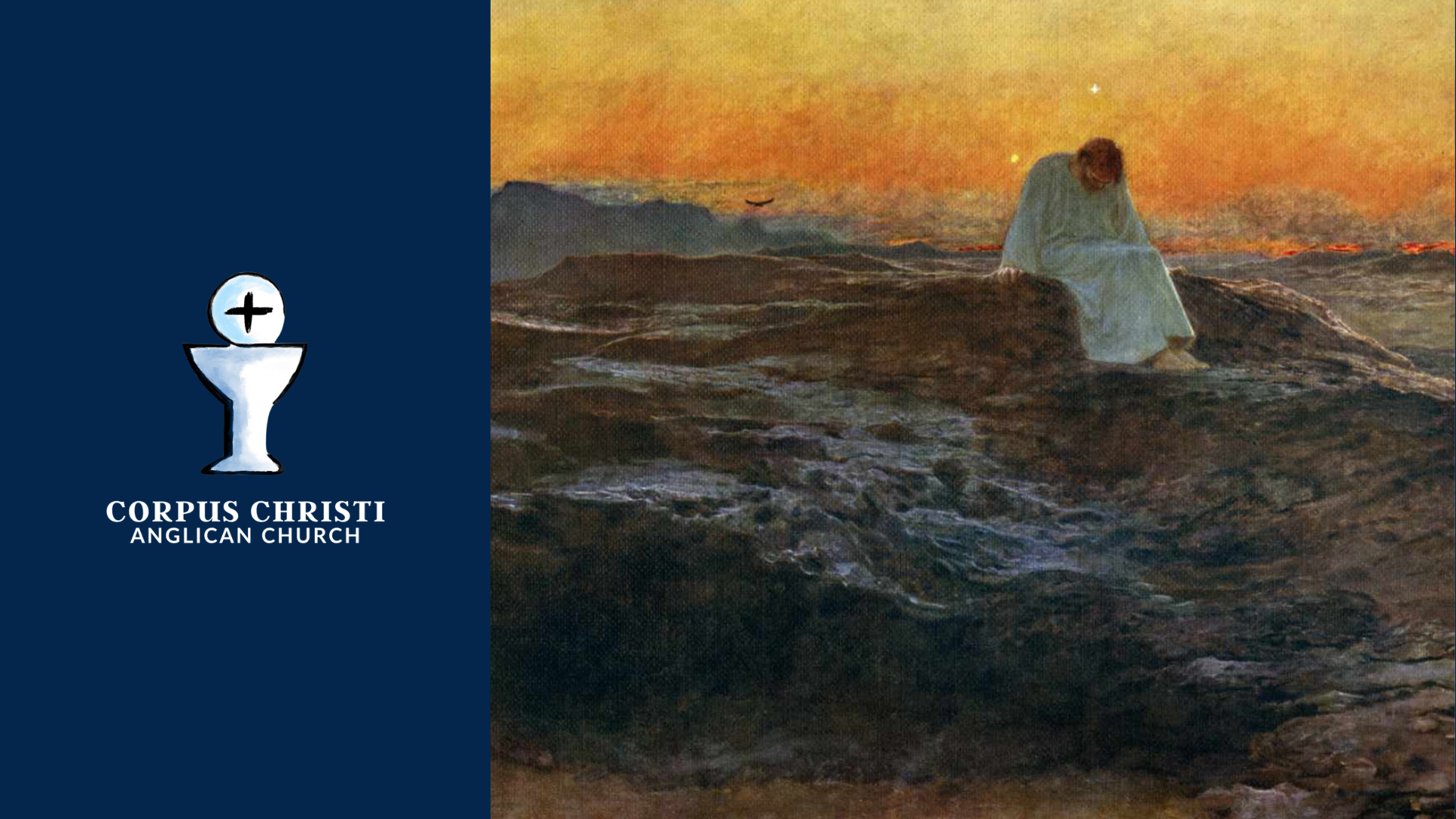
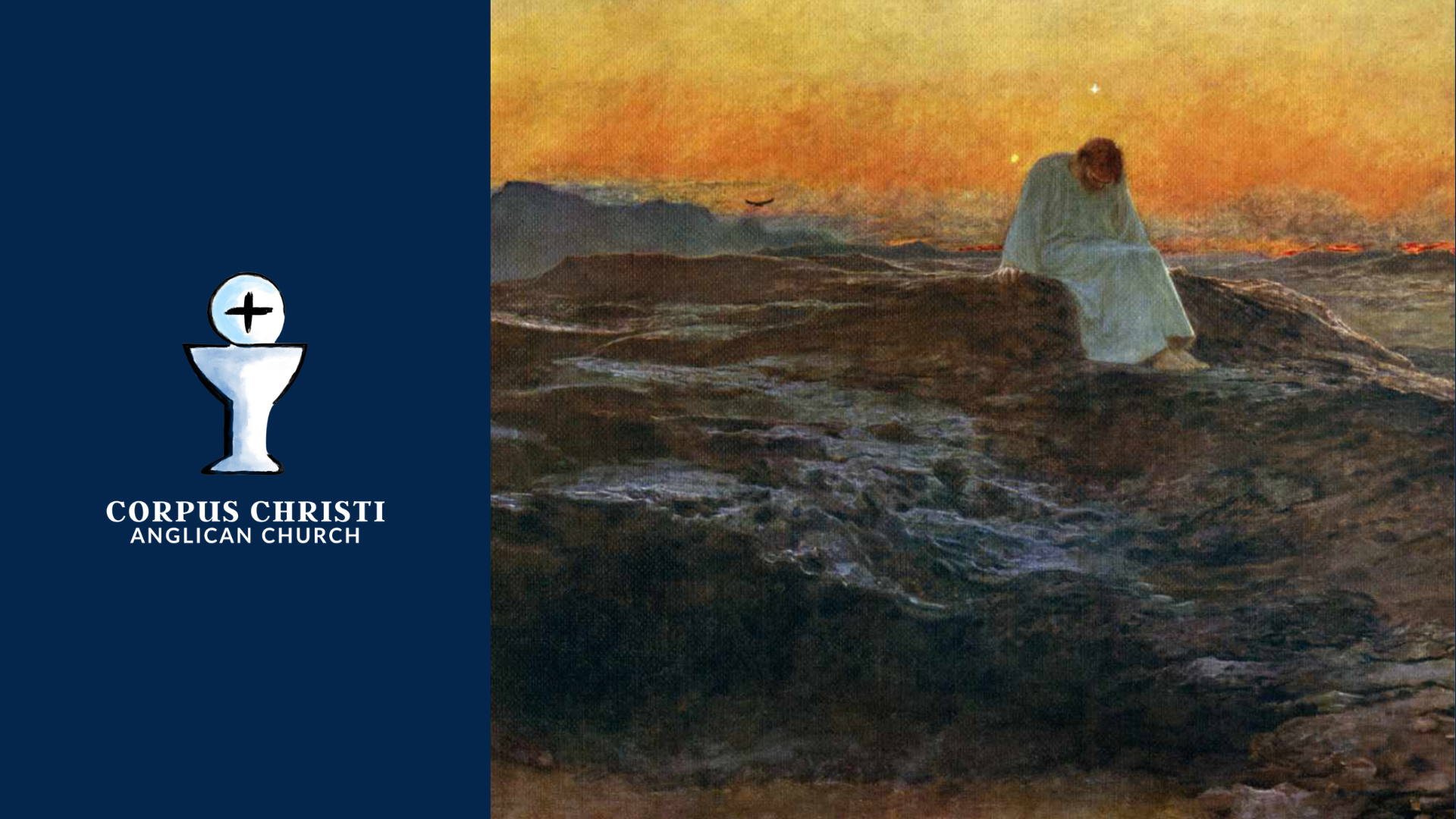
Jesus had spent almost 30 years living in his hometown, taking up the family trade, and preparing for all that God had in store for him in his public ministry through decades of everyday life. In St. Matthew’s Gospel, Jesus had just been baptized by John and experienced the manifestation of God affirming his sonship as Messiah and the one Israel had been looking for. Right after Jesus’ baptism, Jesus is led up by the Spirit into the wilderness. And why? This was preparation. The English translation of “tempting” and “temptation” is pretty unfortunate here. This Greek word, like any foreign word, has a whole range of meanings when it comes into English. God is not leading Jesus to the wilderness to be tempted with evil. God is not tempted by evil nor does he tempt anyone with evil. He does, however, allow us to be in situations where we are tested. It is like a parent helping their child gain independence through trying something hard. Imagine a parent helping their child ride a bike. The child is nervous and says “what if I fall?” The parent tells them that that might be the reality, but even adults fall. Then the parent assures their child that figuring out that bike will open up a whole new world of fun and possibilities; the fall will be worth it. The child finally figures it out and the joy that moment brings is only surpassed by the joy they get when they’re out riding. Testing from God is not punitive, it is formative.
And this is what Jesus is brought to. The Spirit brings him to the wilderness to be tested. Jesus has not done anything wrong to deserve it. In fact, this testing was to the end that Jesus would know his sonship and connection to the father more fully.
This narrative is supposed to bring our minds back to Deuteronomy where Israel is tested over the course of 40 years in the wilderness prior to entering the land of Canaan. In all the ways they had failed the test, Jesus would be victorious.
Jesus reminds us that being in the wilderness is no fault of our own and that in wilderness seasons, when our faith is tested, God’s love still rests on us and his aim is our preparation for a deeper experience of His presence and to become fully human in Christ. Seasons of testing and hardship, or privation and destitution, are the seasons that will ultimately strengthen our relationship with Jesus and our resolve to live into what God is calling us into.
II. Being Lured away with temptation 4:3-10
In the wilderness we will find ourselves subjected to demonic distractions like Jesus was. Satan uses three partial truths to attempt to derail Jesus from the mission God has called him into. First, he points out a good, god-given need and invites Jesus to meet the need in the wrong way. Second, he asks Jesus to test God. Finally, Satan invites Jesus into the right ends through the wrong means. All of these are instructive for our formation in seasons of trial.
a. Meet good needs the wrong way 4:3-4
Satan comes to Jesus in verses 3-4 nearing the end of Jesus’ time of testing in the wilderness. Jesus has a very real human need — to eat. Satan, recognizing this need, invites Jesus as the Son of God to turn the stones into bread. Jesus quotes Deuteronomy 8:3 to say, “One does not live by bread alone, but by every word that comes from the mouth of God.” Jesus submits himself to this hunger in order to learn dependence on the God who takes care of his people.
Jesus did not overcome the devil through miraculous shows of power, but through humility and forbearance. This makes me think back to about 2019 when we were considering planting a church. I remember someone telling me “it will be hard and it will take years”, but they were telling me this to tell me not to do it. They provided me with two different job openings where I could take an easy way out and get a nice rector job somewhere. As Ashley and I prayerfully considered and talked, we felt like God was really calling us to do this. It would be hard, but if I had taken the easy way out I would have missed good, hard, albeit sometimes painful, and necessary lessons in God’s love and my formation. I would have also missed the goodness of what God is doing in this church. When you prayerfully step into the hard thing God is calling you into, whether that is mending a relationship, humbly admitting fault for something, writing and advocating for vulnerable people at great cost to yourself, or stepping into a new vocation, there will be voices that encourage you to look for shortcuts. Instead, it is in our spiritual hunger that we humbly learn dependence on the God who loves us and we learn to overcome our adversary through patience and humility, in companionship with Christ.
b. Putting God under my authority and on my terms (making myself Lord) 4:5-7
After one failure, the Devil comes again to Jesus and in a vision he brings Jesus to some pinnacle on the temple. Jesus is still in the wilderness, not actually in Jerusalem.[1] Satan tells him to jump off because Scripture says that for those who trust in the most high, the angels will catch them so they don’t dash their foot against a stone.[2] He isn’t totally wrong. There has to be some truth to this verse and God’s protection of his people for this to be compelling enough to be a test. Jesus answers by quoting Deut 6:16 about not putting the Lord to the test.
I find it insightful that Satan and the powers of darkness that war against our souls can do so using what seems like a “plain reading of scripture”. Here is where their Scripture interpretation fails: they are using Scripture to try and place God under our Lordship and authority. It’s like thinking that if we do everything just right, then we’ll avoid suffering. We might use a verse like Prov 3:5 “in all your ways acknowledge him and he will make your paths straight.” However, to claim these kinds of maxims as a promise is to attempt to place God under our authority. It ignores the suffering that Jesus went through and does not make space for our own.
Instead, we join in the patience of our Lord to hold space for waiting on God and not claiming proof-texts to test God in our impatience. There is a deeper formation that we’re often not aware of.
c. A Faustian Bargain 4:8-10
Having gone through two somewhat subtle temptations, Satan comes less subtly. In another vision, Satan brings Jesus up to a mountain where he can see all the kingdoms of the earth. If Jesus would bow down to worship Satan, all the nations of earth would be given to him. He is offering him dominion as king of all kings, and the proposed route to this ultimate goal is to bow down before God’s enemy. Jesus quotes again from Deuteronomy chapter 6, verse 13 where worship and allegiance is to be ascribed to YHWH alone.
There is something called a Faustian bargain, which comes from a 16th century German legend. A man named Johan Faust trades his soul to the devil for 24 years of absolute pleasure. The essence of a Faustian bargain is to sacrifice ultimate good for short-term gain. Jesus’ baptism had committed him to the path of servanthood and the path of the cross as the ultimate path to redemption, resurrection, and the glory of kingship. Would this be given up by switching allegiances to gain it quicker and circumvent suffering?
Satan comes to us with similar compromises. Some would rather bring christendom through physical force than compel people by humility and a life transformed by Christ. Some might avoid productive personal conflict by taking personal grudges to the impersonal sphere of social media. Some would rather spend their mental energy on the evils “out there” to keep from looking at the brokenness “in here”. Some resort to high-control in our relationships or belongings to mask how out of control we feel inside. All of these things are a faustian bargain as we long rightly for the blessing and glory of God, but do so without the suffering and cross of our Savior.
Our baptism calls us to renounce the devil and turn to the Lord who saves us daily. Satan’s aim in the wilderness is to distract us and take us fully off course from God’s purpose in each of our lives.
Conclusion: The devil leaves, God attends, we are prepared. 4:11
Jesus didn’t defeat the devil by his own show of strength or bravado. He defeated him through humble, patient, dependence on the Lord who delivers. And ultimately the devil left and he was attended to by God’s angels. Jesus’ testing, and our testing, is not punitive, but formative. This season ultimately allowed him a deeper experience of the love and presence of God even though in the midst of it God may have felt very distant. His constancy, clear sense of mission, and humility allowed him not to get distracted by the voices telling him to take the easy way out, or to lean on God’s “clear” promises about success without suffering, or to make a bargain with evil for short term gain. These voices are very active for each one of us, but God calls us into the wilderness because like a parent who loves us, he wants us to grow and to experience something deeper of his presence than we would have understood before. He wants to make us fully human in the Messiah. And in this patient dependence, the devil will eventually leave. Let’s come clean to Jesus about the ways we’ve tried to take our destiny into our own hands and learn dependence on the Lord who loves us as we we bless the wilderness for what God will do in it.
Let us pray:
Almighty God, you know that we have no power in ourselves to help ourselves: Keep us both outwardly in our bodies and inwardly in our souls, that we may be defended from all adversities that may happen to the body, and from all evil thoughts that may assault and hurt the soul; through Jesus Christ our Lord, who lives and reigns with you and the Holy Spirit, one God, for ever and ever.
[1] Cf. another visionary visit in Ezek 8:1-3; 11:24.
[2] Psalm 91:11-12
Ash Wednesday: God's Nature is the Foundation of Forgiveness
Introduction
Good evening friends. Welcome to Ash Wednesday, the beginning of the Lenten season. I find this to be a helpful 40 days each year to pause, examine, and recalibrate. It is a chance to make sure we’re on the right track. I don’t know if you’ve ever had the opportunity to put together furniture from that blessed Swedish store, but I have. And I can remember starting the process of putting together a dresser. I spent about 45 minutes putting things together when I realized that I reversed two of the boards and so all the work I’d done had to be completely undone before it could be redone again. Oh how frustrating it was. And sometimes life happens this way as well. We start off following Jesus, making decisions and forming habits each day. Our vocations, prayer lives, our friendships, the daily routines, our parenting patterns, habits of leisure, exercise, and coping patterns become hardened as we grow comfortable with the composite results of the many decisions we’ve made over the course of years. We find ourselves heading the wrong direction and we have to start over.
Tonight we remember that we are dust and to dust we shall return. And yet, God is the one who formed us from the dust of the earth and loves us, dusty icons though we are. This season begins with the God who created us in love and whose love invites us to turn towards him and return. The ways we have gotten off track, the things we’ve built incorrectly, the harms we have caused in thought, word, and deed, are not beyond God’s grace to heal. Contrition, almsgiving, fasting, and prayer are not displays of piety to bypass our pain and harm, but invitations to be restored by the God who loves us and gave himself to death on a cross for us, to raise us with him and restore us to perfect communion with him that begins now and lasts eternally. He invites us to reorient ourselves to his kingdom through rhythms that lead to genuine repentance.
God’s love is the basis for our repentance
In Joel 2, which we read earlier, the prophet describes the Day of the Lord, and compares it to a locust plague. The destruction of the Babylonians was described like locusts who would come into Judah’s territory and decimate everything. The text says that before the locusts the land is like the garden of Eden and after they pass through they leave a desolate wilderness and nothing escapes them. There is a concept scholars talk about though with Old Testament prophecy, which is the concept of conditional prophecy. Sometimes when things sound like promises in prophetic literature they’re actually invitations for Israel to repent so God may do the opposite of what was predicted. And Joel 2 is an example of conditional prophecy.
This is why we encounter verses 12 and following, where the LORD tells Judah to return with all their heart, with fasting, and weeping, and mourning. They are called to rend their hearts and not their garments. They are familiar with what religious rituals to carry on doing, but God isn’t interested in empty ritualism; instead, His is interested in a heart that is beginning to turn towards him for his help. And all of this is possible because the Lord is gracious and merciful, slow to anger, and abounds in steadfast love. He relents from punishment. This is who he is. It functions like an old covenant creed and it shows up in the torah, here in Joel, and in our Psalm reading tonight. God’s character is the foundation of the possibility of forgiveness.
I like the way that verse 14 is rendered in the New Living Translation, “Who knows? Perhaps he will give you a reprieve, sending you a blessing instead of this curse. Perhaps you will be able to offer grain and wine to the LORD your God as before.” It is more certain than it sounds. The idea is that they need to begin the process of repentance and see what God will do.
Sometimes we become aware of our brokenness and we get really comfortable with it. I was listening to an interview where they were talking about people who appear successful. Their superpower is that they can do a lot and do it well. And yet doing a lot and doing it well is often a drive and addiction, or coping strategy for keeping someone from dealing with the heartaches and hurts so that they become truly human again in Christ. Our allergy to suffering is mitigated by our drive to perform. And then we learn to believe that if we just keep going we’ll be fine because beginning to repent and heal is to admit that we’re broken and that kind of vulnerability is scary because we might lose our superpower. Lent is a great invitation to become fully human, admit the brokenness, and begin turning toward the Lord and to rest on his faithfulness. His character is the foundation of our hope.
Repentance and spiritual rhythms are to orient us to God’s kingdom
Jesus teaches us something very similar in Matthew 6 which we read tonight. He cautions his follower to watch how they keep their religious observance and spiritual rhythms. There is a way to do a checklist of duties that make us look alright and completely miss the substance of the real work of repentance. The nature of prayer in the teaching of Jesus in Matthew 6 is to form us and reorient us to the kingdom of God and where God is at work in our world. Fasting, giving alms, and prayer are the three spiritually foundational habits of Lent. In the end, they are for our formation more than appeasing God’s desire for moral people.
Their aim and goal is to attune us to God’s work. It reminds me a bit of when Ashley and I had a community garden plot a long time ago. The whole thing was covered in crab grass and we both recognized the problem. Because she and I are wired the way we are, I started scraping off the grass at the surface level with the broad end of a pick axe. I was perfectly happy to throw some seed down and some top soil on it. Now I did do that for part of it, but within a few weeks, plants came up, but so did the grass. Ashley, on the other hand, took to the shovel and went deep. It was slow work, but substantive work. Her work did not cover as much square footage, but where she dug, the grass did not grow back. And in the long run, I had to go back and do it her way. It was harder to see the progress on the slow and substantial work in the short-term, but in the long run, this was the only way to have a healthier garden. I think we often just scrape at the surface spiritually.
When someone comes to me for confession, if they say “I want to confess my pride,” then I will invite them to tell me what pride looked like for them. Vague senses that something is wrong is a good start, but the roots go deep. We need to spend time with where our overreactions and deep sensitivities are. We need to examine our places of insecurity, fear, and cynicism. How many times do we make a joke about something and with a smirk on our faces, we subtly communicate that someone’s opinion is not only unwelcome, but that they are a deeply flawed individual for holding to their conclusions? The religious habits that form us and please God are the ones done with integrity. They work heuristically. As we come to an awareness of how we are going the wrong way, then we begin to honestly come to the Lord with a desire for him to rightly align our desires, thoughts and loves. Even the smallest of desire for repentance is met with the fullness of the grace of God because of who he is. Then as we are formed through these rhythms, we begin to move the right direction, build the right way, become rightly aligned with God’s love and his will. In other words we learn to long for God’s will and love what God loves.
Conclusion
This Lent, let me encourage us to be vulnerably broken before the Lord because God’s very self is compassion and he longs to meet us in his grace. Admitting our brokenness is not to give up our superpowers; it is to become fully human. As you receive a bit of ash on your forehead this evening and you hear the words “remember that you are dust, and to dust you shall return”, be encouraged that God longs to restore you to the dusty, image-bearing, icon he has made you to be.

Transfiguration: Fellowship on the Mountain of God
On this day which focuses on the transfiguration, we’ve looked at three important mountains. We have looked at God’s desire for relationship with his people on mount Sinai, we’ve seen the glory of God revealed in Jesus on Tabor, and we’ve considered the glorious cross on a hill outside of Jerusalem. God is creating a banquet to bring all kinds of people into, and we are reminded of it each week. Let’s become a people who invites others to the table in curiosity rather than pushing them off them mountain; a people who spend time listening to Jesus, seeking to understand more than to be understood; a people who take seriously the call to follow Jesus and love well in obedience when it is potentially humiliating and costly. It is in doing these things that God’s glory is made known in these weak vessels and will go to the nations in our lives and in the lives of the people around us.
CONTENT
Introduction
Good morning friends. It is great to be with you on this final Sunday after the Epiphany. This morning we have some hills and mountains talked about from our Scripture passages and I want to tie together some of what happens on these mountains to help us see how following Jesus is connected to his glory, his rule and reign, being made known among the nations.
When I was about 18 or 19, I lived in Sonoma County in California. I used to mountain bike a lot, and I would often my bike out and ride this 10 mile course along a vineyard-lined highway from Santa Rosa to Kenwood, to a mountain called Sugarloaf Ridge State Park. Once I got there, the last mile and a half would be rough as I made my way straight up the mountain. I loved climbing that mountain on my bike. My legs burned as I went up through the dappled light of tree-lined mountain road. I’d crest the final incline where the trees would break, the sun would shine through, and I found myself on the top of a mountain range that overlooked another two smaller mountains. You can see the view up on the screen. This is is a picture from that mountain.
I’d sit and look out at Mount Hood with the breeze blowing in my face and cooling me down. I loved the opportunity to sit in the dirt, hear nothing but the wind, feel the sun on my body, the dirt on my hands, and watch the world continue to move along below my feet. I don’t know about you, but I often need moments like these in God’s creation that remind me that I do not make the world turn. When I bike or hike I make it a point to stop at some point, breathe deep, and remind myself of this. I can really appreciate the ancient world who would often build worship places on mountains because there was this sense of the mountain being the place where God dwells. Even in the early church, some of the Fathers picture Eden being planted at the top of a mountain.[1]
Our mountain passages this morning remind us of the God who is at work, that we can trust, and that it is not us who make the world turn, but Him. On these mountains, God’s glory is made known, covenants and people are established, and the way of Jesus is clarified. God’s rule and reign, and the glory of his resurrection, is extended to all, through our participation in Christ’s death and sufferings. To join in the glory of the transfiguration, we must understand both mount Sinai and the hill of Galgotha. These mountains give us a composite picture of a life of following Jesus. As we look at these passages together, let me pray for us: “In the name of God, the Father, the Son, and the Holy Spirit. Amen. Lord, may the words of my mouth and the meditation of our hearts be always acceptable in your sight, O Lord, our Rock and our Redeemer. Amen.”
1. Exodus — Mt. Sinai — The Meal on the mountain and salvation to the nations
In Exodus 24, God has delivered his people out of Egypt, and now invites them into a covenant. God comes to Mount Sinai in a cloud with thunder and lightning. The people go up, the elders go a bit further, other leaders go even further, and Moses goes up alone to write down God’s words. God has taken the initiative to establish this agreement with Israel as their God and king. Moses is going to take God’s words and read them to the people and they will agree to this agreement.
The agreement is solemnized and ratified in verse 11 between the two parties with a covenant meal.[2] The people said yes to following the LORD who wanted to make them into a kingdom of priests, a holy nation, and a royal priesthood, a people who would display the goodness of God and invite others into this life. The meal on a mountain is extended to all nations in Isaiah 25:6 when God says, “On this mountain the Lord of hosts will make for all peoples a feast of rich food, a feast of well-aged wines, of rich food filled with marrow, of well-aged wines strained clear.” The meal on the mountain becomes a theme that is found in the book of Revelation and is extended each week in our Eucharistic celebration.
God is establishing a people for his own possession, to display the goodness of his glory as king. Every language, people group, race and heritage, and family is being brought under the rule of our Lord Christ to become one people who are to the praise of his glorious reign. I think sometimes we’d rather push someone off the mountain than invite them to sit next to us at the table. Consider the spaces we find ourselves in deep disagreement; bring them to the level of conscious awareness; and begin to engage one another with curiosity. I know there are a million and one hot-button issues, like gender and sexuality, immigration, parenting styles and education choices, etc. Sometimes, even as the priest here, I feel like I’m walking on eggshells, but I’m trying to work on allowing someone to talk and then to enter into some of these spaces with curiosity rather than an agenda. It’s like the prayer of St. Francis: I want to seek to understand more than to be understood. It is totally countercultural, but if we need to start here to invite people to the table rather than pushing God’s image-bearers off the mountain.
2. Transfiguration — Mt. Tabor — Jesus is one greater than Moses to deliver his people
The one greater than Moses has come to us on a new mountain in the Gospel this morning. Jesus invites Peter, James, and John onto the mountain with him. This is either on Mount Hermon or Tabor, we’re not sure. There are several parallels to the Sinai event: Certain companions come up the mountain, there is a cloud that overshadows, and an appearance of the glory of God. The details aren’t meant to be a one-to-one connection. This Jesus is the prophet like Moses, but greater than Moses. This was a taste of the glory of the kingship of the son of Man that was prophesied about in the book of Daniel.
If you want to know the way of this Son of Man, we are reminded to listen to Him. He is the one who gives God’s commands in this new covenant. As they descend the mountain, there will be a lot of things the disciples will not understand and their only hope to seeing God’s kingdom in the valley of demons is to listen to the Son. We all need rhythms of stillness and silence to be saved and delivered from the daily darkness. I don’t mean physical silence necessarily. I mean that we need regular rhythms of handing over to God what feels turbulent and grievous, to name sin that has gotten calcified, and to meditate on how Jesus is God’s love revealed to us. I was talking with someone the other day about how these rhythms remind me of going to the dentist. I go every 6 months because I need someone with special tools to chip off all the stuff from my teeth that has hardened. Even though that plaque feels like it is part of my teeth, it isn’t! Spiritually, sin and disorder attach to our selves like plaque and calcify and we need regular rhythms of being with Jesus who wants to scrape it off and say “This is not you. Let me take that from you.”
The way we access those spaces is by being honest with ourselves about what’s broken. I remember someone telling me a story from when they spoke to their counselor about why they was getting a certain reaction from their child when they said things a certain way. I have permission to share this. The counselor told them, “Hey, you’re kid is two. You probably look big and scary.” My friend was so embarrassed by not figuring that out himself. Once he brought that to conscious awareness he could begin to ask the Lord why his reactions were a certain way. Was he wanting to feel in charge to compensate for feeling weak and out of control? Was he worried his child would turn out a certain way if he didn’t react with some harshness? Eventually he realized that there was an insecurity there and in an attempt to feel in control, he asserted himself a certain way that made his child feel scared. This was pride and manipulation that was not him, but it had perverted and distorted how he was showing up. He worked on this with Jesus so he could recognize that feeling before it manifest in words or bodily reactions. It started to get better. Listening to Jesus can be so hard, but it is the only way to make it through the valley of demons below.
3. The Cross and Resurrection — A Hill outside Jerusalem
The mount of transfiguration is necessary in light of one more hill mentioned in Scripture: the hill on which Jesus was crucified outside of Jerusalem. Jesus’ glorious reign as king over all and his reign going to the nations was not accomplished through a blood bath against the rebellious, but through his own death on the cross.
N.T. Wright says it this way, “Learn to see the glory in the cross; learn to see the cross in the glory; and you will have begun to bring together the laughter and the tears of the God who hides in the cloud, the God who is to be known in the strange person of Jesus himself. This story is, of course, about being surprised by the power, love and beauty of God. But the point of it is that we should learn to recognize that same power, love and beauty within Jesus, and to listen for it in his voice—not least when he tells us to take up the cross and follow him.”[3]
In this week, as we move from the glory of Jesus on the mountain, to journeying with Jesus, to obedience to the point of death on the cross, I invite us to consider what it means for God to be made glorious in people who take up their cross with Jesus; people who risk humiliation to follow God and love like Christ; people who long for the glorious vision of resurrection and are willing to listen to Jesus when it is costly in order to find his glory in the kingdom of God.
Conclusion
On this day which focuses on the transfiguration, we’ve looked at three important mountains. We have looked at God’s desire for relationship with his people on mount Sinai, we’ve seen the glory of God revealed in Jesus on Tabor, and we’ve considered the glorious cross on a hill outside of Jerusalem. God is creating a banquet to bring all kinds of people into, and we are reminded of it each week. Let’s become a people who invites others to the table in curiosity rather than pushing them off them mountain; a people who spend time listening to Jesus, seeking to understand more than to be understood; a people who take seriously the call to follow Jesus and love well in obedience when it is potentially humiliating and costly. It is in doing these things that God’s glory is made known in these weak vessels and will go to the nations in our lives and in the lives of the people around us.
Let me pray for us:
O God, who on the holy mount revealed to chosen witnesses your well-beloved Son, wonderfully transfigured, in raiment white and glistening: Mercifully grant that we, being delivered from the disquietude of this world, may by faith behold the King in his beauty; who with you and the Holy Spirit lives and reigns, one God, for ever and ever. Amen.
[1] St. Ephrem, Hymns on Paradise.
[2] NIV Application Commentary.
[3] Tom Wright, Matthew for Everyone, Part 2: Chapters 16-28 (London: Society for Promoting Christian Knowledge, 2004), 15.
World Mission Sunday: Send Us Out as Faith Witnesses
CONTENT
Join with me in prayer:
May the words of my mouth and the meditation of my heart be acceptable in your sight, O LORD, my rock and my redeemer.
It has been nine months since I last visited and it is great to be back. God has been working.
I’ve been able to return as a witness twice to two Edenite towns and a Edenite cities.
Friday the first 11 chapters of Revelation in the Edenite language were approved and we’re still on track to publishing the New Testament Translation this Fall.
We’ve finished enough translated scriptures to craft and pray a simple version of Morning prayer.
Your generous gifts have enabled these developments and demonstrate your commitment to the ends of the Earth. Thank you.
Acts 1:8 says:
But you will receive power when the Holy Spirit has come upon you,
and you will be my witnesses
in Jerusalem and in all Judea and Samaria, and to the end of the earth.”
Jesus is speaking to the Apostles, just before ascending to Heaven.
He frames his worldwide agenda from Isaiah 49. In Epiphany, we say every week, “I will make you as a light for the nations” and we respond, “That my salvation may reach to the end of the earth.” Christ’s agenda is salvation reaching everywhere.
Jesus has prepared the Apostles for three years, they witnessed his death and resurrection, and Jesus spent 40 days convincing them and teaching about his kingdom.
But the last question they ask him is what, “Are you restoring the kingdom to Israel?” I sympathize. They longed for deliverance from the brutal Roman empire. They have promises from the prophets about Israels end-time restoration. The Messiah’s come. But they haven’t taken onboard his agenda.
His goal is the salvation of the end of the earth, and he promises to empower and claims them for a critical role and activity.
He says: Focus on me and my agenda! That is your identity. That is your ministry.
Let’s thank God for Jesus’ agenda.
We are about as far removed in space and time as could be imagined from the Apostles. And yet, through them, Christ has brought salvation even to us.
Peter went went west into Europe, Thomas went east all the way to India. They were witnesses amon diverse geographies, cultures, religions and languages. They passed on this promise to the churches they established, who in turn spread all over the world even to us. Let us thank God.
Yet there are places, peoples and languages with no witnessing church or Christians. It’s just six hundred miles from Jerusalem to Eden where I serve, Christ’s witnesses are rare and almost all live their entire lives without meeting a Christian or visiting a Church community.
For the fullfillment of Salvation reaching to them, we must still expectantly pray for this promise to be fullfilled.
Christ called me to Eden, but God has brought people from the ends of the earth here.
Fairfax county schools have students from over 200 languages and 200 countries.
Springfield has thousands of Muslims, Jews, Hindus, and Buddhists, atheists, and agnostics. You work, go to school, live in the same neighborhood, maybe the same family.
The ends of the earth is here physically, yet it s still a challenge to enter the door of your neighbor or coworker and be a witness.
Let’s unpack this promise a little:
You will be my witnesses
YOU
The you in there can be taken individually or corporately. Your corporate witness in West Springfield is critical and important. As important as that is, most of us spend 90% of our time not gathered like now, but scattered in our neighborhoods, workplaces and schools. As we pray. “Lord send us out to do the work you have called us to do, to love and serve you as faithful witnesses of Christ our Lord”.
BE
The promise is about BEING, our identity, our role, our ministry in the world.
MY
Central to the identity is that we are Christ’s. We belong to him. We follow His agenda. He has claimed us for a ministry and a task.
In Eden, people are suspicious of who I represent. Are you an agent of the US? Are you a company man? Are you a charlatan or a hypocrite? This verse helps settle that for me. I belong to Christ and am on the lookout for what He’s doing.
This last week I started training in the school district with people from around the world. Christ’s claim over my life as a witness has been a precious lodestone for me to remember whose I am, and has been a promise that kept me expectant. Each day has been a joy just in being Christ’s witness, his servant among people who have no witnesses.
WITNESS
What is that? Someone who testifies to what they have seen and heard Christ do.
[Note here: Assumption that Christ spends years working salvation into people’s lives and gives us mini-assignments as that, one step along the way]
Luke models that in verse 1, “I have dealt with all that Jesus began to do and teach, until he ascended” That is all we need to share, Jesus has done and said in our lives, and what we see him is doing and saying right now. Simple but not easy.
Bringing up these topics is risky. Who will they think I am? One of those Christians that stands on a street corner shouting the “end is near” or a salesperson.
Will others understand clearly what I say?.
For both these, the Lord says we need something? Do you need a seminary degree? Do you need discipleship? Those are good. The apostles had three years with the Master himself. Was that enough to fullfill this. No: They needed the power of the Holy Spirit, which the Lord promised.
We need that the power of the Holy Spirit just as much as the apostles.
Last week Bishop Chris came to Church of the Epiphany and I saw with new eyes the Anglican liturgical expression of receiving the power of the Holy Spirit to be witnessses. In Baptism the Holy Spirit gives us the power of new life and to be united to Christ. In Confirmation, the Bishop as a representative of the Apostles, lays hands on believers so they’ll receive power to be witnesses and servants.
The Anglican communion has started a non-geographical diocese to welcome Muslim born believers into the into the Church universal. In September He gained my trust after seeing him up close for a couple days as his chaplain. My Edenite partners trusted him as well. They nodded their heads in agreement as he described the special needs of Muslim born believers. One of the Edenite places has connections to the Syriac Orthodox. Orthodox take very seriously the grace imparted by a Bishop. So I asked Bishop Yassir if there was a way to connect with his Diocese. He ended up asking me to pray about ordination. For him, ordained priests are an essential part of Anglican discipleship. So I’ve begun the ordinatoin process with his diocese. I’m excited for the day when one day hundreds, thousands are empowered for witness among the Edenites.
In your families, workplaces, schools and neighborhoods, are you relying the Holy Spirit to empower you to be Christ’s witnesses? Life is busy, hard and distracting here in Northern Virginia and it is easy to forget about the Holy Spirit.
If you have any doubts about the Holy Spirit being given to you to empower you for ministry,
First recall your own confirmation. Let that be a source of confidence for you.
If you struggle with the reception part, consider receiving a fresh reaffirmation when the Bishop visits you in May.
If you’ve been baptized, consider preparing for confirmation and receiving this gift.
How does this power of the Holy Spirit
Whose Agenda?
I hadn’t been to a town called Aldous in five years. I went to a conference in May expecting to lead a group there. At the last minute a local leader changed our itinerary. My heart sank because I’d prayed for months with growing anticipation.
However, I started seeing buses to Aldous. I was sooo close. That day I read in First Thessalonians 3, where Paul said “when I could bear it no longer.” That is how I felt about missing Aldous. I gently broached the idea with Beerah, asking if I could be excused from the group the following day. Beerah wasn’t happy but acquiesced.
So I started off and soon all my contacts were dead ends. I wondered Was I being led by the Holy Spirit or just following a fool’s errand? Aldous was out of the way. Was it worth the risk of just showing up? But the town was neglected and I could not bear the thought of not trying. I caught the first bus of the morning to Aldous and arrived with just the name of a man I’d prayed for for years. He and his family had suffered greatly for decades as Orthodox Christians, but fifty years ago, most had denied Christ and converted en masse to Islam. Another man hosted me. His family had abandoned Orthodoxy for Islam. But he thought well of Christians. Aydin took responsibility to show me around town and introduced me to a couple of the few remaining Armenian Orthodox Christians. They boldly encouraged Aydin to return to Christ!
I think something is happening in that town.
We are inheritors of this apostolic calling to be witnesses as we scatter. Let us remember that we are his, we belong to him and his agenda. Let us expect the power of the Holy Spirit to speak as witnesses.
Let us pray:
“Holy Spirit after we have eaten at your table, send us out to do the work you have given us to do as what … faithful witnesses.. and Let us go forth into the world rejoicing in the power of the Holy Spirit.
Candlemas: Pilgrims and Doorkeepers in the House of Our God
CONTENT
Good evening! I'm Chip Webb, and I'm a member [who serves as senior warden] here at Corpus Christi Anglican Church. [Before I begin, let us pray. Oh, Lord, may the words of my mouth and the meditations of all your peoples' hearts be acceptable in your sight, oh, Lord, our rock and our redeemer. Amen.]
Last summer, there was a mini-reunion of students and one staff couple from my old Virginia Tech college campus ministry in Blacksburg, VA. The next day, I went to my old church down there, and then I spent a few hours driving and walking around places of spiritual significance to me from that time. One place I stopped at was the Blacksburg Town Park, which is where I would go to pray and/or read Scripture at times. That place will forever be spiritually significant to me for a time in the summer of 1987, when I agonizingly sought God's will in prayer for several hours regarding a major, painful decision. It was at that time when, by my recollection, I first learned how to wrestle with God—a spiritual practice that I have found confronting me at various major points in my life since. Returning to that spot last summer and finding the rough spot where I walked, sat, prayed, and figuratively (and perhaps literally) sweated that day was important to me, as it paid tribute to the pilgrimage that I've been on over my life. That experience of pilgrimage is one that all of us share, whether we realize it or not, as there is no spiritual life without a continual pilgrimage seeking to draw closer to God.
Well, today we celebrate Candlemas, which is known in our 2019 Book of Common Prayer (BCP) as a holy day titled The Presentation of Christ in the Temple. But if you're like me, Candlemas is a bit of an unknown to you. I'm not sure that I ever heard of it before I came to Corpus Christi! And yet, it can be— and perhaps should be—an important day in our Christian lives, in our walks with God. What does the word Candlemas mean? Well, it's two words put together into one, candle and mass, to make Candlemas, dropping the final s. The word in that regard is similar to Christmas, which is a word we get from combining the words Christ and mass. Christmas historically has been the mass, the worship service, at which we celebrate the coming of Christ into our world, his incarnation. Candlemas is similar: it is a mass in which we focus on candles' light, as with our prayer candles; if we were in person, we might experience a procession with lighted candles, symbolizing Christ, the light of the world's, entrance into the temple 40 days after his birth. As such it continues with the theme of light that we have been observing in Epiphany, and it shows a progression in the church calendar. We have moved from celebrating Christ's birth at Christmas to a season in which we initially remember the wise men's following a star and their visit to the young light of the world, perhaps some two years after his birth, and now back in time to our Lord's presentation at the temple. Candlemas, according to the Dictionary of the Christian Church, was first celebrated sometime around 350 AD in Jerusalem. The original date for celebrating Candlemas was February 14, but at some point in Church history it switched to February 2, undoubtedly to observe it 40 days after Christmas.
And tonight we have heard four glorious Scripture readings, and participated in reciting one of them! Let us particularly look now at two of those passages, our gospel reading from Luke 2:22-40 and Ps 84, and how they intertwine. Together, they have much to say to us as followers of Christ, as pilgrims in this "dry and weary land" (Ps 63:1) as we sojourn to our ultimate home with God in the new heavens and new earth.
Mary and Joseph were on this same journey at the time of our gospel reading, a spiritual journey through life to our final home with God. They were also more immediately on a pilgrimage to Jerusalem. Verse 22 in our gospel reading tells us that "when the time came for their purification according to the law of Moses, they brought him up to Jerusalem to present him to the Lord." Where did they come from? Luke's account left us prior to this verse in Bethlehem, at the manger. Now Bethlehem is just five or six miles south of Jerusalem and Luke does not mention them journeying again until verse 39, when they return to Nazareth after the presentation at the temple. So they very well might have remained in Bethlehem or some area around there for 40 days. Perhaps less possibly, they returned to their town of Nazareth in the interim, which was about 64 or 65 miles from Jerusalem. So they either had a short pilgrimage to Jerusalem or a moderately long one, but it was still a pilgrimage. Pilgrimages can be short (e.g., to a local church) or long (e.g., to a historic Christian site) in distance.
And they went, according to verse 22, "for their purification according to the Law of Moses." Lev 12 notes that purification was required for a child's mother, who the Law judged to be ceremonially unclean, for a week after a son's birth. She also had to avoid touching holy objects and stay out of the sanctuary for an additional 33 days, for a total of 40 days. (The time was double that for daughters.) So this holy day, which we see as The Presentation of Jesus in the Temple, is also recognized as The Purification of the Blessed Virgin Mary in some Christian traditions.
They also went to present Jesus at the temple in accordance with the Law's requirement for every firstborn son to be presented to the Lord, a tradition that went back to Israel's Passover from Egypt. And at the end of the 40 days, the mother had to bring a sacrifice for her atonement, which for poor people was either two turtledoves or two pigeons. Perhaps Mary felt, along with the psalmist who wrote Ps 84, "My soul longs, yes, faints for the courts of the Lord" (Ps 84:2) given her period of required exile from them. Maybe as she and Joseph approached the temple, they recited Ps 84, or perhaps their hearts sang, "How lovely is your dwelling place, O LORD of hosts" (Ps 84:1). And possibly their turtledoves or pigeons reminded them that all people and creatures who inhabit God's house are blessed (Ps 84:3–4). How about us? We do not worship in a temple; we worship in a much less grand fellowship hall. Yet every week we have icons to remind us visually of saints who have gone on before us; occasionally we have incense; and every Sunday we meet together as the people of God who attend Corpus Christi Anglican Church. Even tonight, in exile from the fellowship hall due to ice, do we wish that we were instead participating in a fuller service there instead of this virtual one? Longing for the space in which we worship as a church can be a profound and praiseworthy mark of Christian spirituality.
In our gospel lesson, Luke now shifts his attention to another person in Jerusalem, Simeon, who we are told "was righteous and devout, waiting for the consolation of Israel, and the Holy Spirit was upon him." (Luke 22:25). Let's notice that phrase "waiting for the consolation of Israel." Fr. Morgan often speaks of how God meets us in our desolations and our consolations. Why did Israel need consolation? Because it was not free and under the control of the Romans. Because despite all of the Pharisees' best efforts over a very long period of time to help the Jewish people grow in faithfulness by heeding the Pharisees' minute extrapolations of the Law, their messiah had not yet come. Israel knew desolation, and both consolations and desolations are marks of pilgrimages. Listen to these words from Psalm 84 again: "Blessed are those whose strength is in you, in whose heart are the highways to Zion. As they go through the Valley of Baca, they make it a place of springs; the early rain also covers it with pool. They go from strength to strength; each one appears before God in Zion" (vv. 5–7). We begin in verse 5 with two consolations: strength in God and a heart for "the highways to Zion," meaning a heart for both pilgrimage ("the highways") and the actual destination of Zion. But then we reach the Valley of Baca in v.
6. Some commentators believe that the word Baca indicates a consolation: a tree that flourishes in dry places, like the Joshua tree, for those who have visited that national park. In that case, the "springs" of v. 6 are waters that enable the tree to grow and the land to flourish. Other commentators, however, see Baca as taken from a word meaning "to weep," and the journey, the pilgrimage, as involving sorrow that results in pools of tears. Interestingly, historians and archaeologists have been unable to locate a Valley of Baca, which leads to the question of whether the pilgrimage in Psalm 84 is meant to be taken as a literal one, a spiritual one, or both. In any case, though, the pilgrims go through a dry land in v. 6, and v. 7 tells us that they "go from strength to strength" all along their journey to Zion. Let's stop briefly and think of the implications of that. Whether we go through dry lands, or dry periods of life, and flourish despite the dryness, or whether we go through seasons of such intense weeping that it is like we flood the ground with our tears, we go from strength to strength. Our circumstances impact us, yes, and considerably so—but ultimately even our darkest times of sojourn will not destroy those whose strength is in God and in whose hearts are the highways of Zion. What we cannot see with our eyes now, we strive to apprehend by faith and will see clearly when the times have reached their consummation—that we go from strength to strength. The late hymnwriter Fanny Crosby put it this way in her hymn "All the Way My Savior Leads Me": "For I know what e'er befall me/Jesus led me all the way."
Back to our gospel story, Simeon is implicitly described by Luke as someone who is considerably older in years than the young couple and infant child, and who faithfully, although perhaps not always patiently, waits for the consolation of Israel and is full of the Holy Spirit. He experiences strength in that he is given a spiritual high watermark in his life and pilgrimage: He gets to see the messiah, the baby Jesus, and hold him in his arms. He then utters what we call the song of Simeon that is present in our Evening Prayer service and closes our Compline service. Here Simeon goes from the strength of seeing Jesus to the strength of prophesying about Jesus, with the prophecy concerning the worldwide scope of the messiah's salvation. Simeon has seen with his physical eyes the baby Jesus; now he sees with his spiritual eyes and heart the glory of that messiah's coming reign. Verse 33 tells us that Joseph and Mary marveled at this prophecy, and we might wonder well if this is one of the things that Mary treasured in her heart, as mentioned later in v. 51.
But then Simeon moves from a prophecy of consolation to one largely of desolation, journeying again from strength to strength. This messiah will not have universally positive effects on all of his countrymen, and he will opposed; what is more, Mary's soul will be pierced as if by a sword. Some in their pilgrimages will flourish in their encounters with the messiah; others will not. Mary herself will enter a Baca of weeping, as she did most notably at the cross. Most of all, this Jesus, this messiah, who is the Word, as John tells us, and who is the light of the world that shines in the darkness, will reveal the thoughts of human hearts and lay them bare—an insight that probably informed the author of the book of Hebrews when he or she described the Word of God as like a sword that reveals the hearts and intentions of people, in Hebrews 4:12. We find a partial correlation to this insight about hearts being laid bare in Psalm 84:8, where the psalmist pleads with God out of his heart, "O Lord God of hosts, hear my prayer; give ear, O God of Jacob!"
It is good, then, that not only are all of our inmost thoughts known by Jesus, but he is also our defense along our pilgrimage. Our secret ways—our hidden thoughts, our actions that are unknown to others, both good and bad—will be revealed, and possibly one day for all the world to see. And yet this Jesus is also the strong defense of those whose strength is in God and in whose hearts are the highways of Zion. The psalmist says in v. 9 of Ps 84, "Behold our shield, O God; look on the face of your anointed!" The shield and the anointed one to the psalmist was Israel's king, enthroned in Jerusalem. Our shield is Jesus; the face of the anointed one is Jesus's face. It is Jesus who is the righteousness of those who are Christians, whatever our sins and other flaws might be. We are to trust in Jesus's defense, remembering the comforting words given to us in 2 Timothy, "if we are faithless, he remains faithful—for he cannot deny himself" (2 Tim 2:13).
Luke finally turns our attention to the prophetess Anna, who we are told is "advanced in years" and evidently somewhere beyond the age of 84. Here we are presented with an arguably even greater example of faithfulness, for "[s]he did not depart from the temple, worshipping with fasting and prayer night and day" (Luke 2:38). We are not told what she said and prophesied about Jesus, just that she was overflowing with thankfulness for her messiah and that she spoke about him to all who longed for Jerusalem's redemption. In Psalm 84, the psalmist, having reached Jerusalem, conveys the climax of the psalm with a resolution: "For a day in your courts is better than a thousand elsewhere. I would rather be a doorkeeper in the house of my God than dwell in the tents of wickedness." It is better to be in God's presence than anywhere else; that is the goal of pilgrimage. Is the pilgrimage described in Psalm 84 a physical one to Jerusalem, a spiritual one in the heart, or both? It doesn't matter. The goal in all of these possibilities is to get to Zion, to the temple, to God's presence. Of course, God is with us along our pilgrimage, but we have a destination of life with God that has a final fulfillment in the eschaton, in the new heavens and the new earth, and that has intermediate fulfillments in the Church.
The psalmist goes on to identify with being a doorkeeper—one who waited at the threshold of the temple either begging for money or continually knocking on the door, seeking to be let in to the temple. He or she is in the temple courts outside of the temple, braving the outside elements and possible poverty rather than living more comfortably with the wicked. Here we have a seeming reflection of the two ways theology that we see in texts like Psalm 1—the way of the righteous versus those of the wicked. We also might remember the words of Jesus about those who knock on God's door, or Bob Dylan's contemporary application of those words, "knock, knock, knocking on Heaven's door." And while we're not told where Anna stayed, her continual presence in the temple and constant works of mercy through fasting and prayer are equivalent to the characteristics of a doorkeeper.
But she is not the only pilgrim who reaches a certain level of destination and becomes a doorkeeper. Mary, Joseph, and Simeon are also doorkeepers. And so who do we identify with most? Mary, needing purification and/or feeling a sword pierce her soul? Joseph, faithfully observing the law and protecting his family? Simeon, faithfully waiting for consolation? Anna, not departing from God's presence, and fasting and praying? We can identify strongly with each of them at different points in our lives. God has many different types of doorkeepers.
He also has many different spots of pilgrimage. Where are we now on our pilgrimage with God? Are we praising and delighting in God, as at the start of Psalm 84? Are we in a Baca where we are grateful for flourishing despite being in a spiritual desert? Are we instead in a Baca where our tears are so numerous that they threaten to flood the earth? Are we at a place where we are fervently imploring God to hear our prayers? Are we asking him to look upon Jesus, our shield and defense, to serve as our righteousness? All of these, and others, are places where we might find ourselves during our earthly pilgrimage.
And so what general applications can we make from all of these considerations of pilgrimage and doorkeeping? They all involve cultivating longings and habits, and so are not quickly achieved.
Cultivate a longing for, and pilgrimage towards, Jesus—We learn in the New Testament, particularly John 2 and 4, that Jesus is the temple now, not any building. We will in the end, at the consummation of all things, be in his presence. Let's make it our goal to consciously be in his presence as much as possible throughout the day. The Daily Office is one great benefit here!
Cultivate a longing for, and pilgrimage with, the Church—The Church is not just a fellowship of like-minded people, but the institution that God has designed for the provision of word and sacrament to humanity. The Church is not in its fullest sense a building or worship space, but the body and bride of Christ. Christ and his Church are inextricably linked. Christianity is more accurately viewed as corporate than individualistic. Regular Sunday worship and other involvement with CCAC can aid here.
Cultivate the humility and purity of a doorkeeper—As doorkeepers, we are less concerned about ourselves than living in God's presence, and less concerned about our prosperity and advancement than our faithfulness. As doorkeepers, we strive to live holy lives, and we confess and repent of our sins. Private devotional practices, weekly worship, and periodic confessions with clergy all can benefit us here.
Cultivate trust in Jesus's power and defense—The good news is that we go from strength to strength even at times when we do not feel God's presence or power. Jesus went from strength to strength; his presentation in the temple fulfilled the Law of Moses, just as his baptism would much later in his life. It's very possible that we could see Jesus's life and ministry as emanating from his presentation in the temple. Even his agony at Gethsemane and on the cross were not the end of his story, as he lives and reigns over the entire universe now. Jesus can be said in one sense to have been a doorkeeper during his agony in Gethsemane, knocking on Heaven's door and leaving the results to God. The author of Hebrews tells us that he learned obedience. Our messiah identifies with us so much that he knows experientially what it means to be both a doorkeeper and a pilgrim. He is trustworthy.
Cultivate models in the saints—Jesus is the light of the world, but all of us who are Christians are as well, for we are in Christ. The same is true of the saints who have gone on before us. For example, as mentioned earlier, consider Mary, Joseph, Simeon, and Anna.
And so the psalmist appropriately ends Psalm 84 with a kind of benediction in verses 11 and 12. May it bless all of us this Candlemas as we celebrate Christ, who is the light of the world that candles only dimly reflect. "For the Lord God is a sun and shield; the Lord bestows favor and honor. No good thing does he withhold from those who walk uprightly. O Lord of hosts, blessed is the one who trusts in you."
In the name of the Father, and of the Son, and of the Holy Spirit. Amen.