Transfiguration: Fellowship on the Mountain of God
CONTENT
Introduction
Good morning friends. It is great to be with you on this final Sunday after the Epiphany. This morning we have some hills and mountains talked about from our Scripture passages and I want to tie together some of what happens on these mountains to help us see how following Jesus is connected to his glory, his rule and reign, being made known among the nations.
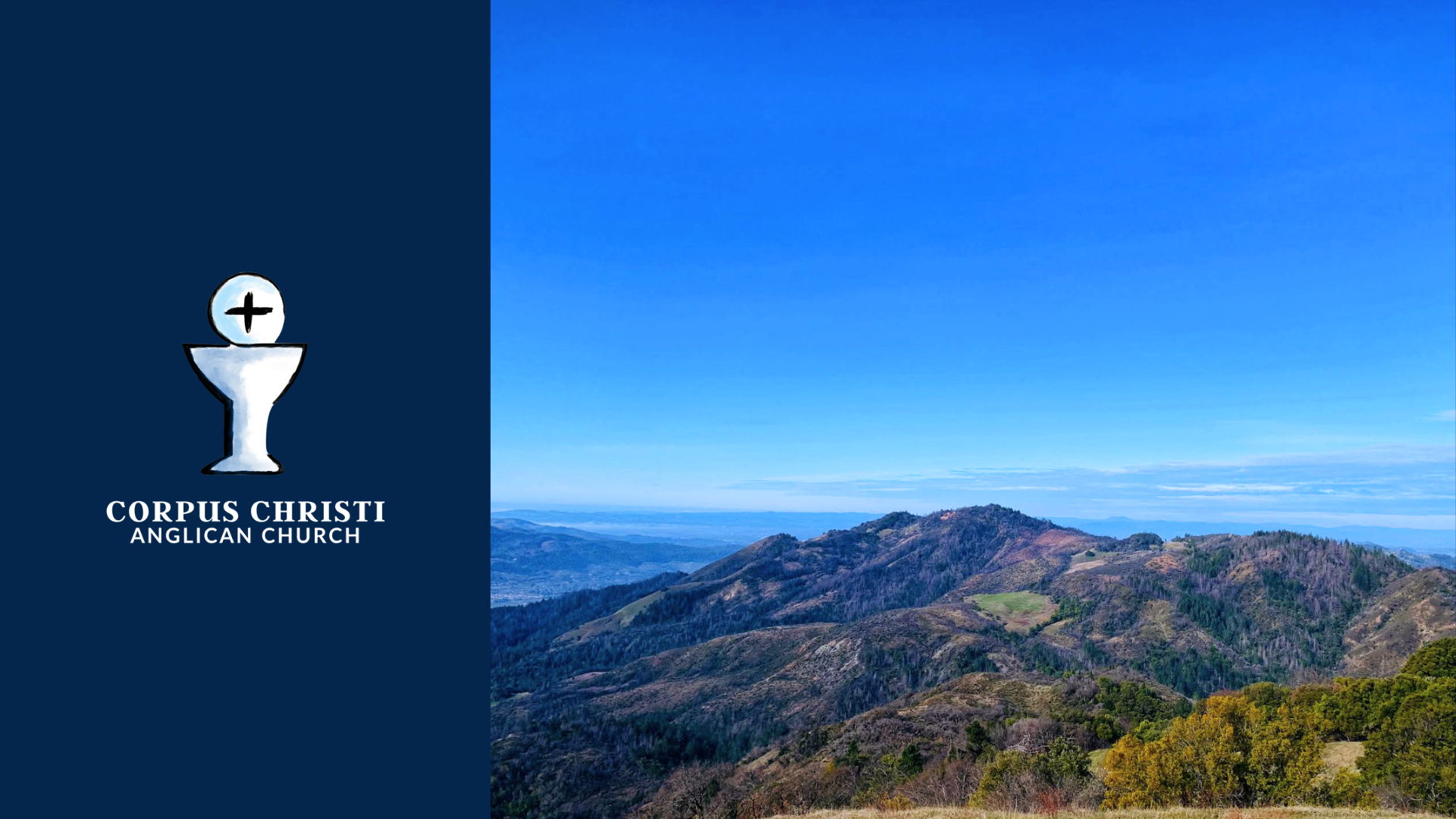
When I was about 18 or 19, I lived in Sonoma County in California. I used to mountain bike a lot, and I would often my bike out and ride this 10 mile course along a vineyard-lined highway from Santa Rosa to Kenwood, to a mountain called Sugarloaf Ridge State Park. Once I got there, the last mile and a half would be rough as I made my way straight up the mountain. I loved climbing that mountain on my bike. My legs burned as I went up through the dappled light of tree-lined mountain road. I’d crest the final incline where the trees would break, the sun would shine through, and I found myself on the top of a mountain range that overlooked another two smaller mountains. You can see the view up on the screen. This is is a picture from that mountain.
I’d sit and look out at Mount Hood with the breeze blowing in my face and cooling me down. I loved the opportunity to sit in the dirt, hear nothing but the wind, feel the sun on my body, the dirt on my hands, and watch the world continue to move along below my feet. I don’t know about you, but I often need moments like these in God’s creation that remind me that I do not make the world turn. When I bike or hike I make it a point to stop at some point, breathe deep, and remind myself of this. I can really appreciate the ancient world who would often build worship places on mountains because there was this sense of the mountain being the place where God dwells. Even in the early church, some of the Fathers picture Eden being planted at the top of a mountain.[1]
Our mountain passages this morning remind us of the God who is at work, that we can trust, and that it is not us who make the world turn, but Him. On these mountains, God’s glory is made known, covenants and people are established, and the way of Jesus is clarified. God’s rule and reign, and the glory of his resurrection, is extended to all, through our participation in Christ’s death and sufferings. To join in the glory of the transfiguration, we must understand both mount Sinai and the hill of Galgotha. These mountains give us a composite picture of a life of following Jesus. As we look at these passages together, let me pray for us: “In the name of God, the Father, the Son, and the Holy Spirit. Amen. Lord, may the words of my mouth and the meditation of our hearts be always acceptable in your sight, O Lord, our Rock and our Redeemer. Amen.”
1. Exodus — Mt. Sinai — The Meal on the mountain and salvation to the nations
In Exodus 24, God has delivered his people out of Egypt, and now invites them into a covenant. God comes to Mount Sinai in a cloud with thunder and lightning. The people go up, the elders go a bit further, other leaders go even further, and Moses goes up alone to write down God’s words. God has taken the initiative to establish this agreement with Israel as their God and king. Moses is going to take God’s words and read them to the people and they will agree to this agreement.
The agreement is solemnized and ratified in verse 11 between the two parties with a covenant meal.[2] The people said yes to following the LORD who wanted to make them into a kingdom of priests, a holy nation, and a royal priesthood, a people who would display the goodness of God and invite others into this life. The meal on a mountain is extended to all nations in Isaiah 25:6 when God says, “On this mountain the Lord of hosts will make for all peoples a feast of rich food, a feast of well-aged wines, of rich food filled with marrow, of well-aged wines strained clear.” The meal on the mountain becomes a theme that is found in the book of Revelation and is extended each week in our Eucharistic celebration.
God is establishing a people for his own possession, to display the goodness of his glory as king. Every language, people group, race and heritage, and family is being brought under the rule of our Lord Christ to become one people who are to the praise of his glorious reign. I think sometimes we’d rather push someone off the mountain than invite them to sit next to us at the table. Consider the spaces we find ourselves in deep disagreement; bring them to the level of conscious awareness; and begin to engage one another with curiosity. I know there are a million and one hot-button issues, like gender and sexuality, immigration, parenting styles and education choices, etc. Sometimes, even as the priest here, I feel like I’m walking on eggshells, but I’m trying to work on allowing someone to talk and then to enter into some of these spaces with curiosity rather than an agenda. It’s like the prayer of St. Francis: I want to seek to understand more than to be understood. It is totally countercultural, but if we need to start here to invite people to the table rather than pushing God’s image-bearers off the mountain.
2. Transfiguration — Mt. Tabor — Jesus is one greater than Moses to deliver his people
The one greater than Moses has come to us on a new mountain in the Gospel this morning. Jesus invites Peter, James, and John onto the mountain with him. This is either on Mount Hermon or Tabor, we’re not sure. There are several parallels to the Sinai event: Certain companions come up the mountain, there is a cloud that overshadows, and an appearance of the glory of God. The details aren’t meant to be a one-to-one connection. This Jesus is the prophet like Moses, but greater than Moses. This was a taste of the glory of the kingship of the son of Man that was prophesied about in the book of Daniel.
If you want to know the way of this Son of Man, we are reminded to listen to Him. He is the one who gives God’s commands in this new covenant. As they descend the mountain, there will be a lot of things the disciples will not understand and their only hope to seeing God’s kingdom in the valley of demons is to listen to the Son. We all need rhythms of stillness and silence to be saved and delivered from the daily darkness. I don’t mean physical silence necessarily. I mean that we need regular rhythms of handing over to God what feels turbulent and grievous, to name sin that has gotten calcified, and to meditate on how Jesus is God’s love revealed to us. I was talking with someone the other day about how these rhythms remind me of going to the dentist. I go every 6 months because I need someone with special tools to chip off all the stuff from my teeth that has hardened. Even though that plaque feels like it is part of my teeth, it isn’t! Spiritually, sin and disorder attach to our selves like plaque and calcify and we need regular rhythms of being with Jesus who wants to scrape it off and say “This is not you. Let me take that from you.”
The way we access those spaces is by being honest with ourselves about what’s broken. I remember someone telling me a story from when they spoke to their counselor about why they was getting a certain reaction from their child when they said things a certain way. I have permission to share this. The counselor told them, “Hey, you’re kid is two. You probably look big and scary.” My friend was so embarrassed by not figuring that out himself. Once he brought that to conscious awareness he could begin to ask the Lord why his reactions were a certain way. Was he wanting to feel in charge to compensate for feeling weak and out of control? Was he worried his child would turn out a certain way if he didn’t react with some harshness? Eventually he realized that there was an insecurity there and in an attempt to feel in control, he asserted himself a certain way that made his child feel scared. This was pride and manipulation that was not him, but it had perverted and distorted how he was showing up. He worked on this with Jesus so he could recognize that feeling before it manifest in words or bodily reactions. It started to get better. Listening to Jesus can be so hard, but it is the only way to make it through the valley of demons below.
3. The Cross and Resurrection — A Hill outside Jerusalem
The mount of transfiguration is necessary in light of one more hill mentioned in Scripture: the hill on which Jesus was crucified outside of Jerusalem. Jesus’ glorious reign as king over all and his reign going to the nations was not accomplished through a blood bath against the rebellious, but through his own death on the cross.
N.T. Wright says it this way, “Learn to see the glory in the cross; learn to see the cross in the glory; and you will have begun to bring together the laughter and the tears of the God who hides in the cloud, the God who is to be known in the strange person of Jesus himself. This story is, of course, about being surprised by the power, love and beauty of God. But the point of it is that we should learn to recognize that same power, love and beauty within Jesus, and to listen for it in his voice—not least when he tells us to take up the cross and follow him.”[3]
In this week, as we move from the glory of Jesus on the mountain, to journeying with Jesus, to obedience to the point of death on the cross, I invite us to consider what it means for God to be made glorious in people who take up their cross with Jesus; people who risk humiliation to follow God and love like Christ; people who long for the glorious vision of resurrection and are willing to listen to Jesus when it is costly in order to find his glory in the kingdom of God.
Conclusion
On this day which focuses on the transfiguration, we’ve looked at three important mountains. We have looked at God’s desire for relationship with his people on mount Sinai, we’ve seen the glory of God revealed in Jesus on Tabor, and we’ve considered the glorious cross on a hill outside of Jerusalem. God is creating a banquet to bring all kinds of people into, and we are reminded of it each week. Let’s become a people who invites others to the table in curiosity rather than pushing them off them mountain; a people who spend time listening to Jesus, seeking to understand more than to be understood; a people who take seriously the call to follow Jesus and love well in obedience when it is potentially humiliating and costly. It is in doing these things that God’s glory is made known in these weak vessels and will go to the nations in our lives and in the lives of the people around us.
Let me pray for us:
O God, who on the holy mount revealed to chosen witnesses your well-beloved Son, wonderfully transfigured, in raiment white and glistening: Mercifully grant that we, being delivered from the disquietude of this world, may by faith behold the King in his beauty; who with you and the Holy Spirit lives and reigns, one God, for ever and ever. Amen.
[1] St. Ephrem, Hymns on Paradise.
[2] NIV Application Commentary.
[3] Tom Wright, Matthew for Everyone, Part 2: Chapters 16-28 (London: Society for Promoting Christian Knowledge, 2004), 15.