Lent 5: Seeds of Joy in the Soil of Sorrow
CONTENT
Introduction
Good morning friends. Today is Passion Sunday. It begins this two week time within Lent that includes Holy Week. If we have joined Jesus in the wilderness for 40 days, we are beginning to narrow down now to the road to the cross. This is why we veil the cross. As we look at the events that happen on the way to the cross, what will eventually be accomplished on the cross can be seen, but only dimly, as through a veil.
Today’s passage is all about God’s presence in our “if only” moments. We all have these “if only” parts of our stories: if only I could have said these or those words before my loved one had passed, if only I could have parented differently, if only I had understood my family system before I entered marriage, if only I had made better vocational choices, if only I had gotten married earlier or started trying for kids earlier, if only I had made better financial investments before now. All these “if only” parts of our story involve real grief and at the same time they are not the end of God’s will or goodness for us. They are the spaces we sow with tears where we can anticipate Jesus bringing a harvest of joy.
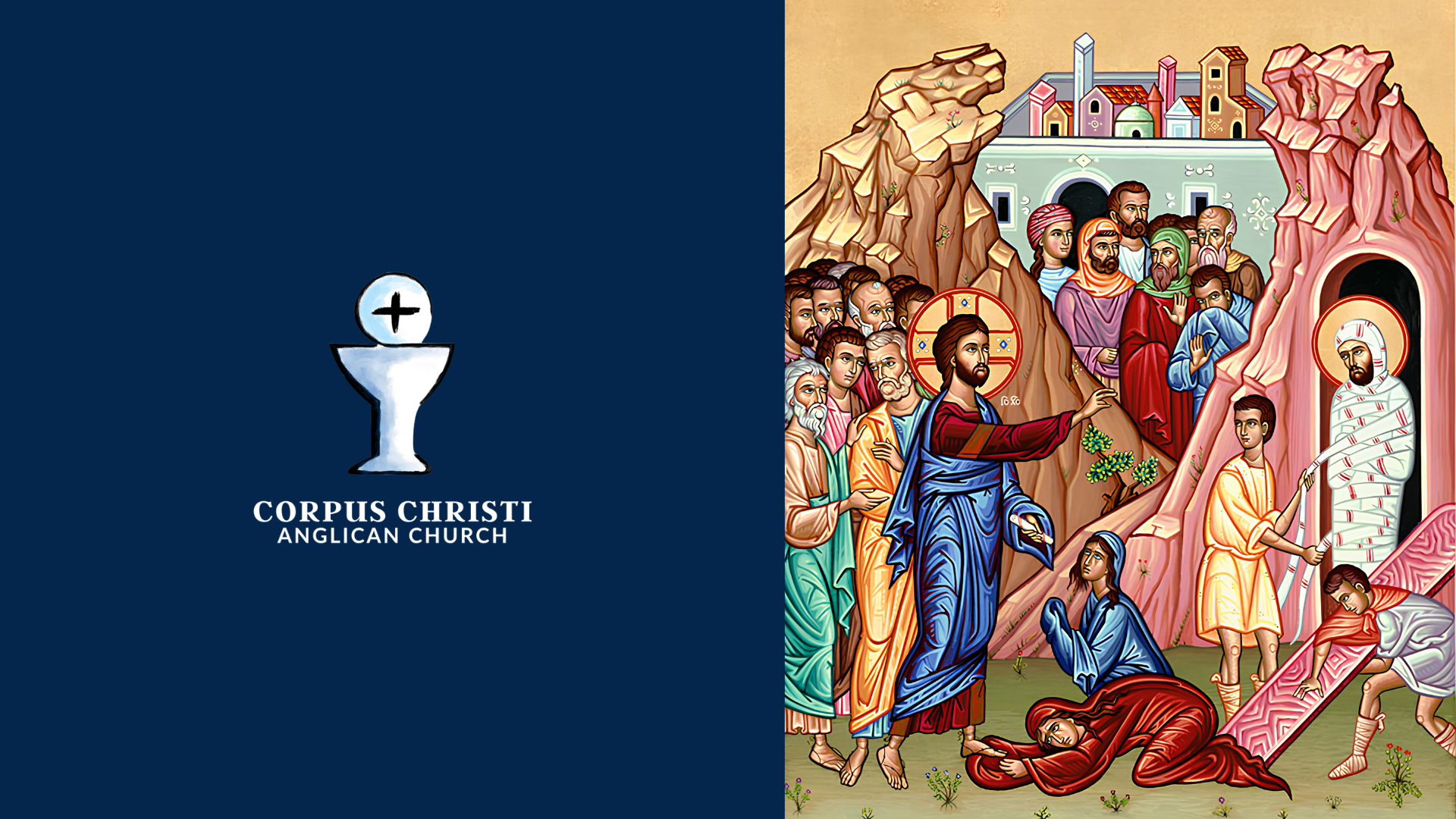
Today’s passage is what God does with “if only” moments. Jesus comes and raises Lazarus as a 7th and final sign in the Gospel of John. This story reminds us that Jesus is the resurrection and the life. In him death will be overcome and those “if only” moments are places of redemption where God’s good kingship will be known where we once saw them as a place where hope had failed. The raising of Lazarus will be the moment that Jesus will cling to to know that the Father hears him even as he is about to enter Jerusalem to meet death.
Let me pray for us as we look at St John’s Gospel: “In the name of God, the Father, the Son, and the Holy Spirit. Amen. Lord, may the words of my mouth and the meditation of our hearts be always acceptable in your sight, O Lord, our Rock and our Redeemer. Amen.”
17-27 Naming where we need Jesus to show up (If only....)
The scene opens in Bethany, which is a short distance from the city of Jerusalem. Mary, Martha, and Lazarus live there. This is a family that Jesus loves. They were well-known in the area. Jesus hears that Lazarus is ill, and yet he stayed two days longer in the place where he was. I’m sure he was praying for Lazarus and for God’s will, but in his decision to wait two days, Lazarus succumbed to his illness and dies.
When Jesus approaches Bethany, Lazarus had been dead for four days. Jesus missed the funeral. Mary is still in a period of grief for her brother and is remaining at home. Martha and Mary are upset. Martha does something about it, leaves the house and meets Jesus to get some answers. She essentially says, “Jesus, if only you had gotten here earlier; my brother would not be dead.” You can feel the tone of her question: “Jesus, where were you? I thought you cared?” The exchange between Jesus and Martha gets into the theological reason this story is included. Jesus tells her that her brother will rise again. Martha, like the Pharisees, believes that her Bible teaches a general resurrection of the faithful. She believed her brother would be a part of that, but that doesn’t give much comfort right now.
Jesus is not skipping past or bypassing her pain. When I lived in Dallas I had a 19 year old coworker who tragically took his own life after battling with mental health issues for a long time. I went to his funeral which was held at a megachurch that met in a mall-turned-church in one of their “side chapels”, which was an old movie theater. The pastor’s sermon felt so hollow. He basically told the congregation all the ways my friend lived such a full life and that we should be joyful that he is in the presence of Jesus. But his life had just begun. I would much rather have my friend back and figure out how to address his mental health challenges. Sometimes I also want to come to Jesus and say “Jesus, if you had been there my friend would not have died”. And it is also true that I can say that God has used the memory of this young man to help people: I’m sure he made an impact on people he knew, money was donated on his behalf to bless others, the few years I knew him have shaped how I view mental health, and I have so much more compassion for what it is like to be a lost 19 year old boy who is struggling to ask for help. Jesus didn’t make the situation better, but he was present to redeem a tragic end. This young man’s life and story have within them the redemption of resurrection life because Jesus is present.
Jesus is telling Martha that our hope is not just in some far off general resurrection. Our hope is in Jesus, who is the resurrection. The resurrection isn’t just a concept, it is a person — and that person is Jesus Christ. Martha believes that Jesus is the Messiah, the Son of God, the one coming into the world. Jesus brings the age to come into the present evil age. And the reason why this is our hope is that Jesus bore our griefs and carried our sorrows — and he triumphs over death. To enter into the age to come does not deny the reality of suffering and death. Jesus redeems suffering and death as the places of redemption where His kingship comes to be known.
28-37 Jesus bears our sorrows and knows our grief (Jesus wept...)
Martha calls for her sister Mary to come because the Teacher is calling for her. Jesus meets them outside the village and those who were mourning with Mary come with her to see Jesus. They thought she was heading to the tomb to go and weep there, so they follow her. This is part of early Judaism’s mourning rituals. There were family and friends who surrounded her to weep and they often hired professional mourners.
Notice that when Mary gets to Jesus she says the same thing “Lord if only you had been here my brother would not have died.” Jesus was moved very deeply at the sight of Mary crying and all those who were mourning with her. He asks where they have laid Lazarus. On the way to the tomb, verse 35 says Jesus began to weep. What was he weeping for? Jesus had just given sight to a man born blind! And Jesus knows what he’s about to do. And yet, I do think these are real tears. I love the explanation of the 4th century Potamius of Lisbon and I’ll summarize it: Jesus wept in fulfillment of this aspect of human love, offering sympathetic tears. He wept to moderate the grief of those mourning. He wept because of the extent to which humanity had fallen under the shadow of sin and death. He wept because God had given humanity every beautiful fruit and flower of the garden and they’d been cast out and exiled because of sin.
Jesus knows our tears and has borne our sorrows. In reflecting on this passage, NT Wright says, “The Word, through whom the worlds were made, weeps like a baby at the grave of his friend. Only when we stop and ponder this will we understand the full mystery of John’s gospel. Only when we put away our high-and-dry pictures of who God is and replace them with pictures in which the Word who is God can cry with the world’s crying will we discover what the word ‘God’ really means.” He is truly a man of sorrows and acquainted with grief. And while there is grief, the grief is productive and the sorrow is redemptive.
38-44 The Father hears us in the face of death (the Father hears...)
Jesus comes to the tomb and tells them to remove the stone. It’s been four days and people have no expectation that Lazarus will rise. In fact, they believe he has begun to decompose. However, in the days where he would have been decomposing, Jesus had been praying for this moment. Jesus reminds them that belief is the precursor to seeing the glory of God — much like the story of the man born blind who had to go and wash in the pool of Siloam. Jesus says something striking. Knowing what he is about to do he enters into prayer: “Father, thank you that you have heard me”. This is a moment he’d been praying about even though everyone thought he was two days too late. He was right on time. God hadn’t heard his prayer just for Lazarus to be raised, but for the right moment and opportunity for the glory of Jesus’ connection to the Father to be made known. He says “Lazarus, come out.” In a culture that knew about incantations, Jesus offers no spell. He names his friend and gives a simple command. Lazarus obeys his Lord and rises up out of the grave. This moment would be the sign that though Jesus enters our sorrows on the way to the cross, he would return them to us as the joys of redemption. The cross and resurrection are why the Psalmist can rightly say that those who sow with tears will reap with songs of joy.[1]
St. Ephrem says, “[Jesus’s] tears were like the rain, and Lazarus like a grain of wheat, and the tomb like the earth. He gave forth a cry like that of thunder, and death trembled at his voice. Lazarus burst forth like a grain of wheat. He came forth and adored his Lord who had raised him.”[2].
Conclusion
In this final sign Jesus has taken our moments of “Jesus if only you had been here”, then he weeps with us, and turns our griefs into moments of redemption where the Father hears us and his glory is made known. As we close, I want to pray the chorus from a song I love from the Porter’s Gate that summarizes what I’m saying. Please pray with me:
“The kingdom’s come // and built upon
wood and nails // gripped with joyfulness,
So send [us] out, // within Your ways
knowing that // the task is finished.
The dead will rise // and give You praise -
wood and nails // will not hold them down!
These wooden tombs, // we’ll break them soon
and fashion them // into flower beds,
The curse is done, // the battle won
swords bent down // into plowshares,
Your scar-borne hands, // we’ll join with them,
serving at // the table You’ve prepared.” Amen.[3]
[1] Psalm 126
[2] Commentary on the Diatessaron.
[3] From Work Songs, released October 6, 2017 . WOOD AND NAILS. By Keith Watts, Isaac Wardell, and Madison Cunningham; Vocals: Audrey Assad and Josh Garrels; Guitar: Isaac Wardell; Piano: Tyler Chester; Celesta: Orlando Palmer; Bass: Jay Foote