Lent 4 (Laetere Sunday): Light From the Dust
CONTENT
Introduction
Good morning friends. It is great to be with you this morning. Today is the fourth Sundxay of Lent, or Laetere Sunday, which means “rejoice”. It is a bit of reprieve that reminds us that hope, preparation, and penitence, can all sit together in the same space. The rose vestments also remind us that we’re nearing the end of Lent.
The questions raised in today’s Gospel are a warning not to search for someone to blame when it comes to others’ suffering. It doesn’t produce anything helpful. Christians don’t believe in Karma, but sometimes they can say things that feel like it. I remember hearing about someone who, when something negative happened to him, he turned to a religious interrogation of himself to try and find some sin that might be in his life that was the cause of his suffering. Imagine how cruel it is to apply this logic to the problems that arise in the birth of children and all that can go wrong in that process. It feels extraordinarily cruel. Jesus, the Good Shepherd, comes to a man born blind in John 9 and does not confront him with religious scrupulosity. He comes to address the man’s healing as a platform for God’s glory.
Instead of any hint of blame, this is actually an opportunity for new creation. Suffering is a reality we cannot avoid, nor can we explain in our narrow understanding of the world. The blind man ends up seeing more than the teachers of Israel, and like him, our good shepherd comes to bring new creation in our places of suffering.
1-7 The Light in the Darkness
Jesus and his disciples encounter this man born blind. The disciples look at this man and ask, “Who sinned, this man or his parents, that he was born blind?” Obviously the man could not have sinned since this blindness had been from birth. They are thinking about verses in the Bible about God visiting the iniquity of the parents on their children. If I could bless something in their question, it is that they don’t want to attribute this tragedy to God. But their explanation feels a bit like Job’s friends who keep asking Job to repent or figure out what he’d done to tick God off. It makes our relationship with God very transactional: If I do the right things, God will bless me, my family, and my country. If I sin, God will bring calamity to my life, the life of my household and my country. This isn’t true. And it is because of this logic that St. Augustine has to write the city of God. If Rome, a Christian empire, falls to the Goths, is Jesus still Lord of all? His answer to this question is yes, and the City of God fleshes that out.
Instead of answering questions of theodicy, God’s role in human suffering, Jesus comes with his presence as both Good Shepherd and Light of the World. The world and its systems are bound up with the kingdom of darkness. Because of this bondage, suffering will be a reality, and things will not always be as they ought to be.
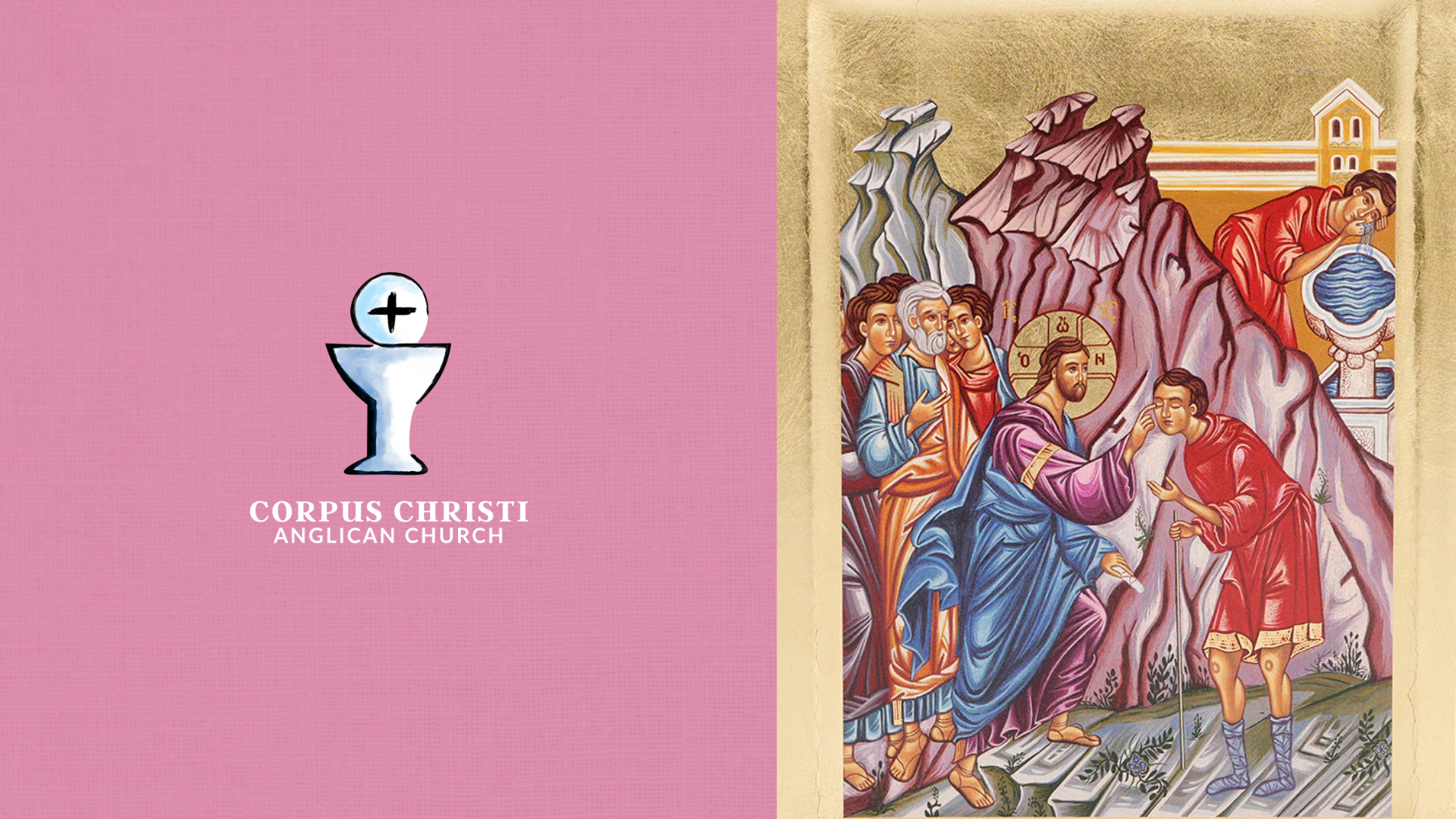
The blind man’s suffering and pain were not an opportunity for philosophical speculation, but an opportunity to anticipate new creation. Jesus brings light from dust: he spits on the ground, makes mud, wipes it on the man’s eyes, and tells him to wash in the pool of Siloam. St. Ephrem, in his commentary on this passage, says it this way: “And he brought forth the light from the dust, just as he had done in the beginning, when there was a shadow of the heavens. “Darkness was spread out over everything.” He gave a command to the light, and it was born from the darkness. Thus also here, he formed clay from his saliva, and he supplied was what lacking in creation, which was from the beginning, to show that what was lacking in nature was being supplied by his hand.”[1]
I love how small this man’s faith is and how great God’s work of new creation is. It does not take a great amount of faith to open ourselves up to the grace of God. This is a picture of what God wants to do in a newly created people. People who had been bound to spiritual blindness can now see and while they may not have all the answers, they do know that it is Jesus who is the one who makes all things new.
8-13 Jesus makes things new: Can this be the same person we knew before?
We see how Jesus is the light of the world who brings new creation where darkness had once reigned. Second, the response of the people is to wonder if this was even the same person they knew before. This is the kind of thing Jesus does. Not everyone has a momentary conversion story, but we all go through daily conversion. I’d encourage you to look at 3-4 major moments that shaped your life in Christ. There was likely some amount of suffering. How did Jesus bring light from dust? I can think back on a dinner that changed my life when I was 14, the death of grandparents, health crises within my family, the birth of our son, moments of financial instability, painful moments at the hands of church leadership, difficult and painful arguments with those close to me, and hard vocational decisions. I would not be who I am without Jesus being my Good Shepherd in these moments. The light of the world will make something new, heal what is broken, and rightly order what has been dis-ordered. People who knew us before these moments and then encounter us afterwards might say “Are you the same person”? And the answer is yes, but now I’m more myself than I was before because I have been with Jesus.
I want to be a church where we are constantly surprised by each others’ transformation because of being with Jesus; a place where we become more ourselves because of having been with Jesus and one another. This is the curiosity involved in discipleship. As you are in your formation groups or playdates, the teams you serve alongside on Sundays, or other times together, walk with one another, and be the presence of Jesus to each other, not providing explanation, but inviting Jesus to be present. Resist the temptation to interpret others’ experiences for them. And certainly don’t waste time on speculating on answers for why they’re suffering. To do that is to heap shame on an already broken heart. Come with a loving and curious presence, sometimes offering prayer, sometimes just offering a listening ear, but always offering an empathetic witness to your brother or sister’s pain and joys. As St. Paul says, “Rejoice with those who rejoice; mourn with those who mourn.”[2]
28-38 Hold onto Jesus in the face of darkness: The blind man becomes teacher and the teachers become blind
We have seen how Jesus is the light of the world who brings new creation where darkness had once reigned. Second, the response of the people is to wonder if this was even the same person. Finally the blind man becomes the teacher to spiritually blind teachers. The Jewish leaders had decided that anyone who confessed Jesus is Lord would be put out of the synagogue. The parents of the blind man had been put out as a result of the blind man just saying that Jesus helped him see. In verse 28, where our reading picked up, the leaders reviled the blind man saying that they were followers of, and disciples of, Moses. They were all out of logical arguments, and when civic discourse broke down, they resorted to exclusion, dehumanization, and violence. This is what the leaders of the synagogue had done and it is what happens today.
You can see this in children. When they are mad, and start to get hostile, they punch, kick, bite, or use words like “I hate you” and “your not my mom or dad”. What they mean is “I am angry and I can’t think clearly and I don’t have the right words right now and I need to get this energy out and then I need a hug”. I would expect to find this paradigm in the world, but God help the church to be different. I would love to see the church become a place where following Jesus means that we are self-aware enough to name things accurately within us and outside us and to bless other image-bearers with our words, holding disagreement with compassion; or if cursing occurs, that we would repent and make amends quickly.
Here the healed man takes on this sardonic tone; he may sound slightly cynical, but his aim in the text is to invite the leaders to open themselves to the work of Jesus. The healed man is amazed that these people did not know what to do with Jesus, but he experienced something no one has ever heard of — that someone born blind has been healed. The only conclusion to draw is that this man is from God. The man is not yet a disciple of Jesus, does not even quite know who exactly Jesus is, but his testimony alone was so threatening that he is thrown out of the community.
Then once he is thrown out, Jesus comes after him like a good shepherd. After hearing that he’d been driven out, verse 35 says that Jesus went and found him. It’s at this point that Jesus follows up and tells the man that He is the Son of Man. The healed man believes and worships Jesus. Then we get to the punch line of the story. There are Pharisees nearby who overhear the conversation and say “Surely we aren’t blind, are we?” The story began with people asking if family sin had resulted in a man’s blindness. The story ends with those who seem to have it all together becoming spiritually blind with the result that sin reigns. The cause and effect is reversed. Sin does not cause the blindness; spiritual blindness keeps us bound to the darkness of sin.
Conclusion
Today’s passage fits the theme of “rejoicing”/Laudete, because it is all about the light of the world bringing about new creation to anticipate what is to come. He is the one who works in us to bring about the goodness of new creation in the face of darkness around us. He is the Good Shepherd who comes to us when others have cast us aside. We cling to him in worship and hope as we share our stories of what Jesus has done in us. This is a story of the God who brings light from dust; He may not give us answers, but he gives us his presence as the troubles of this world become a platform for the Glory of His new creation. We become more fully human because we have been with Jesus.
Let us pray:
O God of unchangeable power and eternal light: Look favorably on your whole Church, that wonderful and sacred mystery; by the effectual working of your providence, carry out in tranquility the plan of salvation; let the whole world see and know that things which were cast down are being raised up, and things which had grown old are being made new, and that all things are being brought to their perfection by him through whom all things were made, your Son Jesus Christ our Lord; who lives and reigns with you, in the unity of the Holy Spirit, one God, for ever and ever. Amen.
[1] Ephrem, Commentary on Tatian’s Diatessaron 16.28.
[2] Rom 12:15