Lent 2: Jesus Answers What We Haven't Yet Thought to Ask
CONTENT
Introduction
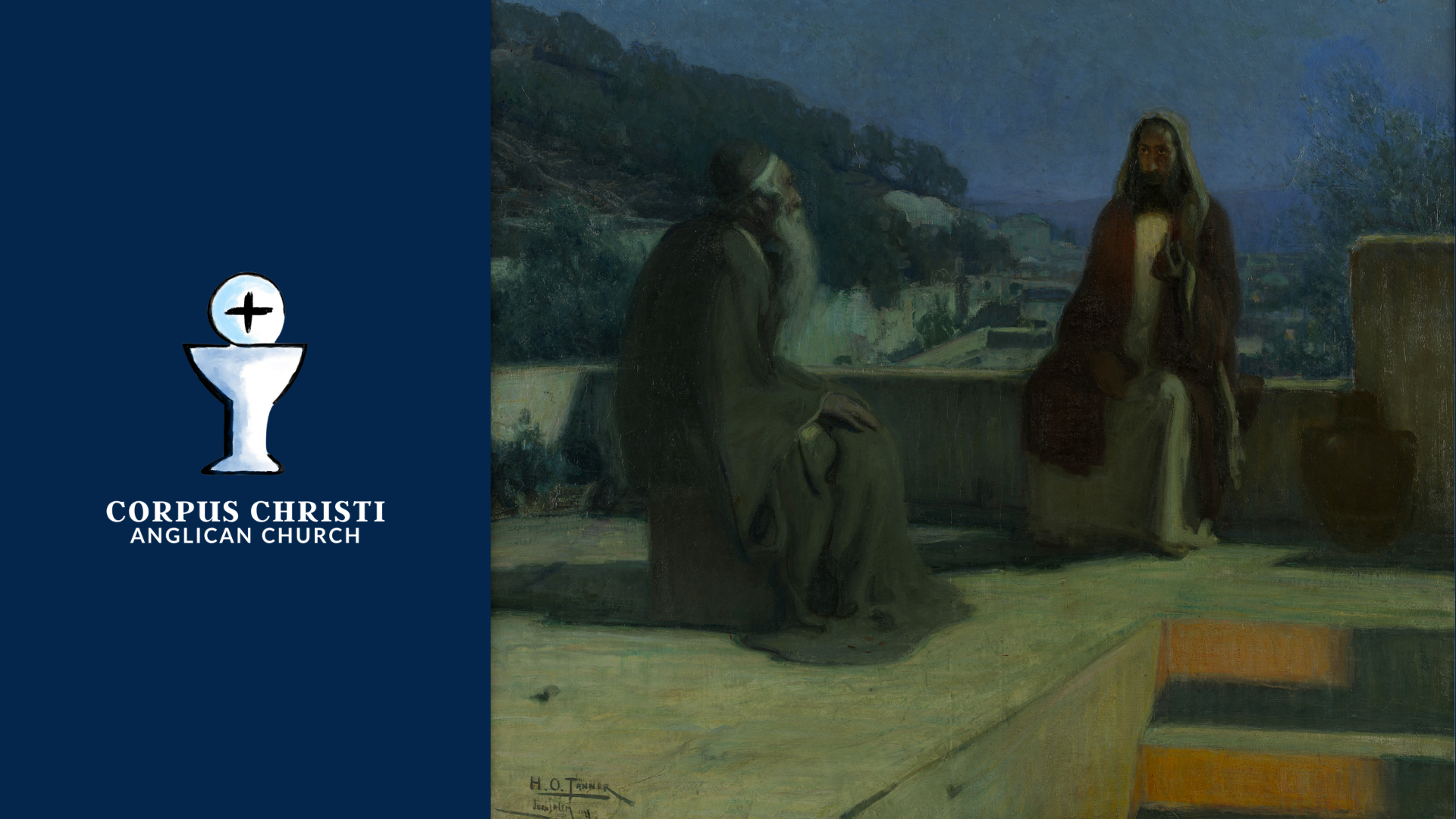
Good morning friends. It is great to be with you on this second Sunday of Lent. Over the next several weeks we will look at snippets from the Gospel of John. These different vignettes challenge some of the assumptions that people had about the Messiah. Today we encounter Nicodemus coming at night to speak with Jesus. He thought he was solving one problem, but in the discussion he learned about a problem greater than he understood. Jesus then solves for the problem that Nicodemus didn’t even know he was asking about.
Like a good spiritual director, Jesus pointed out how Nicodemus needed more than what he was asking for. In our life with Christ, this is a helpful paradigm for prayer. We come to God with our sincere questions, but fully ready to embrace an answer to a question much deeper than the one we we’re asking.
As we look at John 3, let me pray for us. “In the name of God, the Father, the Son, and the Holy Spirit. Amen. Lord, may the words of my mouth and the meditation of my heart be always acceptable in your sight, O Lord, my rock and my redeemer. Amen.”
I. 1-2 Naming the problem
This motif of light and darkness is all throughout the Gospel of John. This week we encounter Jesus meeting with a religious leader in the dark. He comes in spiritual darkness to the light of the world; he also comes under the cloak of darkness because of the risk to being associated with Jesus. John 3 calls Nicodemus a leader of the Jews which I take to mean he was likely a member of the Sanhedrin. This is sort of like a small-scale coalition government. This was made up of different parties that were at odds with one another. Nicodemus knew about Jesus’ cleansing of the temple in John 2 and as a Pharisee, he probably wouldn’t have been bothered that much about it; he may have even cheered him on. Only the Sadducees benefited from the economics of the temple system.
Nicodemus is risking something by coming to Jesus in this way. I’m sure the Sanhedrin has had discussions about Jesus. Jesus is a threat to one group because he is trying to overthrow well-established religious systems in the temple. He is a threat to another group because he claims to be a king and son of God. He is a threat to another group because he claims to be the rightful interpreter of Moses. Yet there is something in Nicodemus that is so curious about Jesus that he is willing to come and find answers for himself.
Nicodemus meets Jesus and says, “Rabbi, we know that you are a teacher who has come from God; for no one can do these signs that you do apart from the presence of God.” Jesus doesn’t have a famous teacher He followed and He doesn’t really fit anyone’s paradigm for what a teacher in Israel should look like; nonetheless, Nicodemus recognizes that there is something about Jesus’ ministry that comes from God. I wonder what he was hoping to discover? Was he hoping to discover someone who could tell him the future, or innovative hot takes on the law, or a plan to overthrow Rome, or justification that his political faction was right amidst the coalition group of the Sanhedrin? I can’t help but wonder if there were some mixed motives? Yes, he wanted to know more about Jesus, but I also wonder if he wanted to know more about how Jesus viewed his particular tribe. We cannot be certain.
We all come to Jesus with good desires clouded by mixed motivations. I think it is encouraging to see Jesus’ posture. He doesn’t turn Nicodemus away, but invites him into a better question. You and I will come to Jesus with very good longings and desires to see something of the kingdom of God. And sometimes, and maybe often, those good desires are clouded by all kinds of unhelpful beliefs, values, and misguided assumptions. Jesus doesn’t say “come back when you’re a bit more grown up spiritually.” He blesses the desire with a question to help us see the kingdom more deeply.
II. 3-13 The Spirit’s Deconstruction and Reconstruction — Problematizing the problem
Jesus tells Nicodemus that no one can see the kingdom unless they are first born from above. Some translations will say “born again”, but there is some intentional ambiguity in the Greek word that allows for both. I think the emphasis lies more on being born from above. Nicodemus asks Jesus how it is possible to be born from above. We cannot crawl back into our mothers wombs!?! This concept of being born from above is a new category for our friend Nicodemus. It doesn’t compute.
Jesus then mentions the Holy Spirit, comparing the Spirit’s work to the wind which blows where it wishes. In our house, when it gets to be about 65-70 degrees, I love to open up our door to our backyard and open up our window to the front yard to get the cross breeze to blow through our house. The problem is that the wind will blow through our nice, tidy piles of papers on the desk or artwork from our son. When the wind blows, those piles go everywhere!! I remember one day I had the windows open and the wind blew everything. I started putting the piles back together and I found a few important papers that I’d been looking for. I like thinking about the Holy Spirit in this was as a gentle disruptor, taking down our neatly stacked ways of being for the purpose of illuminating something we’d forgotten about or lost.
Nicodemus was an older man with an air-tight theology — until he met Jesus. It wasn’t about which tribe of Judaism got it right. It wasn’t about being in the right family, or among the physical children of Abraham. God was doing something new. The need was deeper than a correct interpretation of Moses, or a just sacrificial system, or the overthrow of foreign aggression. The need went to the darkness of the human condition as an invitation to all peoples to experience the light of the world. It’s an invitation to become what God has made us to be as his image-bearing children. And when this is true, some amount of deconstruction has to take place. And the Holy Spirit is a gentle and wise disrupter.
We all have places that need to get reconstructed. When I was in an evangelical and very baptist seminary in Dallas, I remember being very curious about this Anglican tradition. I had some questions and my pastor at the time connected me with a friend of his who was an Anglican priest. When I met him, he very kindly gave me a Book of Common Prayer and I said, “You know, I like everything about this, but I just can’t get over this infant baptism thing. Is it possible to be Anglican and not hold to infant baptism?” He smirked, and kindly said, “Well I haven’t really met any clergy that oppose it before.” I could have carried on with my trajectory assuming that I knew something that the church was ignorant about, but the Holy Spirit began to blow over the caverns of my soul and I started researching the logic of infant baptism. This opened a whole new world to me and it opened me up to the Spirit’s work in baptism. And now as a dad, it has changed the way I parent. Contrary to some of the toxic teaching out there, a child is not a viper in diapers and all the other bad parenting philosophies that flow from such an anthropology. That theology has been completely deconstructed by infant baptism. Instead, these are little image bearers baptized in the Holy Spirit whom God has given his grace to. Each one of us in our baptism is an adopted child of God, born from above, and the sins and disordered affections and attachments are not who we are, but outside distractions that distort God’s image in us and pervert our view of the world. We all have our own places that need deconstruction and reconstruction. It is the work of the Spirit to blow through and disrupt the piles so that we discover important things long forgotten on our journey of discovering the kingdom of God.
Nicodemus, in the darkness of night, was meeting the light of the world. And when the light goes on in the darkness it is painful to our eyes and takes us time to adjust. And Jesus is patient and kind as Nicodemus will definitely need time for his spiritual eyes to adjust.
III. 14-16 Solving the real problem
Our passage ends with Jesus teaching Nicodemus something about Israel’s Scriptures. He brings up an episode from the book of Numbers[1] where after complaining in the wilderness God sends poisonous snakes which bite the people and they are at death’s door. God has Moses erect a bronze snake on a pole. People are to stare at the snake and they would be delivered. Nicodemus came wanting to talk about Jesus’ educational background and Jesus is like “actually let’s talk about new birth, wind, and snakes”. This is not about Jewish tribalism or the overthrow of an earthly empire. Humankind has been infected with a disease of wickedness more insidious and pervasive than anyone is aware of. Jesus’ ministry as the light of the world is related here to his death on the cross. I like what one writer says, “The darkness (and those who embrace it) must be condemned, not because it offends against some arbitrary laws which God made up for the fun of it, and certainly not because it has to do with the material, created world rather than with a supposed ‘spiritual’ world. It must be condemned because evil is destroying and defacing the present world, and preventing people coming forward into God’s new world...”[2] And the new world that Jesus is talking about is explained in one of the most famous verses in all of the new testament, which we read this morning. “For God so loved the world that he gave his only begotten son, that whosoever believes in him will not perish, but have eternal life.”
Conclusion
Nicodemus came in the darkness to mitigate the risk from his colleagues who embraced the darkness as he engaged his questions with the light of the world. In this conversation, his questions, which represented his good desires clouded by mixed motives, were given space by Jesus, who welcomed them and used them to invite Nicodemus into something far more deeper and transformative. Nicodemus needed to let go of his tight theological grid in order to allow the Spirit to show him the work of Jesus and if he would do that he would begin to see the problems of the world as they are so that in Christ he could begin to see himself and the world around him rightly ordered as it should be. As we consider John 3 this Lent hold onto it as an invitation from Jesus to come to him with your questions, to begin to trust the Spirit to deconstruct the darkness and let the Holy Spirit rebuild us as we embrace the light of the world.
Let us pray:
O God, by whom the meek are guided in judgment, and light rises up in darkness for the godly: Grant us, in all our doubts and uncertainties, the grace to ask what you would have us do, that the Spirit of wisdom may save us from all false choices; that in your light we may see light, and in your straight path we may not stumble; through Jesus Christ our Lord. Amen.
[1] Numbers 21:8-9.
[2] Tom Wright, John for Everyone, Part 1: Chapters 1-10 (London: Society for Promoting Christian Knowledge, 2004), 34.