CONTENT
Introduction
Good morning my friends. It is great to be with you this morning. This 40 day season of Lent is where we join Jesus in the wilderness. We are invited to be cleansed of the unhealthy things that have taken root in our lives. The wilderness is a place of preparation for deeper life with God in the mission he calls us to. Today’s Gospel passage is all about Jesus in the wilderness and the clarification of his call in his baptism. As we look at this text together, let me pray for us.
“In the name of God, the Father, the Son, and the Holy Spirit, Amen. Lord, may the words of my mouth and the meditation of our hearts be always acceptable in your sight, O Lord, our Rock and our Redeemer. Amen.”
I. Preparation— Into the wilderness to be tested — 4:1-2
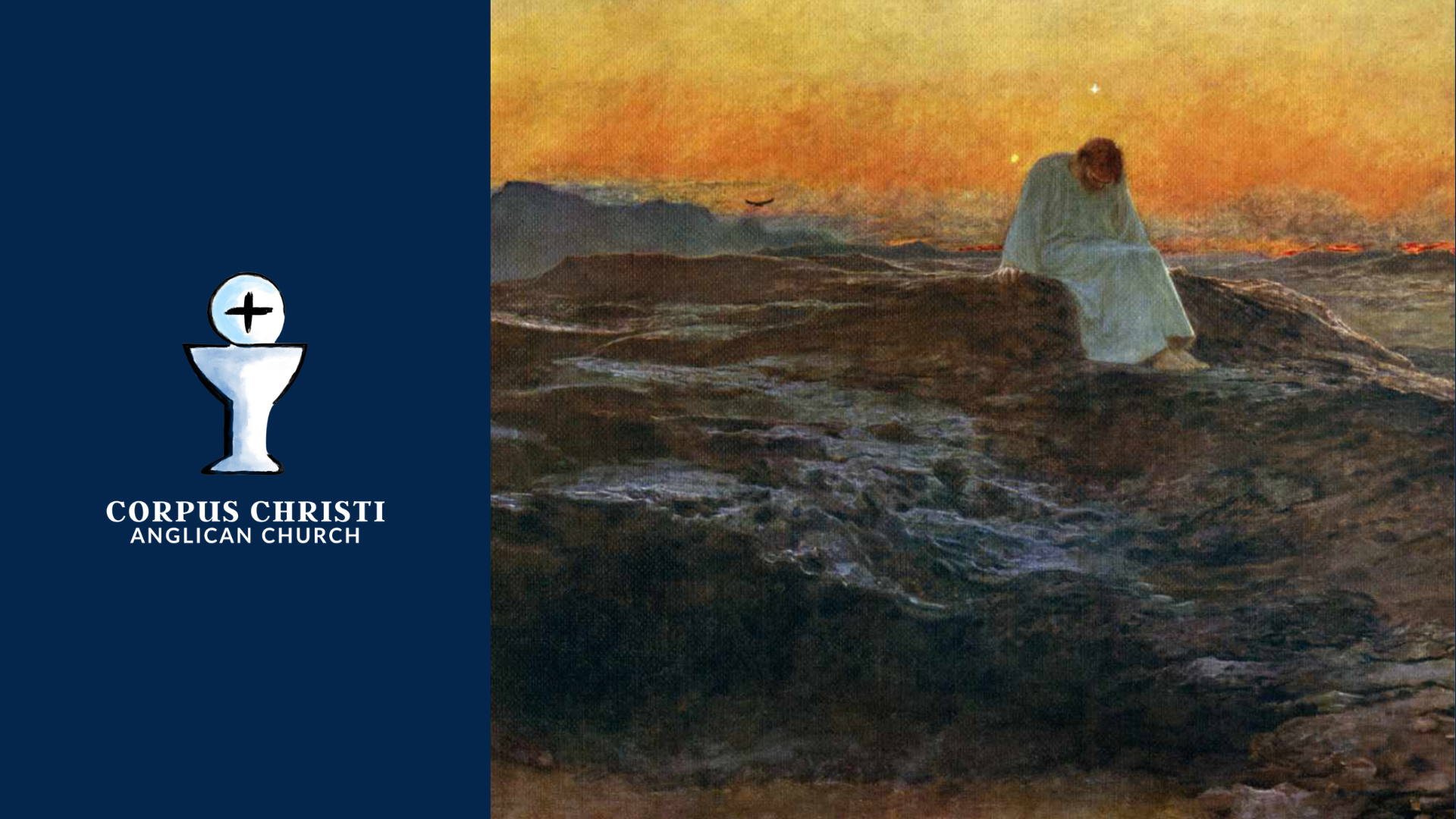
Jesus had spent almost 30 years living in his hometown, taking up the family trade, and preparing for all that God had in store for him in his public ministry through decades of everyday life. In St. Matthew’s Gospel, Jesus had just been baptized by John and experienced the manifestation of God affirming his sonship as Messiah and the one Israel had been looking for. Right after Jesus’ baptism, Jesus is led up by the Spirit into the wilderness. And why? This was preparation. The English translation of “tempting” and “temptation” is pretty unfortunate here. This Greek word, like any foreign word, has a whole range of meanings when it comes into English. God is not leading Jesus to the wilderness to be tempted with evil. God is not tempted by evil nor does he tempt anyone with evil. He does, however, allow us to be in situations where we are tested. It is like a parent helping their child gain independence through trying something hard. Imagine a parent helping their child ride a bike. The child is nervous and says “what if I fall?” The parent tells them that that might be the reality, but even adults fall. Then the parent assures their child that figuring out that bike will open up a whole new world of fun and possibilities; the fall will be worth it. The child finally figures it out and the joy that moment brings is only surpassed by the joy they get when they’re out riding. Testing from God is not punitive, it is formative.
And this is what Jesus is brought to. The Spirit brings him to the wilderness to be tested. Jesus has not done anything wrong to deserve it. In fact, this testing was to the end that Jesus would know his sonship and connection to the father more fully.
This narrative is supposed to bring our minds back to Deuteronomy where Israel is tested over the course of 40 years in the wilderness prior to entering the land of Canaan. In all the ways they had failed the test, Jesus would be victorious.
Jesus reminds us that being in the wilderness is no fault of our own and that in wilderness seasons, when our faith is tested, God’s love still rests on us and his aim is our preparation for a deeper experience of His presence and to become fully human in Christ. Seasons of testing and hardship, or privation and destitution, are the seasons that will ultimately strengthen our relationship with Jesus and our resolve to live into what God is calling us into.
II. Being Lured away with temptation 4:3-10
In the wilderness we will find ourselves subjected to demonic distractions like Jesus was. Satan uses three partial truths to attempt to derail Jesus from the mission God has called him into. First, he points out a good, god-given need and invites Jesus to meet the need in the wrong way. Second, he asks Jesus to test God. Finally, Satan invites Jesus into the right ends through the wrong means. All of these are instructive for our formation in seasons of trial.
a. Meet good needs the wrong way 4:3-4
Satan comes to Jesus in verses 3-4 nearing the end of Jesus’ time of testing in the wilderness. Jesus has a very real human need — to eat. Satan, recognizing this need, invites Jesus as the Son of God to turn the stones into bread. Jesus quotes Deuteronomy 8:3 to say, “One does not live by bread alone, but by every word that comes from the mouth of God.” Jesus submits himself to this hunger in order to learn dependence on the God who takes care of his people.
Jesus did not overcome the devil through miraculous shows of power, but through humility and forbearance. This makes me think back to about 2019 when we were considering planting a church. I remember someone telling me “it will be hard and it will take years”, but they were telling me this to tell me not to do it. They provided me with two different job openings where I could take an easy way out and get a nice rector job somewhere. As Ashley and I prayerfully considered and talked, we felt like God was really calling us to do this. It would be hard, but if I had taken the easy way out I would have missed good, hard, albeit sometimes painful, and necessary lessons in God’s love and my formation. I would have also missed the goodness of what God is doing in this church. When you prayerfully step into the hard thing God is calling you into, whether that is mending a relationship, humbly admitting fault for something, writing and advocating for vulnerable people at great cost to yourself, or stepping into a new vocation, there will be voices that encourage you to look for shortcuts. Instead, it is in our spiritual hunger that we humbly learn dependence on the God who loves us and we learn to overcome our adversary through patience and humility, in companionship with Christ.
b. Putting God under my authority and on my terms (making myself Lord) 4:5-7
After one failure, the Devil comes again to Jesus and in a vision he brings Jesus to some pinnacle on the temple. Jesus is still in the wilderness, not actually in Jerusalem.[1] Satan tells him to jump off because Scripture says that for those who trust in the most high, the angels will catch them so they don’t dash their foot against a stone.[2] He isn’t totally wrong. There has to be some truth to this verse and God’s protection of his people for this to be compelling enough to be a test. Jesus answers by quoting Deut 6:16 about not putting the Lord to the test.
I find it insightful that Satan and the powers of darkness that war against our souls can do so using what seems like a “plain reading of scripture”. Here is where their Scripture interpretation fails: they are using Scripture to try and place God under our Lordship and authority. It’s like thinking that if we do everything just right, then we’ll avoid suffering. We might use a verse like Prov 3:5 “in all your ways acknowledge him and he will make your paths straight.” However, to claim these kinds of maxims as a promise is to attempt to place God under our authority. It ignores the suffering that Jesus went through and does not make space for our own.
Instead, we join in the patience of our Lord to hold space for waiting on God and not claiming proof-texts to test God in our impatience. There is a deeper formation that we’re often not aware of.
c. A Faustian Bargain 4:8-10
Having gone through two somewhat subtle temptations, Satan comes less subtly. In another vision, Satan brings Jesus up to a mountain where he can see all the kingdoms of the earth. If Jesus would bow down to worship Satan, all the nations of earth would be given to him. He is offering him dominion as king of all kings, and the proposed route to this ultimate goal is to bow down before God’s enemy. Jesus quotes again from Deuteronomy chapter 6, verse 13 where worship and allegiance is to be ascribed to YHWH alone.
There is something called a Faustian bargain, which comes from a 16th century German legend. A man named Johan Faust trades his soul to the devil for 24 years of absolute pleasure. The essence of a Faustian bargain is to sacrifice ultimate good for short-term gain. Jesus’ baptism had committed him to the path of servanthood and the path of the cross as the ultimate path to redemption, resurrection, and the glory of kingship. Would this be given up by switching allegiances to gain it quicker and circumvent suffering?
Satan comes to us with similar compromises. Some would rather bring christendom through physical force than compel people by humility and a life transformed by Christ. Some might avoid productive personal conflict by taking personal grudges to the impersonal sphere of social media. Some would rather spend their mental energy on the evils “out there” to keep from looking at the brokenness “in here”. Some resort to high-control in our relationships or belongings to mask how out of control we feel inside. All of these things are a faustian bargain as we long rightly for the blessing and glory of God, but do so without the suffering and cross of our Savior.
Our baptism calls us to renounce the devil and turn to the Lord who saves us daily. Satan’s aim in the wilderness is to distract us and take us fully off course from God’s purpose in each of our lives.
Conclusion: The devil leaves, God attends, we are prepared. 4:11
Jesus didn’t defeat the devil by his own show of strength or bravado. He defeated him through humble, patient, dependence on the Lord who delivers. And ultimately the devil left and he was attended to by God’s angels. Jesus’ testing, and our testing, is not punitive, but formative. This season ultimately allowed him a deeper experience of the love and presence of God even though in the midst of it God may have felt very distant. His constancy, clear sense of mission, and humility allowed him not to get distracted by the voices telling him to take the easy way out, or to lean on God’s “clear” promises about success without suffering, or to make a bargain with evil for short term gain. These voices are very active for each one of us, but God calls us into the wilderness because like a parent who loves us, he wants us to grow and to experience something deeper of his presence than we would have understood before. He wants to make us fully human in the Messiah. And in this patient dependence, the devil will eventually leave. Let’s come clean to Jesus about the ways we’ve tried to take our destiny into our own hands and learn dependence on the Lord who loves us as we we bless the wilderness for what God will do in it.
Let us pray:
Almighty God, you know that we have no power in ourselves to help ourselves: Keep us both outwardly in our bodies and inwardly in our souls, that we may be defended from all adversities that may happen to the body, and from all evil thoughts that may assault and hurt the soul; through Jesus Christ our Lord, who lives and reigns with you and the Holy Spirit, one God, for ever and ever.
[1] Cf. another visionary visit in Ezek 8:1-3; 11:24.
[2] Psalm 91:11-12