CONTENT
Introduction
We began our time together today shouting hosannas with the crowds and then moved quickly to the Passion reading which gives us a sense for how quickly this all took place. The great complexity in Matthew 21 is that the Hosannas are completely appropriate as praises even against the backdrop of the crucifixion and that the entry into Jerusalem would appear to be anything other than triumphant. And yet this is the way that leads to eternal life. God can honor the peoples’ good longings and desires while also seemingly saying ‘no’ to them in order to say ‘yes’ to something better; God is dealing with a problem far deeper than any of them comprehended through a story that no one anticipated.
As we look at Matthew 21, let me pray for us, “We praise you, Almighty God, for the acts of love by which you have redeemed us through your Son Jesus Christ our Lord. On this day he entered the holy city of Jerusalem in triumph, and was hailed as King by those who spread their garments and branches of palm along his way. Grant that we who bear these palms in his Name may ever hail him as our King, and follow Him in the way that leads to eternal life; who lives and reigns with you, in the unity of the Holy Spirit, one God, now and for ever. Amen.”
I. The paradox of Jesus’ kingship vv. 1-9
Jesus and other Galilean travelers from the north are heading to Jerusalem to celebrate the Passover festival. They are near the Mount of Olives, just over the Kidron valley, and Jerusalem begins to come into view.
There is a buzz and excitement about the ministry of Jesus. Is someone coming who will finally overthrow the political corruption that is ruining people’s lives and causing so much pain? Is there finally a king coming who will straighten out the factionalism that is exploiting people in the temple system in Jerusalem? Everyone has ideas about what the age to come will look like when Messiah reigns from Jerusalem.
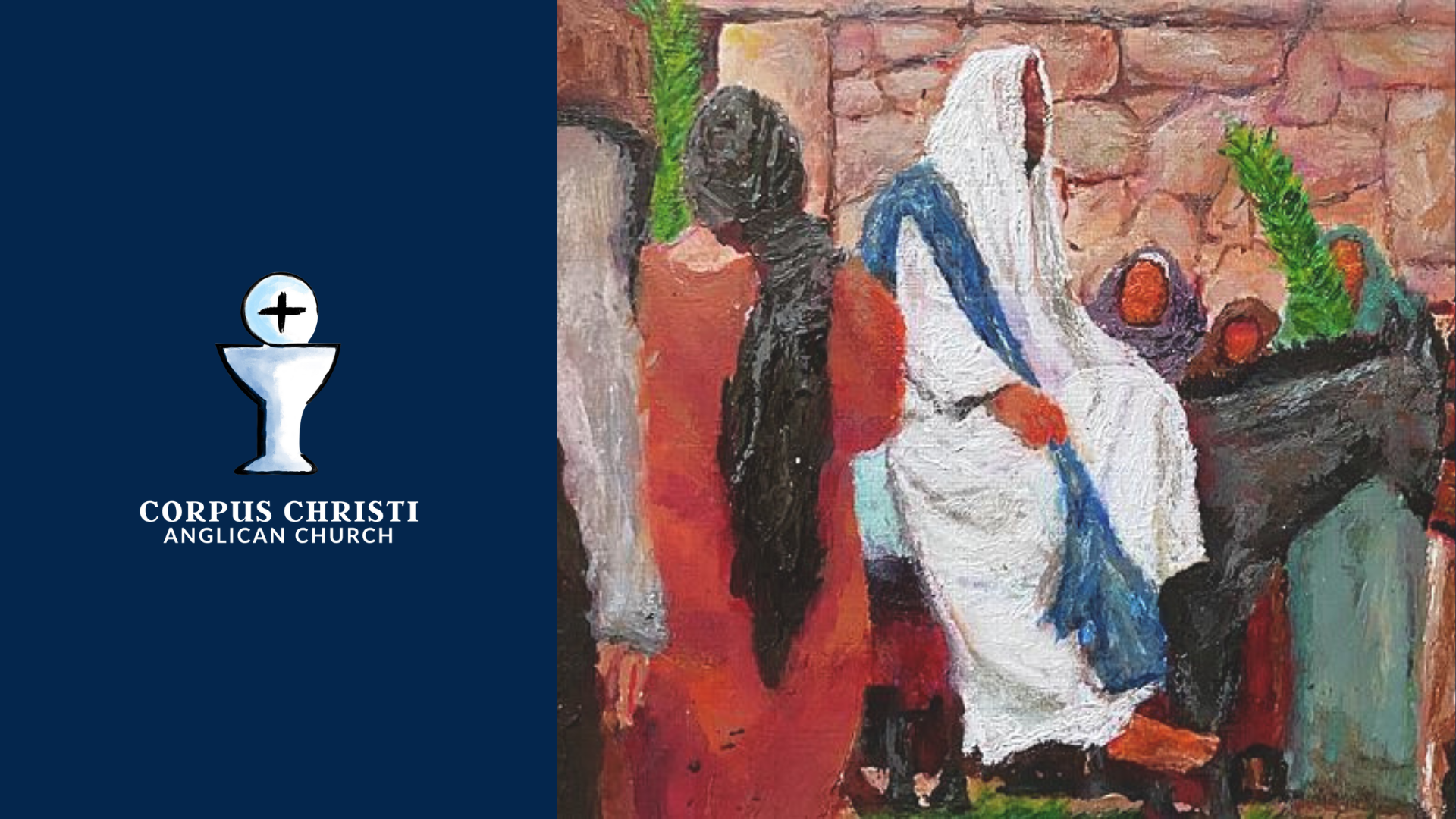
The disciples are asked to borrow a donkey for Jesus to ride on and they retrieve a young colt and its mother. Matthew says that this was to fulfill the prophecy of Zechariah, “Tell the daughter of Zion, ‘Look, your king is coming to you, humble, and mounted on a donkey, on a colt, the foal of a donkey.”[1] There are several allusions here: After David’s son, Absalom, had taken over the kingdom by rebellion and was later killed, David rides a donkey back into Jerusalem to reclaim the throne.[2] Solomon, who succeeds David, rides on David’s donkey to be anointed.[3] Just before the time of Jesus, Simon Maccabeus had cleansed the temple and Jerusalem and the Jews entered it with praise. Simon decreed that each year they were to celebrate the removal of Israel’s enemies with praise and palm branches.[4] If riding on a donkey shows the paradigm of a humble, davidic ruler, then the palms become the symbol to commemorate and anticipate God’s victory over his enemies.
While it is true that this rider on a donkey felt very Davidic, it is also very curious how the donkey-rider of Zechariah will be the one to overthrow the Roman Empire! Jesus did not ride the donkey into Jerusalem to be enthroned like David or like a Maccabean ruler, but to be killed on a pagan cross; but this enthronement was overthrowing a tyranny much deeper than the one they could see.
This reminds me a little of a car we used to have. We had a car that used to leak so much oil. I was buying motor oil in costco packs! Who should be buying that much oil? Mechanics — To use on many cars. You know who shouldn’t be buying that much motor oil? One person, for one car. I took the car to the mechanic and come to find out, the engine block was cracked. At the time I think they quoted me about $4k for parts and labor, which is about as much as we paid for the car! This spurred us on to getting something new. The leaky oil was an indicator — the problem was way deeper than an oil leak. There was no way to fix the surface problem without going in and replacing the whole engine.
Rome’s corruption was not actually the root problem. It was indicative of a deeper and more cosmic problem that had affected Jew, Gentile, and all creation! The answer was not merely the overthrow of a pagan nation. This cosmic problem required cosmic kingship to bring union to heaven and earth.
Jesus wasn’t riding a golden chariot, wearing expensive purple, a ruler who loved a good fight with other aspiring rulers or nations, someone who loved to boast about his accomplishments, who sought after war, or looked for a bloody battle to fight in. Instead, he is a friend of peace who rides a donkey in tranquility in the face of spiritual opposition.[5]
I think the way that Jesus subverts others’ expectations is instructive for us today. We all have dreams of what the age to come should look like right now. What this passage teaches is that those are good and God-given desires and longings. The way that God brings those things about is likely not what we’d expect. There is no glorious enthronement, no new creation, no kingdom, no resurrection, without the way of the cross. Jesus’ way to the cross was a slow dismantling of the kingdom of darkness as death itself was being destroyed.
Practically, what this means is that no family dysfunction, no empire, no individual brokenness gets the final word anymore. Jesus has conquered and will conquer. Rome was only a problem insofar as it was doing the work of death, but a foreign enemy was not the ultimate enemy. God is bringing about new life: the palms are promises and the Hosannas ring true; but it is in a more cosmic way than any of the Galileans would have anticipated. Our praises are never hollow, but we will often find ourselves in the midst of the process of salvation we don’t fully understand.
I see glimpses of new creation in your stories. As you follow Jesus, I love hearing your testimonies: Every time you tell me about a breakthrough in a conversation you’ve had with a spouse, every time you tell me about an answer to prayer, every time you tell me about a child who is doing hard things or helping others, every time you share how Jesus has shown up in your grief or in other unexpected ways. There might be ways that we want Jesus to show up, like “fix my marriage, or fix my job situation, or fix my child, or fix my finances, or fix this country”. We long for new creation in lots of places. These are good longings, but we cannot control the trajectory of how new creation comes about. The dysfunctions might just be the indicators that God is at work below the surface and deliverance might be something far deeper than we expected. These moments might be the road to the cross and ultimately the road to resurrection where we see the glory of Christ as the victorious king.
II. Power and the submission to enemies vv 10-11
In verses 10-11 Jesus comes nearer to Jerusalem. While the Galilean Jews are excited travelers who have come to know Jesus’ importance, Jesus remains less known and less trusted by the Jews in Jerusalem — up to, and including, the Jewish leadership in Jerusalem. We often think that the crowds who celebrated were the same that flipped and shouted ‘crucify him,’ but these were different Jewish communities from different regions. The Southern Judeans shared the apostle Nathanael’s original prejudice: “Can anything good come from Nazareth?”
Judea was under the rule of a Roman prefect whereas Galilee was under the Herodian dynasty at this point. Seeing this Galilean coming down south and claiming to be king may have felt like an overreach to impose authority over the southern district. The title of King of the Jews would be a very destabilizing claim. This is what would get brought up again at his trial. This is a threat to Roman rule, it is a threat to the temple religious system, and to the Sanhedrin. The folks in Jerusalem have every reason to be suspicious of this exuberant Galilean crowd bringing “their” prophet into Jerusalem with a royal procession.
Jesus’s kingship can certainly feel destabilizing, but the Jerusalemites and the Galileans give us two paradigms of how to receive it. We can either give God praise with an openness to what Jesus’ kingship might mean, or we can hold onto everything tightly no matter how broken it is and view Jesus with suspicion. The Galileans would have to continue to hold onto hope in the kingship of Jesus even as he is handed over to those who will crucify him. Those from Jerusalem would have to open their hearts to the idea that maybe God is doing more than what I can see right in front of me.
All of us struggle with wanting to control things to varying degrees. Sometimes it’s wise, but sometimes it’s a refusal of Jesus’s kingship. It can feel safer to hold onto what is broken or is hurting us than to hand it to Christ. We try to curate our lives on social media so that we can control what people think of us. We can try to control the situations our kids will encounter or keep them on a rigid routine to avoid feelings of parental guilt. We can occupy ourselves to death, using workaholism to mask the difficult realities we don’t want to talk about. As Jesus rides in, whether it is through reading Scripture, hearing someone speak hard truth, or a still small voice that is whispering “God is doing something better than this,” do we receive it with Hosannas, trusting in Christ as king to lead us to somewhere ultimately good? Or do we receive it with suspicion clinging too tightly to what is broken because we don’t trust that Christ’s kingship is better than the system we’ve propped up?
Conclusion
Palm Sunday invites us into into a week of walking the way of the cross with Jesus. This road to the cross is the humble road to kingship where the Son of David, the Son of God, will bring about new creation where sin is no more, and even death will die. Our temporal and earthly sorrows are indicators that the kingdom of darkness is still active in the world; yet the surprise of Jesus’ kingship is that his victory reaches to the depths of the cosmos even as it touches the human heart. Our deliverance from sin is a foretaste and deposit of the ultimate goodness that will reign over all things. The Hosannas remind us that a new day of salvation is dawning for those who follow the way of Jesus.
Let us pray:
Almighty God, whose most dear Son went not up to joy but first he suffered pain, and entered not into glory before he was crucified: Mercifully grant that we, walking in the way of the Cross, may find it none other than the way of life and peace; through Jesus Christ our Lord, who lives and reigns with you and the Holy Spirit, one God, for ever and ever. Amen.
[1] Zech 9:9
[2] 2 Sam 19.
[3] 1 Kings 1:38-40.
[4] 1 Macc 13:51.
[5] cf. an incomplete patristic work on Matthew: Manlio Simonetti, ed., Matthew 14-28 (Ancient Christian Commentary on Scripture; Downers Grove, IL: IVP, 2002), 125.