Maundy Thursday: This Is the Night
CONTENT
Good evening! My name is Chip Webb, and I'm a member [who serves as senior warden] here at Corpus Christi Anglican Church. [Before I begin, let us pray. Oh, Lord, may the words of my mouth and the meditations of all your peoples' hearts be acceptable in your sight, oh, Lord, our rock and our redeemer. Amen.]
This is the night, as we heard in our opening exhortations at the start of the service. This is the night, the most sobering night of the year, the most sobering night of the Church calendar for those of us who are Christians. It is not the most wondrous night—that would be Christmas Eve, when we all, like little children, like the little drummer boy, gawk at the baby lying in the manager, the wonder of our lord and savior Jesus Christ in his incarnation. It is not the most convicting night—that would be Ash Wednesday at the start of our Lenten journey, when we take stock of our lives in confessing and repenting of our sins that we commit both as individuals and collectively. It is not the most anticipatory night, for that would be the night of Holy Saturday, when we relive how all of creation and all of history strangely tingled in their uncomprehending anticipation of the new creation that would dawn with the resurrection of our lord and savior Jesus Christ the following morning. It arguably might be the most solemn night of the church year, but Christmas and Holy Saturday are stronger contenders for that title, and one could even make a case for Ash Wednesday. But this is the night, the most sobering night of the year in the events that it commemorates. This, of course, is the night of Maundy Thursday.
This is also the night of the first day of the Triduum. With tonight's service [as Fr. Morgan has mentioned], we are liturgically entering the three days of Holy Week that the one, holy, catholic, and apostolic Church provide us as a gift every year so that we can walk in the manner of Jesus's disciples through critical events in the life of our lord and savior Jesus Christ, and indeed of salvation history. Triduum is a Latin noun that comes from the word tres, for three, and dies, for days—Triduum, three days. Maundy Thursday, which we are observing now, Good Friday, tomorrow, and Holy Saturday, on Saturday make up the Triduum. And if we follow the disciples throughout these three days spiritually, observing the hours of each day by prayerfully meditating on what the disciples were doing at the approximate moments in time and seeking to place ourselves with them where they were, it can be an incredibly intense and beneficial spiritual experience. We'll be looking at examples of what that might mean a bit later, but for now, let's just keep in mind that these three days are a greater gift to us spiritually than we could ask or imagine.
Meanwhile, what about Maunday Thursday? When I first started attending an Anglican church three decades ago now, this service was an unknown to me. Maybe it has been to some of us before tonight. If so, welcome to the mystery—and tonight's service touches upon several mysteries! It's a joy to have you! This is the night when we most fundamentally follow the Church's history of holding a service showing the institution of the Holy Eucharist, which some Christian traditions instead call Communion or the Lord's Supper. We have evidence of a Maundy Thursday mass as far back as the Council of Hippo in 393 BC, according to the Dictionary of the Christian Church. Originally, there were several elements to the service, including the blessing of holy oils, which still continues in some Christian traditions today, and the reconciliation of penitents, which does not. There were originally several masses held on Maundy Thursday, but by the mid-20th century the number had reduced down to one evening liturgy. In understanding the word "maundy," it is probably easiest to think of the word "mandate," in other words, a command. Maundy Thursday is so named for the time not only when the institution of the Eucharist is commemorated, but when the Church recognizes the new commandment that our lord gave us that night: to love one another.
And I would like to suggest that there are three primary ways in which "this is the night." These three ways cover much of the same ground as the four opening exhortations at the start of the service, but they are more general and have broader implications than those exhortations. This is the night:
1. When the true nature of our lord and savior was revealed
2. When our lord and savior provided strength for every Christian's spiritual journey
3. When our lord and savior's ultimate struggle began
1. This is the night when the true nature of our lord and savior was revealed.
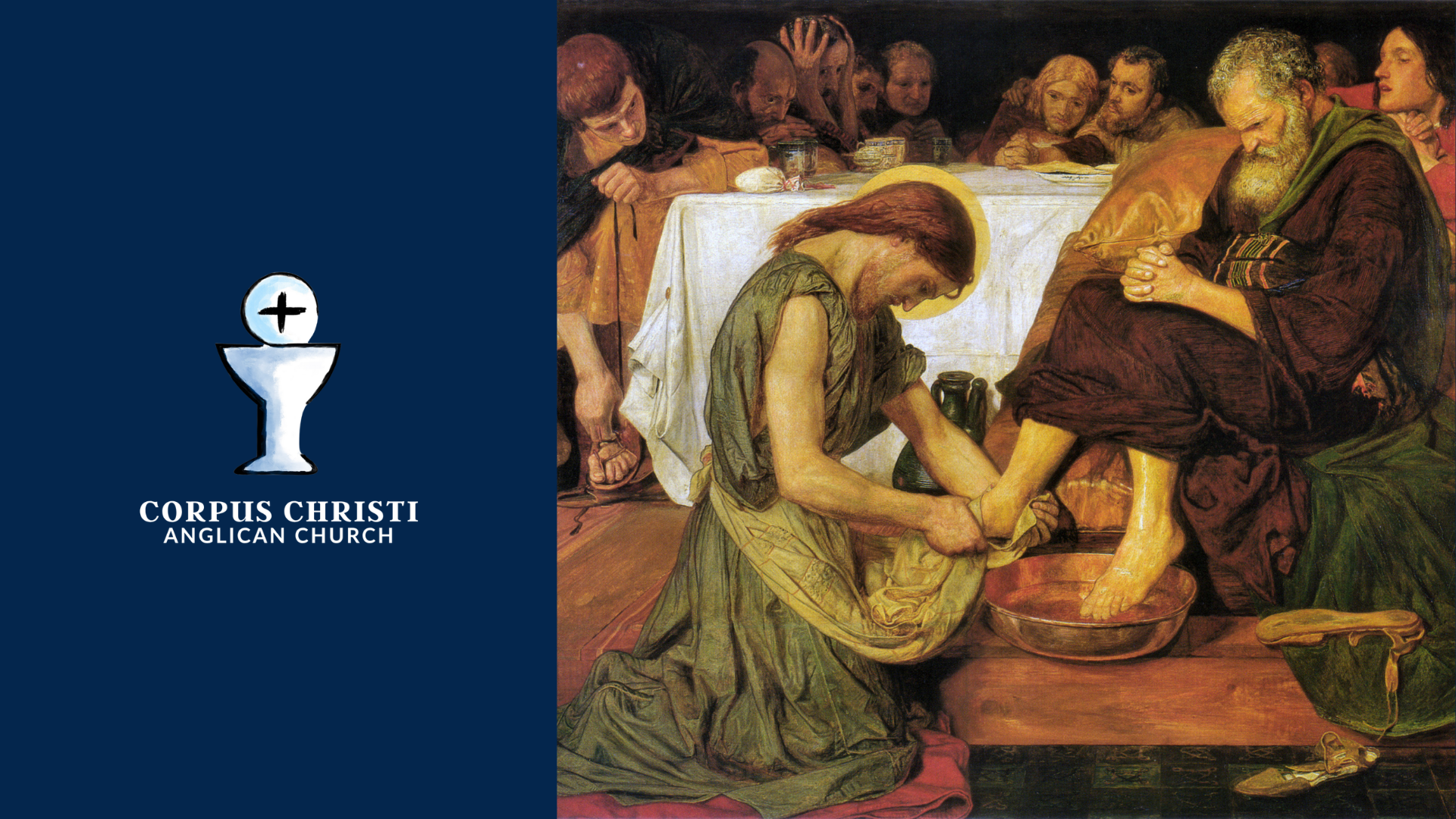
The apostles had known Jesus in many ways—as lord, master, teacher, and perhaps most of all, as the only one to whom they could go because he had the words of eternal life. On top of that, even if they didn't understand or fully comprehend him, they had heard him talk about himself as, and in some cases demonstrate himself as, the bread of life, the water of life, the light of the world, and the resurrection tand the life. And yet even with all of that—and perhaps because all of that—to see Jesus get up from their meal, take a towel, fill water into a basin, and apparently silently begin to wash their feet perplexed them. Here is the one who just a few days earlier had ridden into Jerusalem on the foal of a donkey to cries of "Hosanna," in accordance with Old Testament prophecy; who threw out the moneychangers from the temple; who had discussed weightier matters of the law with scribes, Pharisees and Sadducees; who had pronounced a series of woes upon the Pharisees that could not have helped their cause—and who now was stooping down to wipe off their dusty, sandy, possibly calloused feet. This did not make sense! Would-be messiahs didn't do that! Here is a mystery—and an offensive one, at least to Peter, and probably to a lot of the other apostles. I remember my first Maundy Thursday service, and while I was not offended by seeing foot washing enacted, it was something unfamiliar and new to me. And to the apostle John, it was so inexplicable that he could only define it as a supreme example of Jesus's love for them, in John 13:1.
And what about us in comparison with the apostles? With what we have revealed to us of Jesus in the Scriptures, on the other side of their Holy Spirit–inspired understandings of, and reflections on, Christ that developed after his death, we have more reasons to be astonished, and more cause to feel that we have entered a mystery. Jesus after all, is the one by whom, in whom, and for whom all things were created, as we read in Colossians 1:15–17. Let's tease this out a little bit. The very hands and fingers that set the stars in the sky and that even now, to use a 1970s catchphrase, holds the whole world in his hands, now took up a towel, filled a basin with water, and washed the feet of 12 people whom he had created. Wow! Let's take this a step further and make this personal: What does it mean to you, to me, to each one of us, that our creator would do that to each one of us—and for all we know, might do that to us one day when we see him face-to-face? Let's meditate on that; ponder that; take time to let that truth work its way into our hearts.
What this shows us fundamentally is that Jesus is at heart a servant. Jesus is at heart humble. And Jesus is at heart loving. The apostle Paul, in trying to explain this mystery, came up with a complex thought: "Have this mind among yourselves, which is yours in Christ Jesus, who, though he was in the form of God, did not count equality with God a thing to be grasped, but made himself nothing, taking the form of a servant, being born in the likeness of men" (Phil 2:5–8). There's a lot there, but at the most basic level, Jesus willingly chose to be a servant and gave up all of his privileges—the privileges of being God— to become incarnate here on Earth and serve humanity. By nature, he is God, but he chooses to serve, and that service goes against our understanding of what God should be like but is inseparable from his deity. Perhaps this servanthood helps explain how Jesus could tell his apostles later that evening that he no longer called them servants but friends. A creator who willingly gives up his privileges to come and live and die as one of us in the form of a servant willingly makes himself a friend. In any case, this is the night when the true nature of our lord and savior was revealed, and that nature is one of a God who is a servant out of love for all of humanity.
2. This is the night when our lord and savior provided strength for every Christian's spiritual journey.
The Church can be described in several ways, including as the organic body of Christ, where the Church is the people, and as the mystical bride of Christ. But perhaps a fairly unpopular way of viewing the Church today, given our societal distrust of institutions, is nonetheless a thoroughly biblical and Anglican one: as the institution designed by God for the provision of word and sacrament to humanity. God gave us the Word, Jesus, and we encounter Christ in one sense through the Scriptures, of which the Church is the guardian. Through its preaching and teaching, the Church provides word to humanity. And yet it also provides sacrament, and of the two dominical sacraments, the one we feed upon week after week after week is the Holy Eucharist, in the consecrated bread and wine. The Holy Eucharist is bread and wine for the journey of the Christian life, designed to give strength for the journey of the Christian life. In fact, a Latin term for the Eucharist, viaticum, means provision for the journey! John, interestingly, does not give us a direct account of that sacrament's institution in his gospel, but two other passages this evening either alluded to or described it. First, our psalm reading this evening from Psalm 78 gave us a picture of the prototypes of the bread and wine in God's supply of manna and water for the Israelites in the wilderness. In the life experiences of the Israelites, the apostles, and us, one major commonality is that the sustenance provided comes from God's initiative out of his grace; it is not anything that any of us do to earn it. This is again a sign of God's love for his people, that he would provide for human beings in the various wildernesses through which they travel. The second passage where we more directly read of the 3. of how Jesus instituted the Eucharist.
Now there's a lot that could be said about the Eucharist, and you can get quite a bit more from our introduction to Anglicanism class that is held once or twice a year, but even then you will barely scratch the surface. One thing important to point out is that for those of us who are Anglicans, unlike in some other Christian traditions, the Eucharist is not just a memorial of what Jesus did as outlined in 1 Corinthians and the gospels of Matthew, Mark, and Luke. Rather, it is a present intaking of sustenance by God's grace for the Christian journey in which we really do feed upon the real presence of Christ, and as a result we are by God's power strengthened in our faith as members of Christ's body, the Church. It is good to remember what Jesus did in the institution of the Eucharist; it is even better to actually feed upon him. In part, this is because, as the Anglican Puritan author Richard Sibbes wrote and other Anglican Christians have affirmed, "faith knoweth no difference of time" when we read or hear Scripture. In other words, the reader or hearer with faith experiences things described as being in the past or future in the Scriptures as if they are occurring in the present. This, in turn, means that we have a real connection with saints of the past and future when reading and hearing Scripture with faith. So we pray near the end of our Eucharistic liturgy, "We thank you for feeding us with the spiritual food of the most precious Body and Blood of your Son our Savior Jesus Christ; and for assuring us in these holy mysteries that we are living members of the body of your Son, and heirs of your eternal Kingdom" (BCP, 137). We find ourselves in Christ, and in his Church, as we partake of the Eucharist.
Fun fact here, for certain fiction readers and/or moviegoers: what popular and famous book and/or movie contains an intentional literary stand-in and parallel for the Eucharist? The Lord of the Rings. The bread lembas, which the hobbits receive from the elves of Lothlorien, is a bread "given to serve you when all else fails," as J. R. R. Tolkien wrote in The Fellowship of the Ring. So let's pause and reflect for a moment: What might it mean for any one of us to look at the Eucharist as an aid for when everything else fails? Or, if you prefer not to use Tolkien's appropriation of the idea, how can we better come to see the Eucharist as strength for our journey? Or, what does it mean to follow a savior who so loved us that he gave us such food to strengthen us? So this is the night both when the true nature of our lord and savior was revealed, and when he provided all Christians with strength for their spiritual journeys.
3. This is the night when our lord and savior's ultimate struggle began.
Our liturgy will end tonight with a reading of Psalm 22, during which we reflect on the opposition Christ through his various trials after he and the apostles left the upper room, culminating in his death. Often, we Christians think of our lord's sufferings on the cross and immediately beforehand; however, the late Christian author Fulton J. Sheen, who was a 20th century Roman Catholic bishop, notes in his book Life of Christ that "[i]t is very likely that his agony in the Garden [of Gethsemane] cost him far more suffering than even the physical pain of Crucifixion, and perhaps brought His soul into greater regions of darkness than any other moment of the Passion, with the possible exception of the one on the Cross when He cried: 'My God, My God, why hast thou forsaken Me?'"
It's not in our Scripture readings for this service, but let us briefly bring to mind that agony that our lord and savior suffered in the garden. Let us reflect upon the loneliness he felt at his three closest friends— Peter, James, and John—not being able to keep watch with him while he prayed. Let's remember the blood that fell from his forehead hours before he ever went to the cross or had a crown of thorns placed on his head. Christian songwriter Michael Card wrote in his song "In the Garden":
"Trembling with fear
Alone in the garden
Battle before the final war
Blood became tears
Alone in the garden
To fall upon the silent stone
There in the darkness the Light
And the darkness stood still
Two choices, one tortured will
And there once the choice had been made
All the world could be saved
By the one in the garden"
Brothers and sisters in Christ, let us think of what our savior suffered for you, for me, for everyone in the garden. Why does this matter? Why, oh why, does this matter? Because we will face unimaginable trials in our lives during which our lord and savior appears to be either absent or painfully inactive in helping us undergo things that even might threaten to destroy our faith in him. Can you think of such a time in your life? I know that I can. There are times when there is a horrible silence from God. As the late Rich Mullins wrote to Jesus in his song "Hard to Get,"
"Did you ever know loneliness? Do you ever know need?
Do you remember just how long a night can get
When you are barely holding on, and your friends fall asleep
And don't see the blood that's running in your sweat?
Will those who mourn be left uncomforted
While you're up there just playing hard to get?"
Those feelings that we experience or will experience are real. God does seem to play "hard to get" at times. They are not invalid and they are not wrong. Lament can be a powerful Christian discipline, rightly practiced. And still Gethsemane tells us that yes, Jesus knows what it is like. The same love that led him to become a servant for us and that led him to institute the life-giving bread of the Eucharist for us led him to suffer for us. And because Jesus has experienced silence from God himself, both in Gethsemane and on the cross, our faith can be strengthened.
And so Jesus the servant who has just instituted the Eucharist leaves the upper room for Gethsemane, where he will suffer and have to face the ultimate choice to submit to God's will and proceed to the cross. I hope that you can see from these reflections just how important Maundy Thursday is. This is the night when the true nature of our lord and savior was revealed. This is the night when our lord and savior provided strength for every Christian's spiritual journey. This is the night when our lord and savior's ultimate struggle began.
Well, this night is just the start of the Triduum. We can observe the hours the next few days, reflecting more on Gethsemane tonight, walking with Jesus and his apostles through his arrest and trials and then the cross tomorrow, and reflecting on what the apostles and other disciples must have felt on Holy Saturday. We can weep at times, if we feel moved to do so. We can think about whether we are more like Peter, in denying Christ; more like John, in observing things and reflecting on Jesus's love; more like Mary, at the foot of the cross—those are just some examples. But tonight, after the Eucharist, we will not take the Eucharist again until we celebrate our lord and savior's resurrection during the Easter vigil or on Easter morning. Just as he was separate from God, so we shall be separate from him as we know him in the body and blood. Live into that! And tonight, when the altar is stripped, let us experience it as if our souls are being stripped. Live into the desolations of the next few days, so that the consolations of Easter might be greater. This Triduum is a great gift that the Church offers us. Let us take advantage of it, to the benefit of our souls and of our faith.
In the name of the Father, and of the Son, and of the Holy Spirit. Amen.