CONTENT
In this most somber of our three days, it isn’t seem quite right to say good evening. There’s nothing good about the evening. We are in Good Friday good as in the sense of Holy Friday.
I have to tell you that since the morning my own spirit as I’ve been reflecting throughout, today has been in a kind of grief. Perhaps you felt that grief or perhaps not and you are just beginning to feel the grief.
There’s a verse friends in Zachariah 12 that I think describes the day quite well in verse 10 “and I will pour out on the house of David in the inhabitants of Jerusalem the spirit of Grace and supplication they will look on me. The one they have pierced, and they will mourned for him as one mourns for an only child and grieve bitterly for him as one grieves for her first born son.”
This is the spirituality I think in a verse for Good Friday. We meditate on grief and we do not look away.
We’re entering into the three days as Chip told us yesterday about the last supper in the mystery of these days and indeed there are mysteries.
I had a chance in preparing for the evening to review Egeria, who is a nun we believe she was a nun who traveled to Jerusalem in the 380s and I’ll share a bit more about some of her insights, but we get the sense of the earliest Christians from them. These days were all night vigils all day vigils so from the moment that we have the last supper that they would hold vigil in Gethsemane through the whole night in Gethsemane and they would rise early before the sunrise for what we actually do a little bit later in the service the veneration of the cross talk a bit about that and this would continue into Easter.
These days were days of deep spiritual preparation throughout the history of the church. These days these holy days of Easter, east and west in our own tradition in the Anglican tradition these have been days of deep spiritual preparation and as we’ve headed into the 20th and the 21st century, I’d say as the church global has had to deal with secularism, but I mean by that is people in attention on the thing of things of God as a shorthand the spirituality around Easter is something that we in our day in age are seeking hard to reclaim and so as we start the evening i darkness and we reflect on these days and we take the time. I urge you to come to stations of the cross tomorrow I urge you to come to vigil. I urge you to come to the next morning. It is tiring, I think I was texting a friend and I said I can appreciate Easter Monday now ,but just as Jesus asked his disciples can you not stand with me one hour? This is the question for us can we give our of our hour. We tire ourselves in so many things to exercise the muscle spirituality.
Let’s look at this text. It is a it is a graphic text and I think part of the holiness of this Day and even in the epistles that the phrase and I’m not ashamed of the gospel, we have to understand a little bit about what we’re actually seeing here we’ll go through it in slow fashion, this passion gospel of John that we’re given this year.
I want to start by some context that the Romans had other options besides crucifying Jesus, in fact, they used other options for a serious criminal offenses one apparently they’re all nasty but one is just throw someone off a cliff they could’ve put just a wooden chain around his neck and had him walk around, but crucifixion was a public shaming death. It was a slow death as your nail in your hands are up. You can inhale, but it is very difficult to exhale so to exhale to keep breathing asphyxiation, which is how most die from crucifixion. You need to push yourself up by the nails.
In addition to this we get in the text that Jesus was brutalized prior to this starting at the first Pilate. Pilate had Jesus flogged him and in fact, in the earliest days in this text from 380 that this day they would actually go quite early to see the poll on which he was flogged. That was part of their exercises that day.
The soldier twisted together a crown of thorns and put it on his head in order to mock him in a purple robe. It’s all mockery. They came up to him, saying hail. You can imagine that it wasn’t a quiet hail. It was more hail king of the Jews, and struck him with their hands.
Can you imagine anyone watching seeing this is a pretty brutal brutalized innocent man.
Pilate went out again and said to him see, I am bringing him out to you that you may know that I find no guilt in him. We need a little bit of context with Pilate. You may not quite understand what is going on with Pilate, but Pilate throughout his reign and we know this from Josephus and other sources he struggles to get his relationship with the Jewish people right.
I just wanna give you a few examples early in his reign he goes ahead and he decides that he’s going to build an aqueduct, but he builds the aqueduct using treasury money from the Jewish temple to see this gets him in a lot of trouble, and he has other incidents in which he puts the kind of worship of the Roman gods in front of the Jewish leaders faces, and in fact the years later, the things that the thing that gives him removed, is he violently suppresses a Samaritan gathering where another messianic type figure is claimed, and he goes ahead and kills that figure which eventually is what ends his reign.
And so the text that we get from the gospels as Pilate is struggles with this, but in his conscience, oddly enough, he doesn’t want to. This is what our scripture reports he doesn’t want to do what’s being asked of him and the leaders of the law we’ll see in the text.
You know their command is not to kill not to take a life they don’t want to be seen as having killed Jesus on the Passover when the population of the city is going from 40,000 to 50,000 to probably low estimate 140,000. It’s a much bigger city they don’t want to be seen.
Think of it this way, they want Rome to be seen killing Jesus using their most brutal techniques. This is part of the text we have today and at the same time they’re so concerned about their self imagery that in a few days you know in this next day, they wanna make sure that none of those who crucified are up during the actual passover so as to not create offense. I pointed this out briefly as we continue onto the text because this is the twisted side our human logic as someone who is engaged in the political spaces you often look at politics and it’s it’s a lot of who knows what’s going to happen here you have the ma decide or not wanting to do this but something else what I would describe as evil comes onto the scene to force his hand.
So Jesus came out wearing the crown of thorns and the purple road Pilate says to them, behold the man when the chief priests in the officer saw him they cried out crucify him. crucify him. I want you to get a sense of this and we can’t. This is captured in a bit of the liturgy, but imagine a noise so loud or a moment, so startling that perhaps a riot might be caused I don’t want to over exaggerate, but I don’t want to under exaggerate the degree of pressure crucify him crucify him Pilate has gone to the trouble and said look I’ve done some things that you’ve wanted, and the crowd is stirred up to such a degree crucify him crucify Pilate said to them, take him yourself and crucify him. Find no guilt in him the Jews answered him.
We have a law, and according to that law, he ought to die because he just made himself the son of God when I heard the statement he was even more afraid. He entered his headquarters again, and said to Jesus and I want you to imagine a Pilate here in the moment, just totally exacerbated exacerbated at his wits end not knowing what to do pacing where are you from? But Jesus gave him no answer so it to him you will not speak to me. Do you not know that I have authority to release you and authority to crucify Jesus answer you would have no authority over me at all unless I’ve been given you from above, therefore, he who delivered me over to you has the greater remarkable words from our Lord and save part of the words of obedience he knows he has to, even in this moment assuage Pilate’s conscience.
This Pilate does not want to act from then on Pilate saw to release him, but the Jews cried out if you release this man, you are not Caesar‘s friend everyone who makes himself a king opposes Caesar, and Pilate who has had so many high profile incidences where he’s gotten religion wrong in his reign. This is the pivotal turning point he’s trapped he is trapped in decisions that will eventually cause him to end his rule he’s trapped so when Pilate heard these words, he brought Jesus out and sat down on the judgment seat.
The judgment seat here is where the Romans will come to give their official judicial verdict. So prior to this you’re seeing Pilate interact with the crowd now he’s at the place, the stone pavement, where you can make his official proclamation was the day of the preparation of the passover. It was about the sixth hour he said to the Jew, behold your king, they cried out away with him away with him, crucify him to strongly suggest a group ready to riot if he says no the chief priest answered we have no king, but Cesar would just be straightforward a total lie in terms of their relationship with Rome, but it is their master stroke in their politics with Pilate that day so he delivered him over to them to be crucified.
I’ll get to the last part of the text in a moment but wanna give you a sense of how early Christians and how we ourselves might think about this early time so Egeria notes this and I won’t read the whole passage when I wanna give you some pieces here they arrive before the cross.
“The daylight is already growing bright. They’re the passage from the gospel is read with the Lord has brought before Pilate with everything that is written concerning that which Pilate spoke to the Lord or to the Jews the hole is red and afterward, the bishop addresses, the people comforting them for that they have toil all night and are about to toil during that same day bidding them not be weary, but they have hope in God who will for that to give them a greater reward.”
Listen to the words of this fourth century bishop these are his words to us who take vigil these days, encouraging them as he is able to addresses them “thus go now each one of you to your houses and sit a while. You may be able to go behold the holy wood across each one of us believing it’ll be profitable to his salvation then they go to the column of flagellation and then come back to the veneration”
So just read this passage on the veneration of the cross “chairs place for the bishop and Golgotha behind the cross, which is now standing the bishop. He takes a seat in the chair in a table, covered with a linen cloth this place before him, the deacon stand around the table in a silver guilt casket is brought in, which is the holy wood of the cross”
Think of this remarkable it’s very likely that this is the wood of the cross at this point it’s a piece of it now when it has been put up upon the table, “the bishop as he sits hold, hold the sacred would firmly in his hands. Then the people one by one come down down at the table, kiss the sacred wood and pass through because I know not when someone said so that they pass one by one all bowing themselves, they touch the cross first their forehead then with their eyes, then they kiss the cross and pass through from the earliest days.”
This is part of the Christian worship of these days. What is happening here? We’ll have an explanation a bit later but we’re thinking about just like an icon in some ways. We’re thinking about the events behind it and we’re reflecting in our bodies that worship that is already there in our hearts and this has been part of the earliest days of what it’s meant to be a Christian as far back as the fourth century where they kept vigil and they were physically moving around and they were physically moving and listening, and hearing the words of God because they were reflecting, with their bodies, was already true in their hearts, and though for some of these, some of these practices might be new in God‘s account economy, and in the kingdom of God, these practices are quite old as old as the earliest visited recorded record.
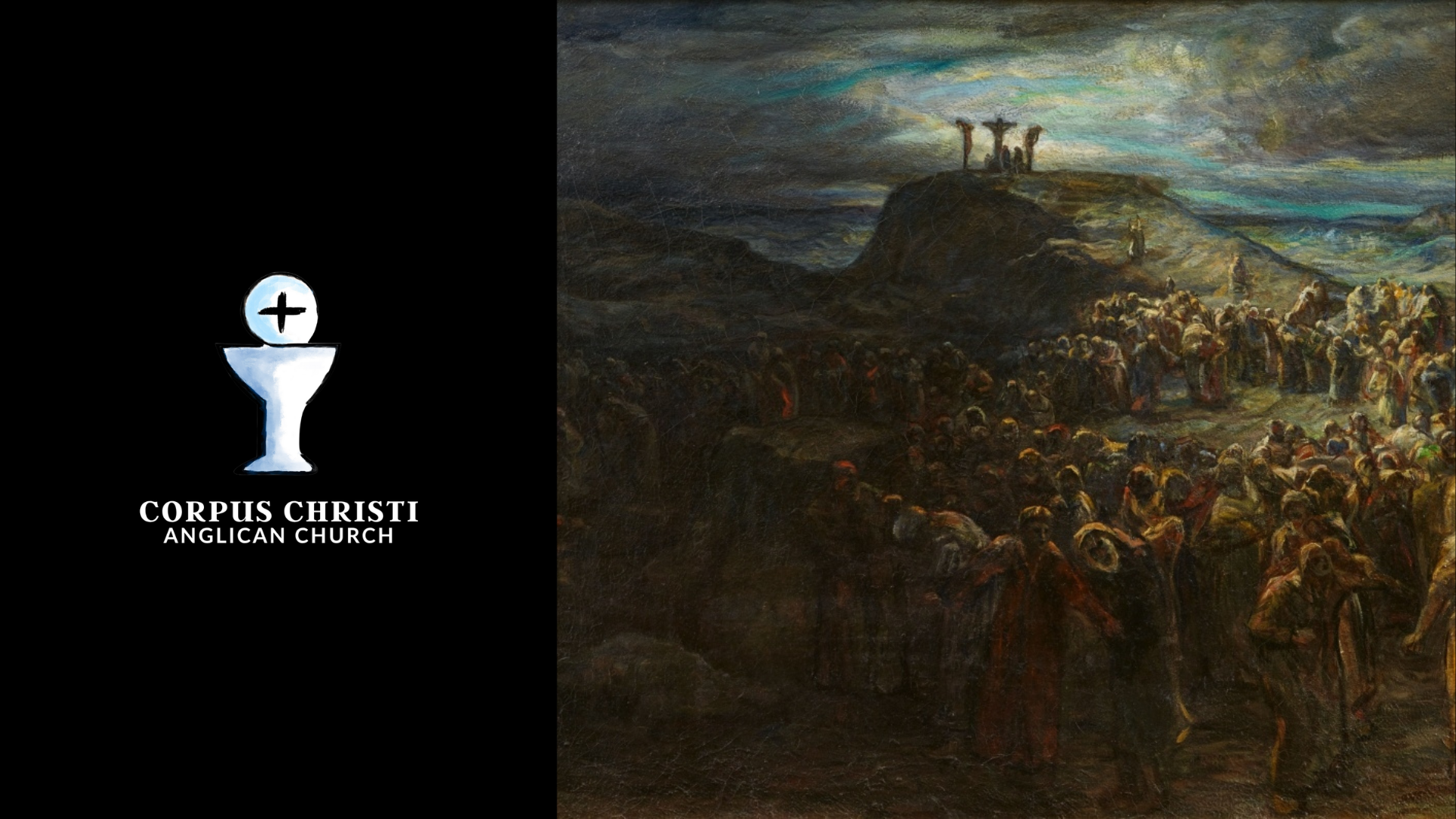
We have a nun going to Jerusalem, and so as we do these tasks as we, as we enter into them in our hearts, realize that we in our own way at a special time are reflecting and committing something to God in that in many ways is the essence of our sacramental life as Christians set aside times that have always been part of the life of the church for which we worship God and spirit and truth now for this final text that has gotten me in a appropriately somber spirit so they talk to Jesus and he went out, bearing his own cross the place called the place of a skull, which is called Golgotha right in front of the city. It’s a classic Roman crucifixion so everyone could see no hiding there. They crucified with him to others one on either side in Jesus between them. Pilate also wrote an inscription and put it on the cross it Jesus of Nazareth, the king of the Jews, my personal take this is pilots way of describing what he thinks a bit of hedging is best but an interesting way politicians when they hedge their bets sometimes tell the truth and when they push him this time, he just says I’ve written whatever she doesn’t want to move on it when the soldiers have crucified Jesus, they took his garments and divides to four parts one part for each soldier also tune for the tunic seamless let us not terrorist, but cast lots the soldiers they could care less what’s happening quite honestly friends. This is the image we get in the gospel it’s revelry it’s games, brutality. It’s a celebration of Romanhood even though creation itself in a moment will mourn in the disciples are scattered his loved ones are scattered they divided my garments among them for my clothing.
The cast remarkably here we get in John’s gospel at the moment of his agony and of his pain we get this touching moment between Mary, his mother and the apostle John in which he says woman behold your son, the love that we see and our icons even the ones around the altar here are of John often end of Mary and the love that is shown I love that Jesus himself is exemplifying in this moment in his agony when at this moment, when you were to look up at him, and the earliest Christians would’ve said, this part of the reason the epistle say, I am not ashamed of the gospel is not a western American. I can speak up and I won’t be ashamed. That’s good. It’s a good impulse you should speak up live into the spirit, but I am not ashamed of the gospel in major ways is it’s the shame of the torture instrument.
If you have seen a Roman crucifixion you would see how brutal it is. You would not think it was pleasant. It was probably one of the most gutwrenching things to watch and this is our savior, brutalized and bleeding and exhausted after this Jesus, knowing that all is now finished said to fulfill the scriptures, I thirst a jar full of soured wine stood there, so they put a sponge full of the sour wine on his branch and held it to his mouth when Jesus had received the sour wine, he said it is finished and he bowed his head and gave up his spirit. The Jon ends the text quoting scripture out of scripture Psalm 69:21. “They gave me poison for food and for my thirst, they gave me sour wine to drink. “
This is the one this is the one spoken of long ago our Savior crucified, dead and exhausted bones, not broken as was promised water and blood flowing from his side, and this is the one friends that as we come towards the veneration of the cross this week we come to this sadness and mournful of days looking at our crucified Lord, who died not for his friends, not for his loved ones for his enemies for his enemies, for those who betrayed him at the last for Peter, who denied him three times for his disciples he will scatter in eventually for those as we get even further along imagine there will probably have been those who would watched him die. Who were Romans who came to believe can you imagine what a grace in this fixes something fundamental in the human race fundamental even more powerful than David more powerful than Moses, more powerful than Abraham someone who is a spotless lamb without blame, who did not deserve any of these things who died a horrific death at the height of his popularity in an evil scheme to destroy God's work on the earth. Let's meditate on that as we continue into the service. Amen.