CONTENT
Introduction
Good evening friends. On Thursday we were reminded of Christ’s institution of the Eucharist and what it means to serve Christ and one another in the kingdom of God. Last night’s service drew us into the mystery of salvation in what happened on the cross. This morning we joined together to walk the way of the cross through the stations of the cross. When Christ died on the cross, creation responded with darkness, and yet God was not absent. Into the darkness, the light shined and the darkness did not overcome it. Jesus was at work in the darkness, conquering Sheol and rescuing humanity from the clutches of sin and death which would ultimately be done in the triumph of His resurrection.
There is an ancient Christian baptismal hymn from the 2nd century, part the Odes of Solomon, which sings of Christ’s victory. This hymn says, “And I opened the doors which were closed. And I shattered the bars of iron, For my own shackles had grown hot and melted before me.”[1] The early church has always made this connection between the death that Christ died, the work of his conquering of Sheol, the victory of his resurrection, and how you and I are joined to Christ and his work through our baptism. Tonight we had the privilege of praying for Les as he has walked with Jesus into baptism; in doing this we also renewed our own baptismal vows. We have died and risen with Christ.
From our passage tonight we see two important truths: 1) God is at work in the dark, and 2) Christ’s resurrection is our commission to the work of new creation.
As we look at Matthew 28, let me pray for us, “In the name of God, the Father, the Son, and the Holy Spirit. Amen. Lord, may the words of my mouth and the meditation of our hearts be always acceptable in your sight O Lord, our Rock and our Redeemer. Amen.”
I. Earthquake, Angel, guards, and empty tomb — God is at work in the dark (1-6)
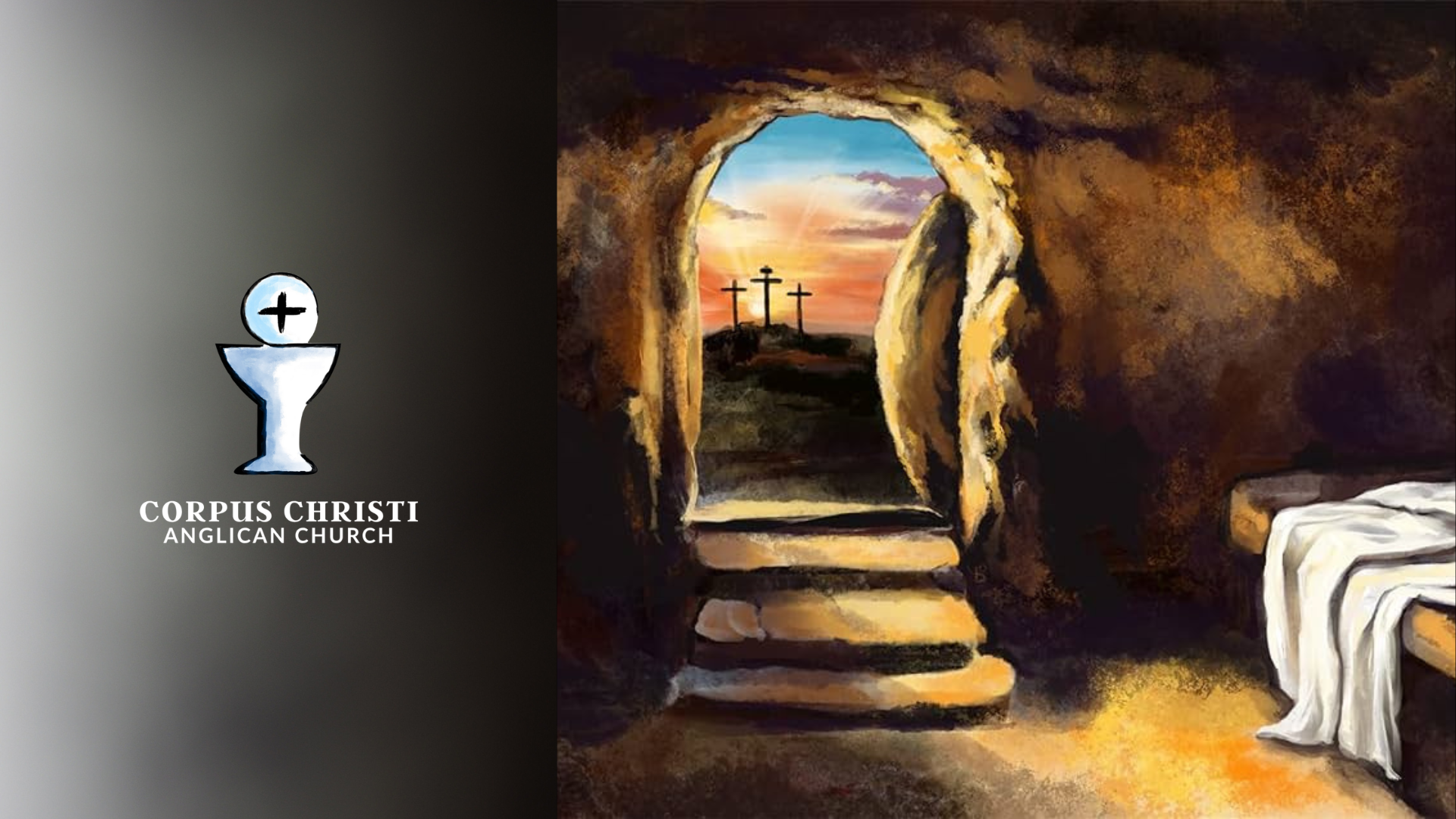
God is at work in the dark. When we left St. Matthew’s Gospel text Last Sunday, the final verse was that the stone had sealed the tomb and guards were there to guard it. The extra measures of security were because of fear and unbelief. Under the cover of darkness, just as dawn was about to begin, Mary Magdalene and the other Mary come to the tomb. As they arrive on scene, there was an earthquake. And as the earth is shaking, an angel descends from heaven to roll back the stone. Heaven and earth are both testifying that the Lord is risen.
The angel of the Lord proclaims the good news to the women, “Do not be afraid; I know that you are looking for Jesus who was crucified. He is not here; for he has been raised, as he said. Come see the place where he lay.”[2] Far from abandoning the one who died on the cross, God heard his prayer. Jesus the Lord of heaven and earth, who had created all things, had been crucified on a pagan cross. After Jesus was buried, the disciples head off. How could the joy of those travelers on Palm Sunday ended with this? I can imagine that over several days they were processing their grief, feelings of guilt over abandoning their teacher, wondering what they had just been through over the last several years, and still holding onto some slight hope that maybe Jesus would actually rise like he said.
Satan has been working hard from the beginning of humankind to weave sin and death into the fabric of all humanity. The work of God in the darkness of Jesus’ death is the dismantling of the systems and powers of the kingdom of darkness. The stone is rolled away to reveal what God has done for these faithful women searching for him. This testimony that Christ has risen has changed their fear to joy and has changed their story forever.
Jesus had given glimpses of new creation and the kingdom of God in his ministry. His resurrection from the dead shows his followers that the age to come is here. Death is defeated and sin is no more. The systems and structures of evil present outside of us and at war inside of us no longer have the final word because Jesus is alive. One church father says, “Pray, brothers, that the angel would descend now and roll away all the hardness of our hearts and open up our closed senses and declare to our minds that Christ has risen, for just as the heart in which Christ lives and reigns is heaven, so also the heart in which Christ remains dead and buried is a grave.”[3] Where are these places of doubt where we need the revealing of the resurrection? I remember a friend saying they never wanted to have kids because they were afraid of what this world would do to them. It was a place of doubt and unbelief. Some doubt that God will begin to heal them if they begin to get honest about the parts of their stories that shaped them. Some are afraid to apologize to their kids because they’re afraid they’ll lose a sense of authority. Some have addictive coping strategies to keep them from facing their fear of vulnerability about what hurts. Disordered fear and unbelief are two sides of the same coin; and they are pervasive, but they’re also a defeat-able enemy. I don’t want to pass over the risk involved in each of these kinds of scenarios, but I do want to name that these are the dark places of doubt where Jesus’ triumph will put death to death. And because Jesus is alive, we can pray for God’s help in rolling back the stone to reveal the goodness of Jesus’ living presence in these places where fear and darkness reigned.
II. Commissioning of new creation (7-10)
The empty tomb is a place of commission. The women are charged with the task of going to gather the disciples to tell them to meet Jesus up in Galilee. They leave the tomb quickly with fear and great joy: fear for the magnitude of the miracle they’d experienced, and joy for what the resurrection means for them and the world. As the women travel on the way to meet the disciples, Jesus meets them. Our text says that Jesus greeting them by saying “Greetings”. If this were 21st century America it would feel like “Oh hey”! The women recognize who they are speaking with and they take hold of his feet and worship him.
Worshiping Jesus is a beautiful paradigm for following Jesus. Grab hold of his feet and worship him. Come to know him. Read the Gospels, hear what he has to say. Read the rest of the Scriptures. Create spaces of silence and stillness in his creation and know his love for you. Discover the ways he fills out the Old Covenant in Scripture; look for his unsearchable glory that is sung by multitudes of heavenly choirs of saints and angels around his throne. Join this song in the mystery of the Eucharist; discover the resurrected Jesus in everyday moments. Discover and name the places of darkness, fear, and doubt. Hold them in the presence of the one who has conquered the kingdom of darkness.
After worshiping Jesus, he tells them not to be afraid, but to go and tell his brothers that he’s risen. That Jesus calls the disciples his brothers here is significant. It follows on the heals of their utter failure and their desertion of him in his time of need. Jesus had predicted their failure in Matthew 26:31. But in 26:32, Jesus predicted that after their failure he was go to Galilee after he was raised up. His mention of “brothers” here is gently restorative. He is restoring to brotherhood those who had deserted him. The good news of Jesus’ resurrection is the good news that death is defeated, sin has no more power, and the age to come has broken into this present evil age. The new day has dawned in the darkness of an empty tomb, these women were entrusted with this news by a heavenly messenger and Jesus himself. These apostles to the apostles would bring this good news to the twelve, and from Galilee, the new creation of the kingdom of Jesus would go forth to all the world.
Conclusion
This night reminds us of the power of the resurrection. God is at work in the darkness to overcome the power of darkness with the light of the resurrected Christ. All things will be made new. Our places of doubt, death, and fear will be transformed into the places where the glory of God shines forth. As we walk along the paths God has called us to, we take hold of the risen Christ and gain perspective for the journey. He has commissioned us to live into the age to come, the life of new creation in the resurrection, and to bring this good news to others as we live it out for ourselves. This is what we have renewed in our baptism vows. As we celebrate the mystery of the resurrection, remember that Jesus’ resurrection is the beginning of new creation: God is at work in the dark, and Christ’s resurrection is our commission to the work of new creation. Alleluia!
Let us pray:
O God, who by the glorious resurrection of your Son Jesus Christ destroyed death and brought life and immortality to light: Grant that we, who have been raised with him, may abide in his presence and rejoice in the hope of eternal glory; through Jesus Christ our Lord, to whom, with you and the Holy Spirit, be honor and glory, now and for ever. Amen.
[1] Odes-Sol. 17:8-9. Charlesworth, pp. 74–5, and 76, n. 11.
[2] Matt 28:5-6.
[3] Peter Chrysologus, Sermons 75.4; Manlio Simonetti, ed., Matthew 14-28 (Ancient Christian Commentary on Scripture; Downers Grove, IL: IVP, 2002), 306.