SERMONS
Archive
- October 2026
- September 2026
- August 2026
- July 2026
- June 2026
- May 2026
- April 2026
- March 2026
- February 2026
- January 2026
- December 2025
- November 2025
- October 2025
- September 2025
- August 2025
- July 2025
- June 2025
- May 2025
- April 2025
- March 2025
- February 2025
- January 2025
- December 2024
- November 2024
- October 2024
- September 2024
- August 2024
- July 2024
- June 2024
- May 2024
- April 2024
- March 2024
- February 2024
- January 2024
- December 2023
- November 2023
- October 2023
- September 2023
- August 2023
- July 2023
- June 2023
- May 2023
- April 2023
- March 2023
- February 2023
- January 2023
- December 2022
- November 2022
- October 2022
- September 2022
- August 2022
- July 2022
- June 2022
- May 2022
- April 2022
- March 2022
- February 2022
- January 2022
- December 2021
- November 2021
- October 2021
- September 2021
- August 2021
- July 2021
- June 2021
- May 2021
- April 2021
- March 2021
- February 2021
- January 2021
- December 2020
- November 2020
- October 2020
- September 2020
- August 2020
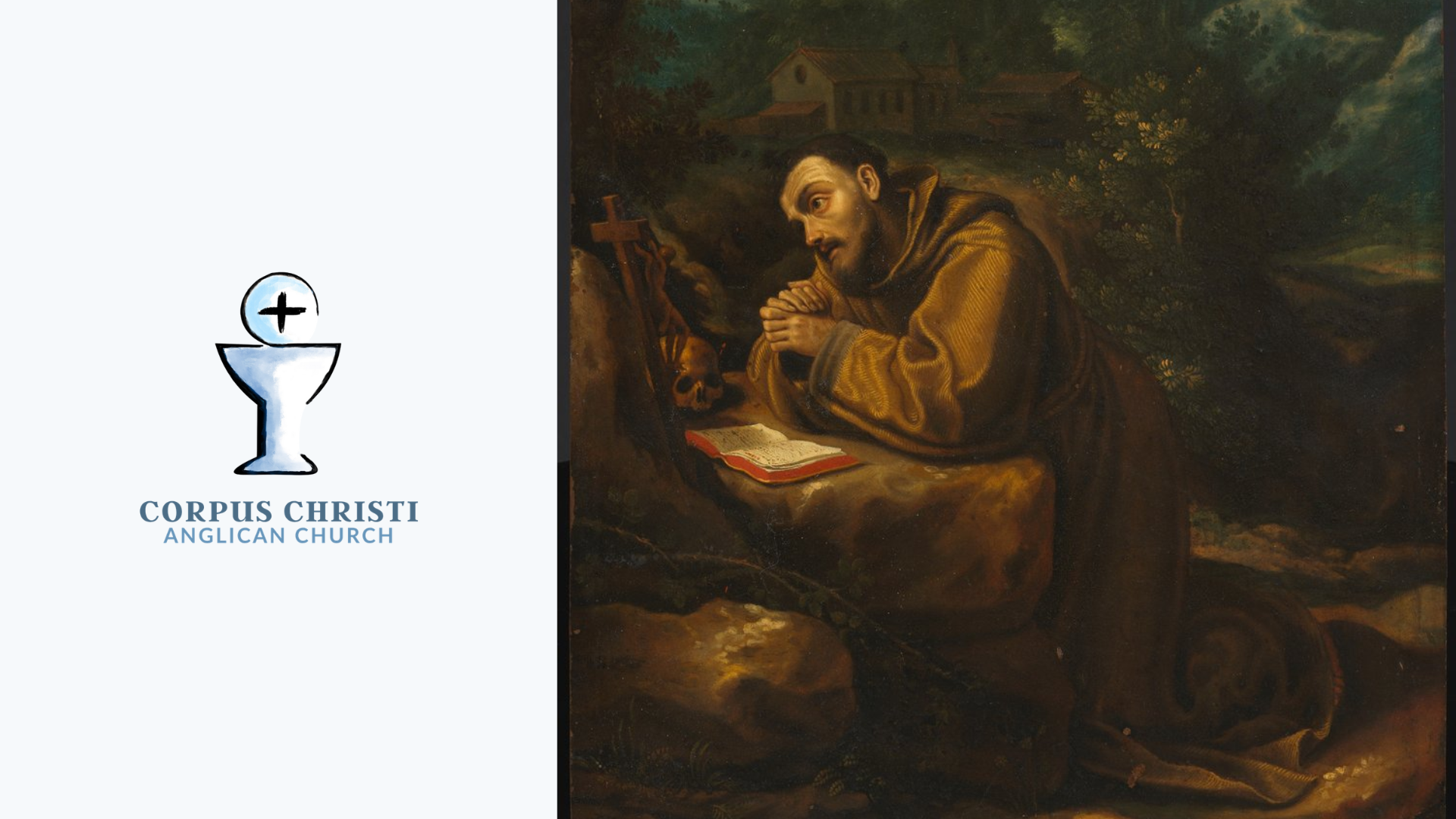
Proper 22: The Life and Teaching of St. Francis
I’m Alexei Laushkin a member here. Let’s pray together father as we turn to the living Saints, especially the life of Saint Francis in our time this morning. Speak to us as you once spoke to him working us as you once worked in him the name of the father‘s son and the Holy Spirit. today I get a chance to graciously talk about something that I know a little bit about but you also when you feel like you, you love something and you know something you always feel like there’s more to know and so in preparing for this time to talk about the life of Saint Francis for whom feast day is today, October 4 800 years ago today actually yesterday he passed and so we are in the life of Saint Francis and if you like me and you have a saint or someone that you admire maybe admire a famous Preacher whenever you speak about them it fills you with a bit of holding trepidation.
I come this morning with that feeling because I think I could probably talk to you a half day about Saint Francis and yet I won’t do that to you. It’s a homily and so I wanna give you some sense of his life and his ministry and his passion and also related to the scripture but I want to start with a very basic question. how many of you know about the life in Saint Francis keep just raise your hand if you know about it OK so do you some man if you don’t know who Saint Francis. I could see it from here so if you’re like me when I first visited a Assisi, which I visited now about a half dozen times a little bit more than a half dozen I had thought of Saint Francis is the same for animals, right maybe he was the saint for those who didn’t like war I didn’t realize that beneath these kind of more remarkable legends and ministries and living witness accounts was the life of a saint, who is very passionate about God, was very passionate about Christ, who believed in the church primarily, as the means for which the Lord would change the world and so I’m not gonna be talking to you about Saint Francis the animal lover, though I do enjoy that part of Saint Francis‘s life.
I’m gonna talk to you about three parts of his story one brokenness with his parents that you may not know about the nativity story for which we get a lot of the nativity tradition comes from Saint Francis and finally his love for the poor and the lost. Those are the three things that we’re gonna cover so Frances was born actually named for his by his mom Giovanni. He was born John. His father was a merchant man merchant men in an era that was very stratified Italy. What now is Italy was not a united nation it was a several different kingdoms, and the paper itself had kingdoms. I’m not gonna go into that, but it was not a one nation it was several different types of cities.
His father was a wealthy cloth merchant, and when he, his mother was from France when he came back and realized that the sun was born, so the father would go off. He was a businessman who would travel for months at a time, and he came back, and the so was born, had already been baptized. He was not happy and so he changed his name to little little Frenchie that’s what Frances is Francesco little Frenchie after his wife Saint Francis was a in his early years.
St. Francis was a fairly passionate fellow so you can imagine someone who he could. His father could afford all the clothes that he ever needed. He liked going out to parties he liked going out and having adventures he was eager to please his father into seek for himself what he thought would be the best thing in life ever which was to become a Knight to essentially live a glorious life and you think about this, they were not nobility. They were merchant men and women and so part of the seeking is that if you became a Knight as someone who has ancestry in kind of the Russian tradition in the Russian empire, if he became a knight or if he did something glorious on behalf of the king that’s how you got your Harold Reed that’s how you got your nobility. At least the chance was there so Frances was really thinking about his family and had to advanced his father‘s Interest at the time if you’ve ever visited have any of you been to a Assisi before OK so some of you have so I can speak a little bit about this but if you’re in a Assis, you look across the way you’ll see Perugia. She has just a neighboring town. It’s the distance between like Alexandria and Fairfax. Maybe it’s not that far like if you took the outer borders, you could walk there this is my point. You can walk there and what it happened was the merchants of a Assisi rebelled against the aristocracy and kicked them out burned their lands. It’s it’s not a pretty time in world history it. None of this is like pleasant stuff as the nobility fled over to Perugia and Frances following his father‘s wishes, joined the Armed Forces of the Assisi in the battle he’s captured and said in prison for a year this begins the transition of his life.
It takes about four years from the time that he is in prison to the point where he has what I would describe a living encounter with Christ. He’s in prison for a year. He’s very sick. His father finds out about it, and as things are cooling off between Perugia and the Assisi, his father pays a ransom. He comes back to a Assisi and get sick for like 8-10 months very ill if any of you’ve had brokenness with your family if any of you have had life tragedy if any of you had long illness like I have had in my childhood Saint Francis can relate to that experience. I just want you to hold onto that for a moment as we go through these next pieces of his story in the process of recovering at about year three he decides I’m gonna go join the Armed Forces again, so he’s still very much following his father‘s wishes. It’s on the way to reenlist that the Lord convict him that this is not the way he should live then the process kind of gets a little challenging. He has a vision that he is supposed to rebuild God‘s church and like most useful people or if you know people administration when they start out, he takes it very literally and he believes it is a specific church that he is supposed to rebuild that is in ruins. This is the crisis San Diamiano, what does he do in order to do this?
Well he starts selling his father stuff to pay for the rebuild hence the conflict friends when we follow the life of Christ the Saints teach us including Saint Francis but also the church fathers and mothers that there will come a point where you will need to choose between Christ Parents or the thing that you love most this is part of the teachings of Jesus and Saint Francis had that moment his father is so enraged. He goes to the Bishop who at the time in this era of bishops kind of settled disputes. They had a slightly magisterial function in terms of magistrate that wasn’t their total role, but that was one of the roles so he goes to the Bishop of the Tang and says look at this scoundrel of a son that I have he is selling. He’s stealing from me stealing from me. Imagine if you’ve ever had a conflicted with a loved one and they’re screaming at you in public. This is what Saint Francis is dealing with the Bishop turns to Frances and says you know the scripture says that shall not steal. This isn’t right what you’re doing Frances takes off all his clothes except for an undergarment so if you see a film, he’s not total anyways there’s an undergarment on that that’s all I need to say in the morning near the altar and the Bishop is so moved a Bishop who wasn’t necessarily the anyways he’s so moved. He puts on imagine what Father Morgan‘s wearing except more grand. he puts that on Saint Francis to cover him and Frances in a low voice and I think he regrets this says the only father I have is in heaven into what’s happening in the medieval time. That we’re discussing as they’re announcing each other publicly a wound that Frances could never heal. There is no recorded restoration between Frances and his parents so this is a saint who knows the brokenness of those imagine Frances has spent his whole life trying to please, his father and it comes to this imagine your own wounds the God can still use them as God use Saint Francis Saint Francis did try to reconcile this really difficult part of his life, but it never healed. It never healed and this is the guy that we serve that perhaps you to come this morning with wounds that aren’t healing I believe that God healed the emotional worms in Saint Francis given the way he lived his life in the way he talked about his parents, never will find kindness and never with disparagement.
He was very cautious about his words. I myself have my own wounds with those who have harmed or or I’ve experienced great harm but less than I learned from Saint Francis is not to air the laundry in public so these are things that are known about Saint Francis, but that he did not talk about very often but this is part of his story part of his legacy. The second is the nativity story. This is interesting so we do have some writings from Saint Francis and I’m going throughout the course of the homily share some of his actual written work we have the equivalent I would say of 60 pages depending on the type from him that are believed to be his writings, so he says a person sins who wished to see who wishes to receive more from his neighbor than what he wishes to give him himself to the Lord God, a person sins who wishes to receive more from his neighbor then he wishes to give himself to the Lord God in the process he lived in the time that Navy was like our time was very troubling. The Crusades, there was violence. There was plagues. There were people who confessed to love the Lord, but did not live like this. Saint Francis had all of that in his life and very early on. They decided to start sending people throughout the world to spread their message, the message of radical imitation of Christ and the way that they live, which I’ll talk better in the moment so he imagine this you know think about the era late 11 century early early late 12th century early 13th century he says I’m gonna go meet with the sultan who is at war of the Christian kingdoms to persuade him about Christ. Can you imagine he’s in Italy and he’s gonna go take a boat to Egypt which would take him months and then he’s gonna convince the people legged that he should cross the lines that are openly at war with each other, and he’s gonna go have an audience with the Sultan to persuade him about Christ. This is the kind of radical obedience that he had the kind of radical sense that this is part of what I should be doing not gonna talk a lot about that encounter. He does meet the Sultan. It’s a peaceful exchange neither convinces the other, but the Sultan kind of grandson safe passage to lead after that point he spends about a year in the holy land visiting the sites of Christ and Bethlehem when he comes back, we don’t have a lot of what happened when he was in the holy land, he thinks to himself the celebration of Christmas needs to be a lot more robust needs to be a lot more robust so what he does is in 1223 he return he he goes to the people he wants him to experience the raw and published reality of Christ birth so when he’s in Bethlehem, it strikes in how poor Bethlehem is in his day so what he does is he goes to a noble money. He says we’re gonna set up a cave in Grigio why Grigio well there’s parts of Italy that actually look like the holy land so if you’re a fan of Mel Gibson s, the passion or if you’re gonna be watching the chosen is gonna have a scene about the resurrection where they’re filming Madera Italy actually looks like the holy land, Jerusalem that’s why they filmed there Madera just in God‘s Providence is the place where those who first made icons which was controversial in even the Aunt fled. They lived in Madera and wrote their icons on the cave so I think it’s just interesting in God‘s economy that several centuries later we’re still telling the big story is about Jesus I’m saying that because this part of Italy looks like Bethlehem that’s why Saint Francis chose it as a place to do it so what did he do?
He got a live a live donkey on Christmas Eve. They went to the countryside, carrying torches and candles, and they went into a dark cave Saint Francis, who is a deacon never priest he is a lifelong. Deacon starts chanting the midnight mass and eyewitnesses record from St. Thomas of Celino that a little child appears in an empty manger, whether they all had a vision, whether it was actually the child I leave that to the Lord’s Providence, I’m not gonna make a judgment call from here. I wasn’t not there, but I believe God can do such things. It impressed the people there so much that the popularity of the nativity scene isn’t just a great reenactment is the sense that Jesus is really present in someway and that’s what convicted those in those early days you see Saint Francis this radical obedience in this move towards the kingdom of God now this last part where I’m talking about his love for the poor and in the way you lived his life I talk a little bit about how does this intersect with angle criticism before I do that so this is a lot this is a Catholic saint, but it’s really a saint of the church, orthodox and Anglican vendor this Anglican sort of love for Saint Francis. I would say it starts really in the early 20th century so I’m all creatures of our God and King that’s a rendition of the mechanicals of creation so William Draper 1919 when he does all creatures of our God King, that’s one of the writings that Saint Francis actually wrote the mechanicals of the creatures is the first writing of any major saint in Italian so at this point Latin still the majority church language and it is the first full Italian vernacular song that we have so early 20th century William Draper, translated into all creatures of our God in king second society of Saint Francis. A religious order also comes into existence in the angle can communion in 1921 and this prayer that has become very popular make me an instrument of your peace. You may know that prayer has been popularized. I would say by the English speaking world and Anglican even probably more than the Catholic world so if you go to Assisi today, most of the merchandise is in English more than Italian so this has been our contribution is Anglican to Saint Francis. The last piece on his love for the poor if you’re like me in the Christian life, you may feel like loving the least of these in the poor is a complicated endeavor. Do you feel that it’s not particularly easy or simple anything from a simple as what do I do if someone asked me for money to how do I encounter someone who is on house and what do I do There? I think Saint Francis taught me as one of the teachers that I am to respond in simplicity yet, let my simplicity know if someone asked me for money. Judge not least I’d be judged Saint Francis learn this lesson very very in a very hard way when he was a young man he was revolted by the poor I mean, revolted to the point where he probably had indigestion seeing the physical poor he did not want to be around them part of his experience in 1205 he kind of comes more fully into loving Christ in 1206 is he meets a leopard now leopards in those days aren’t just people who were just really sick. They had to call out in front of them leopard leopard to avoid the contamination they had to physically by law communicate who they were. Frances heard the bail on the call so they had a bell while he was walking, he, he had an impulse of Grace from Christ.
He walked straight up to the man placed a coin in his disfigured hand. He had never touched a leopard bending down Frances wrapped his arms around the leopard and kiss his hand in face. The leopard return Frances‘s gesture, giving him the kiss of peace back a man who never wanted to touch a leopard there may be places in your life or God is calling you to do something big that you have trouble doing know that Saint Francis knows what that’s like and he believed in that kind of exchange. This started his lifelong love for the port Frances in the first men who became Franciscan’s worked for their daily bread by laboring in the field when their supply of food was not enough to provide what they needed. They begged door-to-door never accepting money but food can you imagine a priest coming to you begging for food? How shocking that would be Frances was not a priest. He was a deacon but a religious person asking you for food a Bishop even asking you for food I need food his life and teaching were meant to enter and reach people where they were at. He teaches us to go out into the world, just like Christ and to say the Christian teachings we see in the beatitudes aren’t abstractions love your enemy, love the least the lost they’re part of our daily fabric of life and they’re meant for us to go forward in these encounters, and this is the way Saint Francis taught his his order in his brother so what does this all mean and had us tie into our scriptures for today in Isaiah? We read the verses that God was looking for justice and the only found bloodshed Saint Francis also lived in a very violent time. He took simple steps and he invites us through Christ not through himself, but through Christ to take simple steps to battle, the injustices that we see that could take a simple form it could be avoid avoiding paying a day laborer, for instance because they don’t get insurance or paying them the right way could take a simple form of responding to those who I need who might need money, but maybe providing food instead they could take a simple form of calling that relative that you’ve neglected. It’s on my list that you haven’t talked to you in a while saying I love you. I’m thinking about you. It can take simple forms God is not looking for the great reformer. He is looking for the small reformer through Christ by the Holy Spirit in our heart, simple things. Psalm restore us, and we shall be whole Saint Francis believe that God could restore the brokenness that he experienced with his family and his parents, do we believe that our deepest wounds can be restored that God‘s goodness lives in the land of the living what might that look like in Matthew Saint Francis lived his life believing that the master would return to set the house in order so one of his big practices were service and simplicity the belief in the holy Eucharist in the church as the means for restoration, which is incredible. I know it’s incredible even for me to say because the church has so many flaws. The church makes scandals in every paper on earth that was true in Saint Francis‘s day as well maybe not the Free Press but the scandal part absolutely, and yet Frances believed it was through the church not outside the church. The God would work that was what his life was about. That’s what he gave his life for that God would work for the ordinary means of the church and so a prayer perhaps before Eucharist could be restore our faith, Lord, that a church can actually work to change the community that we’re in because it takes believe we’re like the doubting Thomas I believe help my unbelief Saint Francis believed in the church. The third part he believed in was holy obedience, he spoke a lot about judgment that the Lord would judge the church and that you need to obey obedience is not a word that we like I’m gonna close on this. It’s not a word that feels good. It’s not a word that rubs are American sensibilities as well but it’s a trust. It’s a trust that God is working in institutions and in people. It’s a trust that God will reform that which is broken in.
It is a trust not to put ourselves as our own gods, as though we knew everything, but that we in Community would discern what is best and that God works through Community so it is an act of faith Saint Francis live that active faith, he believed in the gospel of Matthew that the master would return, and that his vineyard was supposed to operate a certain way noticed the vineyard was a corporal thing he wasn’t returning to an abstraction. He was returning to something that was supposed to be working in Saint Francis said live your life as though that we’re true live your life as though that we were true, was closing prayer, gracious Father we thank you for the life in the example of Saint Francis his hard teaching his love and his passion, the mystery of his life. We asked that those of us formed in the Anglican communion might learn from his example which points primarily to our own example, which is Christ, the name of the father son and Holy Spirit.

Ascension Reflections on Building the Life of the Church
Good morning. I’m Alexei, a member here. Let’s pray together. Father, as we consider these words, help them to manifest in us a wellspring of life. Lord, we pray in the name of the Father, Son, and Holy Spirit. Amen.
Last sermon, if you were here or if you had a chance to listen for Ascension Day, Father Morgan covered, among other things, the expectations of the disciples in terms of what would come next and the meaning of adoration. We heard a very long, but good, example of Father Morgan’s love of coffee as it relates to adoration today. I am given similar texts, but I’m going to weave the text a bit differently in terms of what we covered today. I will cover the preview of what is to come with the children of God, us, our active pursuit of building and how and by what means, and what contrast these momentous days of Ascension leading up to Pentecost will look like. We’ll look at the spiritual elements of this building up of the body and consider the persecuted church out of our First Peter passage, and its practical application, and how that draws us from the smaller loves into the greater loves of the body of Christ. We will consider how to be in the world and not of it, holding the body and how to navigate the times we’re in, and will consider how we can claim a love for even our nation and pray for it, but how that is a secondary love to the love of the body of Christ and how those two loves are in relation to each other. First, I’m gonna start with a bit of a reflection from Alexander Schmemann.
So, for those of you who might be newer to the Anglican church or might be newer to liturgy, you might notice that every year we make a big deal of our liturgy. It really, in many ways, for those of us who practiced in the Anglican tradition for some years, starts at Advent and it moves all the way through Pentecost. But sometime in this part of the year, Easter to Pentecost, we kinda lose a little bit of its meaning, or it can seem that way. And so Schmemann, I think, gives us a way to think about liturgy and the importance of liturgy again. As a church where we read the Book of Common Prayer, we’re common people, and we’re seeking uncommon transformation, and part of that is the liturgy. Part of that is the liturgy of this day and going into Pentecost itself. So let’s hear Schmemann on these words. Alexander Schmemann, for those of you who don’t know, is an Orthodox teacher and protopresbyter.
“In the center of our liturgical life, in the very center of that time which we measure as year, we find the feast of Christ’s Resurrection. What is Resurrection? Resurrection is the appearance in this world, completely dominated by time and therefore by death, of a life that will have no end. The one who rose again from the dead does not die anymore. In this world of ours, not somewhere else, not in a world that we do not know at all, but in our world, there appeared one morning Someone who is beyond death and yet in our time. This meaning of Christ’s Resurrection, this great joy, is the central theme of Christianity and it has been preserved in its purity by the Orthodox Church. There is much truth expressed by those who say that the real central theme of Orthodoxy, the center of all its experience, the frame of reference of everything else, is the Resurrection of Christ.
The center, the day, that gives meaning to all days and therefore to all time, is that yearly commemoration of Christ’s Resurrection at Easter. This is always the end and the beginning. We are always living after Easter, and we are always going toward Easter. Easter is the earliest Christian feast. The whole tone and meaning of the liturgical life of the Church is contained in Easter, together with the subsequent fifty-day period, which culminates in the feast of Pentecost, the coming down of the Holy Spirit upon the Apostles. This unique Easter celebration is reflected every week in the Christian Sunday, which we call in Russian ‘Voskresenie’ (Resurrection Day). If only you would take some time to read the texts of Sunday Matins, you would realize, though it may seem strange to you, that every Sunday we have a little Easter. I say ‘little Easter,’ but it is really ‘Great Easter.’ Every week the Church comes to the same central experience: ‘Having seen Thy Resurrection...’ Every Saturday night, when the priest carries the Gospel from the altar to the center of the church, after he has read the Gospel of the Resurrection, the same fundamental fact of our Christian faith is proclaimed: Christ is risen! St. Paul says: ‘If Christ is not risen, then your faith is in vain.’ There is nothing else to believe. This is the real center, and it is only in reference to Easter as the end of all natural time and the beginning of the new time in which we as Christians have to live that we can understand the whole liturgical year. If you open a calendar, you will find all our Sundays are called Sundays after Pentecost, and Pentecost itself is fifty days after Easter. Pentecost is the fulfillment of Easter. Christ ascended into heaven and sent down His Holy Spirit. When He sent down His Holy Spirit into the world, a new society was instituted, a body of people whose life, though it remained of this world and was shared in its life, took on a new meaning. This new meaning comes directly from Christ’s Resurrection. We are no longer people who are living in time as in a meaningless process, which makes us first old and then ends in our disappearance. We are given not only a new meaning in life, but even death itself has acquired a new significance. In the Troparion at Easter we say, ‘He trampled down death by death.’ We do not say that He trampled down death by the Resurrection, but by death. A Christian still faces death as a decomposition of the body, as an end; yet in Christ, in the Church, because of Easter, because of Pentecost, death is no longer just the end, but it is the beginning also. It is not something meaningless which therefore gives a meaningless taste to all of life. Death means entering into the Easter of the Lord. This is the basic tone, the basic melody, of the liturgical year of the Christian Church.
“And the real content of the Church life is joy. We speak of feasts; the feast is the expression of the joyfulness of Christianity.
“The only real thing, especially in the child’s world, which the child accepts easily, is precisely joy. We have made our Christianity so adult, so serious, so sad, so solemn, that we have almost emptied it of that joy. Yet Christ Himself said, ‘Unless you become like children, you will not enter the Kingdom of God.’”
We reflect on Schmemann, and he’s pushing us into this idea that our Christian year is in these days, these high days of Easter, these days of the Ascension leading us into Pentecost. We can get into some of our passage. We look into John 17, which is where we started. I just wanna cover a few pieces out of the Gospel of John. It’s really, when we look at it, a bit—this is a combination of very serious and also a bit comical at the very end. So He’s taken up into heaven, and the comical part: they look up, and then two men are dressed and stand and say, “Why are you looking up?” That’s the comical part. “This same Jesus has been taken from you into heaven and will come back in the same way you’ve seen Him go into heaven.” And so then, as we continue into 12 and 13 and 14, we notice that what the apostles give themselves into is an intense focus on prayer coming into Pentecost. This is tied into the very essence of our Anglican way of life. Our Book of Common Prayer—prayer is the anchor of the waiting as part of our Christian life. It’s the anchor, but it’s also part of the building.
I’m gonna move us into Genesis 11 a little bit. The Ascension, in many ways, is a kind of bridge, is one of the Exodus bridges. OK, so in the book of Exodus, you’re leaving from Egypt and you’re crossing the Red Sea. Jesus, in a very literal way, is ascending to heaven, creating a bridge for us. Do you see that parallel? He’s creating a bridge for us, an Exodus bridge. Second thing is, in the Old Testament, you have the Exodus, you have the wilderness, then you eventually have the coming into the Promised Land after a severe sequence of things that culminates in the Old Testament in the temple, the temple itself and temple worship. In the New Testament, what this whole culminates into—Ascension as a start and Pentecost—is the temple of our own bodies, our own bodies, the Lord dwelling within us. You can see, then, the seriousness of our bodies and our actions and our acts in the epistles, how seriously we take what we do with our bodies, why this is now the place where the Spirit, God’s presence, dwells with us.
You can see these parallels here now both the Old Testament and New Testament are dealing with a human tendency that I want us to look at in Genesis 11 as we start thinking about what is the Ascension mean for our life as a Christian that’s the tower of Babel so what I’m doing here is I’m contrasting new Old Testament the New Testament what is the human condition? What is life apart from God actually look like what does the scriptures have to say about it if you can see the connection because this is the starting point of ours ascension to worship Genesis 11 the whole world had one language in a common speech as men moved east where they found a plane in Shinar and settled there they said to each other come let’s make bricks and bake and thoroughly. They use brick and instead of stone and for mortar and they said come let us build ours of the city with a tower that reaches to the heavens so that we may make a name for ourselves two things are going on here that I want to draw our attention to one. Is that notice of the tower of Babel we’re moving from the natural to things that man makes brick.
Do you see that the technological development were no longer using what God has given us, but we are selves are making the equivalent the equivalent of their day the iPhone AI you know these things are still alive in the sense of what man breaks a generation or two ago cars and airplanes. The making of the brick is not necessarily the challenge meaning what man makes a lol more than it’s a challenge of what you what you’re making in your life your personal life what you do with your time in your energies it’s the second part to make a name for ourselves to make a name for ourselves to put us first to put our ways first. Think about this to put our ways first, but we’ll still exploit the poor in the town in the Babel system and then if you look in the New Testament Babylon takes on the same kind of archetype. Egypt is another architect to make our name for ourselves, but we will not have justice to make a name for ourselves, but we will not reform our hearts for peace patients kind of self-control to make a name for ourselves, but to worship ourselves not to worship God.
The temple in the Old Testament is this place where you’re making sacrifices for sin in heaven and earth can then be in a place to make your to make it right with God, Jesus who’s made our way right with God ascend into heaven, and then gives us new tools, new tools for the body of Christ to move forward his patient kind of self-control. The new tools that are necessary to actually take conflict more slowly how many of you had conflict this week. Do you have conflict with anyone add conflict this week one way that the Ascension in the Christian life and the Holy Spirit dwelling in our temple in our bodies matter is it slows us down? It slows us down in a world that is wanting to speed us up.
Do you feel that how fast everything is how much your time is supposed to be taken up everything supposed to be on the quick the double quick and if you don’t have time, ask AI will give you the answer, right just slow us down but not to slow us down just to be slow. This is not even though it’s wonderful to be slow and it’s wonderful to have a relaxed life and to have a more peaceful life in a life where you have time to have time for yourself and to rest the point isn’t the slowness the point is the time to go back in prioritize, the Lord right think of the conflict you had this week if you have conflict this week or think of a difficulty you had this week if you didn’t have conflict, part of stepping back from the conflict from the difficulty from the distraction is not just for rest sake it’s to go back and seek for the Kingdom of God and of itself to slow down and then apply the Christian life to your circumstances, which can be difficult sometimes why can it be difficult because we wore against the world the flashing the devil there’s all these things that push for our time but again this is going back to living as Christians in our day-to-day and to be a sweet offering go into our Peter passage in for Peter.
It’s very interesting what we’re given and it’s interesting if you’re thinking about why did we have the particular readings that we had today the psalm if you noticed, it’s the Ascension verse did you see that in the Psalm he ascended into heaven, right it’s right there and then we also have the the John 17 prayer we end with and then we’ve already covered a little bit of the ax but in first Peter, it’s pretty interesting but love do not be surprised at the fiery ordeal that is taking place among you to test you as though something strange were happening to you, but rejoice and so far as you share Christ suffering many of us, not all of us but many of us in the Christian Weston in the United States were a bit removed for some of the suffering and not saying that we don’t suffer. Certainly people can look down on us for being very religious. Certainly people cannot think well of us for going committing our life to Christ that that does happen, but it’s a different degree then you will be jailed.
So I wanna talk about three examples of persecution that it is happening the church today and how that draws us back into a love for the body and then tie back into our Discipline so three examples of people that I’ve known and come across in the last year within my personal life involvement for Kingdom Mission Society. The persecuted church has been very important and certainly for the Anglican Church in North America. It is also very important.
First example I want to talk to you is something that probably was in the news today or this last two weeks he probably heard of Pastor Ezra Jin or maybe Jimmy Lai been persecuted in China in the last year. The Chinese government at last year and a half has made it illegal for you to not meet in the state sponsored church Pastor Ezra Jin had the largest online church in China. They reached probably 50,000 people a week and that also meant this is how a Chinese could go and get some of the online Bible apps right so they jail Pastor Ezra Jin in about a year and a half ago or last October less than that and 200 members of his church in the charges there are fraud why are the charges fraud well from the Chinese government‘s perspective they’re operating tithing and offerings apart from the state church therefore that’s the fraud he is kept in a place where he cannot talk to his family knowing the daughter who attends a sister church in the region he is kept the lawyers are harassed and threatened to their licenses be removed unless they drop the case and he it is unclear half and he’s given his diabetes medication. He is facing likely 7 to 10 years in prison in what is the story due for us well this story best for us were to pray for Pastor Ezra certainly to think about how we speak up or support the persecuted church but what happens when we start thinking about the prosecuted church as we realize that these are believers alive right now praying to God right we are tied with them in a fellowship right and that helps us. Yes pray for our love for our country, but also to pray for the global body.
Let me give you two more examples and will move into our clothes out of John 17. The second is the church in Syria. This is the church that at the start of the 20th century was 20% or more of the Syrian population it’s now down to 2%. It is eight different churches in Syria. The stories go that Christian communities are often harassed with bullhorns and threatens that they should convert to Islam it’s not the whole society that does this but some of the extremists so you can imagine being a church like ours suddenly being interrupted by a large bullhorn that’s the experience of our brothers and sisters saying convert to Islam. What happens is the man in the church will go and talk to the person and say please stop and they’ll make a report to the government to please stop but in one of these churches have three weeks after an incident like that there was a church Bonding right as we pray for our brothers and sisters in Syria in Iraq in Iran, who face this kind of intimidation is how I describe the Christian persecution in much of the Middle East today
Third one I wanna talk about is Christian prosecution in the Congo you would think well why the Congo it’s an 80% Christian nation. Why would they have Christian persecution in the Congo well, they’re having Isis affiliated groups who are going and asking are you Christian? Is your name Christian John that sounds like a Christian name convert otherwise I’ll cut your hand off. It’s really at that level, it’s very brutal. It’s very brutal and we think of our brothers and sisters in the Congo. These are very different types of places you know different types of the economies, different types of living, but we are united in this first Peter passage for them can’t suffer Price suffering or living Krise suffering. Do you see them until we get connected with the global body, even as we give things for God‘s blessings in the United States and then other parts of the Western world that we’re connected with the global body, and we know that these are not suffering as murderers of thieves or as criminals, right we know they’re suffering as Christians and so we pray for them we think about how to send relief and sad to send aid through the Anglican Church in North America. Does that quite well and we support our brothers and sisters who are in this place and we know that they’re deeply connected into our liturgy and then I’ll move to the John passage, we know out of the book of Revelation that they are in White right they are calling out. They are the martyrs and White and let’s make a connection of our liturgy. That’s the same White that you’re given in baptism right this is the connection for the liturgical life. This is one of the reasons that part of building the new city part of building the city of God on earth part of building up the church is where we’re turning it all around we’re not practicing injustice within the church. I’m not saying there’s a scene in the church there’s certainly is we’re turning it all around because God‘s doing the building so it’s slow sometimes God‘s doing the precious building in our lives think about your own growth and faith.
It’s a slow growth, but this is all enabled in part because of the new exodus because of the Ascension the feast day we’re celebrating today right let’s let’s final finish and John 17 so here it’s pretty incredible in the gospel of John. we’re given Jesus‘s prayer to God the father we are let in on a divine conversation. How amazing is this and here’s what he pray in 17. He talks about his time being here. He talks about being glorified and then at the end here at 17 he says 11, which is our remain you know I will remain in the world no longer, but they are still in the world and I’m coming to you. Holy father protect them by the power of your name the name you gave me so they may be one as we are one. He praise for the unity of the church the unity of the church that begins in our hearts, the unity of the church for the spirit dwells in our hearts and dwells in our conflicts the unity of the church that it matters what you do if your body it matters what you do if your time he prays for the temple that will go on forever in our own resurrection right and so it in Dallas each of us within incredible meaning Jesus does with incredible dignity CS Louis talks about you’re talking to strangers you may be having everlasting conversations conversations with eternal consequences in his writings so think about that as we had between now and as we go into Pentecost, we’re thinking about the meaning of these days the liturgy is what we’re given going back to Schmemann right from Easter to Easter from Easter to Pentecost. This is what we’re given until the next age to experience the simple joys of the Christian life where it’s not about ambition, it’s about having the Lord‘s business at mind always and having contentment joy from following the Lord always not in flashy moments and flashy careers so that can be fine if it’s present there it’s that you have your contentment somewhere else and that is what helps heal the restlessness. It’s been in the human spirit since the garden. Jesus is what helps heal this and says we think about Ascension as we head into Pentecost this week about the importance of time and your week and take the small steps if you haven’t opened up the book of common prayer if you haven’t done your scripture reading in a while use this week as a mini renewal week because I always find the Pentecost is sending season in my own walk-in lot, so think about that enter into the glory of this time whatever stage of life that you’re in and seek the Lord fully let’s pray vicious father we thank you for this ascension Sunday what enables through the waters adapt we asked that you would be with us and help us to renew our hearts even this day the name of the Father Son and Holy Spirit.
A Holy Friday: Why We Venerate the Cross
CONTENT
In this most somber of our three days, it isn’t seem quite right to say good evening. There’s nothing good about the evening. We are in Good Friday good as in the sense of Holy Friday.
I have to tell you that since the morning my own spirit as I’ve been reflecting throughout, today has been in a kind of grief. Perhaps you felt that grief or perhaps not and you are just beginning to feel the grief.
There’s a verse friends in Zachariah 12 that I think describes the day quite well in verse 10 “and I will pour out on the house of David in the inhabitants of Jerusalem the spirit of Grace and supplication they will look on me. The one they have pierced, and they will mourned for him as one mourns for an only child and grieve bitterly for him as one grieves for her first born son.”
This is the spirituality I think in a verse for Good Friday. We meditate on grief and we do not look away.
We’re entering into the three days as Chip told us yesterday about the last supper in the mystery of these days and indeed there are mysteries.
I had a chance in preparing for the evening to review Egeria, who is a nun we believe she was a nun who traveled to Jerusalem in the 380s and I’ll share a bit more about some of her insights, but we get the sense of the earliest Christians from them. These days were all night vigils all day vigils so from the moment that we have the last supper that they would hold vigil in Gethsemane through the whole night in Gethsemane and they would rise early before the sunrise for what we actually do a little bit later in the service the veneration of the cross talk a bit about that and this would continue into Easter.
These days were days of deep spiritual preparation throughout the history of the church. These days these holy days of Easter, east and west in our own tradition in the Anglican tradition these have been days of deep spiritual preparation and as we’ve headed into the 20th and the 21st century, I’d say as the church global has had to deal with secularism, but I mean by that is people in attention on the thing of things of God as a shorthand the spirituality around Easter is something that we in our day in age are seeking hard to reclaim and so as we start the evening i darkness and we reflect on these days and we take the time. I urge you to come to stations of the cross tomorrow I urge you to come to vigil. I urge you to come to the next morning. It is tiring, I think I was texting a friend and I said I can appreciate Easter Monday now ,but just as Jesus asked his disciples can you not stand with me one hour? This is the question for us can we give our of our hour. We tire ourselves in so many things to exercise the muscle spirituality.
Let’s look at this text. It is a it is a graphic text and I think part of the holiness of this Day and even in the epistles that the phrase and I’m not ashamed of the gospel, we have to understand a little bit about what we’re actually seeing here we’ll go through it in slow fashion, this passion gospel of John that we’re given this year.
I want to start by some context that the Romans had other options besides crucifying Jesus, in fact, they used other options for a serious criminal offenses one apparently they’re all nasty but one is just throw someone off a cliff they could’ve put just a wooden chain around his neck and had him walk around, but crucifixion was a public shaming death. It was a slow death as your nail in your hands are up. You can inhale, but it is very difficult to exhale so to exhale to keep breathing asphyxiation, which is how most die from crucifixion. You need to push yourself up by the nails.
In addition to this we get in the text that Jesus was brutalized prior to this starting at the first Pilate. Pilate had Jesus flogged him and in fact, in the earliest days in this text from 380 that this day they would actually go quite early to see the poll on which he was flogged. That was part of their exercises that day.
The soldier twisted together a crown of thorns and put it on his head in order to mock him in a purple robe. It’s all mockery. They came up to him, saying hail. You can imagine that it wasn’t a quiet hail. It was more hail king of the Jews, and struck him with their hands.
Can you imagine anyone watching seeing this is a pretty brutal brutalized innocent man.
Pilate went out again and said to him see, I am bringing him out to you that you may know that I find no guilt in him. We need a little bit of context with Pilate. You may not quite understand what is going on with Pilate, but Pilate throughout his reign and we know this from Josephus and other sources he struggles to get his relationship with the Jewish people right.
I just wanna give you a few examples early in his reign he goes ahead and he decides that he’s going to build an aqueduct, but he builds the aqueduct using treasury money from the Jewish temple to see this gets him in a lot of trouble, and he has other incidents in which he puts the kind of worship of the Roman gods in front of the Jewish leaders faces, and in fact the years later, the things that the thing that gives him removed, is he violently suppresses a Samaritan gathering where another messianic type figure is claimed, and he goes ahead and kills that figure which eventually is what ends his reign.
And so the text that we get from the gospels as Pilate is struggles with this, but in his conscience, oddly enough, he doesn’t want to. This is what our scripture reports he doesn’t want to do what’s being asked of him and the leaders of the law we’ll see in the text.
You know their command is not to kill not to take a life they don’t want to be seen as having killed Jesus on the Passover when the population of the city is going from 40,000 to 50,000 to probably low estimate 140,000. It’s a much bigger city they don’t want to be seen.
Think of it this way, they want Rome to be seen killing Jesus using their most brutal techniques. This is part of the text we have today and at the same time they’re so concerned about their self imagery that in a few days you know in this next day, they wanna make sure that none of those who crucified are up during the actual passover so as to not create offense. I pointed this out briefly as we continue onto the text because this is the twisted side our human logic as someone who is engaged in the political spaces you often look at politics and it’s it’s a lot of who knows what’s going to happen here you have the ma decide or not wanting to do this but something else what I would describe as evil comes onto the scene to force his hand.
So Jesus came out wearing the crown of thorns and the purple road Pilate says to them, behold the man when the chief priests in the officer saw him they cried out crucify him. crucify him. I want you to get a sense of this and we can’t. This is captured in a bit of the liturgy, but imagine a noise so loud or a moment, so startling that perhaps a riot might be caused I don’t want to over exaggerate, but I don’t want to under exaggerate the degree of pressure crucify him crucify him Pilate has gone to the trouble and said look I’ve done some things that you’ve wanted, and the crowd is stirred up to such a degree crucify him crucify Pilate said to them, take him yourself and crucify him. Find no guilt in him the Jews answered him.
We have a law, and according to that law, he ought to die because he just made himself the son of God when I heard the statement he was even more afraid. He entered his headquarters again, and said to Jesus and I want you to imagine a Pilate here in the moment, just totally exacerbated exacerbated at his wits end not knowing what to do pacing where are you from? But Jesus gave him no answer so it to him you will not speak to me. Do you not know that I have authority to release you and authority to crucify Jesus answer you would have no authority over me at all unless I’ve been given you from above, therefore, he who delivered me over to you has the greater remarkable words from our Lord and save part of the words of obedience he knows he has to, even in this moment assuage Pilate’s conscience.
This Pilate does not want to act from then on Pilate saw to release him, but the Jews cried out if you release this man, you are not Caesar‘s friend everyone who makes himself a king opposes Caesar, and Pilate who has had so many high profile incidences where he’s gotten religion wrong in his reign. This is the pivotal turning point he’s trapped he is trapped in decisions that will eventually cause him to end his rule he’s trapped so when Pilate heard these words, he brought Jesus out and sat down on the judgment seat.
The judgment seat here is where the Romans will come to give their official judicial verdict. So prior to this you’re seeing Pilate interact with the crowd now he’s at the place, the stone pavement, where you can make his official proclamation was the day of the preparation of the passover. It was about the sixth hour he said to the Jew, behold your king, they cried out away with him away with him, crucify him to strongly suggest a group ready to riot if he says no the chief priest answered we have no king, but Cesar would just be straightforward a total lie in terms of their relationship with Rome, but it is their master stroke in their politics with Pilate that day so he delivered him over to them to be crucified.
I’ll get to the last part of the text in a moment but wanna give you a sense of how early Christians and how we ourselves might think about this early time so Egeria notes this and I won’t read the whole passage when I wanna give you some pieces here they arrive before the cross.
“The daylight is already growing bright. They’re the passage from the gospel is read with the Lord has brought before Pilate with everything that is written concerning that which Pilate spoke to the Lord or to the Jews the hole is red and afterward, the bishop addresses, the people comforting them for that they have toil all night and are about to toil during that same day bidding them not be weary, but they have hope in God who will for that to give them a greater reward.”
Listen to the words of this fourth century bishop these are his words to us who take vigil these days, encouraging them as he is able to addresses them “thus go now each one of you to your houses and sit a while. You may be able to go behold the holy wood across each one of us believing it’ll be profitable to his salvation then they go to the column of flagellation and then come back to the veneration”
So just read this passage on the veneration of the cross “chairs place for the bishop and Golgotha behind the cross, which is now standing the bishop. He takes a seat in the chair in a table, covered with a linen cloth this place before him, the deacon stand around the table in a silver guilt casket is brought in, which is the holy wood of the cross”
Think of this remarkable it’s very likely that this is the wood of the cross at this point it’s a piece of it now when it has been put up upon the table, “the bishop as he sits hold, hold the sacred would firmly in his hands. Then the people one by one come down down at the table, kiss the sacred wood and pass through because I know not when someone said so that they pass one by one all bowing themselves, they touch the cross first their forehead then with their eyes, then they kiss the cross and pass through from the earliest days.”
This is part of the Christian worship of these days. What is happening here? We’ll have an explanation a bit later but we’re thinking about just like an icon in some ways. We’re thinking about the events behind it and we’re reflecting in our bodies that worship that is already there in our hearts and this has been part of the earliest days of what it’s meant to be a Christian as far back as the fourth century where they kept vigil and they were physically moving around and they were physically moving and listening, and hearing the words of God because they were reflecting, with their bodies, was already true in their hearts, and though for some of these, some of these practices might be new in God‘s account economy, and in the kingdom of God, these practices are quite old as old as the earliest visited recorded record.
We have a nun going to Jerusalem, and so as we do these tasks as we, as we enter into them in our hearts, realize that we in our own way at a special time are reflecting and committing something to God in that in many ways is the essence of our sacramental life as Christians set aside times that have always been part of the life of the church for which we worship God and spirit and truth now for this final text that has gotten me in a appropriately somber spirit so they talk to Jesus and he went out, bearing his own cross the place called the place of a skull, which is called Golgotha right in front of the city. It’s a classic Roman crucifixion so everyone could see no hiding there. They crucified with him to others one on either side in Jesus between them. Pilate also wrote an inscription and put it on the cross it Jesus of Nazareth, the king of the Jews, my personal take this is pilots way of describing what he thinks a bit of hedging is best but an interesting way politicians when they hedge their bets sometimes tell the truth and when they push him this time, he just says I’ve written whatever she doesn’t want to move on it when the soldiers have crucified Jesus, they took his garments and divides to four parts one part for each soldier also tune for the tunic seamless let us not terrorist, but cast lots the soldiers they could care less what’s happening quite honestly friends. This is the image we get in the gospel it’s revelry it’s games, brutality. It’s a celebration of Romanhood even though creation itself in a moment will mourn in the disciples are scattered his loved ones are scattered they divided my garments among them for my clothing.
The cast remarkably here we get in John’s gospel at the moment of his agony and of his pain we get this touching moment between Mary, his mother and the apostle John in which he says woman behold your son, the love that we see and our icons even the ones around the altar here are of John often end of Mary and the love that is shown I love that Jesus himself is exemplifying in this moment in his agony when at this moment, when you were to look up at him, and the earliest Christians would’ve said, this part of the reason the epistle say, I am not ashamed of the gospel is not a western American. I can speak up and I won’t be ashamed. That’s good. It’s a good impulse you should speak up live into the spirit, but I am not ashamed of the gospel in major ways is it’s the shame of the torture instrument.
If you have seen a Roman crucifixion you would see how brutal it is. You would not think it was pleasant. It was probably one of the most gutwrenching things to watch and this is our savior, brutalized and bleeding and exhausted after this Jesus, knowing that all is now finished said to fulfill the scriptures, I thirst a jar full of soured wine stood there, so they put a sponge full of the sour wine on his branch and held it to his mouth when Jesus had received the sour wine, he said it is finished and he bowed his head and gave up his spirit. The Jon ends the text quoting scripture out of scripture Psalm 69:21. “They gave me poison for food and for my thirst, they gave me sour wine to drink. “
This is the one this is the one spoken of long ago our Savior crucified, dead and exhausted bones, not broken as was promised water and blood flowing from his side, and this is the one friends that as we come towards the veneration of the cross this week we come to this sadness and mournful of days looking at our crucified Lord, who died not for his friends, not for his loved ones for his enemies for his enemies, for those who betrayed him at the last for Peter, who denied him three times for his disciples he will scatter in eventually for those as we get even further along imagine there will probably have been those who would watched him die. Who were Romans who came to believe can you imagine what a grace in this fixes something fundamental in the human race fundamental even more powerful than David more powerful than Moses, more powerful than Abraham someone who is a spotless lamb without blame, who did not deserve any of these things who died a horrific death at the height of his popularity in an evil scheme to destroy God's work on the earth. Let's meditate on that as we continue into the service. Amen.
On Jesus and the Poor
TranscriptioN
Good morning. I'm Alexi Laushkin, a member here at Corpus Christi Anglican Church. Let's pray together.
“Gracious Father, we thank you for these words from the Gospel of Luke. May they touch our hearts. May what is from you and throughout the centuries of the Church meet with us who live in a relative place of prosperity today. In the mighty name of Jesus. Amen.”
This is not the Gospel of Luke passage, a particularly easy passage of Scripture, and it's not one that's often preached on or talked about, in part because we don't necessarily like, as modern Christians, this conflict between the rich and the Gospel. It's uncomfortable. Does it literally mean that someone who is rich and unable to think about the poor and who has oppressed their neighbors will go to hell? Feel that tension. Does this Gospel really mean that? Is this another in the line of the teaching of “it's easier for a camel to go through the eye of a needle than to inherit the kingdom of heaven”? Is this one of these teachings out of the Gospel where you have the rich ruler, and another teaching of the Gospel, come to him and say, “Lord, what must I do to inherit eternal life?” And Jesus says to him, “Sell all your possessions and follow me.” Does that mean that the rich must sell all their possessions to follow the Lord? Feel the discomfort of this Scripture.
I certainly did in preparing for it. So I'm going to give kind of three overviews as we go through the Scripture. One, talking about the text itself in light of the tradition of the Gospels: Luke, Matthew, Mark, and John. The second, the tradition of the Church as it relates to the poor, talking about Franciscans, Methodists, William Wilberforce, part of what we should think about today. And third, practical application for what it means for us in Northern Virginia, in our personal habit, in our close personal relationship, and the practical vision of our Church, which is to be a people transformed by the Book of Common Prayer, uncommonly together.
So the Gospel of Luke passage—what do the Scriptures have to say about the poor? Well, Luke, if you're a student of the Gospels, is particularly focused on the least of these, the poor. In parts of the Church and the tradition of the Church, you might hear Roman Catholic brothers and sisters talking about the preferential option of the poor. What do they mean by that? That God has a special place in His heart for the poor, the least of these, the marginalized. And the Gospel of Luke tradition—certainly I do a lot of racial reconciliation work in ministry. If I go to a historic black church, the Gospel of Luke proclamation, where Jesus is starting his message that He has proclaimed the good news to the poor in the year of the captive and the release of the captive, a year of Jubilee. It's an essential part of how they think about mission and ministry. And Luke takes on this focus.
Mark and John, the Gospels, also take on this focus of the God's people doing incredible acts of loving service. The Gospel of Matthew talks about acts of sacrifice and forgiveness as part of the testimony of the Scriptures. So all four Gospels agree that there is something specific and special about the kingdom of God and how it transforms our understanding of relationships.
Ancient Israel, as well as much of the ancient world, was a relatively hierarchical place. And so if we were visiting at the time of Jesus, we would notice the difference in the ancient world between those of means, those who have riches, and those who do not have means, and those who do not have riches. The Old Testament text tries to deal with this sense of the have and the have-nots through this concept of Jubilee, a specific pattern in the Scriptures that debts ought to be forgiven after a certain period of time. You know, some will say seven years, but the actual practice of Jubilee actually varied quite a bit in terms of Israel's history. What I'm trying to say, though, is the Old Testament talks a lot about debts, and land, and wages, and the importance of those things. And the prophets themselves—Amos, certainly Daniel, and in various ways certainly Micah—talk about God's people neglecting matters of justice, matters of the least of these.
And I, myself, and I've talked previously about concepts of injustice in the American context. I've often talked about immigration, that we have a segment of people in the United States who are not under the law, but are asked to work for lower wages, and they often can't access the justice that they need in things that happen to them.
So the Testament of the Scripture often talks about the poor, but what does the Gospel of Luke really do about this witness? Well, it is in a fundamental way, both what Luke 16, this rich man, and the rich man who goes and asks Jesus, “How might I go and inherit eternal life?” are honing in on something that is an important part of a kingdom myth-busting, is how I would describe it. Which is that both this man and the rich young ruler who goes to Jesus, we're not meant to think of them in this text as unholy, sinful, impious. In other words, we're meant to think of these as fairly pious Jews, since they have followed the law, they have honored their mother and father, they have tithed, they worship the one God of Israel. We're not necessarily meant to think that they are not necessarily pious, but what Jesus is pressing into is that they can't leave their own personal injustices aside and inherit—be part of the inheritance of God's people. They can't leave it aside.
So let's get into the text. How bad is it? Well, there's a rich man who's dressed in purple and fine linen and lived in luxury every day. So what are we supposed to think about that? Think about someone who lives in Aspen, Colorado, a very wealthy part of the United States, who has no burdens. Maybe they live in Hollywood. Maybe they live in—cough, cough—McLean. But perhaps every day they have inherited wealth, or you think of a modern American today whose inheritance is from their parents or their grandparents, and they don't need to work per se. They can set their agenda every day.
And this young man—well, this is not necessarily a young man—but this man loves fine clothes. He loves shopping at Tysons, too, every day. At his gate lay the beggar named Lazarus, covered with sores. So, friends, if you've ever seen the poor and the least of these in this area, you often might see them maybe as not having a regular bath, but usually you have to go out of the United States to see someone who's truly beaten up and covered in sores. And so if you've had a chance to do missionary travel, or sometimes you will find this or come across someone in the United States who is badly in need with open sores. I myself have been able to witness someone with sores, but also someone who recently had been tortured, and it's a ghastly sight. So the text is not trying to help us pull away from the fact that it would have been pretty obvious to this rich man that Lazarus was in need. You know, there was no excuse. He was literally bleeding outside of his gate, longing to eat what fell from the rich man's table.
Can you imagine that the text here is giving us the example that this wasn't a one-time thing, or perhaps he just ignored it one day, and he was just too busy. Ah, he didn't do it right at one time. That's not what the text is saying here. The text is saying that this was constant. So for the sake of our time, let's imagine that maybe Lazarus was there for a year and a half, okay? A year and a half. Every day, the rich man would have seen this. You can imagine what he might have thought about Lazarus: like, oh, again? At my gate? Oh, I don't want to look at him. Oh, fine. Here's something for him to do. Here, Lazarus, you know, go do something. Clean the house a little bit. I'll give you maybe a little bit of a scrap. Imagine that there's a relationship here that's ongoing, because this is what the text is calling us towards.
The time came when the beggar died, and the angels carried him to Abraham's side. The rich man also died and was buried. In Hades, where he was in torment, he looked up and saw Abraham far away with Lazarus by his side. So it's interesting. There's a communication happening here in the life to come. And the rich man sees Abraham and Lazarus. And what does he do? Just to show you the sense of unrepentance here in the text. He goes, Abraham, my equal, time for me to talk to you, right? Look at the pride here. Abraham, my equal. He doesn't talk to Lazarus—Lazarus, he knows. Abraham, he does not. But he addresses himself to Abraham. “Father Abraham, have pity on me.” Then look what happens. “Send Lazarus. Send the servant. Send that poor man who was there to serve me once again to serve me again. Notice the insidiousness of this unrepentance. Send him to dip the tip of his finger in water and cool my tongue, because I am in agony in this fire.”
And so yes, the text talks about the reality of hell, the difficulty of hell, the torment of it. And it is a real reality. It is part of our witness as Christians. It is serious. And now the rich man, who in his days had luxury, is hoping beyond hope, because he was a man who lived with dignity, that another, who he perceives as his equal, might be able to help him. What does Abraham say? “Son, remember that in your lifetime you received good things, while Lazarus received bad things. Now he is comforted here, and you are in agony. And besides all of this, between us a great chasm has been set in place, so that those who want to go from here to you cannot, nor can anyone cross over from here to us.” The importance of Jesus, friends, the chance to decide, is in this life, not in the life to come. These are the days. These are the hours. These are the weeks that separate one destiny from another. Even Abraham can't change that—he makes that clear. There's no change. It's a grave text.
He answers, “I beg you, Father.” Again, who does he say to send? Lazarus. Send Lazarus. Send the servant. Look at how unrepentant this is as an attitude. He doesn't say send Abraham, send yourself, send an angel. Send Lazarus. The contempt in this relationship. “And send Lazarus to who? To my family.” So this man obviously had love in his heart for his family, but not for the poor, not for the wretch in front of his door. “For I have five brothers. Let him warn them, so they will not also come to this place of torment.”
Abraham replied, “They have Moses and the prophets. Let them listen to them.”
“No, Father Abraham.” He's really serious—more serious than he ever was about helping Lazarus. Really serious about this. “But if someone from the dead goes to them, they will repent.”
And Jesus, in His own foreshadowing, because this is a teaching of Jesus, says it this way: “He said to him, ‘If they do not listen to Moses and the prophets, they will not be convinced even if someone rises from the dead.’”
The Gospel of the Lord will not be convinced even if someone rises from the dead.
This pattern in humanity to disregard the poor and the least of these, the other, is so deeply ingrained that the gospel reverses it in such a marvelous way. And we have trouble with it, both in the personal sense of having trouble with it, because in the American society we like to distance ourselves from this problem to the degree that our whole cities are planned. If you do public policy advocacy, our cities are planned to be away from the poor.
The most contentious city council meeting in America is low-income housing, let me tell you, and that's true everywhere. We don't want the poor near us. They can be another part of town. We don't want to hear their plight. We don't want to know about their problems, because their problems are not our problems. This is the same rich man's spirit that infects us.
And it's not just an American phenomenon. I was in Rome, the Lord being my helper this week. It's an Italian phenomenon. I've been in parts of Africa. It's an African phenomenon. This impacts all of humanity, which is why the gospel is so serious about the upside-down kingdom, about the kingdom of God and God's people, where the rich are not honored more than the poor, where there's a level set.
And that needs to impact how we think about the mission of our church. It needs to impact our personal attitudes. And in the gospel of Luke, it's not just the material poor, but the Hebrew word used is outcast for the poor.
And so the poor also include people we don't really want to talk to. So in Luke's gospel, that includes tax collectors, not necessarily people of no means, per se, but people outside of our orbit. And so at the most basic sense, the four witnesses of the gospel tell us prejudice has no place in the Christian life.
Prejudice has no place. Animosity has no place. Greek, Jew, Gentile, white, black, Asian, Republican, Democrat, has no place. And this is why, when we look at contemporary things, we have to, when we engage in these political questions, because sometimes, especially in the 20th century, we can hear the poor and we can think, oh, it's about politics, right? So I've been in many churches where, when we talk about the poor, someone will pipe up, oh, but Jesus said, the poor we will always have with you. It's not that serious. Oh no, it's that serious.
Luke makes it that serious, my friends. And it's not a political question, though it can be used politically. But it's why the kingdom of God can't align itself with any temporal power. Not right, not left. Not to say some get it closer in a small age and some get it further in another age, but we have to resist the temptation that fundamentally the future of the world depends on a nation or a political party.
In the book of Revelation, towards the end, the fall of Babylon, the fall of the earthly kingdoms of the world, and what happens? Well, at the end, I was reading it as part of my morning devotion. There's a mourning for Babylon, and I want you to think of Babylon as political power, the political power of the earth. Why? Because people can't get rich anymore. That's why they're mourning. The second reason underneath it is that it comments that Babylon had still contained within herself slavery, the oppression of people to people, the disregard of the poor. Same witness. Same witness.
The beginning of the text, for the Bible, it's Cain and Abel. The end of the text, it's Babylon falling. Same witness. Same text. Talking about that no earthly kingdom will be free totally of exploitation, but by God's help and the help of Jesus, we are to be free of that type of attitude in our heart and to the best of our ability and the best of our choices, free from it in our decision-making. So when we don't get easily captured by left or right, by the glories and the bad days, we are in our own way reclaiming our kingdom of inheritance that says ultimately the kingdom of God engages in the world but is above the world, and that we are a people of hope, even though the American church has not done very well with this, that we believe that this is a place where neither Jew nor Gentile, neither Greek nor slave, neither black nor white, neither Asian or Hispanic, have to be in separation, that there is one gospel, one Lord, one faith, one baptism.
That's what we proclaim as God's people. We live into it in sometimes in an imperfect way, but that is the vision. It's the vision that Luke calls us back into.
Jesus himself calls us back into. Why? Because fundamentally people like to exploit each other. They like to get away with it, and yet the gospel doesn't let us, and it won't let us. Whether we talk about it or not, it won't let us. Jesus is so serious about it. He contains this teaching within a teaching about heaven and hell. That's serious. It can't get more serious. It's that serious for us as well. What do we do with this? Well, we have witnesses within the church.
St. Francis, the way that he took this teaching out of the Gospels, is they would go out and he sent his disciples out, and he did not pay them. Can you imagine unpaid clergy? He did not pay them. They were to go out in simple wear, much simpler than what I'm wearing. They were to go out in essentially what I would call today street trash clothes in plain color, so you can imagine old clothes, maybe your oldest clothes in your wardrobe.
A Franciscan would go out. They would go out together, men and women, and they would go out and just preach the gospel, and they would minister to people without food and without money, and what would they do at the end? They would go for the humility of begging for food for dinner. Can you imagine begging for food? Could you imagine encountering someone on the Washington Metro subway?
They say they're a priest. They pray for you.They heal, you know, they comfort you. They're able to really encourage you in the faith, and at the end of that, they say, can you buy me some McDonald's? That was the Franciscans, their witness in the early days. It's uncomfortable to think, you know, clergy person asking me for food at the end. This is what the Franciscans did, but it wasn't just the Franciscans.
In other generations, you had the Jesus Passionists. In other generations, you had the Methodists, John Wesley himself, preaching to workers in England who were fed up with being oppressed for their wages, and he would preach to them where? In the open air, which was humiliating in that context.
It was seen as something you shouldn't do, and yet he did it, and people's hearts were transformed. In our days, further on, you had the witness of William Wilberforce speaking out about the injustice of slavery, and today we have many smaller works and acts of justice radically caring for the poor. Does that mean I'm saying, everyone, we need to go become Franciscan or Methodist and just follow, you know, the latest, what sounds really good? No, I'm not saying any of that.
What I'm saying is, God has sent witnesses about this teaching, and some of their teachings are really radical, and so when we think about the personal application, what does this mean for us? We have to think about what are some of the habits that are from church history that might apply to us today. Well, one big habit is to avoid one of the easiest Christian sins that's out there, which is the sin of Christian prejudice, to hate your brother and sister because you don't understand their politics, or you don't understand their background, or you don't understand why they think the way that they do. It's a personal growth to repent of the prejudice that we have towards our fellow Christians of various backgrounds, and to seek to learn from great sources. There are great sources in the Anglican tradition. Yesama Kali is an ACNA priest.
There are great sources there, just ways to get started on how to think about how to grow in heart posture, or ask the person you might have a prejudice towards, what are some things that help me understand how you follow Jesus better? Because much of these things aren't over doctrine, though those are there as well, and doctrine is important to defend.
It's important to follow the canons and institutions of the ACNA, but oftentimes what I discover is people just have prejudice, and it's mostly over politics, friends. I've been doing this for 15 years in various churches, mostly over politics at the end of the day. How could you believe that? How could you think that? All of that.
So we have to have a heart posture of openness, and listening, and prayer. Second, more practically, on the actual poor that we see in our world, Jesus's teachings, you know, we're gonna have a Lent coming up during Advent. You could do it now.
You do it during the small group formation time that you have. A personal commitment to give to everyone who asks of you, in some way, according to the measure of grace that you have for them. Oftentimes when we're encountering the poor, we can think, ah, they're gonna use the money for their drug addiction, and they're not gonna do it right, and this and that, and you think about how God must think of answering our prayers.
Well, if I give grace to this daughter, they're just gonna do it again. How could it be they're just gonna do the same sins? And so we have to have mercy, as much as God has had mercy on us. But prudence.
So if you don't want to give funds, buy a meal. You don't want to do that, give water. You don't want to do that, you can approach myself or Father Morgan, you know, we'll give you ministries that you can refer them to, you know, whatever it might be.
There's just this personal habit of being grace-filled. Whether the person's in a good spot or not a good spot. Of course, this is not a teaching to radically abandon your sense of safety or any of that.
It has to be according to who you are. God gives us for generosity of the heart according to the person. So use prudence within all of that.
The second is a little harder, which is we are to remain open in our closest relationships that give us the most heartache. And that could be another sermon, so I'm just going to be brief on this. But it means that the people who give us the hardest time, we are to remain forgiveness oriented and open to their needs. Oftentimes you will find people who are in need.
I encountered a gentleman maybe about 16 years ago who walked into our church at the time, and they were certainly hallucinating, not in their right mind. Another member and myself put them up in a hotel room. We reached out. They had a lot of family. Part of what had gone on is the family was so tired of the person not wanting to address their own illness that they had created some distance to the degree they didn't know where their family member was.
And so this requires part of the daily taking up of our cross when it's long-term need from a close family member where it's just hard, you can't convince them to do the right thing. And yet the Gospels ask us to be tender enough that that they might not become truly abandoned, because oftentimes this is the case with some of our most severe homeless and difficult folks. So there's part of the grace that we need for those who have wronged us 70 times 70 times, right? That's part of the grace there.
And the third is an important understanding that God can help us and in prayer with these difficult matters. It's not about perfection, which is so much a part of our American Christian mentality. We just want to check the box.
We did it, Lord. We've loved everyone. We've overcome all our prejudices. We've done it all, Lord. I've done it all for you. What more should I do? We have this sense that the Apostles oftentimes have. We've done it right. Bless me, God. This is not the attitude of a father towards a child. I don't want any of my five children to be like, “I've done it right. Bless me, Father.” Instead, it is a relationship deepening.
And this is also part of our witness according to how we're made, according to our station in life. And to remember what is radically true of the Gospels, more true than any political promise, that Jesus has accomplished in himself the reconciliation of all things, that the injustices of this life have an answering point, that all the things that we would like to be true of God are actually true in Jesus himself. He's good and personally good to each of us, whether we are rich or poor, things have gone well or not gone well.
And he asks us as his children to be open to blessing those around us that we might encounter who are the least of these, the outcasts, the unfortunate ones, and not to close our voice to them, whether they be nearby, which is sometimes the hardest, or a chance encounter, which is oftentimes how we experience this more often.
And so all we do at the end is say, “Lord, be with me. Help me.” And it pushes us into the daily patterns of prayer.
“Let me be open, Lord, if I encounter you in a stranger today. In the name of Jesus. Amen.”
Transcribed by TurboScribe.ai. Edited using ChatGPT.

Maundy Thursday: Kingdom Expectations

TranscriptioN
Good evening. Good evening. I'm Alexei Laushkin, a member here.
Let's pray. Gracious Father, we thank you for this holy set of services. We ask that you would be with us and help us not to miss the many things that happen in these next several days.
In the name of Jesus, amen. Kingdom expectations. You may, with the uncertainty that many people have faced in the Washington area, or you could think about a time where you've also faced uncertainty, maybe recently or in the past, you may remember the day before an uncertainty began, right? Things seemed normal and fine.
I was recently at a conference, and the conversation centered around 9-11, and we heard from a speaker who was in the White House in the morning, and it was prior to everything that happened on that horrible day, and he had sent an email to another colleague saying, most boring day of the Bush presidency, not knowing what was about to happen. Calamity, uncertainty, expectation, kingdom expectations. We're moving from Palm Sunday into this moment with Jesus and his disciples, the reclining at table, and I want you to get into the disciples' minds as best we can, ask God to be in our hearts and maybe think about what might be on their minds.
They've been with Jesus going on now three years. They've seen him perform miracles. They've seen him stay away from Jerusalem for the most part.
They've seen him recently raise someone who was dead, right? They've seen the crowds in this big festival say, Hosanna, Hosanna. And they think to themselves, this is it. This could be the time.
I want you to imagine this could be the time that the Messiah returns, the kingdom is restored. Just think what's about to happen and what verses might go through their minds. What do they think might happen next? Maybe they think about King David, right? If you can think about how King David ascends to the throne, there's a variety of calamities and difficulties and wars and battles, and perhaps they think to themselves, this is the time.
Or they could think about, in the passage we just read, the Exodus, the many motions that it took for deliverance from God's people to finally make it to the promised land. What they're probably not thinking about is betrayal that same night. That's probably not what they're thinking about.
That what would happen next would be an instantaneous collapse. They're probably not thinking about that. And so they're in this moment thinking about what will occur next.
They're in Jerusalem, and Jesus gives them something surprising to think through, and I'll get to that in a moment. But I want to get at some themes as we think about Easter and we think about our time with Easter. I think we have a tendency, and certainly I do, where we'd like the triumph of death over life, the triumph of Jesus over sin.
We'd like, and we have a tendency to think in very kind of binary ways. It's a celebration of good over evil, and in some ways that's very true. It's a celebration of life over death, and in some ways that is also very true.
But it is also a restoration of God being present with his people over a time in a way that the temple itself wasn't really able to do. And Jesus is the holy temple, and I think this gets to a bit of the meaning about the foot washing and why we have the foot washing this particular night. So if you think a little bit about the children of Israel, it's not by accident that in our reading tonight, this is another way to put it, that Judas is present.
It's not by accident that in the epistles, when we're asked to push away evil, that we're also given teachings to judge not least we be judged, or not to, if you know the parables of the wheat and the chaff, not to necessarily pull up that which is evil among us. And I want us to meditate a little bit on this as we're thinking about this new commandment that in many ways is being given in the midst of a betrayal that's going to happen that very night. And I want you to think about this in relation to our Christian life and that process for these next several days of what it looks like to have our inner hearts cleaned and cleansed.
Jesus is doing something wildly unexpected. And I think that when we often think about the Easter story, a story that's so familiar to us, the foot washing also somewhat familiar, the vigil pieces familiar, I want us to invite us to enter into the shock and expectation of the kingdom of God as we start this evening, the wildness of what's about to happen. And the first wild thing, just to repeat it from as I started, is that the disciples don't expect what's going to happen.
There's a shock process that happens. The second thing I think with foot washing, remember we're getting ready for service tonight and someone in my family was like, oh, foot washing, it's kind of, it's a little gross. It's uncomfortable.
But I think for those of us who've done foot washing before, it's also very familiar. So there's this tension of like it's a little bit of a stretch, but it's also a bit uncomfortable, but it's also a bit familiar. And I want to get us back into the shock, the expectation of the evening, the shock of the evening.
So this is from Bishop Barron. He was doing a sermon a few years back, and he was talking about the shock of what it would be like. And I want you to imagine that you've been invited to a very fancy dinner.
If you're a sports person, pretend your favorite sports star is there. If you're someone who likes shows, pretend someone very famous. You know, very fancy house.
It's a home for the sake of conversation. It's in McLean. It's a big home.
Someone, you know, with a nice suit. They've invited you in. The car is taking you out.
It's a table. Let's make it close to what's happening this night. So maybe it's about 15.
You're one of the 15. And your favorite star, and let's pretend we all have shoes that, you know, could be cleaned, takes out shoe polish and decides to go person by person before appetizers are served to polish your shoe. You would find it shocking.
You might even say you don't need to do that. It's a little bit, you know, shoe polishing is something people do, but it's not something people do all the time. And to have someone take off their tuxedo or make it a little easier for them to get at your shoe, it would feel really uncomfortable.
And this is the setting that we have when Jesus is taking out his outer garment. Jesus is taking his place, is putting himself in the position not just of a servant but of one of the lowliest servants. It's not every servant who would do the feat.
It usually was the lowliest servant. And you can see that Peter is just shocked. He says, I don't want this.
This is Peter who has seen Jesus do some pretty incredible things. And Jesus gives him this kind of a bit of a get thee behind me Satan sort of moment. Like this is something you must do to be part of the kingdom of God.
And then Peter says, well, okay, all of me. He says, no, it's okay. We don't need to do all of you.
And so it's this command and it's this flipping. And in many ways, it's the cleansing of the temple that we saw happen in Palm Sunday, but we see happen with his disciples, a cleansing of the temple. And I want us to think a little bit about this and a bit about the brokenness that all of this represents and Jesus' hope for this night in ways that are really unexpected.
This is not, again, a narrative the disciples are thinking about or think what would happen. So the temple is a place and just where God's glory is dwelling for Israel. It is the center of the worship life of Israel.
And I'm going to go out of Ezekiel a little bit here just in a moment. But I want you to think about the history of Israel for a moment. The history from the Exodus through Solomon is not necessarily a history where everything's going well.
It's not just a positive, joyful moment. You have enmity. You have sorcery.
I'm just giving you some of the highlights. You've got people who make our current day politics look nice and easy. It's a difficult set of generations in terms of what's happening in Israel.
And through all of that, God is still present with his people and eventually with the temple under Solomon's time. So it's not the case. I think sometimes we get the sense when we're reading the Old Testament where we sort of think, well, they sinned.
They just weren't good enough. God left them. And so then he needed to send his son.
And thank goodness we don't have to deal with all that religion in the way that they had to deal with it. I'm being very simplistic just to get us into that mindset. But what I'm trying to help you think about with the radicalness of Jesus and God's rescue plan for all of us is that God is not— but he's also very patient.
There are things happening in Israel that are really difficult and bad, and his glory hasn't left. He hasn't abandoned his people. There's judgment, but there's not abandonment.
But there is a portion, and I just want to give you a sense of what some would be thinking about around Jesus in Ezekiel 10, where there is a pronunciation that God's judgment, God's presence would leave the temple. So I want you to think about that. We're going to be tying this into foot washing in a moment.
This is Ezekiel 10, 15. Then the cherubim rose upward. There were the living creatures I had seen by the Kibar River.
When the cherubim moved, the wheels behind them moved. Did it pause there? So if you hang around Anglicans long enough, you're going to realize that the angels aren't just like the little creatures— the cherub—they're not just like little babies. It's a very Western picture.
You're going to see a much more complex picture of what angels look like. So if you're wondering what Ezekiel is referring to, he's actually talking about the angelic, not what you might see at Hallmark. When the cherubim stood still, they also stood still.
When the cherubim rose, they rose with them, because the spirit of the living creatures was in them. Then the glory of the Lord departed from over the threshold of the temple and stopped above the cherubim. While I watched the cherubim spread their wings and rose from the ground, and as they went, the wheels went with them.
They stopped at the entrance of the east gate of the Lord's house, and the glory of Israel was above them. These were the living creatures I had seen beneath the God of Israel by the Kibar River, and I realized that they were cherubim. Each had four faces and four wings.
And so in this Ezekiel passage, it's heartbreaking. And Ezekiel itself is a bit of a mysterious book of prophetic writings. But it's heartbreaking.
You see the spirit of God leave by the east gate. Now we have something in Ezekiel 43. A little bit further.
This is a prophetic utterance about the future. And in Ezekiel 43, you see, this is verse 3. The vision I saw was like the vision I'd seen when he came to destroy the city, and the vision I'd seen by the Kibar River and fell face down. The glory of the Lord entered the temple through the gate facing east, and the spirit lifted me up.
And so Ezekiel's talking about a time when the glory of the Lord will return. And in our gospel reading for Palm Sunday in Mark, it makes mention that Jesus himself is coming from the east, very intentionally. That the spirit of the Lord will be returning to the temple.
Jesus himself says, I am the temple. Right? And so on this night, where you might expect a plan to, the disciples might expect an eventual plan to reassert temple worship in a new way. I mean, there's lots of ideas about what would it look like for the Messiah to return.
Instead, you get this cleansing element where Jesus himself embodies what is to occur next. That instead of a dynamic where you need to be, and I'm thinking about these unexpected moments, maybe these moments that you've been in. But instead of pushing into, I need to do everything I can to make sure, you know, let's think of American things that we want, right? That there's provision for my children.
That I'm able to have a sustainable job. If you're in a different life circumstance, that I have a good and fulfilling career in future. That I do well by doing right.
That hard work, fair play leads to a good life. All these American isms related to success and how, when we feel uncertain, we want to cling to that success. And here is Jesus in this act of foot washing, actually giving us the opposite example.
We don't have to be held captive by the sin that so easily entangles our lives. We don't have to be focused on any other reality besides the temple and the spirit living in us through Christ. This night, before he is betrayed in just a few hours as we go through it, he is not coming with an army.
He is not coming with a political agenda. He's not coming with, here are the 30 ways that we're going to chase the Romans out of Jerusalem. All these things could have been on the disciples' minds.
I'm not saying they all were. But this is a way that God had reinstituted his kingdom in the past. Instead, he's coming to turn our very desire to put ourselves in the center of our lives and say, no, I who could say that's what we should all be doing, instead I'm going to humble myself.
The God of the universe is going to humble himself and wash his disciples' feet and say, go and do likewise. He's going to be ultimately emptying himself out completely and totally. And in those words of communion that are also related to this evening, that's what we have week after week, this emptying of self, this turning and cleansing of the temple.
But it's not the sort of turning and cleansing that says, well, all the evil, out the door. All that is wrong, be gone. In many ways, it is a seedling that will grow and outgrow the sin that's in the world.
But the difficulties, the Judas's of our life are still present at this same table. And so as we enter into this Easter season and we start thinking to ourselves, I'm not yet, Lord, the sort of person I ought to be in Christ, which is sometimes maybe this can come up for you. I'm not yet where I wanted to be this Easter.
If you're like some of the folks I interact with day to day or week to week and pray with, I had a terrible Lent. I did nothing for you, Lord. Very Anglican problem.
However you enter into this evening, know that this is not the table or the process for the very, very good and those who try very, very hard. Instead, it is the grace to enter into your life as it is right now. It's the unexpected presence of God in our vulnerability, in our difficulties, in the moments that don't seem to add up.
And yet the glory and the grace of the Lord is present with us tonight. And as we move into the foot washing in a moment, I know it is it is a vulnerable act. It is uncomfortable at times, but however you enter in, whether you come up or you sit and pray, let the Lord touch you and know that this is the way he wants to serve you.
Let the foot washing be an example of the of the way that God is ultimately serving your greatest need in this moment. Because at this night of greatest importance, in this time that is commemorated for all time, our Lord Jesus Christ takes the path of humility and the path of service and commands us to do likewise. Let us pray.
“Gracious Father, we thank you for this evening and we thank you for this holy time. We ask that you would meet us whatever has happened in our weeks and in our days and wherever we are with our walks with you so that we might have Easter be born in our hearts into everlasting life. Amen.”
Transcribed by TurboScribe.ai. Edited by the Vicar.

Advent 4: Jesus in the Everyday Mess
Transcription
I'm Alexei Laushkin, a member here in on the vestry. Please pray with me. Gracious Father, as we approach you this fourth Sunday of Advent and our hearts are in preparation for this Christmastide, be with us and illuminate our hearts through your Spirit. In the name of Jesus, Amen. We're at the fourth Sunday of Advent and for many of us, mentally, we are in the Christmas season in our minds. Gifts wrapped, hopefully, family here or at least travel anticipated, hopefully, and all the pieces that go along with this season
Our scripture today talks about, in this fourth Sunday of Advent itself, our candle focuses on love, God's love for us in Jesus. In our scripture passages from Micah, the Psalms, Hebrews, and Luke, focuses on the meaning of Christ and many themes related to the fulfillment of God's promises to Israel and the foreshadowing thereof in this famous passage we have with Mary in the Magnificat. And one of the things that kind of animated my week and perhaps part of yours as well, is this idea of what does it mean perhaps to be Anglican.
So I was at a holiday party this week and we're talking to believers of different backgrounds and I was asked, well what does it mean? Corpus Christi, that sounds very interesting. And if you've been attending here for some time, were people set apart for uncommon prayer, right? Common prayer, uncommon transformation. What does it mean to be Anglican? And the question was, well does it mean that you have very stuffy services? That was the question that was asked to me.
I said, well no, it's not necessarily in the service type. But to be Anglican is to look back at the church's tradition and to think about what are the elements of the Christian life. Confession of sin, the partaking of the Eucharist, the disciplines and habits that cleanse our hearts and prepare us to live the Christian life.
And so one of the reasons that our tradition can have a C.S. Lewis, who many of you probably know, but the school my children attend is Charlotte Mason, also an Anglican. And our catechesis is a Good Shepherd, a Montessori type focus. It focuses on the person.
I said one of the reasons you can have a Charlotte Mason or a C.S. Lewis come from the Anglican tradition is they're really focused on the things that are uncommon for the Christian life and a remembrance of those things. So what are some of those things? What can we be thinking about as it relates to the season of life that we're in? When we look at our Micah passage, we see this focus on the restoration of the kingdom of God. Micah 5.3, therefore he shall give to them until that time when she who's in labor has brought forth, then the rest of his kindred shall return to the people of Israel.
And he shall stand and feed his flock in the strength of the Lord and the majesty of the name of the Lord his God, and they shall live secure. For now he shall be great to the ends of the earth, and he shall be the one of peace. And so in this sense of God relating to his people, there is this anticipation in this hope that God will return and restore the temple.
And what does it mean for the temple? Have any of you here been to Jerusalem? Just a little bit of, a few of you have been to Jerusalem. The temple system in Jerusalem was focused on a place, it's not like our sense of when we hear the word temple. When we hear the word temple, we might think, well it's just a really nice church, a really big church.
This may be one way we think about temples. Maybe it was a beautiful church, maybe like the National Cathedral, or perhaps the National Basilica in town. But that's not necessarily the role of the temple, which is this glorified place of just a nicer way to worship God.
No, in the temple system, you had a whole system of worship and sacrifice really for the remission of sin. And so you would come, there'd be various feast days, you would come to a place which was the Holy of Holies where God would dwell, in the sense that God being present and close to his people wasn't something that was easily thought about or thought on. And the people, you know, in this temple system, and if you think about the temple system itself, if you're a student of the Old Testament, this was foreshadowed in the tabernacle, foreshadowed further in the commandments given by God, in the sense that there are certain things that are required to bridge the relationship between God and man.
The temple system was meant to be a place where the restoration of true worship would happen between God and God's people. If you look at the sense of what Israel was asked to do, be a people set apart for the nations, be a people who exemplified the truth and the love of God to the least of these, right worship, what you quickly find is, in the Old Testament, something that you may find today, which is that God's people were not living up to the promise, right? And so you may come here today in the season of Advent, and you may look at religious people and religious institutions, and you may feel very similarly that God's people don't quite live up to that promise. So there's hypocrisy within the people of God.
There's hypocrisy, by the way, that they treat the least of these. They say one thing and maybe do another. There may be hypocrisy as it relates to, are they really that loving as a people? What does God do with this problem of religious people not living up to the way he has asked them to live? Well, throughout the Old Testament, because in Micah in particular, a disregard for the poor, disregard for the least of these, a profiting out of wealth, certainly in the prophet Jeremiah, the sense of the rich and the righteous doing many things with the temple, but their lives not reflecting a holiness of life, you were faced with this real reality of exile, meaning the temple is destroyed and the people of God are then put into exile.
And so a good chunk of the Old Testament writings about restoration, restoration of Messiah, is the sense that when will God restore his relationship, the temple, but also restore his love for his people in the sense of what the temple might mean for the nation. So when we're in the season of Advent and we're thinking about what is this meaning of Jesus's love that we have, what we have is a restoration of the temple in Jesus himself. What does that mean, a restoration of the temple in Jesus himself? Well, it means that when you discover the right relationship between God and his people, that the real focal point of that right relationship being made available to you is in Jesus himself and not necessarily in a temple system.
In other words, that gap between how we desire to live and God's ability to meet us in that desire is now placed in Christ. And this is a great miracle. This is a great cataclysmic change in our ability to approach God.
On a personal level, it's exemplified in profession of faith. So I grew up in a Christian household, meaning Christmas this time of year was probably one of the most magical times for me growing up. So I would tell, I'm an only child, I would tell my parents in Los Angeles, you know what we need to do? We need to go to midnight service.
Maybe you have kids like this. We go to midnight service and I want to hear all the songs because the songs of Christmas are joyful songs. This season is filled with the sense of joy.
And you can see even the world around us kind of reflects that joy in a way that's a bit unusual, in a way that's a bit magical. You'll see stores, I mean just right next to the church, we have a whole gas station, right, that plays Christmas songs. And you can turn on the radio and the lights go with the songs and there's a sense of joy and peace that's reflected in our culture that really isn't quite there in other parts of the year.
You'll have people who aren't necessarily people of faith or particularly religious who celebrate Christmas. You may have relatives for whom this is true. Christmas is this joyous time.
And for me, prior to confession of faith, Christmas was one of my favorite times of years. The songs were wonderful. There are songs that we would start playing.
I mean you even see it in the reflection of the culture of when do we start playing Christmas songs, right? But as in the Anglican tradition, we have this hopeful tension point, so we're not quite at Christmas, but it's because of the gift of what Jesus is as it relates to faith itself. So for me, by the time I'm 10, 11, 12, 13, 14, I would say that I had some experiences of God, a deep love of Christmas, but no real sense of the anchoring that faith can provide. The anchoring that it can provide.
What do I mean by anchoring? Because I realize part of when you talk about faith, it can be hard to potentially relate to if it's outside of your experiences. So I want to take a little bit of time about this in this extended meditation on Jesus and his significance in illuminating some of the scriptures as it relates to the temple. Well, one of the things that I think is easier to relate to if you have not had an experience of God is that, and even if you have, how to deepen that experience of God is a sense that when we love something, we tend to put a lot of focus and attention on it, right? So whether that is a spouse, whether that's a dating relationship, whether it's something that interests us, could even be a hobby, we put a lot of attention to it, right? It could be, for some, I know that it can even be gaming.
It takes a lot of different forms where we put our attention and where we put our time. And why do we do that, right? We even have the phrase in the culture, mindless scrolling, or we're going to have the Netflix binge. Well, what is that about? We're looking for something to either engage our interests or to help fulfill a need.
And part of what it means to have Jesus as the center of those things is that we're putting time and attention in with Jesus within our life circumstances. Well, that sounds really lovely, Alexei, but what does that mean? What does that look like? Well, I can narrate the last day and a half for me. So my household, I'm a father of five children, and we're now in the break season, so most of the gifts are ready.
But with our household, when we're on break, a lot of stuff can just kind of happen, right? Well, what do I mean by that? Well, you wake up early and one spouse didn't get any sleep. Why didn't they get any sleep? Doesn't sleep come naturally to a father of five? Well, no, not if your kid wakes up and has a nightmare or needs Tylenol or any number of things. So in this particular instance, it's Casey who didn't get the sleep, so I'm up early.
So what am I doing? Well, breakfast making. Okay, and then I'm thinking about the sermon, and then I'm thinking about preparation for that. And then what happens? Are kids just magically happy because it's break and it's time off? No, they're not.
They want to know what's going to happen today. And who's responsible for what's going to happen today? Well, in my household, it's the parent that has the energy, right? So that's me, right? So what am I going to do? Well, then you set aside plans. You're going to go outside, and hopefully it's going to be a nice little outing outside.
Was it a nice outing outside yesterday? No, it was really cold. The kids could only last about 10-15 minutes. So what is dad supposed to do? He's got a sermon tomorrow.
And then God's supposed to enter in. How's that all supposed to look, Alexi? These are nice words, but what does it look like? Well, for me, with my disciplines and love of Jesus, it was just a very short, Lord, have mercy. Lord, have mercy. Please help. We did some hot chocolate. We did dinner.
We played a board game of candy canes, which was a lot of fun. A lot of discipline, though, to get through that board game. And then it's the bedtime routine, right? And what's the bedtime routine? Is it just joyful and easy and peaceful? And where's Jesus? And where are all these disciplines in the bedtime routine when the kids are screaming? Well, it's another small prayer, Lord, have mercy.
Why is that prayer meaningful to me? Is it just to make me feel good? No, because in my teenage years, I had an experience with the living God, right? The living God. And maybe you've had these experiences in your life where the Lord comes to meet you and it's awe-inspiring. It's as wonderful as opening presents on Christmas morning, even more wonderful than that.
It's something you want to devote your whole life to, your whole interviews to. But if you're like people, going back to hypocrisy, our desire to do good, to orient towards God, to experience the grace of God, does not match the reality. Does not match the reality.
So we have to double, triple focus, be in a community where repentance and the communion, the Eucharist, which is not just a simple meal. It's the strengthening of our faith in encountering Jesus himself. It is a strengthening, if you're from this kind of background, it's a strengthening of the gift of the spirit in your heart so that you might be empowered.
But then you need reminders. So this morning I wake up going back to, what does this look like, Alexi, really? I wake up and I think, I'm gonna have lots of time to think about exactly what I want to say. Does that happen? No.
It's seven o'clock. After seven o'clock, people are sick. We're trying to figure out who's going to stay home.
Breakfast has to be made. What does this look like, Alexei? What does this faith look like? Well, worship. So I put on worship music so my heart can connect.
But honestly, you know, you end up feeling a lot of anxiety. You're running out of time. It's a car ride.
What do you do with the car ride? We're going listen to N.T. Wright, right? You listen to a little bit about these questions about the temple, what the temple means. And, oh, okay, but what does this faith look like, Alexi? Well, just before the sermon starts, I turn to Father Morgan. I say, well, what about water out of the Old Testament? Because that's where my headspace was.
And he encourages me to look it up. But there's no time, right? And so this sense of not having time is not a hindrance to the worship of God. It's not a hindrance to our orientation of what Jesus means in this love that we're asked for.
As our lives grow deeper in faith and as our lives become more complex, perhaps you're dealing with, your story is different than mine. Perhaps you're dealing with an illness at home. Perhaps you're dealing with severe loss.
Perhaps you're dealing with depression. Perhaps you're dealing with unmet expectations, financial concerns. All of these things can be difficult and weighty in a season that's supposed to be joyous.
However, seek ye first the kingdom of God is still the same. That God can come and meet us in our mess. That God can come and meet us in our dissatisfaction.
And when we encounter the Holy Spirit and we encounter this faith, our hearts are captivated by it. Our hearts are captivated by it. And our hearts are worshipful towards it.
And so what does this mean as it relates to the kingdom? Well, there's two songs that are lifted up before us. The one out of Luke for the Song of Mary and then another one that comes to mind is Exodus 15, the Song of Moses. What is the Song of Moses? Well, the Song of Moses is the song that happens when Israel escapes Egypt.
And he bursts out into worship, into thanksgiving. And it's a spontaneous praise of the Lord. And it makes sense.
I think if we were there and we had left Egypt and we had just escaped an army that was pursuing us, our hearts too would be prone to give thanks. And there are times in our lives where big things happen. Big, big things happen, even either collectively or money comes through when we didn't expect it or we were saved from something that seems just really difficult, an illness or I'm glad I wasn't there type moment for which our hearts give thanks.
But the Song of Mary is a different song. The Song of Mary is a different song. It's a very ordinary song.
It feels very much like it could come out of an Advent type season or a Christmas type season. What's happening? Mary is going to the hill country of Judea. And she is greeted by Elizabeth.
It's a family setting. And Elizabeth gives her this encouraging news. You know, she speaks in a loud voice, which if you're in a family gathering would definitely get your attention, would it not? If someone spoke to you in a loud voice.
And Elizabeth says, blessed are you among women and blessed is the child you will bear. But why am I so favored that the mother of my Lord should come to me? And I think we have a tendency sometimes to read the scriptures in religious words and almost think that we're like watching a play, maybe a great play out of Hamlet or Shakespeare. And we say to ourselves, of course that's what Elizabeth should say to Mary.
That just makes sense. It fits the beauty of the season. But that's not what's going on here, right? Elizabeth is saying something deeply personal to Mary.
With Elizabeth's words, Mary is experiencing a God moment, the kind we've been talking about, the kind Moses sings about, the kind I've been talking about just in the daily habits. And Mary breaks out into song over a very ordinary family encounter. It's ordinary and extraordinary.
It's ordinary in context. It's extraordinary in conviction. She is having a big God moment.
And Mary says, my soul glorifies the Lord and my spirit rejoices in God my Savior, for he has been mindful of the humble estate of his servant. From now on all generations will call me blessed, for the mighty one has done great things for me. Holy is his name.
His mercy extends to those who fear him from generation to generation. He has performed mighty deeds of his arms. He has scattered those who are proud in their inmost thoughts.
He has brought down rulers from their thrones, but he has lifted up the humble. He has filled the hungry of good things, but he has sent the rich away empty. He has helped his servant Israel, remembering to be merciful to Abraham and descendants forever, just as he promised our ancestors.
What an extraordinary response. It's related to the family context and it's beyond the family context. It's words for all time.
It is a profession of faith. Her faith that God had done great things for her, who was doing great things to the fulfillment, this fulfillment of longing. So what is happening in these verses? What does this have to do with temples and Advent and Christmas? Well, in these verses Mary is becoming a bridge from the Old Testament to the New Testament.
She is becoming a bridge as the mother of God, exemplifying what we will do in this age until the time of our passing, which is the true worship of God in our hearts. And these themes, I want you to notice, are not just themes about how wonderful it is that we have a connection with the living God. For me, one of the reasons I confess faith was the love of God was more real than the love I was experiencing on earth.
And so it was very compelling to me. It's extraordinarily compelling. And it captured my heart.
It made me want to read scripture right away. And if that's you today, meaning some version of that, go ahead and read the scripture. Talk to Father Morgan.
Approach people who can help walk with you in this journey and we'll be praying for you. But within that context, it's not just about good news for her personal soul, though that's there. Notice the good news for creation, the good news for creation, the good news for restoration.
He has lifted up the humble. He has filled the hungry with good things. He has sent the rich away empty.
This is a news of restoration that the right things would be, the wrong things would be made right. That those who are in destitute would experience freedom. That the worship of the Lord would be matched by the way the Lord's people lived.
That they would be righteous and kind. What does that look like practically? Well, one of the things the scripture teaches us and one of our challenges is to give to all those who ask of us, right? Give to those who ask. That's hard, isn't it? Give to those who ask.
Ooh, going to that grocery store, I've got a meal to prep. I don't know this person's background. Words of Jesus, judge not, least you be judged.
I'm saying exercise prudence, of course, but prudence should not get in the way of kindness and love. This is love, Advent Sunday. The restoration, right worship, planned giving and spontaneous ability to love people who are in need right before you, right? We are not asked to be so busy as a society and a culture that we don't live the Christian life back to the beginning.
The Anglican way of life and service walk us through all aspects of the life of the church so that we might remember we are in need of repentance. We are in need of community. We are in need of generosity.
All flowing from the living head, Jesus himself, that transform our hearts. Not that we would be some righteous people removed from the world, living lives that cannot be emulated, but instead that Jesus would come and enter into our mess, our absolute mess. Mess made because the world is not well ordered.
Our lives are not well ordered. But the love of God dispels fear and brings wholeness of life. That's what we celebrate on Christmas.
We celebrate in this Advent season that we don't have to triple and quadruple our efforts to get close to God, but instead that God has come to us in our mess and has met us. And we pray that that love would be so available in us and to those who are in need of connection and hope from the living God, that they too would have a Christmas miracle. What is the biggest miracle? Faith.
Faith that animates and dispels all the difficulty. And it's not because religious people are good or righteous or do the right thing. They often don't.
But they follow the one who can and does meet us in the mess. Let's pray. Gracious Father, we thank you for this Advent season.
We ask that you would meet us in extraordinary love. We thank you that you're so gracious, so kind, that in following this Christian life, it's not about effort, but about our response to spontaneous love, just as it was with Mary, exuberant love, overflowing. May that be part of our lives during this Christmas season. Amen.
Transcribed by TurboScribe.ai. Edited by the Vicar.