SERMONS
Archive
- October 2026
- September 2026
- August 2026
- July 2026
- June 2026
- May 2026
- April 2026
- March 2026
- February 2026
- January 2026
- December 2025
- November 2025
- October 2025
- September 2025
- August 2025
- July 2025
- June 2025
- May 2025
- April 2025
- March 2025
- February 2025
- January 2025
- December 2024
- November 2024
- October 2024
- September 2024
- August 2024
- July 2024
- June 2024
- May 2024
- April 2024
- March 2024
- February 2024
- January 2024
- December 2023
- November 2023
- October 2023
- September 2023
- August 2023
- July 2023
- June 2023
- May 2023
- April 2023
- March 2023
- February 2023
- January 2023
- December 2022
- November 2022
- October 2022
- September 2022
- August 2022
- July 2022
- June 2022
- May 2022
- April 2022
- March 2022
- February 2022
- January 2022
- December 2021
- November 2021
- October 2021
- September 2021
- August 2021
- July 2021
- June 2021
- May 2021
- April 2021
- March 2021
- February 2021
- January 2021
- December 2020
- November 2020
- October 2020
- September 2020
- August 2020
Maundy Thursday: This Is the Night
CONTENT
Good evening! My name is Chip Webb, and I'm a member [who serves as senior warden] here at Corpus Christi Anglican Church. [Before I begin, let us pray. Oh, Lord, may the words of my mouth and the meditations of all your peoples' hearts be acceptable in your sight, oh, Lord, our rock and our redeemer. Amen.]
This is the night, as we heard in our opening exhortations at the start of the service. This is the night, the most sobering night of the year, the most sobering night of the Church calendar for those of us who are Christians. It is not the most wondrous night—that would be Christmas Eve, when we all, like little children, like the little drummer boy, gawk at the baby lying in the manager, the wonder of our lord and savior Jesus Christ in his incarnation. It is not the most convicting night—that would be Ash Wednesday at the start of our Lenten journey, when we take stock of our lives in confessing and repenting of our sins that we commit both as individuals and collectively. It is not the most anticipatory night, for that would be the night of Holy Saturday, when we relive how all of creation and all of history strangely tingled in their uncomprehending anticipation of the new creation that would dawn with the resurrection of our lord and savior Jesus Christ the following morning. It arguably might be the most solemn night of the church year, but Christmas and Holy Saturday are stronger contenders for that title, and one could even make a case for Ash Wednesday. But this is the night, the most sobering night of the year in the events that it commemorates. This, of course, is the night of Maundy Thursday.
This is also the night of the first day of the Triduum. With tonight's service [as Fr. Morgan has mentioned], we are liturgically entering the three days of Holy Week that the one, holy, catholic, and apostolic Church provide us as a gift every year so that we can walk in the manner of Jesus's disciples through critical events in the life of our lord and savior Jesus Christ, and indeed of salvation history. Triduum is a Latin noun that comes from the word tres, for three, and dies, for days—Triduum, three days. Maundy Thursday, which we are observing now, Good Friday, tomorrow, and Holy Saturday, on Saturday make up the Triduum. And if we follow the disciples throughout these three days spiritually, observing the hours of each day by prayerfully meditating on what the disciples were doing at the approximate moments in time and seeking to place ourselves with them where they were, it can be an incredibly intense and beneficial spiritual experience. We'll be looking at examples of what that might mean a bit later, but for now, let's just keep in mind that these three days are a greater gift to us spiritually than we could ask or imagine.
Meanwhile, what about Maunday Thursday? When I first started attending an Anglican church three decades ago now, this service was an unknown to me. Maybe it has been to some of us before tonight. If so, welcome to the mystery—and tonight's service touches upon several mysteries! It's a joy to have you! This is the night when we most fundamentally follow the Church's history of holding a service showing the institution of the Holy Eucharist, which some Christian traditions instead call Communion or the Lord's Supper. We have evidence of a Maundy Thursday mass as far back as the Council of Hippo in 393 BC, according to the Dictionary of the Christian Church. Originally, there were several elements to the service, including the blessing of holy oils, which still continues in some Christian traditions today, and the reconciliation of penitents, which does not. There were originally several masses held on Maundy Thursday, but by the mid-20th century the number had reduced down to one evening liturgy. In understanding the word "maundy," it is probably easiest to think of the word "mandate," in other words, a command. Maundy Thursday is so named for the time not only when the institution of the Eucharist is commemorated, but when the Church recognizes the new commandment that our lord gave us that night: to love one another.
And I would like to suggest that there are three primary ways in which "this is the night." These three ways cover much of the same ground as the four opening exhortations at the start of the service, but they are more general and have broader implications than those exhortations. This is the night:
1. When the true nature of our lord and savior was revealed
2. When our lord and savior provided strength for every Christian's spiritual journey
3. When our lord and savior's ultimate struggle began
1. This is the night when the true nature of our lord and savior was revealed.
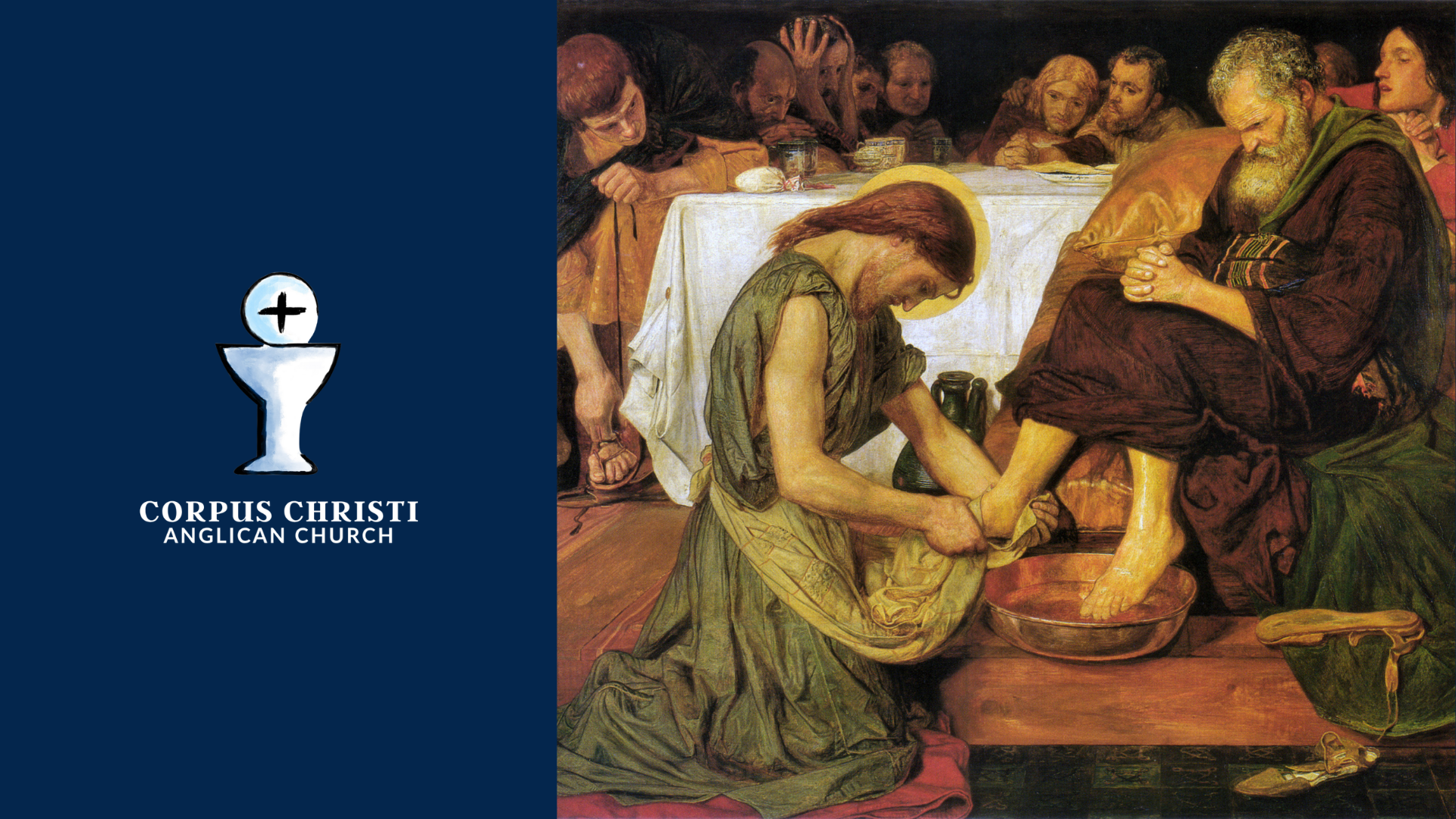
The apostles had known Jesus in many ways—as lord, master, teacher, and perhaps most of all, as the only one to whom they could go because he had the words of eternal life. On top of that, even if they didn't understand or fully comprehend him, they had heard him talk about himself as, and in some cases demonstrate himself as, the bread of life, the water of life, the light of the world, and the resurrection tand the life. And yet even with all of that—and perhaps because all of that—to see Jesus get up from their meal, take a towel, fill water into a basin, and apparently silently begin to wash their feet perplexed them. Here is the one who just a few days earlier had ridden into Jerusalem on the foal of a donkey to cries of "Hosanna," in accordance with Old Testament prophecy; who threw out the moneychangers from the temple; who had discussed weightier matters of the law with scribes, Pharisees and Sadducees; who had pronounced a series of woes upon the Pharisees that could not have helped their cause—and who now was stooping down to wipe off their dusty, sandy, possibly calloused feet. This did not make sense! Would-be messiahs didn't do that! Here is a mystery—and an offensive one, at least to Peter, and probably to a lot of the other apostles. I remember my first Maundy Thursday service, and while I was not offended by seeing foot washing enacted, it was something unfamiliar and new to me. And to the apostle John, it was so inexplicable that he could only define it as a supreme example of Jesus's love for them, in John 13:1.
And what about us in comparison with the apostles? With what we have revealed to us of Jesus in the Scriptures, on the other side of their Holy Spirit–inspired understandings of, and reflections on, Christ that developed after his death, we have more reasons to be astonished, and more cause to feel that we have entered a mystery. Jesus after all, is the one by whom, in whom, and for whom all things were created, as we read in Colossians 1:15–17. Let's tease this out a little bit. The very hands and fingers that set the stars in the sky and that even now, to use a 1970s catchphrase, holds the whole world in his hands, now took up a towel, filled a basin with water, and washed the feet of 12 people whom he had created. Wow! Let's take this a step further and make this personal: What does it mean to you, to me, to each one of us, that our creator would do that to each one of us—and for all we know, might do that to us one day when we see him face-to-face? Let's meditate on that; ponder that; take time to let that truth work its way into our hearts.
What this shows us fundamentally is that Jesus is at heart a servant. Jesus is at heart humble. And Jesus is at heart loving. The apostle Paul, in trying to explain this mystery, came up with a complex thought: "Have this mind among yourselves, which is yours in Christ Jesus, who, though he was in the form of God, did not count equality with God a thing to be grasped, but made himself nothing, taking the form of a servant, being born in the likeness of men" (Phil 2:5–8). There's a lot there, but at the most basic level, Jesus willingly chose to be a servant and gave up all of his privileges—the privileges of being God— to become incarnate here on Earth and serve humanity. By nature, he is God, but he chooses to serve, and that service goes against our understanding of what God should be like but is inseparable from his deity. Perhaps this servanthood helps explain how Jesus could tell his apostles later that evening that he no longer called them servants but friends. A creator who willingly gives up his privileges to come and live and die as one of us in the form of a servant willingly makes himself a friend. In any case, this is the night when the true nature of our lord and savior was revealed, and that nature is one of a God who is a servant out of love for all of humanity.
2. This is the night when our lord and savior provided strength for every Christian's spiritual journey.
The Church can be described in several ways, including as the organic body of Christ, where the Church is the people, and as the mystical bride of Christ. But perhaps a fairly unpopular way of viewing the Church today, given our societal distrust of institutions, is nonetheless a thoroughly biblical and Anglican one: as the institution designed by God for the provision of word and sacrament to humanity. God gave us the Word, Jesus, and we encounter Christ in one sense through the Scriptures, of which the Church is the guardian. Through its preaching and teaching, the Church provides word to humanity. And yet it also provides sacrament, and of the two dominical sacraments, the one we feed upon week after week after week is the Holy Eucharist, in the consecrated bread and wine. The Holy Eucharist is bread and wine for the journey of the Christian life, designed to give strength for the journey of the Christian life. In fact, a Latin term for the Eucharist, viaticum, means provision for the journey! John, interestingly, does not give us a direct account of that sacrament's institution in his gospel, but two other passages this evening either alluded to or described it. First, our psalm reading this evening from Psalm 78 gave us a picture of the prototypes of the bread and wine in God's supply of manna and water for the Israelites in the wilderness. In the life experiences of the Israelites, the apostles, and us, one major commonality is that the sustenance provided comes from God's initiative out of his grace; it is not anything that any of us do to earn it. This is again a sign of God's love for his people, that he would provide for human beings in the various wildernesses through which they travel. The second passage where we more directly read of the 3. of how Jesus instituted the Eucharist.
Now there's a lot that could be said about the Eucharist, and you can get quite a bit more from our introduction to Anglicanism class that is held once or twice a year, but even then you will barely scratch the surface. One thing important to point out is that for those of us who are Anglicans, unlike in some other Christian traditions, the Eucharist is not just a memorial of what Jesus did as outlined in 1 Corinthians and the gospels of Matthew, Mark, and Luke. Rather, it is a present intaking of sustenance by God's grace for the Christian journey in which we really do feed upon the real presence of Christ, and as a result we are by God's power strengthened in our faith as members of Christ's body, the Church. It is good to remember what Jesus did in the institution of the Eucharist; it is even better to actually feed upon him. In part, this is because, as the Anglican Puritan author Richard Sibbes wrote and other Anglican Christians have affirmed, "faith knoweth no difference of time" when we read or hear Scripture. In other words, the reader or hearer with faith experiences things described as being in the past or future in the Scriptures as if they are occurring in the present. This, in turn, means that we have a real connection with saints of the past and future when reading and hearing Scripture with faith. So we pray near the end of our Eucharistic liturgy, "We thank you for feeding us with the spiritual food of the most precious Body and Blood of your Son our Savior Jesus Christ; and for assuring us in these holy mysteries that we are living members of the body of your Son, and heirs of your eternal Kingdom" (BCP, 137). We find ourselves in Christ, and in his Church, as we partake of the Eucharist.
Fun fact here, for certain fiction readers and/or moviegoers: what popular and famous book and/or movie contains an intentional literary stand-in and parallel for the Eucharist? The Lord of the Rings. The bread lembas, which the hobbits receive from the elves of Lothlorien, is a bread "given to serve you when all else fails," as J. R. R. Tolkien wrote in The Fellowship of the Ring. So let's pause and reflect for a moment: What might it mean for any one of us to look at the Eucharist as an aid for when everything else fails? Or, if you prefer not to use Tolkien's appropriation of the idea, how can we better come to see the Eucharist as strength for our journey? Or, what does it mean to follow a savior who so loved us that he gave us such food to strengthen us? So this is the night both when the true nature of our lord and savior was revealed, and when he provided all Christians with strength for their spiritual journeys.
3. This is the night when our lord and savior's ultimate struggle began.
Our liturgy will end tonight with a reading of Psalm 22, during which we reflect on the opposition Christ through his various trials after he and the apostles left the upper room, culminating in his death. Often, we Christians think of our lord's sufferings on the cross and immediately beforehand; however, the late Christian author Fulton J. Sheen, who was a 20th century Roman Catholic bishop, notes in his book Life of Christ that "[i]t is very likely that his agony in the Garden [of Gethsemane] cost him far more suffering than even the physical pain of Crucifixion, and perhaps brought His soul into greater regions of darkness than any other moment of the Passion, with the possible exception of the one on the Cross when He cried: 'My God, My God, why hast thou forsaken Me?'"
It's not in our Scripture readings for this service, but let us briefly bring to mind that agony that our lord and savior suffered in the garden. Let us reflect upon the loneliness he felt at his three closest friends— Peter, James, and John—not being able to keep watch with him while he prayed. Let's remember the blood that fell from his forehead hours before he ever went to the cross or had a crown of thorns placed on his head. Christian songwriter Michael Card wrote in his song "In the Garden":
"Trembling with fear
Alone in the garden
Battle before the final war
Blood became tears
Alone in the garden
To fall upon the silent stone
There in the darkness the Light
And the darkness stood still
Two choices, one tortured will
And there once the choice had been made
All the world could be saved
By the one in the garden"
Brothers and sisters in Christ, let us think of what our savior suffered for you, for me, for everyone in the garden. Why does this matter? Why, oh why, does this matter? Because we will face unimaginable trials in our lives during which our lord and savior appears to be either absent or painfully inactive in helping us undergo things that even might threaten to destroy our faith in him. Can you think of such a time in your life? I know that I can. There are times when there is a horrible silence from God. As the late Rich Mullins wrote to Jesus in his song "Hard to Get,"
"Did you ever know loneliness? Do you ever know need?
Do you remember just how long a night can get
When you are barely holding on, and your friends fall asleep
And don't see the blood that's running in your sweat?
Will those who mourn be left uncomforted
While you're up there just playing hard to get?"
Those feelings that we experience or will experience are real. God does seem to play "hard to get" at times. They are not invalid and they are not wrong. Lament can be a powerful Christian discipline, rightly practiced. And still Gethsemane tells us that yes, Jesus knows what it is like. The same love that led him to become a servant for us and that led him to institute the life-giving bread of the Eucharist for us led him to suffer for us. And because Jesus has experienced silence from God himself, both in Gethsemane and on the cross, our faith can be strengthened.
And so Jesus the servant who has just instituted the Eucharist leaves the upper room for Gethsemane, where he will suffer and have to face the ultimate choice to submit to God's will and proceed to the cross. I hope that you can see from these reflections just how important Maundy Thursday is. This is the night when the true nature of our lord and savior was revealed. This is the night when our lord and savior provided strength for every Christian's spiritual journey. This is the night when our lord and savior's ultimate struggle began.
Well, this night is just the start of the Triduum. We can observe the hours the next few days, reflecting more on Gethsemane tonight, walking with Jesus and his apostles through his arrest and trials and then the cross tomorrow, and reflecting on what the apostles and other disciples must have felt on Holy Saturday. We can weep at times, if we feel moved to do so. We can think about whether we are more like Peter, in denying Christ; more like John, in observing things and reflecting on Jesus's love; more like Mary, at the foot of the cross—those are just some examples. But tonight, after the Eucharist, we will not take the Eucharist again until we celebrate our lord and savior's resurrection during the Easter vigil or on Easter morning. Just as he was separate from God, so we shall be separate from him as we know him in the body and blood. Live into that! And tonight, when the altar is stripped, let us experience it as if our souls are being stripped. Live into the desolations of the next few days, so that the consolations of Easter might be greater. This Triduum is a great gift that the Church offers us. Let us take advantage of it, to the benefit of our souls and of our faith.
In the name of the Father, and of the Son, and of the Holy Spirit. Amen.
Candlemas: Pilgrims and Doorkeepers in the House of Our God
CONTENT
Good evening! I'm Chip Webb, and I'm a member [who serves as senior warden] here at Corpus Christi Anglican Church. [Before I begin, let us pray. Oh, Lord, may the words of my mouth and the meditations of all your peoples' hearts be acceptable in your sight, oh, Lord, our rock and our redeemer. Amen.]
Last summer, there was a mini-reunion of students and one staff couple from my old Virginia Tech college campus ministry in Blacksburg, VA. The next day, I went to my old church down there, and then I spent a few hours driving and walking around places of spiritual significance to me from that time. One place I stopped at was the Blacksburg Town Park, which is where I would go to pray and/or read Scripture at times. That place will forever be spiritually significant to me for a time in the summer of 1987, when I agonizingly sought God's will in prayer for several hours regarding a major, painful decision. It was at that time when, by my recollection, I first learned how to wrestle with God—a spiritual practice that I have found confronting me at various major points in my life since. Returning to that spot last summer and finding the rough spot where I walked, sat, prayed, and figuratively (and perhaps literally) sweated that day was important to me, as it paid tribute to the pilgrimage that I've been on over my life. That experience of pilgrimage is one that all of us share, whether we realize it or not, as there is no spiritual life without a continual pilgrimage seeking to draw closer to God.
Well, today we celebrate Candlemas, which is known in our 2019 Book of Common Prayer (BCP) as a holy day titled The Presentation of Christ in the Temple. But if you're like me, Candlemas is a bit of an unknown to you. I'm not sure that I ever heard of it before I came to Corpus Christi! And yet, it can be— and perhaps should be—an important day in our Christian lives, in our walks with God. What does the word Candlemas mean? Well, it's two words put together into one, candle and mass, to make Candlemas, dropping the final s. The word in that regard is similar to Christmas, which is a word we get from combining the words Christ and mass. Christmas historically has been the mass, the worship service, at which we celebrate the coming of Christ into our world, his incarnation. Candlemas is similar: it is a mass in which we focus on candles' light, as with our prayer candles; if we were in person, we might experience a procession with lighted candles, symbolizing Christ, the light of the world's, entrance into the temple 40 days after his birth. As such it continues with the theme of light that we have been observing in Epiphany, and it shows a progression in the church calendar. We have moved from celebrating Christ's birth at Christmas to a season in which we initially remember the wise men's following a star and their visit to the young light of the world, perhaps some two years after his birth, and now back in time to our Lord's presentation at the temple. Candlemas, according to the Dictionary of the Christian Church, was first celebrated sometime around 350 AD in Jerusalem. The original date for celebrating Candlemas was February 14, but at some point in Church history it switched to February 2, undoubtedly to observe it 40 days after Christmas.
And tonight we have heard four glorious Scripture readings, and participated in reciting one of them! Let us particularly look now at two of those passages, our gospel reading from Luke 2:22-40 and Ps 84, and how they intertwine. Together, they have much to say to us as followers of Christ, as pilgrims in this "dry and weary land" (Ps 63:1) as we sojourn to our ultimate home with God in the new heavens and new earth.
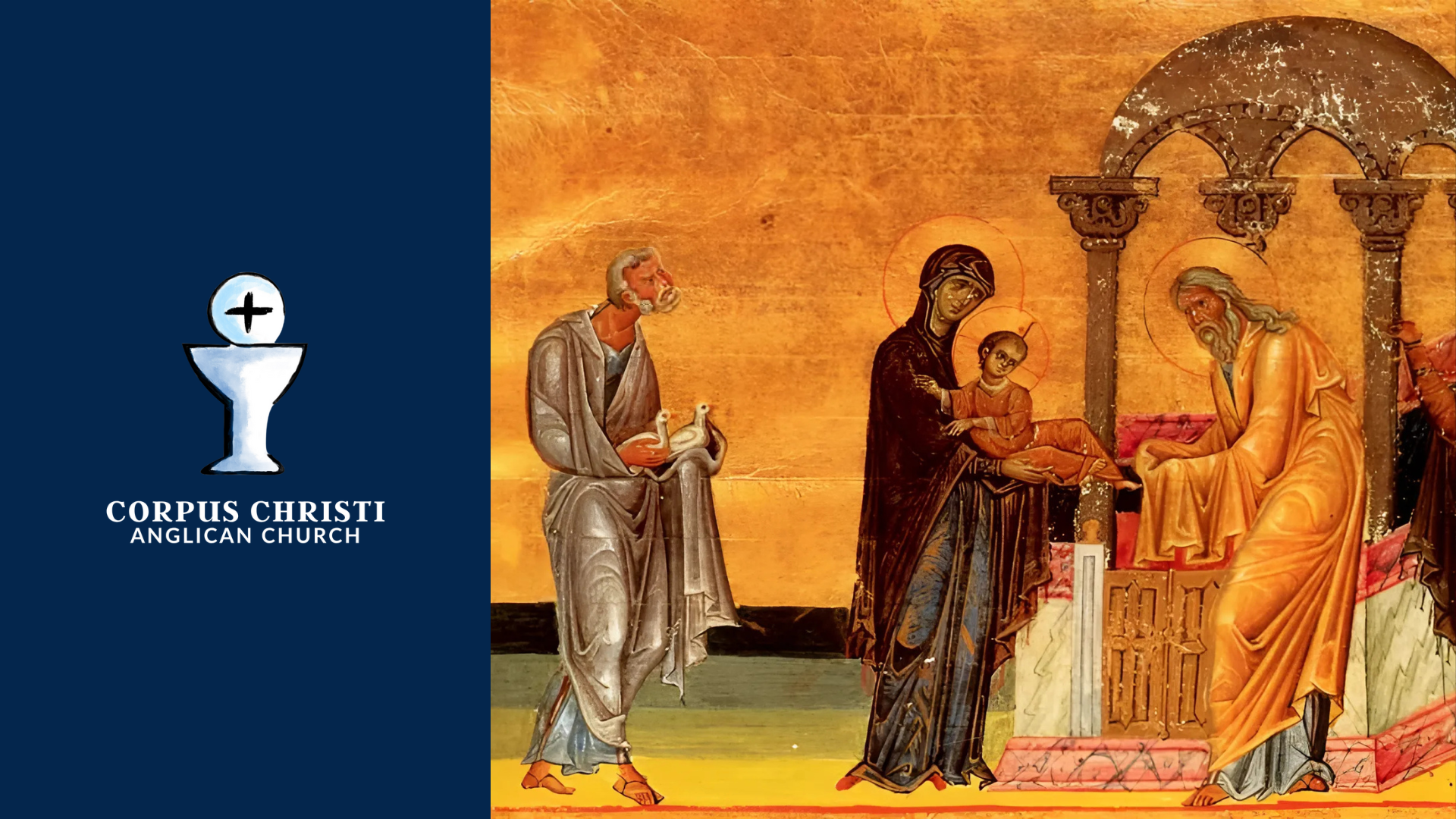
Mary and Joseph were on this same journey at the time of our gospel reading, a spiritual journey through life to our final home with God. They were also more immediately on a pilgrimage to Jerusalem. Verse 22 in our gospel reading tells us that "when the time came for their purification according to the law of Moses, they brought him up to Jerusalem to present him to the Lord." Where did they come from? Luke's account left us prior to this verse in Bethlehem, at the manger. Now Bethlehem is just five or six miles south of Jerusalem and Luke does not mention them journeying again until verse 39, when they return to Nazareth after the presentation at the temple. So they very well might have remained in Bethlehem or some area around there for 40 days. Perhaps less possibly, they returned to their town of Nazareth in the interim, which was about 64 or 65 miles from Jerusalem. So they either had a short pilgrimage to Jerusalem or a moderately long one, but it was still a pilgrimage. Pilgrimages can be short (e.g., to a local church) or long (e.g., to a historic Christian site) in distance.
And they went, according to verse 22, "for their purification according to the Law of Moses." Lev 12 notes that purification was required for a child's mother, who the Law judged to be ceremonially unclean, for a week after a son's birth. She also had to avoid touching holy objects and stay out of the sanctuary for an additional 33 days, for a total of 40 days. (The time was double that for daughters.) So this holy day, which we see as The Presentation of Jesus in the Temple, is also recognized as The Purification of the Blessed Virgin Mary in some Christian traditions.
They also went to present Jesus at the temple in accordance with the Law's requirement for every firstborn son to be presented to the Lord, a tradition that went back to Israel's Passover from Egypt. And at the end of the 40 days, the mother had to bring a sacrifice for her atonement, which for poor people was either two turtledoves or two pigeons. Perhaps Mary felt, along with the psalmist who wrote Ps 84, "My soul longs, yes, faints for the courts of the Lord" (Ps 84:2) given her period of required exile from them. Maybe as she and Joseph approached the temple, they recited Ps 84, or perhaps their hearts sang, "How lovely is your dwelling place, O LORD of hosts" (Ps 84:1). And possibly their turtledoves or pigeons reminded them that all people and creatures who inhabit God's house are blessed (Ps 84:3–4). How about us? We do not worship in a temple; we worship in a much less grand fellowship hall. Yet every week we have icons to remind us visually of saints who have gone on before us; occasionally we have incense; and every Sunday we meet together as the people of God who attend Corpus Christi Anglican Church. Even tonight, in exile from the fellowship hall due to ice, do we wish that we were instead participating in a fuller service there instead of this virtual one? Longing for the space in which we worship as a church can be a profound and praiseworthy mark of Christian spirituality.
In our gospel lesson, Luke now shifts his attention to another person in Jerusalem, Simeon, who we are told "was righteous and devout, waiting for the consolation of Israel, and the Holy Spirit was upon him." (Luke 22:25). Let's notice that phrase "waiting for the consolation of Israel." Fr. Morgan often speaks of how God meets us in our desolations and our consolations. Why did Israel need consolation? Because it was not free and under the control of the Romans. Because despite all of the Pharisees' best efforts over a very long period of time to help the Jewish people grow in faithfulness by heeding the Pharisees' minute extrapolations of the Law, their messiah had not yet come. Israel knew desolation, and both consolations and desolations are marks of pilgrimages. Listen to these words from Psalm 84 again: "Blessed are those whose strength is in you, in whose heart are the highways to Zion. As they go through the Valley of Baca, they make it a place of springs; the early rain also covers it with pool. They go from strength to strength; each one appears before God in Zion" (vv. 5–7). We begin in verse 5 with two consolations: strength in God and a heart for "the highways to Zion," meaning a heart for both pilgrimage ("the highways") and the actual destination of Zion. But then we reach the Valley of Baca in v.
6. Some commentators believe that the word Baca indicates a consolation: a tree that flourishes in dry places, like the Joshua tree, for those who have visited that national park. In that case, the "springs" of v. 6 are waters that enable the tree to grow and the land to flourish. Other commentators, however, see Baca as taken from a word meaning "to weep," and the journey, the pilgrimage, as involving sorrow that results in pools of tears. Interestingly, historians and archaeologists have been unable to locate a Valley of Baca, which leads to the question of whether the pilgrimage in Psalm 84 is meant to be taken as a literal one, a spiritual one, or both. In any case, though, the pilgrims go through a dry land in v. 6, and v. 7 tells us that they "go from strength to strength" all along their journey to Zion. Let's stop briefly and think of the implications of that. Whether we go through dry lands, or dry periods of life, and flourish despite the dryness, or whether we go through seasons of such intense weeping that it is like we flood the ground with our tears, we go from strength to strength. Our circumstances impact us, yes, and considerably so—but ultimately even our darkest times of sojourn will not destroy those whose strength is in God and in whose hearts are the highways of Zion. What we cannot see with our eyes now, we strive to apprehend by faith and will see clearly when the times have reached their consummation—that we go from strength to strength. The late hymnwriter Fanny Crosby put it this way in her hymn "All the Way My Savior Leads Me": "For I know what e'er befall me/Jesus led me all the way."
Back to our gospel story, Simeon is implicitly described by Luke as someone who is considerably older in years than the young couple and infant child, and who faithfully, although perhaps not always patiently, waits for the consolation of Israel and is full of the Holy Spirit. He experiences strength in that he is given a spiritual high watermark in his life and pilgrimage: He gets to see the messiah, the baby Jesus, and hold him in his arms. He then utters what we call the song of Simeon that is present in our Evening Prayer service and closes our Compline service. Here Simeon goes from the strength of seeing Jesus to the strength of prophesying about Jesus, with the prophecy concerning the worldwide scope of the messiah's salvation. Simeon has seen with his physical eyes the baby Jesus; now he sees with his spiritual eyes and heart the glory of that messiah's coming reign. Verse 33 tells us that Joseph and Mary marveled at this prophecy, and we might wonder well if this is one of the things that Mary treasured in her heart, as mentioned later in v. 51.
But then Simeon moves from a prophecy of consolation to one largely of desolation, journeying again from strength to strength. This messiah will not have universally positive effects on all of his countrymen, and he will opposed; what is more, Mary's soul will be pierced as if by a sword. Some in their pilgrimages will flourish in their encounters with the messiah; others will not. Mary herself will enter a Baca of weeping, as she did most notably at the cross. Most of all, this Jesus, this messiah, who is the Word, as John tells us, and who is the light of the world that shines in the darkness, will reveal the thoughts of human hearts and lay them bare—an insight that probably informed the author of the book of Hebrews when he or she described the Word of God as like a sword that reveals the hearts and intentions of people, in Hebrews 4:12. We find a partial correlation to this insight about hearts being laid bare in Psalm 84:8, where the psalmist pleads with God out of his heart, "O Lord God of hosts, hear my prayer; give ear, O God of Jacob!"
It is good, then, that not only are all of our inmost thoughts known by Jesus, but he is also our defense along our pilgrimage. Our secret ways—our hidden thoughts, our actions that are unknown to others, both good and bad—will be revealed, and possibly one day for all the world to see. And yet this Jesus is also the strong defense of those whose strength is in God and in whose hearts are the highways of Zion. The psalmist says in v. 9 of Ps 84, "Behold our shield, O God; look on the face of your anointed!" The shield and the anointed one to the psalmist was Israel's king, enthroned in Jerusalem. Our shield is Jesus; the face of the anointed one is Jesus's face. It is Jesus who is the righteousness of those who are Christians, whatever our sins and other flaws might be. We are to trust in Jesus's defense, remembering the comforting words given to us in 2 Timothy, "if we are faithless, he remains faithful—for he cannot deny himself" (2 Tim 2:13).
Luke finally turns our attention to the prophetess Anna, who we are told is "advanced in years" and evidently somewhere beyond the age of 84. Here we are presented with an arguably even greater example of faithfulness, for "[s]he did not depart from the temple, worshipping with fasting and prayer night and day" (Luke 2:38). We are not told what she said and prophesied about Jesus, just that she was overflowing with thankfulness for her messiah and that she spoke about him to all who longed for Jerusalem's redemption. In Psalm 84, the psalmist, having reached Jerusalem, conveys the climax of the psalm with a resolution: "For a day in your courts is better than a thousand elsewhere. I would rather be a doorkeeper in the house of my God than dwell in the tents of wickedness." It is better to be in God's presence than anywhere else; that is the goal of pilgrimage. Is the pilgrimage described in Psalm 84 a physical one to Jerusalem, a spiritual one in the heart, or both? It doesn't matter. The goal in all of these possibilities is to get to Zion, to the temple, to God's presence. Of course, God is with us along our pilgrimage, but we have a destination of life with God that has a final fulfillment in the eschaton, in the new heavens and the new earth, and that has intermediate fulfillments in the Church.
The psalmist goes on to identify with being a doorkeeper—one who waited at the threshold of the temple either begging for money or continually knocking on the door, seeking to be let in to the temple. He or she is in the temple courts outside of the temple, braving the outside elements and possible poverty rather than living more comfortably with the wicked. Here we have a seeming reflection of the two ways theology that we see in texts like Psalm 1—the way of the righteous versus those of the wicked. We also might remember the words of Jesus about those who knock on God's door, or Bob Dylan's contemporary application of those words, "knock, knock, knocking on Heaven's door." And while we're not told where Anna stayed, her continual presence in the temple and constant works of mercy through fasting and prayer are equivalent to the characteristics of a doorkeeper.
But she is not the only pilgrim who reaches a certain level of destination and becomes a doorkeeper. Mary, Joseph, and Simeon are also doorkeepers. And so who do we identify with most? Mary, needing purification and/or feeling a sword pierce her soul? Joseph, faithfully observing the law and protecting his family? Simeon, faithfully waiting for consolation? Anna, not departing from God's presence, and fasting and praying? We can identify strongly with each of them at different points in our lives. God has many different types of doorkeepers.
He also has many different spots of pilgrimage. Where are we now on our pilgrimage with God? Are we praising and delighting in God, as at the start of Psalm 84? Are we in a Baca where we are grateful for flourishing despite being in a spiritual desert? Are we instead in a Baca where our tears are so numerous that they threaten to flood the earth? Are we at a place where we are fervently imploring God to hear our prayers? Are we asking him to look upon Jesus, our shield and defense, to serve as our righteousness? All of these, and others, are places where we might find ourselves during our earthly pilgrimage.
And so what general applications can we make from all of these considerations of pilgrimage and doorkeeping? They all involve cultivating longings and habits, and so are not quickly achieved.
Cultivate a longing for, and pilgrimage towards, Jesus—We learn in the New Testament, particularly John 2 and 4, that Jesus is the temple now, not any building. We will in the end, at the consummation of all things, be in his presence. Let's make it our goal to consciously be in his presence as much as possible throughout the day. The Daily Office is one great benefit here!
Cultivate a longing for, and pilgrimage with, the Church—The Church is not just a fellowship of like-minded people, but the institution that God has designed for the provision of word and sacrament to humanity. The Church is not in its fullest sense a building or worship space, but the body and bride of Christ. Christ and his Church are inextricably linked. Christianity is more accurately viewed as corporate than individualistic. Regular Sunday worship and other involvement with CCAC can aid here.
Cultivate the humility and purity of a doorkeeper—As doorkeepers, we are less concerned about ourselves than living in God's presence, and less concerned about our prosperity and advancement than our faithfulness. As doorkeepers, we strive to live holy lives, and we confess and repent of our sins. Private devotional practices, weekly worship, and periodic confessions with clergy all can benefit us here.
Cultivate trust in Jesus's power and defense—The good news is that we go from strength to strength even at times when we do not feel God's presence or power. Jesus went from strength to strength; his presentation in the temple fulfilled the Law of Moses, just as his baptism would much later in his life. It's very possible that we could see Jesus's life and ministry as emanating from his presentation in the temple. Even his agony at Gethsemane and on the cross were not the end of his story, as he lives and reigns over the entire universe now. Jesus can be said in one sense to have been a doorkeeper during his agony in Gethsemane, knocking on Heaven's door and leaving the results to God. The author of Hebrews tells us that he learned obedience. Our messiah identifies with us so much that he knows experientially what it means to be both a doorkeeper and a pilgrim. He is trustworthy.
Cultivate models in the saints—Jesus is the light of the world, but all of us who are Christians are as well, for we are in Christ. The same is true of the saints who have gone on before us. For example, as mentioned earlier, consider Mary, Joseph, Simeon, and Anna.
And so the psalmist appropriately ends Psalm 84 with a kind of benediction in verses 11 and 12. May it bless all of us this Candlemas as we celebrate Christ, who is the light of the world that candles only dimly reflect. "For the Lord God is a sun and shield; the Lord bestows favor and honor. No good thing does he withhold from those who walk uprightly. O Lord of hosts, blessed is the one who trusts in you."
In the name of the Father, and of the Son, and of the Holy Spirit. Amen.
5th Sunday of Easter: The Light and His Callings
TranscriptioN
Well, good morning. My name is Chip Webb, and I'm a member here at Corpus Christi Anglican Church. Before I begin, let us briefly pray.
“O Lord, may the words of my mouth and the meditations of all your people's hearts be acceptable in your sight. O Lord, our rock and our redeemer. Amen.”
Well, we're now in the season, as Fr. Morgan mentioned, when we have the joy of having our youth and our younger kids with us during the service. And so let me ask them, adults, don't help them out.
Let me ask them what season of the church calendar this is. Yes, Easter. Thank you.
And this is the fifth Sunday of Easter. Now, what do we focus on during the Easter season? Christ's resurrection. Yes, that is primarily what we focus on, the resurrection and its implications for our lives.
And we focus on that in all of our service, our homilies, etc. Now, what do we do during the Easter season? Do we fast like we do in Lent? OK, I'm seeing no. And the answer is no, because we don't fast.
We feast. Yes. Now, watch it, kids.
That doesn't mean that you get to continually ask your parents for your favorite food because we don't want to be gluttonous. But we do want to feast in the sense of spiritually and or literally because we are celebrating the resurrection of Jesus. We had 40 days of repenting for our sins and sometimes fasting during Lent.
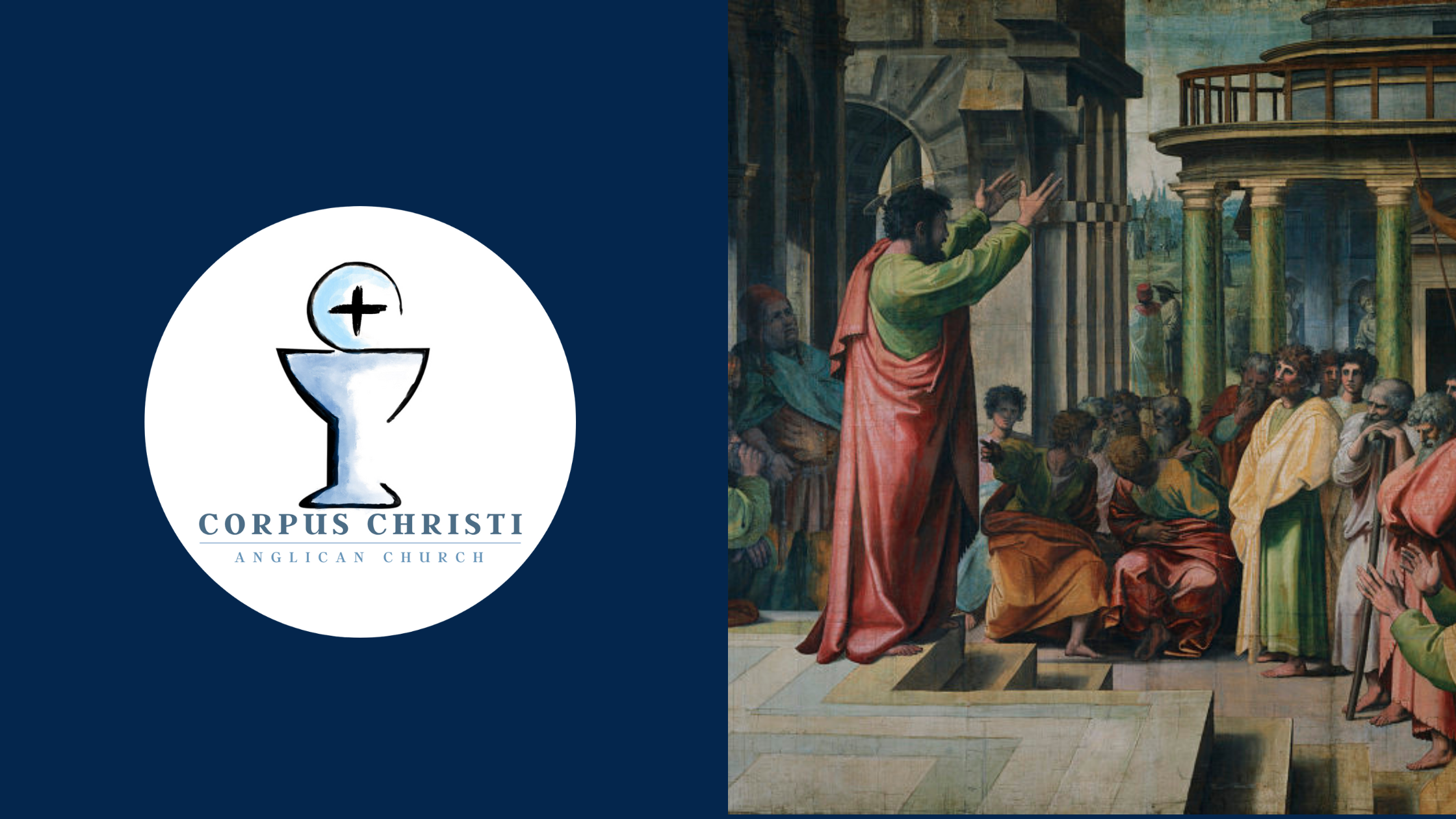
But then with Easter, we have 50 days of feasting. And this year, one of our electionary passages each week is taking us through the Book of Acts. And more specifically, portions of the life and ministry of St. Paul.
We're seeing how his life was changed. Two weeks ago, we saw Paul's conversion on the road to Damascus. That direct encounter with the risen Christ that turned Paul's life upside down.
Let me ask our youth and kids one more question. How did Paul change? How is he different? Anyone? OK, well, he went from persecuting, from hurting Christians to being a Christian and telling people of the good news of Jesus Christ and his resurrection. And also his name changed from Saul to Paul.
So we saw that we saw that two weeks ago. Then last Sunday on Good Shepherd Sunday, we looked at one of Paul's early sermons on his first missionary journey, taking the good news of Jesus around the Roman Empire. So we moved from looking at the change that Paul experienced two weeks ago to some of the contents of his faith last week
And this week we are looking at Paul's calling and how it changed in response to the providential circumstances of life. Now, in today's reading from the Book of Acts, chapter 13, we pick up just one week after the sermon Paul gave that was covered in our reading last week. And right before where our reading began today in verse 42, we see the reaction of evidently the majority of the crowd to Paul's sermon in Pisidian Antioch.
They were enthused and they asked Paul to repeat his sermon or at least expand on it, repeat its points, what have you. And so one week later, they must have invited a ton of their friends because we read in verse 44 that the whole city came to the synagogue to hear Paul's sermon. Isn't that amazing? Here's Paul on his first missionary journey, reaching large, interested crowds with the good news of Jesus' resurrection.
Nothing could be better, right? Well, just one verse later, the bottom drops out. A number of Jews from later references, it appears that they were mostly the educated religious people, not only do not accept his message, but work to counter it. That's a pretty darn quick turnaround.
One week, people mostly or maybe even totally accepted his message or at least were open to it. Then the next week, at least a sizable percentage of the congregation opposed it, motivated, we are told, by jealousy. Now, we're not told exactly what the jealousy was over.
Some commentators, such as the Anglican theologian John Stott, believed that it was due to the crowd size or some would say that it's due to the fact, this would be associated with that, that he is in danger of taking over the position of authority that the regular teachers had. So either one's possible. We don't know for absolutely sure.
But whatever the reasons, Paul was experiencing a rapid change of fortunes in the city in Antioch. Now, I think that at least in general, most of us can relate to what Paul went through. Have you ever shared with others about Jesus? And you seem to for a short time or a long time be making a connection with them.
And then something just changes. And sometimes you're not even sure what. And they're no longer responsive.
I would say that that's sort of like what Paul experienced. Or, take something different. Have you been following God to the best of your ability and seemingly going down life thinking that you are following God exactly as he wants you to? And then all of a sudden you find your way blocked.
I know this type of situation very well. And in general, that seems to be what happened to Paul here. His way was blocked to an extent.
Or, maybe you've started out in a generally, or maybe even very good period of life, and then suddenly without warning, everything collapses. Maybe it's your jobs. Maybe it's your health.
It could be any one of a million of things. Many of us have experienced such traumatic circumstances. I dare say most of us.
And we will, the longer that we live, run into those. Any or all of those scenarios, make no mistake, are very difficult. And regarding those that involve our callings, it is never easy to have our direction from God, or seeming direction from God, frustrated.
Such situations can raise all sorts of questions in our head about what God is doing, and why he would either cause or allow, depending upon your particular theological bent, this to happen to you. And, you know, just this last Thursday, I personally celebrated, by reflecting on it, a spiritual birthday. It was the 40th anniversary of when I had committed my life to Christ's Lordship, and when I had become a serious disciple of Jesus Christ.
And now, when I did that, I didn't do it fully knowing what I was doing. I may have thought I had a pretty good idea. And I will say, earlier in that evening, I was a little bit reluctant still to do it, until the campus minister convinced me otherwise.
And the next few years after that were marked by quite a few struggles over what God wanted me to do in my life. You know, finally, over time, those struggles seemed to resolve. And I finally thought I had a good grasp, I mean, not a perfect grasp by any means, but I thought I had a good grasp of what God wanted me to do, and how my life was going to go.
And I had gone into English education to teach high school students. Things were great in terms of the academics, things were wonderful. And then I ran into the real-life training ground of student teaching.
And what I found was that all my somewhat clever lesson plans did not compensate for an inability to discipline students. And things were so bad enough that neither my cooperating teacher nor my professors involved with me would recommend me to go on. And so then I was stuck.
What do I do now with my life? And I have to say, I was incredibly perplexed, and that's an incredible understatement. Now in Paul's case, the blockage related to his ministry. We see in Acts that Paul and Barnabas, following the example of Jesus, went to the Jewish synagogues in the towns that they visited along their missionary journey.
In doing so, they were following the example of Jesus, who said that he was sent to the lost sheep of Israel. And undoubtedly, this was also an expression of Paul's calling. He was the Hebrew of Hebrews, the Pharisee of Pharisees.
His heart was for his fellow Jews. And in Acts, Paul is shown to be fervently attempting to persuade fellow Jews that Jesus is Messiah soon after his Damascus Road experience. We are not given any insight into how Paul reacted emotionally to this blockage once it came, but we do see in verses 46 and 47 that he re-evaluated his mission.
And in that re-evaluation, an ancient passage from chapter 49 of the book of Isaiah, from one of the four servant songs in that book, formed the nucleus of a new direction for him. Quote, I have made you a light for the Gentiles, that you may bring salvation to the ends of the earth. Unquote.
And for me, at least, perhaps the most interesting thing about Paul's citation of the quotation there in verse 47 is that he calls it a command. The Old Testament prophets, including Isaiah, frequently depicted Israel as a nation that was intended to be a light to other nations. In other words, to the Gentiles.
While the New Testament sees the depiction of a servant in those four Isaiah servant songs as ultimately fulfilled in Christ. So when Paul cites being a light to the Gentiles as a command, he is both taking up the role intended by God for the nation of Israel, and, on the other hand, he is also imitating the Lord Jesus Christ, who is faithful to God in precisely all of the different points where Israel was unfaithful to God throughout its history. In other words, the command that Paul now announces that he will obey, it's not particular to him.
It is one that was given to Israel as far back as Abraham. The original Abrahamic call was for Abraham and his descendants to be a blessing not just to his family and kinfolk, but to the nations. And the command is one that is only perfectly obeyed and only perfectly fulfilled in Jesus Christ.
But what about the Jews? God's chosen people and the group that seemingly, judging from Paul's other writings, still was most on Paul's heart. Well, it's important to remember first that, as I mentioned earlier, many of them responded positively to Paul's message, enough that they asked him back to the synagogue and invited their friends. But concerning the Jews who oppose Paul's message, interestingly, Paul asserts in verse 46 that they have judged themselves to be unworthy of eternal life by their opposition to the message of the resurrected Jesus.
In other words, their own actions have consequences and condemn them. Now, are we talking about a permanent condemnation here? No, not necessarily, because there is room for repentance still. But, nonetheless, their actions have had consequences and in a sense have condemned them.
The rest of chapter 13 details the results of these actions and Paul's re-evaluation of his mission. The Gentiles rejoice, while the Jews who oppose Paul, they harden in their opposition and they get other Jews to agree with them and to create such a situation that Paul, Barnabas, and company leave Pisidian Antioch. And so Paul, indeed, he became an apostle to the Gentiles, as he is commonly called.
But with his new focus on the Gentiles, did Paul give up on the Jewish people? No. If we jump into chapter 14, to the start of it, we see that in the next town, Iconium, he is there at first with Barnabas in the Jewish synagogues. So, even though his mission was changing, his heart for the Jewish people and his outreach to the Jewish people did not change.
It may have changed to some degree, but it never changed totally. And so in Acts 13, we see that as a result of one blocked calling, a new one emerges that serves as a foundation for the Church. On Friday, my wife Sharon and I attended the consecration of a newly opened building, the Trofimus Center, which is a new event center for Trinity Anglican Seminary in Ambridge, Pennsylvania.
Well, it is the one holy Catholic and apostolic church that has been made of the stones of both Jews and Gentiles down through the centuries on the foundations of the apostles. The church, which was initially viewed by the Romans as a Jewish sect rather than a separate religion, by reaching out to and incorporating Gentiles became the light to the world that Israel was intended to be. Paul, in obeying the command to be a light to the Gentiles, serves as a prototype and as an example for the Church.
And we, at Corpus Christi Anglican Church, we are one local expression of this emphasis centuries later. We are a common people using common prayer and undergoing uncommon transformation because others in the Church prior to us have carried the torch from Paul. And one overarching goal of our uncommon transformation is to be a light to the nations like the Christians who have gone on before us.
But then what about our personal callings or seeming personal callings that are or at least seem to be from God but are blocked? Well, there are five applications that we can take from them, that we can take, excuse me, concerning them from our scripture readings today and or the life of the Apostle Paul. Number one, we should view our callings within the context of the Church. We are all called as part of the Church, Christ's body, to be a light to the world around us and to be a blessing to the nations.
In doing so, we imitate Christ. Recall the words of the Charles Wesley hymn, Hark the Herald Angels Sing. Light and life to all he brings, risen with healing in his wings.
Think about that. Jesus brings light wherever he goes and with it he brings life and healing. In the picture we get of the New Jerusalem in Revelation 21, the leaves of the tree of life are for what? The healing of the nations.
And that comes after the marriage supper of the Lamb that we heard about today earlier in Revelation 19. We are also to be a light as one of our high priorities with the other high priorities being other aspects of our obedience to Christ. As we do so, by God's grace, we bring his life and healing with us into the world.
Any additional godly personal callings are subservient to this greater calling. Conversely, anything that we pursue that might prohibit us from being a light cannot be our calling. It's just not in our definition.
So, let us discern whether our callings are valid in the light of God's intentions for the church as revealed in Scripture. Number two, our heart should be for all people. You know, when you think about the New Testament, we almost have a biblical mathematical model.
Jew plus Gentile equals everyone. Everyone. Psalm 145 reminded us today in verse 9 that God has mercy upon all.
There is no one beyond the reach of his love. As much as possible, given our human limitations, and we have our own in many, so it should be with us. Our gospel reading today stressed the importance of loving one another.
Even when people seem far from God, we are to always hope for them. Think of the example of the Apostle Paul in the book of Romans when he expressed how much he held out hope for the Jews even though he was grieved over them. Remember, everyone, everyone is created in the image of God.
So, number one, we should view our callings within the context of the church. Number two, our heart should be for all people. Number three, recognize that our callings do not necessarily end when they are blocked.
They might just be modified. Opposition to Paul's message did not end Paul's heart for the Jewish people. A blocked career path does not have to mean that your gifts go unused.
It just means that they might be used in a different career or outside of a career. Be open to how God might use your callings in lesser or greater ways than you anticipate. Number four, take a proper view regarding callings.
Remember that God is not so much interested in what we do as who we are. That is, he is most interested in the development of our characters so that we become more and more and more like Jesus with each passing day, ideally. We can only be a light of the world as we become more like Jesus.
We can only share Christ's life and healing with people as we become more like Jesus. So, let us also resist any temptations to view our callings as ones of self-actualization. It's our American culture, not the Christian faith, that places so much stress upon individualism.
And number five, wrestle with God regarding callings when necessary. We don't see Paul wrestling with God about the situation in Acts 13, but we do see him wrestling in 2 Corinthians chapter 12 over a thorn in his flesh that undoubtedly inhibited his callings. Wrestle with God.
Wrestle, wrestle, wrestle with him. It is in wrestling with God, in being honest with him and about our uncertainty with him, about how he is leading us, etc., that we learn more of what God is like and we learn more how to love him. And realize that being confused about how God leads us and works in our lives is pretty darn normal.
There might well be times when we might say, with the late songwriter Rich Mullins, I can't see how you're leading me unless you've led me here, to where I'm lost enough to let myself be led. That is okay. It is fine not to understand what God is allowing or doing in our lives, or where or how he is leading us.
Jesus is still our good shepherd, as we saw emphasized last Sunday. Wrestle with God in all of his mystery That might never be resolved to your satisfaction in this lifetime or the next one. Our Acts passage ends with the comment that the disciples were filled with joy and the Holy Spirit in verse 42.
Similarly, the consecration of the Trochmas Center on Friday was an occasion for much joy, as well as the presence of the Holy Spirit. Two sections of two different hymns that we sang stand out to be related to these topics. With the elect from every nation mentioned in the church's one foundation, let us rejoice in the light in our darkness that Jesus brings, according to the hymn, Only Begotten Word of God Eternal.
And may by God's grace, individually, we be that light to others, and may the church collectively be that light to everyone. In the name of the Father, and of the Son, and of the Holy Spirit. Amen.
Transcribed by TurboScribe.ai. Edited by the Vicar.

A Lifelong Journey of Seeing Christ
Transcription
Well, good morning and happy snow day. Supposedly. Rain day, shall we say. Maybe snow day. I just got back from Western Pennsylvania where it was snowing every day except for yesterday. I'm Chip Webb and I'm a member of Corpus Christi who serves the senior warden. And before I begin, let us pray.
“O Lord, may the words of my mouth and the meditations of all your people's hearts be acceptable in your sight. O Lord, our Rock and our Redeemer. Amen.”
Well, today is the second Sunday in a special season of the church's life. What season is it? Epiphany. Happy Epiphany, everyone. Now, Epiphany gets less attention than a lot of other seasons of the church's year like Advent and Lent. Yet Epiphany is still very important. And I'd like our youth and younger ones to help us all out with some matters.
Now, adults, you're not allowed to give them any clues. First, what story do we most remember during Epiphany? We Three Kings. There we go.
The coming of the Magi to pay homage to Jesus. And we talked about that in youth group last week a little, didn't we? Okay, a little bit of a tougher question. What sense of our five senses do we perhaps most associate with Epiphany?
Yes. Sight. Sight, yes.
Our eyes, right? Can anyone explain that a little bit more in the sense of how did sight apply to the Magi we just talked about? Yes. Okay. They saw a star and they followed it, right? We Three Kings following yonder star.
And what happened when they got there to their destination with sight? Yes. Okay, they gave their gifts, good. And what did they see? Jesus.
[Child voice: Baby Jesus]
Now, maybe, maybe not. Because King Herod was seeking kids two years old and under, he might have been a bit older. He might have been up to two years. We don't know for certain. Okay, one more semi-difficult question. This is a harder one.
What characteristic of God do we particularly associate with Epiphany? I'll give you a hint, it's five letters. Sorry, what did you say? Glory. Yes, good, Cole.
Good, good, good. It's His glory. Epiphany is associated with seeing God's glory. Well, thank you, youth and younger. Now, I'd like to throw out a question to everyone, including youth, younger ones, and adults. What does it mean when we say that we have had an Epiphany? Yes.
New idea, new understanding, Spike? A realization, yes. New idea, new understanding, realization, and insight can be any of those. Something that gives us a new way of looking at things, and that potentially changes our lives, right? And today our Gospel passage invites us to consider a story that might be well known to many of us, but that might be a bit of a mystery to us.
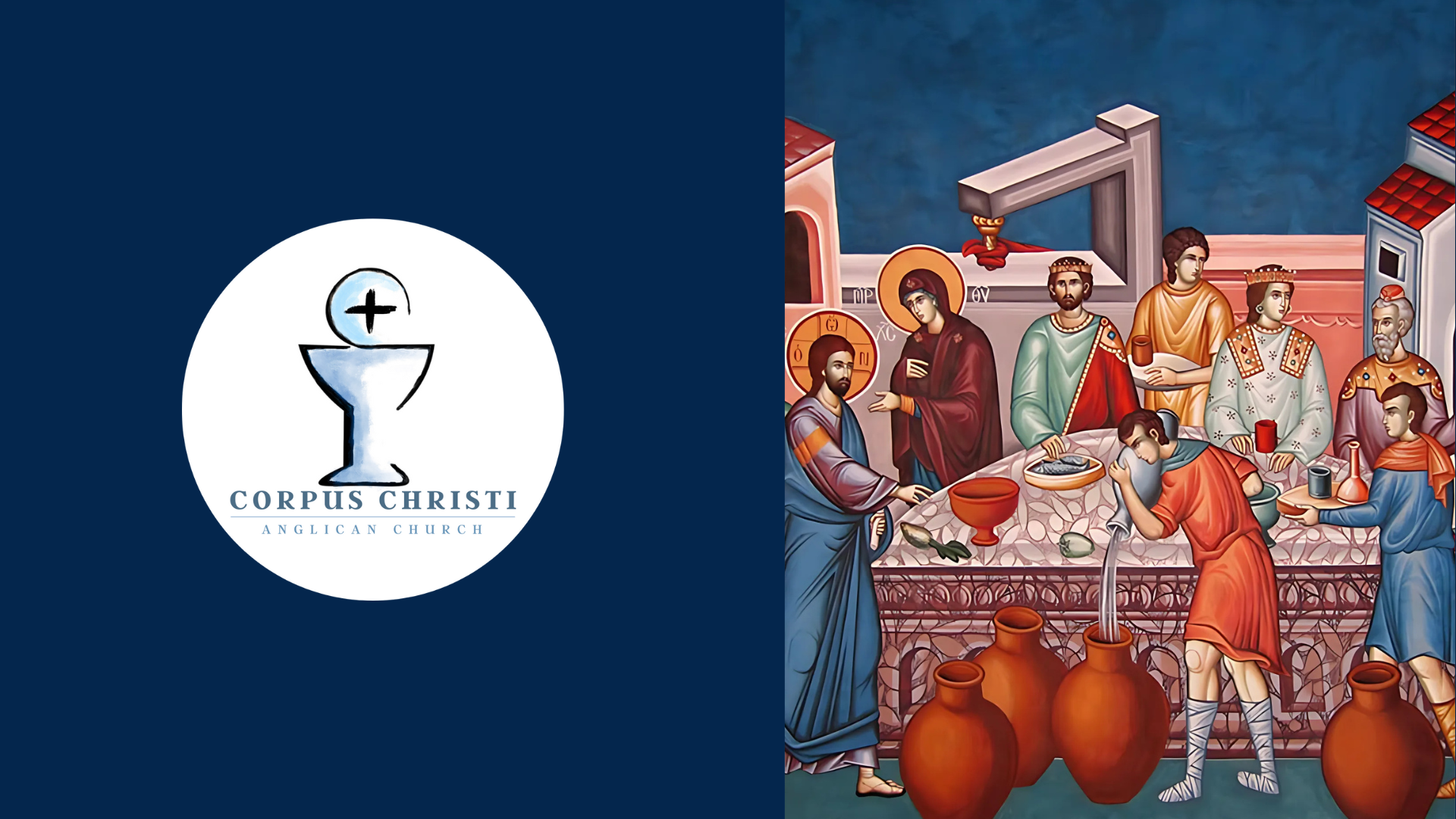
The Wedding at Cana. The story seems straightforward enough, right? Jesus attends a wedding at Cana and turns water into wine. Simple.
It seems pretty straightforward in terms of the events it recites, and as a miracle, it doesn't seem particularly flashy or even important. Like, it's not as important as, say, giving sight to the eyes of a blind man, right? So if you're like me, you've often wondered why exactly this is in the Gospel of John, and why this is a sign like the Apostle says it is, as we heard when Father Morgan read the Scripture. Does anyone else ever wonder these things? Okay.
On top of this, the Church has long associated this Gospel passage with the season of Epiphany. In her book, Epiphany, the Season of Glory, Anglican author Fleming Rutledge points out that the Church connected it with this season, “from the earliest centuries”. Fascinating, right? So as it turns out, this story has a lot more to it than is evident at first glance.
There are quite a few implications for us as Christians journeying through the season of Epiphany, and a good argument can be made that there are almost bottomless depths to it. It has a lot to say to us about seeing over the course of our Christian lives, and how that seeing can uncommonly transform us. And so let's examine in detail some of the implications of this story for us as individual disciples, and then briefly consider the implications for us as part of the one holy Catholic and Apostolic Church.
Let's begin by looking at the individual disciples mentioned in verses 2 and 11, and the context of the wedding. Were the disciples his twelve apostles, or were they a larger group? The text does not specify, but from the context of John, and reading back in John chapter 1, we are probably only talking about Andrew, Peter, Philip, and Nathaniel. The gospel presents them as the first disciples to follow Jesus.
Biblical scholar Ben Witherington notes in his commentary on this chapter that at this time, judging from various references in chapters 1 through 3 of the gospel, Jesus probably was still living with his family and making journeys to visit John the Baptist at the Jordan, but he most likely had not yet launched out on his own in ministry. If that is indeed the case, he probably just had this small group of four disciples at the time of the wedding. And when are we told that the wedding took place in verse 1? Anyone remember? Spike? On the third day.
Now, back to youth and our younger kids again. Can you think of any special significance that we as Christians place on the third day? Yes? He rose from the dead. You get the prize.
Yes, the third day is the day of Jesus's resurrection, and in his book, the fourth gospel, Roman Catholic scholar Louis Boyer argues that, “…It is hard not to see in the detail of the third day a reminder of the resurrection, particularly in the early church where this expression could not fail to call up that idea.” Now, that doesn't mean that the resurrection is being specifically referenced. John, after all, is chronicling an event that took place before the resurrection. Nevertheless, John's use of the phrase the third day would have caused an echo of the resurrection to ring in his first century reader's ears. Now, hold on to that idea and we'll come back to it in a bit. At the wedding, one or more of the disciples, because we have the account here, must have noticed Mary, Jesus's mother, approach her son.
So let's try to put ourselves hypothetically in the place of a disciple observing this interchange in the events that follow. They have no wine, she says in verse 4. Now, wedding feasts at the time lasted several days, so you know living in the first century that running out of wine during weddings is not uncommon, nor is it unexpected. Various reasons have been proposed for why the wine ran out in this case, one of them being that Jesus and his disciples were last-minute additions to the wedding guest list, so there was not enough for everyone.
Another one is that Jesus and his disciples had not, due to their poverty, brought the fair share of wine expected of all wedding guests during that age. Now, maybe one of those reasons is correct or maybe not. Scholars don't know, the texts don't tell us.
But what we, putting ourselves back in the shoes of a disciple at that time, next see and hear as recorded in verse 5 is that Jesus responds as if this statement, they have no wine, were a request made of him. And he says, woman, what does this have to do with me? My hour has not yet come. Now to our 21st century ears, the word woman seems surprisingly generic and perhaps even dismissive, but to our disciple that would not be the case.
The word had no such negative associations with it. While it wasn't necessarily an affectionate term, it wasn't a harsh one either. For that reason, some Bible translations use phrases such as dear woman instead of just woman.
Nevertheless, as a 1st century disciple, we would find it unusual for a son to use it with his mother, and Jesus uses it again with Mary during her one other appearance in the gospel at the foot of the cross when Jesus says, woman, behold your son in chapter 19. That's an interesting point in and of itself, that the appearances of Mary bracket the gospel, but that's something we really don't have time to consider today. But there's a mystery there about Jesus using the word woman, and Christians with different understandings of Jesus and Mary over the centuries have come to varying conclusions about it.
But there is general agreement among scholars that Jesus is working to distance himself from Mary, not as a son rebelling against his mother, or as a son trying to evade his family responsibilities and ties, but in the sense of separating his mission from the demands of other people, including, but not limited to, his own mother. Who does Jesus listen to and obey, according to other passages throughout John's gospel? Anyone? Yes? The Holy Spirit? Okay, but more specifically, another. Yes? God.
God the Father. My Father is always working, etc., etc., etc. So the hour has not yet come for him to fully start his ministry, some scholars say. Others believe that the hour that Jesus mentions is the hour of his suffering and glorification, that's a nice epiphany word, on the cross. Since Jesus uses the word hour in that sense in chapter 12. But whether Jesus is speaking of the beginning or the end of his earthly ministry, he is speaking of his mission.
Now regardless of Jesus's intent about the hour, our no-doubt perplexed disciple observing this event next hears the Jesus's mother say, do whatever he tells you to servants responsible for making the wedding run smoothly. And then, perhaps to his astonishment, either immediately or a while later, he sees Jesus address them, telling them to fill six stone purification jars with water. As a first century Jew, you know that the purification jars are used for rituals to be used in following the law, including the washing of hands to keep yourself from being unclean.
And the servants do fill the purification jars, perhaps a little too eagerly from our disciples point of view, for they fill them to the brim, that is to the point where they're almost spilling over. And you hear Jesus then tell them to take some of the water to the master of the feast, who is essentially the chief steward supervising the other stewards. And either with your own eyes and ears, or from talking to the servants later, you find out that the master has commended the bridegroom, who is ultimately responsible for much of the details of the wedding, for bringing out the best wine toward the end of the wedding.
Wait a minute, you saw Jesus tell the servants to fill the jar with water, but now the chief steward said there was wine, and not only was there wine, but wine of the highest quality. Your mind is blown, and as a result, you and the other disciples who have either seen these events as well, or who hear about them from you in all your astonishment, “believe in him.” Verse 11, believe in Jesus.
It's not, importantly enough, that you haven't believed in him already, since you believed in him enough to follow him and come to this wedding. But whatever believing in Jesus in verse 11 means, you are coming to a deeper belief, and whether you realize it at this point, or you come to realize it in retrospect, you are seeing Jesus display his glory. Wow, I don't know about you, but my mind is blown.
Just putting myself in that perspective. So let's unpack this a little more for us as 21st century disciples of Jesus, in terms of what this means for us as individuals. First, if we are Christians, then we are followers of Christ, right? And unlike our first century disciple, we live after the time of Jesus' incarnation, after his birth, which we celebrate in the Christmas season, after his life, including the three-year ministry that was just beginning at the time of the wedding in Cana, and after his death on the cross, which was his supreme glorification when he was lifted up, and to paraphrase our Book of Common Prayer, stretched out his arms on the hard wood of the cross so that all peoples could look to him and be saved.
We are some of the ones of whom John wrote, blessed are those who have not seen and yet believed, in chapter 20 of this Gospel. And yet for all of our differences with first century followers of Jesus, I'd like to suggest that there are at least three similarities we share with them. Number one, Jesus is mysterious. We are not watching the events of the wedding of Cana, but how Jesus acts is, if we're honest, no less perplexing for us at times than it would have been for one of his first century disciples or apostles. We are not always sure of how to take his words in Scripture, and other Christians throughout the century, and scholars as well, have not always been certain either. No one can fully define or comprehend the real presence of Jesus in the Eucharist.
And when it comes to following Jesus, we don't always understand how Jesus leads us, or even if he has led us to a particular place. Sometimes the words of the late singer- songwriter Rich Mullins in the song Hard to Get fit our lives very well. “I can't see how you're leading me unless you've led me here, to where I'm lost enough to let myself be led.” Jesus's incomprehensibility is a normal part of the Christian life. To put it in epiphany type language, it's hard to see Jesus some of the time, isn't it? That's part of why we need the Church. The Church ties us to our brothers and sisters in Christ who have lived throughout prior ages, who live during this current time as in this room, and who will live in the future.
We most interact, those of us who come to Corpus Christi regularly, with those we know at Corpus Christi most likely, or maybe people at our jobs as well, if we had no Christians there. But the wisdom of those who have gone before us have been left to us in the scriptures, in the Church's tradition, and in their writings. So we can better adapt to the mysterious ways of Jesus.
And that mystery extends, of course, to the other members of the Holy Trinity, God the Father and God the Holy Spirit, by interacting with other Christians. Remember, too, that those who have passed on as Christians are alive. They are not dead. A thin veil separates them from us, even though we do not see them. See again. So Jesus is mysterious.
Number two, another similarity. Believing in Jesus is a process, not a one-time event marked by many stages. As much as some of our Christian traditions like to emphasize a moment-in-time conversion, as Father Morgan has said many times, we have regular, even daily conversions.
Just as Andrew, Peter, Philip, and Nathaniel had believed in a certain sense before coming to Cana, then believed in a greater sense due to Jesus's miracle at Cana, and would come to believe even more over time, so it is with us. Uncommon transformation is not a one-and-done process. Discipleship does not involve standing at one fixed point in our spiritual lives.
Becoming Christ-like is not something at which we arrive. This last week I attended a class at Trinity Anglican Seminary on employing the wisdom of the Church Fathers in Christian education. One of the things the instructors said that stood out to me is that when we leave this life and are with Christ, we undoubtedly still will be growing in Christ-likeness.
Now I know that idea is controversial, it runs contrary to many Christians' beliefs, but at least for the moment hypothetically entertain that idea. What does it mean for you? For me? If we adopt the perspective that growing and becoming like Jesus is a never-ending process, not only in this life, but in the life to come. What implications might that have for us now? Are there some things with which we struggle that we want to continue to resist, but maybe we can give ourselves more grace when we fail? Does such a longer period of time for growth show us that the love of God for us stretches out longer and further than we might imagine? The fact that believing in Jesus is a process might just be an incredible benefit for us.
So, Jesus is mysterious, believing in Jesus is a process, and number three, as the season of Epiphany reminds us, we will have catapults in our life, epiphanies, that God gives us by his grace. While Jesus is often mysterious, and while believing in Jesus in some senses is a never-ending event, God nevertheless will give us events when, like the first disciples, we learn to see Jesus better, and that provides great boons in our Christian life. Speaking personally, after I committed to following Jesus as Lord when I was 18, while I didn't always consciously formulate it this way, I pretty much thought that being a Christian essentially meant being a good American.
If I just basically got things together, gave up my interest in science fiction, fantasy, Dungeons & Dragons, and rock music, and if I was a thousand times less self-focused and more inclined to help others, particularly my parents, plus I acted as a good citizen, I would be hitting close to the mark of what Jesus wanted from me. That was what I had picked up over the years that following Jesus meant. Boy, was I wrong.
It's not that some of those things weren't good, although in retrospect I probably wouldn't have destroyed my rock albums, but following Jesus proved to be so much more of a matter of a greatly needed heart transplant than making those external adjustments that I was way off the mark in my expectations. When God gave me epiphanies, or as I call them, catapults in my Christian life, they dealt with far more serious issues and happened over time. For example, reparenting so that I truly saw God my Father.
Later, truly experiencing God's love and understanding to a much greater degree his love for everyone, and also pursuing a sense of calling. And regarding seeing Jesus's glory, as many of you know, the biggest event that I can share regards how God preserved both my life and my faith amidst six health crises over a two and a half month period in 2021. It was through that time that I really came to know Jesus as strong in a way I had never known previously, and that has changed my life.
Those are some of my catapults in brief, and I'm happy to share more details personally or in other settings, but what is your story? Each one of us undoubtedly has had or will have unique epiphanies. For some, these realizations and insights will be noticeable and perhaps sometimes even dramatic. For others, they will happen, but it might be hard or take a long time to recognize them as having occurred, because their impact upon us might be real but imperceptible. But take heart. Regardless of whether they are easily identifiable or not, those epiphanies result in figurative resurrections in our hearts that enable us to become more like Jesus. Well, those three items are for us as individuals, and they are enough to show us how we undergo a lifelong process of learning to see Jesus.
Very briefly, I'll just mention that for the church corporately, the wedding at Cana shows how Jesus is superior to the Jewish law, and it also provides something of a picture of the marriage of Christ and the church. Our Old Testament reading from Isaiah 62 also spoke to that. Fleming Rutledge additionally points out that the 1928 Book of Common Prayer marriage liturgy specifically recognizes Jesus's blessing of the wedding at Cana as a reason for the church's blessing of marriage.
Now, those points that I just mentioned could take up an additional sermon, but for both individual Christians and the church corporate, there is an end, a telos, to which we are moving, and of which the season of epiphany gives us a partial picture. Does anyone know what it is? It's what Christians traditionally call the beatific vision, seeing God, seeing Jesus face to face. Our journeys in this life of wrestling with the mystery of Jesus, undergoing the process of believing in Jesus, and experiencing epiphanies that help us to see Jesus substantially better, really just contribute to the larger journey of coming to see God and Jesus face to face.
And to close, I'd like to quote part of a song called Arrive by the band MyEpic. I call the band members Baptists in love with the beatific vision, which is an unusual combination. As much as possible, quiet your thoughts and place yourself in the lyric, reflecting on the future reality of reaching your life's goal using the metaphor of a ship journey.
Listen for the epiphany applications related to sight and glory in these lyrics. Experience the momentum of this journey as described in God's love for you. Let's take a moment just to pause before I start to read this.
“Any day now, I will leave the seas behind, and I, I will find you. I don't know yet what I'll see when I arrive, but I, I will be with you. All my hopes rest on the day when I see these tides align, realign. I'll keep my eyes on the horizon and my course set until then. When your new dawn outshines the old one, I'll be looking up, looking up, I'll be looking up, looking up. I'll leave my ship then and run the waves as they're rising up, rising up, I'll be rising up, rising up. And behold, you who know I could yet bear, nor any mind yet conceive, and I'll take hold of you there, and then let go of belief. Somehow, made new, I'll be like you. A song begins without an end. Beloved, behold forever.” Let me slowly repeat those last lines again and think of Jesus as saying the last three words to you with all of his glorious heart. A song begins without an end.
“Beloved, behold forever.” In the name of the Father and of the Son and of the Holy Spirit, amen.
Transcribed by TurboScribe.ai. Edited by the Vicar.