Candlemas: Pilgrims and Doorkeepers in the House of Our God
CONTENT
Good evening! I'm Chip Webb, and I'm a member [who serves as senior warden] here at Corpus Christi Anglican Church. [Before I begin, let us pray. Oh, Lord, may the words of my mouth and the meditations of all your peoples' hearts be acceptable in your sight, oh, Lord, our rock and our redeemer. Amen.]
Last summer, there was a mini-reunion of students and one staff couple from my old Virginia Tech college campus ministry in Blacksburg, VA. The next day, I went to my old church down there, and then I spent a few hours driving and walking around places of spiritual significance to me from that time. One place I stopped at was the Blacksburg Town Park, which is where I would go to pray and/or read Scripture at times. That place will forever be spiritually significant to me for a time in the summer of 1987, when I agonizingly sought God's will in prayer for several hours regarding a major, painful decision. It was at that time when, by my recollection, I first learned how to wrestle with God—a spiritual practice that I have found confronting me at various major points in my life since. Returning to that spot last summer and finding the rough spot where I walked, sat, prayed, and figuratively (and perhaps literally) sweated that day was important to me, as it paid tribute to the pilgrimage that I've been on over my life. That experience of pilgrimage is one that all of us share, whether we realize it or not, as there is no spiritual life without a continual pilgrimage seeking to draw closer to God.
Well, today we celebrate Candlemas, which is known in our 2019 Book of Common Prayer (BCP) as a holy day titled The Presentation of Christ in the Temple. But if you're like me, Candlemas is a bit of an unknown to you. I'm not sure that I ever heard of it before I came to Corpus Christi! And yet, it can be— and perhaps should be—an important day in our Christian lives, in our walks with God. What does the word Candlemas mean? Well, it's two words put together into one, candle and mass, to make Candlemas, dropping the final s. The word in that regard is similar to Christmas, which is a word we get from combining the words Christ and mass. Christmas historically has been the mass, the worship service, at which we celebrate the coming of Christ into our world, his incarnation. Candlemas is similar: it is a mass in which we focus on candles' light, as with our prayer candles; if we were in person, we might experience a procession with lighted candles, symbolizing Christ, the light of the world's, entrance into the temple 40 days after his birth. As such it continues with the theme of light that we have been observing in Epiphany, and it shows a progression in the church calendar. We have moved from celebrating Christ's birth at Christmas to a season in which we initially remember the wise men's following a star and their visit to the young light of the world, perhaps some two years after his birth, and now back in time to our Lord's presentation at the temple. Candlemas, according to the Dictionary of the Christian Church, was first celebrated sometime around 350 AD in Jerusalem. The original date for celebrating Candlemas was February 14, but at some point in Church history it switched to February 2, undoubtedly to observe it 40 days after Christmas.
And tonight we have heard four glorious Scripture readings, and participated in reciting one of them! Let us particularly look now at two of those passages, our gospel reading from Luke 2:22-40 and Ps 84, and how they intertwine. Together, they have much to say to us as followers of Christ, as pilgrims in this "dry and weary land" (Ps 63:1) as we sojourn to our ultimate home with God in the new heavens and new earth.
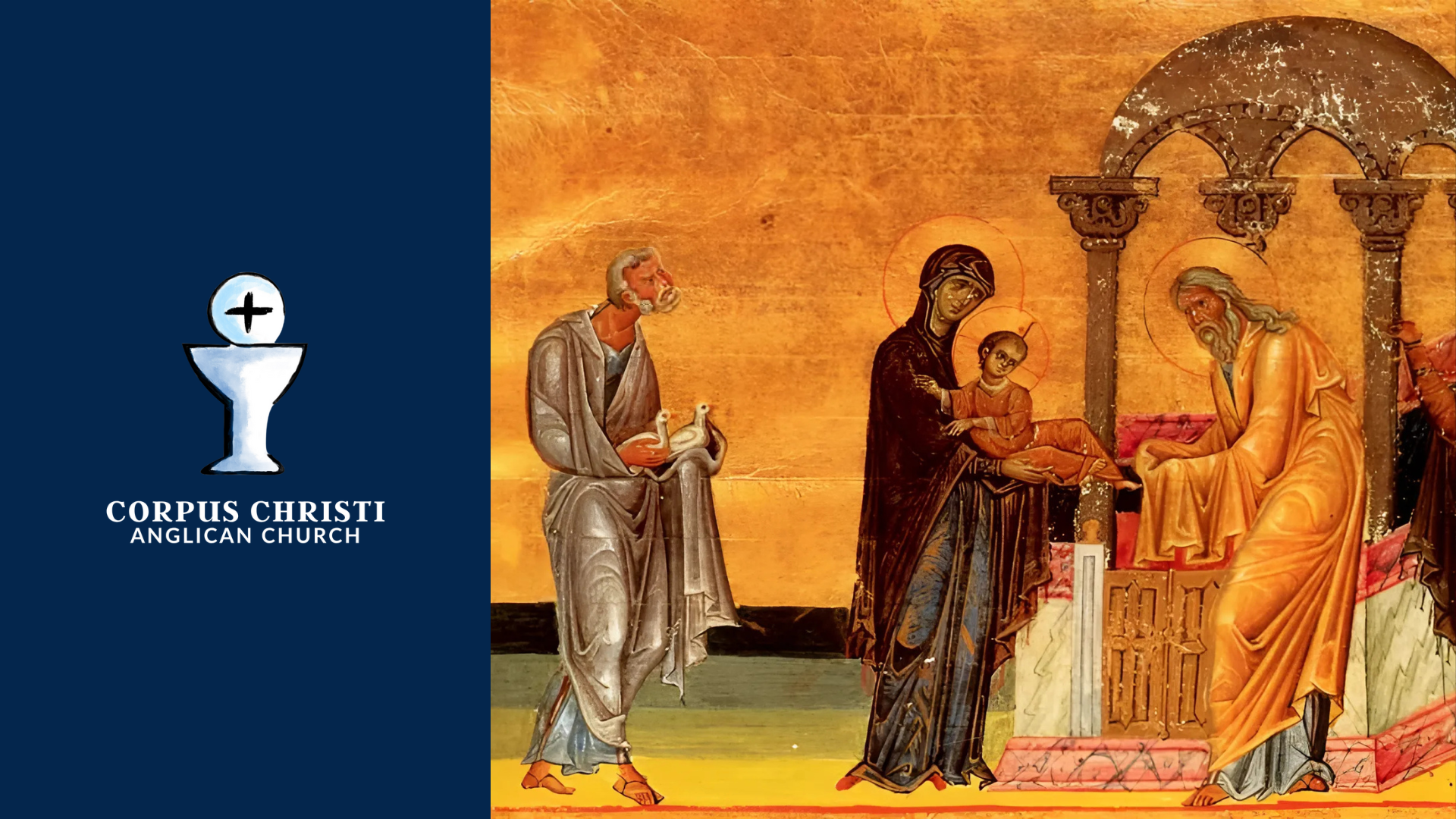
Mary and Joseph were on this same journey at the time of our gospel reading, a spiritual journey through life to our final home with God. They were also more immediately on a pilgrimage to Jerusalem. Verse 22 in our gospel reading tells us that "when the time came for their purification according to the law of Moses, they brought him up to Jerusalem to present him to the Lord." Where did they come from? Luke's account left us prior to this verse in Bethlehem, at the manger. Now Bethlehem is just five or six miles south of Jerusalem and Luke does not mention them journeying again until verse 39, when they return to Nazareth after the presentation at the temple. So they very well might have remained in Bethlehem or some area around there for 40 days. Perhaps less possibly, they returned to their town of Nazareth in the interim, which was about 64 or 65 miles from Jerusalem. So they either had a short pilgrimage to Jerusalem or a moderately long one, but it was still a pilgrimage. Pilgrimages can be short (e.g., to a local church) or long (e.g., to a historic Christian site) in distance.
And they went, according to verse 22, "for their purification according to the Law of Moses." Lev 12 notes that purification was required for a child's mother, who the Law judged to be ceremonially unclean, for a week after a son's birth. She also had to avoid touching holy objects and stay out of the sanctuary for an additional 33 days, for a total of 40 days. (The time was double that for daughters.) So this holy day, which we see as The Presentation of Jesus in the Temple, is also recognized as The Purification of the Blessed Virgin Mary in some Christian traditions.
They also went to present Jesus at the temple in accordance with the Law's requirement for every firstborn son to be presented to the Lord, a tradition that went back to Israel's Passover from Egypt. And at the end of the 40 days, the mother had to bring a sacrifice for her atonement, which for poor people was either two turtledoves or two pigeons. Perhaps Mary felt, along with the psalmist who wrote Ps 84, "My soul longs, yes, faints for the courts of the Lord" (Ps 84:2) given her period of required exile from them. Maybe as she and Joseph approached the temple, they recited Ps 84, or perhaps their hearts sang, "How lovely is your dwelling place, O LORD of hosts" (Ps 84:1). And possibly their turtledoves or pigeons reminded them that all people and creatures who inhabit God's house are blessed (Ps 84:3–4). How about us? We do not worship in a temple; we worship in a much less grand fellowship hall. Yet every week we have icons to remind us visually of saints who have gone on before us; occasionally we have incense; and every Sunday we meet together as the people of God who attend Corpus Christi Anglican Church. Even tonight, in exile from the fellowship hall due to ice, do we wish that we were instead participating in a fuller service there instead of this virtual one? Longing for the space in which we worship as a church can be a profound and praiseworthy mark of Christian spirituality.
In our gospel lesson, Luke now shifts his attention to another person in Jerusalem, Simeon, who we are told "was righteous and devout, waiting for the consolation of Israel, and the Holy Spirit was upon him." (Luke 22:25). Let's notice that phrase "waiting for the consolation of Israel." Fr. Morgan often speaks of how God meets us in our desolations and our consolations. Why did Israel need consolation? Because it was not free and under the control of the Romans. Because despite all of the Pharisees' best efforts over a very long period of time to help the Jewish people grow in faithfulness by heeding the Pharisees' minute extrapolations of the Law, their messiah had not yet come. Israel knew desolation, and both consolations and desolations are marks of pilgrimages. Listen to these words from Psalm 84 again: "Blessed are those whose strength is in you, in whose heart are the highways to Zion. As they go through the Valley of Baca, they make it a place of springs; the early rain also covers it with pool. They go from strength to strength; each one appears before God in Zion" (vv. 5–7). We begin in verse 5 with two consolations: strength in God and a heart for "the highways to Zion," meaning a heart for both pilgrimage ("the highways") and the actual destination of Zion. But then we reach the Valley of Baca in v.
6. Some commentators believe that the word Baca indicates a consolation: a tree that flourishes in dry places, like the Joshua tree, for those who have visited that national park. In that case, the "springs" of v. 6 are waters that enable the tree to grow and the land to flourish. Other commentators, however, see Baca as taken from a word meaning "to weep," and the journey, the pilgrimage, as involving sorrow that results in pools of tears. Interestingly, historians and archaeologists have been unable to locate a Valley of Baca, which leads to the question of whether the pilgrimage in Psalm 84 is meant to be taken as a literal one, a spiritual one, or both. In any case, though, the pilgrims go through a dry land in v. 6, and v. 7 tells us that they "go from strength to strength" all along their journey to Zion. Let's stop briefly and think of the implications of that. Whether we go through dry lands, or dry periods of life, and flourish despite the dryness, or whether we go through seasons of such intense weeping that it is like we flood the ground with our tears, we go from strength to strength. Our circumstances impact us, yes, and considerably so—but ultimately even our darkest times of sojourn will not destroy those whose strength is in God and in whose hearts are the highways of Zion. What we cannot see with our eyes now, we strive to apprehend by faith and will see clearly when the times have reached their consummation—that we go from strength to strength. The late hymnwriter Fanny Crosby put it this way in her hymn "All the Way My Savior Leads Me": "For I know what e'er befall me/Jesus led me all the way."
Back to our gospel story, Simeon is implicitly described by Luke as someone who is considerably older in years than the young couple and infant child, and who faithfully, although perhaps not always patiently, waits for the consolation of Israel and is full of the Holy Spirit. He experiences strength in that he is given a spiritual high watermark in his life and pilgrimage: He gets to see the messiah, the baby Jesus, and hold him in his arms. He then utters what we call the song of Simeon that is present in our Evening Prayer service and closes our Compline service. Here Simeon goes from the strength of seeing Jesus to the strength of prophesying about Jesus, with the prophecy concerning the worldwide scope of the messiah's salvation. Simeon has seen with his physical eyes the baby Jesus; now he sees with his spiritual eyes and heart the glory of that messiah's coming reign. Verse 33 tells us that Joseph and Mary marveled at this prophecy, and we might wonder well if this is one of the things that Mary treasured in her heart, as mentioned later in v. 51.
But then Simeon moves from a prophecy of consolation to one largely of desolation, journeying again from strength to strength. This messiah will not have universally positive effects on all of his countrymen, and he will opposed; what is more, Mary's soul will be pierced as if by a sword. Some in their pilgrimages will flourish in their encounters with the messiah; others will not. Mary herself will enter a Baca of weeping, as she did most notably at the cross. Most of all, this Jesus, this messiah, who is the Word, as John tells us, and who is the light of the world that shines in the darkness, will reveal the thoughts of human hearts and lay them bare—an insight that probably informed the author of the book of Hebrews when he or she described the Word of God as like a sword that reveals the hearts and intentions of people, in Hebrews 4:12. We find a partial correlation to this insight about hearts being laid bare in Psalm 84:8, where the psalmist pleads with God out of his heart, "O Lord God of hosts, hear my prayer; give ear, O God of Jacob!"
It is good, then, that not only are all of our inmost thoughts known by Jesus, but he is also our defense along our pilgrimage. Our secret ways—our hidden thoughts, our actions that are unknown to others, both good and bad—will be revealed, and possibly one day for all the world to see. And yet this Jesus is also the strong defense of those whose strength is in God and in whose hearts are the highways of Zion. The psalmist says in v. 9 of Ps 84, "Behold our shield, O God; look on the face of your anointed!" The shield and the anointed one to the psalmist was Israel's king, enthroned in Jerusalem. Our shield is Jesus; the face of the anointed one is Jesus's face. It is Jesus who is the righteousness of those who are Christians, whatever our sins and other flaws might be. We are to trust in Jesus's defense, remembering the comforting words given to us in 2 Timothy, "if we are faithless, he remains faithful—for he cannot deny himself" (2 Tim 2:13).
Luke finally turns our attention to the prophetess Anna, who we are told is "advanced in years" and evidently somewhere beyond the age of 84. Here we are presented with an arguably even greater example of faithfulness, for "[s]he did not depart from the temple, worshipping with fasting and prayer night and day" (Luke 2:38). We are not told what she said and prophesied about Jesus, just that she was overflowing with thankfulness for her messiah and that she spoke about him to all who longed for Jerusalem's redemption. In Psalm 84, the psalmist, having reached Jerusalem, conveys the climax of the psalm with a resolution: "For a day in your courts is better than a thousand elsewhere. I would rather be a doorkeeper in the house of my God than dwell in the tents of wickedness." It is better to be in God's presence than anywhere else; that is the goal of pilgrimage. Is the pilgrimage described in Psalm 84 a physical one to Jerusalem, a spiritual one in the heart, or both? It doesn't matter. The goal in all of these possibilities is to get to Zion, to the temple, to God's presence. Of course, God is with us along our pilgrimage, but we have a destination of life with God that has a final fulfillment in the eschaton, in the new heavens and the new earth, and that has intermediate fulfillments in the Church.
The psalmist goes on to identify with being a doorkeeper—one who waited at the threshold of the temple either begging for money or continually knocking on the door, seeking to be let in to the temple. He or she is in the temple courts outside of the temple, braving the outside elements and possible poverty rather than living more comfortably with the wicked. Here we have a seeming reflection of the two ways theology that we see in texts like Psalm 1—the way of the righteous versus those of the wicked. We also might remember the words of Jesus about those who knock on God's door, or Bob Dylan's contemporary application of those words, "knock, knock, knocking on Heaven's door." And while we're not told where Anna stayed, her continual presence in the temple and constant works of mercy through fasting and prayer are equivalent to the characteristics of a doorkeeper.
But she is not the only pilgrim who reaches a certain level of destination and becomes a doorkeeper. Mary, Joseph, and Simeon are also doorkeepers. And so who do we identify with most? Mary, needing purification and/or feeling a sword pierce her soul? Joseph, faithfully observing the law and protecting his family? Simeon, faithfully waiting for consolation? Anna, not departing from God's presence, and fasting and praying? We can identify strongly with each of them at different points in our lives. God has many different types of doorkeepers.
He also has many different spots of pilgrimage. Where are we now on our pilgrimage with God? Are we praising and delighting in God, as at the start of Psalm 84? Are we in a Baca where we are grateful for flourishing despite being in a spiritual desert? Are we instead in a Baca where our tears are so numerous that they threaten to flood the earth? Are we at a place where we are fervently imploring God to hear our prayers? Are we asking him to look upon Jesus, our shield and defense, to serve as our righteousness? All of these, and others, are places where we might find ourselves during our earthly pilgrimage.
And so what general applications can we make from all of these considerations of pilgrimage and doorkeeping? They all involve cultivating longings and habits, and so are not quickly achieved.
Cultivate a longing for, and pilgrimage towards, Jesus—We learn in the New Testament, particularly John 2 and 4, that Jesus is the temple now, not any building. We will in the end, at the consummation of all things, be in his presence. Let's make it our goal to consciously be in his presence as much as possible throughout the day. The Daily Office is one great benefit here!
Cultivate a longing for, and pilgrimage with, the Church—The Church is not just a fellowship of like-minded people, but the institution that God has designed for the provision of word and sacrament to humanity. The Church is not in its fullest sense a building or worship space, but the body and bride of Christ. Christ and his Church are inextricably linked. Christianity is more accurately viewed as corporate than individualistic. Regular Sunday worship and other involvement with CCAC can aid here.
Cultivate the humility and purity of a doorkeeper—As doorkeepers, we are less concerned about ourselves than living in God's presence, and less concerned about our prosperity and advancement than our faithfulness. As doorkeepers, we strive to live holy lives, and we confess and repent of our sins. Private devotional practices, weekly worship, and periodic confessions with clergy all can benefit us here.
Cultivate trust in Jesus's power and defense—The good news is that we go from strength to strength even at times when we do not feel God's presence or power. Jesus went from strength to strength; his presentation in the temple fulfilled the Law of Moses, just as his baptism would much later in his life. It's very possible that we could see Jesus's life and ministry as emanating from his presentation in the temple. Even his agony at Gethsemane and on the cross were not the end of his story, as he lives and reigns over the entire universe now. Jesus can be said in one sense to have been a doorkeeper during his agony in Gethsemane, knocking on Heaven's door and leaving the results to God. The author of Hebrews tells us that he learned obedience. Our messiah identifies with us so much that he knows experientially what it means to be both a doorkeeper and a pilgrim. He is trustworthy.
Cultivate models in the saints—Jesus is the light of the world, but all of us who are Christians are as well, for we are in Christ. The same is true of the saints who have gone on before us. For example, as mentioned earlier, consider Mary, Joseph, Simeon, and Anna.
And so the psalmist appropriately ends Psalm 84 with a kind of benediction in verses 11 and 12. May it bless all of us this Candlemas as we celebrate Christ, who is the light of the world that candles only dimly reflect. "For the Lord God is a sun and shield; the Lord bestows favor and honor. No good thing does he withhold from those who walk uprightly. O Lord of hosts, blessed is the one who trusts in you."
In the name of the Father, and of the Son, and of the Holy Spirit. Amen.