
SERMONS
Archive
- July 2026
- June 2026
- May 2026
- April 2026
- March 2026
- February 2026
- January 2026
- December 2025
- November 2025
- October 2025
- September 2025
- August 2025
- July 2025
- June 2025
- May 2025
- April 2025
- March 2025
- February 2025
- January 2025
- December 2024
- November 2024
- October 2024
- September 2024
- August 2024
- July 2024
- June 2024
- May 2024
- April 2024
- March 2024
- February 2024
- January 2024
- December 2023
- November 2023
- October 2023
- September 2023
- August 2023
- July 2023
- June 2023
- May 2023
- April 2023
- March 2023
- February 2023
- January 2023
- December 2022
- November 2022
- October 2022
- September 2022
- August 2022
- July 2022
- June 2022
- May 2022
- April 2022
- March 2022
- February 2022
- January 2022
- December 2021
- November 2021
- October 2021
- September 2021
- August 2021
- July 2021
- June 2021
- May 2021
- April 2021
- March 2021
- February 2021
- January 2021
- December 2020
- November 2020
- October 2020
- September 2020
- August 2020

4th Sunday of Epiphany: Distractions from Obedience to the Lord
CONTENT
Introduction
Good morning dear friends. It is great to be back in person with you. I know this has been a really weird week with different routines, kids at home all week, and other challenges. All that to say I’m really glad to be back worshiping with you this morning.
Today’s reading from the book of Micah and I want to look at it this morning because I think there are some helpful things for us in it. Our passage today reminds us that sometimes we make following the Lord too complex, but the complexity is strategic; we create complexity to keep us from the simple, but difficult task, of doing what is truly right and good in the Lord’s sight. It is hard because we have to be honest about what we’ve done or left undone, or face those wounds we’ve walled off to keep safe, and we have to do what is right and good even when it is costly. Rather than do the hard work God calls Israel and us to do, we would rather fill our lives with distractions (even ministry distractions) that God has not asked us to do to keep us from addressing hard things. It is something we are all tempted to and this is why Micah 6 is a great reminder to us as well. As we look at this passage, let me pray for us: “In the name of God, the Father, the Son, and the Holy Spirit. Amen. Lord, may the words of my mouth and the meditation of our hearts be always acceptable in your sight O Lord, our rock and redeemer. Amen.”
The case brought against the people (6:1-5)
The prophet Micah is prophesying in the first half of the 8th century and the beginning of the book puts this over the time period of the reigns of the vice-regents, Jotham and Ahaz, and then King Hezekiah. Tiglath Pileser III started a fresh campaign and pressure that would culminate in the fall of Samaria in the north in 722 BC where the northern kingdom of Israel was pretty much destroyed. This happened while Ahaz and Jotham were reigning over Judah in the south. Hezekiah, who would reign after them, would form an anti-Assyrian coalition with with the Palestinian and Syrian subject states. It would keep them safe for a time, but even the south would come to be taken later by the Babylonians in the 7th century.
This is a period of relative wealth and ease for Judah as they have successfully staved off the Assyrian threat. The surface-level peace and relative economic prosperity have become a double-edged sword spiritually. Micah is a covenant mediator and social and religious commentator on Jerusalem during this time where Sargon II takes the northern kingdom and as Judah forms alliances with foreign nations to ensure security.
Micah starts with a legal proceeding where God calls Israel to bring their case against God, “Rise, plead your case.” God asks Judah a question “O my people, what have I done to you? In what have I wearied you? Answer me!” God lays out his saving acts. He rescued them from Egypt, he gave them leaders, he did not allow foreign enemies to conquer them, he brought them across the Jordan river. This passage is used for us every year in our Good Friday service. The reproaches begin with this question “O my people, what have I done to you? How have I wearied you? Testify against me.” They end with, “I opened the rock and gave you drink from the water of life, and you have opened my side with a spear. I raised you on high with great power, and you have hanged me high upon the Cross. O my church, what have I done to you? How have I wearied you? Testify against me.”
God is inviting people back to covenant relationship. God is not sitting up somewhere stewing in anger or terrified by the anxiety about how bad a failing Judah will make him look. God confidently and mercifully invites them back while holding in tension the fact that he will not be mocked and he wants to make them into his covenant people. He has been seeking their good, but they have consistently walked away from the goodness God has for them and what he wants to make them into. We do this do. It is the very nature of sin and why it is both subtle and destructive. God has the same invitation to us to come and pay attention to all he has done for us. Look at his saving acts and ask what things, people, relationships, addictions, habits, patterns, and thoughts are drawing us away from knowing his love in Christ. Don’t paper over them with placebos and platitudes, spiritual bypassing, or even ministry opportunities. Do the simple work of being honest, no matter the cost.
The defense: Entering the Lord’s presence improperly (6:6-7)
Verses 6-7 change genre and form the peoples’ response. It’s like they are saying “God, how much is enough!?” They could bring a calf a year old. In other words, they’ve made an investment of time and money to rear this calf for a year in order to offer something costly to the Lord. Or should they offer God ten thousand rivers of oil? Would God be more pleased if they could offer him something greater and more expensive? If they could do big and great things for God would he then be pleased with them? Would that be enough? Or the most extreme example. The people ask if they should give their own firstborn for their transgressions. God had condemned human sacrifice, but this didn’t stop Judah or Israel from trying it. King Ahaz himself, during Micah’s ministry would offer his own son to the god Molech. It was an extreme and despicable rite that in this context is very ironic. They’ve gone so far their own way that they’ve now viewed apostasy as a pleasing offering. After all that God has done Judah is eager to sacrifice a lot of stuff to make sure that God gets the honor due his name. It’s almost like they’re saying, “Geez God, how many sacrifices does it take to make you happy?” It almost feels like a critique on any notion of “do great things for God and he will be pleased and bless your life.” And Micah is saying, that that is entirely the wrong question. There is no amount of zeal or sacrifice that will cover up a life of injustice, rebellion, misguided autonomy, and spiritual neglect.
The simplicity of pleasing the Lord (6:8)
There is no amount of work we can do for God or for the church or to try and make God look good that will atone for a life of injustice and moving away from God’s presence. It’s the age old lie of the garden where shame forced Adam and Eve to say “I am bad” and to move toward fixing their own problems themselves. Instead of turning away from them, God turns toward Adam and Even in invitation to ask where they have gone? The difference between guilt and shame is that guilt, within a securely attached relationship, invites someone into repair for the wrong they’ve done. It is useful. Shame, by contrast, tells someone that they are bad and it moves people into isolation. God does not shame his people, but here in Micah and elsewhere, he does account for the wrongs they’ve done so that they experience a sense of guilt that moves them to his kind invitation back into the goodness for which they were made.
Here’s my translation of vers 8: “He has told you, humanity, what is good, and what Yahweh requires of you: only to do justice, and to love covenant faithfulness, and to walk circumspectly with your God.” First they are called to do “justice” which often is used in Scripture as a call to our responsibility to take care of the weaker members of society: the poor and vulnerable, the immigrant and foreigner, the widow, and the orphan. It insists on the God-given rights of others because this is God’s very character and disposition toward his people. God’s people are to love covenant faithfulness. A lot of translations will say mercy, but this word is really about faithfulness to the covenant that God has established with his people. He has done everything to deliver his people, to bring about their well-being, and to make them a chosen nation, royal priesthood, and kingdom of priests. They are to love the process by which they become what God has called them to be; however it is often easier for them to rely on their own ways or the ways of the nations towards an inadequate vision of prosperity. The beatitudes are like a preamble of a new covenant. We are called to grow in love with Jesus’ words to us and following him to become more like him.
Finally, he says to walk circumspectly with your God. Humility is inferred but not explicit. The idea is that this person is taking great care in the small details of how they walk with God. There is humility in submitting yourself to the will of God and not doing things from your own reactions and proclivities. The call to walk circumspectly is an invitation to bring God’s will to bear on the entirety of our lives.
When we choose to see the image of God in all people, when we are patient in prayer and learning facts rather than being driven by addiction to scrolling and rage-bait, when we seek to discover healing and name wounds accurately, when we allow guilt to move us toward relationship rather than heaping shame on ourselves in isolation and allowing false narratives to drive us away from the love of God, then we will find ourselves in the state of counting ourselves fortunate that Jesus promises in the beatitudes. It is simple, but it is also difficult and costly. Judah had offered God everything except for what God actually asked for. We are tempted to do the same. Chuck DeGroat has a great little paragraph that illustrates the point: ““I’ve learned a thousand ways to cope,” a retreat participant once told me, “and they’re all easier than healing.”...That’s the lie, I thought to myself when I heard them. That’s the root of the ancient fallacy, one we’ve acted on for time immemorial. We’ve fallen for the lie that a bit of drink here and an hour of scrolling there will quell the deep ache of our hearts, the lie that keeps us from attending to what’s happening within, where our wounds fester. But it’s here, in our spaces of self-soothing and our places of pain management, that God once again meets us.”[1] I’d add to this, along with Micah, that even ministry, community service, and other good things can distract us from dealing with the simple and costly obedience that God asks of us.
Conclusion
The community of faith has preserved Micah’s prophetic works as a timeless treasure to call us to repentance and hope in the God who invites us to know him and his love for us. God has done everything to save us and he calls us to put down all the things we use to distract ourselves from healing our wounds and finding true peace in Christ. The work is simple, but it is hard, and it is costly. It begins in each of our hearts as we walk very carefully with Christ. God has turned his face towards us and invites us to be at home in his presence: to grow in our knowledge of his love for us and others, and in the hard work of addressing our wounds, to become the good image-bearers he has made us to be.
Let me close by praying again for us this collect for this Sunday: “O God, you know that we are set in the midst of many grave dangers, and because of the frailty of our nature we cannot always stand upright: Grant that your strength and protection may support us in all dangers and carry us through every temptation; through Jesus Christ our Lord, who lives and reigns with you and the Holy Spirit, one God, for ever and ever. Amen.”
[1] Chuck DeGroat, Healing What’s Within, 155.
3rd Sunday After Epiphany: Unity in the Church — Remember Who You Are
CONTENT
Many of you may know the Disney story of the Lion King. It tells the story of a young lion cub, named Simba, destined to be King. Simba believes a lesser story about who he is and leaves behind his identity as future king to live a lesser life of ease leaving his call and kingdom in dire condition. Eventually, Rafiki, the prophet monkey, finds Simba, helping to get to the question that changes everything…: “Remember who you are”. Most of us don’t have a prophet monkey to hit us upside the head with a stick. But we do have the apostle Paul and that brings us to our lesson in 1Corinthians. We are in the first chapter of the first letter to the believers at a young church in Corinth, not unlike Corpus Christi, and in a city not unlike the northern Virginia area. Paul has been away from the church about three years… and right out of the gates, at the beginning of his letter, Paul is strongly exhorting the believers to remember who they are.
At first glance, the apostle Paul appears to be writing to the believers in Corinth to stop bickering and moving in cliques. Like a family squabble. But sitting in the passage, studying the context and listening intently reveals Paul emphatically appealing to the church on an issue far more dangerous than cliques and squabbles. In fact, the Corinthians have left their identity in Christ and as a result are living in disunity; having moved away from the Lordship of Jesus Christ and the message of the Gospel into various divisions that empty the power of the cross. And Paul is not only writing to the believers in Corinth, he is speaking to the church worldwide. He is pointing to disunity as a deadly cancer and arguing that Unity in our Christian relationships reveals the Lordship of Jesus Christ in our lives and the power of the cross.
As Paul argues for unity, he points to ways that the believers have left their identity. Their disunity reveals that they are not following the Lordship of Jesus Christ, they have moved away from the centrality of the Gospel and divided themselves into cultural ways of thinking rather than remaining rooted and grounded in Christ.
Paul begins by making an appeal to the believers at Corinth and to the church in the name of Jesus Christ. He invokes Christ’s name to call them back to the authority of Christ because they are not yielded to it. He speaks in vs 10 for “all” of them to be in agreement,” to have no divisions, and that they be united in the same mind and purpose.” This is strong, clear language. The very fact that he “appeals” to them in this way indicates they are not in agreement, they are not of one mind and purpose, they are divided. He argues later that his own call is to proclaim the Gospel, in humility, otherwise, the cross is emptied of its power.
Well, if the cross is emptied of its power, then Jesus is not Lord. The crucifixion is meaningless. And this is serious. Like cancer, it's deadly to our faith. Paul’s way of argument here, by claiming that Christ did not send him to baptize but rather to proclaim the Gospel indicates that the quarreling of the believers is over inferior matters interfering with the proclamation of the gospel and thereby robbing the cross of its power.
The Corinthians have moved away from the Gospel. The Gospel is the good news that God has reconciled the world-you and me- to himself through the death of Jesus Christ. Fundamentally it's about bridging the gap of separation and mending division, not only between god and people, but also BETWEEN people and people. To be God’s people is to be united with Christ. To be united with Christ is to be united with one another who are in Christ. In vs 13, Paul asks, “is Christ divided?” He’s asking rhetorically to explicitly point out their division and separation from the gospel. This is serious. In vs 17, he points out his own call, in order to remind them of theirs.
In moving away from the centrality of the Gospel, they have forgotten their identities in Christ, and their call to serve Jesus in their relationships and their love for one another. They’ve replaced that belief and love with cultural ideals represented by lesser authorities. Paul explains in vs11-12, “For it has been reported to me by Chloe’s household that there are quarrels among you, my brothers and sisters, What I mean is that one of you says, “I belong to Paul,” or another, “ I belong to Apollos,” or another, “I belong to Cephas,” or still another “I belong to Christ.” Paul is stating that those divisions among the Corinthians had created a drift away from the centrality of following Jesus and they have lost their identity as bearers of the Gospel, the good news that every one of us is a child of God, beloved by God, forgiven by God. The Gospel compels us to love Jesus and to love one another above all else. In all three synoptic gospels, Matthew, Mark and Luke, in different scenarios, Jesus teaches us that the greatest commandment is to love the Lord your God with all your heart, with all your mind and strength and to love your neighbor as yourself. These divisions Paul addresses exposes the drift away from living out the Gospel that has happened.
Instead of focusing on the power of the Gospel to save, forgive and to be united to and in Christ, the Corinthians have turned to lesser authorities Paul, Apollos, and Peter in ways that these guys never intended…but instead that align with the Corinthians own cultural comfort. In this turn away from Christ, they see themselves as superior to one another. They hone in on various philosophical emphases and those become preeminent over the lordship of Jesus Christ. They lost the humility that the cross itself and the life of Jesus embodies. They’ve lost their identity. Paul isn’t calling out each of these leaders he lists as problematic, he’s calling out the ways that believers have aligned themselves with selected characteristics of these leaders; and honestly, twisted them. Believers in the church are still doing this today. See if you recognize any of these:
The “I belong to Paul” gang: Paul planted the church in Corinth in 50-51AD over a period of 18 months, the longest he stayed anywhere except for Ephesus.
Then he departed. This letter was written about three years later, after he’s gotten a direct report of the troubles the church is experiencing. So, it's been a while since the believers have seen or heard from Paul. Scholars suggest that these are people who relive the “glory days” and hold to the past rather than living in the present and availing themselves to ongoing sanctifying work of the Spirit of God. People do this today in churches. They get stuck in a moment, a movement and they continually look behind them and miss what God is doing in the present, today. Chris and I just had a lovely visit with a dear saint who lives in the “I follow Chris clique” at a church where we ministered. As they reminisced about the way it was when we were there and how hard it is, three years later, to attend the church, we prayed and encouraged them that God’s Spirit is still moving there and to look for what he’s doing. Seven words of a dying church are: “We have never done it that way” or “that’s not our way of doing church.” Life is dynamic and changing constantly all around us. We have to learn from the past, ground ourselves in the present, watching for the work of the Spirit today, even as we hope for the future.
The “I belong to Apollos” is another ageless faction, still present among believers today.. Apollos was a gifted rhetorician; he spoke eloquently, he exposited the Old Testament with precision and clarity. He moved people with his speech. He had a charism. Saying “I belong to Apollos” would be a deference to an intellectual elitism. Though this charism of Apollos would help mature believers, the choice of believers to “belong” to Apollos indicates a slide back into a cultural issue common both in Corinth and today: a selectivity to an aspect of faith to the abandonment of the entirety of our faith. In other words, the expression of intellect becomes an idol over the actual content of that expression.
The “I belong to Cephas (or Peter)” folks could refer to those converts from Judaism to Christianity who had defaulted back to the cultural norm of legalism. Later in the letter to the Corinthians Paul will address “rules” the believers were defaulting to regarding food offered to idols and we know about how Paul and Peter clashed over food rules in Galatians 2. When life seems out of control, or initial fires of our faith begin to peter out (no pun intended) the temptation is so strong to build rules and laws to sustain us instead of turning and waiting on the Holy Spirit to renew us. We focus on outward patterns of our behavior rather than our relationship to our Lord, Jesus. It's from our relationship with Jesus that our behavior manifests, not the other way around.
Our last groupies, the “I belong to Christ” people, is not actually a reference to the Lordship of Jesus. Paul identifies a fourth faction here and it most likely indicates a spiritual elitism that is a bit of an offshoot of the old Gnostic heresy in elevating secret knowledge and mystery over the plain Lordship of Jesus Christ and a willingness to yield to his authority in our leaders in our church. We discipled several of these groupies in one of our congregations. Two of them actually went into the mission field long term…three different times…after six month stints they would call and come home having decided the leadership wasn’t following the Lord the way they were. We would rescue them financially and emotionally each time, but eventually left us as well. A common refrain is, “we follow the Lord, not the rector.” Even if the rector is following the Lord and preaching the Gospel. It's a deceptive disguise of uber holiness. But in reality it creates great disunity and it's confusing but it is quite prevalent today in the church. Some say, “I don’t need church because I have Jesus!” Well, Jesus established the church and called us to be the church and to proclaim the Gospel to build the church and he calls us to do it in unity. In John 17, before Jesus goes to the cross, he prays, asking God, “ protect them by the power of your name, the name you gave me, so that they may be one as we are one.”
We now see the problem of disunity that Paul is addressing. It’s the very first thing he addresses in this long important letter to the Corinthians that examines what it means to be the people of God. It's the first thing he addresses because it’s critical for the church to live in unity. Their disunity is caused by their not living into their identity as followers of the Lord Jesus Christ. They’ve moved away from the message of the Gospel into cultural norms overlaid in spiritual terms that have divided them into, essentially, dangerous cliques. Paul wants them to return to their identity as believers. Like Simba, they need to “remember who they are,” lest they walk away from their call and destiny to build God’s kingdom. They must return to the belief in the preeminence of Jesus Christ as Lord and the saving work of the Gospel as evidenced by believer’s unity. Unity in our Christian relationships reveals our identity as believers under the Lordship of Jesus Christ. What does it mean to be the people of God?
Let me ask some hard questions here. Have you believed the Gospel? Do you believe you have sinned? I ask this because our Culture has reshaped what sin is. Sin is moving apart from God, his authority, taking authority yourself, being your own lord, not loving God, not loving others being in disunity from other believers. Stepping away from scripture, or rationalizing that.
Do you believe that when you ask for forgiveness he has forgiven you? Have you asked for forgiveness? Have you received his forgiveness?
Have you received his love for you? Do you realize how much you matter to Him? It may be hard to see in seasons of grief, anxiety or disappointment, confusion. . If you’re having difficulty receiving Jesus’ love or forgiveness for you, it may be hard to follow him as Lord and to live in your identity as his child, united to him, and united to other believers. Reach out to Father Morgan, to a leader in your church, to a spiritual friend you can trust. If you’re in a season of grief, allow Corpus Christi to help you, but you must tell them you need help. Sometimes we hide behind pride because it hurts to make ourselves vulnerable again when we’ve been disappointed. When Jesus asked the Father, in the Garden of Gethsemane, “would you take this cup from me?” I wonder if he felt disappointed, as a human being, in the way God required for our salvation to be accomplished. Maybe Jesus’ acceptance of disappointment might encourage you, that he’s walked the road of grief and disappointment ahead of you and he wants to walk it with you. Life can be quite disappointing. Yet, Unity in our relationship with Jesus reveals the Lordship of Jesus Christ in our lives.
If you’ve believed the gospel, then return to Your identity as a believer in the Lordship of Jesus Christ and unity will be the fruit of that.
I became a Christian at a very early age. I was raised in a wonderful church but as for most of us, life got hard in my teen years. I really struggled. When I was 16 I spent some time with a youth pastor and he could see that I loved Jesus and I had accepted him as my savior. But, he asked me if I knew what it meant to follow him as my Lord. His question that day changed everything for me. It was a turning point that I return to again and again when I find myself out of sync with others or with the Lord. I have to be reminded that Jesus IS Lord, and my life revolves around him, not the other way around. Ephesians 1:23, in the Message version, says, “The church, you see, is not peripheral to the world; the world is peripheral to the church. The church is Christ's body, in which he speaks and acts, by which he fills everything with his presence.” We have to live in unity with one another, or we empty the Gospel and the cross of its power.
As the people of God, our relationships to others matter. Are you united to those believers around you in your family and church? Is there anyone with whom you’re in conflict, yet you both follow Jesus?
Our unity as believers is critical. If you have family members that have not accepted Christ, they need to see your unity with other believers. They need to see your identity and oneness with Christ. They need to see humility and love for others in us. With family members who are believers, it's normal that we have disagreements that separate us. Often these are born out of years of old systems and patterns and we get stuck believing that we are always right as a defense mechanism. What if we surrender the need to be right? In Jesus, Jesus is right. Jesus is right every time. What if your rightness comes solely from Jesus being right; not you. Could that be enough? Sit in the beatitudes in Matthew; or his teachings throughout the Gospel. You’ll notice he never teaches, “you must be right.” He tells us that he is our right(ness) or righteousness. Ask yourself, in your conflicts with other believers, especially family members, “maybe I could be wrong?” Maybe there is a nuance or perspective I haven’t seen or become aware of yet. Take every disagreement to the Lord and wait on him to reveal His heart for this person. He may show you something that changes everything. And I can assure you, when you walk in humble submission to the Lordship of Jesus Christ, it does change everything. Your priorities change. You don’t need to be right. You can allow the Holy Spirit to convict and persuade others, You don’t have to do the Holy Spirit’s work in convicting everyone.
Unity in our relationships in the church reveals the Lordship of Jesus Christ in our lives. Now I’m going to meddle a little…Frustrations with your pastor and church leaders happen. That’s normal. We bring different backgrounds and cultural perspectives to every relationship and expectations from our past. Your pastor absolutely loves Jesus Christ as Lord above all else. He has devoted himself to loving and serving the church, both Corpus Christi and the worldwide church. He studies, he prays, he listens, he loves, he serves. He loves Jesus, he loves his family, he loves you, the church. If you have frustration with him or anyone else in leadership at the church, remember that God anointed him for this work and sovereignly placed he and other leaders there for a season and God is at work in their lives as much as He is working in yours. And prayerfully, with humility, consider what God might be shaping in you as you walk through any disunity. Ask God to reconcile you and to bring about restoration.
Unity in our relationships in the church reveals the Lordship of Jesus Christ in our lives. It defines us as the people of God both to one another and to a world dying without Jesus. Paul wrote this letter to a congregation in a context very similar to our own, even 2000 years ago. Is Jesus divided? Was Paul crucified for you? No, and no. Jesus is one and we are one with Jesus so we are one with one another. Jesus was crucified for you. He is our only Lord and Savior. On this snowy day, would you consider if you may have left your identity to follow lesser ones and like Simba, left the Kingdom you are called to. And maybe consider me your Rafiki, the prophet monkey, thwacking you upside your head to “remember who you are.” A beloved child of the King, called to love and serve Jesus as Lord and to live in unity with the body of believers called the Church.

2nd Sunday After Epiphany: Follow Jesus and Discover the Kingdom of God
CONTENT
Introduction
Good morning friends. I’m Fr. Morgan Reed, the Vicar here at Corpus Christi Anglican Church. On this 2nd Sunday after the Epiphany we hear John the Baptist’s reflection on the baptism of Jesus, and his invitation to some of his disciples to follow Jesus. I love the question that Jesus poses to John’s disciples. He asks, “What are you looking for?” That question feels like a continual invitation from Jesus to be honest about what we are looking for in a Savior. In asking the question honestly, we start to identify our worries, doubts, insecurities, hurts, the things we want rescue from. It is an invitation to journey with Jesus so that the glory of his rule and reign grows our vision for who he is.
Looking for the Son of God is about the journey and not the destination. As we look at our Gospel text this morning, let me pray for us: “In the name of God, the Father, the Son, and the Holy Spirit. Amen. Lord, may the words of my mouth and the meditation of my heart be always acceptable in your sight, O Lord, my rock and my redeemer. Amen.”
29-34 John’s commentary on Jesus’ baptism
The Gospel of John assumes we know the details of Jesus’ baptism. Unlike the other gospels, it does not give us the narrative details. Instead the emphasis is on the signs that Jesus is Messiah. John mentions this intriguing phrase “I myself did not know him; but I came baptizing with water for this reason, that he might be revealed to Israel.” John’s whole baptism ministry was to the end that someone who would be baptized would be revealed as the Messiah that Israel anticipated. This whole business about John not knowing Jesus probably has to do with the fact that John’s knowledge of Jesus as Messiah had not been fully filled out until Jesus is baptized.
John knew that the Messiah would be the one to come and bring God’s justice to God’s people. The suffering part was not quite as clear. In early Judaism there were passages about the Messiah suffering on behalf of God’s people to deliver them from sin, like Isaiah 53. There were also passages that spoke about the Messiah coming like a victorious king to deliver God’s people from foreign oppression, like Micah 5:2. How these two images of the Messiah came together was a mystery during the baptism ministry of John. In fact, some teachers of Israel thought that there would be two Messiahs — one to suffer and one to reign.
John recounts that when he had baptized Jesus that he saw the vision of God revealed and the Spirit resting on Jesus in the form of a dove. He concludes and testifies that this is the Son of God. He calls him the Lamb of God who takes away the sin of the world. John brings together the suffering Messiah imagery and the victorious Messiah ideas together in ways that would only make sense after Jesus is crucified and raised from the dead. This imagery is fully laid out in Revelation 5:11 where the elders and angels sing “Worthy is the Lamb who was slaughtered to receive power and wealth and wisdom and might and honor and glory and blessing!” John’s ministry is now coming to a close as Jesus’ begins to ramp up.
Cyril of Alexandria says it this way: “No longer does John need to “prepare the way,” since the one for whom the preparation was being made is right there before his eyes...but now he who of old was dimly pictured, the very Lamb, the spotless Sacrifice, is led to the slaughter for all, that he might drive away the sin of the world, that he might overturn the destroyer of the earth, that dying for all he might annihilate death, that he might undo the curse that is upon us...For one Lamb died for all, saving the whole flock on earth to God the Father, one for all, that he might subject all to God.”[1]
John’s ministry was beginning to come to an end. The one he hoped for had come. John would eventually be killed and he would not see the fulness of what he predicted on this side of eternity. Things did not unfold as he thought they would, but his life is a foundational testimony to the life and ministry of Jesus. His life pointed people to Jesus, not matter what this might mean. This was certainly true for his two disciples mentioned next.
35-39 “What are you looking for?”
In verses 35-39, on the “next day” after John’s baptism of Jesus, two of John’s disciples see Jesus walk by. John says “Look, the Lamb of God!” and invites these disciples to follow Jesus. One of these two disciples is identified as Andrew, Simon’s brother. The other one is left unidentified. As they begin following Jesus, Jesus poses this question to them: “What are you looking for?” In the context of the story, I wonder if they look at each other a bit bewildered. “What do you mean what are we looking for? We are looking for the Messiah, the one who is going to destroy our enemies, make God’s people upright again, the one our teacher John spoke about...” and so on.
Jesus’ question to them is included by John here as a question for us. What are you looking for? Andrew and this other disciple had to follow Jesus for some time before they really learned what they were looking for. They were looking for someone to deliver them from their disordered loves, their bondage to spiritual darkness, death, false narratives they’ve been told, and much more. It would take time for them to name these things to know what they were really looking for. Following Jesus is the beginning of asking the right questions and shaping our desires so we can ask rightly “What are we looking for?”
They ask Jesus the Rabbi where he is staying. They want to continue this conversation over dinner. Jesus answers them, saying “Come and see”. It is a genuine invitation. He wants them to come and see and expand their vision of the ministry of the Messiah.
This reminds me of following Jesus in the church. I remember beginning to attend an Anglican church and someone walked me through Holy Week. I intellectually understood what was going to happen and thought it was neat, but it wasn’t until I went through a Holy Week with the church that I really experienced the goodness of God in it. Experiencing something of the quick move from joy to rejection, the moments of darkness and silence, the joy of the fire and the resurrection. Easter made so much more sense because of both the liturgy and experiencing it in the lives of my church family. Life with Jesus is not just a mental assent to an image of the Messiah, it is an expansion of our vision of the Messiah’s work as we follow him and taste and see that the Lord is good. Jesus invites us to come and see His work. He invites us because like Andrew and this other disciple, he wants us to follow him.
40-42 Peter is invited to come and see
One of these two disciples of John the Baptist is named. It is Andrew, who is the brother of Simon, whom Jesus will call Peter. Andrew is so excited about his discovery of the Messiah that he is compelled to go and invite his brother. Andrew brings Simon to Jesus to meet him. Jesus meets Simon and renames him Cephas, which is Aramaic for stone. This is instructive as we think of discipleship.
Andrew followed Jesus. He spent time listening to him and learning from him. I’m sure he asked him a lot of questions. He took it all in. He allowed his time with Jesus to reorder his world and paradigms. He was now internally convinced that this was the anointed, the Messiah of God. He wants to bring others not to an intellectual understanding, but into the same deep inner knowledge and reorienting relationship with Jesus that he himself has experienced. To do this he needed to bring Simon into Jesus’ presence and Jesus begins to reframe Simon’s reality starting with a new name.
Discipleship is ongoing, not immediate. We follow Jesus and we begin to ask him questions along the journey: “Why am I in pain? Why are people inflicting pain on others? Have I messed up this relationship beyond your ability to bring healing? Am I still doing your will if I’m not doing the same job anymore? Why has my family member caused me so much harm? Where are you right now?!” And to these Jesus has this same beautiful invitation: “Come and see — because I want you to follow me and see what the kingdom is like.” And as we grow in a knowledge of God’s love and how he rightly orders the world, we are compelled to invite others to come and meet this Jesus with us. We are not superior to others. We are fellow pilgrims discovering Jesus on the road home.
Some have speculated that the Gospel writer, who never mentions himself by name, is the other unnamed disciple of John the baptist. We can’t know for sure. But it would make sense of why there is so much Aramaic. John the Evangelist is possibly recounting these foundational first-hand moments and using the Aramaic he was accustomed to using with Jesus: “Rabbi” in Aramaic to “teacher” in Greek. “Messiah” in Aramaic to “Anointed” in Greek. “Cephas” in Aramaic to “Peter” in Greek. John is perhaps recounting these moments as he remembers them but inviting his Gentile readers into the story through translating the phrases to something more familiar for his audience. This day he is remembering was foundational for his journey with Jesus and it invites his readers, as Andrew does his brother, to come and follow Jesus, to refine their questions (and ours) in light of a relationship to this good Shepherd, to experience the kingdom of God, to discover what we are truly longing for and to expand our vision for Jesus’ ministry and the story he is telling of the kingdom of God in our lives.
Conclusion
Today’s Gospel is all about an invitation to follow Jesus, what we call becoming a disciple. John the baptist had his view expanded of Jesus’ ministry. His disciples, Andrew and the other — possibly John the apostle— had their vision of Jesus’ ministry expanded. Peter is invited to learn the ministry of the Messiah. Through all of these lives you and I are also invited to come and see the Lamb of God who takes away the sin of the world. We are invited to ask “What are you looking for” and then we are invited to be surprised as Jesus walks with us in life’s complications and expands our vision for his kingdom and proves himself to be our good shepherd along difficult paths. All of us are pilgrims together learning to ask better questions of Jesus as we walk with him, listen to him, and as he reorients us as we follow Him. And as we follow Him, we are invited into a deeper experience of the love of God, to taste and see that He is good, and to invite others to journey with us as we walk with Jesus.
Let us pray:
Grant, Almighty God, that the words we have heard this day with our ears may by your grace be grafted in our hearts, that they may bring forth in us the fruit of a righteous life, to the honor and praise of your Name; through Jesus Christ our Lord. Amen.
[1] Cyril of Alexandria, Ancient Christian Commentary on Scripture.
The Baptism of Jesus: Chaos No Longer Reigns
CONTENT
Introduction
Good morning friends. It is so good to worship with you all this morning. On this first Sunday after the Epiphany we celebrate the baptism of Jesus. The moment of Jesus’ baptism was reminding me this week of when I collected rocks as a kid. I have these opals that I got when I was little. If you let them dry out, they look completely unassuming, like a normal rock, but once you put them in water they shine with amazing colors, and if you were to turn the lights off and shine a black light on them, they will radiate with amazing neon hues. It reminds me of Jesus’ baptism because what we have is an unassuming picture of a man being baptized, but then what happens is the curtain is pulled back and the glorious vision of heaven in the ministry of Jesus is revealed. The kingdom is inaugurated and sheds light on the rest of his ministry.
This will be the beginning of the ministry of the Messiah and what unfolds in Jesus’ ministry has the full energy and work of the Triune God behind it. In the baptism of Jesus the rule and reign of God is made known to the powers of darkness, creation anticipates its renewal, and the Trinity reveals its working in our salvation. As we look at Jesus’ baptism this morning, let me pray for us:
“In the name of God, the Father, the Son, and the Holy Spirit. Amen. Lord, may the words of my mouth, and the meditation of our hearts be always acceptable in your sight, o Lord, our Rock and our Redeemer. Amen.”
1) Jesus comes to be baptized — to bring justice and undo the powers of darkness. (3:13-15)
Jesus is roughly 30 years old when we meet him at this point and he is going to begin his public ministry. He has come from the North in Galilee, and makes the trek to Judea to see John. This is no accident. It’s about a 70 mile walk, so Jesus is very purposeful in making this trip to begin his ministry. John had just finished preaching to the crowds about the Messianic figure to come. He is talking about final judgment, the winnowing fork and getting rid of the chaff, and this Messiah’s future baptism being one of the Holy Spirit and of fire. This crowd is primed to see something miraculous.
There’s something recognizable about this Jesus, but initially this image is quite unimpressive. John greets him with the recognition that Jesus is the one he was talking about. He should be baptized by Jesus, not the other way around! How can Jesus come to John’s baptism which is for repentance and the forgiveness of sins when Jesus is one who has committed no sin? There has been a lot of ink spilled over this problem throughout church history. There are a couple of important things to think about here. First, he could have come with the full manifestation of his glory as the king who will judge, but instead, his kingship begins with the humble identification with penitential humanity. He will join them in their trials and sorrows, even being made fully like them in their death. John the Baptist would have been the big celebrity in this moment, and Jesus begins his ministry without any show or pomp at the waterside with the rest of troubled humanity.
The second thing to name is the sacramental quality of this act. Hilary of Poitiers says this: “He had no need for baptism. Rather, through him the cleansing act was sanctified to become the waters of our immersion.” This is perhaps intertwined with what it means when Jesus tells John that he has to be baptized to fulfill all righteousness. John’s question is why would Jesus need to be baptized? Jesus says, “Let it be so now; for it is proper for us in this way to fulfill all righteousness.” He isn’t talking about some reformational idea of personal justification. That would be anachronistic and completely foreign to early Judaism. He is talking about the arrival of God’s kingship where all that has been turned upside down by sin, injustice, and death will be put right again. The baptism is the beginning of the display of God’s kingship. Jesus is baptized to begin to put an end to the powers of darkness and evil. This is how the judgment will come about that John had predicted before Jesus showed up!
2) Jesus is baptized — To make holy the waters and bring new life. (3:16)
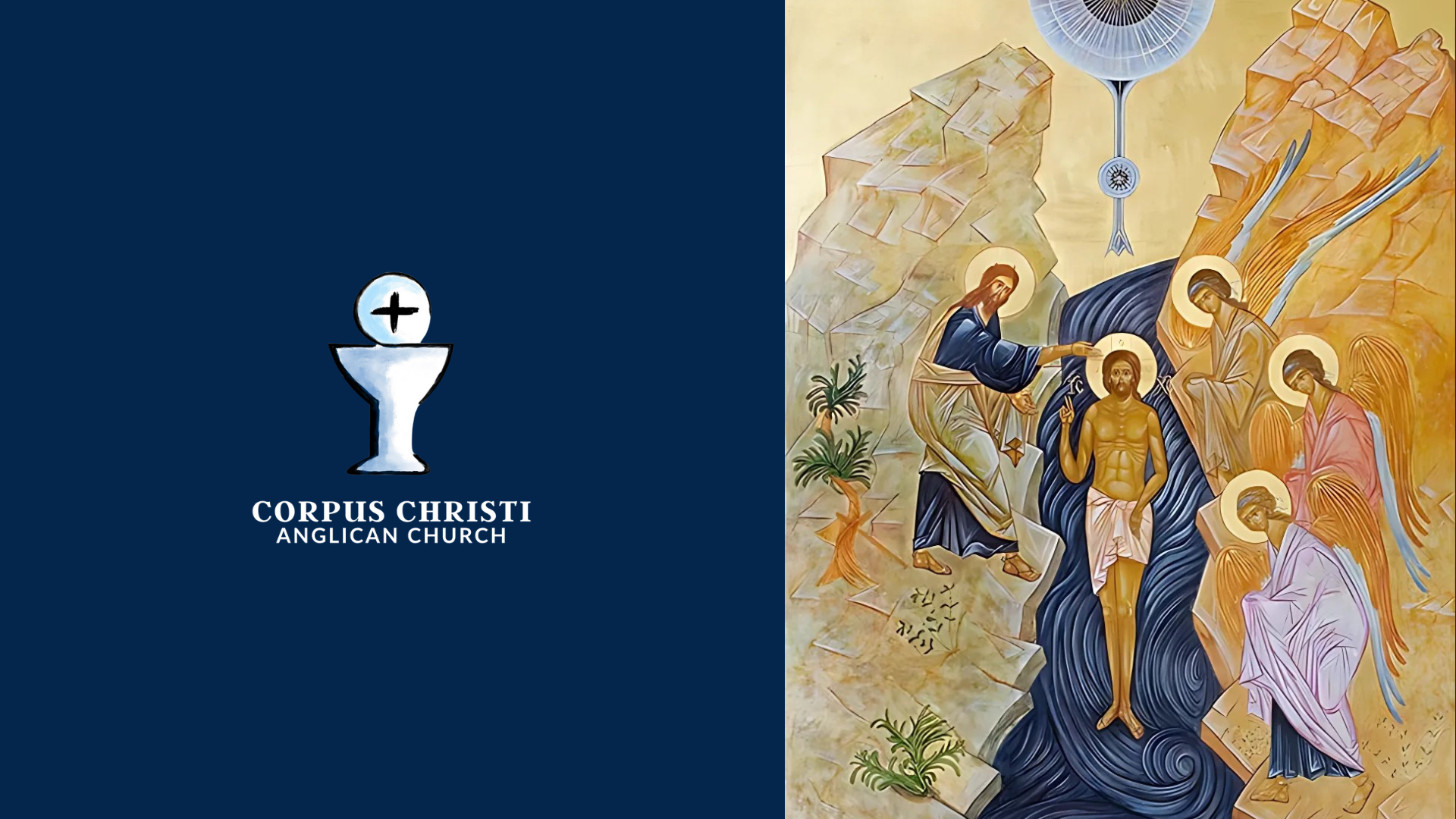
Second, Jesus is baptized to sanctify the waters and bring new life. If you look at a lot of Eastern icons of the baptism of Jesus, he is not fully submerged in the water. As far back as one goes into the Old Testament, the waters are always mythologically representative of chaos. This is why in Psalm 29 the LORD is said to sit enthroned over the flood. Whether we’re talking about the flood of Noah or the floodwaters destroying Assyria in Nahum, or even back to creation itself where the waters represent the formless and void chaos before creation is rightly ordered, the waters are representative of a destructive force of chaos. Jesus is not fully submerged by them because he created them and will not be overcome by them. Instead, by entering them he has sanctified the waters so that what was an instrument of death becomes the material means of new life thereafter.
Jesus’s baptism is a cosmic renewal that points to the renewal that all creation longs for. All creation longs for its proper use once again and here Jesus restores the waters so the Spirit who hovers over the waters, utilizes them to restore God’s image in God’s image bearers.
As Jesus comes up from the waters the text says that the Spirit of God descended like a dove and was alighting on him. There are several images coming together here and this is certainly not comprehensive, possibly both the Spirit who hovered over the waters of chaos and the dove that came back to Noah. This is the only place in the New Testament where the Spirit is compared to a dove and when we think back to Noah, the dove that had been sent out after the flood returned with a symbol of new life that signified the renewal of creation. Here again the Holy Spirit comes as the one who effects the new life and this begins the ministry of Jesus. The arc of the narrative of the Messiah’s glory as king will be marked by miracles, but also by deep betrayal, falsehoods, the powers of the kingdom of darkness, death, and descent into Sheol. And yet the Spirit is alighting the entire ministry so that what comes through His death is resurrection, the conquering of death, renewed creation, and new life for the followers of Jesus who will reign with him in his glorious kingdom which begins here at this baptism. We join him through baptism in a death like his so that we are raised with him in a resurrection like his. We are brought into His kingdom so that we might reign with him. What began as a familiar, but unimpressive image of the Messiah coming for baptism has turned into a full-blown theophany on the level of God coming at Mount Sinai.
3) The Trinity is involved in transferring us to this new kingdom — Sonship and reigning (3:17 // Isa 42 // Ps 2)
Jesus was baptized to destroy the powers of chaos, death, and evil. He was baptized to sanctify the waters and bring us and all creation into new life and renewal. Finally, His baptism brings us into a new kingdom. In verse 17 the voice of the Father in Heaven ratifies the kingship of Jesus with a declaration “This is my Son, the Beloved, with whom I am well pleased”. This brings together two important Old Testament images. First, we read Isaiah 42 today which has the Spirit of God falling on God’s chosen servant that will bring the deliverance about for God’s people. This verse does not use the language of sonship, but Psalm 2 famously does, which is where God says “You are my son, today I have begotten you”. And this psalm is a famous enthronement Psalm for the Davidic ruler as a son of the Divine Ruler, YHWH. The Servant of God and Son of God are manifested here in the person of Jesus, spoken by the Father, illumined and empowered by the Spirit. The life of the Triune God was showing forth from the waters. Everything that happens from here on out is to the end that Jesus rules and reigns as king over all.
The image of Jesus ruling and reigning over all as judge is still true, but what is more important is how he gets there. He begins with this full identification with broken humanity and lives the rest of his ministry out in the light of the life of the Trinity. He will see triumphs and miracles, he will have people walk away, he will be misunderstood and betrayed, he will take moments to be off in fellowship with God in prayer, he will be surrounded by noisy crowds — All of this is framed by the God’s manifestation and ratification of his kingship here at his baptism.
Conclusion
The same is true for us. Baptism, for us, is nothing less than a ratification of the victory of God for his people. In the baptism of Jesus the rule and reign of God is made known to the powers of darkness, creation anticipates its renewal, and the Trinity reveals its working in our salvation. What is true cosmically is true personally for each one of us and I want us to have this at the forefront of our remembrance today as we support Caedan in his baptism. As Caeden comes to be baptized you are seeing someone renounce sin, evil, and darkness, to turn from the kingdom of darkness and who is being brought into the Kingdom of the Son. He is going to be given the Holy Spirit and the rest of his days are framed in the light of the Spirit’s work and his story is connecting the dots of the manifestation of the reign of Jesus the Messiah in his life and in the lives of those he meets. Each one of us is called to pray for him and renew our own vows as we remember what God has done for each of us in this same baptism we share with him. As we remember the baptism of Jesus, remember your baptism. Remember that your story is part of this cosmic renewal where God is making his kingdom come on earth as it is in heaven. Let me pray for us:
Give us, O Lord, a steadfast heart, which no unworthy thought can drag down; an unconquered heart, which no tribulation can wear out; an upright heart, which no unworthy purpose can tempt aside. Bestow upon us understanding to know you, diligence to seek you, wisdom to find you, and faithfulness that finally may embrace you. Amen.

Epiphany: The Longing of the Magi and the Glory of Jesus
CONTENT
Introduction
Good evening friends. It is so great to be with you to celebrate the feast of the Epiphany of our Lord. This season is actually older in the church’s calendar than the feast of Christmas itself, but because it doesn’t always fall on a Sunday, it doesn’t get nearly as much attention. Epiphany is an important season that draws us into the revealing of the glory of God in bringing heaven and earth together in the rule and reign of Jesus. This day focuses on the Magi in the western tradition. Then we continue the theme as we look at the revealing of the glory of God in Jesus’ baptism, in the turning of water into wine, and the transfiguration. The second to the last Sunday of this season we call world mission Sunday and it highlights that God’s glory is still going out to all the nations through the Church, which is his body. As we look at our Gospel passage today, let me pray for us: “In the name of God, the Father, the Son, and the Holy Spirit, amen. Lord, may the words of my mouth and the meditation of our hearts be always acceptable in your sight O Lord, our Rock and our Redeemer, Amen.”
King of the Jews (1-6)
St. Matthew begins his infancy narrative quite differently than St. Luke. There is no mention of a manger or animals, shepherds, or angels. Instead, we arrive at the place where Mary and Joseph are with their baby, Jesus, in Bethlehem. The timing of this happens under king Herod, who was an Idumean, a group of people descended from Esau and the Edomites who were forcibly converted to Judaism a few hundred years before by the Maccabees. He was an exceptional builder and administrator, but also a cruel tyrant, of whom it has been said that it is better to be Herod’s dog than his son. He was someone who was quick to put an end to anyone he perceived as a political threat.
Jesus was born into this culture of warring madness and it makes it all the more striking that some Magi come to Herod and ask “Where is the child who was born king of the Jews?” These are pagan astrologers who worked in the Royal court, often associated with Babylonia, but their location is ambiguous. The point is that they are Gentiles. These Gentile rulers have come to pay homage to the king of the Jews. Herod, though, claimed this title as his own, so you can imagine Herod’s surprise when astrologers from the East follow a divine light in the sky to find a king of the Jews — who was presumably not him.
Herod’s reign was about himself and his own preservation. By contrast, the rule of Jesus as king of the Jews was to be for the good of the nations. Matthew highlights the nature of Jesus’ kingship as one of a tender shepherd by quoting Micah 5:2 about the rule of the Messiah and bringing it into conversation with 2 Sam 5:2 which contrasts David’s shepherding rule with the tyranny of Saul. Jesus would be king of the Jews to the benefit of the nations around them.
The Nations will come to him (tie into great commission) (7-12)
Herod tells the Magi to go find the child and bring back word of where he is. He probably wouldn’t trust a Jew with this task seeing that the Jews would be eager to meet their Messiah, but these pagan rulers really had no skin in the game. The star appears again for the Magi who follow it to a house in Bethlehem where they find Jesus and Mary, his mother. The light of the world was born in dark times and yet we see the beginning of the nations streaming to the light in the little town of Bethlehem. One of the church Fathers, St. Chromatius, says it this way: “A boy he is, but it is God who is adored...The Son of God, who is God of the universe, is born a human being in the flesh....He is heard in the voice of a crying infant. This is the same one for whose voice the whole world would tremble in the hour of his passion. Thus he is the One, the God of glory and the Lord of majesty, whom as a tiny infant the magi recognize. It is he who while a child was truly God and King eternal....”
The Magi pay homage to this child and offer him their gifts, a foretaste of great commission where Jesus, after the resurrection, will tell his disciples to go into all the nations and make disciples. These Magi are warned in a dream about the schemes of Herod and they go home another way. The story has an important lesson for us about the reign of God. Reconciliation with God and one another is only possible under the Lordship of Christ. It is true of pagans and Jews, it is true of warring nations, it is true of groups of people, it’s true of households, it is true of our own relationship with the God who made us. Herod is an imposter who ruled by fear. Its like he was whetting his sword while he was being nice to the Magi. He shows us that there is a cruel kind of niceness that is manipulative and self-serving and will not produce real reconciliation. Jesus offers us something more difficult, but more real. Humility is the beginning of the kingdom, not denial or the appearance of opulence, not defensive posturing or violence, but humility, honesty, and contrition. This is how the glory of Jesus spreads.
Conclusion
On this Epiphany and in the season after Epiphany, we are invited to explore the goodness of the glory of Jesus who is our kind shepherd-king. We join the Magi in offering him the fruit of our lives to experience the reconciliation he brings. We join the disciples in being discipled so that we can make disciples. The work begins in our own hearts as we ask God to restore and reconcile what is broken. This is the process of Jesus taking us out of the darkness and bringing us into his glorious light. Let me pray for us as we close:
O God, by the leading of a star you manifested your only Son to the peoples of the earth: Lead us, who know you now by faith, to your presence, where we may see your glory face to face; through Jesus Christ our Lord, who lives and reigns with you and the Holy Spirit, one God, now and for ever. Amen.
Second Sunday of Christmas: Did We Just Forget Jesus?!
CONTENT
Introduction
Good morning friends and Merry Christmas. We are nearing the end of Christmastide and this morning we get a fascinating window into the childhood of Jesus. This glimpse into the 12-year-old Jesus shows us something of the clarity that Jesus had about his own call. He takes the initiative to expand his parents’ own view of his ministry. As I’ve thought about this passage this week, I think that something it teaches us is that we need to stay where Jesus is; he will break through norms and expectations we have; and when he does this, it is an invitation to ponder rather than to go back to what is comfortable or familiar.
As we look at our gospel passage together, let me pray for us “In the name of God, the Father, the Son, and the Holy Spirit. Amen. Lord, may the words of my mouth and the meditation of our hearts be always acceptable in your sight, O Lord, our rock and our redeemer. Amen.”
1) Forgetting Jesus: Regardless of our piety we can move along and lose a sense of where Jesus is confidently ministering vv. 41-45
In our Gospel passage we meet Jesus as a pre-teen. He isn’t old enough to make his covenantal vows (which would have been 13), but he is starting to learn the vows he will make. This is a season for him of intensified catechesis as he prepares for manhood. Mary and Joseph make their way to Jerusalem for their annual pilgrimage. Normally it is only required that the male from the family go on this pilgrimage, but the fact that Mary and Jesus come with him tells about the piety of the holy family. They are devoted to God and want to raise their son with a sense of rootedness in the tradition of the Torah.
When people travel up to Jerusalem they do so in caravans for safety. It was likely their caravan had people they knew and trusted. It was a two-day walk from Nazareth to Jerusalem. They would walk a day, stop in the middle, stay overnight, fuel up, and hit the road again, arriving on the second day. After the seven days in Jerusalem, Mary and Joseph join the caravan and make it a day’s journey toward Nazareth. Perhaps they thought Jesus was with the other kids or friends in the caravan. He’d turn up when they got to their stop. But to their surprise, when they get to their stop, Jesus is nowhere to be found! Mom and dad are terrified!
The text doesn’t blame the parents at all. In fact, some have even wondered if Mary might have been the source of this narrative. Perhaps Mary had written his down in her journal of memorable moments from Jesus’ childhood and then told Luke about it later. We don’t know. But this is certainly memorable.
There is a helpful lesson for us in this. Mary and Joseph were incredibly pious god-fearing people and somehow they still ran along and left Jesus behind. I wonder if there might be a word of caution for us to look for where Jesus is and not to charge ahead and just assume he is in this or that scheme with us. There are so many directions we want to go, good things we want to start, but we often forget to ask if Jesus has asked us to go there or to do that thing. It’s a helpful caution for those of us who like to charge ahead and accomplish a great many things.
I remember working on a website and was hoping to keep that job while I helped as an associate to plant another church. The reality is, though, that I couldn’t keep three jobs and fundraise for the thing I felt God was calling me to do. God in his kindness allowed our grant money to run out for the website. It was really painful. I tried to get an NEH grant and didn’t get the votes I needed, but looking back, I would have tried to push ahead on too many things, so God’s “no” to that project was a kind invitation to something else that felt more risky, but it was the very place he was at. Perhaps you’ve also experienced God’s no to something meaningful. It is painful.
I can’t tell you the 5 easy steps to find Jesus in decision making and I’m distrusting of anyone who can; but what I can say is that the first step to locating Jesus is to look for him. One of the tools that I find really helpful is to have a regular examen. St. Ignatius of Loyola has a really helpful one that is simple to use. Just search for Ignatian examen and you’ll find it. It is a great tool for decision making. This is a great way to pause and make sure you are paying attention to where Jesus is in your day and what he is asking of you or not asking of you.
2) Breaking expectations (the surprise of Mary and Joseph) vv. 46-47
We have seen how this text encourages us not to forget Jesus. Now we’ll look at how Jesus breaks our expectations. Joseph and Mary know their Old Testament and the prophecies about the Messiah. We have recorded miracles about shepherds and Magi visiting them. We have heard about angels coming to them at various points. What we aren’t told much about is the day-in-and-day-out raising of this child. They do this trip every year and for the last 5 or 6 years, since they got back from Egypt, there had been no problems.
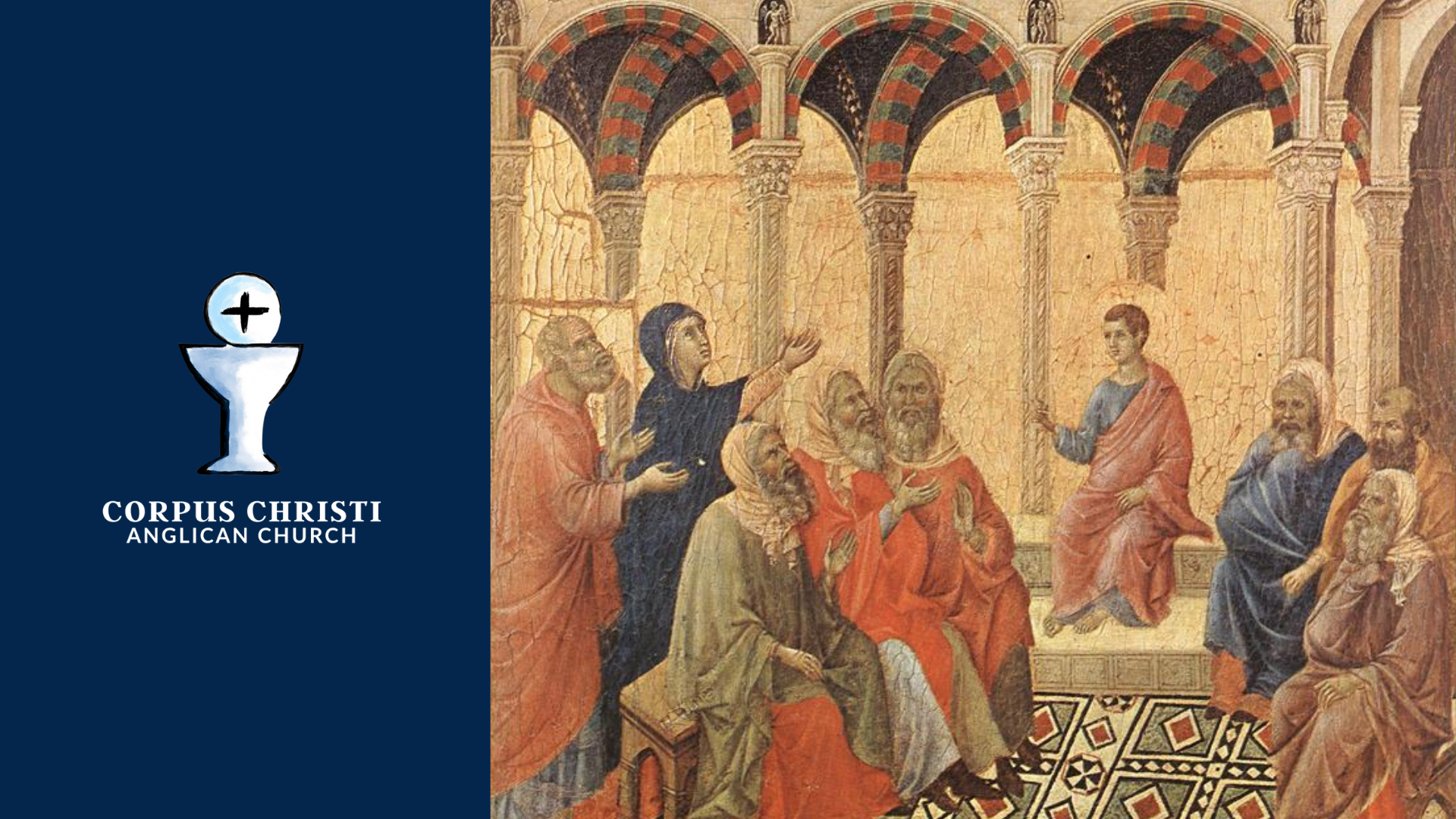
Mary and Joseph in their anxious fear make the long walk back to Jerusalem and they find Jesus in the temple area listening to the teachers and engaging with them. When they find him they don’t say “how could we have done this to you?!” Instead, Mary says, “Child, why have you treated us like this? Look, your father and I have been searching for you with great anxiety!” We definitely see the humanity of his parents here. The words that Jesus offers to his parents are a mild and respectful rebuke, and offer us the whole reason this story is recorded. Jesus says “Why were you searching for me? Did you not know that I must be in my Father’s house?” It could also be translated “about the things of my Father?”
These are the first words of Jesus in the Gospel of St. Luke. They occur well before he is baptized and begin his public ministry. There is an incredible security and self-understanding involved in this 12 year old which likely came from what his parents told him about himself! Little kids are kind of a mirror for how we parent. When your kids are like 4 or 5 you’ll watch them put their stuffies to bed the way you bed them to bed. You’ll see them exhort or rebuke their dolls or stuffies the ways you’ve exhorted or rebuked them. In those first 6-7 years they receive a lot of scripts about themselves and the world around them. When Jesus says this to Mary and Joseph, I can imagine a bit of embarrassment as Jesus has just echoed back the things he has learned about himself from them back to them. But they didn’t expect it to look like this!
That is a helpful reminder in following Jesus. Jesus cannot be constrained by our images of him or what he can do. As we follow Jesus, he will lead us to places we never thought we’d go, but he is also with us in wherever he leads. And as we walk with Jesus, we join in his confident rootedness not in the tasks we accomplish or the vocations we have, but in our relationship to God.
3) Pondering Jesus: Take note of where Jesus shows himself strong and faithful vv. 48-52
We looked at searching for Jesus and not moving ahead without seeking him. We looked at how following Jesus will often change our expectations, and how our rooted position in His love is enough to ground us in those times. And finally, we join Mary in pondering Jesus. When the shepherds had visited and told her about the testimony of angels, we had this phrase about Mary pondering these things in her heart. After hearing Jesus tell her and Joseph something they believe but hadn’t fully teased out yet, she tucks it away for later. An early commentator, the Venerable Bede says this, “As before, when she conceived the Word itself in her womb, so now does she hold within her his ways and words, cherishing them as it were in her heart. That which she now beholds in the present, she waits to have revealed with greater clarity in the future. This practice she followed as a rule and law through all her life.”[1] The virgin Mary exemplifies discipleship here and invites us into the same. She had born the Word and now is hearing and marking the words and teachings of The Word, who is now growing up before her very eyes.
The text, to clarify any confusion, does mention that Jesus went back with them to Nazareth, that he was obedient to them, and that as the years went on, he increased in wisdom and in divine and human favor. Mary made a note of this event and it was an opportunity for wonder at what was being done through Jesus. She could have tried to control things and tried to fit Jesus into her image of the child he had always been. She could have kept her mind closed off to what God was doing, but she opened herself to a bigger vision of the Messiah and to do this with her own son is a great act of faith.
Jesus is engaging with the teachers in a way that shocks people because it is so profound. Mary and Joseph’s anger and anxiety gives way to wonder as they contemplate who this child is becoming. It is a great invitation to wonder and marvel at the work of Jesus. Make it a habit to note the ways God has surprised you and been at work. Perhaps this is with the cultivation or re-cultivation of a surprising friendship, a conversation that encouraged you, the provision of your spiritual or physical needs, a surprising word of encouragement or challenge, a drawing from a child, or just a silent moment where God felt near despite the turbulence outside. Ponder these things in your heart and trace the story of the work of the Messiah.
Conclusion
As we close this Christmas season out together with a story of Jesus as a preteen, His first words of the Gospel are an invitation to us as well to be rooted in the love of God: “Did you not know that I must be in my Father’s house?”. We are reminded that we should stay where Jesus is. Don’t forget about him and move too far too fast, or even in the wrong direction. As you look for Jesus, be open to the fact that he will expand our vision for his work and his kingdom as he does things differently than we would have imagined. Finally, take time to ponder his mysterious working rather than returning again and again to what is comfortable.
Let us pray:
O God of peace, who has taught us that in returning and rest we shall be saved, in quietness and in confidence shall be our strength: By the might of your Spirit lift us, we pray, to your presence, where we may be still and know that you are God; through Jesus Christ our Lord. Amen.
[1] Taken from the Ancient Christian Commentary on Scripture.
Feast of the Holy Innocents: The Incarnation and the Hope for Grieving Humanity
CONTENT
Introduction
Good morning friends. Welcome to Corpus Christi Anglican Church. I’m Fr. Morgan Reed, the vicar here, and I’m so glad you’re here on this 4th day of Christmas. After the celebration of Christmas day, the next three days in the church calendar are commemoration days. The first is the stoning of St. Stephen, the second is the exile of St. John the Apostle, and finally, today is the slaughter of the holy innocents by Herod. The church has often referred to these people on these days as the Comites Christi, the companions of Christ. They embody three kinds of martyrdom: 1) Those who willingly took up their cross and it cost them their lives, 2) Those who willingly took of their cross and suffered for it, though not to the point of death, and 3) those who took up their cross without having the ability to choose to do so.
I know it might feel really strange to have these heartbreaking commemorations in the middle of the happiest season of all, but if you are at all acquainted with the brokenness this world and the cruelty of sin and evil, then you can appreciate that the joy is not in the season itself, it is in the incarnate son of God coming to triumph over the darkness. One writer says it well: “God knows the evil and suffering that plague our world and has dealt with it decisively in Jesus Christ. In a world of darkness and death, the God revealed in Christ brings light and life.”[1] In our Gospel passage we see the light of God coming into the world as one who is a new Israel, the holy remnant, and the branch of Jesse. As we look at our Gospel passage together this morning, let me pray for us: “In the name of God, the Father, the Son, and the Holy Spirit, Amen. Lord, may the words of my mouth and the meditation of our hearts be always acceptable in your sight O Lord, our Rock and our Redeemer. Amen.”
1) Contrast of Joseph and Herod — How to respond to fear (Hos 11:1)
Jesus is the idealized Israel who will be brought out of Egypt. At this point in the Nativity story, Jesus is perhaps 1 or 2 years old and he has just been visited by the Magi from the East who offer him their gifts. The Magi leave and the story focuses in on Joseph. We are not told much about the life of Joseph in the Gospels, but this event gives us a window into his faithfulness as a follower of God. An angel comes to him in a dream warning him about the evil schemes of Herod. The angel tells him to take Mary and Jesus and go to Egypt.
Here, Joseph takes Mary and Jesus by night for a trip that is, at minimum, a twelve hour walk. They have gone from these miraculous moments of joy where shepherds and angels are declaring wonders, where Magi are following a star to find them, to fleeing as refugees under the cloak of darkness. Just as Mary is obedient to the will of God, so Joseph also shows us his characteristic obedience to following the Lord’s command.
Egypt was a natural place to go since it had a large Jewish community and even an alternate temple set up there. But there is a theological reason for being there. God was making a new Israel in the person of Jesus to come forth out of Egypt. This is what St. Matthew means by quoting Hos 11:1 “Out of Egypt I have called my son”. It is a reference to Israel being brought out of slavery in Egypt and into the promised land. What Israel was penultimately, Jesus becomes ultimately as he typologically fulfills what they were supposed to be.
Joseph’s willingness to take his family to Egypt on God’s command makes him an ideal father for the Messiah, someone to emulate. He is a contrast from the tyrannical Herod who is set on destroying any potential political rivals and has no regard for the plan of God. Darkness is rising up and trying to destroy the light of the world, but the light escaped by night to Egypt and thwarted the powers of evil. I like how NT Wright describes this scenario: “Before the Prince of Peace had learned to walk and talk, he was a homeless refugee with a price on his head...”[2] And this is how our king began his reign. God was preserving the light so that justice and true freedom would be brought to the world.
2) The threat of God’s kingdom to the powers of darkness — Tragic death of the infants (Jer 31:15)
Jesus is the idealized Israel who will be brought out of Egypt. Jesus is also the holy remnant will be brought back from exile. While the Holy Family is in Egypt, Herod attempts to get rid of the Messiah by ordering that boys two and under in Bethlehem be executed. It is so horrible to consider how someone could consider indiscriminate infanticide; and it is very in line with what we know of Herod. This atrocity doesn’t even show up in documents outside the Bible and this is because on the level of atrocities Herod committed, this is actually less worse than others. This is someone who had his own wife and children executed out of a paranoid fear that they would usurp his power. Someone in Roman history once said it was better to be Herod’s dog than his son. Herod is a pawn of the kingdom of darkness and shows us the disdain and disregard of tyranny against human life that is so endemic of the spiritual forces that war against God’s good creation.
Matthew mentions that this massacre stands in a long line of moments that fulfill Jer 31:15, but it carries a special significance here. God is not the author of this tragedy, but this tragedy was not unforeseen by God either. In the midst of a very joy-filled passage about the new covenant we hear about the voice that is heard in Ramah, wailing and loud lamentation, Rachel weeping for her children; she refuses to be consoled because they are no more.” It was in Ramah that the exiles were gathered for their march to Babylon in 586 BCE.[3] Ramah was in the territory of the tribe of Benjamin, who was one of Rachel’s two sons. And while Bethlehem would have been in Judah’s rather than in Benjamin’s territory, this is the place near where Rachel was buried.[4] This is why Rachel is pictured as weeping over the holy innocents in Bethlehem.
Her weeping is for the grief over the loss of her children. And in its context, it also anticipates God bringing her children home. Grief and hope are both honored and sit side-by-side in the prophetic imagination. The tragedy in Bethlehem was real. It is a loss no one should have to bear. It also is endemic of the battle raging between the light of Christ and the darkness of the ruler of this world. This battle still rages on. It happens in the injustice carried out by tyrannical despots. It happens through the injustice of broken systems and institutions. It happens in the harm done by family and friends. It happens in the loss of hope when dreams are not realized or when we receive unplanned and tragic diagnoses. It happens in the words we say that we wish we could take back or the words we wish we had spoken. There are certainly times to join Rachel in weeping for her children. And when we join Rachel in her weeping, we can hold the tension of also joining her in her hope because God will bring his kingdom about in the midst of darkness.
In her excellent book on the Christmas season, the Rev. Dr. Emily Hunter McGowin says this about this event, “When the Christ child grows up, he will gather the girls and boys of Israel in his arms and proclaim God’s blessing over them. As the the holy innocents died involuntarily in the place of the infant Jesus, so the end of Matthew’s Gospel reveals the innocent one dying voluntarily in the place of all. It is only in his victorious resurrection from the dead three days later that Rachel, and all weeping mothers, find hope. Death — even this kind of unthinkable death— does not get the last word.” In this child there is hope.
3) The hope of Jesus even when we can’t see it yet — The wisdom of going to Nazareth and the plan of God (Isa 11:1 — the branch)
We have seen Matthew picture Jesus as the new and ideal Israel as well as the new and ideal remnant. The final picture we have is that he is branch from the tree of Jesse. The Holy Family has spent a few years as refugees in Egypt at this point. We don’t know how old Jesus is when they return but he could have been as old as 5-7 years of age. It is interesting to think that Jesus spent his preschool and kindergarten years in Egypt.
Joseph’s life had been turned upside down by this child. And despite a path he wouldn’t have chosen and years in exile because of his son, he remains faithful to the Lord. The Angel of the Lord appears to him in Egypt to let him know Herod has died and Archelaus is now overseeing Judea. He can go back. Joseph is no fool. Archelaus isn’t much better than Herod. He was so violent and oppressive that even the Romans, even the Romans!, would come to depose him and replace him with someone else. Rather than bringing his family in near proximity to another bloodthirsty tyrant, he brings the blessed virgin Mary and Jesus to the insignificant, backwater town of Nazareth.
St. Matthew finds the significance of this moment in Isaiah’s prophecy: “He will be called a Nazorean”. This is an allusion to Isaiah 11:1 which talks about a shoot that will come from the stump of Jesse and a branch (נֵצֶר) will grow out of its roots. The word play is on being a Nazarean, and the word for branch “a Nézer”. In Isaiah hope seemed lost as the tree was cut down, but hope would spring up from the felled tree as a shoot would come from the stump. I preached on Isaiah 11 back on Advent 2 if you want to go back and listen to that sermon. Here we see God making good on his promise that hope is not lost. The branch of Jesse has shot up from the tree that was cut down.
Conclusion
Jesus entering into the pain of the human predicament began before he uttered a word. He has parents raising him who say “yes” to the Lord’s will at all costs and their faithfulness was part of the plan of the light entering the darkness and not being overcome by it. The feast of the death of the holy innocents invites us to hold hope and grief in tension. We live in the liminal space where the darkness of sin and death exists side-by-side with the breaking in of the new creation that is dawning. Mourning and hope can be held in tension and live in the same space for the follower of Jesus. Jesus is the new Israel, the righteous remnant, and the branch who will conquer. He is emmanuel, God-with-us, and the darkness won’t overtake him. Rather than simple answers, we hold onto God’s promises as he gives us his presence. The victory that Christ has won will be our own ultimately and as we wait in the tension of hope and grief, we sing and pray with candles lit, lamenting in hope, defiantly proclaiming that Christ is Lord, clinging to his promises, and tuning in to the glimpses of light where brokenness is restored as a foretaste of the ways he is making all things new.
Let us pray:
Almighty God, out of the mouths of children you manifest your truth, and by the death of the Holy Innocents at the hands of evil tyrants you show your strength in our weakness: We ask you to mortify all that is evil within us, and so strengthen us by your grace, that we may glorify your holy Name by the innocence of our lives and the constancy of our faith even unto death; through Jesus Christ our Lord, who died for us and now lives with you and the Holy Spirit, world without end. Amen.
[1] Emily Hunter McGowan, Christmas, 98.
[2] Matthew for Everyone.
[3] Jer 40:1.
[4] Gen 35:16-20; 48:7.
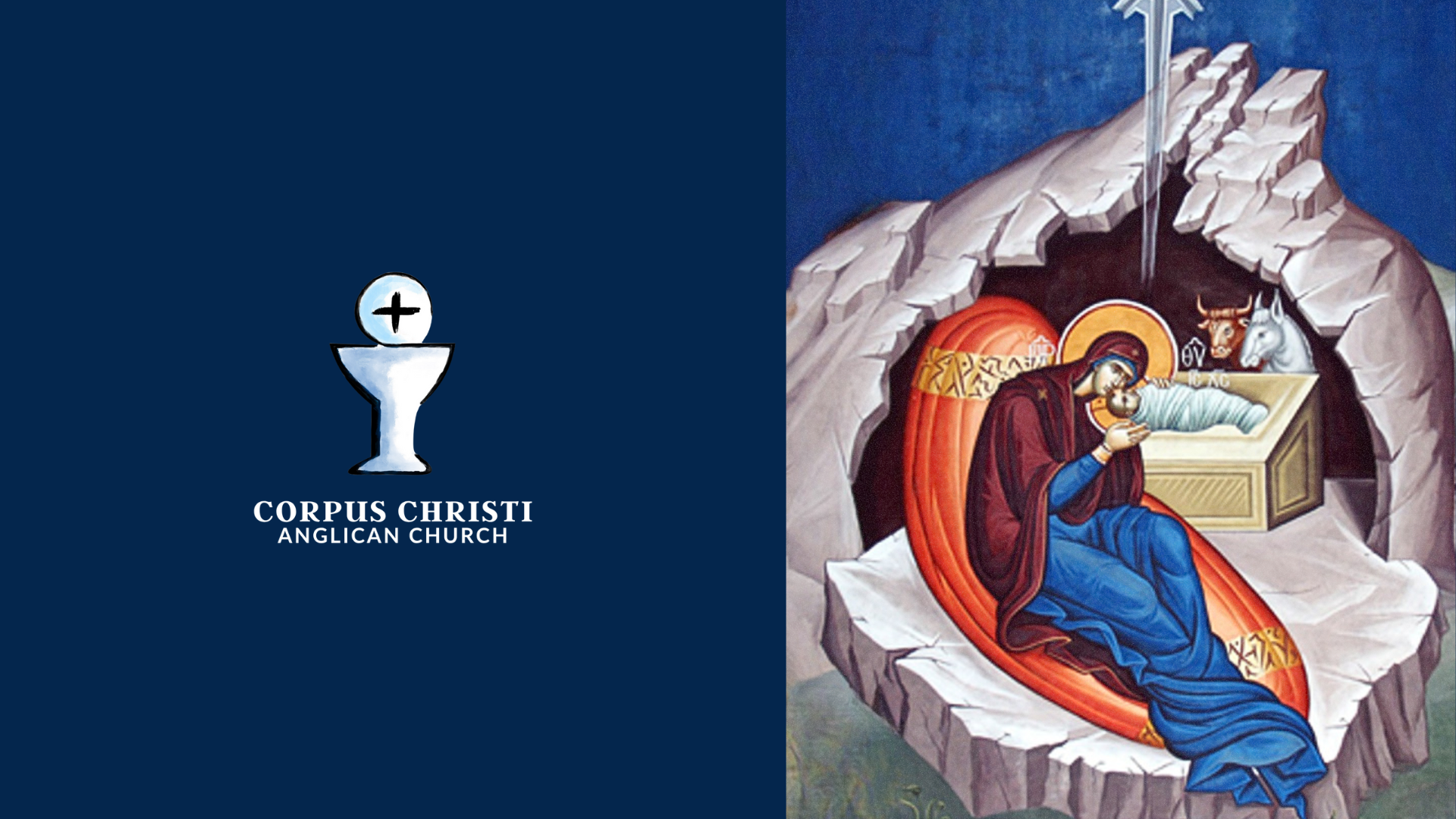
Christmas Eve: Bethlehem Opened Paradise
CONTENT
Intro: Good evening dear friends. Merry Christmas. I’m Fr. Morgan Reed, the Vicar here at Corpus Christi Anglican Church. I am so delighted to have you with us this evening to worship our Lord together.
There is a really neat genre of art called Trompe l’oeil, meaning deceive the eye. One artist named Thomas Deininger has taken it in a new direction by creating objects like a parrot, a bee, a painting, but then if you go around to the side of the object, you realize the whole thing was made from trashed objects. It’s amazing! And I find the whole concept helpful when thinking about the nativity story. There is the image and the pieces that make it. We see details of a story like the famous story about Jesus in swaddling cloths and lying in a manger. We are familiar with the animals of the nativity. There are shepherds and angels. All of these make the nativity story recognizable, but when we turn to the side we begin to see the divine details that compose the story we’re familiar with. God has become human to save us from sin and death and to make all things new. Heaven has been opened and God is inviting us from Bethlehem back to paradise. The realities of this earthly life become windows to heaven to see and experience the kingdom of God that we ultimately long for.
As we look at the Christmas story together today, let me pray for us, “In the name of God, Father, Son, and Holy Spirit, Amen. Lord, may the words of my mouth and the meditation of our hearts be always acceptable O Lord, our Rock and our Redeemer, Amen.”
1) Christ has opened paradise in Bethlehem
The story begins with the setting of Christ’s birth in the context of the Roman Empire. It was during the time of Caesar Augustus, the adopted son of Julius Caesar, who after winning several strategic victories, he had proclaimed himself a son of god. He had, from his perspective, created global peace through his empire and the proclamation about this peace was sometimes called the gospel.
Caesar and Rome are a foil to God’s kingdom and are the historical context as we move to this couple, Mary and Joseph, in the small town of Bethlehem, because of a census that Caesar had called for. They arrive at Bethlehem, which is the town of Joseph’s ancestral lineage. Mary is quite far along in her pregnancy so she comes with him.
When they arrive, they get to the house of either family or a family friend only to discover that the normal guest room is occupied, so they’re given another room in the house. Mary gives birth to a healthy baby boy and at some point after his birth we are given these details about him being swaddled and placed in a feeding trough because they were functionally able to make a soft bassinet out of it.
This is one view of the Christmas story: the manger, the census, even Caesar himself. These historical realities are true but point us to a deeper reality that is going on. Now we move to the component parts of the trompe l’oeil of the story and we begin to see the heavenly realities. We meet the angels who appear in the darkness to shepherds and the glory of God shows up around them and the shepherds are terrified. Heaven proclaims that in Bethlehem, David’s city, is born this day a Savior who is Christ the Lord. This was the hope of Israel and of the nations. A multitude of angels appear and praise God, singing “Glory to God in the highest, and peace on earth among those whom he favors!”
The shepherds are given the details about Bethlehem and the feeding trough so that they can find this child. They find Mary, Joseph, and the child. They are struck with wonder and amazement. Mary is taking note of all that’s going on and pondering them in her heart.
Israel was looking for a Davidic ruler to overthrow empirical powers. What they got was heaven on earth where God became man to rescue humanity from sin and death and bring them back to fully restored life with their creator. There is a beautiful quote from someone in the church’s history about this, where it is said “Bethlehem has opened Eden: Come, let us see! We have found joy hidden! Come, let us take possession of paradise within the cave. There the unwatered stem has appeared, from which forgiveness blossoms forth! There the undug well is found from which David longed to drink of old! There the Virgin has borne a child, and at once the thirst of Adam and David is made to cease. Therefore let us hasten to this place where for our sake the eternal God was born as a little child!”[1]
Christ would live in perfect obedience and union with his father, would be mocked and die on a cross to conquer sin for us, would rise from the dead to conquer death for us, and would ascend to reign on high and make all things new. But first, he must be born, Son of God and Son of Man. He was conceived by the Holy Spirit, fully divine — and born of the virgin Mary, fully human. He took all of what we are as humans to raise it up again into full fellowship and union with the life of God. When we think back to the garden of Eden in the book of Genesis, God’s invitation to humanity was perfect fellowship, a daily walk in the cool of the day, but we were tempted by the voice that called us away from dependence on God and life with our creator to do things our own way in believing that we have the capacity without God’s help to figure it out. This voice tempts us time and time again and as a result creation is broken and we are broken.
The young woman, Eve, mourned because she and Adam were cast out of God’s presence, but she now takes comfort in this young woman, the blessed virgin Mary. Through Mary’s child, paradise is opened again and Eve’s children will stream to it. This child is Emmanuel, God with us, because although we had walked away, God, in his compassion has given us this child to be our savior, who is Christ, the Lord. He is making all things new in the hearts and lives of people by the power of his resurrection and his rule and reign as a promise that he will do it ultimately. And tonight we celebrate the miracle that began it all in wonder with the shepherds who hear the heavens declare the story that God has come to earth in this child and become king of all, that in him all things will be renewed if we simply swear our allegiance to him and trust him as our king and Lord.
Conclusion
As we look at the parts of the story, let’s not get too hung up on a manger or animals. The story that God is telling is the beginning of the end of sin and death. It is the story of God’s plan to make all things new and invite his people into life with him once again. As we consider the Incarnation and Nativity of our Lord, let me close us by praying for us:
“Almighty God, you have given your only-begotten Son to take our nature upon him, and to be born of a pure virgin: Grant that we, who have been born again and made your children by adoption and grace, may daily be renewed by your Holy Spirit; through Jesus Christ our Lord, to whom with you and the same Spirit be honor and glory, now and for ever. Amen.”
[1] Anonymous. Ancient Christian Commentary on Scripture.

Advent 4 (Annunciation): The Blessed Virgin’s Yes
TRANSCRIPTION
For those of you who have come in, later Deacon Grace is a dear friend to our church. Five years ago, probably about this time when we were getting started, we were still meeting in a conference room in Fairfax County Park. Deacon Grace was with us learning as she was doing her schoolwork about what it was like to play at the church in a pandemic.
We're really grateful that you endured that year with us. She preached her first sermon with us, and so she is now a deacon and married to Colin, who is also a deacon. We're grateful to have both of you here this morning.
I'm really excited. Let me pray for you. Heavenly Father, I thank you for Deacon Grace, the ways that you've called her.
Thank you that she's here with us. As we think about the Annunciation this morning, would you bless her and fill her with your spirit. Lord, may we hear from you this morning.
In Jesus' name we pray. Amen. Yes, as Father Morgan said, I have loved getting to be a friend of Corpus Christi.
And it's so good to see you all this morning. And I just want to thank you all for seeing me this morning. You have seen me through being a very excited college student and seminarian.
Chip and Peg, you got to see me through discernment. And now it is just so fun to get to be here as a deacon. So thank you all for always welcoming me back in different ways.
And now would you all pray with me. Stir up your power, O Lord, and with great might come among us. Amen.
This past year, I got to spend the week between Christmas and New Year's at Mepkin Abbey, a monastery in South Carolina. Mepkin is home to about two dozen Catholic monks who open their home to those seeking set-aside time for retreat and prayer and rest. Guests are invited seven times a day to join the brothers in the Liturgy of the Hours, beginning at four o'clock in the morning and going until eight o'clock at night.
At the end of the day, just before their service of Compline, before bed, the day's prayers finish with the brothers bidding all those who are gathered to turn toward a statue of the Virgin Mary. Her arms spread and welcome, the smile on her face as the lights are turned down. All are invited to sing the Salve Regina, an ancient prayer, and for them somewhat of a bedtime lullaby, which, since I heard it for the first time, often makes its way into my mind.
They sang, Hail Holy Queen, Mother of Mercy, our life, our sweetness, and our hope. To thee we cry, poor banished children of Eve. To thee we send up our sighs, mourning and weeping in this valley of tears.
Turn then, most gracious advocate, thine eyes of mercy towards us. And after this exile, help us to see Jesus, the blessed fruit of thy womb. O clement, O loving, O sweet Virgin Mary.
The song of these brothers and of other Catholics around the world is appropriate for today, as we have reached our final Sunday in Advent. We began our first week with the call to stay awake and watch for the Lord. Moving toward the flame of our second candle, bringing the light and the promise of a kingdom that is not of this world, where violence will be no more, and a little child will be crowned as king.
Hearing again last week on our third Sunday, the call to rejoice in the midst of the dark chaos of this world, and beholding the altar covered in rose-colored cloths. And today, hearing twice, the Virgin shall conceive and shall bear a son, and they shall call him Emmanuel. This particular Sunday at Advent's end is traditionally devoted to the Annunciation, remembering the Blessed Virgin Mary's resounding yes to hear the will of God and do it.
Mary, as heard in this devotional lullaby and in our scriptures, helps us to see Jesus. In her yes, as she proclaimed, behold, I am the servant of the Lord. Let it be to me according to your will.
Saint Mary's role in salvation's story was a role unlike any other. Chosen to be the mother of God, saying yes to receiving God in Christ in her very being, and going before all those who would come after her who would also receive God in Christ, beginning the family of the church. As Saint Augustine writes, she gave milk to our bread.
In our Protestant context, Mary's role can be difficult to discuss, as it is often passed over or put to the side. Yet this Sunday in Advent is an invitation to not pass Mary over, to look to her as she is told of in scripture and in the tradition of the church, and to enhance our devotion to Jesus through her devotion to him, and to echo her resounding yes. The yes that came from the lips of she who is blessed among women, the first to receive the Holy Spirit within her, the one whom Jesus chose to be closest to first, and in many ways, who is the first disciple, the mother of the firstborn of a large family, in whose yes the church echoes her own resounding yes.
In our scriptures today, Saint Mary's yes is not the only yes that we hear. We cannot forget the yes of Saint Joseph, son of David, spouse of Mary, who echoes Mary's yes in his own, leading the train of all who would come after Mary to say yes to God. Today in our gospel reading, we find Joseph asleep, perhaps sleeping fitfully, after receiving the news that the woman he was engaged to was expecting a baby that was not his, and turning the unlikely story she told him of a visit from an angel over in his mind.
In his dreams, Joseph too receives an angel's visit, carrying the command of the Lord on his wings, as he says, do not fear to take Mary as your wife, for what has been conceived in her is of the Holy Spirit. She will bear a son, and you shall call his name Jesus, for he will save his people from their sins. This child, the angel says, is the fulfillment of centuries-long waiting for God to come to be with his people and to bring their salvation.
Today, the day of salvation has arrived, held in the home of Mary's womb. And Joseph, we hear very simply, wakes from sleep and does what the angel of the Lord commanded him, taking Mary as his wife and calling the child's name Jesus. These yeses of blessed Mary, mother of God, and Saint Joseph herself, a preteen girl and a man in his early twenties, or by some traditions, a widower, those chosen among women and men to be the mother and the guardian of the Christ, who received the one whom all the world had been waiting for, were yeses to God and yeses for the sake of all who would belong to him through Christ, helping us to see Jesus and to say our own resounding yes.
Yet, these yeses were not easy ones to say, for as both said yes to God and Christ, both also were saying yes to public shame, to gossip and ridicule, to an inexplicable and improbable situation of a virgin conceiving and bearing a son, saying yes to lives that would be marked forever by receiving Christ as their own. Ultimately, they said yes to being associated with Jesus. They said yes to a life of destitution, fleeing a violent king and seeking safety in a country far from their home, and living life as refugees.
They said yes to the promised Messiah, born on a straw-covered stable floor, whose childhood was spent not in the soft clothing of king's houses, but among the wood and the nails of a carpenter's shop, who grew up to be a poor man with no place to lay his head, who came to his own and whose own did not receive him, whose words were both gentle enough to calm the raging of the seas and hard enough to refine the hearts and the hands of his hearers as precious metals tried in the fire. Who came to save his people from their sins and who said that anyone who does the will of God is his mother or sister or brother. Our own yeses to God are not easy yeses to say, for we too say yes to the inexplicable and the improbable, that the virgin did conceive and is born a son.
We say yes to lives marked forever by receiving Christ as our own, to love and to serve him with all that we are, to bring ourselves before him in daily prayer, to affirm our faith of he who came down from heaven, was incarnate from the Holy Spirit, and was born of the Virgin Mary. We say yes to the discomfort of opening ourselves before Christ in the confession of our sins, shoulder to shoulder with one another on Sunday mornings, in the quiet of our own homes, or in the hearing of a priest, to seek to be those who, as the psalmist says, who have clean hands and a pure heart. We say yes to receiving the challenge of the scriptures, to seeking Jesus and seeing him as he is, not what we wish he might be.
Trusting in his words, both gentle and hard, and allowing ourselves to be refined as precious metals in the furnace, that we too may be numbered among those who do the will of God, be made members of his family. With Blessed Mary and Saint Joseph, we too say yes to association with Jesus, he who is the king of glory, whose earthly throne was in the depths of dust, heeding his call to embrace those who, like him, are hungry and thirsty, whose need is very visible, who are strangers longing to be welcomed, and who, like him, have no place to lay their head. We say yes to seeking his face in theirs, standing with and for the least of these, as we stand with and for him.
Yet, above all else, our yeses to God are yeses to the life that really is life. They are yeses to the Christ who came that we may have life and have it in full measure, who is the light of the world, whom the darkness cannot overcome, to whom, in Saint Paul's words, we are called to belong to, and through whom we have received grace, who is the son promised so long ago through the prophet's lips, whose name is called Emmanuel, our God with us, who desires nothing but the love and devotion and resounding yes, of those whom he has loved and devoted himself to and has already said a resounding yes to. In just a moment, we will be invited to the altar to receive God in Christ in the Eucharist, the pledge of his yes to us, receiving him again into our very bodies as Mary received him into her womb and being given the chance again with our outstretched hands to say our yes back to him.
And as we go forth from this place, sustained by his sacrament to love and serve the Lord, awaiting the arrival of Christmas in this week to come, we will receive Christ again as we remember his birth, his yes to us as he came here to make his home. Amidst the gifts given, the strains and song of carols, the scent of pine and the candlelit faces, the loved ones visited or welcomed, the family and friends whom we grieve, and the faces that we are not able to see, we will be invited to say yes again to the one who said yes to us in his first coming, entrusting ourselves and all that this week stirs up in us into his loving care. And finally, as this season of Advent ends, anticipating Christ's second coming in extra measure, and as we have been reoriented to look together towards the day when he will come again to be with us, when we will see him face to face and we will stand before him with his arms of welcome and his eyes of mercy and his lips that have already said yes to us, we will be invited again to say yes to God.
May our answer now and then and always be a resounding yes.
Transcribed by TurboScribe.ai.

Advent 3: A Testament of Faith — The Power of a Loving Church Community
cONTENT
Good morning friends, it is an honor and a privilege to be able to share my story with you all today. As Morgan said, my name is Spike Douglass, and together with my wife, Nasya, we are on staff here at Corpus Christi as your worship music directors. I am somewhat of a rarity here at Corpus Christi, in that I am what you would call a “cradle Anglican.” Both sides of my family have deep roots in the Episcopal and Anglican church, especially through my grandfather, who was an Anglican priest his whole career. However, in spite of that deep familial connection, (or maybe because of it), I didn’t really find a home for myself in the Anglican church until after college and into adulthood, which is when I really made my faith my own.
Today, as I share part of my story with you all, I want to frame it in the context of our passage from James, where we are called to be people of integrity in loving community who pray with faith. And within that call, there are three main ways of being that I want to focus on: the first is that the church community is patient, the second is that our community is prayerfully compassionate and confessional, and thirdly that our community is restorative. With that in mind, let me pray.
Lord, let the words of my mouth, and the meditation of all our hearts, be acceptable in your sight, O Lord, our rock and our redeemer. Amen.
So firstly, the church community is patient. I think one of the main ways my childhood faith journey was formed was really through patience. When I was quite young, about 5 years old, my family belonged to a small church mission. It was about the size that Corpus Christi was when I first started attending back in early 2022, about 30ish people on a good day.
This mission was a small group of people who were part of a well-established church on the far side of the Las Vegas Valley who were tired of driving an hour across town on a Sunday morning. I think a lot of my waiting during this time really came from waiting to see how, or if, our mission would grow and become more well-established.
As a kid, I remember my parents feeling proud that our little mission kept finding ways to survive, moving from hotel conference rooms to more permanent office space, and even being able to march in the annual Nevada Day parade in town one year! But overall, I also remember feeling the frustration of my parents on the stagnant size of the mission, and I think the effects of the 2008 recession drove the nail in the coffin for this small group, as our members were scattered across the country, and the world.
That scattering included my own family, as my dad was transferred to the international department of his company, and we moved to Doha, Qatar. Our patience looked different here, as the church family we found ourselves a part of was the largest Anglican church in the country. Our waiting here was for our permanent church building to be completed, which took 6 years from when we joined that church to the opening of that building.
The patience was well worth it, as the permanent building gave us a chance to centralize our church community in one place, support the smaller Anglican congregations in the country by providing them with a place to worship as well, and be a true representative of the Anglican Communion in Qatar.
But perhaps the biggest area of my faith journey where I exercised patience with the prayerful support of my church community was with my early relationship with Nasya. For those who don’t know, Nasya and I were high school sweethearts. We met in our youth group and started dating at the end of my senior year of high school, right before I moved away for college. For seven years, we were in a long-distance relationship, with Nasya in Doha, and then Canada, and myself at school in Virginia.
When people say long-distance relationships are hard, they’re not kidding! But thankfully, we both had a strong relationship with the Lord, and we were able to find comfort in him while apart, and the times we were together were even better because we were able to be in each other’s presence and get to pray together, worship together, and spend precious time together.
One of the things I remember most about that time spent apart from each other is actually how truly welcoming and excited all of you were in the lead up and anticipation of Nasya moving here to Northern Virginia! I will never forget the kind words you all shared with me during this time, whether it was sharing your excitement that she was coming, asking about ways to help her transition to life in the US, and especially the ways this church supported us last year during the lead up to our wedding. I know that this community was one of the main reasons Nasya and I were able to so quickly become comfortable living in this area and “doing life” with all of you.
The second way we are called to be a church community is by being prayerfully compassionate and confessional.
Some of my biggest faith moments have been through compassionate prayer. I remember in high school, I joined my youth group on several mission trips to Nepal, where we spent time meeting with the Nepali people in Kathmandu and the surrounding villages, taking time to talk with them, help with chores, hear about their daily struggles, and pray healing prayers for them.
I’ve seen the true power of prayer at work in these moments, where we heard that folks who prayed with us there saw miraculous healing of their injuries and maladies, and where we were able to discern through prayer the needs of the local community there and help in any way we could.
Prayer also doesn’t just need to be silent or spoken. One of the most powerful areas of prayer I have seen not only in my own faith journey, but in all the church communities I have been part of, has been through praise and worship. Some of my closest “come to Jesus” moments have been during worship. I regularly find myself overcome with emotion during the communal singing of hymns and songs of praise. In high school, Nasya and I were both worship leaders in our youth group, and it has been such a blessing to be able to continue to share the love we have for leading worship with Corpus Christi.
Confession has also been a powerful time of prayer and reconciliation for me. While in college, I did not have a church family, but I was part of a campus ministry in which I was heavily involved. The pastor here was a great man, strong in his faith and always ready to lend an ear to the students in his care. I felt very lost in my walk with Christ during college without a strong church foundation, and there were definitely times where I made some less-than-questionable decisions. But having a strong mentor in the faith to confess my shortcomings to and work through scripture together to find reconciliation helped me be able to set my heart right for post-graduation, and open my heart to finding a new church community again.
And this leads into my third point, which is that the church community is restorative.
After I graduated from college, I moved back to Las Vegas and back into my parents’ house. I found work on a ranch in central Nevada, where I lived and worked 4 days on and 3 days off at home. Since I was on the ranch over the weekends, I still did not have a church family to really plug into. I like to think of that summer working on the ranch as my days literally wandering the wilderness, not knowing what I was really doing with my life yet or how to get started.
After deciding I should actually figure out how to use the degree in Political Science I had just spent 4 years earning, I quit that job on the ranch and decided to take a leap of faith and move to the DC area to start looking for work. I had no job leads, no housing lined up other than my best friend’s couch for a couple of weeks, and no real community here. For the first three months living in Springfield, I was unemployed, living off my meager savings and whatever gig work I could occasionally find, and feeling like I had made a huge mistake. I consider this period of time as my days of figuratively continuing to wander the wilderness.
Eventually, I was able to find employment, and I was able to start getting back onto my feet. That Christmas was when I proposed to Nasya, and after returning to Springfield after the holidays, I decided that I was done finding excuses to not find a church to plug into. It was time to see if I had any real connection to the faith that my parents tried to instill in me growing up.
After literally googling, “Anglican churches near me,” Corpus Christi popped up as only a mile away from where I was living at the time, so I said, “What the heck,” and went to check it out that following Sunday.
I still vividly remember Morgan being taken aback that anyone would visit this little mission! The first thing he said to me after hello was, “How did you even find us??” I could tell even on my first visit that this church was where God was calling me to be.
I was instantly comfortable in the liturgy, finding it very close to what I was used to growing up, but with enough differences from how any church that I attended with my parents worshiped that I could call this church my own. I started becoming a regular attendee of Corpus Christi and participated in our first Members Sunday. I threw myself headfirst into being a member of the body of Christ in a way that felt completely natural and unforced. This congregation, you all have become a family for Nasya and me in a way that means so much to us, especially with our own families so far away.
In closing, the church community that has been built at Corpus Christi is one of the strongest, healthiest, and godliest communities I have been lucky enough to be a part of. Our call to be people of integrity in loving community who pray with faith is truly realized in the day-to-day interactions of the body of Christ here in Springfield, and I find myself lucky and blessed to be able to call this church my home.