The Baptism of Jesus: Chaos No Longer Reigns
CONTENT
Introduction
Good morning friends. It is so good to worship with you all this morning. On this first Sunday after the Epiphany we celebrate the baptism of Jesus. The moment of Jesus’ baptism was reminding me this week of when I collected rocks as a kid. I have these opals that I got when I was little. If you let them dry out, they look completely unassuming, like a normal rock, but once you put them in water they shine with amazing colors, and if you were to turn the lights off and shine a black light on them, they will radiate with amazing neon hues. It reminds me of Jesus’ baptism because what we have is an unassuming picture of a man being baptized, but then what happens is the curtain is pulled back and the glorious vision of heaven in the ministry of Jesus is revealed. The kingdom is inaugurated and sheds light on the rest of his ministry.
This will be the beginning of the ministry of the Messiah and what unfolds in Jesus’ ministry has the full energy and work of the Triune God behind it. In the baptism of Jesus the rule and reign of God is made known to the powers of darkness, creation anticipates its renewal, and the Trinity reveals its working in our salvation. As we look at Jesus’ baptism this morning, let me pray for us:
“In the name of God, the Father, the Son, and the Holy Spirit. Amen. Lord, may the words of my mouth, and the meditation of our hearts be always acceptable in your sight, o Lord, our Rock and our Redeemer. Amen.”
1) Jesus comes to be baptized — to bring justice and undo the powers of darkness. (3:13-15)
Jesus is roughly 30 years old when we meet him at this point and he is going to begin his public ministry. He has come from the North in Galilee, and makes the trek to Judea to see John. This is no accident. It’s about a 70 mile walk, so Jesus is very purposeful in making this trip to begin his ministry. John had just finished preaching to the crowds about the Messianic figure to come. He is talking about final judgment, the winnowing fork and getting rid of the chaff, and this Messiah’s future baptism being one of the Holy Spirit and of fire. This crowd is primed to see something miraculous.
There’s something recognizable about this Jesus, but initially this image is quite unimpressive. John greets him with the recognition that Jesus is the one he was talking about. He should be baptized by Jesus, not the other way around! How can Jesus come to John’s baptism which is for repentance and the forgiveness of sins when Jesus is one who has committed no sin? There has been a lot of ink spilled over this problem throughout church history. There are a couple of important things to think about here. First, he could have come with the full manifestation of his glory as the king who will judge, but instead, his kingship begins with the humble identification with penitential humanity. He will join them in their trials and sorrows, even being made fully like them in their death. John the Baptist would have been the big celebrity in this moment, and Jesus begins his ministry without any show or pomp at the waterside with the rest of troubled humanity.
The second thing to name is the sacramental quality of this act. Hilary of Poitiers says this: “He had no need for baptism. Rather, through him the cleansing act was sanctified to become the waters of our immersion.” This is perhaps intertwined with what it means when Jesus tells John that he has to be baptized to fulfill all righteousness. John’s question is why would Jesus need to be baptized? Jesus says, “Let it be so now; for it is proper for us in this way to fulfill all righteousness.” He isn’t talking about some reformational idea of personal justification. That would be anachronistic and completely foreign to early Judaism. He is talking about the arrival of God’s kingship where all that has been turned upside down by sin, injustice, and death will be put right again. The baptism is the beginning of the display of God’s kingship. Jesus is baptized to begin to put an end to the powers of darkness and evil. This is how the judgment will come about that John had predicted before Jesus showed up!
2) Jesus is baptized — To make holy the waters and bring new life. (3:16)
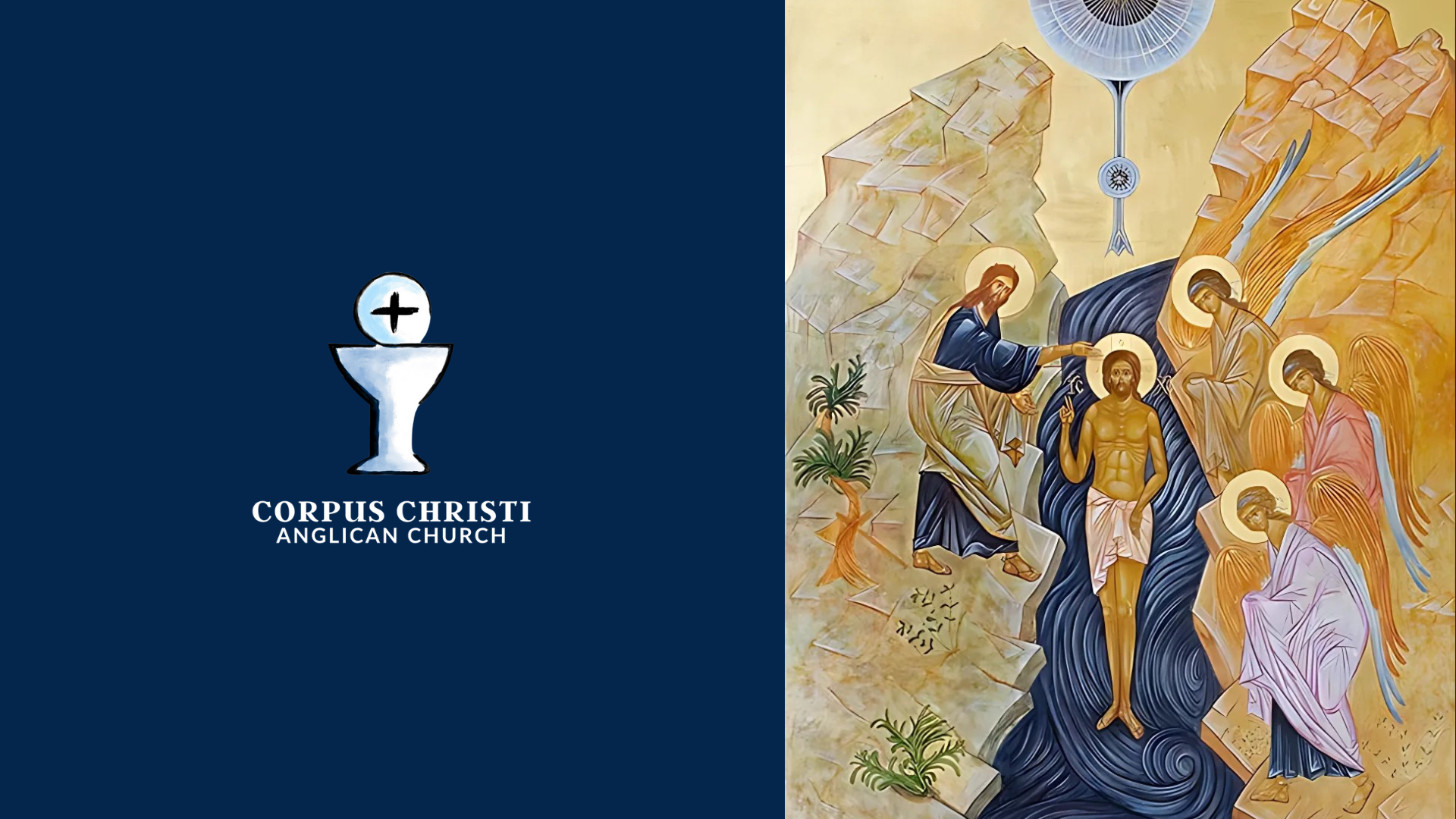
Second, Jesus is baptized to sanctify the waters and bring new life. If you look at a lot of Eastern icons of the baptism of Jesus, he is not fully submerged in the water. As far back as one goes into the Old Testament, the waters are always mythologically representative of chaos. This is why in Psalm 29 the LORD is said to sit enthroned over the flood. Whether we’re talking about the flood of Noah or the floodwaters destroying Assyria in Nahum, or even back to creation itself where the waters represent the formless and void chaos before creation is rightly ordered, the waters are representative of a destructive force of chaos. Jesus is not fully submerged by them because he created them and will not be overcome by them. Instead, by entering them he has sanctified the waters so that what was an instrument of death becomes the material means of new life thereafter.
Jesus’s baptism is a cosmic renewal that points to the renewal that all creation longs for. All creation longs for its proper use once again and here Jesus restores the waters so the Spirit who hovers over the waters, utilizes them to restore God’s image in God’s image bearers.
As Jesus comes up from the waters the text says that the Spirit of God descended like a dove and was alighting on him. There are several images coming together here and this is certainly not comprehensive, possibly both the Spirit who hovered over the waters of chaos and the dove that came back to Noah. This is the only place in the New Testament where the Spirit is compared to a dove and when we think back to Noah, the dove that had been sent out after the flood returned with a symbol of new life that signified the renewal of creation. Here again the Holy Spirit comes as the one who effects the new life and this begins the ministry of Jesus. The arc of the narrative of the Messiah’s glory as king will be marked by miracles, but also by deep betrayal, falsehoods, the powers of the kingdom of darkness, death, and descent into Sheol. And yet the Spirit is alighting the entire ministry so that what comes through His death is resurrection, the conquering of death, renewed creation, and new life for the followers of Jesus who will reign with him in his glorious kingdom which begins here at this baptism. We join him through baptism in a death like his so that we are raised with him in a resurrection like his. We are brought into His kingdom so that we might reign with him. What began as a familiar, but unimpressive image of the Messiah coming for baptism has turned into a full-blown theophany on the level of God coming at Mount Sinai.
3) The Trinity is involved in transferring us to this new kingdom — Sonship and reigning (3:17 // Isa 42 // Ps 2)
Jesus was baptized to destroy the powers of chaos, death, and evil. He was baptized to sanctify the waters and bring us and all creation into new life and renewal. Finally, His baptism brings us into a new kingdom. In verse 17 the voice of the Father in Heaven ratifies the kingship of Jesus with a declaration “This is my Son, the Beloved, with whom I am well pleased”. This brings together two important Old Testament images. First, we read Isaiah 42 today which has the Spirit of God falling on God’s chosen servant that will bring the deliverance about for God’s people. This verse does not use the language of sonship, but Psalm 2 famously does, which is where God says “You are my son, today I have begotten you”. And this psalm is a famous enthronement Psalm for the Davidic ruler as a son of the Divine Ruler, YHWH. The Servant of God and Son of God are manifested here in the person of Jesus, spoken by the Father, illumined and empowered by the Spirit. The life of the Triune God was showing forth from the waters. Everything that happens from here on out is to the end that Jesus rules and reigns as king over all.
The image of Jesus ruling and reigning over all as judge is still true, but what is more important is how he gets there. He begins with this full identification with broken humanity and lives the rest of his ministry out in the light of the life of the Trinity. He will see triumphs and miracles, he will have people walk away, he will be misunderstood and betrayed, he will take moments to be off in fellowship with God in prayer, he will be surrounded by noisy crowds — All of this is framed by the God’s manifestation and ratification of his kingship here at his baptism.
Conclusion
The same is true for us. Baptism, for us, is nothing less than a ratification of the victory of God for his people. In the baptism of Jesus the rule and reign of God is made known to the powers of darkness, creation anticipates its renewal, and the Trinity reveals its working in our salvation. What is true cosmically is true personally for each one of us and I want us to have this at the forefront of our remembrance today as we support Caedan in his baptism. As Caeden comes to be baptized you are seeing someone renounce sin, evil, and darkness, to turn from the kingdom of darkness and who is being brought into the Kingdom of the Son. He is going to be given the Holy Spirit and the rest of his days are framed in the light of the Spirit’s work and his story is connecting the dots of the manifestation of the reign of Jesus the Messiah in his life and in the lives of those he meets. Each one of us is called to pray for him and renew our own vows as we remember what God has done for each of us in this same baptism we share with him. As we remember the baptism of Jesus, remember your baptism. Remember that your story is part of this cosmic renewal where God is making his kingdom come on earth as it is in heaven. Let me pray for us:
Give us, O Lord, a steadfast heart, which no unworthy thought can drag down; an unconquered heart, which no tribulation can wear out; an upright heart, which no unworthy purpose can tempt aside. Bestow upon us understanding to know you, diligence to seek you, wisdom to find you, and faithfulness that finally may embrace you. Amen.