Feast of the Holy Innocents: The Incarnation and the Hope for Grieving Humanity
CONTENT
Introduction
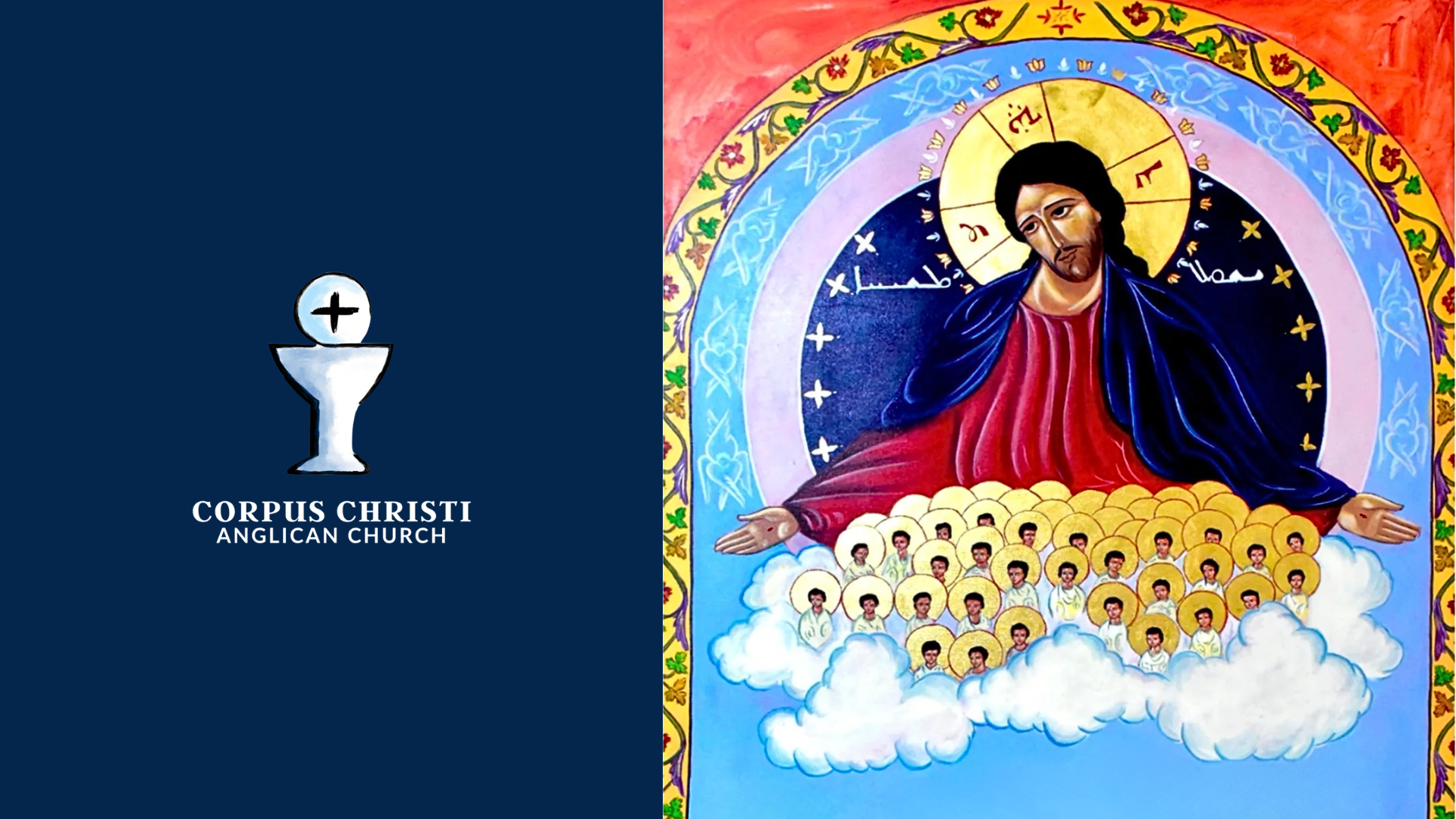
Good morning friends. Welcome to Corpus Christi Anglican Church. I’m Fr. Morgan Reed, the vicar here, and I’m so glad you’re here on this 4th day of Christmas. After the celebration of Christmas day, the next three days in the church calendar are commemoration days. The first is the stoning of St. Stephen, the second is the exile of St. John the Apostle, and finally, today is the slaughter of the holy innocents by Herod. The church has often referred to these people on these days as the Comites Christi, the companions of Christ. They embody three kinds of martyrdom: 1) Those who willingly took up their cross and it cost them their lives, 2) Those who willingly took of their cross and suffered for it, though not to the point of death, and 3) those who took up their cross without having the ability to choose to do so.
I know it might feel really strange to have these heartbreaking commemorations in the middle of the happiest season of all, but if you are at all acquainted with the brokenness this world and the cruelty of sin and evil, then you can appreciate that the joy is not in the season itself, it is in the incarnate son of God coming to triumph over the darkness. One writer says it well: “God knows the evil and suffering that plague our world and has dealt with it decisively in Jesus Christ. In a world of darkness and death, the God revealed in Christ brings light and life.”[1] In our Gospel passage we see the light of God coming into the world as one who is a new Israel, the holy remnant, and the branch of Jesse. As we look at our Gospel passage together this morning, let me pray for us: “In the name of God, the Father, the Son, and the Holy Spirit, Amen. Lord, may the words of my mouth and the meditation of our hearts be always acceptable in your sight O Lord, our Rock and our Redeemer. Amen.”
1) Contrast of Joseph and Herod — How to respond to fear (Hos 11:1)
Jesus is the idealized Israel who will be brought out of Egypt. At this point in the Nativity story, Jesus is perhaps 1 or 2 years old and he has just been visited by the Magi from the East who offer him their gifts. The Magi leave and the story focuses in on Joseph. We are not told much about the life of Joseph in the Gospels, but this event gives us a window into his faithfulness as a follower of God. An angel comes to him in a dream warning him about the evil schemes of Herod. The angel tells him to take Mary and Jesus and go to Egypt.
Here, Joseph takes Mary and Jesus by night for a trip that is, at minimum, a twelve hour walk. They have gone from these miraculous moments of joy where shepherds and angels are declaring wonders, where Magi are following a star to find them, to fleeing as refugees under the cloak of darkness. Just as Mary is obedient to the will of God, so Joseph also shows us his characteristic obedience to following the Lord’s command.
Egypt was a natural place to go since it had a large Jewish community and even an alternate temple set up there. But there is a theological reason for being there. God was making a new Israel in the person of Jesus to come forth out of Egypt. This is what St. Matthew means by quoting Hos 11:1 “Out of Egypt I have called my son”. It is a reference to Israel being brought out of slavery in Egypt and into the promised land. What Israel was penultimately, Jesus becomes ultimately as he typologically fulfills what they were supposed to be.
Joseph’s willingness to take his family to Egypt on God’s command makes him an ideal father for the Messiah, someone to emulate. He is a contrast from the tyrannical Herod who is set on destroying any potential political rivals and has no regard for the plan of God. Darkness is rising up and trying to destroy the light of the world, but the light escaped by night to Egypt and thwarted the powers of evil. I like how NT Wright describes this scenario: “Before the Prince of Peace had learned to walk and talk, he was a homeless refugee with a price on his head...”[2] And this is how our king began his reign. God was preserving the light so that justice and true freedom would be brought to the world.
2) The threat of God’s kingdom to the powers of darkness — Tragic death of the infants (Jer 31:15)
Jesus is the idealized Israel who will be brought out of Egypt. Jesus is also the holy remnant will be brought back from exile. While the Holy Family is in Egypt, Herod attempts to get rid of the Messiah by ordering that boys two and under in Bethlehem be executed. It is so horrible to consider how someone could consider indiscriminate infanticide; and it is very in line with what we know of Herod. This atrocity doesn’t even show up in documents outside the Bible and this is because on the level of atrocities Herod committed, this is actually less worse than others. This is someone who had his own wife and children executed out of a paranoid fear that they would usurp his power. Someone in Roman history once said it was better to be Herod’s dog than his son. Herod is a pawn of the kingdom of darkness and shows us the disdain and disregard of tyranny against human life that is so endemic of the spiritual forces that war against God’s good creation.
Matthew mentions that this massacre stands in a long line of moments that fulfill Jer 31:15, but it carries a special significance here. God is not the author of this tragedy, but this tragedy was not unforeseen by God either. In the midst of a very joy-filled passage about the new covenant we hear about the voice that is heard in Ramah, wailing and loud lamentation, Rachel weeping for her children; she refuses to be consoled because they are no more.” It was in Ramah that the exiles were gathered for their march to Babylon in 586 BCE.[3] Ramah was in the territory of the tribe of Benjamin, who was one of Rachel’s two sons. And while Bethlehem would have been in Judah’s rather than in Benjamin’s territory, this is the place near where Rachel was buried.[4] This is why Rachel is pictured as weeping over the holy innocents in Bethlehem.
Her weeping is for the grief over the loss of her children. And in its context, it also anticipates God bringing her children home. Grief and hope are both honored and sit side-by-side in the prophetic imagination. The tragedy in Bethlehem was real. It is a loss no one should have to bear. It also is endemic of the battle raging between the light of Christ and the darkness of the ruler of this world. This battle still rages on. It happens in the injustice carried out by tyrannical despots. It happens through the injustice of broken systems and institutions. It happens in the harm done by family and friends. It happens in the loss of hope when dreams are not realized or when we receive unplanned and tragic diagnoses. It happens in the words we say that we wish we could take back or the words we wish we had spoken. There are certainly times to join Rachel in weeping for her children. And when we join Rachel in her weeping, we can hold the tension of also joining her in her hope because God will bring his kingdom about in the midst of darkness.
In her excellent book on the Christmas season, the Rev. Dr. Emily Hunter McGowin says this about this event, “When the Christ child grows up, he will gather the girls and boys of Israel in his arms and proclaim God’s blessing over them. As the the holy innocents died involuntarily in the place of the infant Jesus, so the end of Matthew’s Gospel reveals the innocent one dying voluntarily in the place of all. It is only in his victorious resurrection from the dead three days later that Rachel, and all weeping mothers, find hope. Death — even this kind of unthinkable death— does not get the last word.” In this child there is hope.
3) The hope of Jesus even when we can’t see it yet — The wisdom of going to Nazareth and the plan of God (Isa 11:1 — the branch)
We have seen Matthew picture Jesus as the new and ideal Israel as well as the new and ideal remnant. The final picture we have is that he is branch from the tree of Jesse. The Holy Family has spent a few years as refugees in Egypt at this point. We don’t know how old Jesus is when they return but he could have been as old as 5-7 years of age. It is interesting to think that Jesus spent his preschool and kindergarten years in Egypt.
Joseph’s life had been turned upside down by this child. And despite a path he wouldn’t have chosen and years in exile because of his son, he remains faithful to the Lord. The Angel of the Lord appears to him in Egypt to let him know Herod has died and Archelaus is now overseeing Judea. He can go back. Joseph is no fool. Archelaus isn’t much better than Herod. He was so violent and oppressive that even the Romans, even the Romans!, would come to depose him and replace him with someone else. Rather than bringing his family in near proximity to another bloodthirsty tyrant, he brings the blessed virgin Mary and Jesus to the insignificant, backwater town of Nazareth.
St. Matthew finds the significance of this moment in Isaiah’s prophecy: “He will be called a Nazorean”. This is an allusion to Isaiah 11:1 which talks about a shoot that will come from the stump of Jesse and a branch (נֵצֶר) will grow out of its roots. The word play is on being a Nazarean, and the word for branch “a Nézer”. In Isaiah hope seemed lost as the tree was cut down, but hope would spring up from the felled tree as a shoot would come from the stump. I preached on Isaiah 11 back on Advent 2 if you want to go back and listen to that sermon. Here we see God making good on his promise that hope is not lost. The branch of Jesse has shot up from the tree that was cut down.
Conclusion
Jesus entering into the pain of the human predicament began before he uttered a word. He has parents raising him who say “yes” to the Lord’s will at all costs and their faithfulness was part of the plan of the light entering the darkness and not being overcome by it. The feast of the death of the holy innocents invites us to hold hope and grief in tension. We live in the liminal space where the darkness of sin and death exists side-by-side with the breaking in of the new creation that is dawning. Mourning and hope can be held in tension and live in the same space for the follower of Jesus. Jesus is the new Israel, the righteous remnant, and the branch who will conquer. He is emmanuel, God-with-us, and the darkness won’t overtake him. Rather than simple answers, we hold onto God’s promises as he gives us his presence. The victory that Christ has won will be our own ultimately and as we wait in the tension of hope and grief, we sing and pray with candles lit, lamenting in hope, defiantly proclaiming that Christ is Lord, clinging to his promises, and tuning in to the glimpses of light where brokenness is restored as a foretaste of the ways he is making all things new.
Let us pray:
Almighty God, out of the mouths of children you manifest your truth, and by the death of the Holy Innocents at the hands of evil tyrants you show your strength in our weakness: We ask you to mortify all that is evil within us, and so strengthen us by your grace, that we may glorify your holy Name by the innocence of our lives and the constancy of our faith even unto death; through Jesus Christ our Lord, who died for us and now lives with you and the Holy Spirit, world without end. Amen.
[1] Emily Hunter McGowan, Christmas, 98.
[2] Matthew for Everyone.
[3] Jer 40:1.
[4] Gen 35:16-20; 48:7.