
SERMONS
Archive
- July 2026
- June 2026
- May 2026
- April 2026
- March 2026
- February 2026
- January 2026
- December 2025
- November 2025
- October 2025
- September 2025
- August 2025
- July 2025
- June 2025
- May 2025
- April 2025
- March 2025
- February 2025
- January 2025
- December 2024
- November 2024
- October 2024
- September 2024
- August 2024
- July 2024
- June 2024
- May 2024
- April 2024
- March 2024
- February 2024
- January 2024
- December 2023
- November 2023
- October 2023
- September 2023
- August 2023
- July 2023
- June 2023
- May 2023
- April 2023
- March 2023
- February 2023
- January 2023
- December 2022
- November 2022
- October 2022
- September 2022
- August 2022
- July 2022
- June 2022
- May 2022
- April 2022
- March 2022
- February 2022
- January 2022
- December 2021
- November 2021
- October 2021
- September 2021
- August 2021
- July 2021
- June 2021
- May 2021
- April 2021
- March 2021
- February 2021
- January 2021
- December 2020
- November 2020
- October 2020
- September 2020
- August 2020
On Jesus and the Poor
TranscriptioN
Good morning. I'm Alexi Laushkin, a member here at Corpus Christi Anglican Church. Let's pray together.
“Gracious Father, we thank you for these words from the Gospel of Luke. May they touch our hearts. May what is from you and throughout the centuries of the Church meet with us who live in a relative place of prosperity today. In the mighty name of Jesus. Amen.”
This is not the Gospel of Luke passage, a particularly easy passage of Scripture, and it's not one that's often preached on or talked about, in part because we don't necessarily like, as modern Christians, this conflict between the rich and the Gospel. It's uncomfortable. Does it literally mean that someone who is rich and unable to think about the poor and who has oppressed their neighbors will go to hell? Feel that tension. Does this Gospel really mean that? Is this another in the line of the teaching of “it's easier for a camel to go through the eye of a needle than to inherit the kingdom of heaven”? Is this one of these teachings out of the Gospel where you have the rich ruler, and another teaching of the Gospel, come to him and say, “Lord, what must I do to inherit eternal life?” And Jesus says to him, “Sell all your possessions and follow me.” Does that mean that the rich must sell all their possessions to follow the Lord? Feel the discomfort of this Scripture.
I certainly did in preparing for it. So I'm going to give kind of three overviews as we go through the Scripture. One, talking about the text itself in light of the tradition of the Gospels: Luke, Matthew, Mark, and John. The second, the tradition of the Church as it relates to the poor, talking about Franciscans, Methodists, William Wilberforce, part of what we should think about today. And third, practical application for what it means for us in Northern Virginia, in our personal habit, in our close personal relationship, and the practical vision of our Church, which is to be a people transformed by the Book of Common Prayer, uncommonly together.
So the Gospel of Luke passage—what do the Scriptures have to say about the poor? Well, Luke, if you're a student of the Gospels, is particularly focused on the least of these, the poor. In parts of the Church and the tradition of the Church, you might hear Roman Catholic brothers and sisters talking about the preferential option of the poor. What do they mean by that? That God has a special place in His heart for the poor, the least of these, the marginalized. And the Gospel of Luke tradition—certainly I do a lot of racial reconciliation work in ministry. If I go to a historic black church, the Gospel of Luke proclamation, where Jesus is starting his message that He has proclaimed the good news to the poor in the year of the captive and the release of the captive, a year of Jubilee. It's an essential part of how they think about mission and ministry. And Luke takes on this focus.
Mark and John, the Gospels, also take on this focus of the God's people doing incredible acts of loving service. The Gospel of Matthew talks about acts of sacrifice and forgiveness as part of the testimony of the Scriptures. So all four Gospels agree that there is something specific and special about the kingdom of God and how it transforms our understanding of relationships.
Ancient Israel, as well as much of the ancient world, was a relatively hierarchical place. And so if we were visiting at the time of Jesus, we would notice the difference in the ancient world between those of means, those who have riches, and those who do not have means, and those who do not have riches. The Old Testament text tries to deal with this sense of the have and the have-nots through this concept of Jubilee, a specific pattern in the Scriptures that debts ought to be forgiven after a certain period of time. You know, some will say seven years, but the actual practice of Jubilee actually varied quite a bit in terms of Israel's history. What I'm trying to say, though, is the Old Testament talks a lot about debts, and land, and wages, and the importance of those things. And the prophets themselves—Amos, certainly Daniel, and in various ways certainly Micah—talk about God's people neglecting matters of justice, matters of the least of these.
And I, myself, and I've talked previously about concepts of injustice in the American context. I've often talked about immigration, that we have a segment of people in the United States who are not under the law, but are asked to work for lower wages, and they often can't access the justice that they need in things that happen to them.
So the Testament of the Scripture often talks about the poor, but what does the Gospel of Luke really do about this witness? Well, it is in a fundamental way, both what Luke 16, this rich man, and the rich man who goes and asks Jesus, “How might I go and inherit eternal life?” are honing in on something that is an important part of a kingdom myth-busting, is how I would describe it. Which is that both this man and the rich young ruler who goes to Jesus, we're not meant to think of them in this text as unholy, sinful, impious. In other words, we're meant to think of these as fairly pious Jews, since they have followed the law, they have honored their mother and father, they have tithed, they worship the one God of Israel. We're not necessarily meant to think that they are not necessarily pious, but what Jesus is pressing into is that they can't leave their own personal injustices aside and inherit—be part of the inheritance of God's people. They can't leave it aside.
So let's get into the text. How bad is it? Well, there's a rich man who's dressed in purple and fine linen and lived in luxury every day. So what are we supposed to think about that? Think about someone who lives in Aspen, Colorado, a very wealthy part of the United States, who has no burdens. Maybe they live in Hollywood. Maybe they live in—cough, cough—McLean. But perhaps every day they have inherited wealth, or you think of a modern American today whose inheritance is from their parents or their grandparents, and they don't need to work per se. They can set their agenda every day.
And this young man—well, this is not necessarily a young man—but this man loves fine clothes. He loves shopping at Tysons, too, every day. At his gate lay the beggar named Lazarus, covered with sores. So, friends, if you've ever seen the poor and the least of these in this area, you often might see them maybe as not having a regular bath, but usually you have to go out of the United States to see someone who's truly beaten up and covered in sores. And so if you've had a chance to do missionary travel, or sometimes you will find this or come across someone in the United States who is badly in need with open sores. I myself have been able to witness someone with sores, but also someone who recently had been tortured, and it's a ghastly sight. So the text is not trying to help us pull away from the fact that it would have been pretty obvious to this rich man that Lazarus was in need. You know, there was no excuse. He was literally bleeding outside of his gate, longing to eat what fell from the rich man's table.
Can you imagine that the text here is giving us the example that this wasn't a one-time thing, or perhaps he just ignored it one day, and he was just too busy. Ah, he didn't do it right at one time. That's not what the text is saying here. The text is saying that this was constant. So for the sake of our time, let's imagine that maybe Lazarus was there for a year and a half, okay? A year and a half. Every day, the rich man would have seen this. You can imagine what he might have thought about Lazarus: like, oh, again? At my gate? Oh, I don't want to look at him. Oh, fine. Here's something for him to do. Here, Lazarus, you know, go do something. Clean the house a little bit. I'll give you maybe a little bit of a scrap. Imagine that there's a relationship here that's ongoing, because this is what the text is calling us towards.
The time came when the beggar died, and the angels carried him to Abraham's side. The rich man also died and was buried. In Hades, where he was in torment, he looked up and saw Abraham far away with Lazarus by his side. So it's interesting. There's a communication happening here in the life to come. And the rich man sees Abraham and Lazarus. And what does he do? Just to show you the sense of unrepentance here in the text. He goes, Abraham, my equal, time for me to talk to you, right? Look at the pride here. Abraham, my equal. He doesn't talk to Lazarus—Lazarus, he knows. Abraham, he does not. But he addresses himself to Abraham. “Father Abraham, have pity on me.” Then look what happens. “Send Lazarus. Send the servant. Send that poor man who was there to serve me once again to serve me again. Notice the insidiousness of this unrepentance. Send him to dip the tip of his finger in water and cool my tongue, because I am in agony in this fire.”
And so yes, the text talks about the reality of hell, the difficulty of hell, the torment of it. And it is a real reality. It is part of our witness as Christians. It is serious. And now the rich man, who in his days had luxury, is hoping beyond hope, because he was a man who lived with dignity, that another, who he perceives as his equal, might be able to help him. What does Abraham say? “Son, remember that in your lifetime you received good things, while Lazarus received bad things. Now he is comforted here, and you are in agony. And besides all of this, between us a great chasm has been set in place, so that those who want to go from here to you cannot, nor can anyone cross over from here to us.” The importance of Jesus, friends, the chance to decide, is in this life, not in the life to come. These are the days. These are the hours. These are the weeks that separate one destiny from another. Even Abraham can't change that—he makes that clear. There's no change. It's a grave text.
He answers, “I beg you, Father.” Again, who does he say to send? Lazarus. Send Lazarus. Send the servant. Look at how unrepentant this is as an attitude. He doesn't say send Abraham, send yourself, send an angel. Send Lazarus. The contempt in this relationship. “And send Lazarus to who? To my family.” So this man obviously had love in his heart for his family, but not for the poor, not for the wretch in front of his door. “For I have five brothers. Let him warn them, so they will not also come to this place of torment.”
Abraham replied, “They have Moses and the prophets. Let them listen to them.”
“No, Father Abraham.” He's really serious—more serious than he ever was about helping Lazarus. Really serious about this. “But if someone from the dead goes to them, they will repent.”
And Jesus, in His own foreshadowing, because this is a teaching of Jesus, says it this way: “He said to him, ‘If they do not listen to Moses and the prophets, they will not be convinced even if someone rises from the dead.’”
The Gospel of the Lord will not be convinced even if someone rises from the dead.
This pattern in humanity to disregard the poor and the least of these, the other, is so deeply ingrained that the gospel reverses it in such a marvelous way. And we have trouble with it, both in the personal sense of having trouble with it, because in the American society we like to distance ourselves from this problem to the degree that our whole cities are planned. If you do public policy advocacy, our cities are planned to be away from the poor.
The most contentious city council meeting in America is low-income housing, let me tell you, and that's true everywhere. We don't want the poor near us. They can be another part of town. We don't want to hear their plight. We don't want to know about their problems, because their problems are not our problems. This is the same rich man's spirit that infects us.
And it's not just an American phenomenon. I was in Rome, the Lord being my helper this week. It's an Italian phenomenon. I've been in parts of Africa. It's an African phenomenon. This impacts all of humanity, which is why the gospel is so serious about the upside-down kingdom, about the kingdom of God and God's people, where the rich are not honored more than the poor, where there's a level set.
And that needs to impact how we think about the mission of our church. It needs to impact our personal attitudes. And in the gospel of Luke, it's not just the material poor, but the Hebrew word used is outcast for the poor.
And so the poor also include people we don't really want to talk to. So in Luke's gospel, that includes tax collectors, not necessarily people of no means, per se, but people outside of our orbit. And so at the most basic sense, the four witnesses of the gospel tell us prejudice has no place in the Christian life.
Prejudice has no place. Animosity has no place. Greek, Jew, Gentile, white, black, Asian, Republican, Democrat, has no place. And this is why, when we look at contemporary things, we have to, when we engage in these political questions, because sometimes, especially in the 20th century, we can hear the poor and we can think, oh, it's about politics, right? So I've been in many churches where, when we talk about the poor, someone will pipe up, oh, but Jesus said, the poor we will always have with you. It's not that serious. Oh no, it's that serious.
Luke makes it that serious, my friends. And it's not a political question, though it can be used politically. But it's why the kingdom of God can't align itself with any temporal power. Not right, not left. Not to say some get it closer in a small age and some get it further in another age, but we have to resist the temptation that fundamentally the future of the world depends on a nation or a political party.
In the book of Revelation, towards the end, the fall of Babylon, the fall of the earthly kingdoms of the world, and what happens? Well, at the end, I was reading it as part of my morning devotion. There's a mourning for Babylon, and I want you to think of Babylon as political power, the political power of the earth. Why? Because people can't get rich anymore. That's why they're mourning. The second reason underneath it is that it comments that Babylon had still contained within herself slavery, the oppression of people to people, the disregard of the poor. Same witness. Same witness.
The beginning of the text, for the Bible, it's Cain and Abel. The end of the text, it's Babylon falling. Same witness. Same text. Talking about that no earthly kingdom will be free totally of exploitation, but by God's help and the help of Jesus, we are to be free of that type of attitude in our heart and to the best of our ability and the best of our choices, free from it in our decision-making. So when we don't get easily captured by left or right, by the glories and the bad days, we are in our own way reclaiming our kingdom of inheritance that says ultimately the kingdom of God engages in the world but is above the world, and that we are a people of hope, even though the American church has not done very well with this, that we believe that this is a place where neither Jew nor Gentile, neither Greek nor slave, neither black nor white, neither Asian or Hispanic, have to be in separation, that there is one gospel, one Lord, one faith, one baptism.
That's what we proclaim as God's people. We live into it in sometimes in an imperfect way, but that is the vision. It's the vision that Luke calls us back into.
Jesus himself calls us back into. Why? Because fundamentally people like to exploit each other. They like to get away with it, and yet the gospel doesn't let us, and it won't let us. Whether we talk about it or not, it won't let us. Jesus is so serious about it. He contains this teaching within a teaching about heaven and hell. That's serious. It can't get more serious. It's that serious for us as well. What do we do with this? Well, we have witnesses within the church.
St. Francis, the way that he took this teaching out of the Gospels, is they would go out and he sent his disciples out, and he did not pay them. Can you imagine unpaid clergy? He did not pay them. They were to go out in simple wear, much simpler than what I'm wearing. They were to go out in essentially what I would call today street trash clothes in plain color, so you can imagine old clothes, maybe your oldest clothes in your wardrobe.
A Franciscan would go out. They would go out together, men and women, and they would go out and just preach the gospel, and they would minister to people without food and without money, and what would they do at the end? They would go for the humility of begging for food for dinner. Can you imagine begging for food? Could you imagine encountering someone on the Washington Metro subway?
They say they're a priest. They pray for you.They heal, you know, they comfort you. They're able to really encourage you in the faith, and at the end of that, they say, can you buy me some McDonald's? That was the Franciscans, their witness in the early days. It's uncomfortable to think, you know, clergy person asking me for food at the end. This is what the Franciscans did, but it wasn't just the Franciscans.
In other generations, you had the Jesus Passionists. In other generations, you had the Methodists, John Wesley himself, preaching to workers in England who were fed up with being oppressed for their wages, and he would preach to them where? In the open air, which was humiliating in that context.
It was seen as something you shouldn't do, and yet he did it, and people's hearts were transformed. In our days, further on, you had the witness of William Wilberforce speaking out about the injustice of slavery, and today we have many smaller works and acts of justice radically caring for the poor. Does that mean I'm saying, everyone, we need to go become Franciscan or Methodist and just follow, you know, the latest, what sounds really good? No, I'm not saying any of that.
What I'm saying is, God has sent witnesses about this teaching, and some of their teachings are really radical, and so when we think about the personal application, what does this mean for us? We have to think about what are some of the habits that are from church history that might apply to us today. Well, one big habit is to avoid one of the easiest Christian sins that's out there, which is the sin of Christian prejudice, to hate your brother and sister because you don't understand their politics, or you don't understand their background, or you don't understand why they think the way that they do. It's a personal growth to repent of the prejudice that we have towards our fellow Christians of various backgrounds, and to seek to learn from great sources. There are great sources in the Anglican tradition. Yesama Kali is an ACNA priest.
There are great sources there, just ways to get started on how to think about how to grow in heart posture, or ask the person you might have a prejudice towards, what are some things that help me understand how you follow Jesus better? Because much of these things aren't over doctrine, though those are there as well, and doctrine is important to defend.
It's important to follow the canons and institutions of the ACNA, but oftentimes what I discover is people just have prejudice, and it's mostly over politics, friends. I've been doing this for 15 years in various churches, mostly over politics at the end of the day. How could you believe that? How could you think that? All of that.
So we have to have a heart posture of openness, and listening, and prayer. Second, more practically, on the actual poor that we see in our world, Jesus's teachings, you know, we're gonna have a Lent coming up during Advent. You could do it now.
You do it during the small group formation time that you have. A personal commitment to give to everyone who asks of you, in some way, according to the measure of grace that you have for them. Oftentimes when we're encountering the poor, we can think, ah, they're gonna use the money for their drug addiction, and they're not gonna do it right, and this and that, and you think about how God must think of answering our prayers.
Well, if I give grace to this daughter, they're just gonna do it again. How could it be they're just gonna do the same sins? And so we have to have mercy, as much as God has had mercy on us. But prudence.
So if you don't want to give funds, buy a meal. You don't want to do that, give water. You don't want to do that, you can approach myself or Father Morgan, you know, we'll give you ministries that you can refer them to, you know, whatever it might be.
There's just this personal habit of being grace-filled. Whether the person's in a good spot or not a good spot. Of course, this is not a teaching to radically abandon your sense of safety or any of that.
It has to be according to who you are. God gives us for generosity of the heart according to the person. So use prudence within all of that.
The second is a little harder, which is we are to remain open in our closest relationships that give us the most heartache. And that could be another sermon, so I'm just going to be brief on this. But it means that the people who give us the hardest time, we are to remain forgiveness oriented and open to their needs. Oftentimes you will find people who are in need.
I encountered a gentleman maybe about 16 years ago who walked into our church at the time, and they were certainly hallucinating, not in their right mind. Another member and myself put them up in a hotel room. We reached out. They had a lot of family. Part of what had gone on is the family was so tired of the person not wanting to address their own illness that they had created some distance to the degree they didn't know where their family member was.
And so this requires part of the daily taking up of our cross when it's long-term need from a close family member where it's just hard, you can't convince them to do the right thing. And yet the Gospels ask us to be tender enough that that they might not become truly abandoned, because oftentimes this is the case with some of our most severe homeless and difficult folks. So there's part of the grace that we need for those who have wronged us 70 times 70 times, right? That's part of the grace there.
And the third is an important understanding that God can help us and in prayer with these difficult matters. It's not about perfection, which is so much a part of our American Christian mentality. We just want to check the box.
We did it, Lord. We've loved everyone. We've overcome all our prejudices. We've done it all, Lord. I've done it all for you. What more should I do? We have this sense that the Apostles oftentimes have. We've done it right. Bless me, God. This is not the attitude of a father towards a child. I don't want any of my five children to be like, “I've done it right. Bless me, Father.” Instead, it is a relationship deepening.
And this is also part of our witness according to how we're made, according to our station in life. And to remember what is radically true of the Gospels, more true than any political promise, that Jesus has accomplished in himself the reconciliation of all things, that the injustices of this life have an answering point, that all the things that we would like to be true of God are actually true in Jesus himself. He's good and personally good to each of us, whether we are rich or poor, things have gone well or not gone well.
And he asks us as his children to be open to blessing those around us that we might encounter who are the least of these, the outcasts, the unfortunate ones, and not to close our voice to them, whether they be nearby, which is sometimes the hardest, or a chance encounter, which is oftentimes how we experience this more often.
And so all we do at the end is say, “Lord, be with me. Help me.” And it pushes us into the daily patterns of prayer.
“Let me be open, Lord, if I encounter you in a stranger today. In the name of Jesus. Amen.”
Transcribed by TurboScribe.ai. Edited using ChatGPT.
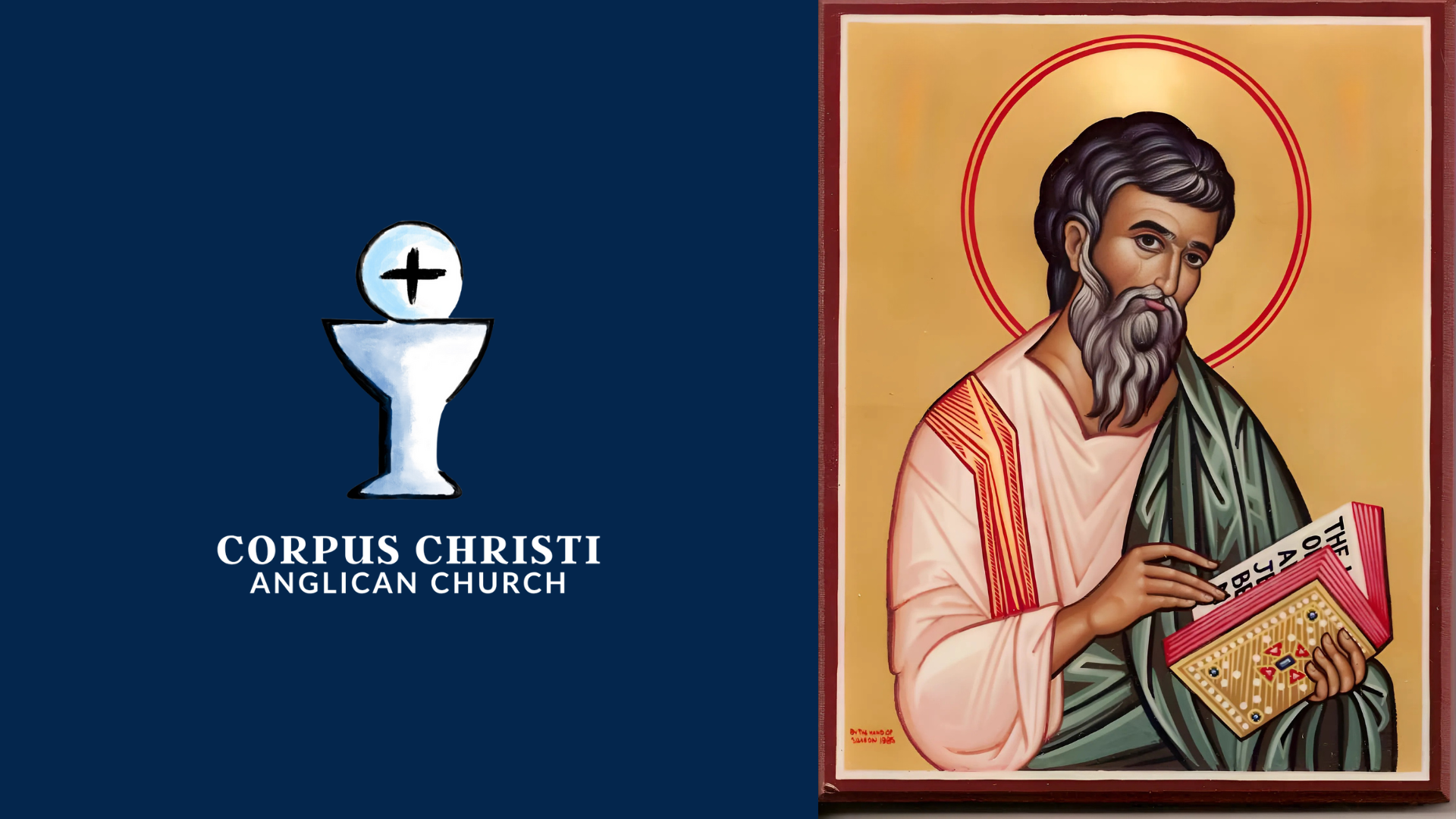
Feast of St. Matthew: Where Mercy Meets What Seems Irredeemable
TranscriptioN
Good morning again, my friends. It is good to see you this morning. It's great to be with you on this feast day of St. Matthew. I'm so glad that you're here.
If you're new or visiting, sometimes we have a—well, we have a season called Ordinary Time, and we wear green, and it's a long time. And so whenever a feast day shows up on a Sunday, I love to take it and see what the Lord might give us out of whatever saint it is that day that we celebrate.
I was really grateful for the life and example of St. Matthew this morning as we celebrate what Jesus did in calling this person to follow him. He is one of the twelve disciples of Jesus, of those who followed Jesus for his three years of ministry before Jesus was crucified and rose from the dead. And Matthew is this really polarizing character in the story, because he introduces real complexity to what is otherwise a pretty tidy religious system in Jesus's day. Jesus confronts the Pharisees with a parable as they're talking about, you know, “Why does your teacher eat with tax collectors and sinners?” He gives them some parables.
One is about not putting new wine in an old wineskin, right? The old wineskin was useful as it helped the wine develop, but now that the wine's been fermented, if you put new wine into that old wineskin that's already been expanded, it'll break. It's not useful anymore. He tells them a parable about crying at a wedding, and there's—you know—tears are at a funeral.
Tears of sorrow are very appropriate in a funeral as you grieve what's lost. It points to the things you deeply care about, but it would be sort of in misalignment with what's happening in the joy of a wedding to have tears of sorrow, perhaps. But for the sake of argument, in Jesus's case, it would be. His point in these parables is not that you can find an exception, but that something new is happening.
He's telling them a story alongside what's happening. Something new is taking place, and Matthew is a stress test on the theological system of those that he's talking to. Can their theology contain Matthew? What do you do with this sinner, this tax collector? And so Jesus is—Matthew becomes—a stress test.
Can this hold Matthew? And all of us expand our theology over time. It's not a bad thing at all. I was remembering back a long time ago, at least over a decade and a half ago. I was in college, and my Greek professor—somebody in the class had asked about a famous pastor and their version, interpretation of a text—and my professor used to do these funny power stances where he put his leg up on the desk like this, you know, and lean forward and he goes, “Ah, yes, that pastor. If he's ever right, it's always for the wrong reasons.” I remember that moment, and I thought, oh wow, because that pastor that he's talking about had a lot of influence on me when I was a young Christian as a teenager. And I realized that as time went on, he was absolutely right. The things that I had learned didn't stand up to the complexities that I was running into as I learned more about the world around me, as I learned more about God's Word, and about the nature of humanity.
I would say that in those years, I went through a bit of a deconstruction process myself to ask, you know, what is the system I hold? Can it hold the weight of human suffering that I'm understanding to be around me? Can it hold the weight of academic rigor? Can it hold up women as equal image-bearers of God as men? Can it offer me something from the Bible that's better than just legalistic behavior change? And can it do more than blame psychosomatic problems on sin as some blanket category? Can my theology bear the weight of those things? And back then, the answer was no. The old wineskin was failing. And so, you know, I went through my own deconstruction-reconstruction process as I was thinking through this in community, in a church.
And, you know, what do we do when we are confronted with the complexity of the world around us? How do we look at the theological system that we've constructed and ask, can it bear the weight of what I'm experiencing right now? Today's feast, St. Matthew, I would invite us to think about as an invitation to engage with complexity, to name complexity, and to lean on Jesus, who is there with you in the complexity, because he's able to hold space for the brokenness around us more than we can. And he leads us in offering mercy that we didn't even know we needed. And so today's feast day is a great invitation to explore complexity, holding hands with Jesus as he's present with us.
St. Matthew is going to frustrate some people to no end. He's going to frustrate their system, the things that they care deeply about. But if they would walk with Jesus for what they don't yet understand, they would see in St. Matthew something beautiful as Jesus is doing something new.
And so, as we look at St. Matthew, this tax collector, let me pray for us:
“In the name of God, the Father, the Son, and the Holy Spirit, amen. Lord, give us understanding to know you, diligence to seek you, wisdom to find you, and faithfulness that may finally embrace you. Amen.”
Jesus's ministry today is in Capernaum. It's in Galilee, which is like the northern part of Israel, to the west of the Sea of Galilee. He's in Capernaum, and he's among the Jews there, and he's already called some fishermen to come and follow him. Fishermen are unimpressive, but they're not controversial. They're not a threat to anyone's system. They're just not like the dream team that you'd want to pick if you were trying to be an influencer. But he picks some fishermen to follow him, and now he calls Matthew in chapter 9 to come follow him in his Galilean ministry. And Matthew—or Levi is his other name—he is going to be potentially offensive.
Imagine if you are Simon the Zealot, who is a patriot for the Jews, and you are all about getting rid of Roman authority, and now Jesus says, “I'm gonna bring somebody who collects taxes for Rome into my entourage.” You are not going to meet that well, potentially. So in Capernaum, tax collectors would be responsible for collecting a variety of taxes that Herod Antipas was going to levy on the region, and they had to meet their quotas to pay somebody above them who needed to meet their quotas.
And as a tax collector on the bottom of the totem pole, it would have been really common to extort money. Why is that? Because not only did you have to collect what was owed, but think about the cost of your labor, your travel—and you need to—and you want to have a certain lifestyle. And so if you charge extra fees for your work, that is totally legal to do in this culture. And so it is very common for tax collectors to extort other people, because it is legal and part of the system.
It's expected. It is not virtuous or good, but this is why tax collectors and sinners get lumped into the same boat. So even if you're one of the good ones, you are still amongst this unclean group of tax collectors and sinners. You, by definition, are disobedient to God's law, and nobody wants to be around you.
You're the bad guy. And so the Pharisees were encouraging distance from these kinds of people, and Matthew, the tax collector, is our test case. They don't want anything to do with him or his friends.
Their posture is to stay ritually clean. Let's preserve what we have. We want God to bless us. Let's keep the law. A lot of those things aren't bad, right? But it's the disposition of isolation from the sinners that Jesus is going to challenge. Jesus's challenge—if I were to summarize it in like a quote—it would be: What if someone could change? What if? What if we see them in need of healing rather than in need of being shunned or dehumanized? What if? So the problem is one of disposition and understanding the grace of God.
And that's not even an option that they had entertained for themselves. No—instead, they wanted to be isolated and keep pure and clean, away from these people who are violating God's law. And so Matthew, you can imagine, has developed probably a complex of sorts.
You know, he's believed narratives about himself that others have told him. So I would imagine there's a level of self-hatred that he feels, because others have given him narratives that he has now believed. And when Jesus calls, he follows, because he wants to see what's going to happen.
I wonder if there might have been some hope in his heart that he would be free of the self-hatred that he was experiencing, or wondering if there were better narratives for his life than just, You'll never amount to anything more than this. You're not welcome here. All these sorts of things.
And so something new is happening. And in longing for something better, he takes the next step, which is to walk with Jesus wherever Jesus is going to take him. So Matthew then hosts a dinner.
And we have this imagery of reclining. They're sort of like lying down, sitting next to each other, having dinner. And imagining this scenario, you know, Jesus honors Matthew by coming to his house and having dinner with Matthew's friends, which, as you would expect, are these sinners and tax collectors.
This group of shunned individuals, socially. And I wonder if Jesus's other disciples felt really awkward at this point. They're in there having dinner with these people.
And again, I can imagine Simon the Zealot going, These people don't love Judaism. Why would I ever sit down and have dinner with these people? And these fishermen are like, Oh, I remember that guy. He was the guy who's collecting extra taxes when I hauled in that load last Thursday.
And so now they're sitting down having dinner, being reintroduced to one another as human beings and, you know, fellow followers of Jesus—potentially, people who are going to consist of the kingdom of God. And so Jesus hears this pejorative question from the Pharisees: Why is it that your teacher—you know, that's pejorative right there—your teacher's over there eating with tax collectors and sinners?
And instead of getting insecure and defensive, feeling some kind of way and responding out of his insecurity, notice the clarity in Jesus's vision. Jesus doesn't change. His ethics don't change. He knows exactly why he is among the sinners and the tax collectors, and he is so unanxious about this accusation. He says, “Those who are well have no need of a physician, but those who are sick.” And so there's something beautiful in that tension here.
We read in the New Testament passage in 2nd Timothy: there are all kinds of classes of people who are going to be disobedient to what God has intended for creation, and welcoming into staying that way is not good for them, and it's not part of the kingdom of God. But Jesus recognizes that people are sick, and he doesn't long for them to stay that way. It's a big welcome, and it's an invitation to something new.
And so, but at the same time, his disposition and posture is one of welcome and invitation. And so he sees what is broken, he sees what's sick, and he doesn't turn his back to them. And that's what's different in the Pharisees.
So there's a difference between judgment and condemnation, and people get this wrong all the time at a popular level. When our English translations quote Jesus saying, “Do not judge,” that's not what that word means. It means do not condemn, which is a totally different thing.
And a better translation would be for Jesus to say, “Don't condemn.” So when I go to the doctor, I want the doctor to make a judgment about what is ailing me. I want them to rightly discern the problem and name it accurately so that we can fix it. I can go get the right medication.
So Jesus calls these people sick, not to condemn them, not to turn his back and say, You're out, you're on your own, I'm only gonna be with these people. But he invites them to a deeper life than they can personally imagine for themselves. And that's the generous invitation. By judging them, what he's actually inviting them into is to rid themselves of self-condemnation and the false narratives that other people have put on them. There's a grace in his judgment, because others have heaped condemnation on their shoulders, and that often turns into self-condemnation.
And so you're welcoming people in, creating the context for naming what's broken accurately, and staying in relationship with others and with Jesus so that he can heal what's sick and broken. We're not the ones who heal people, right? We're not the ones who are responsible for their healing. That's what Jesus does.
And so we have to be careful that we're not standing in the way of what Jesus wants to do in somebody, and so we need to stay in relationship as far as is possible and healthy and good. And the reality is none of us are perfect, but being able to name things accurately and with the compassion of Jesus so that the outcome is that Jesus heals somebody—that takes a lot of time and trust and care and very secure relationships and community to get to that point. But what's important here, though, is that while the Pharisees are building this intricate house to bring people into to adorn the beauty of God, Jesus is creating a front porch to invite his awkward neighbors over.
And that's really important. This is a great paradigm for ministry. I was thinking back to the height of COVID, when our son was a newborn. We used to sit on our front porch all the time, and as our neighbors were passing by, we were longing for friendships, and we would invite them to hang out on our lawn, get to know them, let our son crawl around in the grass. Now only a handful of those neighbors actually made it inside the door, and even less of those made it to our kitchen table. But without the front porch, nobody would have made it to dinner with us.
And so the Pharisees had set the most beautiful table. They'd spent no time on building a front porch. And God calls us as a church to think well about both.
So I want to encourage us—and this is something I'm doing as well—pray about those places of the spiritual house. We think a lot about what happens here with our volunteering and our strategy and things, but how do we create the front porch where people not just see us, but where they get to know us, where they begin to trust that Jesus is good because they've had an encounter with us? And then as they do that, they have a longing to come in and sit and have dinner in the house with us.
And so if the Eucharist celebration together in this and being involved intimately in community is the banquet that's before them that's going to feed their souls as they come to learn and name their brokenness in community and learn to anticipate God's grace here, then what are the steps that we need to take to help people get there? I don't have an answer, but I've started with baseball. And so for each of us it's a different place, right? Like where is it that we're rubbing shoulders? I had somebody in the snack shack yesterday ask me about the Trinity. I don't know what it is for you, but how are we creating front porches?
There is a guiding principle here in Jesus's ministry, which brings clarity to how we prioritize God's Word with the complexities of society and our own stories. We heard a lot about obeying God's Word, listening to God's Word, those who are disobedient to it, and the question becomes, what is the guiding principle? In Proverbs it was the fear of the Lord being the beginning of wisdom. And here in the gospel texts it seems to be mercy that is the guiding principle for applying God's law to the complexity around us. God didn't give Israel a covenant in order to just make sacrifices.
That's not why. He gave the covenant so that Israel would come to know the loving-kindness of God in covenant relationship to him as their king. And then in knowing the goodness of God's rule and reign as king, other nations around them would see the goodness of their God and their relationship to him, and then they might long to be a society that is under the rule and reign of God with this compelling picture of God's love and his faithfulness.
And that's why Jesus in this passage quotes Hosea 6:6 where he says, “I desire mercy and not sacrifice.” It's a critique of the priorities of the Pharisees. Not that they're applying what their law is wrong, but they're misprioritizing what is first and foremost, which is the covenant faithfulness of God.
And so Jesus is like one of the Old Testament prophets here, calling out people for following these externals of the law while neglecting the guiding principles of justice and mercy and the mercy of God. So there are people who cannot come to the table. Like there is some element of that.
We heard it in the New Testament, and I'll give just one example from a long time ago. I had been working at a church. I met a guy at Starbucks. We got into a conversation. He wanted to come visit our church. I knew he was part of another religion that was not good, but I said, “You are welcome to come and visit.”
He would visit every time and bring pamphlets so that at the end of the service you could talk to all of our people to get them to join a cult. So we had to have a conversation, right? This is, you know, one example of someone who is not welcome to the table. We need to keep him on the front porch.
There are persons who, for a variety of reasons, are unsafe in a community, right? Whether this is abuse or something else. So we have to be wise, right? Not all people get the same level of vulnerability and trust. That's not wise. So it's okay for some to stay on the front porch.
I think that's really different than the person who has developed unhelpful addictions to cope with the harm they've experienced, or people who are at some place of deconstruction or questioning for reasons, you know, that vary person to person. Jesus was unanxious about this kind of person, about St. Matthew. He was clear, though, about what was broken, and he was kind in his invitation to healing and wholeness, which, by the way, Matthew wanted. Matthew longed for this, and he was unwavering in his mission to call people into what God has made them to be. And so Matthew is a stress test on the capacity of the Pharisees' system to knowing the mercy of God, and Jesus is essentially giving them a new container to hold it in.
So St. Matthew would live the rest of his life following Jesus. After the resurrection, he goes far and wide. There are multiple traditions. One tradition says he went to Africa and was martyred there. Another tradition says that he went to Persia, where he was stabbed to death.
There's a lot of different historical traditions around what happened to him, but at least one of them is that he wrote down the gospel of Matthew so that we could have the good news of Jesus and what it means to follow him. And he wanted the Jews to understand that Jesus is the fulfillment of their scriptures. So if you look at the genealogy in chapter one, or if you see the over 50 quotations in the gospel of Matthew, all of these are pointing the Jews back to their scriptures to show them that Jesus is the fulfillment of it. And this is the gift that Matthew gave to us as one of the eyewitnesses of Jesus's life and teaching.
So Matthew went from having no vision for his life, from others speaking condemnation over him, to being able to tell the story of Jesus that we are still telling today in the 21st century. And this is our invitation as well. As we tell the story of Jesus, we are reminded that he is among the sinners and the tax collectors, and he has found us, and he invites us to a different kind of life.
And as we learn to grow in faith, hope, and love together, let's pray that we could be a people who embody the welcome of Jesus as well, so that we can see the kingdom of God grow around us. In the name of the Father, the Son, and the Holy Spirit. Amen.
Transcribed by TurboScribe.ai. Edited using ChatGPT.
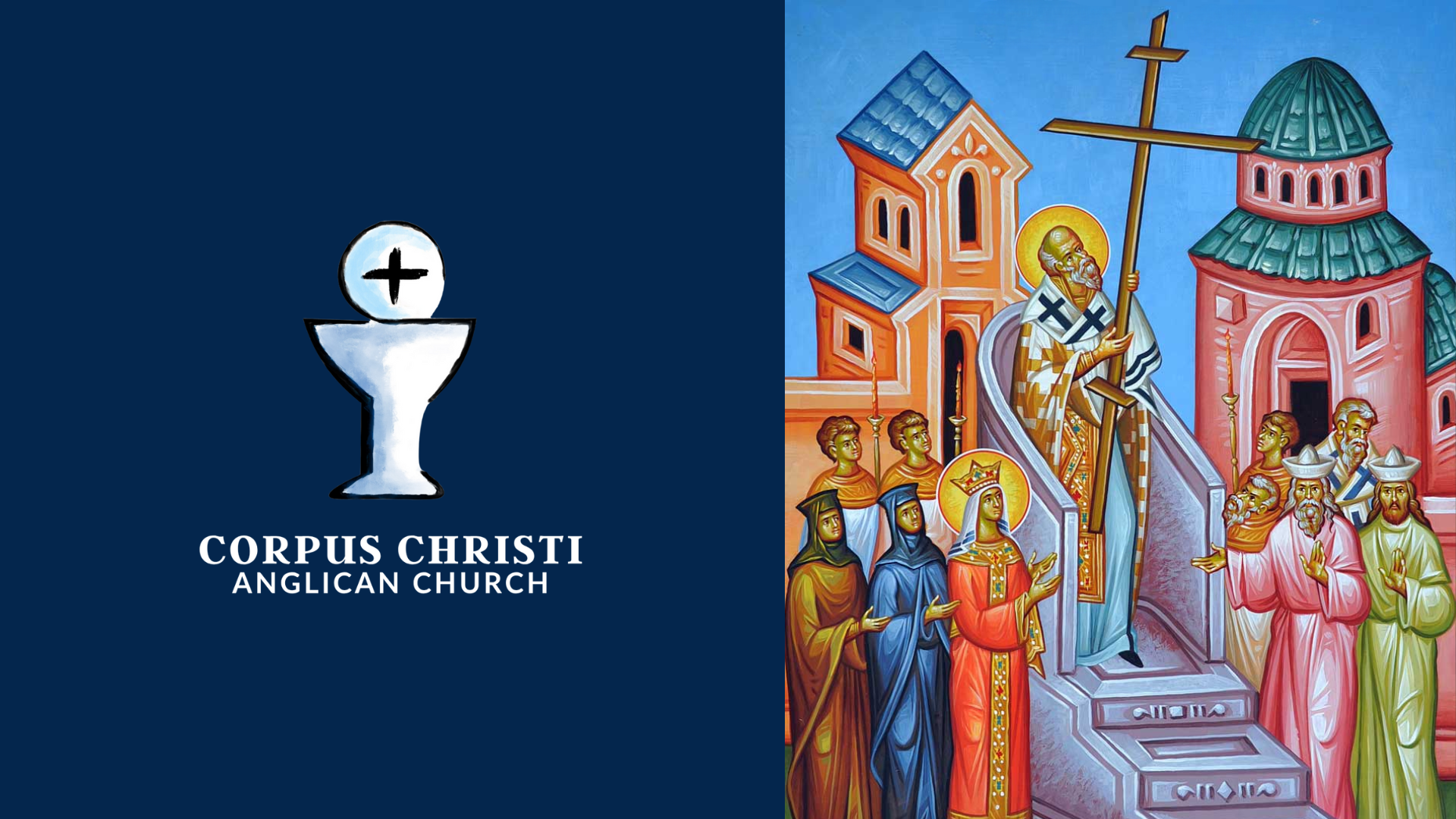
Feast of the Holy Cross: The Glory of Jesus in the Community of Faith
TranscriptioN
Good morning again, everybody. It's good to see you this morning.
This is a special day. First, it's the Feast of the Holy Cross, which is always September 14th, and it just so happens that this year it's on a Sunday. And this week, one of the things that they have in our church calendar are called Ember Days. They're days to especially set aside to pray for people who are ordained or people who are going to be ordained. So, as you think about those who are ordained or those who are in the process, be praying for them this week.
This day focuses on the hope and the victory and the light that is found in the work of the cross of Jesus. And it's also our fall kickoff day. And so we're gonna have a cookout following the service. Would love for you all to be there. The barbecue team has prepared a brisket. And this kicks off a lot of our fall programming this week. So, the kids are in CGS, and we're gonna start formation groups this week. I love how Holy Cross Day frames the fall kickoff, because what it does is it says the work of Jesus is central to our life together as a community and becoming the body of Christ together.
All the things that we view programmatically are to adorn what we're supposed to become in our lives with Jesus. And so, God has made us for the life and love of the Trinity, and the cross is what makes that possible, as we were separated from him by our sin. And so, creation doesn't experience its ultimate end until it's restored by the work of the cross and the resurrection of Jesus as the means of that restoration.
Holy Cross Day History
So why is this day in our church calendar? This day is celebrated by us, the Roman Catholic Church, and the Eastern Orthodox. And we all celebrate it back in 326. In the 20th year of the reign of Constantine, he sent his mother Helena to Jerusalem to venerate the holy places there. And in the course of her journey around Jerusalem, it's said that she discovered the Holy Sepulcher as well as three crosses that were there, which were supposedly the crosses on which were hung Jesus and the two thieves. And she wasn't sure which one was which.
And as legend has it, there is a woman who is in Jerusalem at the time. She's near to death and she's sick, and she touches one of the crosses and she's miraculously healed. And so, at that point, this is why St. Macarius of Jerusalem is lifting up the cross, because as he's one of the ecclesial leaders in Jerusalem at the time, he sees that this miracle has been done and he exalts this as the Holy Cross on which Christ must have been crucified for the world's salvation.
And so, this is the history of the veneration and the exaltation of the true cross, this instrument of shame on which was hung the world's salvation. And so, beyond the exaltation of the true cross, what this day reminds us of is that in Jesus Christ, death has been defeated. Sin no longer has any power, or ultimate power, over those who are in Christ.
So, September 14th every year happens in the middle of Ordinary Time, and it's this nice time in Ordinary Time to commemorate the glory that the cross reveals of Jesus—the glory of Jesus being revealed in the cross. And the cross then is the light for the nations; it's the hope of our redemption, and it's the promise of victory over all the powers that are set against us. It's the tree of life that brings healing to the nations.
And so, in our gospel reading today, we read John chapter 12. In this passage, some Greeks had come to Jesus. These are probably God-fearing Gentiles who started following the law. They're in the city for the Feast of Passover. They've got some questions about the ministry of Jesus, if he is the Messiah. And this is anticipating in John's gospel the universal scope of salvation for the people outside of the Jews—beyond the Jews—this other flock as well that's being brought in. And they're wondering, what is God doing in this man? They don't ask him a direct question in the text, but in asking just to see Jesus, this prompts a dialogue that he has with them and others about his time not yet having come to be glorified, and what that means. The question they do ask follows on the heels of this: we thought that the Messiah was supposed to reign forever, and with the little knowledge that they have of who this Messiah is, they understand that he is supposed to reign over all, and that his kingdom will last forever.
And so, they're probably thinking that this is about to take place—sharpen your swords, right? But victory over death didn't require a sword; it required a cross. And it wasn't a victory over a human emperor—that would be too small of a vision for the kingdom of God—it was over Satan and over the rulers and powers of this world that were set against us, and their use of sin and death in the destruction of the good creation. And so, our ultimate enemy is both greater and more insidious than any earthly authority.
And Jesus had been preparing his followers for his kingdom not by sharpening their swords, but in naming their brokenness and preparing to follow him in suffering. Earthly power is too small of an aim for the kingdom of God. Instead, it's this renewal of humanity, and it's this renewal of all creation, of which our lives are a part. And it's seen now, breaking in one day at a time, in broken lives that are being transformed by the gospel of Jesus' death and resurrection.
Kenosis
The language that Jesus uses about being lifted up on the cross in the Gospel of John couches the crucifixion in a cosmic battle between God and Satan. And the crucifixion then, as it's couched this way, becomes the decisive moment of the transfer of power from the ruler of this world into the hands of the Son of Man.
And our New Testament passage today is a famous one from the book of Philippians, chapter 2. It's called the Great Kenosis passage, which means "the laying aside," and it forms this song that the church takes on about taking on the mind of Christ, letting go of all the things. In the form of God, he did not regard equality with God a thing to be grasped, right? This is the mind of Christ.
And I love, as I was reading about this, one writer describes this passage this way,
“He says, if creation's purpose was to make beings capable of union with the Trinity's love, then Christ would have to overcome our alienation in order to complete creation. So, he descended in Kenosis all the way down to Sheol, where he found Adam and Eve shackled by mortality, and he broke their chains, trampling down death by death, and he raised up human nature to ascend with him. It's a beautiful summary of the gospel—how the cosmic meets the personal. And so, this is the mind to which you and I are called—all of us—to take on, the mind of Christ. Do we look to go into the depths with people, to call them forth to become their new creation selves?”
I think the exaltation of the cross invites us to explore the mystery of God's grace in our broken stories. And then that invites us to explore God's grace in the brokenness of other human stories—our neighbors, our friends, our relatives. And that involves discovering, through the situations that we go through or our own reactions, what we believe about ourselves and what we believe about God. We all have our own proclivities and our besetting sins. I was just confessing mine to the music team this morning about my own triggers yesterday at a weird baseball event.
But we all have them, right? And I've discovered in my own story that I struggle with feeling like I am only as loved as my last success. And I really take it personally when things don't go well. Like, I'll be affected the next day, and it's something I'm continually working on—to know that God loves me even if something didn't go as planned.
You know, when a Sunday doesn't go well, the baseball game doesn't go well, when I make small mistakes that I just can't get rid of. Other people—it's a different thing, right? Maybe you don't feel loved if you don't feel validated, or if you don't feel needed or valued, or if people don't see you as having amazing intellectual prowess, if you're not seen as fun—whatever it is, right? We all have these places that are part of our story, and we get triggered by them, and it's really hard.
One of the things that I loved on our vacation was seeing the Ben & Jerry's factory in Vermont, and the reason why is they have a really cool graveyard there for the dead flavors that they tried and completely failed. It's an attraction unto itself. They have glorified their failures for the public to see day in and day out, and it inspired me to keep a record of failures and to celebrate what was good in my desire to attempt something that did not work, and then to move on and know that God still loves me, because even in that desire that was good, there was something unique in me that reflected something of the goodness of God—not because I can accomplish something good, but because of who he's made me to be, and he actually loves that, right?
And so, each one of us uniquely shows something of the goodness of the image of God, and it's not dependent on how much one accomplishes for the kingdom. So think of your own stories, your own proclivities, the things that you hold on to—consider what they reveal about what's broken, and the deeply held beliefs that we have about God and about ourselves—and then come to your new creation self by laying hold of the grace of God that's found at the foot of the cross. And as you take hold of that grace, learn to call that forth in other people as well by wondering with them with kindness and compassion and some curiosity. And as your neighbors tell you about their struggles—parenting, their bent towards workaholism, alcoholism, anger, perpetual anxiety, whatever it is—enter into that wounding with them and wonder with them if God's grace might actually be greater than the brokenness they're experiencing.
Half the battle is naming it as brokenness, the other half is knowing that God's grace goes deeper than that brokenness. And so, as people become more radicalized, as they become more tribal, it's all the more important to rehumanize one another—to rehumanize our neighbors, even those with whom we have disagreement. That's part of taking on the mind of Christ, because he became like us. He entered into the wounding to show us what new creation could become in us. And so, make space for someone's vulnerability, name and bless the goodness of their longings, the things they were trying to do, and then wonder with them about how the work of Jesus might be there to restore what's broken in them. And that's what happens in a healthy church.
As we name God's grace for one another, this is one of the things we are called to in taking on the mind of Christ with one another—naming the grace of God in one another when we struggle to name it for ourselves. That's how we discover the depths of the mystery of salvation through the cross, as broken people in community who are longing for God's grace as we grow together in taking on the mind of Christ.
Learning the Significance of the Cross in the Community of Faith
So, this is also the fall kickoff day, and that's really important. I wanted to highlight some of the ministries that happen on Sunday, even though these are just a sample of the larger life together, because we do other things outside of Sunday. But part of our Sunday life together is that we gather weekly and we're growing together as a church family.
So, I asked some of our different team leads about why they do what they do and what impact that's made on their walk with the Lord, and they gave me some really great answers. So, I want to read those to you as we think of taking on the mind of Christ in community and what that's looked like in a very specific way.
One person said, "I'm reminded of all the actions and efforts that can often go unnoticed in the preparation of a Sunday service, and it makes me really grateful for the generosity of everyone's involvement on a Sunday. In those moments, I'm reminded of all the imperceived ways that Jesus supports and sustains me. True love continues to give even without recognition."
Another person said, "Serving on the music team has given me the ability to help others worship the Lord using their talents that God gave them."
Another said, "Serving has deepened our understanding of the love Jesus has for his church by reminding us that hospitality is at the heart of community. Hospitality brings people together. Hospitality is love in action. But it also puts into perspective how much hospitality Jesus engaged in—feeding the 5,000 and the 4,000 and numerous other examples of bringing people together through hospitality in order to share truth through his teachings. Hospitality is where we get the opportunity to gather together and grow as a church body."
Someone said, "Helping with the barbecue team reminds me of Jesus feeding the 5,000. Getting to serve delicious food to my church family at these events reminds me that Jesus will always provide."
And then the last one: "Jesus demonstrated his love for his disciples when he served them, whether by teaching them, feeding them, or washing their feet. When I serve in the liturgy, I'm a conduit of his continuing love for his church as he feeds us through the Word and in the Eucharist. I'm a vessel that he uses to love his body, the church, during worship. I'm both loved by him as he uses me to fulfill his purpose, and a means to show his love to others."
And so, I'm grateful for the thoughtfulness of those who are spearheading the different things that happen in our life together in the church, and the ways that doing this—taking on the mind of Christ—shows you something of Jesus' love for you.
Conclusion
Serving on Sundays is just one way to grow in our relationship with Jesus. Consider your calendars. Consider opening your calendars up to the lives of one another to enter into each other's lives together. Have some conversations during the cookout. This is a good starting point. You can keep it light. Ask some questions like: What have you learned about yourself this summer? What's been good? What's been interesting? What's going well as you enter the fall season? What's causing you anxiety as you go a little deeper? What's bringing you joy right now? You know—keep it light. Pace yourself. Don't go too deep too quickly. But the point is, these are the moments where we open ourselves up into each other's lives as we eat together and we are together. We make space for one another.
These people around you, as you look around at one another, these are the ones who are going to help you discover the grace of God in the work of the cross. We're all here for one another for that reason.
And so, on this Feast Day, remember the glory of Jesus that's revealed in the work of the cross. He's reached far below the abyss of our brokenness to raise us up to the heights for which you and I are created—which is life with him, where we're perfectly known, where we're perfectly loved. And so, let's hold on to that grace together. Let's take on the mind of Christ and then live this out in community together.
Let me pray for us.
“O God of unchangeable power and eternal light, look favorably on your whole church, that wonderful and sacred mystery. By the effectual working of your providence, carry out in tranquility the plan of salvation. Let the whole world see and know that things which were cast down are being raised up, and things which had grown old are being made new, and that all things are being brought to their perfection by him through whom all things were made, your Son Jesus Christ our Lord. Amen.”
Transcribed by TurboScribe.ai. Edited by the author.

What Must I Love to Be Saved?

TranscriptioN
Well, good morning again, my friends. It is good to see you this morning. Thanks for being here. In today's gospel passage, we're coming off the heels of where we were last week in Luke chapter 14.
Now Jesus moves from addressing the Pharisees to addressing the crowds, and here he's sharing how one is to follow him to enter the life that's present in the kingdom of God, but there's also some warnings for those who are going to follow Jesus about the costliness of following him and the risk that's involved. Think of him like a pioneer. Jesus is somebody who's blazing a path forward, and he's calling them into this journey, into new creation, into the kingdom of God, into all that God has made them to be, but he's also warning them that it's going to be a hard, hard road, and even though it's going to be a hard road, it's going to be worth it.
Remember that for the Jew listening to Jesus in the first century, salvation is a very temporal and earthly matter. It is not somewhere above the earth or out there in the future, another reality than what we have right now, but for them listening, salvation or deliverance is this entrance into this new age that they're expecting where God reigns over his people, and they are living in his kingdom, and while there is a future component to the kingdom of God, it is here and now. It is broken into our reality through the life in the ministry of Jesus, and so even though we can talk in some ways about the future of the kingdom of God, the good news of it is that it is right now.
It is currently happening, and so following Jesus becomes this lifetime of salvation work. It is not just saved for some future reality, it is delivered from a present reality and into a present reality. Following Jesus is a lifetime of salvation.
It's the hard work of daily deliverance from worldly attachments in order to rightly align our loves and rightly order them, and I know somewhere in the Gospels it says somebody comes to Jesus and they ask him, what must I do to be saved? And that it's almost like in this passage Jesus is functionally telling them the better question is, what must I love to be saved? How do I arrange my loves would be the sort of question behind this discussion, and that is a lot harder for the northern Virginian, because we are good at making checklists, knocking things out. There's a predisposition to a type of workaholism that is ingrained in this culture, but instead of what must I do to be saved, which in some ways is easier, what must I love to be saved? What do I have to love? How do I arrange my loves to be delivered from the present evil age? So what Jesus is calling us to in this passage is to follow him along this lifetime journey of rightly ordering our loves and to become attached to the things of the kingdom of God and not the things of this world.
The Call To Discipleship
Jesus starts with a really hard saying. He says, whoever comes to him and does not hate his father and mother, his wife and his children, brothers and sisters, yes even his own life, cannot be my disciple. And that's one of those ones where you hear someone say, the word of the Lord? I think? You know, it's a tough one. So but he's telling then he tells them to carry their cross and to follow him.
What does this mean? Then in verse 33 says, you can't be my disciple unless you give up all your possessions. What we don't want to do is read this as, go live naked in the wilderness and then you can be Jesus's disciple. This would not be the right application to understanding what Jesus is calling us to.
In fact, that would be a contradiction to some of the other things that Jesus told us to do, which is to love our neighbors as ourselves. And so these two things are not in contradiction, but they are juxtaposed in a helpful way. So this is a call to allegiance to Jesus as our Lord and King.
And when we live in the allegiance to Jesus's Lord, it rightly arranges our loves in this taxonomy of affection for for who we love and what we love within this larger frame of loving Jesus first and all things being arranged in order around that, as he takes us along this lifetime journey of following him. It makes me think of my own story. So when I was 14, that's when I really started walking with the Lord, and I was awakened to the grace of God at that time.
And I was in a tradition that had a great divide between secular and Christian. Probably not a helpful thing to bifurcate as far as they did, but when I started following Jesus and taking that seriously, I knew that I needed something. I came to understand my need for Jesus, and to rightly understand the world around me, to rightly order my life around following him.
And that dictated how I responded to that need, which, as the 14-year-old boy in the context that I was in, was to sell off all my secular CDs. Kids, do you know what CDs are? Anybody know what a CD is? No? They're these cool little discs that look like mirrors. They have music on them.
Sometimes they hold data. It's back in the olden days. So, you know, if I look charitably on my little 14-year-old self, I bless that little 14-year-old's desires to unlearn the grammar of worldly attachment and disordered love.
That was a good desire in order to learn what the church has taught about the grammar of love and attachment when you're following Jesus. Now, if I were to look back, I actually really enjoyed those bands that I threw away, and it's kind of a bummer that I got rid of those CDs for a time, but, you know, but I did. In doing that, I got some time to rightly order my life around following Jesus, learned to put him first in key areas, and then, you know, I could reintroduce those things later once they didn't have the same pull or framing around my life that they once did, right? This is how we rightly order our affections in our lives around following Jesus.
So, as we rid ourselves and reframe our worldly attachments and reprioritize our loves, what's at stake is virtue. Life in the New Age, the ability to bless the goodness of creation and to name accurately what's broken around us and in ourselves, and it's so much more than just behavior modification. God doesn't want us just to, you know, be well-behaved humans.
There's so much more that we were made for. He wants us to be his image bearers fully, to experience his deeply personal, life-transforming, healing work that he is doing. It's called, the Church Fathers often call it, union with God.
This word fellowship, union with God's life. This is what God's made us for. You can think again, back to the garden, this is the life we were made for.
To be a disciple is to experience salvation now, deliverance in these different areas of our life, in marriage, in our singleness, in our friendships, in our parenting, in our work and vocation, in the ways that we're generous, in our forgiveness, in our love of other people, in welcoming the stranger. All of these areas are contexts for salvation, where the Holy Spirit rightly orders our loves and attachments. So how do all the stations and vocations of our lives become part of the journey of following Jesus, in living a life of virtue, and becoming people that are fully alive? That's the question, and that is a more holistic view of discipleship than just being more religious, doing a little bit better.
It is costly, and it is hard, and it's not something easily accomplished. This takes a lifetime of following Jesus. It's a lifetime of reprioritizing the things that we love.
When we feel like we've figured it out, something changes, and we start fresh. It's like raising children. When we think we've got it, they turn six, and then you're learning how to parent all over again, right? And so, as we follow Jesus, you know, we think we figured out, but it takes this constant dependence on the Lord to ask what he's teaching us in these various situations that we run into each day.
Counting the Cost
So Jesus tells the crowd about discipleship, and he's going to use a couple analogies. He talks about somebody who's intending to build a tower, and that person should figure out how much it's going to cost to complete a task. Otherwise, after laying a beautiful foundation, they're going to run out of money, and it's going to be this continual public joke that everybody drives by on their camel and looks at, and they say, oh, there's that lovely foundation where that builder couldn't finish what they started because they ran out of money.
And everyone in the town knows who that builder is, right? So what he's teaching us in this analogy is, it is so good for us to regularly take stock of what it's going to cost to be in allegiance, to live in allegiance to Jesus as Lord. If we're going to follow Jesus, and if we're going to go on this journey with him of putting away the things that we depend on, it's going to cost us putting away things that are broken and that are familiar. And he's going to bring us to places where we're going to have to trust him for what we don't really yet understand.
And I like this image of starting a building project, because I can imagine somebody sitting down, they've got this image of what they want to build in their mind, and they're asking the question, what do I need to get there? I'm going to create this budget, look at the different construction categories, the different phases of the project, how much cash do we have on hand, how much is coming in, and then we can consider whether this product is feasible. And this is compared to discipleship. So we need to regularly do some accounting work in discipleship, not QuickBooks, but like in our souls.
So think about what it looks like for you if you were a healthy follower of Jesus at the end of the day, at the end of the week, at the end of the month, at the end of the year, at the end of your life. What does it look like if you were a healthy follower of Jesus? Notice what habits have started to calcify, what's formed that's keeping us from being honest with ourselves and other people? Are there grudges that we're holding on to, places of self- contempt that we haven't explored, or things that have developed that we need to talk with somebody about? Are there places of immaturity that we're starting to become aware of for the first time if we've hurt other people and then we figured that out? Are we ready to do the hard work of attempting to ask for forgiveness and aiming for repair in those relationships? What's it going to cost us to be a fully mature disciple of Jesus? What does it look like and what does it cost? Those are the spiritual accounting that we need to take stock of. And our New Testament reading was from the book of Philemon, and it is a really interesting and helpful example of this.
So he's this well-off individual in the church, and he has this slave who's run away, Onesimus, and Onesimus has become a Christian because of St. Paul's ministry, and tradition has it that eventually Onesimus actually becomes the Bishop of Ephesus, and he was the first one to collect St. Paul's letters. He's a really interesting person. Now imagine Philemon is receiving this letter from Paul, and he has found out that his runaway slave, who has, you know, cost him so much grief, has now become a Christian.
How do you react to that? What's going on inside Philemon? To follow Jesus well, if we read this letter, he's now confronted with some hard realities. First, he needs to change his thinking about the virtue of holding on to Onesimus as a slave, even though culturally it's appropriate and legal. While the Roman system didn't see slaves as full image-bearers of God, he now has to imagine and realize that Onesimus fully bears the image of God with him, and to allow this slave who broke the law to be received by him as a brother, if he's going to follow Jesus and experience Christian life fully.
Even Philemon would need to submit eventually to Onesimus's ecclesiastical authority. Isn't that wild? He was my slave, now he's my bishop, right? This is what he's gonna have to go through internally. There are some very earthly attachments, and we read behind the letter to Philemon, that it's gonna cost him to get rid of, or to change, to find the full life that Jesus wants to bring him into.
First, he's gonna have to change his mind, and he's gonna have to admit that he was wrong. That's hard. He's gonna have to give up his legal right to own another human as property.
That's hard. He's gonna have to let go of his desire to feel important as a man of status and wealth. He's gonna have to work through his feelings of anger about losing his investments.
Now, that's what it's gonna cost him at a very practical level here, to follow Jesus, to be fully formed as somebody who is following Jesus as his Lord, and set those worldly attachments aside to enter fully into life and what the kingdom of God could look like. It's only in the kingdom of God where your slave becomes your bishop. That's amazing.
Assessing the Risk of Discipleship
So Jesus had told this parable about counting the cost, and next he tells a parable about considering the risk that of what you're gonna have to undergo when following Jesus as Lord. He tells this parable about a king who's considering going to war with another king, and that king has to take inventory of his soldiers to see if this war that he's going to start with another king is viable. Does he have an army, a sizable army, that can confront the other side? And if it's not possible, then he needs to readjust, and he needs to make other plans to send a delegation to make peace before he's forced into a war that he can't win.
And so as I think of that first parable about counting the cost, that has a lot to do with initially stepping into following Jesus, taking the initiative to go into it. This one is about as you're following Jesus, you're constantly navigating the battle, the conflict that you're in, the ongoing battles that are going to happen as you follow Jesus. It invites us into an examination of our own capacity, and a bit of reflection before we run headlong into things that we don't yet have the capacity for because of our spiritual maturity.
Youthful vitality often has an excitement to run into things that outpace their character, and their capacity, and their skill. I think of my early 20s and all the missteps that I made professionally, by saying the wrong thing to the wrong person at the wrong time, and you know, wish I could go back 20 years and rectify those situations. But you know, I had to learn that stuff, and so praise God I wasn't a priest in my 20s.
So you need to build the capacity over time for the ways that you are following Jesus. He's not asking us to jump into the deep end when we don't know how to swim. So this passage about this king who's declaring war can be read as a grace to us.
No one expects a child to emotionally regulate themselves, articulate their longings clearly in abstract ways, and do the hard work of making repair when they've hurt each other when they're like younger than six. I know a lot of adults who have a hard time with this too, right? And so you know, but we don't expect a child to be to do that when they're not developed mentally, when they don't have the capacity yet. And these are skills that are developed over time in small ways, and our life like Jesus is a lot like that in the spiritual journey.
There's this kind invitation from Jesus to take one day at a time to grow, to build capacity in the small things, and to risk more and more and more reasonably as we move from the disorder of worldly attachments and disordered loves into the love of God and the life of the kingdom. St. Thomas Akempis said this well. He said, when a spirit of fervor is enkindled within you, you may well meditate on how you will feel when that fervor leaves.
So I take that to say, walk with Jesus, don't run. And I also find grace in this for myself, and I hope it's an encouragement for you this morning too. When you wonder why you're not further along than you should be, when I wonder why, why am I not as far along as I should be in my walk with Jesus? He's inviting us not into this unwieldy picture of perfection that we can't attain. He's in this life-changing image that's unattainable, but he's inviting us into just the next right step with him as we journey along this path of salvation.
Conclusion
Life is hard. Life is complicated. I hardly have to tell anybody that. If only it was as easy as asking this question, what do I have to do to be saved? But instead, Jesus is inviting us into something deeper, into rightly ordering our loves and affections and attachments, and asking this question, what do I have to love to be saved? He invites us into this lifelong journey of discipleship where we're daily counting the cost of what it means to be more like him each day. He invites us into his goodness and kindness in a life of following him in little things, more and more, so that we see more and more of life in the of God.
Life in the kingdom of God is where God's glory is shown when we become who God's made us each to be in our own uniqueness, and we can be honest and we can see God where we can repair brokenness in community, where the worries, the disorders, and the attachments of this world no longer have that same pull or power to draw us away from the goodness and the love and the presence of God. Let me pray for us. “Lord Jesus Christ, you said to your apostles, peace I give to you, my own peace I leave with you. Regard not our sins, but the faith of your church, and give to us the peace and unity of that heavenly city, where with the Father and the Holy Spirit you live and reign now and forever. Amen.”
Transcribed by TurboScribe.ai. Edited by the author.

The Seat of Honor and The Seat of Welcome
TranscriptioN
It's good to see you this morning on this holiday weekend. I'm Father Morgan Reed. I'm the vicar here at Corpus Christi Anglican Church, and I am grateful to be with you here this morning.
One of the books that I read several years ago that had a lasting impact on how I view ministry and think about even the process of starting a church is a book called “The Gospel Comes with a House Key,” and it is all about the nature of hospitality and ministry together. The author of that book shares the story of her conversion to Christianity, where it wasn't a result of preaching or even going to a church, but it was the result of regular invitation to this couple's home for dinner weekly, or at least on a regular basis. The husband did happen to be a pastor, but it was over the course of those dinners that conversations were exchanged, that life was shared together, that trust was built, and because of all that, Jesus became trustworthy. And so, hence the title, “The Gospel Comes with a House Key.”
In today's gospel passage, Jesus is having a midday meal with a Pharisee, a ruler of the Pharisees, and he shares two parables about how humility and hospitality are supposed to be dispositions of the people who are going to follow Jesus as their Lord. It's part of what it looks like to be a citizen of the kingdom of heaven. They're characterized by humility and hospitality. And so, as we look at the nature of those two things—humility and hospitality—let me begin by praying for us.
“In the name of God, the Father, the Son, and the Holy Spirit. Amen. Lord, may the words of my mouth and the meditation of my heart be always acceptable in your sight, O Lord, my rock and Redeemer. Amen.”
In the first parable that we read, Jesus tells this story about somebody who's invited to a banquet, and having somebody's seat in close proximity to the host or the organizer or the special guest is a place of honor. It's a measure of status in the company of all who are gathered. In attempting to put oneself at the seat of honor, someone risks something. You risk the embarrassment of misunderstanding how important you are and being reminded of the social ladder when the host comes and they bring you down some seats in front of everybody, and they make room for those who should rightly be there. Instead, Jesus says it's better to start by choosing the lowest seat, and then when the host recognizes you, they can say, “Oh friend, please don't sit all the way over there; come closer.” And they're invited into the seat of more honor in front of everybody. And on the one hand, it sounds like practical wisdom, and it is, but it's also a parable about the nature of the kingdom of God.
All of our passages have something to do with humility or hospitality this morning. We read one from the book of Ecclesiasticus, which, if you're new to the Anglican tradition, you may not have even heard of that book before. The book of Ecclesiasticus is also called the Wisdom of Ben Sira, and in the Anglican tradition, sometimes in our daily readings and in our Sunday readings, we're encouraged to read these books that are called deuterocanonical books or the Apocrypha. They're part of our readings as we live together and learn about life in the kingdom of God. And they give us wisdom, and they give us wisdom from a really unique perspective. These are Second Temple Jews who are living in the centuries leading up to the New Testament, and so we're given perspective on God's wisdom in those centuries in the Apocrypha.
And it was interesting, in today's passage from Ecclesiasticus, we hear about the nature of pride, and he gives some really tangible examples. He says that sovereignty passes from nation to nation because of injustice, insolence, and a lust for wealth. Also, sort of famously, today's king is tomorrow's corpse, right? And ultimately, this is continuing in the biblical tradition of wisdom as it reminds us that the beginning of human pride is to forsake the Lord.
To abandon the Lord is the beginning of pride. To move from dependence on the Lord to autonomy and to self-reliance is that soil that the seeds of pride are sown into. And I also love that Ben Sirah reminds us that pride and arrogant disregard for other people—those aren't things that were created for people. So when you see people acting in them, it's making them less human, not more human. As image bearers of God, we were created for fellowship with God, to be in the presence of God. If you think back to Genesis, walking in the garden in the cool of the day.
And pride and arrogant disregard for others are foreign to who we are. They don't help us to see ourselves rightly, to see God rightly, or to see creation rightly. They make us less human, not more human. And that's precisely because the nature of pride is to move away from the Creator, to move away from the God who's made us and loves us, and therefore to move away from wisdom. Wisdom begins with the fear and knowledge of the Lord.
It sort of reminds me of a child. This isn't my child; this is a hypothetical child. This reminds me of a child—it might have been even me when I was young—who receives for himself a model airplane. And having never built a model airplane in this child's life, and they can't read, they decide that they want to try and do it themselves. And they say, “I don't need those instructions, I can do it myself.” Now they tear open all the packaging, they start thumbing through all the parts, getting them out of all the places that they're being held, with their labels, the numbers that they are according to the instructions, and they start just gluing everything together according to how they think it ought to be. And then they start putting the decals on, because that makes the plane look really cool, but all the decals are in the wrong place, and what's left is a bunch of pieces that are still in the box.
Now imagine, as that child looks at their plane that they've made, they look back at the box, they get frustrated, because what they've just built looks nothing like what's on the box. And then they go to their parent and they say, “This is broken, it looks nothing like how it's supposed to look. The parent's gonna lovingly say, “Hmm, let me wonder with you for a moment. I think you're right. I wonder how that might have happened. I wonder how those instructions might have been helpful in showing you where all those pieces go to that model airplane, and where the decals go.” And that is the story of what we do over and over again when we give in to pride, which is foreign to us. And this nature of insolence or disregard for others—we say, God, I don't know how things ended up like this. This is not at all how they're supposed to look.
But we've moved from dependence on God, and we've said, I can do this myself. And I'm reminded again of Genesis chapter 3, when God is walking in the garden in the cool of the day, expecting to find fellowship with these image-bearers that he's made. This was their routine, to be in fellowship with one another, in dependence on their Creator. And he comes, and he asks them this question; He says, “Where are you?” The reality is, they've hidden themselves. They know that things are not the way they're supposed to be. They're realizing that they were the reason that it ended up that way. And God invites them in with this question: “Where are you?”
When pride has made a mess of things, God lovingly invites us back with that question over and over again, which is an invitation to ask what we were made for, which is fellowship with God. To forsake the Lord is the beginning of pride, and pride, autonomy, insolence, this blatant disregard for others—those things were not created for human beings. We were created out of love from God, for fellowship, for union with our Creator. And it's in returning to that fellowship over and over again that we learn not only who God is, but what we were made for, and what creation itself was made for. It gives us a right perspective and true wisdom.
One of the things that I've been reading lately is a book called “The Apostolic Fathers,” this collection of writings of people who came right after the Apostles died. So these were—some were the people that the Apostles ordained. Whether or not they were ordained by the Apostles, they were like the second and third generation.
And in the Letter to Diognetus, there's a lot of really interesting political theology in there, so if you want to look it up online, you can read through it. The author in that book touches on this connection between humility, and service, and rightly seeing the world. And he says this: by loving God, you will be an imitator of His goodness. And don't be surprised that a person can become an imitator of God. One can, if God's willing, for happiness is not a matter of lording it over one's neighbors, or desiring to have more than weaker people, or possessing wealth and using force against one's inferiors. No one is able to imitate God in those things.
On the contrary, these things are alien to His greatness. So he's continuing in this biblical tradition of humility—becoming humble, following the Lord, rightly esteeming ourselves in God's sight, taking the posture of serving others. That's going to be the way that the kingdom of God is revealed.
And we learn exaltation in God's kingdom when we learn humble service in God's kingdom. And so, along with this parable about humility, Jesus gives another parable in verse 14 about the nature of hospitality, which is the love of strangers. Hospitality is something that ought to be given in this parable, not exchanged.
There seems to be this problem that Jesus is addressing where people would throw a banquet, and there's sort of this transactional disposition behind it. In this scenario where you're showing hospitality in a very calculated and transactional way, you're expecting something in return. Doesn't this now obligate my guest to throw a banquet on par with what I've just done? Can I invite somebody who's going to return the favor in the future? And you're kind of looking in a calculated way at who you can invite so that you can benefit from them. Who can I invite that's going to return the favor?
Instead, what Jesus says is the one who follows him is the one who gives hospitality without reciprocity. That we give hospitality, we don't exchange it. And I'm struck then by the reading that was read in the book of Hebrews, where it says, let mutual affection continue. Do not neglect to show hospitality to strangers, for by doing that some have entertained angels without knowing it. And that reference goes back to Genesis chapter 12, where Abraham is welcoming three strangers in, and he gives them shelter, some water, some food, and come to find out that these strangers that he welcomed in happen to be divine messengers who are giving him a message from the Lord for him and for his wife.
One of the keys from this book that I had mentioned earlier, “The Gospel Comes with a House Key,” is that hospitality moves people from being strangers to neighbors, and by God's grace from neighbors to the household of God. Hospitality moves people from being strangers to neighbors, and by God's grace from neighbors to becoming the household of God. And hospitality then, like welcoming the stranger, is a practice that is deeply rooted in the Christian tradition, and it's because of Israel's history, but also because of Israel's history, we find it in the teachings of Jesus. And so it's always been foundational work in the kingdom of God, because we don't know as we welcome people in who we're inviting and what we're going to learn of the kingdom as we invite them into our lives. So we make space for all kinds of people at our tables.
There was a previous church that I'd worked at. One of the things that we did at that church that was really helpful—for a season we had these weekly dinners, and we would invite our neighbors over to our household. And Ashley and I, back then, we lived in an apartment complex over on Columbia Pike in Arlington. It was a really diverse apartment complex, and so we started inviting our neighbors over. Some we had gotten to know, some we didn't. We met some neighbors who were Ethiopian Orthodox, some who had completely deconstructed from the faith, some who were Christians but going to another church, some who had moved here from Guatemala and they were going to another church. And in fact, I remember as we dinnered, the Guatemalan family had asked if I would come to their church sometime and teach church history, and he would translate it into Spanish for their small group, which I thought was such a cool opportunity as we got to know our neighbors.
All of us ate around the table, and we learned to make conversations and learned to get to know each other from our different vantage points. We eventually moved to Alexandria from there, and then Springfield, and we've met new neighbors. But I think back to that season as something so helpful and paradigmatic for moving forward as I think about how the kingdom of God moves forward. Hospitality opens us up to receiving God's kingdom work in other people, and when we open our tables, we open ourselves up to being surprised by the kingdom work that God's doing in others.
When you look at the website for the church, if you go to the "About Us" page, one of the first core values of our church is hospitality. And there are a lot of ways that we do this. I was even thinking this morning that big three-by-three-foot sign over there and hanging it up in the morning is an act of hospitality because I want people to easily find where they're going, right? We give a lot of thought to: how do people enter the room? What does it feel like? How are people welcomed when they're here by you? These are all really important things on a Sunday morning to show hospitality and welcome people into the congregation. I'm always grateful when we are not on a holiday weekend and we pack out these chairs and someone thinks, I should get more chairs so that other people can sit here. That is an act of hospitality.
So, to commend you all for doing a great job and to encourage you to keep on doing that as we move forward. And then beyond Sundays, there are ways that we want to show hospitality in these formation groups as we welcome people into our homes and eat together. And I'm always encouraged when I hear stories of you all getting together on your own without any prompting from me. I love hearing, “Oh I got coffee with so-and-so and we had a great conversation.” Those are acts of hospitality that welcome in the kingdom in surprising ways that we wouldn't have anticipated had we not taken the risk to get to know somebody. And it can feel a little bit like that.
And we do have to be wise and we have to have appropriate boundaries, of course, but there is a goodness to the risk of welcoming those who are not yet known with generosity and kindness, because that's one of the ways that the love of God is known in community. When you think of your own story, who welcomed you in and how have you experienced the love of God? And that's why I love celebrating house blessings. So to those of you who have just recently moved—I saw some nods like, oh yeah, we got to talk to Morgan about that. I love doing house blessings because it fills our imaginations for the ways that God can use the places that we live, the tables that we eat around, and the backyards that we play in. And so if you've never had a house blessing and you want one, please let me know. I would love to get that on the calendar and we can talk about that.
So humility and hospitality, as we close—these are challenging. They're challenging, but they're worth it. I love how one commentator framed humility and hospitality in this passage. He says, humility and openness to all are two major facets of following Jesus's ethics. For the disciple, service and meeting the needs of others is not an option. It's the appropriate response to Jesus's call to follow him. The church is not to worry about the chair of honor. Rather, it is to make chairs available to those who are looking for a place to sit—even for those who think there are no chairs for them.
Humility is challenging because it requires us to be secure in who God's made us without thinking of ourselves too highly. In other words, it's the constant work of rightly esteeming yourself in God's sight. And it also requires us seeing and loving the image of God in other people when they might be challenging. When there's that one neighbor that you wish wasn't your neighbor. Hospitality can be challenging for several reasons. It requires risk of opening ourselves up to receive other people into our lives. It costs us something to feed people.
I was realizing the other day that if we're gonna have people over, our bathroom door needs to be able to lock. So I had to go to Home Depot and buy a handle and replace it so that we could actually lock our bathroom. It's an act of hospitality. You're welcome the next time you visit. Right? It costs us something. It is risky doing life together when you see the ways that I am—I'm gonna use myself—when I am not a perfect parent, or in the ways that I don't keep my home as clean as I wish it were. And there's some risk of rejection when you invite somebody over or take the initiative to invite someone to coffee or a meal somewhere. That can be really hard. There's a lot that goes into that. But let's continue in mutual love as a community.
Grow in humility and answer God's call to come back when he keeps asking over and over again, “Where are you?” He is inviting us into his life. And because he invites us in, as we respond, we can invite others into that life as well. Learn dependence on him and live out of that deep place of abiding in God's presence. And then continue in hospitality to learn more about the love of God and the work of Christ in you and in others.
Let me pray for us.
“O God, who created all peoples in your image, we thank you for the diversity of races and cultures in this world. Show us your presence in those who differ from us, and enrich our lives with their fellowship, until our knowledge of your love is made perfect in our love for all your children, through Jesus Christ our Lord. Amen.”
Transcribed by TurboScribe.ai. Edited using ChatGPT.
Feast of St. Bartholomew: Greatness and Gospel Witness
TranscriptioN
Good morning again, everybody. It is good to be with you this morning. We had a really fun pool day yesterday. Thank you to those who came and enjoyed time together out in the sunshine and got roasted. It's nice to have a few hot days left of the summer.
I'm Father Morgan Reed. I'm the vicar here at Corpus Christi Anglican Church, and it is great to see those of you who are new and visiting. I'm so glad that you're here this morning. For those of you who have been here a long time, I am also glad to see you, too. So, thank you for being here as we celebrate this feast day of St. Bartholomew together.
I was mentioning to somebody during Ordinary Time, when the church calendar gives us one of the feast days of the apostles, I want to take it. So today we celebrate the feast day of Bartholomew, one of the apostles of Jesus.
This week, I was pondering a little bit on social media influencers and how the culture of influencers allows for this strange phenomenon where people can actually fake it until they make it. You don't have to be an expert; all you have to do is make a cleverly stitched reel and you could be an influencer—just to have the right ingredients. You don't have to be an expert, and you probably will have more influence than somebody who is well-trained and can craft a long essay, something that's a well-constructed argument.
In fact, I saw a show where this woman had built and started a restaurant. She opened it and was using social media to boost her presence, and she was actually marketing herself before having any experience as a celebrity chef. She even had her own line of cookware that she was selling to boost her income and sales. But on the ground, the restaurant that she had started was totally mismanaged. It was dirty, the food was bad, and when people came once, they just never came back.
But she could sort of create a false narrative about the restaurant because she was controlling the social media influence. And so, she was so focused on celebrity and greatness that she never actually did the hard work of learning the process of how to run a restaurant, to work her way up and have to go through that whole process of knowing the business inside and out. And one of the reasons that I wanted to take today to commemorate one of the martyrs of the church is that when we think of St. Bartholomew and other martyrs, it reminds us that following Jesus is not about chasing greatness.
There are a lot of Christians that chase greatness. They try to keep up appearances to garner influence. In fact, there are even now social media categories like “evangelical influencer,” or you've probably seen “Catholic priest influencers.” I'm not against that. It's the waters that we swim in. It's fine. But just to note the pitfalls—that one does not have to be an expert in subject matter to create a lot of influence. And St. Bartholomew's life reminds us that we need to focus on the process of following Jesus rather than amassing greatness or influence. So, as we look at the life of St. Bartholomew, let me pray for us.
In the name of God, the Father, the Son, and the Holy Spirit. Amen. Lord, may the words of my mouth and the meditation of my heart be always acceptable in your sight, O Lord, my rock and my redeemer. Amen.
So today we wear red because St. Bartholomew is one of the martyrs of the church, and the church often wears red on the feast days for its martyrs—those who have witnessed to the life of Christ to the point of shedding their own blood, giving their life to witness about who Jesus is and what he's done. And this is one of those feast days.
And so, in the history of the church's tradition, Bartholomew is actually the same person as Nathanael. Nathanael—we think his whole name would have been in Aramaic Nathanael Bartholomew, which would come into Greek as Nathanael Bartholomew. And so, if you'll remember the story back in John Chapter 1 (we didn’t read it this morning), Nathanael is the guy who, as he's sitting under a fig tree, hears about this guy Jesus, and he says, “Can anything good come out of Nazareth?” He's that guy.
And I really like the way Eugene Peterson captures this interaction in The Message between Nathanael and Jesus when he encounters him. It says:
When Jesus saw him coming, he said, “Ah, there is an Israelite. There's no false bone in his body.” Speaking of Nathanael.
Nathanael says, “Where did you get that idea? You don't even know me.”
And Jesus answered, “One day, long before Philip called you here, I saw you sitting under the fig tree.”
Nathanael exclaimed, “Rabbi, you are the Son of God, the King of Israel.”
And Jesus said, “You've become a believer simply because I said that I saw you one day sitting under a fig tree? You haven't seen anything yet.”
It's a great translation of what's happening in this interaction with Nathanael and Jesus. Nathanael was a straight shooter. No one was wondering what he was thinking. He was also humble enough that when he encountered the truth, he changed his mind about things. Humility, honesty—these are virtues that characterize St. Bartholomew, or Nathanael.
And he had to, along with the other disciples, learn really hard lessons. He's not exempt. He had to learn all the same lessons the other disciples did about humility and about power and the nature of the kingdom of God.
There are two traditions around what happened to Nathanael after the resurrection of Jesus. One has him going to Lycaonia and then Ethiopia with the gospel to preach. The other has him going through Mesopotamia and even into Parthia. And so, in the tradition where he goes through Parthia, he goes with Jude, who's also called Thaddeus. And so Thaddeus and Bartholomew take the gospel to Armenia, which is the first Christian kingdom. It becomes Christian before Constantine accepts Christianity.
And so, even to this day, Bartholomew and Thaddeus are the patron saints of Armenia. The rest of his life was spent following Jesus, witnessing to the power of Jesus in his resurrection. Not because he pursued greatness. Sorry, he was great, but not because he pursued greatness. It was because he pursued Jesus and he helped people see who Jesus is. And they helped people see the world as it is and what it could be. They helped people see themselves for who they are and what God has made them to be as his image bearers. And Bartholomew had to learn the same authority in the gospel passage that we read today as all the other disciples did.
In the gospel passage, Jesus is giving his final charge to the disciples. He's just told them that one of them is going to betray him. And immediately following that paragraph, St. Luke gives us this paragraph, where they're arguing about which one of them is to be regarded as the greatest in the kingdom. And so remember, in their minds, Jesus is going to reign over an earthly kingdom. Something like an empire. It's going to have this universal scope to it. It's going to be counter to the Roman Empire and all other kingdoms of the earth. And of course, you're going to need people to rule over various regions. And so the question in their mind becomes, how do we get a place of a throne in this kingdom? We've been following you. We've given up a lot. Is it going to be worth it? Can we have the authority that you have to rule over a slice of your kingdom? And now these are fishermen. They're tax collectors. These are other people who have no experience at all in governing over any municipality. This is not their career trajectory. But as they're thinking about Jesus and his kingdom, these thoughts of importance, comfort, notoriety—those things are becoming so alluring for them as they're thinking about the kingdom. And that's a really good reminder for us. It's a reminder to follow Jesus and do good work. It's simple. Follow Jesus and do good work. Do hard work. Hard work on yourself. Hard work on thinking about how Jesus is incorporated into your life.
If you're noticed, if you're honored by people, if you have seasons of relative comfort, that's totally fine. Take note of those things. Name them as they are. Give God thanks for them along the way because they're not going to be normal all the time. Watch for subtle shifts in yourself. There are these subtle shifts where honor, comfort, and notoriety move from being byproducts of your life to becoming aspirations or goals.
Watch for those subtle shifts. Dan Allender, in a podcast I had listened to, Dr. Dan Allender, said this little phrase that felt really appropriate here: “The more subtle, the more satanic.” The more subtle, the more satanic. And that really resonates with me. Notice the subtle shifts in our souls. Take notice of those things. That requires us to examine ourselves carefully as we're following Jesus. And to listen to the Holy Spirit in prayer constantly. And then to spend time discerning the movements of our souls as we're listening to the Holy Spirit. In those times of goodness or in times of trial, the goal is always a deeper knowledge of the love of God. The church has called those consolations and desolations—where Jesus is seemingly present, or where Jesus is seemingly absent.
In whatever season you're in, the goal is a deeper knowledge of the love of God. And as we think about the church, our goal is not corporately to, say, reach a region for Jesus, which feels very business-y. You know, “We're going to reach the nation, reach Springfield, reach Franconia.” But it's to see God's kingdom come in us, in our households, and in our neighborhoods. It moves from inside out. How you live your life is intertwined with the ways that we see the kingdom coming on a broader scale.
And there are things I can't control in my life, but what can I control? I can work on my own interior life every day with the Holy Spirit. I can work on showing up when my wife needs me to show up. I can listen to her. I can work on being present for our son, coach a baseball team, be the kind of manager that parents would love for their kids to have. I can control those things. That's something I can work on. It's within the realm of possibility. Trying to reach an area for Jesus is sort of like this product-orientation mindset. It's really out of my control.
So desiring to be great can potentially run the risk of clouding our vision for the opportunities that are right in front of us every single day. If you're a lawyer, defend justice. Write policy that accomplishes the welfare of the people that you're writing the policy for. If you're a teacher, come to class each day looking to help the kids in your class live life in the kingdom of God, to live out their lives as image bearers of God. If you're raising little ones at home, imagine your house as a kind of monastery where you're creating this school for the Lord's service in the everyday, ordinary stuff of raising little ones. There's so much that's out of our control, right? But the stuff of following Jesus we can do intentionally every single day. This is the substance of discipleship. Those are the subversive kingdom tactics that guard our internal life from subtle satanic opposition. And so that means that an influential product or a way of thinking doesn't justify a life of disordered loves.
I don't know if you're familiar with the theologian A.W. Tozer. He was a really well-known theologian, and he tried to adopt a life of rigorous poverty. Problem is, it's almost like he did it without considering the rest of his family, and he had seven kids. And so, when I think about this, his wife—to the point, his wife Ada Cecilia Pfautz—and she and her seven kids were forced to use public transit because he refused to get a car, even though he could. That's one example of many, but there was this disintegration with his study, his writing, and the life of his family. And so when he passed away, his wife remarried a man named Leonard Odom.
And somebody had asked Ada in an interview, “You know, what's it like to be married to Leonard after being married to the great A.W. Tozer?” And her response was, “I have never been happier in my life. Aiden Tozer loved Jesus Christ, but Leonard Odam loves me.” And I don't think Tozer set out to be a terrible husband, but there was this deep disconnect and there was this disorder to his love for Jesus and his family.
Seeking first the kingdom of God means that you have to rightly order your life with Jesus so that others experience the love of God through you, which means you have to experience it for yourself first. And it's really hard to integrate life with Jesus with our everyday chaos. But that is the substance of discipleship—naming things honestly, receiving grace for them.
To desire to be great is going to get in the way of seeing God's kingdom come. And so, seeing Bartholomew is a great example of someone who would carry on in Jesus's example of service, laying down his life for the sheep of God in a well-ordered, integrated way.
St. Paul, in our New Testament reading today—I hope you didn't miss this in First Corinthians—gives us another example of humility in his testimony about being an apostle. The Corinthians, they seem to be following these teachers who are making them feel superior. They're avoiding suffering, and these teachers are promising things like status and comfort, wealth and ease—almost like the Corinthians are little kings. And the impression that we get is these folks now seem to be looking down on St. Paul's ministry because St. Paul seems to be suffering, so they must be doing something right.
And so St. Paul needs to address the fact that they are misguided in their feelings of importance. And so how do you begin to address somebody who is so blinded by their inflated sense of self-grandeur? I'm not always sure how to do that right, but it's interesting to watch Paul here because his letter is just dripping with sarcasm. He essentially—this is my paraphrase—in 1 Corinthians 4:8ff, I would paraphrase it this way:
“Wow, look at how you all are so grown up. You're all doing so well. Man, you really look like you're living life as Jesus wanted you to live. You look like kings as you're reigning with Jesus. You didn't even need my help. Actually, you didn't even need the help of any of the apostles. JK. Honestly, I really wish you were kings. It would have been a lot easier if I could have just had what you have without having to go through all the stuff I went through—you know, like Jesus did.”
Then he drops the mic. This is St. Paul's address of these people who have an inflated sense of ego.
And in Paul's day, it's interesting—there was this practice where, as generals would be victorious in battle, they would come into a city through a victorious procession. Because there's no social media, how do you find out if they won? Well, it's a victory procession, and they're going to take all the spoils from their military exploitations and process them through the town. And they would come in, and at the back of this processional train are the captives of war, the prisoners. And at the end of that ceremony, all of these people who were captured in battle would either be given into slavery or they would be executed as part of the pagan liturgy.
And so Paul, in verse 9, compares himself and the other apostles to those captives who are at the back of the victory procession. They're being sentenced to death, he says, a spectacle to the world, fools for Christ's sake. So St. Paul has endured these afflictions through the power of the Spirit, not because he was seeking influence on a massive scale, not because he was trying to be great, but because the new-creation life in the kingdom of God doesn't come without the trials that are involved in a cruciform life. The way of the apostles is to focus on this substantive work of living humbly with Christ in all of life. It's this close walk and abiding in the presence of God.
It's the hard work of daily conversion—to watch the movements of our soul and to repent and then to receive God's grace often, daily, maybe multiple times a day—to name things honestly, to turn from the things that are not of the image of God, to look to Jesus to receive his grace. And it's the challenge of noticing others in their grief and struggle, to be able to offer them something of the goodness of the kingdom of God in their image-bearing selves.
So St. Bartholomew and his feast day—this is such a great reminder that if anyone is to be considered great, it's only because they've pointed people to the one who is truly great. The fruit of somebody's life is important, and it also can't be manufactured. So we need to make time to root out the subtle satanic shifts that move us from the grace and love of God in order to note where the Holy Spirit's at work, where he's moving.
The daily life of following Jesus is the witness that our households and our neighborhoods need. And as a church community, if you and I are following daily in that life with Jesus and his abiding presence, our mutual witness of life together is going to produce that substantive work of the kingdom of God together as we help people see what God can do in a community of lives that are being transformed by the gospel of grace and the power of Jesus.
As we close our time, let me pray again this collect for the feast day of St. Bartholomew:
“Almighty and everlasting God, you gave your apostle Bartholomew grace truly to believe and to preach your word. Grant that your church may love what he believed and preach what he taught, through Jesus Christ our Lord, who lives and reigns with you and the Holy Spirit, one God, forever and ever. Amen.”
Transcribed by TurboScribe.ai. Edited using ChatGPT.

Distill, Divide, Interpret the Signs, and Decide
TranscriptioN
Good morning. I come from a long line of women with green thumbs. I'm not a horticulturist, but I'm more of a piddler, and I enjoy rooting plants. I normally have a puddle of plant clippings that I am rooting on my kitchen counter by my kitchen sink. This summer, I've had several clippings of impatiens that are rooting, and here's what the clippings looked like when I started. And then, here's my puddle of clippings on my kitchen counter.
I look over these clippings each time I wash dishes at the sink, and this week I noticed they weren't really flourishing. But I looked into the containers they were in, and I could see healthy roots growing in them, so I moved on. But Thursday morning, I looked over at my clippings while washing breakfast dishes, and I saw this: there were a lot of leaves missing, and some small things on the counter. You can see down there on the lower half of it, and these had multiplied. Frankly, these droppings on the counter panicked me, so I began looking up the exterminator's phone number.
My husband, Chris, consulted ChatGPT—you know, the newest version of YouTube for all the do-it-yourselfers. ChatGPT suggested that there was a beetle or a caterpillar, and that's a big improvement from what I thought was going on. When I looked closer, this is what I saw. Oh my word—how in the world had this giant caterpillar been right under my nose the past several days? I had washed dishes just inches from it all week long. I had seen these tiny little black things on the counter, and I had just ignored them. As I studied my rootings, I realized there was a lot more damage than I had been willing to see. These sweet, tender plants could die. They didn't look anything like they once had. I wondered how all this had been going on right in front of me, and I had missed the signs.
In our Gospel text today in Luke, we have a really tough passage to interpret. There's a lot of energy in it, and I find that when things are too uncomfortable, or if you push me too hard, sometimes I just let things go right over my head, or I feign ignorance, or I turn the other way. Does anybody here do the same? Or if something is incomprehensible to me—like how a giant caterpillar got inside my house and ate my baby plants—I might tune it out completely. Exhibit A. Can you relate to this, or is it just me?
I find that with Scripture, there are passages like this one that can be both terribly uncomfortable and really incomprehensible. We just don't have the background, the culture, or the understanding of the culture to fully grasp them. So sometimes we let them go over our heads or just move on. Doing this—as understandable as it is—causes us to miss the signs that Jesus is giving us to shape our lives as disciples.
This is a difficult tone in this passage, coming from Jesus, and these are challenging words. But I believe if we face the discomfort, we can dive in, knowing that the Gospel is good, and that the nature of Jesus is good. He always brings light, hope, and goodness. We can make sense of this message and allow it to challenge and encourage us today.
So let me set this up for you. At this point in the Gospel of Luke, we're on the road with Jesus as he is teaching the crowds and his disciples. In previous chapters and verses leading up to this one, he's been teaching important lessons crucial to the life of a disciple. We'll actually learn in the next chapter that he is on his way to Jerusalem, where he will fulfill what he is called to do on the cross in order to secure our salvation. The end of his time on earth is now in sight—distantly in sight—but we are on that road now. So things are getting real.
You know when you don't have a lot of time left with someone you love, you really begin to focus. You hone in, and you tell them the things you need them to know. When Chris and I would leave our kids with a babysitter, he'd be out in the car waiting on me. I'd be running through the list, finishing up the details with the kids and the sitter. I'd be getting more and more focused, and the last things I would say were the things I wanted to be sure they knew: "That one needs a bath. That one needs to do homework. And they all need to be in bed by nine. Thank you, I'm out."
Or, on a more serious note, I can remember one of the last things my father instructed me as he knew his death was imminent. He said, "Cat, when I'm gone, I want you to grieve for me. Grieve a while, and then I want you to get up and move on." He was very stern, very serious, because I'm not sure he believed I would do it. That was 30 years ago this summer, but I did it.
So we find Jesus teaching here—hard, but helpful—about discipleship and life in God's kingdom, the things we really need to know. In this short, pivotal passage, Jesus is clarifying his mission. He's painting a vivid picture of who he is and what he's doing. He distills, he divides, and he gives us the signs to interpret and decide.
In this passage, Jesus teaches the crowds and disciples that he brings a fire of judgment that distills and purifies. It will fully immerse him in suffering, and it will divide even the strongest, most fundamental relationships. He seems, honestly, a bit exasperated—"You hypocrites!" He seems frustrated that people can recognize the patterns the world gives them to plan for their future, as would be true in an agricultural society, but they refuse to interpret the clear signs he is giving about his kingdom at hand—which is, in fact, their real future, their spiritual future.
And maybe the toughest part of this passage is where Jesus says, "Do you think I have come to bring peace on earth? No, I tell you, but rather division." I had to sit and think about that for a minute. Didn't Isaiah call Jesus "Prince of Peace"? Didn't Jesus promise his disciples to give them peace? Didn't the angels, when announcing Jesus' birth in their proclamation to the shepherds, talk about Jesus bringing peace? You know this: "Glory to God in the highest, and on earth peace, goodwill toward men." That's the King James Version we sing every Christmas. (You're welcome that I didn’t sing it for you today.)
But newer translations, like the ESV, actually state: "Glory to God in the highest, and peace among those with whom he is pleased." In other words, this peace will be for those who have decided to follow him. This distinction gives us a clue to today's startling teaching of Jesus.
Jesus’ mission is to distill those who decide to follow him from those who don’t, and this distilling or purifying brings division. The whole package of Jesus is so powerful that making the decision to follow him divides even the most fundamental relationships there are. And in Jesus’ context, and often in our own, that is within our families.
Jesus gives quite a litany here: they’ll be divided—father against son, son against father, mother against daughter, daughter against mother, mother-in-law against her daughter-in-law, and daughter-in-law against her mother-in-law.
It’s interesting to note that part of John the Baptist’s mission, when he came ahead of Jesus, was to turn the hearts of parents to their children. That is God’s desire. He doesn’t want families to be divided. Jesus is not announcing that he’s coming in order to divide us from the people we love. Actually, Jesus is giving his followers straight talk: to follow him will inevitably divide them from those who don’t.
We need to hear this message today. To know and love Jesus is to know and love the truth. Jesus says about himself in John 14, “I am the way, the truth, and the life, and no one comes to the Father but by me.” Jesus, being the truth, brings reconciliation to God, but because some people won’t choose him, it brings division. And division from those you love—especially those closest to you—is painful.
Jesus was preparing his followers, and he’s preparing us, so that we can interpret the signs of the kingdom and follow him wholeheartedly. Only reconciliation with God can bring eternal and lasting peace. Truth can unify, but honestly, in the world today, it more often divides. It distills; it purifies.
Peace is found in God through Jesus Christ, the Prince of Peace—but not in the world. Any idea of peace that is created by man apart from God is an unsustainable, fleeting mirage that will dissipate in time. As believers, we pray for peace. We pursue peace on earth because reconciliation with God is our peace. Peace with God overflows our hearts and lives as we abide in Christ, living in union with him, and this peace touches the world.
Any other attempt at peace is missing the fundamental foundation of reconciliation that comes only from God and the work of Jesus. We need to hear this truth today because we are called to be both light and love to our brothers and sisters who do not follow him. We are not to disdain them or be in enmity with them. They are in enmity with him. We are called to love them, to serve them, to pray for them, and hopefully to lead them to him. Even though we’re divided, we are not called to follow them—we are called to follow Christ, even if that divides us.
I recall more times than I care to count having conversations with former members of our church in Charleston who had stopped attending. I would ask, “Is everything okay?” And if they were honest, they would explain that their young adult child—the one we had baptized, discipled, and confirmed—had decided to follow some other teaching rather than Christ. Either the science of atheism, Buddhism, or some new spiritual awakening—something that wasn’t Jesus. And so they were now divided, and they could not stand to be divided. So in order not to be divided from their child, they chose to follow their child and their new teachings rather than the truth of Jesus.
But I can also tell you heartwarming stories of other friends who held on to their belief in Jesus, even when divided from their child. Eventually, their child returned to the faith. I’ve seen it happen with parents as well, both ways.
Romans tells us that it is the kindness of the Lord that leads man to repentance, and it’s true. Jesus’ urgency in this passage is well-founded. He is waking his followers up to interpret the signs right in front of them—that the kingdom is at hand. It’s beginning now, so that they’re prepared for their future with him. He clarifies his mission: he is distilling and dividing, and you must interpret these signs and decide.
He says he came to bring fire to the earth, and he wishes it were already kindled. What’s he talking about—this fire? Then he says he has a baptism with which to be baptized, and he’s constrained until he accomplishes it.
“Fire” is an important word in Scripture. It’s used often pertaining to God and to Jesus. I could write several sermons about it, but I digress. For this passage, in three of the Gospels—Matthew, Luke, and John—John the Baptist announces Jesus, stating that he will baptize with the Holy Spirit and with fire. The scholar F.F. Bruce writes that in Greek, the word “fire” can also mean spirit, breath, or wind.
Earlier in Luke, John the Baptist adds to his announcement about Jesus: “His winnowing fork is in his hand to clear the threshing floor and to gather the wheat into his granary, but the chaff he will burn with unquenchable fire.” So even though “fire” is sometimes connected to the Holy Spirit, in this passage it indicates distilling, purifying, sifting, and separating.
In John’s words, Jesus’ mission will purify, and it will burn like wildfire, leaving absolutely no one untouched. Jesus longs for that fire to be started. The fire is linked to his baptism.
Now, what is this baptism Jesus is speaking of? We’ve already seen him baptized. This is where the passage feels a bit incomprehensible. Jesus is bringing fire, he’s getting baptized again, and he’s under constraint until it’s completed. What’s going on?
Jesus is using the language of baptism here to express his desire to do the will of God. He received a baptism of repentance at the start of his ministry, though he had no sins to repent of. He willingly chose to identify with humanity, following God’s will that we turn away from our sins and be baptized. But now, he’s going to be immersed in the pit of death—again, identifying with humanity, with you and me, and with the curse of sin we carry. He will take that curse on our behalf, even to death, and destroy it by conquering death.
One scholar notes that baptism here is a metaphor for Jesus facing a period of being uniquely inundated with God’s judgment. In both Matthew and Mark, when James and John ask to sit at his right and left hand, Jesus replies: “Are you able to drink the cup I drink or be baptized with the baptism I am baptized with?” In other words: Are you able to share in my suffering and death?
It’s hard language.
So Jesus is telling us he’s bringing fire to the world. He will distill it, even as he suffers for the world, and this will divide even the closest of relationships. At this point, he’s been with them for nearly three years. He’s inaugurated the kingdom of God. For everyone watching—including us—we’ve seen him restore sight to the blind and wholeness to the lame. In that culture, without disability aid, these healings restored people not just physically, but socially and economically. The lepers he healed were no longer ostracized. They could return to families, communities, and worship. He restored far more than bodies; he restored lives.
He delivered people from demons. He raised the dead—a hint of the resurrected life to come. And still, the people missed the signs.
Jesus calls them hypocrites for knowing the signs of the weather but not the signs of the kingdom. They knew the prophecies. They had the Scriptures. Yet they missed the Messiah standing before them.
Jesus is still distilling and dividing, and he calls us today to interpret the signs of his kingdom, already begun, and to decide.
That caterpillar on my kitchen counter had been there awhile. The signs were right in front of me, inches from where I washed dishes, but I ignored them. That creature was tearing through my tender rootings, ready to metamorphosize into new life. I wasn’t paying attention.
When I give my testimony, I share that one of the core lies I believed for most of my life was that I didn’t belong anywhere—not to my family, not to any group of friends. My testimony to the power of knowing and following Jesus is that he defeated that lie. I do belong. I belong to Jesus. And if you have been distilled and divided, and interpreted the signs and decided, you belong with me to Jesus. This is our family.
We are in the family of Jesus. The time is upon us. That is the urgency in this passage, and in Jesus’ tone: to share the good news of the kingdom everywhere we can, especially with those from whom we’re divided. We have the best news in the world.
For that, we can all say: Thanks be to God.
Transcribed by TurboScribe.ai. Edited using ChatGPT.

Enduring Faith
TranscriptioN
It's very good to see you all this fine Sunday. My name is Steven Myles, and I'm a member here at Corpus Christi Anglican Church. For those of you who are new or visiting with us this morning, I'm not the person that you would normally see in this space. Father Morgan Reed, the beloved vicar of our church plant, is on a well-deserved vacation with his family. And in his stead, he asked me to speak this morning and not mess things up too badly. So I have had the opportunity to deliver the homily once before. And if you recall, the last time I was up here, I openly admitted that I am a baby Anglican. It's true. The majority of my life I've spent with Baptist and non-denominational communities of faith.
And so the rhythms of the Anglican Church calendar, the commemoration to the Saints of old, the different holy days, are still relatively novel to me. So bear with me here, the newbie, but for a few moments, I would like to call our attention right at the onset to two things. The Saint which we commemorate on this day and where we are positioned in the church calendar. It's marked to commemorate St. Lawrence. And St. Lawrence was a deacon and martyr of the Catholic Church in Rome around the third century. And so in this very month, this month of August, 1,767 years ago, the Emperor of Rome, Emperor Valerian, made the decree that all bishops, deacons, and priests were to be executed and that the riches of the church were to be put into the coffers of the Roman Empire. And the next day, Pope Sixtus, the Pope, was executed, and Lawrence, the Saint that we're commemorating this day, was ordered to go and collect the riches of the church to surrender them before he would be executed. And Lawrence worked swiftly, and over the course of the next three days he did, he collected the riches of the church and then he distributed them to the poor. And as he stood before the prefect of Rome three days later, he was asked to present the riches of the church. And he pointed to the poor, the indigent, the blind, the crippled, and the one suffering, and he said, "Here are the riches of the church." And then he was executed. It's a powerful testimony.
So that is the Saint, St. Lawrence, that we commemorate on this, the 10th of August. And in regards to the church calendar, there is a period of time after Pentecost and before Advent known as ordinary time. Right? There are no major feasts or holy days. Each week is numbered, and this week we are smack dab in the middle of that stretch. This is the 14th week of ordinary time. And although the time is ordinary, by God's grace we have the opportunity this morning to redeem these moments and to once again focus our minds and our intentions on abiding with God.
So please pray with me. “The grass withers, the flower fades, but Your word, O Lord, will stand forever. Lord, the word that goes out from Your mouth, it shall not return to You empty, but it shall accomplish that which You purpose and shall succeed in the thing for which You sent it. And so, Father, we cling to this truth, and we ask that You would speak to us this morning, and may Your word accomplish that which is needed in each of us. In Christ's name. Amen.”
So before we jump into today's text in Hebrews 11, I want to give you a rough outline of what the next few moments are going to look like. So I will attempt to briefly summarize the book of Hebrews prior to chapter 11. Bold task. And then we will look at Hebrews 11 and the two distinct categories that faithfulness falls into that we encounter in the text. A conquering faith and an enduring faith. And then finally, I'll close with a few words which I hope will encourage us to remain steadfast despite our situation. Now, why do we have to go back and summarize the entire book of Hebrews, you might ask? That's a fair question, okay? But when we get to chapter 11, where our text is today, it's kind of the culmination of this argument that the author has been making for the past ten chapters, okay? This assertion that Jesus Christ is superior to all the other previous ways that God has revealed Himself in the past.
And so this is very similar to other authors of the New Testament who have crafted a very particular message. Under the inspiration of the Holy Spirit, these authors would systematically and methodically argue the case for Jesus Christ as the Messiah and the veracity of what He claims. In John's account of witnessing, right? Witnessing firsthand with his eyes the miracles and teaching of Jesus Christ, he states very plainly that his purpose in writing these things is that you may believe, and that by believing you may have life.
In Paul's letter, he declares very explicitly that it was necessary to first preach the Word of God to the—But because they rejected it, the gospel of Jesus Christ is extended to the Gentiles. And so Paul's subsequent letters are intentionally meant to plant and nourish faith in people without an understanding of God's involvement throughout history. So in the same fashion, the author of Hebrews has a very distinct purpose.
He's writing to Jewish believers, as the name of the book implies, right? And so understanding his audience, there's this baseline assumption that the reader is intimately familiar with the Old Testament. He doesn't explain the covenant with Abraham, Mount Sinai, the Torah, the sacrificial system. It's expected that these things are already to be understood.
So the book of Hebrews, prior to chapter 11, the author very methodically lays out this four-point argument, okay? To prove that Jesus is the ultimate revelation of God's love and mercy. So the author elevates Jesus above all the other prior revelations from the Old Testament, from the Torah. He's greater than the angels. He's greater than Moses. He's greater than the priestly order. And Jesus is greater than the sacrificial system. Those are the four main points. And then coupled with those four points are four warnings. Because Jesus is greater than the angels, beware of rejecting His message. Because Jesus is greater than Moses, beware of abandoning Him. Because Jesus is—beware. So those are the four points and the counter four warnings.
That's what the first ten chapters have set out to accomplish. Jesus is the ultimate revelation of God's redemption, so you, the reader, do not turn away from the One who fulfills everything that the law and the prophets have directed you towards. And so that's the first point of this homily, right? Everything prior to chapter 11.
Now we get into today's text. Chapter 11 is sometimes often referred to as the Hall of Faith, right? Hall of Fame, Hall of Faith. You guys got it.
So now that we've arrived at the culmination of this argument, right, that he's been making for the last ten chapters, the author has demonstrated now that Jesus is not nullifying their traditions, right? He's not rendering moot everything that they have been brought up in, but rather He is the fulfillment of everything that the Jewish reader would have been taught as a young man in the synagogue. So now in chapter 11, he is encouraging them to continue in this same tradition of faith as those that have gone before. And he provides a litany of examples.
Abel, Enoch, Noah, Abraham, Isaac, Jacob. Because even though Jesus is the new revelation, nothing has changed in regards to the prescribed manner in which mankind is restored to a right relationship with God. Throughout all time, the prescribed manner in which man is restored to a right standing with God has remained constant.
We are saved by God's grace through faith. And the very first act of faith mentioned in Hebrews 11 goes all the way back to Abel, right, very early on. Adam and Eve, Cain and Abel.
And so in the Genesis account, it is inferred that God initiated a blood sacrifice the moment Adam and Eve sinned against Him. Genesis tells us that God killed an animal in order to clothe Adam and Eve with the skins of those animals. What is inferred there is a blood sacrifice as an atonement for sin.
So this is an indication to us of why Abel's sacrifice was acceptable and Cain's was not. For the Genesis story in chapter 4 recounts that Abel brought an offering of the firstborn of his flock. It was an animal sacrifice. And Cain brought an offering of the fruit of the ground. The profundity of this interaction between Cain and Abel and God cannot be overstated. Why was Abel's offering accepted and Cain's was not? Why? Is it better to be a shepherd than a farmer? Was his offering more costly than his brother's? Abel had followed the prescribed method that God had given for atonement. He exercised faith and obedience, and he offered a blood sacrifice. Cain, on the other hand, tried to circumvent God's prescribed method and offered the fruit of the ground, or in other words, the fruit of his efforts. Cain's offering was rejected because he tried to approach God through the merit of his good works.
Mankind has always and will always be deceived into believing that they can earn God's favor. This idea of earning something from God is pervasive. And even for the people who have matured in faith, you don't automatically become immune to this line of reasoning. Especially in our Western world, we are taught that the punishment should suit the crime and payment should be commensurate with the level of effort. And so through nature and nurture, we kind of develop a transactional view of relationship. And this is the portion of my message I was most conflicted about.
Because here in chapter 11, we're presented with this list of elders, and they fall into one of these two categories. Either a conquering faith or an enduring faith. But how can we judiciously examine both of these categories without favoring one over the other? Let me try to explain this a little bit better.
Because more than anything, what I want to do is I want to reach for examples like David and Daniel and Samuel, right? And I want to place them here at the forefront of our attention. And I want to be able to point to the amazing things that they accomplished through their lives of faithfulness. Right? They shut the mouths of lions. Literally conquered kingdoms. Administered justice. Obtained the promises. And more than anything, I want to use their examples to encourage you to not lose hope, to persevere, because you all know just as well as I do what is outside in this world.
It is a cold and unjust world in which we travel. And what's more than likely, though, is that our problems and our struggles — they didn't have the decency to stop at the door. Right? But they're right here with us, and the tension is pulling on us. The financial struggles of losing work. The slow slip into a cold marriage. The quiet suffering of a miscarried child. The pain in your body that won't go away. And I don't think that the intention behind highlighting these types of conquering faith stories is meant to be misleading. Right? It's natural.
We love a happy ending, and these stories of conquering elders can certainly strengthen our resolve and spark hope. And so, I don't know — maybe it's just me on this point — but when those are the examples that are predominantly celebrated, predominantly in the spotlight, then I get this idea in my head that maybe that's what a faithful life should look like.
If only my faith were stronger, then maybe I wouldn't be stuck in this situation. And that step is so subtle. Right? It's almost an unconscious progression of logic.
Of course, in our transactional minds, we can kind of make the leap that a faithful life equals a fruitful life — a life that conquers all obstacles. And yet, when we come to the text, we learn that man's economy and God's economy on this point cannot be farther apart. And yet, too often, the former is projected onto the latter, and we end up with this distorted view of God's will. We end up with a muddled and watered-down understanding of the truth. Right? The number of young men and women in our country that are escaping Christianity as soon as they're out of their parents' sight — statistically speaking — is on the rise. And I'm not going to stand here and reduce it down to this one reason — that's too simplistic — but I do believe a contributing factor is this prevalent understanding in the American church that a life of faithfulness to God is a path to comfort, a path away from suffering.
And so, when our next generation of young men and women are faced with the reality of this world and their faith isn't fixing everything, it isn't utilitarian, it's cast aside. And so, too often, these examples of a conquering faith are lifted up, but it can come at the expense of a richer and deeper understanding. And I think, though, Hebrews 11 brings balance to this propensity towards the conquering faith by reminding the reader of tremendous examples of enduring faith.
Abraham would never see the covenant fulfilled. Moses chose to suffer alongside his brothers rather than live comfortably in Egypt. Others were afflicted, many more were mocked and imprisoned, and some were put to death.
And we know that Jesus himself, the author and perfecter of our faith, was betrayed and died alone. And so, the profound truth that Hebrews 11 is instructing us in is that God does not measure faith by the result that it achieves, but by the obedience it maintains. Scripture gives us a glimpse forward to the day where a servant will stand before his God, and the words that he longs to hear are, “Well done, thou good and faithful servant.” Faithful, not fruitful. God is the one who produces the fruit, and all that we can do is bear that which he chooses to bestow. Noah labored for a hundred years, toiling in the sun, building an ark, and at the end, eight lives were saved.
Jonah preached to the city of Nineveh, and over a hundred thousand souls repented and were saved. And yet, both of these men were faithful to what God had revealed to them. God recognized both of their faiths, yet the results were wildly disparate.
So even now, God is searching. Right now, he is seeking men and women of true faith. Verse 6 rightly states that without faith, it is impossible to please God. And true faith is not a collection of beliefs; it's not this intellectual pursuit of a perfect theology. True faith ignites action. Abel offered when there was no manual.
Enoch walked when there was no example to follow. Noah built a boat though he had never seen rain. And Abraham ventured out into the unknown without a map.
These men and women were driven by what verse 1 calls an assurance of things hoped for and the conviction of things not seen. They did not require the guarantees of safety and security before they went out, and they did not demand God to prove himself before they would believe. They did not require constant validation in order to earn their loyalty.
And so, this path to a restored relationship with God, like I mentioned earlier, has remained constant — that we are saved by God's grace through faith. And we're not called to strictly adhere to a set of rules and regulations. We're not called to sacrifice animals to atone for sin. Right? The time for those revelations is past.
We live in the age now where Jesus Christ has been revealed, and the faith that God will honor is the faith placed in the finished work of Jesus's life, death, and resurrection. And maybe you've heard this before. Maybe it all makes sense. But the one thing you can't wrap your head around is why? Why, though? The last verse in our passage from today, in verse 16, is what I've been holding on to after praying and preparing for this sermon. And it's a small phrase that says, “Therefore, God is not ashamed to be called their God.” So after the author has gone through this litany of examples of faithful men and women, he adds this small phrase — that God is not ashamed to be called their God.
My prayer is that the same could be said about me. My prayer is that the same will be said about you. There is a love that you simply cannot understand until you experience it. The power of God's love is the only force that I have experienced in my life that has not only changed who I am, but has literally changed the desires — the things that I desire in my heart. You all might not know, but I am keenly aware of the depravity of the things that I used to chase after. And God understands our nature. He knows that we are weak, and so he provides his Spirit to fill and empower us to live in the way that he always intended. This satisfaction of not only being loved unconditionally, but being restored to a true purpose — I think this is why it makes sense. Because otherwise, it looks crazy. Right? To the world, these things look foolish.
Why remain when others have left? Why endure when there's no relief? Why trust if it doesn't make sense? These men and women in the Hall of Faith tasted and saw that God is good. And like Job — Job who lost everything in this world — he lost his wife, he lost his children, he lost his wealth, his occupation, he lost his friends, he lost his health. And when he was stripped of everything, his words were, “Though he slay me, yet I will trust in Him.”
The truth is that these men and women were wholly satisfied in God alone. They did not need the joys of this world. They did not even need the blessings that could come from his hand. He alone was their portion, and God was not ashamed to be called their God.
And so, today, do not be lured into the temptation of putting your life in the scales and deciding that my life is a wreck because my faith is weak. Or don't fall into the trap that because God is remaining silent, He is far from you. Rather, maybe you're closer to the heroes of faith who are called to endure rather than conquer. And so, do not lose faith. Do not be discouraged. For lo, He is with us, and He will not forsake us. Amen.
Transcribed by TurboScribe.ai. Edited using ChatGPT.

Good Asceticism: Training to Name What Should Be Renounced
TranscriptioN
Well, good morning again, friends. It is great to see you this morning. Happy August, if you can believe it. I am so delighted to be here with you and to see some new faces. I'm looking forward to meeting you after the service, so please stay and have coffee and snacks with us. But thank you for being here this morning.
I'm Father Morgan Reed. I'm the vicar here at Corpus Christi Anglican Church, and over the last several weeks, we've been in a series on the Epistle of St. Paul to the Colossians. Today ends that series, and next week, Steven Myles will be preaching, and we'll be getting into other things.
And so, last week we looked at chapter 2, and one of the things that was the main theme in chapter 2 that we got into was rooting ourselves in the tradition that was passed down from Jesus through the Apostles to avoid drifting back into spiritual captivity. And then this morning, we're skipping over a small section that is pretty important, so when you have some time, go read through the rest of chapter 2.
In this small section, St. Paul's outlining some of the problems that are happening in this church. There are matters of avoiding certain food or drink. Teachers are encouraging them to avoid certain food or drink, presumably as clean or unclean; observing certain feast days, new moons, Sabbaths—sort of a return to the Mosaic Law in some ways. And he mentions the worship of angels in that passage and dwelling on certain types of visions. So we're getting a window into the things that are arising in the Colossian church that he's addressing. And he also talks about not submitting themselves again to elemental principles, which we mentioned a few weeks back.
These teachers had set up rules that were creating a false sense of humility for the congregation—that if I could keep these rules of self-abasement, obedience to Torah, mystical experiences, then I can increase and have a higher knowledge of God himself. And I can rid myself of the things that make me unclean or that keep me from understanding God more deeply. He argues that all of those things pale in comparison to Christ.
And so, this is a very Christocentric letter—that Christ is in all, through all, he's over all. It's all about Jesus and who he is. And what he's saying is that those teachings from those teachers who are coming into your midst—they're of no value when it comes to keeping yourself, to keeping your self-indulgence in check, and to knowing God more deeply. They're of no value. Christ himself is the valuable one for keeping our self-indulgence in check and knowing God more deeply.
And there's an important word that he brings up in the letter, and it's helpful for us to know too. I'm sure it's something that doesn't get thrown around a lot, and this is the word ascesis, or asceticism. Kids, if you have your little papers here, and you say, "What did I hear today?" you can write down ascesis—A-S-C-E-S-I-S, ascesis or asceticism. It's an important word. And it refers to how you train for something. How are we training in a spiritual life? What are the results of our training?
And there is a dark and useless type of asceticism that exists, and that kind of asceticism keeps someone bound to the kingdom of darkness through pseudo-spiritual habits and other kinds of practices—and this is what he's arguing against. There is another type of asceticism that is good. It produces virtue. It produces the love of God. And he's arguing for an asceticism based on knowing Jesus Christ as Lord—training in the right things, not in the wrong things; training ourselves to put on virtue and to put off the old life of the old age. And doing that type of asceticism together in community makes the Word of Christ effective among us. It allows the peace of Christ to reign over us as a community, and it binds us together in the love of God.
So we begin our passage today, Colossians 3:5, where Saint Paul says to "put to death whatever in you is earthly." Different translations have different things here. The first one's fornication or sexual impurity, then just general impurity, passion, evil desire, covetousness or greed, which he calls idolatry. We don't often think of greed or covetousness as a form of false worship with a false god as its object, but he calls it that.
He starts with a specific kind of sin—a misuse of somebody's body in improper physical relations, fornication. He moves more broadly to impurity, and purity would include fornication, and it moves more broadly into moral evil. He mentions passions, which have to do with disordered loves and affections, and then he mentions the very desire or intention to do evil. And then he concludes with greed or covetousness, which he calls idolatry, because when the object of your affections becomes something other than the Lord—something you're desiring that is less than God—it shapes your desires, and that's why it becomes an idol.
So he's calling the church to become who they are. He's calling them to live out the thing that they've been made positionally in Christ. Our bodies had been an instrument of sin. They've been bound to the present evil age through distorted affections and loves, through perverted truths fueling unhelpful thinking and immoral behaviors. All these things put us in misalignment with the God who created us and loves us. And that old life was put to death in Christ when we were baptized with Christ. And each one of us then died, and we were raised to new life again as we shared in the death and the resurrection of Jesus.
And so, good asceticism trains us to live out the resurrection, and it involves putting off those ways of life that had been part of us when we were bound to the present evil age. St. John Chrysostom compares it to a statue that had been filthy, covered in rust, and somebody comes along and they scour the statue clean. And then after that, somebody has to regularly come through and clean the statue so that no rust or anything is allowed to grow on the statue over time.
St. Paul's commanding the church—and I love the way Janet did such a great reading—he tells them, "Do not lie to one another." The church is called to not lie to one another. And this is because I think self-deception and deceiving others is associated with the life of the old age that we died to, where we were in solidarity with Adam. But instead, we now live with Christ. We live in him. And this new self—if you go back to verse 10—he says this new self is being renewed in knowledge according to the image of its Creator.
And that word image is worth dwelling on for a second. The image of the Creator—the word image comes from a Greek word where we get icons, iconos. And this phrase is an allusion back to Genesis, back to the creation account in Greek. And the Greek Old Testament says that male and female were created in the iconos—in the icon of God. We don't often read that in Greek—our translations are from Hebrew. Anybody remember—any of the kids remember—when it says God created man and woman, he created them in his… what do we say in English? "Image and likeness." That's right. Selem and demut, which are very important words to know as well. But in Greek, it's an icon. We are icons of the Creator, and this is what he is restoring us to.
So asceticism is good when it trains us to name those things that we need to renounce. Unhelpful asceticism trains us to avoid dealing with sin, and as a result, it ends up incurring more filth, and it distorts the image of God in us—it distorts us as icons.
Doing the work of prayer, engaging with Scripture, with the community of faith, the Church's tradition, locating ourselves in the story and in the plan of God, and listening to the Holy Spirit prepares us to receive God’s grace. And when we're prepared—when we have this disposition of preparation to meet God’s grace—we can risk naming things honestly, to renounce the ways that we’ve been bound. Those things that potentially humiliate us—we can risk confessing them to the Lord, because we expect grace to be abundant. Christ wants to rightly order our loves. He wants to restore his image in us. He wants to bring us to a greater knowledge of his love and his peace. And he wants to reveal his new creation work in each one of you to the world, as a compelling argument of what he can do in a life that’s being transformed by the Gospel of God.
So why are we tempted to lie to one another? Why do we avoid telling the truth? It's a good question that I've been thinking about this week, and I think children provide a helpful example. This is not my child—in fact, this is probably me. This might be me, hypothetically. But let's say a child breaks something in the house. They break a lamp or something, and the child doesn't generally immediately go to a parent and say, "Mom, I broke the lamp. It was me. I take full blame, and I apologize." Genuinely. Sincerely.
It's not that forthcoming, generally. And why is this? You know, there's often an attempt to hide evidence. "My sister did it." You know, it's the sibling who did it. Or, "It just broke itself. Weirdest thing. I have no idea." You know, maybe Mom or Dad had told them not to play ball in the house, or to wrestle near the lamp, or to lean back in their chair near the lamp—or period. And the child's brain then, as they've broken this thing, is just flooded with this deep sense of guilt and humiliation. And their minds and bodies can't bear this feeling of humiliation.
Now, if the parent comes in and they're super dysregulated, and they respond to this child with verbal attacks and rage and shaming insults like, "How could you do that? How could you be so dumb?"—right, that would be a horrible thing to say to your child—but by shaming the child like that, they reinforce the child's need to lie and to protect themselves, to avoid having that kind of reaction again from their parent.
So, if however the parent comes in and they connect with the child, they say something like, "I see your tears. I see a broken lamp. I wonder what those tears are for." The child might cry more, but the child is now humanized. They are given respect and honor as an individual, and they're invited into a conversation about the events that have just transpired. The parent might say, "You know, it sounds like you did something that you knew you probably weren't supposed to do. And I think something that we both loved got broken, didn’t it? Thanks for being honest with me and telling me that. You know what, I also don’t like feeling guilty or sad. Sometimes I do things, and I immediately realize I shouldn’t have done that. And I hate that feeling too. That doesn’t feel good, does it? I wonder what you might do differently if you were able to do it over again."
Now the child feels connected to the parent. There’s a bond of love that’s happening, and they've named what they feel and why. It’s not weird to feel that. They've explained it. And that child begins to metabolize humiliation. It runs through their body and makes its course through in a way that teaches them, without shame, that they can join you as the parent in the solution.
And so, there might be some natural consequences, right? Like, you might say, "You know what, we need to clean that up. I'm going to ask that you do that." Or, "Yeah, it's going to cost some money to buy a new lamp, and so over the next few weeks, we'll be taking some money out of your allowance to help pay for that so we can get a new lamp, and we can all enjoy it."
But from a formation standpoint, this child has now learned the usefulness of that feeling they want to avoid. "Maybe I ought not do those things that make me feel this way." There’s a usefulness as a guide to moral virtue. And they've learned that you still are connected with them in this bond of love and familial relationship. They learn—because of the way that you reacted—that they don’t need to hide the things that they do wrong when they feel that thing. They can come to you honestly and name that, because the parent is safe.
Now, that is really hard as adults, because we often don’t have that capacity even with one another, right? And so sometimes the default is rage or shaming one another. But imagine if our asceticism—our training in the spiritual life—trained us to be honest and metabolize those feelings of guilt and humiliation because we trust that Jesus wants us to heal, and he wants to make us fully human again as image-bearers, right? Like, Jesus wouldn’t come to us when we’ve done something wrong and say, "How can you be so dumb?" Instead, we would expect Jesus to come and say, "Yeah, that doesn’t feel good, does it?"—and to invite us into a new way of life.
So the person who knows this kind of love, has experienced that love and forgiveness, that peace and grace, has the capacity to offer that kind of peace and love to one another. And so the Church, when it’s at its best, is a training ground for this formative kind of truth-telling and renunciation of the old self, with the hope and the expectation of receiving the grace of God in community, as we're in relationship with one another.
And what can often happen, though, is people—because of their own stories—learn to hate part of themselves or shut it off because that part of themselves was never welcomed. It wasn’t even allowed. And so they protect themselves by weaving together webs of self-deceit. And I think this is part of the root of lying to one another. I generally don’t come to somebody looking to lie—it just happens. And why is that? It’s more insidious than just my own will to be evil. It’s something that’s been built up over time.
So rage starts to take over in the name of holiness, right? "We do things the right way here," right? And there’s an anger associated with that. Immorality is swept under the rug in the name of saving face. And the result is a stunted kind of discipleship training that’s based on self-deception. And the image of God—the icon of God—is dimmed in us. The result of that kind of discipleship is that someone becomes less human. But good asceticism makes us more human, because it renews the image and the icon of God in us. This is verse 10.
And so, later on as he goes along, St. Paul tells us to clothe ourselves in virtue, and he names these: compassion, kindness, humility, meekness, and patience—a discipleship that’s aimed at virtue formation. It’s an invitation to explore who Jesus is and what he’s done. Jesus is the perfect image—the icon—of the invisible God. And so, as we make habits of stillness, silence, prayer, service, giving intentions to the rhythm of our day, we can ask how God’s coming to us in those moments, how he’s showing himself to us, how he’s renewing us, and how he’s actually creating a seminal desire in us to hold on to those virtues that reflect his character.
Where do we see God cultivating virtue in our souls? This passage mentions forgiveness. Forgiving one another is a characteristic of the Christian life, because we've been forgiven by God, and it's so important.
And I also want to give a little bit of a caveat on forgiveness, because I've heard about it misused. So forgiveness is not bypassing sin. It's not overlooking things, ignoring harm—that’s not forgiveness. There are situations where I've heard of, let’s say, just powerful or emotional abusers coming to church authorities and saying, "Well, I said I’m sorry to this person," and then someone in ecclesial authority responding with, "Well, look, they’re repentant, so you’ve got to forgive them." Not so.
Unless harm is accurately named, that its implications are teased out with sincerity, then forgiveness can’t really be offered with integrity, because we haven’t named all the harm. So in the absence of somebody’s genuine repentance—because I think this happens a lot, where we've been harmed and someone just won’t admit it to us or name it—what does forgiveness look like?
I think forgiveness can look like naming the harm accurately to ourselves and to Jesus, and then releasing to God our own contempt or our desire for vengeance. "Oh, that person would fail in life," right? To be able to say to God, "Oh, I wish that they would change. I am really hurt by them. But I trust that I don’t have to hate them anymore—I release them to you." That’s what forgiveness can look like in the absence of someone’s genuine repentance.
Now, aside from that caveat, even in healthy relationships—whether it's the household or in the Church—we're going to experience various levels of rupture. It's true in the house; it's true in the Church. And when it happens, we need to practice naming the hurt accurately to one another, and then to do the hard work of repairing with one another in relationship, with integrity. And this is because we’re bound by the love of God.
So I want to hear when I have hurt you. That is valuable to me, because I love you. And vice versa, right? This is how love works. I want to create capacity to hear those things without judgment. This is because love is the grace of all graces. And so we need to be a community that’s bound together in the love of God.
Paul tells them to let the peace of Christ rule over their hearts. Then he tells them that this peace, as it reigns over one another—this is the kind of peace that allows one another to flourish without the fear that we’re going to be dehumanized or cast out by one another. He finally tells them to let the Word of Christ dwell in them richly. When you create this kind of love, Christ’s words are effective in community. I can say to somebody, “Christ invites us into this,” and this is valuable to them. They can say it to me, and I receive that—even if it’s admonishing—and I can receive it as a word from Christ, because we are bound together in a secure relationship and in love.
So Christ’s words are effective when the community is bound by the love of God.
As we finish up the book of Colossians together today, consider your asceticism. And how are you training to be renewed into the image of your Creator? How are you training to be God's image-bearer in the world? We need to renounce the evils and the self-deception of the life that we lived before we took hold of the grace of God in Christ. We need to put on virtue, and then do the hard work of knowing ourselves accurately and truly, and knowing God's love accurately and truly, so that the Spirit might begin to bear fruit in our hearts, and we might come to know more deeply the grace and love of God.
And as image-bearers of God, we have to become a community where Christ’s word is effective among us, where the peace of Christ reigns, and where the love of God binds us together.
And so, I want to end today’s sermon with a quote that I found really helpful in my reading this week. One writer sums up this passage, and he says it this way:
“The Christ who lives in each of his people is the Christ who binds them together in one. This restoration of the original image of creation will yet be universally displayed. But how good and pleasant it is when here and now that day of the revelation of the sons and daughters of God is anticipated, and our divided world is confronted with a witness more eloquent than all of our preaching, and feels constrained to say as they did in Tertullian’s time, ‘See how they love one another.’”
May that be so for us.
Let me pray.
Almighty and merciful God, it is only by your grace that your faithful people offer you true and laudable service. Grant that we may run without stumbling to obtain your heavenly promises, through Jesus Christ our Lord, who lives and reigns with you and the Holy Spirit, one God, forever and ever. Amen.
Transcribed by TurboScribe.ai. Edited using ChatGPT.

Rooted in Christ and His Apostles
TranscriptioN
Well, good morning again, everybody.
It is good to be with you. Seeing some of you after coming back from several weeks of being gone is a delight and a joy to my heart as well, so I am glad to be here with you, my friends. And as I mentioned before, if you're new or visiting, I'm Father Morgan Reed.
I'm the vicar here at Corpus Christi Anglican Church, and if you're new to Anglicanism, that's an Anglican way of saying the senior pastor of a new church. So, we are in a series in the book of Colossians. We were just in chapter 1 for a few weeks.
Today we're getting into chapter 2, and this really gets into the meat of what St. Paul has to say to these churches in the Lycus Valley, in Colossae, and in Laodicea. These groups are tempted to move away from the faith that had been handed down to them from Christ through the Apostles. If you have bad soil, then whatever plant you want to grow in that soil is not going to grow.
You've got to test the soil. You've got to amend the soil if you have a type of plant that you want to put in it so that that plant can flourish, that you're hoping is going to grow. And our passage this morning in chapter 2 of Colossians reminds us to root ourselves deeply in good soil. Namely, the good soil here is Christ himself, as we understand him from the faith that's been handed down to us through the Apostles in the church.
And the reason why we need to root ourselves in that is to the end that we're delivered from the present evil age. If you want to experience the salvation of God in your life right now, from this present evil age, you have got to be rooted in the faith of the Apostles that points us to Jesus. So St. Paul, he's encouraging these believers, and he uses the language of rooting—to put roots deep down into the soil of the faith that's been handed down to them from the Apostles, of which he is one of them, obviously.
What he says to them is almost like a thesis to the letter in verses 6 and 7: "As you therefore have received Christ Jesus the Lord, continue to live your lives in him." They hadn't been following Jesus for those three years of Jesus's ministry. They're totally dependent on the testimony of others to understand who Jesus is.
So he says, "Rooted and built up in him and established in the faith, just as you were taught, abounding in thanksgiving." Paul is concerned that these believers are built up in the faith that's been handed down to them. And the issue arose with these particular Christians that there were some teachers who had come in and were offering a rival tradition of who Jesus was and how to follow him, and this was threatening to resubjugate them to the thing which they had been freed from. And I think it's likely a reference to something like proto-rabbinic Jewish teaching—because there was no rabbinic Judaism back then, but sort of the roots of it—where these Christians were starting to go back to the law of Moses, and in this Jewish-flavored error, they're moving back into places where they're starting to follow the law in order to grow in Christ.
This is a problem that he is addressing. So, the elemental principles here are what he's addressing and are referred to in other places in the New Testament as these Jewish ceremonies and rituals. I think it's in the book of Hebrews as well.
These serve the purpose—these elemental principles—in the providence of the life of the people of God to bring them to Jesus. But once Christ came, these elemental principles no longer held the power that they held. They were useful to bring people to Christ, but to continue to hold on to those things as the means of growth in Christ, after coming to a knowledge of who Jesus is, makes those things into an idol and begins to pervert the testimony of those who were following Jesus as Apostles. So what is the faith handed down? This is the question that sort of arises naturally in Colossians 2. What is the faith that's been handed down? The idea of passing down authority through time and people is not foreign to Judaism.
If you read the document called the Pirkei Avot—the Sayings of the Fathers in Judaism—there is this idea that the seat of Moses had an authority, and it was passed down to Joshua through the laying on of hands. And you can sort of take this line all the way down to the prophets, to certain people in the Second Temple period, all the way down to, in Jesus's day, the Pharisees. I know that we often talk about the Pharisees as the bad guys, but actually, these were the ones who rightly sat in Moses's seat and were given authority to interpret the law authoritatively for the people of God.
And so, this authority to sit in Moses's seat was a real one. When you read the Gospels, Jesus—he never questions their authority to interpret the law. He questions their abuses of the tradition that they've established.
He points out their hypocrisy in not living up to the laws that they've rightly written down, or the ways that they misprioritize one law over another to benefit themselves and not the community and following God. In some ways, where he says, "making them twice the son of hell as you are," the idea is they're locking people out of the kingdom by misprioritizing and being hypocrites—but not necessarily in their interpretation of the law and applying it to the people of God. So, Jesus, though, has a greater authority than Moses.
He is a new Moses, making a new people. And so, this proto-rabbinic tradition was a good tutor to bring people to Christ, but once Christ has come, the old tradition has to give way to the new tradition that is in Christ. And that tradition—if you think about it—Moses saw the face of God and passed on the tradition to Joshua, the seventy elders, etc. Now we have Apostles who behold the face of God, and they are ordained to then pass on this tradition through the laying on of hands moving forward.
And so, this is where in the New Testament we get the bishops—the overseers—who are carrying on the work of the Apostles in these different regions, like Timothy, who receives the laying on of hands. He oversees several churches with different presbyters. And this might be new to you, but this is actually part of my own journey into the Anglican Church—why I found this really important and helpful.
In my studies, I was reading a lot about a topic called canon criticism. Canon criticism. It's a really fun field.
And it is. And so, it's the study of how the Bible was put together and who kind of calls the Bible the Bible at any given time. It's a fascinating field.
And what impressed me in canon criticism, when you get to the New Testament—what we call the New Testament—is that St. Paul's letters are actually the earliest Christian writings we have, right? Bible or not. His writings are some of the earliest we have. And his writings are about 20 to 30 years after the resurrection of Jesus.
So that makes them older than the rest of the New Testament. Which means: How did the church govern itself for 30 years when there is no New Testament? Right? How does the church govern itself when Paul hasn't even written letters yet—for 30 years? And then, if you think about it, St. John the Apostle—he's writing in like the 90s AD—so 60 years later. He's the last of the Apostles. The book of Revelation is one of the latest.
You know, if he's writing in 90 AD, that's 60 years later. So, if you think about it, St. Paul's letters are earlier than any of the Gospels. And then St. John's writing over here.
So, for like 90 years—no, 60 years, sorry—for six decades, the church is trying to figure out how to govern itself without a completed New Testament—20 years of those with no Gospels or letters—just the testimony of the Apostles. How does the church do this? Because I guarantee you, there was no shortage of heresies that were cropping up in 60 years. You know, just look at the last 60 years.
We're really creative with ways that we invent false teaching. So they were no different than we are in the early church. And so, it must have been that there is some tradition with the Apostles that is given to them by Christ, that they can discern the work of the Spirit and name it, even in the time where there is no New Testament written down.
Even the process of accepting things as the work of the inspiration of the Holy Spirit is a work of the Holy Spirit. When we talk about accepting the Bible and the books of the Bible, these books are collected, circulated. How is it that the next generation is going to arbitrate these new scenarios they're running into as people keep creating new teachings?
This is one sort of aside:
Even Paul's letters—what they call the 13, which includes Hebrews, whatever—but Paul's letters that are collected, tradition says that—you guys remember Philemon? Who's the slave in Philemon that's being asked to be freed? Anybody know? Onesimus. Good, I heard a couple of Onesimuses out there. Tradition has it Onesimus becomes a bishop, and he's the one responsible for collecting Paul's letters that we have in the canon now.
That's a fascinating thing. Can you imagine Philemon finding out that his slave is now a bishop, right? This is the radical work of the Holy Spirit. So, thinking about the church, situations are going to arise.
Like, people are going to start to think, “Oh, Jesus only was an apparition when he died, because flesh can’t—or God can’t—suffer.” Or, “Jesus must have only been spiritually resurrected, not physically, because the body’s evil.” Or just the idea that the body itself—flesh—is evil. These things are all cropping up in those first 60 years. And how do you deal with those?
The answer is that the Apostles had written about them, laid hands on people to write about them, to carry on this testimony of Jesus in this apostolic work. And so, for me, like, I still believe that the Bible was a primary authority, but for me, there had to be other sources of authority in the church than just my own mind.
This—you know—modern, at-the-time American, Reformed Evangelical interpretation of the text. There had to be more authority than just that, right? And so, that train of thought landed me safely into the harbor of the Anglican Church. We need bishops who are in the apostolic tradition to help us navigate what the Scriptures say about various topics.
If you want to read more on that, I highly recommend a book. If you're going to be in the catechism, in the confirmation class in the fall, this is a good one to add to your reading list. It's called The Gospel and the Catholic Church by the late Archbishop Michael Ramsey, who was the Archbishop of England in the 20th century.
One of our values at Corpus Christi Anglican Church is to live out the church’s tradition, and that looks like reading Scripture with the church, which can be noticing how Scripture interprets itself—Old Testament to Old Testament, Old Testament to New Testament, New Testament to New Testament, right? Peter even says Paul's letters are hard to understand, right? It’s fascinating. How does Jesus read the Psalms? How does Paul use the Law and the Prophets? Go beyond that.
Start reading the second generation of bishops. I call those the friends of the Apostles. These are the Apostolic Fathers, like Saint Ignatius of Antioch or Clement of Rome or the next generation after that, like Polycarp of Smyrna.
These people's writings are freely available online. There are other important works in the early church, like the Didache, the Epistle of Diognetus, the Epistle of Barnabas. These are really important.
The church has kept them for us. Pray with the church—so read with the church, pray with the church. Keep the church’s calendar as part of your rhythm.
Keep rhythms of prayer as you’re able to—not in a legalistic way, but expecting the Holy Spirit to speak by creating opportunities in your life for him to do so. Structure your life with the intention of a monastic, and make habits of prayer that fit your life situation with what God has entrusted to you. But all of these habits of prayer that we enter into with the church are to draw us into the love of Christ.
It’s sort of like in St. Benedict’s rule—it’s to establish a school for the Lord’s service. So be little Benedictines, right? We're all, in a way, oblates who are trying to create a school for the Lord’s service as a church. Partake of the sacraments with the church, and receive God’s grace to live out his calling regularly.
So, to discover the apostolic witness of the faith that was once for all handed down to the saints is to learn the work of the Holy Spirit. Those two are not separated. I’m gonna read a little bit here from St. Ignatius of Antioch.
He’s one of my favorite Apostolic Fathers. He’s writing this at the latest 105 CE—so we’re talking within 15 years of the Apostle John going to be with the Lord. He says this in his letter to the Ephesians:
“Thus it’s proper for you to run together in harmony with the mind of the bishop, for your council of presbyters is attuned to the bishop as to strings of a lyre.
Therefore, in your unity and harmonious love, Jesus Christ is sung.”
So you have this connection of obeying and reading and living with the church for the sake of seeing Jesus more clearly—and in this case, singing him, which I love, that imagery. So we need to root ourselves in the good soil of Jesus Christ and be strengthened in the faith that was handed down to us.
St. Paul moves on in verse 11. He says that they have experienced a spiritual circumcision, which is a reference to their baptism, and he names two things that stand against humanity in this, that keep people from experiencing the life that’s found in God. The first is in verse 14.
He mentions a record that stood against us with all of its legal demands. And it’s as though God has taken this record of debts that’s written against humanity, and he’s put that contract above the head of Jesus, where Jesus has this “King of the Jews” title. It’s almost like the contract is there as well, and when Jesus dies, in a real way, as people die with him, the record of sin is dealt with so that people can now experience the new life that’s in Christ. It’s not an arbitrary exchange of roles—like our sin for his righteousness, necessarily, on an individual basis—but as the Christ, Jesus is made the true representative of his whole people.
Remember, we talked about the individual and the corporate being alternated in Jewish thinking. Jesus is made a representative of his people, and so he can rightly destroy the contract that’s held over his people. This is in the Church Fathers—they talk about him tearing up the contract into pieces—and that’s how God makes new life possible.
It’s not brought about through the law of Moses—that law which was keeping Gentiles from experiencing the life fully in God’s family. It’s not found in that anymore. Jesus and Jesus alone tears up the contract, and he brings new creation, and he creates a new people.
And the second thing that stands against us are the rulers and the authorities—not earthly ones necessarily. These authorities and rulers in this world are ones that we cannot see.
Right, in the Nicene Creed we talk about things visible and invisible. These are rulers and authorities we can’t see. Their authority is derived, in one sense, from God—it’s not self-generated.
It’s also very distorted and perverted, and in their perversion, they work against humanity becoming all that God has made it to be, and they work against humanity enjoying the divine life that they were created to experience and participate in. And so, by participating in the victory of Christ, we also participate in the victory over the powers that stand against us. There’s one writer, and I really like the way that he connects these two ideas of powers and the contract.
He says it this way:
“It might even be said that he took the document, ordinances and all, and nailed it to his cross as an act of triumphant defiance in the face of those blackmailing powers that were holding it over men and women in order to command their allegiance.”
So what has bound us to sin no longer has authority to do so anymore in the cross of Christ. The powers and the authorities do exist in some obvious places—like when Christians give credence or allegiance to things like karma, horoscopes, astrology, fatalism, fortune-telling.
There are all kinds of perversions that we can name and create. We create new ones on a weekly basis. There are all kinds of things that are perversions of divine power.
And that was more obvious—and it can even be influence over politicians. This was really obvious in Rome to whom the groups that Paul’s writing, because in those days you actually had to sacrifice to the local deities for the welfare of the people. This is why Jews and Christians become the scapegoats—because they refuse to offer sacrifices to the local gods.
So, when famine hits, who’s responsible? Those people who won’t sacrifice to the local gods. So you can sort of see it more obviously in Rome, but it’s still true today. And so, the powers are often subtle.
If you go back to the Garden of Eden and you think about the serpent's words to Eve, they're almost true, and they're slightly wrong. And it's that slightly wrong part that makes things that are forbidden look good. And so, the powers and the authorities work slowly, methodically, deceptively to draw image-bearers of God away from the love and presence of God.
That's what they do. Here's a hypothetical example. Someone's grown up fairly poor, and they've become determined not to live like that as an adult.
And so, this person worked hard, they made a lot of money, they lived lavishly, and they let their family do the same. The children of this person didn't work as hard, but instead they became quite entitled. And the result of that scenario is that now the kids, as they grow up, they're gonna have to either rely on Dad, find a job that pays very highly without having the skills to find one of those jobs, or they're gonna have to marry somebody of wealth or something else.
But those are kind of your options, right? This man was so determined not to be like his own father, and that drove his whole life narrative. And instead, what he should have done is started to look backwards and name things honestly. He could have worked on asking what harm was there, what good was there.
Was it that maybe he lived in a scenario where his father actually did make a lot of money, but spent it on things that didn't benefit the family? That would be a place of harm to start naming. Was it something else? Was there a time in his childhood where he became aware that he was living in poverty? What friend told him that? What teacher told him that? How did he feel about that? Where was there goodness in the ways that he grew up? Where was there harm? That's a much harder thing to do than to adopt a narrative of, I am just not going to be like this person. Instead, he was determined not to be like his father without actually knowing what that meant.
And so, it caused a whole mountain of other problems. There are subtle lies that undergird this man's life, that are drawing him away from the love of God and the right use of creation, that are a result of wanting to respond to something that caused him harm. We all have places like that man, where we've given in to these subtle voices of defeated powers.
Things that are drawing us into the kingdom of darkness—things that draw us away from the love of God. So we have to do the hard work of naming things honestly, to get rid of them, to in a sense practically tell those authorities they have no more authority—to bring these truths before the cross of Christ. So as we conclude, let me tie together for us this sort of spiritual warfare aspect and the apostolic tradition.
The Colossians didn't have to appease elemental powers or elemental laws or give in to falsehoods that draw them from the love of God—and neither do we. God had made a mockery through the cross of those very authorities and powers that had lifted Jesus up onto the cross. Falsehoods and the powers of darkness—they're fought against by this vision of Christ. Knowing Christ, and Christ centrally, Christ over all—this Christ that has been handed down to us through the apostolic faith.
And so, we have to be rooted in what points us to and clarifies who Jesus is. That's what establishes us, that's what strengthens us, and that's what brings us into the abundance of thanksgiving that God has for his people. Jesus is central. And so, my encouragement this morning is to get to know Jesus in the Scripture and through the church's interpretations of the Scriptures.
Get to know him in the prayers of the church. Get to know him in the sacraments, where the Holy Spirit meets you in communal worship. And get to know him in the lives and in the writings of the saints that have gone before you—those that the church has deemed worthy of being part of this great tradition of which we're all a part. So grow in Christ with the church, in a faith that can't be shaken. As I conclude, let me pray for us, and I'll pray for us one of the ancient prayers of the church.
O God, who art the unsearchable abyss of peace,
the ineffable sea of love,
the fountain of blessings,
and the bestower of affection,
who sends peace to those that receive it:
Open to us this day the sea of your love,
and water us with the plenteous streams from the riches of your grace.
Make us children of quietness and heirs of peace.
Enkindle in us the fire of your love,
sow in us your fear.
Strengthen our weakness by your power,
and bind us closely to you and to each other
in one firm bond of unity,
for the sake of Jesus Christ. Amen.
Transcribed by TurboScribe.ai. Edited using ChatGPT.