Feast of St. Bartholomew: Greatness and Gospel Witness
TranscriptioN
Good morning again, everybody. It is good to be with you this morning. We had a really fun pool day yesterday. Thank you to those who came and enjoyed time together out in the sunshine and got roasted. It's nice to have a few hot days left of the summer.
I'm Father Morgan Reed. I'm the vicar here at Corpus Christi Anglican Church, and it is great to see those of you who are new and visiting. I'm so glad that you're here this morning. For those of you who have been here a long time, I am also glad to see you, too. So, thank you for being here as we celebrate this feast day of St. Bartholomew together.
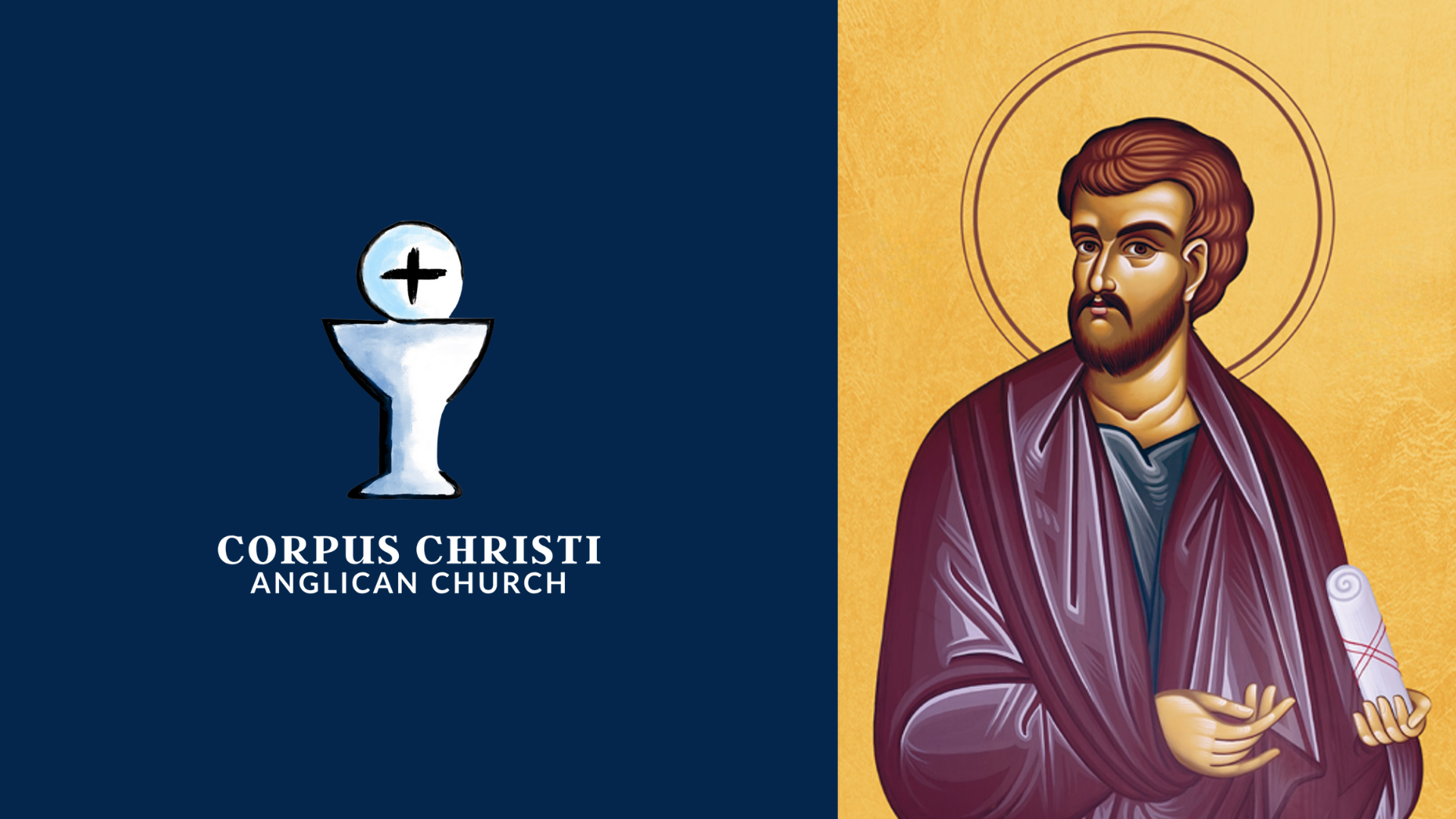
I was mentioning to somebody during Ordinary Time, when the church calendar gives us one of the feast days of the apostles, I want to take it. So today we celebrate the feast day of Bartholomew, one of the apostles of Jesus.
This week, I was pondering a little bit on social media influencers and how the culture of influencers allows for this strange phenomenon where people can actually fake it until they make it. You don't have to be an expert; all you have to do is make a cleverly stitched reel and you could be an influencer—just to have the right ingredients. You don't have to be an expert, and you probably will have more influence than somebody who is well-trained and can craft a long essay, something that's a well-constructed argument.
In fact, I saw a show where this woman had built and started a restaurant. She opened it and was using social media to boost her presence, and she was actually marketing herself before having any experience as a celebrity chef. She even had her own line of cookware that she was selling to boost her income and sales. But on the ground, the restaurant that she had started was totally mismanaged. It was dirty, the food was bad, and when people came once, they just never came back.
But she could sort of create a false narrative about the restaurant because she was controlling the social media influence. And so, she was so focused on celebrity and greatness that she never actually did the hard work of learning the process of how to run a restaurant, to work her way up and have to go through that whole process of knowing the business inside and out. And one of the reasons that I wanted to take today to commemorate one of the martyrs of the church is that when we think of St. Bartholomew and other martyrs, it reminds us that following Jesus is not about chasing greatness.
There are a lot of Christians that chase greatness. They try to keep up appearances to garner influence. In fact, there are even now social media categories like “evangelical influencer,” or you've probably seen “Catholic priest influencers.” I'm not against that. It's the waters that we swim in. It's fine. But just to note the pitfalls—that one does not have to be an expert in subject matter to create a lot of influence. And St. Bartholomew's life reminds us that we need to focus on the process of following Jesus rather than amassing greatness or influence. So, as we look at the life of St. Bartholomew, let me pray for us.
In the name of God, the Father, the Son, and the Holy Spirit. Amen. Lord, may the words of my mouth and the meditation of my heart be always acceptable in your sight, O Lord, my rock and my redeemer. Amen.
So today we wear red because St. Bartholomew is one of the martyrs of the church, and the church often wears red on the feast days for its martyrs—those who have witnessed to the life of Christ to the point of shedding their own blood, giving their life to witness about who Jesus is and what he's done. And this is one of those feast days.
And so, in the history of the church's tradition, Bartholomew is actually the same person as Nathanael. Nathanael—we think his whole name would have been in Aramaic Nathanael Bartholomew, which would come into Greek as Nathanael Bartholomew. And so, if you'll remember the story back in John Chapter 1 (we didn’t read it this morning), Nathanael is the guy who, as he's sitting under a fig tree, hears about this guy Jesus, and he says, “Can anything good come out of Nazareth?” He's that guy.
And I really like the way Eugene Peterson captures this interaction in The Message between Nathanael and Jesus when he encounters him. It says:
When Jesus saw him coming, he said, “Ah, there is an Israelite. There's no false bone in his body.” Speaking of Nathanael.
Nathanael says, “Where did you get that idea? You don't even know me.”
And Jesus answered, “One day, long before Philip called you here, I saw you sitting under the fig tree.”
Nathanael exclaimed, “Rabbi, you are the Son of God, the King of Israel.”
And Jesus said, “You've become a believer simply because I said that I saw you one day sitting under a fig tree? You haven't seen anything yet.”
It's a great translation of what's happening in this interaction with Nathanael and Jesus. Nathanael was a straight shooter. No one was wondering what he was thinking. He was also humble enough that when he encountered the truth, he changed his mind about things. Humility, honesty—these are virtues that characterize St. Bartholomew, or Nathanael.
And he had to, along with the other disciples, learn really hard lessons. He's not exempt. He had to learn all the same lessons the other disciples did about humility and about power and the nature of the kingdom of God.
There are two traditions around what happened to Nathanael after the resurrection of Jesus. One has him going to Lycaonia and then Ethiopia with the gospel to preach. The other has him going through Mesopotamia and even into Parthia. And so, in the tradition where he goes through Parthia, he goes with Jude, who's also called Thaddeus. And so Thaddeus and Bartholomew take the gospel to Armenia, which is the first Christian kingdom. It becomes Christian before Constantine accepts Christianity.
And so, even to this day, Bartholomew and Thaddeus are the patron saints of Armenia. The rest of his life was spent following Jesus, witnessing to the power of Jesus in his resurrection. Not because he pursued greatness. Sorry, he was great, but not because he pursued greatness. It was because he pursued Jesus and he helped people see who Jesus is. And they helped people see the world as it is and what it could be. They helped people see themselves for who they are and what God has made them to be as his image bearers. And Bartholomew had to learn the same authority in the gospel passage that we read today as all the other disciples did.
In the gospel passage, Jesus is giving his final charge to the disciples. He's just told them that one of them is going to betray him. And immediately following that paragraph, St. Luke gives us this paragraph, where they're arguing about which one of them is to be regarded as the greatest in the kingdom. And so remember, in their minds, Jesus is going to reign over an earthly kingdom. Something like an empire. It's going to have this universal scope to it. It's going to be counter to the Roman Empire and all other kingdoms of the earth. And of course, you're going to need people to rule over various regions. And so the question in their mind becomes, how do we get a place of a throne in this kingdom? We've been following you. We've given up a lot. Is it going to be worth it? Can we have the authority that you have to rule over a slice of your kingdom? And now these are fishermen. They're tax collectors. These are other people who have no experience at all in governing over any municipality. This is not their career trajectory. But as they're thinking about Jesus and his kingdom, these thoughts of importance, comfort, notoriety—those things are becoming so alluring for them as they're thinking about the kingdom. And that's a really good reminder for us. It's a reminder to follow Jesus and do good work. It's simple. Follow Jesus and do good work. Do hard work. Hard work on yourself. Hard work on thinking about how Jesus is incorporated into your life.
If you're noticed, if you're honored by people, if you have seasons of relative comfort, that's totally fine. Take note of those things. Name them as they are. Give God thanks for them along the way because they're not going to be normal all the time. Watch for subtle shifts in yourself. There are these subtle shifts where honor, comfort, and notoriety move from being byproducts of your life to becoming aspirations or goals.
Watch for those subtle shifts. Dan Allender, in a podcast I had listened to, Dr. Dan Allender, said this little phrase that felt really appropriate here: “The more subtle, the more satanic.” The more subtle, the more satanic. And that really resonates with me. Notice the subtle shifts in our souls. Take notice of those things. That requires us to examine ourselves carefully as we're following Jesus. And to listen to the Holy Spirit in prayer constantly. And then to spend time discerning the movements of our souls as we're listening to the Holy Spirit. In those times of goodness or in times of trial, the goal is always a deeper knowledge of the love of God. The church has called those consolations and desolations—where Jesus is seemingly present, or where Jesus is seemingly absent.
In whatever season you're in, the goal is a deeper knowledge of the love of God. And as we think about the church, our goal is not corporately to, say, reach a region for Jesus, which feels very business-y. You know, “We're going to reach the nation, reach Springfield, reach Franconia.” But it's to see God's kingdom come in us, in our households, and in our neighborhoods. It moves from inside out. How you live your life is intertwined with the ways that we see the kingdom coming on a broader scale.
And there are things I can't control in my life, but what can I control? I can work on my own interior life every day with the Holy Spirit. I can work on showing up when my wife needs me to show up. I can listen to her. I can work on being present for our son, coach a baseball team, be the kind of manager that parents would love for their kids to have. I can control those things. That's something I can work on. It's within the realm of possibility. Trying to reach an area for Jesus is sort of like this product-orientation mindset. It's really out of my control.
So desiring to be great can potentially run the risk of clouding our vision for the opportunities that are right in front of us every single day. If you're a lawyer, defend justice. Write policy that accomplishes the welfare of the people that you're writing the policy for. If you're a teacher, come to class each day looking to help the kids in your class live life in the kingdom of God, to live out their lives as image bearers of God. If you're raising little ones at home, imagine your house as a kind of monastery where you're creating this school for the Lord's service in the everyday, ordinary stuff of raising little ones. There's so much that's out of our control, right? But the stuff of following Jesus we can do intentionally every single day. This is the substance of discipleship. Those are the subversive kingdom tactics that guard our internal life from subtle satanic opposition. And so that means that an influential product or a way of thinking doesn't justify a life of disordered loves.
I don't know if you're familiar with the theologian A.W. Tozer. He was a really well-known theologian, and he tried to adopt a life of rigorous poverty. Problem is, it's almost like he did it without considering the rest of his family, and he had seven kids. And so, when I think about this, his wife—to the point, his wife Ada Cecilia Pfautz—and she and her seven kids were forced to use public transit because he refused to get a car, even though he could. That's one example of many, but there was this disintegration with his study, his writing, and the life of his family. And so when he passed away, his wife remarried a man named Leonard Odom.
And somebody had asked Ada in an interview, “You know, what's it like to be married to Leonard after being married to the great A.W. Tozer?” And her response was, “I have never been happier in my life. Aiden Tozer loved Jesus Christ, but Leonard Odam loves me.” And I don't think Tozer set out to be a terrible husband, but there was this deep disconnect and there was this disorder to his love for Jesus and his family.
Seeking first the kingdom of God means that you have to rightly order your life with Jesus so that others experience the love of God through you, which means you have to experience it for yourself first. And it's really hard to integrate life with Jesus with our everyday chaos. But that is the substance of discipleship—naming things honestly, receiving grace for them.
To desire to be great is going to get in the way of seeing God's kingdom come. And so, seeing Bartholomew is a great example of someone who would carry on in Jesus's example of service, laying down his life for the sheep of God in a well-ordered, integrated way.
St. Paul, in our New Testament reading today—I hope you didn't miss this in First Corinthians—gives us another example of humility in his testimony about being an apostle. The Corinthians, they seem to be following these teachers who are making them feel superior. They're avoiding suffering, and these teachers are promising things like status and comfort, wealth and ease—almost like the Corinthians are little kings. And the impression that we get is these folks now seem to be looking down on St. Paul's ministry because St. Paul seems to be suffering, so they must be doing something right.
And so St. Paul needs to address the fact that they are misguided in their feelings of importance. And so how do you begin to address somebody who is so blinded by their inflated sense of self-grandeur? I'm not always sure how to do that right, but it's interesting to watch Paul here because his letter is just dripping with sarcasm. He essentially—this is my paraphrase—in 1 Corinthians 4:8ff, I would paraphrase it this way:
“Wow, look at how you all are so grown up. You're all doing so well. Man, you really look like you're living life as Jesus wanted you to live. You look like kings as you're reigning with Jesus. You didn't even need my help. Actually, you didn't even need the help of any of the apostles. JK. Honestly, I really wish you were kings. It would have been a lot easier if I could have just had what you have without having to go through all the stuff I went through—you know, like Jesus did.”
Then he drops the mic. This is St. Paul's address of these people who have an inflated sense of ego.
And in Paul's day, it's interesting—there was this practice where, as generals would be victorious in battle, they would come into a city through a victorious procession. Because there's no social media, how do you find out if they won? Well, it's a victory procession, and they're going to take all the spoils from their military exploitations and process them through the town. And they would come in, and at the back of this processional train are the captives of war, the prisoners. And at the end of that ceremony, all of these people who were captured in battle would either be given into slavery or they would be executed as part of the pagan liturgy.
And so Paul, in verse 9, compares himself and the other apostles to those captives who are at the back of the victory procession. They're being sentenced to death, he says, a spectacle to the world, fools for Christ's sake. So St. Paul has endured these afflictions through the power of the Spirit, not because he was seeking influence on a massive scale, not because he was trying to be great, but because the new-creation life in the kingdom of God doesn't come without the trials that are involved in a cruciform life. The way of the apostles is to focus on this substantive work of living humbly with Christ in all of life. It's this close walk and abiding in the presence of God.
It's the hard work of daily conversion—to watch the movements of our soul and to repent and then to receive God's grace often, daily, maybe multiple times a day—to name things honestly, to turn from the things that are not of the image of God, to look to Jesus to receive his grace. And it's the challenge of noticing others in their grief and struggle, to be able to offer them something of the goodness of the kingdom of God in their image-bearing selves.
So St. Bartholomew and his feast day—this is such a great reminder that if anyone is to be considered great, it's only because they've pointed people to the one who is truly great. The fruit of somebody's life is important, and it also can't be manufactured. So we need to make time to root out the subtle satanic shifts that move us from the grace and love of God in order to note where the Holy Spirit's at work, where he's moving.
The daily life of following Jesus is the witness that our households and our neighborhoods need. And as a church community, if you and I are following daily in that life with Jesus and his abiding presence, our mutual witness of life together is going to produce that substantive work of the kingdom of God together as we help people see what God can do in a community of lives that are being transformed by the gospel of grace and the power of Jesus.
As we close our time, let me pray again this collect for the feast day of St. Bartholomew:
“Almighty and everlasting God, you gave your apostle Bartholomew grace truly to believe and to preach your word. Grant that your church may love what he believed and preach what he taught, through Jesus Christ our Lord, who lives and reigns with you and the Holy Spirit, one God, forever and ever. Amen.”
Transcribed by TurboScribe.ai. Edited using ChatGPT.