
SERMONS
Archive
- March 2026
- February 2026
- January 2026
- December 2025
- November 2025
- October 2025
- September 2025
- August 2025
- July 2025
- June 2025
- May 2025
- April 2025
- March 2025
- February 2025
- January 2025
- December 2024
- November 2024
- October 2024
- September 2024
- August 2024
- July 2024
- June 2024
- May 2024
- April 2024
- March 2024
- February 2024
- January 2024
- December 2023
- November 2023
- October 2023
- September 2023
- August 2023
- July 2023
- June 2023
- May 2023
- April 2023
- March 2023
- February 2023
- January 2023
- December 2022
- November 2022
- October 2022
- September 2022
- August 2022
- July 2022
- June 2022
- May 2022
- April 2022
- March 2022
- February 2022
- January 2022
- December 2021
- November 2021
- October 2021
- September 2021
- August 2021
- July 2021
- June 2021
- May 2021
- April 2021
- March 2021
- February 2021
- January 2021
- December 2020
- November 2020
- October 2020
- September 2020
- August 2020
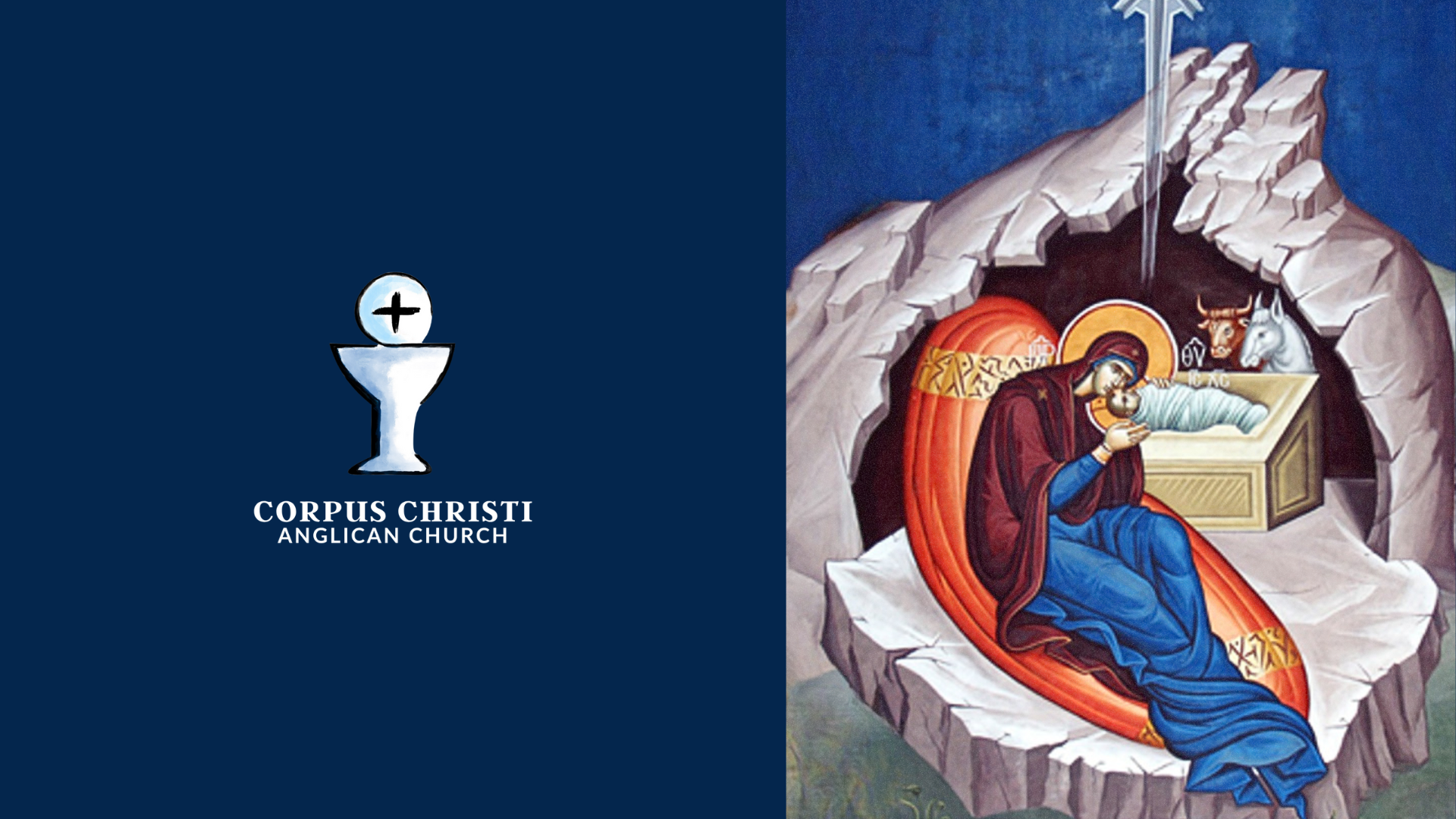
Christmas Eve: Bethlehem Opened Paradise
CONTENT
Intro: Good evening dear friends. Merry Christmas. I’m Fr. Morgan Reed, the Vicar here at Corpus Christi Anglican Church. I am so delighted to have you with us this evening to worship our Lord together.
There is a really neat genre of art called Trompe l’oeil, meaning deceive the eye. One artist named Thomas Deininger has taken it in a new direction by creating objects like a parrot, a bee, a painting, but then if you go around to the side of the object, you realize the whole thing was made from trashed objects. It’s amazing! And I find the whole concept helpful when thinking about the nativity story. There is the image and the pieces that make it. We see details of a story like the famous story about Jesus in swaddling cloths and lying in a manger. We are familiar with the animals of the nativity. There are shepherds and angels. All of these make the nativity story recognizable, but when we turn to the side we begin to see the divine details that compose the story we’re familiar with. God has become human to save us from sin and death and to make all things new. Heaven has been opened and God is inviting us from Bethlehem back to paradise. The realities of this earthly life become windows to heaven to see and experience the kingdom of God that we ultimately long for.
As we look at the Christmas story together today, let me pray for us, “In the name of God, Father, Son, and Holy Spirit, Amen. Lord, may the words of my mouth and the meditation of our hearts be always acceptable O Lord, our Rock and our Redeemer, Amen.”
1) Christ has opened paradise in Bethlehem
The story begins with the setting of Christ’s birth in the context of the Roman Empire. It was during the time of Caesar Augustus, the adopted son of Julius Caesar, who after winning several strategic victories, he had proclaimed himself a son of god. He had, from his perspective, created global peace through his empire and the proclamation about this peace was sometimes called the gospel.
Caesar and Rome are a foil to God’s kingdom and are the historical context as we move to this couple, Mary and Joseph, in the small town of Bethlehem, because of a census that Caesar had called for. They arrive at Bethlehem, which is the town of Joseph’s ancestral lineage. Mary is quite far along in her pregnancy so she comes with him.
When they arrive, they get to the house of either family or a family friend only to discover that the normal guest room is occupied, so they’re given another room in the house. Mary gives birth to a healthy baby boy and at some point after his birth we are given these details about him being swaddled and placed in a feeding trough because they were functionally able to make a soft bassinet out of it.
This is one view of the Christmas story: the manger, the census, even Caesar himself. These historical realities are true but point us to a deeper reality that is going on. Now we move to the component parts of the trompe l’oeil of the story and we begin to see the heavenly realities. We meet the angels who appear in the darkness to shepherds and the glory of God shows up around them and the shepherds are terrified. Heaven proclaims that in Bethlehem, David’s city, is born this day a Savior who is Christ the Lord. This was the hope of Israel and of the nations. A multitude of angels appear and praise God, singing “Glory to God in the highest, and peace on earth among those whom he favors!”
The shepherds are given the details about Bethlehem and the feeding trough so that they can find this child. They find Mary, Joseph, and the child. They are struck with wonder and amazement. Mary is taking note of all that’s going on and pondering them in her heart.
Israel was looking for a Davidic ruler to overthrow empirical powers. What they got was heaven on earth where God became man to rescue humanity from sin and death and bring them back to fully restored life with their creator. There is a beautiful quote from someone in the church’s history about this, where it is said “Bethlehem has opened Eden: Come, let us see! We have found joy hidden! Come, let us take possession of paradise within the cave. There the unwatered stem has appeared, from which forgiveness blossoms forth! There the undug well is found from which David longed to drink of old! There the Virgin has borne a child, and at once the thirst of Adam and David is made to cease. Therefore let us hasten to this place where for our sake the eternal God was born as a little child!”[1]
Christ would live in perfect obedience and union with his father, would be mocked and die on a cross to conquer sin for us, would rise from the dead to conquer death for us, and would ascend to reign on high and make all things new. But first, he must be born, Son of God and Son of Man. He was conceived by the Holy Spirit, fully divine — and born of the virgin Mary, fully human. He took all of what we are as humans to raise it up again into full fellowship and union with the life of God. When we think back to the garden of Eden in the book of Genesis, God’s invitation to humanity was perfect fellowship, a daily walk in the cool of the day, but we were tempted by the voice that called us away from dependence on God and life with our creator to do things our own way in believing that we have the capacity without God’s help to figure it out. This voice tempts us time and time again and as a result creation is broken and we are broken.
The young woman, Eve, mourned because she and Adam were cast out of God’s presence, but she now takes comfort in this young woman, the blessed virgin Mary. Through Mary’s child, paradise is opened again and Eve’s children will stream to it. This child is Emmanuel, God with us, because although we had walked away, God, in his compassion has given us this child to be our savior, who is Christ, the Lord. He is making all things new in the hearts and lives of people by the power of his resurrection and his rule and reign as a promise that he will do it ultimately. And tonight we celebrate the miracle that began it all in wonder with the shepherds who hear the heavens declare the story that God has come to earth in this child and become king of all, that in him all things will be renewed if we simply swear our allegiance to him and trust him as our king and Lord.
Conclusion
As we look at the parts of the story, let’s not get too hung up on a manger or animals. The story that God is telling is the beginning of the end of sin and death. It is the story of God’s plan to make all things new and invite his people into life with him once again. As we consider the Incarnation and Nativity of our Lord, let me close us by praying for us:
“Almighty God, you have given your only-begotten Son to take our nature upon him, and to be born of a pure virgin: Grant that we, who have been born again and made your children by adoption and grace, may daily be renewed by your Holy Spirit; through Jesus Christ our Lord, to whom with you and the same Spirit be honor and glory, now and for ever. Amen.”
[1] Anonymous. Ancient Christian Commentary on Scripture.

Advent 2: John the Baptist and the Repentant Remnant
cONTENT
Introduction
Good morning, friends. It is wonderful to be here with you on this second Sunday of Advent. Today, we hear about the ministry of John the Baptist. He is the forerunner, whose icon we keep on the Old Covenant side of the altar. He had a clear sense that his life and ministry were to call people to follow Jesus as the Messiah. He provided the foundation and base for the ministry of Jesus to be launched. John the Baptist invites us to prepare the way of the Lord in Advent by calling us to look beyond what we see right now, look around us and notice the ways things are broken, and look to the one to come who can and will deliver us. As we look at Isaiah and our Gospel text, let me pray for us:
“In the name of God, the Father, the Son, and the Holy Spirit, Amen. Lord, may the words of my mouth and the meditation of our hearts be always acceptable in your sight, O Lord, our Rock, and our Redeemer. Amen.”
Look beyond: John the Baptist is calling people into the new age Isaiah prophesied about
First, we need to look beyond what we can presently see. We read Isaiah 11 this morning, which was meant to be a corrective and exposition on what the Messianic reign would look like. Some were tempted to think before Israel’s exile that there was be an unbroken line in the reign of the house of David until the reign of a Messiah, but Isaiah 7 and the encounter with King Ahaz would destroy that hope. As God would cut down the mighty tree of Assyria, he would also destroy the mighty tree of the proud and corrupt house of David.
While it looked like there was no hope for the house of David, there would be a branch of Jesse, that a remnant would follow. Ahaz wouldn’t be the last Davidic monarch to ruin Israel’s hope. It would happen again as Israel went into exile, then hope was kindled again with Zerubbabel, who began the rebuilding process. The Maccabeans may have ruled like little kings, but they were not of David’s line and ultimately became corrupt. The Idumeans, who were Edomites, were forcibly converted by the Maccabees. This would come to bite them later as the Idumeans, who were pro-Roman and Jewish-adjacent, produced the Herodian dynasty who was ruling Judea in the time of John the Baptist. Everyone is still waiting and looking for the branch of Jesse because it cannot be located in the Herodians.
Isaiah paints a glorious picture of the rule and reign of this Davidic King. It is a new future where the nations are streaming to the mountain of God, as we read about last week. One writer says, “What Isaiah envisioned was...the sovereign execution of a new act of creation in which the righteous will of God is embraced, and the whole earth now reflects a reverent devotion “as the waters cover the sea.”[1] John the Baptist shows up in this period as a prophetic figure who joins the prophetic voice of Isaiah 40, calling for people to go to the wilderness to prepare the way of the Lord. There is an anticipation of the Davidic ruler coming. To be part of the movement, John is calling people into this new age that Isaiah prophesied about.
His presence is a critique on the current leadership. Do not trust the Herodians, do not trust the corrupted temple system. Prepare the way because the Davidic branch is coming. Prepare through works of repentance. Josephus, the 1st century Jewish historian, actually writes more about John than about Jesus. This is probably indicative of how great John’s influence was and why he was seen as such a political threat to Herod Antipas. He says about John’s baptism, “...For immersion in water, it was clear to him, could not be used for the forgiveness of sins, but as a sanctification of the body, and only if the soul was already thoroughly purified by right actions.”[2] He is asking them to look beyond the current rulers and authorities to live under the authority of the Messianic king in the midst of a corrupt and broken world. It’s still true of us as an Advent reminder that we are called to navigate living under the authority of Jesus in a world bound to sin. We are citizens of the Kingdom where Jesus is king, and we’re navigating the welfare of others as people in exile.
Look around: John calls them to register themselves among the remnant
John was calling people to look around at the brokenness and to enroll themselves into this sacred remnant. His baptism has a surprising element to it. In verse 6, people are coming to him at the river as religious pilgrims looking for hope. They want something more than Jerusalem has to offer. John’s baptism is closely associated with what you would find in Gentile converts. But these aren’t Gentiles. The very fact that Jews are coming to a prophetic voice in the wilderness to prepare for the Messianic kingdom is a revival movement that draws the attention of both the Pharisees and Sadducees.
The Pharisees sit in the seat of Moses as interpreters who are helping people live out the law in a decentralized way. The Sadducees hold power over the temple, priesthood, and cultic life in Jerusalem. They’re frenemies who send a delegation to investigate what is happening. John has quite the greeting: “You brood of vipers, who warned you to flee from the wrath to come?” He isn’t diplomatic, but he sure is clear. The idea is that they’re like snakes lurking in the shadows, who are alerted to a coming fire and flee the scene. When the Messiah comes, there will be judgment. Do they think they’re really safe? They need to amend their lives, note the corruption and injustice they’ve caused, and bear fruits worthy of that repentance. He says that the axe is laid at the root of the tree, which again brings us back to the felling of the tree imagery, and the house of Judah, which we saw in Isaiah 11.
This attack on people’s fragile strongholds of confidence is instructive for Advent. It invites us to examine what we cling to for validation and comfort. The delegation from the Pharisees and Sadducees relied on their status and familial ties; they prioritized comfort before renewal. We are all prone to this. While I am a huge fan of religious ritual and rhythm, there is also something good about momentary, holy disruptions. For example, each week we have sacramental confession as part of the liturgy. But to make a good and right confession, we need to prepare for it throughout the week. This is why I encourage people to come to confession outside of Sundays on occasion. It is out of these times of confession that I like to work with people on the spiritual rhythms they have. It is available to all of you; some of you should probably do it, but of course, none must do it. You can still prepare for confession each day before morning and evening prayer as well. Even if you don’t come for private confession, perhaps there is an opportunity each week to make a habit of writing our sins down in preparation for Sunday. Are we able to name patterns or wrath, overreactions, overindulgences, workaholism, or other addictions, places where we continually deny how broken things are? Making space for this kind of preparation is the holy unsettling we need to prepare the way of the Lord.
Look at the One to Come
John the Baptist calls the people to look beyond the current circumstances they’re in. He calls them to look around them at the world in its brokenness, and enroll themselves in the remnant that is going to experience the salvation of the one who is to come. Finally, he calls the people to look at the one who is coming. The most surprising thing to me about the prophetic ministry of John the Baptist is that someone with such a large following and impact could have such a clear vision that his ultimate goal was to lead people to deliverance under the Kingship of the Lord’s anointed one. How many leaders in human history would have taken their large following as an indicator that they themselves are a messianic figure?!
John knew the scope of his ministry. He was preparing disciples to prepare the way for the Lord’s kingdom. This Sunday of Advent invites us into this ministry of preparation as well. We prepare ourselves for the kingdom of God to prepare others to see Jesus as well.
We have things in our calendar that are routine maintenance to keep things healthy: flushing water heaters, opening and closing water valves, oil changes, weeding, waterproofing fences, brushing teeth, etc. We understand routine maintenance in the physical world, but preparing well for the king who is coming involves spiritual routine maintenance. Where have we allowed seedlings of resentment to sprout up? What addictions have kept us from naming harm done to us honestly? What routines have developed that keep us from connection and friendship with others or from regular silence and solitude with God? Giving attention to these spaces is the work of preparing the way for the king who is coming to free us from bondage to sin and death. And the good news is that while he is coming to do this ultimately, he actually does this now in his death and resurrection, by the power of the Holy Spirit who is his presence in and among us. Preparing to meet the Lord gives proper scope to all the areas of our lives.
Conclusion
On this second Sunday of Advent, John the Baptist invites us to turn from the works of darkness to bear fruits worthy of repentance as preparation for the return of the Lord. We need to look beyond what we see right now to what God is doing in our souls through the situations we encounter. We need to look around us and notice the ways things are broken and how we long for God’s kingdom to come. This is our invitation to enroll in the remnant that Jesus is reigning over as king. We need to look to the one to come who can and will deliver us. Just like in Isaiah 11, it might seem hopeless when we feel the discontinuity between God’s plan and the reality we are experiencing, but in the purification of God’s people, Jesus is still reigning over all. The work of God in the repentant heart is a small glimmer of hope that Jesus, the branch of Jesse, will not fail. His kingdom is sprouting and growing even when we wonder where hope is or when it feels like the tree has been chopped down. How are we preparing to meet him? The small glimmers of hope in Christ’s work are the promise of the realities of the good things to come for the people of God who follow Jesus as their Lord and King.
Let us pray:
Almighty God, by whose providence your servant John the Baptist was wonderfully born, and sent to prepare the way of your Son our Savior by preaching repentance: Make us so to follow his teaching and holy life, that we may truly repent, boldly rebuke vice, patiently suffer for the sake of truth, and proclaim the coming of Jesus Christ our Lord; who lives and reigns with you and the Holy Spirit, one God, for ever and ever. Amen.
[1] Brevard Childs, Isaiah: A Commentary
[2] Josephus, Antiquities 18.5.2, 116-119.

Advent 1: Preparing for the Dawn of Christ's Return
cONTENT
Introduction
Good morning friends. It is great to be with you as we begin our liturgical year together with the season of Advent. This season of waiting and longing is formative in making us who God called us to be as we prepare with hope to meet the Lord. I remember watching some of the shows about homesteading in Alaska and watching people prepare for entering the long and dark winter where there wasn’t light for a few months. Even in those seasons of darkness, there is preparation to be done, whether it is fir trapping, or gathering firewood; being proactive in seasons of darkness allow them to not only to flourish in the darkness, but then prepare them better for life in the season of light when the icy world begins to thaw. Preparing well in the seasons of darkness prepares us well to greet the dawn of the new day when Christ comes again.
I realize that people usually make resolutions in January as they look at the the new year, but I wonder if it wouldn’t be more appropriate to use the season of Advent to take stock of our longings, desires, and lives in order to ask the Lord how we might resolve to prepare to become what he’s calling us to become? Today’s collect will be read each Sunday in Advent along with other ones as we are invited to cast off the deeds of darkness and put on the armor of light. It is a season where we feel the depths of the world’s anticipation of the Lord’s coming, because things did not turn out the way the world had hoped for and all creation longs to be made new. Advent, fittingly, leads us up to the nativity of our Lord, but actually it is predominantly an anticipation of the end of the reign of darkness in the world when Christ comes again to make all things new. We begin the year with a reminder of where all things are heading. Advent invites us to prepare for the coming of God’s kingdom in small ways so that we are ready when he ultimately returns. Our passages this morning frame it in terms of light and preparation.
As we look at our texts, let me pray for us: “In the name of God, the Father, the Son, and the Holy Spirit, amen. Lord, my the words of my mouth and the meditation of our hearts be always acceptable, O Lord, our Rock and our Redeemer. Amen.”
1) Walk in the light (Isaiah 2:5 and collect)
First let’s think about light. Our Old Testament reading today comes from Isaiah 2 where the prophet Isaiah is inviting people to choose to follow the Lord. There is a beautiful scene painted that also gets used in Micah, though we don’t know if one or the other is older, or if this passage preceded them both. The imagery is of pilgrimage, as all nations stream up the holy mountain to meet God in the temple, the place where heaven and earth are brought together. The nations want to go up to the house of the God of Jacob, which is Isaiah’s invitation to the people: be the people who show the nations the goodness of God. In that poetic passage, God reigns over all justly, instruction goes out from him, and people have no need for weapons any longer. All the swords will be beating into plowshares and spears into pruning hooks. There will be true peace, a shalom which reconciles and restores, and doesn’t just provide for just a temporary cessation of hostilities.
In verse 5 Isaiah says, “O house of Jacob, come, let us walk in the light of the LORD!” What follows his call to them is a listing out of all the ways they have walked away from the LORD and disobeyed. The prophet named the crossroads the house of Jacob is at. They could either be the house of Jacob in name only — the result is the irony that by relying on their status and listening only to the voices that told the leaders what they wanted to hear, they would risk losing everything. Or they could live into this vision of the house of Jacob in Isaiah 2 which lives with integrity and puts God’s goodness, mercy, and justice on display in a compelling vision that draws in the nations around it.
The call to walk in the light is the same for you and I. We should seek to live in integrity of heart, not depending on our status or a past experience to feel justified, but in a life of conversion and repentance, grace, and trust. Light comes when we become honest with ourselves. I remember someone decades ago I knew and the only things she could talk about were the frustrations she had with the people in her life. It was every conversation. Eventually, as new people would come into her life, it became somewhat of a self-fulfilling prophecy. The poor woman was unaware the damage she was causing herself because she was not aware of how she was showing up with other people. Following Jesus means we need to become aware of the places where we need God’s grace. We cannot rely on our past experiences, the faith of our households of origin, or even ecclesiastical status for our continual assurance that we are becoming who God has made us to be. Instead, we undergo the difficult and daily process of noticing our overreactions to things, our besetting sins, our places of inability to function, the false narratives we’ve held deeply, and we hold them before the light of Christ, fully expectant that his light will scatter the darkness. That healing is the integration we need to draw ourselves and others into the goodness of the light of God.
2) Be ready for him at all times (24:43-44)
First there is light, second, there is preparation. Our gospel passage is from Matthew 24 is another apocalyptic passage of Jesus. Remember that apocalypse means something like uncovering or revealing, and Jesus is showing his disciples something of what is coming so that they’re prepared when calamity strikes. Jesus is speaking about the destruction of the temple and about when the Son of Man will come to bring an end to foreign rule and the beginning of the new age. The disciples are asking Jesus when this will happen and what will be the signs of Jesus’ reign. The destruction of the temple in Jesus’ prophetic ministry here is not arbitrary, but I think it has to do with the fact that the corruption in the temple was indicative of broader trends. Cleansing began with the most pronounced place of corruption.
It isn’t that the disciples were wrong to want to know when or how, but Jesus isn’t concerned with giving them or us an eschatological road map. I had to look this up because I didn’t believe it existed, but it does. A guy truly wrote a book called “88 reasons Why the Rapture will be in 1988”. Like the disciples, there are strands of theology concerning themselves with the wrong things. Jesus isn’t calling us to speculative timelines and rapture charts. he is giving us enough to stay awake as the forces of wickedness draw people into their grip so that we are not swept away by the deeds of darkness as well. He isn’t giving the disciples or us enough information to preoccupy ourselves with dates and events.
Jesus tells the disciples that no one knows when the son of Man is coming. No one knows this hour, not even the angels. He ends the section by saying “Therefore, you also must be ready, for the Son of Man is coming at an unexpected hour.”
This invites the disciples to ask whether they’re preparing for the Son of Man’s coming and how they are doing so? It is a similar invitation to Isaiah 2, but in light of the New Covenant. How do we prepare for the coming of Christ, his second Advent? Let me suggest that we all take this Advent to consider the monastic concept of a rule of life. Rather than viewing this as something like a set of dos and don’ts, it is more like the trellis you build in order to maximize the growth of the plant you’re growing. The other day I saw a fast motion video of a watermelon vine growing. Over the course of 3-4 months, it had spread like chaos all over the little room it was in. If someone had carefully constructed a trellis, the vine would climb, more green would be exposed to the sunlight for energy, and more melons would grow because more flowers are exposed. This is how a rule of life brings intentionality to rhythms of communal life.
We have a built-in rule through the daily office of morning and evening prayer. The prayer itself helps us engage with scripture, do confession, praise and thanksgiving, intercession, and more. But then we need to do some other things and this will look different depending on our stories and seasons of life. If this is a season where you have small kids at home you may not be able to have time to exercise like you want to or have the kind of relationship with your spouse you used to before you were with kids. That’s okay. Be intentional about the moments you have, name them, and cultivate them. In this season, you may find yourself going through a major life transition: feeling yourself growing older, experiencing you’re parents aging into more dependence, learning how to be a single parent, feeling underemployed, or in a vocational change, or becoming more aware and grieving the loss of the ways things didn’t turn out as you hoped they would. Don’t let the vine grow into chaos all over the floor — give some thought and intentionality to your time and energy. You may not have the hours to spend reading and writing like you used to — or the other activities that brought you rest and joy. What does bring you rest and joy in this season and how can you cultivate that and create small things to look forward to? Are there 5-minute pockets you can use and redeem so that you are prepared to see Jesus when he shows up in the everyday moments? In our rule, can we also cultivate practices that notice the needs of others so that we don’t get stuck in spirals of self-pity? Do we make time for a little silence and solitude, gratitude, exercise, service to others, friendship or hospitality, prayer? How have we constructed our trellis? Building the trellis of seeing Jesus in the everyday ordinary stuff of life and relationships is the work of preparing to meet Jesus when he comes again in power and great glory.
Conclusion:
I’m so grateful for Advent. I hope we make the most of this liturgical new year together. This is the time to walk in the light, becoming aware of where darkness has taken hold, and bringing it before the Lord so that we can discover his grace and bring others into a knowledge of Him. We need to prepare to meet him each day with intentionality so that we are ultimately prepared to meet him when he comes again. As we close, let me once again pray this collect for us from the first week of Advent.
“Almighty God, give us grace to cast away the works of darkness, and put on the armor of light, now in the time of this mortal life in which your Son Jesus Christ came to visit us in great humility; that in the last day, when he shall come again in his glorious majesty to judge both the living and the dead, we may rise to the life immortal; through him who lives and reigns with you and the Holy Spirit, one God, now and for ever. Amen.”
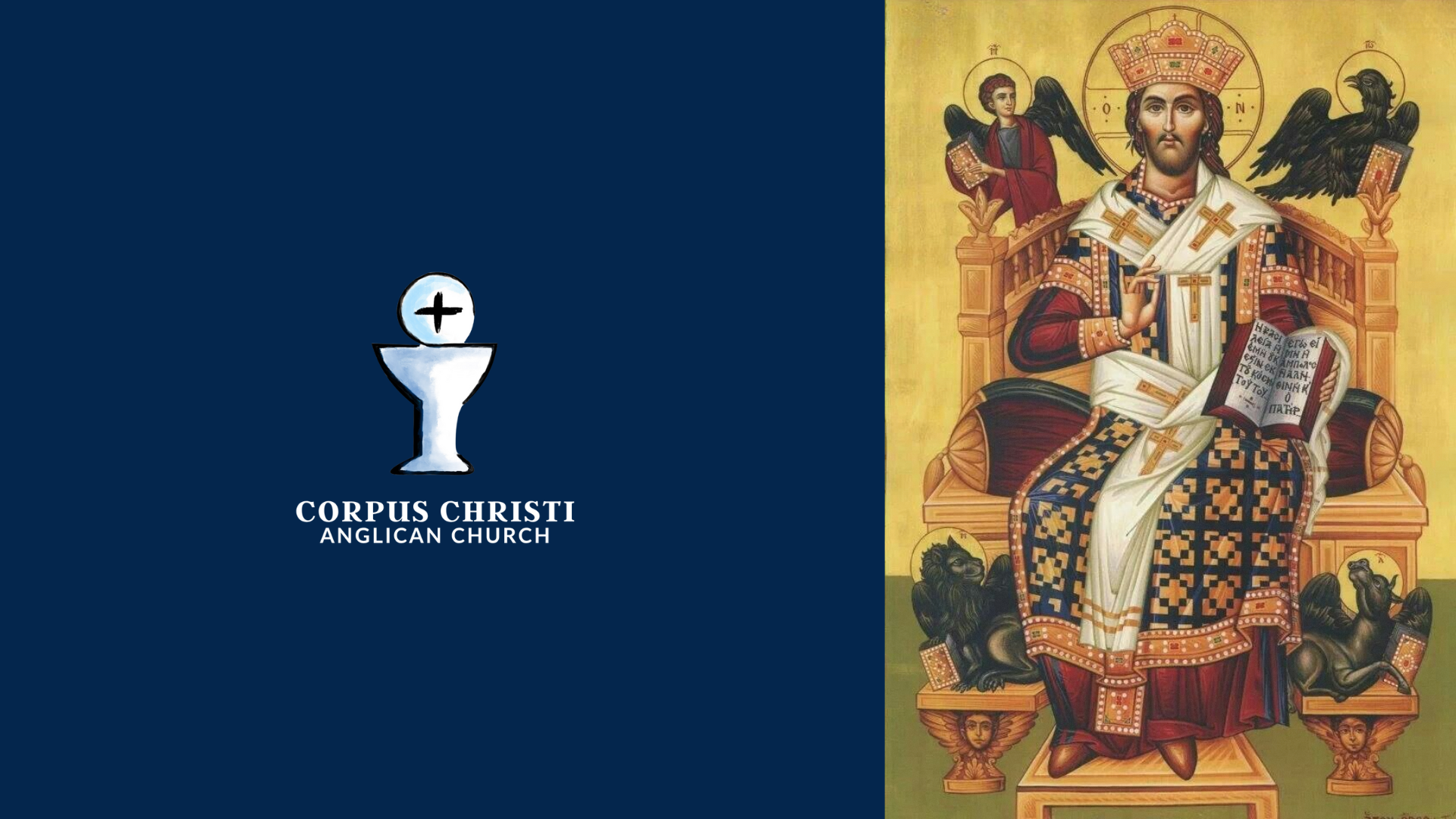
Sunday of Christ the King: Citizens of Heaven, Pilgrims on Earth
cONTENT
Introduction
Good morning, friends. Welcome to the end of our liturgical year, the Sunday of Christ the King. This is a really new feast in the calendar of the church. In fact, today is its 100th celebration. There was a turbulent revolutionary period between 1917 and 1922 as Vladimir Lenin consolidated power, led his socialist-Bolshevik party in fighting a civil war, and as he won and consolidated power, began to push out his opponents. World War I had just ended, and people were figuring out how to rebuild in Europe. Lenin’s version of Marxism promised people land, bread, and peace — and people bought into it. This began the creation of what would be the Soviet Union as Lenin and his form of socialism promised answers to hurting peoples’ questions.
Around 1922, Joseph Stalin had become the secretary-general of the Communist Party and in just 2 years would expel Trotsky to become dictator and ruling leader when Lenin died in 1924. Stalin had forcibly collectivized the USSR’s agriculture and industry, held power by intensive police terror, and extended soviet control over a number of European states. He is really the architect of what we would now consider to be soviet totalitarianism. He executed people, sent them to labor camps, and persecuted the Russian Orthodox Church and other religious groups in the name of militant atheism. This movement was creating global alliances that were harmful not just to the church, but to human civilization at large.
As the church finds herself in 1925, wondering what her future will be in this world, Pope Pius XI institutes the feast of the Solemnity of Our Lord Jesus Christ, King of the Universe. In his encyclical, his message of hope to the church is that governments will come and go but it is Christ who reigns as king forever. He says, “From this it follows not only that Christ is to be adored by angels and men, but that to him as man angels and men are subject, and must recognize his empire; by reason of the hypostatic union Christ has power over all creatures.”[1] This feast day ends our liturgical year with the crucial reminder that Jesus Christ is Lord and King — He has the final word. Every area of our lives shall be under Christ’s reign so that we can declare and put on display the goodness of his rule and reign in a broken world, subject to unjust empires and spiritual forces of wickedness, which is longing for restoration.
As we look at the Gospel text this morning, let me pray for us: “In the name of God, the Father, the Son, and the Holy Spirit. Amen. Lord, may the words of my mouth and the meditation of our hearts be always acceptable in your sight, O Lord, our Rock and Redeemer, Amen.”
• Mocking will come from those who don’t have eyes to see — Lk 23:35-39
In the Gospel today St. Luke shows us humanity’s response to our Lord. There are curious watchers and mockers all throughout the text. The people who condemned Christ to be crucified stand and watch in curiosity at what will happen as an outcome for their call to have Jesus killed. The leaders of the people take it a step further and don’t just stand in curiosity, but move towards mockery. If Jesus was so good at saving others, why can’t he save himself? This is echoed by the Roman soldiers who form a third group of mockers. While kings sit in luxury on their thrones, satiating themselves with delicacies and drinking the finest wine, our Lord received a crown of thorns and in his thirst, was given the poor man’s sour wine: enough to momentarily satisfy this thirst, but only enough to prolong his suffering. They join in the chorus of saying “Hey, if you can save others, why don’t you save yourself?”.
All of the mockery and suffering is framed by the inscription above Jesus’ head. “Jesus, the Nazarene, the King of the Jews”. Everyone is accosting Jesus, even one of the criminals crucified next to him. One author paints a helpfully vivid picture of what St. Luke is doing: “Jesus has stood on its head the meaning of kingship, the meaning of the kingdom itself. He has celebrated with the wrong people, offered peace and hope to the wrong people, and warned the wrong people of God’s coming judgment. Now he is hailed as king at last, but in mockery. Here comes his royal cupbearer, only it’s a Roman soldier offering him the sour wine that poor people drank. Here is his royal placard, announcing his kingship to the world, but it is in fact the criminal charge which explains his cruel death.” Humanity’s problem was far deeper than an ethnic community losing political power. His death, resurrection, and ascension procured a kingship far more real, spiritual, and cosmic than holding onto earthly power. His Kingship, his rule and reign, breaks into the world to overcome sin and death one person, household, neighborhood, and town at a time. The diaspora of the church spread abroad in the world is promise that God is bringing all things into the fullness of their new creation. We will find people mocking because this kingdom does not fit the contours of any earthly kingdom perfectly.
In the early church, there is a great letter saved for us called the Epistle of Diognetus which says, “But while they live in both Greek and barbarian cities, as each one’s lot was cast...at the same time they demonstrate the remarkable and admittedly unusual character of their own citizenship. They live in their own countries, but only as nonresidents; they participate in everything as citizens, and endure everything as foreigners. Every foreign country is their fatherland, and every fatherland is foreign. They marry like everyone else, and they have children, but they do not expose their offspring. They share their food, but not their wives. They are in the flesh but do not live according to the flesh. They live on earth, but their citizenship is in heaven.”[2] We cannot set our hope in human institutions to provide the salvation we long for. We begin with Christ as our king and live in the world under delegated and penultimate authorities. We do not look to Darius, Caesar, or any earthly authority who might promise the kingdom of God, or that they can fix every ill in the world, and then demand our unquestioning allegiance to them. We need to prayerfully, and in allegiance to Christ our King, shape the institutions that will in turn shape us. Doing the work of God’s kingdom means risking mockery to desire that we and others become more like Jesus and that things are ultimately made right again.
It starts with the hard work of naming accurately done wrong, or not done right. It is hard to name someone else’s harm of us accurately so that they might come to repentance. It is hard to ask for forgiveness, and often harder to extend forgiveness when others have genuinely repented. It is hard to do what is good and right when it is common to uphold injustice and vice — especially when injustice and vice become legal!
Citizens of God’s kingdom don’t long for the appearance of satisfaction, comfort, or opulence — a put-together life— but we risk admitting that we are not put together so that people can see the transforming work of the Holy Spirit in us. Sometimes when I talk with someone not a part of the church, they will share about something deeply broken. And my reply is often “there are a lot of people who have struggled with that”. Sometimes I’ll ask if they even want to hear of my own story with regards to what they're going through if it seems appropriate. It’s in those moments of recognizing our common humanity that I’m able to share something about the goodness of the work of Jesus in a way that it can be held in honor, because the problem is not just that we are not morally good, it is that we are deeply wounded and in need of becoming whole again. The kingship of Jesus is so much deeper than acquiring earthly power or changing people’s behavior. It is about helping others see how our desire for autonomy and separation from God has broken us more than we’re often able to admit; but also helping others become acquainted with the power of Jesus, who reigns over all, and is far more able deliver us than we would have ever believed. We risk mockery for the benefits of heavenly citizenship.
• The cross is the doorway to paradise and Christ’s reign (Lk 23:40-43)
One of the thieves on a cross next to Jesus refuses the mockery. His life is nearly done, he knows his flaws and probably deeply regrets the life choices that led to this moment. Jesus is really his last hope. He knows the inscription above Jesus’ head and in the mystery of God, he has some faith that Jesus is telling the truth about the kingdom of God, whatever that might mean. I can imagine this kind of faith being something like “Jesus, I’m not sure what this kingdom will look like, but when you arrive there, please remember me as someone who is favored and not someone who has taken the side of the wicked and the unjust.” He says, “Remember me when you come into your kingdom.” A simple desire opens up the door to the grace of God.
Jesus tells the man immediately, “Truly, I tell you, today you will be with me in Paradise.” When someone turn towards God with the smallest amount of faith, God turns toward him or her with an overwhelming amount of grace. The man on the cross is hope for all of humanity who longs for God’s kingdom to break into the chaos of our brokenness, of our failed relationships, our unmet expectations, and our injustices. St. Ephrem says it this way:
Adam had been naked and fair,
but his diligent wife
labored and made for him
a garment covered with stains.
The garden, seeing him thus vile,
drove him forth.
Through Mary, Adam had
another robe
which adorned the thief;
and when he became resplendent at Christ’s promise,
the garden, looking on,
embraced him in Adam’s place.”[3]
Conclusion
After a hundred years of celebrating the Solemnity of Our Lord Jesus Christ, King of the Universe, we end the liturgical year with the reminder that Jesus’ kingdom will rule over all. Humanity is still inventing new ways to rebel against God, new ways to exploit one another, new idols to worship. And yet, Christ has ascended on high where he sits as king above all. He used the apostles as agents of cosmic renewal where the Gospel of Christ was overturning wickedness and death by the transformed lives of people by the Holy Spirit. You and I have joined that same heritage and citizenship, where every foreign land is our fatherland, and fatherland is where we journey as strangers. As we go about doing the hard work of repentance, naming things accurately, and risking mockery, we trust that Christ, who rules over all, will transform us and those around us by his grace because his citizenship acquaints us with the grace of God and brings the healing and restoration we long for.
Let us pray:
O God, the King of glory, you have exalted your only Son Jesus Christ with great triumph to your kingdom in heaven: Do not leave us comfortless, but send us your Holy Spirit to strengthen us, and exalt us to that place where our Savior Christ has gone before; who lives and reigns with you and the Holy Spirit, one God, in glory everlasting. Amen.
[1] Quas Primas, 13.
[2] Michael Holmes, The Apostolic Fathers in English. Epistle to Diognetus, 5:5-9.
[3] Hymns on Paradise 4.5.
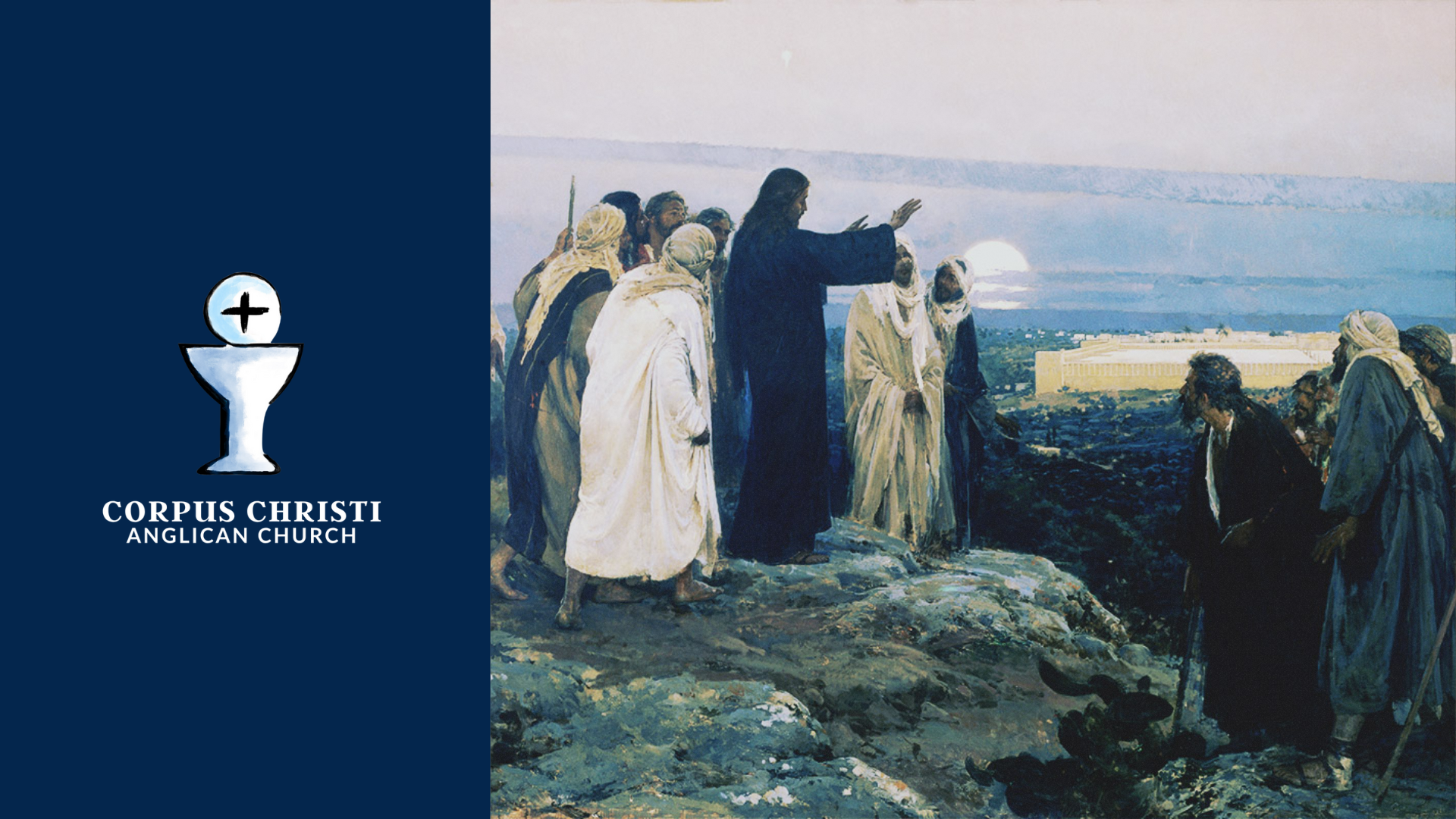
Uncovering God’s Kingdom Where Chaos Seems to Reign
cONTENT
Introduction
Good morning everyone. I’m Fr. Morgan Reed, the Vicar here at Corpus Christi Anglican Church. Today’s passage is the apocalypse as told by Jesus. In English, we use the word apocalyptic almost synonymously with destruction. For example, “the devastation of the city looked apocalyptic”, or people joke about a zombie apocalypse.
This doesn’t do justice to how Christians have used this word historically. Apocalypse means “revealing” or “uncovering” and apocalyptic literature was hopeful for the Christian because it demonstrated the slow unfolding of the victory of God over chaos and the victory of God’s people over death and evil. I think of it a bit like a movie. There are some shows or movies where at the beginning we see a snapshot of how the story will end. The rest of the movie is about showing you the process of how it got there. Apocalyptic literature is a bit like this.
We know the end: “For the Lamb at the center of the throne will be their shepherd; he will lead them to springs of living water. And God will wipe away every tear from their eyes.”[1] We know now that what awaits us is the great day where the unjust encounter God’s judgment and the righteous will be brought into the fullness of new creation where they experience God’s inexhaustible divine life and presence which they’ve only known in part now. It can be easy to lose hope as we watch the world and people around us devolve into chaos, or to see the wicked prosper. I wonder how many times we’ve said “I can’t even” or “I have no words for this” in a given week. Perhaps it feels incalculable and so we compartmentalize the “I can’t evens” and the “I have no words” moments right now with hope that someday Jesus will make things better. Jesus, in our passage today, gives us a glimpse of what is coming in order to reorient us when the present reality is chaos.
As we look at this passage together, let me pray for us:
“In the name of God, the Father, the Son, and the Holy Spirit, amen. Lord, may the words of my mouth and the meditation of my heart be always acceptable in your sight, O Lord, my Rock and my Redeemer. Amen.”
A. (21:5-11) Apocalyptic stability: non-anxious people
The first point I take from Jesus’ apocalypse is that hope in Christ creates stability and a people who are non-anxious. Second, because of our apocalyptic hope, we should live soberly and endure so that we experience salvation. Let’s look at the first point: apocalyptic hope creates stability and a people who are non-anxious. In Luke 21:5-11, Jesus is with his disciples and while Luke’s Gospel doesn’t tell us where the dialogue is happening, Mark and Matthew place this dialogue on the Mount of Olives. In Mark’s Gospel, those with Jesus are identified as Peter, James, John, and Andrew — This passage is often called the Olivet discourse.
They admired how the temple was adorned with beautiful stones and gifts dedicated to God. This had been the building project of Herod the Great, who had built up the temple significantly after it’s destruction as part of a national reconstruction program. Jesus is basically telling them not to get too excited because it’s just temporary.
Feel the gravity of that for a second. One of the things my son and I love to do is ride our bikes into DC, ride by the reflecting pool, and then head into the WWII memorial and stick our feet in the water. While we are sitting there, it is amazing to look up and to be surrounded by all the monuments which ground us in the history of what it means to be American. Imagine someone sitting next to us who looks at us at that moment and says something like “Yea, don’t be too impressed. This is all going to go away someday. They are just a bunch of stones.” You would probably scoot a bit further away from this person.
I would imagine that this is a little bit of the angst that the disciples are feeling as Jesus begins talking about the temple being destroyed. But since they know Zech 14, they also know that if the destruction of Jerusalem is coming, then then the Lord will come from the Mount of Olives and conquer and reign from Jerusalem over the whole earth. Destruction is the anticipation of salvation and those two things, in their minds, are not separated by a great length of time. Their question makes sense: When are the events that bring about the temple’s destruction going to take place? And are there going to be signs that this will be the case?
Jesus answers their question in a reality that was true for them and is still true today. There will be people who will come claiming that they’re the Messiah, or at least that they are your only hope for salvation. Don’t believe them. There will be wars, insurrections, scandals, and human sin will seem to reign corporately, individually, and systemically. There will be natural disasters, famines, plagues, earthquakes, and more. These will be signs that creation is groaning, the same creation that has hope that “...it will be liberated from its bondage to decay and brought into the freedom and glory of the children of God.”[2]
The apocalypse of Jesus is the stabilizing and reorienting vision we need. The depravity of others and the calamities of the earth are the slow revealing of the glorious plan of God to make all things new. You and I, like the Psalmist can still praise God for his goodness and complain to him when what our experience does not meet the standard of what we expect of his character and faithfulness.
There are wounds where God brings healing; and each time there are moments of redemption, we see God’s kingdom breaking in now as a foretaste of what is to come: healing, answered prayer, the ability to be reconciled, the ability to walk out of dysfunction, a move towards God’s love for you and others, a deep sense of God’s nearness. Rather than running from the suffering toward those who promise us salvation, we run to the God who frees us from the ultimate captivity that creation itself longs to be freed from. The apocalypse, or revealing, of God’s plan in Christ, is the foundation of a church that is reflective and non-anxious.
B. (21:12-18) Apocalyptic hope: Live soberly, endure, and be saved
Second, the apocalypse of Jesus is our hope, which calls us to live soberly and endure if we want to see God’s salvation. As a reminder, when we’re talking about salvation, we aren’t talking in categories of ultimate heaven or hell. In the time of Jesus they are discussing a present evil age and an age to come. The present evil age is filled with human bondage to sin and rebellion and its effects on creation. The age to come is the one where God rules over all things. These two ages overlap and interlock. Christ inaugurates the new age in his ministry. In the church we see the new age break in now through the work of God as a taste of what will be the end of the story where God does ultimately shepherd His people, lead them to streams of water, and wipe away every tear from their eyes.
The word “saved” then would refer to something more like deliverance from bondage to the ruler of the present evil age to be delivered into the kingdom of the Beloved Son. It is a healing from the chaos within. It is the overturning of the brokenness we have brought about in ourselves and others. It is the supernatural work of redemption in the places of wounding and brokenness we have deemed unredeemable. And all of this is to the aim that we join creation in the renewal of Jesus’ work of new creation. The end of all these things is to grow perfectly in a knowledge of God’s love, to join God in His very life. The deliverance now is a revealing, or apocalypse of what is to come.
In verses 12-17 Jesus tells his disciples of the persecution that they will undergo as they follow him. In the book of Acts you have Christians being killed for following Jesus. The book of Revelation itself, even after Jerusalem and the temple had been destroyed, is an apocalyptic hope for those churches mentioned in the first few chapters who are undergoing trial both inside and outside the church. Jesus was teaching his disciples ahead of time that the destruction of the temple was a promise of Christ’s return, but it wasn’t a guarantee that ultimate rescue would happen right away. God would uphold them in the interim, even giving them the words necessary, but they weren’t to be surprised when opposition came because of the name of Jesus Christ.
Jesus says “By your endurance you will gain your souls.” When Jesus talks about souls, he means something like their most very human selves. If you and I, like the disciples, want to discover who we are in this new age, as sons and daughters of Christ our King, then our endurance in trial will be the apocalypse, the unfolding of God’s plan for who we truly are. To do anything less is to become less human and less than fully ourselves. As this revelation unfolds, we can hold onto hope that what Jesus has started, he will complete and that the road to following Jesus might be long and complicated, but it leads to that place where the good shepherd restores our very being and wipes away every tear from our eyes.
Conclusion
I was encouraged last week by an old homily by John Keble that mentioned two important mysteries at work. There is a mystery of iniquity where the enemy of humanity is at work to ruin humankind and creation. Yet there is another mystery, which is the mystery of godliness in which God is at work in Christ to save and deliver humankind and all creation![3] The apocalyptic hope is discovering when the mystery of godliness clashes with and overcomes the mystery of iniquity. So while the apocalypse of Jesus, the revealing, might feel strange, it is beautiful. As God’s plan unfolds in unexpected ways, we ought to follow the disciples in being non-anxious. We do not need to run to false saviors and idols who promise only a shadow of salvation. We can provide relief in the disasters without having to explain every calamity since we know that every hardship is one more aching groan in the process of the birth of new creation. We know the end of the story and so we can join in prayerful reflection and hope that by enduring we will come to know the love of God in Christ more deeply and that we will be delivered from wayward affections, disordered desires, the wounds of human brokenness, and will become more fully ourselves as sons and daughters of God. We pray that the Lord will come soon, but in the waiting, continue to follow where he leads, knowing that one day we will all come to the one who leads us to still waters, restores us, and will wipe every tear from our eyes.
Let me pray for us:
Most loving Father, you will us to give thanks for all things, to dread nothing but the loss of you, and to cast all our care on the One who cares for us. Preserve us from faithless fears and worldly anxieties, and grant that no clouds of this mortal life may hide from us the light of that love which is immortal, and which you have manifested unto us in your Son, Jesus Christ our Lord. Amen.
[1] Rev. 9:17
[2] Rom 8:21.
[3] John Keble, https://archive.org/details/sermonsacademica00keblrich/page/104/mode/2up
All Saints’ Sunday: The Help of God and the Nearness of the Kingdom
TranscriptioN
Well, good morning again, everybody. It is good to see you this morning on our All Saints Sunday. This morning, I put the marker in the wrong page, and I read the right passage from the wrong Gospel. So actually, if you have your Bible, go to Luke chapter 6, which is also the Beatitudes, but I'm gonna be preaching from the Lukan version of the Beatitudes this morning. But I wanted you to get it all. So you got both Gospels. We're all about the synoptics here, so, you know, thank you for listening to both and dealing with both Gospels this morning.
So, as we get started, I know that there are many of you for whom this is your first All Saints Sunday because you've come in from other traditions, and so I'm so glad that you get to experience this feast day. It is one of my favorites in the church's calendar. For those of you who don't know me and are new and visiting, I'm Father Morgan Reed. I'm the vicar here, and I'm really glad you're here. Afterwards, please stop me and say hello, or I'll try and find you and say hello. I would love to get to know you, but thank you for being here this morning.
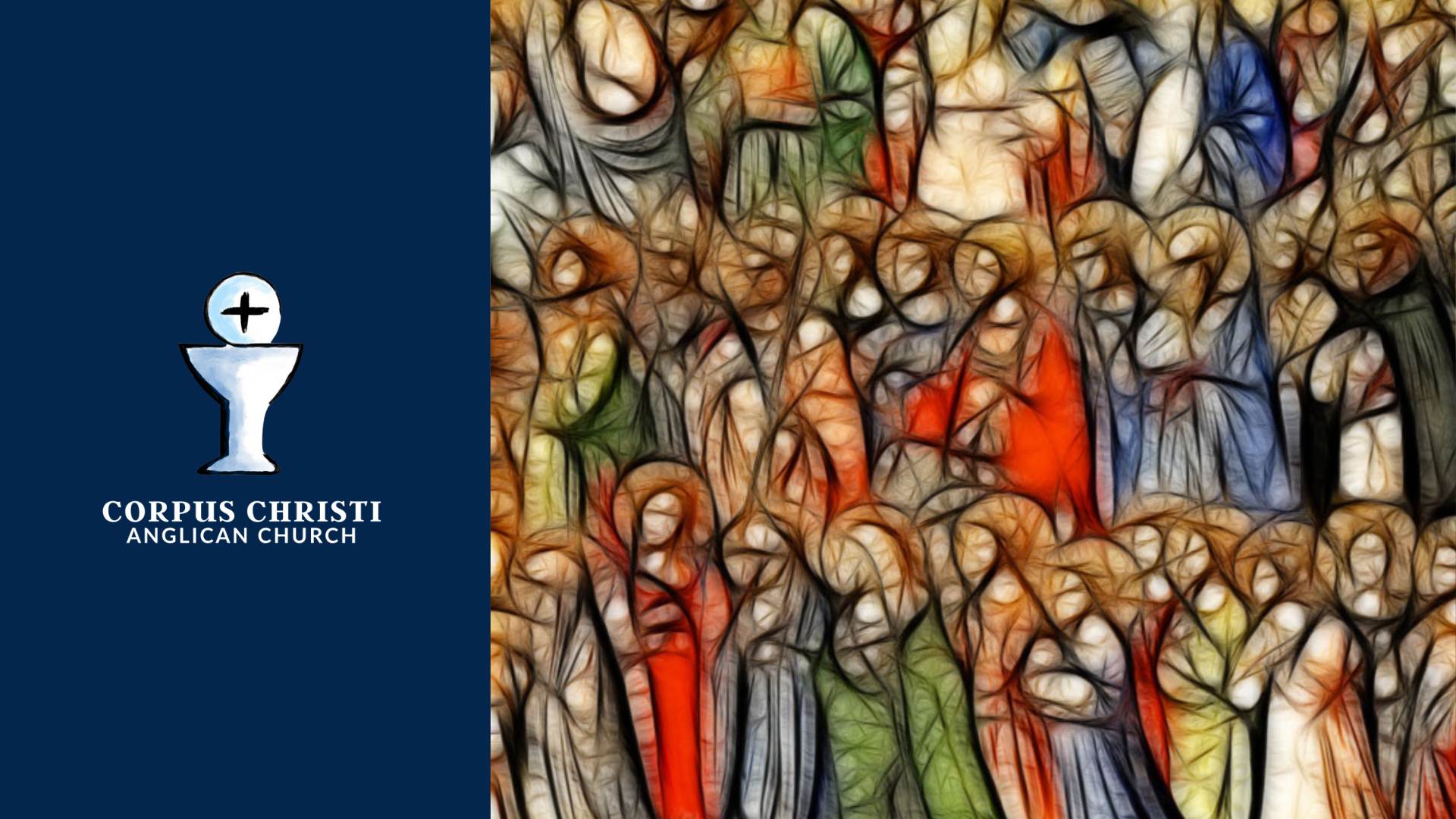
This day reminds us of those who have gone before us—those that we remember and those that we may not remember. And so I was telling somebody one of the things I love about All Saints Day, and I chose this art intentionally because there are so many saints for whom we don't know the names and faces of, and they are part of our journey whether we realize it or not, and this day calls attention to that very fact.
And if you look in our Book of Common Prayer, which is what we use in our liturgy, there are different reasons why somebody might be commemorated as a saint. There are those who are remembered as martyrs—those who gave their lives for the testimony of Jesus Christ. There are missionaries or evangelists, people who have pioneered a place for the gospel among those who haven't heard it yet or experienced the grace of God. There are pastors, people who show us the shepherding care of Jesus. There are teachers of the faith, also called doctors of the church—people who brought clarity to really complex topics in really complex times. There are monastics or religious people we commemorate for their deep lives of prayer, the deep well from which we draw all the time, and their intentionality. There are ecumenists—people who worked toward the unity of the body of Christ among disparate parts of the church around the world. And there are reformers of the church, people who either saw corruption in the church or something that needed to be changed, and they worked toward changing the church, moving it toward holiness and the holiness of God. And there are, finally, in our Book of Common Prayer, renewers of society—people who show us the goodness of Jesus and the profound examples of God's justice and mercy in their lives and what they call people to in the societies in which they lived.
All of these categories of people show us something of the goodness of the work of God in the person and life of Jesus Christ. And so these people form the roadmap as we are figuring out how to live out God's ideal for creation, how to live out God's plan for us as we become more like Jesus. All of these people who have gone before us become a roadmap for that.
And so the Beatitudes are commonly read on All Saints Sunday in the church. Essentially, what Jesus is teaching in these passages is that those who would follow him—his kingdom is seen best in the lives of those who know that they need God's help the most. His kingdom is seen best in the lives of those who know that they need God's help the most.
And as we look at this passage, let me pray for us.
“In the name of God, the Father, the Son, and the Holy Spirit. Amen. God, the maker and redeemer of all believers, grant to the faithful departed the unsearchable benefits of the passion of your Son, that on the day of his appearing they may be manifested as your children, through Jesus Christ our Lord, who lives and reigns with you and the Holy Spirit, one God, now and forever. Amen.”
Well first, just to name what's different in Luke's gospel than in Matthew's. In Matthew's, it's all about blessed, blessed, blessed. I think there's nine categories of those who are blessed. In St. Luke's gospel, there's only four. And he has counterpoints of the four opposite categories who are accursed or woe to those. He says, blessed are you and woe to you, in four different categories. And so if you have your Bible, again, I encourage you to look at Luke 6. But in Luke's account, Jesus frames the Sermon on the Mount with those four blessings and woes.
It feels a little bit like if you read Psalm 1, and it begins blessed is the person who does not, stance it, etc. And then later on it says, and not so the wicked. So there's this blessing and cursing in Psalm 1, and when that's taken together with Psalm 2, the kind of function is like the doorways by which we enter into the Psalter.
It's the wisdom by which one enters into the life that the Psalter is painting a picture of. And so similarly here, the Beatitudes are like the doors that help us enter into the portrait of life in the kingdom of God.
And so first, I want to look at these blessed ones. It's a little different than Psalm 1, because these aren't commands. As though Jesus is saying, you know, you should aim to be poor, that should be your goal, or you should aim to be sad or weeping, or aim to be hungry, or aim to be hated by people. Those aren't goals.
They're not in and of themselves virtuous, so that if you're like, well yeah, everyone hates me, I must be doing something right. It's not, that is not a good indicator that you are necessarily following Jesus. But the reality is, as you do follow Jesus, and you become more holy, more like him, the reality is, you follow him into his death and resurrection.
And so suffering will be inevitable. But in Christ, suffering is meaningful. But suffering will be a reality.
And so when we think of the poor, the sorrowful, the hungry, the despised, those who have this very real bodily sense that there is a need, there is something going wrong, that the awareness of something wrong attunes us to the spiritual realities that we are in need of God's divine help. So what's true in the body is true in the soul as we follow Jesus.
And when you think of the audience Jesus is preaching to, these are the people longing for the kingdom of God, and they're not the well-off, they're not the well-fed. These are the people who are are looking for a Messiah to come and restore all things. And so these very much are the people Jesus is talking to, and so we will find ourselves in those places when we follow him as well. And when you do, when you find yourself knowing your own need for good companionship to be taken care of as you're following Jesus, then what he's saying is consider yourselves fortunate, consider yourselves blessed. That's the sense of what blessed means here. Consider yourselves fortunate when that happens.
In Eugene Peterson, he's a famous pastor who passed away a while back, but in his biography he was saying that when he translated the Message Bible, he originally wanted to, instead of Makarios here being blessed, he wanted to translate it lucky, because that's the sort of sense of like, “Hey, consider yourselves lucky if you find yourselves in this place.”
And his editor wisely said, “That's a terrible idea. No evangelical publisher is going to give you the time of day if you put lucky in your Bible translation.” So he wisely took that part out. But the point is still true, this idea that when you find yourselves in need as you're following Jesus of material resource, of friends, of food even, of finding comfort, then count yourselves fortunate when those situations come. It's really countercultural, and the reason why is because at those moments when you're attuned to the need of the body, you're closer to seeing God's kingdom than when you weren't aware of your need.
I remember some time ago, a few years back, I was getting food for our family, and I was holding our son who at the time was probably three, and I was holding him in one arm and the food in the other, and there was a curb that I was walking down to get to the car, and that curb was bigger than I had expected it to be, and so I have these terrible rubber band ankles, and when I stepped off this curb, my ankle just went out from under me and popped. It was the most horrible feeling, and I fell to my knees, somehow by the grace of God did not drop either my child or the Chipotle, but I get back. I had to drive home with my left foot and then go to the hospital and get x-rays, and I had indeed fractured a bone in my ankle. It was a terrible feeling, and I get up the next morning, and I look at my foot, and the whole bottom of my foot had turned black, and I thought, oh no. So I call a friend who knows more than I know about these things, and I said, “Here's what's happening.” And they said, “Oh that's great. That means you're on the process of healing.” But there is no way. This is so ugly. That can't be what healing looks like. Why is this good news that my ankle is so awful, and I hated that healing looked like that for the next few weeks, but you know I was thinking of this phrase like, blessed is that sprained ankle whose foot was bruised profusely because it was in the ugliness of that foot that I knew that healing was at hand.
It would be worse if I hadn't. The worst cuts are when you don't bleed initially, because you know that bad things are coming after that, but you know, think of it now in the spiritual realm, like poverty, sadness, hunger, exclusion for the sake of following Jesus and being faithful in the kingdom of God. These aren't the goal necessarily, but they are sometimes an inevitable reality for the one who's following Jesus, because we don't get to lavish ourselves with all the comforts of the world all the time, and so when those things come as we follow Jesus, those, when we're attuned to them and recognize them, those can be the very holy moments where we see the signs of God's nearness as we're following Jesus, and when we follow him, sometimes things are gonna get really difficult.
I hardly have to tell any of you that, but when they do, Jesus is encouraging us to count ourselves amongst the fortunate, amongst the blessed, because we're actually in a long line of people who have gone before us, who have suffered in the likeness of Jesus, who are among the fortunate, and because their hope for seeing the kingdom is our hope as well. It's countercultural today as it was back then, because back then, seeing somebody well-off was a sign of divine favor and prosperity. We haven't moved that far in our culture either, and so we look at our own society, we might have alternate beatitudes, or we would think, you know, blessed or fortunate are those who find themselves at ease because they've worked really hard to earn what they've got.
Blessed are those who achieve everything they wanted, no matter who they had to hurt in the process. Blessed are those who attain some amount of celebrity, those who benefit economically off the backs of the poor, those who avoid suffering because God must be pleased with them. Blessed are those who don't acknowledge the reality of their own mortality, but instead they're allowed and they can whip up a frenzy and get people to surround them with their ideas, and they must be showing us a sign of God's favor if they can draw a Jesus is calling us to follow him in our experience of suffering the loss of all things in order to see the realities of the kingdom come in our lives, because he's bringing about the realities of the kingdom through a people who are following him into his death and his resurrection, but the precursor to resurrection is death. And so, the need of our body attunes us to the need of our souls as we're following Jesus. And when we recognize that need for God where things aren't as we expected them to be or hope they would be, then we can count ourselves fortunate in those moments because we are intimately closer to seeing the realities of Jesus's nearness where his kingdom is coming and where he is good.
And so in contrast to the blessed, the fortunate, Jesus gives us the four categories of woe, you know, like not like “whoa”, but like woe to you, right? These are, in my Old Testament class we used to joke about these being called the woe-ricles, because you have the oracles of blessing and you have the woe oracles of cursing. Like these are like somebody lamenting the loss of something. It's I wish, like if you're at a funeral, it's almost like, “I wish this person had done it differently;” like there's a deep-seated woe about the state of the individual. And that language in the Old Testament was associated with funerary rites. And so, when we think of the woes in this passage in Luke, he says woe to the rich, woe to the well-fed, woe to those who laugh now, and those who are influential and well thought of. Now there's nothing inherently sinful about any of those things.
If you find yourself well-off, money is a tool, right? It's not a name. And again, just as none of those other things were aims of virtue, poverty, hunger, etc., none of these things are aims of vice, or are a result of vice necessarily. There's nothing inherently sinful about being well-fed or well-known, but what he's saying is if you find yourselves in a state where this is your constant reality, it's something you've aimed for, it's something you look for, it's something that takes up a lot of mental load in your life, and your life is then as a result of that characterized by satisfaction and ease, fame, the kind of laughter that you might associate with like toxic positivity, where you're ignoring the realities of how hard things are, then woe to you, is what he's saying.
You're at a complete disadvantage in that state from seeing God's kingdom come, because the shallow veneer of the view of God's kingdom is obscuring your vision for the love of God and for the real purpose of creation and why you're here. And so, this is the person who believes that they actually have no need of God's help, because they've arranged their lives in such a way that their body can't indicate to them anymore their need for God's help. And as a result, they're desensitized from the breaking in of God's kingdom in their lives. They run past it. They don't acknowledge it. They can't see it. Material success isn't always kingdom success, and we often get that confused.
So Jesus warns those who are listening to him, he would warn us as well, that in Israel's history there were this group of people who find themselves in that state constantly, and people thought well of them.
And does any of the older kids here, do you know who he calls those people in Israel? Or adults? Anybody want to guess? What? They're within Israel, yeah. The people who like would be well fed, well taken care of, all that. Anybody want to guess? Caroline. Close.
The Old Testament equivalent, false prophets. So he says, “Yeah, if you find yourselves amongst these, you're in good company with the false prophets of old, of Israel.”
And so, you know, so if you find, to find ourselves amongst those people, the curse, those who have, those who are in the woe category, when you find yourself there, you're overlooking what's broken for the sake of keeping up appearances. That's what is kind of at the root of the problem here. We're ignoring what's gone wrong to make sure that we can project a picture of what feels totally right. There's a false sense of peace, a false sense of tranquility, and you know what? We're culturally primed for that.
So imagine seeing a happy family photo on social media, maybe for the holidays, but then discovering that in that happy family photo, there was a day-long process of tears, and moaning, and groaning, and weeping, and gnashing of teeth, and protests of, I don't love you anymore, and all the sorts of things that go into a happy family photo. The photo is a curated facade. It's an aspirational reality, and sometimes, by the grace of God, it does actually become, you know, an ontological reality, but sometimes those family photos, they just mascot all that process that was going into this, tells us nothing of the conflict involved, and it's not a bad thing, it's the reality that we're in, but I'm starting to say that we're primed for this.
I remember seeing on social media a friend of mine from Bible College who had posted a really happy photo of him and his wife, and then like a month and a half later, it was taken down, and I found out that they were at the time almost separated, and they were going through a divorce.
The curated reality was just this veneer, and it had no substance behind it, and it's so easy to do that with our lives, and how we project ourselves on the internet, and then that trains us for how we do it with one another, and so this is a permission to be undone, right? This is a permission to take down the veneer and the facade.
The one in these Beatitudes who is cursed, he's cursed because they're keeping up appearances without the actual health and divine, they're keeping up appearances of health and divine prosperity without any of the substance of the reality of the kingdom of God, and so Jesus is setting up these blessings and the curses as these categories, like a doorway entering into a vision of the kingdom of God, which is to follow him in his example, and so he's going to go on for chapters in the Sermon on the Mount to show how the disciples can understand the world rightly when they learn to love as God loves, and we're not going to get into all that, but this is where he goes. If you want to understand the world as it is, learn to love the world as God loves it, which is entered into by this category of blessings and curses, and so one author says this about loving the way that God loves. He describes it as glorious, uproarious, absurd generosity.
Think of the best thing that you can do for the worst person, and then go ahead and do it. Think of what you'd really like someone to do for you, and then go do it for them. Think of the people to whom you are tempted to be nasty, and then lavish generosity on them instead.
So Jesus isn't just giving them a list of do's and don'ts in this passage. What he's giving them is a helpful picture of the subversion of the brokenness of the world by death and resurrection as they follow him. And so, as Christians, I'm going to use some of the language from St. Augustine of Hippo. He talks about “We're to hate the fault that's in the world by loving its true nature as God intended it to be”, which I find helpful as we learn to love as God loves in this uproarious, absurd kind of generosity and mercifulness.
Then we start to see the world as it is and hate the fault and the brokenness while loving it for the ways that God has intended it to be. And so Jesus, as we close, he is inviting us to follow him in this long procession of people who have gone before us for centuries. And each of us has been uniquely made with our unique stories, and we have a unique story to tell about the grace and the mercy of God in our lives and of his kingdom, as we're learning what it means to follow him. And so, when we follow our Lord, we do so into that death and resurrection that Jesus experienced, knowing the goodness that Jesus is with us.
The suffering is purposeful in order to make the world right again, to order what's been disordered. And so, when you're following Jesus, those moments of suffering aren't something to be passed over, but there's something to remind us that we are in need of God's help. His kingdom's seen best when we're most aware of our need for God's help.
And so, we can be encouraged in our time of need that that's when Jesus is closest to us, that he's pleased with us as we're following him. That this isn't his judgment to castigate us in the realm that we've done something wrong, but there is something for us of his goodness in this hardship. And that we can count ourselves then fortunate in those moments to be primed to see his kingdom, just as those who have gone before us, because those who have experienced his death and resurrection in life, their ultimate hope is our ultimate hope as well, as we look for a better country of which the Saints show us.
So as we close this morning, let me pray again this call for us from the Feast of All Saints.
“Almighty God, you have knit together your elect in one communion and fellowship in the mystical body of your Son. Give us grace so to follow your blessed Saints in all virtuous and godly living, that we may come to those ineffable joys that you have prepared for those who truly love you, through Jesus Christ our Lord, who with you and the Holy Spirit lives and reigns, one God, in glory everlasting. Amen.”
Transcribed by TurboScribe.ai. Edited using ChatGPT.

Becoming Acquainted With Our Need for God’s Mercy
TranscriptioN
Well, good morning again, everybody. It is good to see you this morning. I'm grateful to see some new faces. Those of you who are new and visiting, welcome. We're so glad that you're here. I'm Father Morgan Reed. I'm the vicar here at Corpus Christi Anglican Church, and I am really glad to be here with you worshiping our Lord this morning.
So each year around this time, I'm reminded of something I used to do before I was planning on being ordained. Back in my old life, I was planning on going into academia, and every year around this time, I would go to—it's called SBL or the Society of Biblical Literature—and those meetings were really fun for me. We get to travel the country to wherever they had it each year, and we would have lovely discussions about things like the Dead Sea Scrolls, Aramaic paleography, Syriac and like a headstone inscriptions, you know, all sorts of really interesting things that are interesting to everybody, right? And so this was fun for me, and one of the interesting dynamics about Society of Biblical Literature is that—you may not know this, but academic jobs are really hard to come by.
So imagine 10,000 people coming to a conference center jockeying for position, who are trying to either further their academic careers or who are trying to find an academic job for the first time. It was sort of a weird thing, but you know, each session would have four to five talks, about 20 minutes each, and each was followed by a Q&A session. And now there were people who were very secure in themselves, and they would go to these sessions, and they would ask a very thoughtful question that was engaging with the talk.
But then, inevitably, there would be somebody who would then raise their hand, and they would say something like, well, I guess this isn't as much of a question as much as it's a statement. And then you could feel the room go, oh, here we go, you know, what's gonna happen? And so there was one paper I went to, and there was somebody in the audience who was well-known. He's like the godfather of Old Testament textual criticism, which means something to about like three of you.
And so I was in there, and I knew this guy was there. And then when the person gave this talk, this guy raises his hand, and he does one of those, okay, I don't have a question, this is more of a comment. I thought, oh no, what's gonna happen next? And for the next like five or ten minutes, which could have been its own talk, this guy proceeded to disagree with this poor graduate student who was kind of pouring themselves out after pouring themselves into a paper.
It was humiliating, and you felt the collective response of the group in there lose respect for this scholar as time elapsed, and this person was just berating this young graduate student. It really didn't matter at that point what this man's brilliance or achievements were. His hubris was starting to overshadow his good work.
And we all can think of times where we know people who, because of pride, it's begun to overshadow the good things that they've done in their lives. And so the questioner who says, well, you know, this is more of a comment than it is a question, reminds me a little bit of the hubris that we find in today's gospel passage. And it reminds us of the kind of humility that we need when we're approaching the Lord in prayer.
This passage is this warning against pride, against self-justification. It's a passage about the difficulty of repentance and contrition because of the honesty involved, and then it's a passage about God's disposition to those two different kinds of attitudes. So as we look at our gospel text this morning in Luke 18, let me pray for us.
“In the name of God, the Father, the Son, and the Holy Spirit. Amen. Lord, may the words of my mouth and the meditation of my heart be always acceptable in your sight, O Lord, my rock and Redeemer. Amen.”
So Jesus tells us a parable in Luke chapter 18, and he actually tells us who he's talking to in this passage. He says, to some who trusted in themselves that they were righteous and regarded others with contempt. So this first man in the parable is a Pharisee, and this isn't to say that all Pharisees are like this, but there were certainly Pharisees who in Jesus's day prided themselves in their discipline, self-discipline, and their ability to keep the law, even going beyond the law. There were set hours of prayer in that day, and you can imagine that this man is making it every single day to those prayer times.
In the passage, he sort of waltzes right into the temple, you can imagine into the holy place, with a bit of a smug air of contentment with himself and a little bit of entitlement, and he opens his mouth, and I'm gonna paraphrase what he's saying. ‘God, I thank you, not for your grace, but, or of the good things that you've given, but I give you thanks for me, because I'm really great. I go way beyond what you require in your law. I fast twice a week. You didn't even ask me to do that. You didn't, but you know what? I'm really great, and I thank you for that. You know, I give a tenth of my income. Did I mention how grateful I am for how great I am? Thank you so much, Lord, that I am not a bad person, like thieves, people who cheat on their spouses, people have no sense of justice, or worst of all, that guy over there, that tax collector.”
So we get the sense that this Pharisee comes to the temple multiple times a day, if not per week, to thank God about his own greatness. He truly believes that he is God's gift to humanity. What would you do without me, God? Sort of his disposition. Meanwhile, the tax collector in the parable is standing far off, probably in the court of the Gentiles, and he comes every once in a while, hoping not to be really noticed by anybody, and worse than being noticed in this case, he's pointed out by this guy who's known as being pious in the community, and he's now the object of the contemptuous gaze of the righteous person in the community.
So I hope as you hear my paraphrase and my retelling of that, that none of that sits right with you. It's not supposed to sit right with us. It's supposed to feel really icky, and it was supposed to when Jesus said it as well.
That person, the Pharisee, was doing all the right things on the outside to make them look right before God without any of the substance to actually do what was to make him right before God. It was a form of avoiding the reality of his own brokenness, his disordered loves, his dysfunctional attachments to the world, which those things are sort of the nature of sin. One of the church fathers, St. Augustine, says this about the passage, he came to the doctor.
It would have been more worthwhile to inform the doctor by confession of the things that were wrong with himself instead of keeping his wounds secret and having the nerve to crow over the scars of others. It's not surprising that the tax collector went away cured, since he hadn't been ashamed of showing where he felt pain. And so I really like how he puts that in a medical frame, thinking of the doctor and healing.
I can imagine the kind of person that goes to the doctor just to brag about how healthy they are, to check the box, and you know, look at all the things I'm doing in my life, doctor, but they fail to inform the doctor of those lingering headaches that keep persisting or the pain they're having in their foot. They sort of ignore those things in order to, well, they brag about the things that are going well in order to ignore the things that might be causing them harm. It's easier to brag about our accomplishments and credentials than it is to confess our sins or to be honest about our brokenness.
As you think through the last week, there are places that have invited us into examining our brokenness. What emails gave us a rise this week in our spirit? As you think of the conversations you had with co-workers, friends, or family, which one of those caused a disproportionate amount of angst, contempt, anger, envy, sadness? What meeting are you dreading coming up this week? Who is it and why? Those are the moments that are invitations to examine ourselves and to ask the doctor for health. I think we move through those things too quickly without reflection because those are the places that point out to us where brokenness is, where disordered loves or where loves have become disordered, where attachments might be to this kingdom of darkness.
Sometimes we define sin just as this overarching category of rebellion against God, and it's not wrong, but it needs more definition. When you get down to it, sin is rebellion against the goodness of who God is. It's rebellion against the goodness of how God created the world, which he calls very good. It's rebellion against them being truly human because we were meant to be God's good image-bearers on this earth. And so, disordered loves, attachments, and pride make us less human. So the way that the monastic tradition in the past has talked about these things is disordered attachments or disordered loves.
And I find that helpful to give specificity to this overarching category of rebellion against God because to rightly order loves and rightly order attachments with the kingdom of God is to rightly order the world, is to understand the world as God intended it to be. So somebody might come to church regularly, they might say or not say certain things because they know it's right or wrong, they might pray at certain times, they might hold very public ethical positions, and they might do all those things to avoid dealing with the humiliation of living comfortably with a secretly disordered interior life. It's possible.
And the Pharisee shows us that. They might not even know what they're doing when they're doing that. And that's exactly what Satan wants. That's the very thing that makes us less human, holding on to a secret life, bypassing the brokenness, ignoring the disorder through our spiritual achievements. The very thing which could save us, which could be spaces of redemption, then become traps through religiosity. And so the Pharisee, he's also, it's interesting to me, he's characterized not just by pride but by other-centered contempt.
And I wonder then if the flip side of the coin of pride is other-centered contempt. So contempt for others and pride being flip sides of the same coin. Because if I can name the faults of other people really well, sometimes I can do that in order to avoid the humiliation of looking at my own brokenness. And like a doctor, naming those things for which I need forgiveness and healing. And so we can see in the Pharisee the dangers of pride, self-justification.
Now we want to look at this tax collector and the difficulty of repentance. Remember why tax collectors are so hated in the time of Jesus. People in those days purchased rights over a territory. They had to collect taxes to pay to some municipal leader. And so private, the tax collection was almost like a privatized industry, where individual tax collectors had to collect enough taxes not only for those that they owed money to, who were paying off the land, but also to make an income. And so it was really common for somebody who's a tax collector to charge extra fees. And what those fees were was up to the tax collector.
So in a society like that, extortion is commonplace. In fact, it's not just commonplace, it's actually acceptable. It's just common. Everyone assumes it's going to happen. And so, for any Jew who's going to become a tax collector, they're already on the outside of society. They're considered a traitor. Somebody who doesn't really trust that Yahweh is king, they're a tool of Caesar.
And so, imagine the amount of self-hatred in the life of the tax collector. He knows exactly where he stands in the community, what everyone thinks of him. He's viewed with suspicion by everyone he meets, and he probably doesn't choose that job for himself. Unfortunately, because of his life circumstances, that job has found him. We don't know what they are, doesn't matter.
The point is, no one who is self-respecting says, I aspire to the place of tax collector, right? He is so aware of his own brokenness and sin as a tax collector, he hardly needs anyone to tell him how broken he is. And so hearing the voice of condemnation from the Pharisee is only echoing the very thing that he feels about himself. He says, yeah, you're right, that's exactly who I am. It's just echoing the shame voice. We all have one of those. We all have a shame voice, and what echoes it for us? He knows that he has nothing to approach God with.
But maybe, just maybe, if he can get close to God's presence, then he's gonna rediscover some semblance of his humanity, and this relationship with God that he longs for. Contrition is really difficult because it requires us to join the tax collector in risking humiliation to express our needs to God, to admit that we have, that we are not the one who God needs to build his kingdom, that we need God more than he needs us, right? And the tax collector, he wants to know that God is in control. He wants to know if there's somewhere that he can go where all the poor decisions in his life that he may have made aren't going to define him, where he finds somebody who's going to attune well to the sorrow of his heart, and discover the delight in him and the love that he's longing for.
That's what he's hoping for. And so, he approaches the temple cautiously. He takes himself to the most unassuming place, the edge of the temple in the court of the Gentiles, at the edge of grace, where he hopes to meet the grace of God, to find answers, to find love, and to hopefully reframe his own world.
And the incredible truth of this parable is that it's that man who's on the edge of grace that's actually at the center of God's delight and God's pleasure. And so as we think about the Pharisee and the tax collector, as we close, I want to look at God's disposition towards these two people. Jesus says that it was the tax collector who went home justified, who went home right in the sight of God rather than the Pharisee.
And I can imagine in my mind's eye that the Pharisee walks smugly back out of the temple with no knowledge that he has gone from the temple unjustified and looking poorly and not at the center of God's pleasure. So what Jesus invites us into in this passage is a life that is in search of the mercy and grace of God to rearrange the disordered loves and attachments that have formed for us, and then to become truly human because of that in Christ. And I've said this before, but I love, there's a patristic quote, I think it's attributed to St. Irenaeus, about the glory of God is a human fully alive. The glory of God is a human fully alive. To become fully human, we have to seek out Jesus and we have to constantly keep our need for God's grace in front of our eyes.
The humble don't compare with others, but they're keenly aware of their own brokenness and their own need of God's work of restoration in their own heart, their own need for the death and resurrection of Jesus in their own specific places of wounding.
The self-righteous, by contrast, are constantly comparing. They're known for bypassing their own dysfunction and they're coasting through life on a wave of other-centered contempt. And they can often find themselves amongst very religious people, but this person finds themselves very far from the pleasure of God.
So I want to encourage us from this passage to make a habit of being needy. Make a habit of being needy. Specifically, to recognize our need for God to reorder our world, to make us new in the person and work of Jesus. And so, come with your need and reflect deeply on the grace of God. And whenever every opportunity comes up for you in prayer, come in stillness and quietness to notice where we are longing for God's grace to make the world new again. Let me pray for us.
“Almighty and everlasting God, you govern all things both in heaven and on earth. Mercifully hear the supplications of your people. And in our time, grant us your peace. Through Jesus Christ our Lord, who lives and reigns with you in the Holy Spirit, one God, forever and ever. Amen.”
Transcribed by TurboScribe.ai. Edited using ChatGPT.

In Returning and Rest We Shall Be Saved
TranscriptioN
I remember telling some of you that during my ordination, I got to swing the thurible, and it was a funny experience because we swung the thurible to the procession song Oceans by Hillsong. And today I have just done a gospel reading under a disco ball. Thanks be to God.
Yeah, these are the moments. This is church planting right here. I'm so grateful. What a joyous weekend we've gotten to share together. I am so grateful that we've gotten to spend all this good time together sharing meals, a long hike, and other things. And it was a joy to have Reverend Summer Gross with us for the last few days. Grateful for her ministry among us.
And the theme for this weekend has been creating space for God, and part of beginning that desire is coming out here for a whole weekend to Front Royal—to set everything down for an entire weekend, which is very countercultural in the NOVA area. And this is such a great start to honoring such a desire for space for the Lord. And so I hope you'll take some of the material that you've had from the weekend.
I hope you take some time to reflect on the experiences that you've shared with one another this weekend and to utilize that to frame your life by prayer. Because what often I am tempted to do is to frame prayer in the context of my life—so that life happens and prayer is some subsection of it—but rather making prayer the frame for where life happens.
And so, in line with several of the themes this weekend, I wanted to look at our passage today—this exhortation from St. Paul in the Second Epistle of Timothy—to Timothy, I should say. So he is calling Timothy to remain in the tradition that's been handed down to him and that’s shaped him. And that tradition includes scripture—not as a body of proof texts, but as something, a tool of discovery, a tool of training, something to be lived, something to be preached and lived out and modeled for others.
Timothy's call is to fulfill his ministry. I've heard another translation say, "discharge the duties of your ministry," and I love that too. The point is, he's sort of at a swan song here. If you had some last words to give to somebody, what would you tell them? And these are St. Paul’s words to this young bishop, overseer.
It reminds me a bit of the prayer that the bishop prays over us when we're confirmed or received or renew our baptism vows. He'll pray:
"Almighty and ever-living God, let your fatherly hand be upon these your servants. Let your Holy Spirit ever be with them, and so lead them in the knowledge and obedience of your holy Word, that they may faithfully serve you in this life and joyfully dwell with you in the life to come, through Jesus Christ our Lord. Amen."
And so you and I have this call on us as those who are in the Church, living out life with Jesus—to follow Jesus and walk with the Holy Spirit, to grow in the knowledge and obedience of God's Word, to grow in what that even means for us as unique servants of God—to serve God faithfully, to discharge all the duties of our ministry, whatever God’s called us into. And fulfilling the duties of our ministry is hard. It’s really hard. It’s hard because we face daily derailments—maybe hourly derailments—endless crashing waves of unmet and upset expectations. "Lord, I thought things were gonna be this way. Where are you? Why haven’t you shown up yet?" We talked about that last week or two weeks ago.
And so this weekend, one of my hopes is that this weekend would be a reminder to us that you and I require rest, silence, and solitude at various points to experience the salvation of God—that if we're immersed in chaos, we will not experience this transference from the kingdom of darkness to the kingdom of the Beloved Son—but it requires intentionality. No matter how small, right? I know that silent time with young children is prime real estate, but the point is that there is an intentionality built into our lives of experiencing the salvation of God in silence, solitude, and rest.
So we have to know the sweetness of the gospel, the goodness of it, before it paints a compelling picture of the kingdom of God for others to experience. If we want them to experience it—if that’s our desire—then it has to be sweet and good for us first. And so Timothy is struggling here, and he needs encouragement. It’s why the letter is written. And I don’t know about you, but I can relate to him, and maybe you can this morning as well as you think about the struggles that Timothy is facing.
So as we look at 2nd Timothy this morning, let me pray for us.
“In the name of God the Father, the Son, and the Holy Spirit. Amen. Lord, may the words of my mouth and the meditation of my heart be always acceptable in your sight, O Lord, my rock and Redeemer. Amen.”
Well, first we have to create space for understanding the tradition that's been handed down to us. St. Paul has spent time in his letter mentioning how things around Timothy are gonna go from bad to worse with regards to persecution—the level of apostasy around him as people turn from the faith. He shouldn’t be surprised when those things happen because they're going to. But he's called, in the midst of that, to deeply root himself in the tradition in which he was discipled. And what tradition was that?
We know from earlier in the letter that Timothy grew up with a faithful mother and grandmother. So Lois, his grandmother, and Eunice, his mother, had raised him up in the faith—these two godly women that he was to learn from. He was also shaped by the community that he'd been baptized in. What lessons were there for him as he thought about the people that he knew? And then Paul himself, who was being an example of carrying on a life of faith—what was he supposed to learn from Paul as Paul had dealt with persecutions and sufferings? Timothy was certainly no better; he would go through similar things.
So take time to consider what shaped you. It’s really important to make space for that. Who has invested in the deposit of faith in your life? And if you can’t think of people in your biological family background, I can tell you that people in this church are part of that family who are depositing that in you. Every meal that you’ve shared, the conversations as they go deeper—these are deposits of the faith as people are investing themselves in you and vice versa. I actually care for your well-being, and I know that you care for mine, and this is true in the Church. We care for one another.
And so, what’s the nature of the faith that's in us? The answer, St. Paul says, is found in Holy Scripture. And in that time when he talked about Scripture, there was no New Testament yet. He’s talking about what we would refer to as the Old Testament. Most of the New Testament books hadn’t yet been written by the time he’s writing this, or they hadn’t all been yet recognized as Scripture by this time.
So he’d been taught the Scriptures—the Old Testament—as a young man. And Scripture, this Scripture that he knew of, was pointing him to the Jesus that the Church is following. And so he’s supposed to examine people who are causing opposition, potentially heretical ideas, by the standards of the Scriptures which he has been trained in, that he’s been discipled in. Again, the point is to understand Jesus in the Scriptures, but we need the Scriptures to understand this Jesus whom we follow.
And so, note the Scripture’s purpose: it’s not just a handbook of proof texts for the refutation of ideas, although it can do that. But according to verse 16, it says, “All Scripture is inspired by God and is useful for teaching, for reproof, for correction, for training in righteousness, so that everyone who belongs to God might be proficient and equipped for every good work.” There’s a proficiency and an equipping involved in understanding the Scripture.
And so within a hundred years of this time—in St. Timothy’s day, St. Paul’s day—within a few hundred years, the Church would discern through the Spirit which writings had the mark of the Holy Spirit, as the process of the formation of the New Testament canon would take place. But note that Scripture is both inspired and profitable—two things. It’s inspired, and maybe because of that, it is profitable.
Many of you took the opportunity to hike yesterday, and what an incredible hike it was. Various groups made it various distances. I was really impressed with the five-year-olds who climbed a thousand feet up switchbacks yesterday and hiked almost four miles. Ten would have been—I would have been super, super impressed. I would be impressed with adults who did that too! But yeah, I mean, wow. It was a stunning time on the Appalachian Trail.
And if you think about the Appalachian Trail, you can read books about it, right? There are books written about people taking a year to go hike this thing, and those stories are incredible. But reading about going on the Appalachian Trail is a fundamentally different experience than actually going out there and seeing beyond what’s just on Google Maps or Apple Maps, right? It was a beautiful 75-degree day. Some leaves were falling as the wind was blowing. There were steep inclines; you felt those switchbacks in your calves, and we were surrounded by beautiful fall colors. And doing it with friends is a whole different experience.
So Scripture, similarly, is not a book just to be read and comprehended like some other book to understand something about something. It’s something to be experienced. Scripture is something to be prayed, something to be sung, something to be meditated on in the quiet—for the Holy Spirit to read us through it. It’s something to be read multiple times, something to take in, something to experience and be trained in. It’s formative. It’s useful.
So we've got to create time to abide with God in His Word—as a tool to invite us into the life of the kingdom of God that He wants to bring us into.
Spending time with the Scriptures—reading it with the Church—is so helpful. One of the things I find really helpful is reading the Bible with the Church—finding some ancient writers. It could be a hundred years old, could be fifteen hundred years old—read with other people outside modern American whatever—and that can be a really helpful discipline: to read with the Church across time and geography. Note the holiness, the examples of people who have placed Scripture so central to their lives and have had to live it out in different contexts. But make space for that, because that’s the time we need to be grounded in the Word of God and to become the person that God is shaping us into. It frames our formation; it frames our life when we create the space to abide in God's presence with His Word.
And then next, we need to create space to name the story that God is telling. What story is God telling in your life, and how does your story fit into the greater cosmic story that He’s telling? St. Paul gives Timothy this charge: to proclaim the message—or preach the Word, in some translations—in any season, to convince, to rebuke, to encourage. And the first two of those, when I say “convince” and “rebuke,” sound a little harsh, right? It sounds strict. But the third one, “encourage”—we’re kind of like, okay, I can breathe easy. Encourage, got it, yeah.
But all three are necessary, I think. Encouragement helps us understand that the aim of those things is healing. Timothy is not rebuking in order to be right, to prop up his own ego, to show his own theological training. His care is for the salvation of someone’s soul. It is for the healing of somebody in their brokenness and their sin.
So these things are necessary—the reproofs, the rebukes, the exhortations, and the encouragement—all at various times. And we all have to name this distortion in the brokenness of sin in our own lives and our own unique and distorted loves and brokennesses—to discover the ways that God's grace comes to meet us and heal us in our own uniqueness. Because each of us have different stories, different proclivities—like, you know, a priest who overfunctions and decides at 6 a.m. to try and set up most of the altar stuff when we have an altar team. We all have our own unique proclivities.
People don’t want to do that today, right? They don’t want to name their own unique brokennesses. And they didn’t want to in Timothy’s day either—so it’s not new. It’s easier to blame-shift, to excuse ourselves, to bypass brokenness than it is to hold on to that little feeling of humiliation that we get when we have to admit that something might be wrong, or that we need help, or that we did the wrong thing this morning at 7 a.m. You know that little feeling of humiliation, right?
It’s easier to bypass those things, smooth them over, and walk away from them than it is to own it and to be curious and invite the Holy Spirit into those moments. But it’s sort of the scandalous part of the kingdom of God that it comes through admitting that our little fiefdoms—our broken fiefdoms—don’t measure up to the goodness of the bigness of the kingdom of God, where Jesus is Lord and we are not.
It’s easier to settle in my brokenness than it is to accept what I don’t understand about what God wants to do in His grace. And so the reason why Paul has this charge to Timothy is that there’s going to come a time where people are not going to want to hear what’s true. That must have only happened back then.
They’re going to believe whatever they want—what makes them feel good and comfortable—and then they’re going to make sure to surround themselves with people who think just like they do. That doesn’t sound familiar, right? Nothing is new under the sun.
And so Timothy is called to keep on preaching tirelessly, to hold out the gospel for people, to do the work of an evangelist—which isn’t just proclaiming the Four Spiritual Laws; it’s holding out the compelling nature of the goodness of the kingdom of God for people who don’t want to hear it—and to carry out the fullness of his ministry. And that call is not different for each one of us.
And so when people say they want to get back to doing things like the early Church, I often wonder what they mean—because don’t they realize that this was the early Church? The same problems then, the same problems now.
If you read Galatians, St. Paul has to correct Peter and say, “Hey, you really blew it. Your theology is great, but your table fellowship is not following in line with your theology.” Right? And he has to call him out publicly in a letter that is now in Scripture.
And so St. Paul has to undergo persecution by different schismatic groups. Later on in this chapter, he’s going to talk about Alexander the coppersmith, who caused him a lot of trouble. And this is not new.
And so it’s not like after the Apostles died, heresy stopped and—great, we got the deposit of the apostolic faith, there are no problems anymore! When did the early Church not have problems? Each successive generation had to deal with innovations of heresies, how people misunderstood Jesus, how they denied the fundamental goodness of creation—whether that’s people denying that Jesus was physically resurrected, or just spiritually, or that the spirit of the Christ came on Jesus at a certain point and left Him.
This denial of the fundamental goodness of the created body—that God wants to bring that body into His kingdom—is not new. All sorts of errors crop up over time.
So the task of the Church leaders like Timothy was to hold forth the goodness of the truth of the gospel without wavering, to do the hard work of examining the good deposit that had been placed in him in the face of all the opposition around him, to be grounded in it, to remind his people of the cosmic story of salvation that God is telling in Christ.
And that’s our call too—to this story that the world is broken, that it’s bound to the kingdom of darkness, that God in His love came to humanity in real flesh—not an apparition—to raise up what was broken and bound by sin in each of our lives by His death and resurrection, to raise it up—our lives, our whole selves—to the life that is found in God.
And that all creation, what we experience together in our lives, is a foretaste of what the cosmos are going to experience—that there is hope for the world around us because of what each one of us undergoes in this cosmic story of salvation—and that life is available to all who look to Jesus for their salvation.
This One was really crucified. He was really risen, and He was really ascended. And so in the midst of the kingdom of darkness, those who follow this Christ are like little lights of the kingdom of heaven right now. And as we live out the gospel, the transformation that’s brought about in our lives is a foretaste of what God is doing in the rest of creation.
It’s good to create space to think about that while you’re in creation. So go enjoy some fall foliage and think about the death and the resurrection in the context of colorful trees.
The story that God was bringing about in Timothy is the story that He’s bringing about in our healing and our salvation—as this foretaste of the greater narrative that He is doing in heaven and on earth.
And so Timothy reminds us that our call, our work, our call takes adequate retreat time—space. We need to be intentional about this. I was thinking, like, we need to create functionally—not ontologically—little monastic cells through the Daily Office, times of prayer. We talked about breath prayers—those are really helpful. Visio divina, lectio divina... I don’t mean like really create a monastic cell (unless you really want to, and then tell us how you did it), but create a monastic cell in your heart. Think of your household as a monastic cell where you retreat to carry on the rhythms of attuning yourself to the grace of God—where God attunes to you, where you listen to what He’s doing.
We need to create space for those times and those rhythms. We can’t fully discharge the duties of our ministry without the stillness and the silence that are so necessary for our rescue and our salvation from the kingdom of darkness, which is a daily experience.
And so I want to encourage us this weekend to hold fast to the deposit that's been invested in us. All of us are a part of this redemption plan that God is telling—the story that He’s telling—and in our uniqueness, God has gifted us and placed us where He has, both individually and as a Church.
And so, know the scripture not as a book to assent to a body of knowledge, but as an experience to taste and see that the Lord is good. Take time to name and be grateful for the people that have placed a deposit in you and are investing in you. In this deposit of faith in your life and who have done so with integrity. And as you go from the retreat, this weekend may encourage you to examine your own rhythms and insert the stillness and the silence that you so desperately need. The things that are going to carry you through the turbulent waves of this troublesome world, which is what our baptism liturgy talks about.
So I want to take a minute here to just pray in silence before I close us with a final collect. So I'm giving you a little bit of stillness and silence this morning, relative, of course. But take like a minute to just pray in silence and I'll close us with a collect.
“God of peace, who has taught us that in returning and rest we shall be saved, in quietness and in confidence shall be our strength; By the might of your Spirit lift us, we pray, to your presence, where we may be still and know that you are God; through Jesus Christ our Lord. Amen.”
Transcribed by TurboScribe.ai. Edited using ChatGPT.

Trusting in a Great God and Not in a Great Faith
TranscriptioN
Good morning again, my friends. It is good to be with you this morning. I'm Father Morgan Reed. I'm the vicar here at Corpus Christi Anglican Church, and it is a joy to celebrate the Lord with you this morning.
Today's passage is about the relationship of faith to following Jesus, and the nature of relationship is really important as Jesus pushes back on the hubristic type of approach of thinking that there is a transactional approach to having a relationship with God. It reminds me a little bit of a book I was reading a while back on marriage, where it pointed out an unhealthy pattern in some couples, where one spouse would deeply long to have their spouse meet a desire for them. It could be physical, could be emotional, whatever it is, and whether they name that need or not, they would start doing extra things for their spouse, not out of a sense of love, but to obligate their spouse to meet their need, right? There's this ulterior motive, and along those lines, I once heard a pastor somewhere say, you know, if you give your husband a crown, you'll make him a king.
In other words, what he's saying is if you fake it, and you treat him better than he is, then he'll rise to the occasion. Ew. First of all, it's terrible advice. It doesn't work. And second, it's just placating immaturity in your spouse. But also, what's interesting about that transactional approach to marriage is that it makes the actions of the wife suspect at any given time.
You know, is marriage then a big transaction of each other trying to have their needs met by doing kindnesses to one another? It brings in this ulterior motive, and that's just not the nature of relationship—true, authentic goodness. So similarly, in our walk with Christ, we have to watch that we're not obeying out of this desire to obligate or try and obligate God to having our needs met or having certain outcomes arise as a result of our faithfulness.
And this morning, in our gospel passage, we're encountering Jesus giving his disciples instructions about what the life of faith looks like. What does it look like to have a relationship with God as our King in the kingdom of God? And this passage has really two important descriptions of the nature of faith. First, it's that the presence of faith shows how great God is, not how great our faith is. Good faith shows how good God is, and not how good our faith is. And second, faithfulness is given because of who God is and the grace that he's given to us, not to try and obligate God to anything, as though we could even do that. So as we look at our gospel passage this morning, let me pray for us.
“In the name of God, the Father, the Son, and the Holy Spirit. Amen. Lord, I love that psalm where if we delight in you, you give us the desires of our hearts. And so it is a work to grow in delighting in you, so that what we want is to see you in all of our doings and in all of our goings and all of our words and thoughts. So, Lord, be with us and help us to desire you. In Jesus' name we pray. Amen.”
We start the gospel reading this morning with this really enigmatic phrase that Jesus says about, if you just have a mustard seed amount of faith, then you could take a giant mulberry tree, uproot it, and go plant it in the sea—which is sort of a silly image. Mulberry trees don't grow in water. And that's the point. It's impossible to uproot this mulberry tree and to plant it into the sea. But that's also the point here—that God does the impossible. It's not dissimilar from when Jesus says, you know, it's impossible for a camel to go through the eye of a needle, but with God, all things are possible. Here it points to this reality.
Jesus isn't interested in having his disciples go around figuring out how to uproot mulberry trees and throw them into the sea. Nor is he worried about them going around wondering if they have enough faith in each moment. That is not his concern. The point is that the effectiveness of faith to accomplish the work of the kingdom isn't about the greatness of somebody's faith; it's about the greatness of the God in whom we have faith. It's not about adding more; it's about just the presence of it. And so the whole reason Jesus brings this up is he gave them a really hard saying before. He started talking about, you know, as you're my disciples, you're gonna have to rebuke one another at times.
There are times where somebody's going to get out of line, believe something erroneous—whatever. You're gonna have to rebuke somebody for something. And when that happens, if that person who follows me turns and repents, then you need to be prepared to forgive them.
And so that is a hard thing to do once, but Jesus goes above and beyond and says, as many times as they repent, you're to have the disposition of forgiveness. And this prompts them to ask, well, Jesus, can you add to our faith? Because that is a lot. And presumably, then, they believe that they don't have enough faith to accomplish that thing that shows them to be followers of Jesus.
And so Jesus begins to talk about not the amount of faith, but just the presence of it. Because if it were the amount of faith, then it would be up to each one of us to muster up something in ourselves, and it would depend on our greatness. But instead, this is a miracle.
It comes from the power of God. It's not my ability to accomplish something; it's God's power to do it. And so it's the presence of faith, as small as a mustard seed—not my ability to move God.
And so God calls us to pray and to trust. He isn't waiting for us to hit some arbitrary goal, like, you know, if you're fundraising or something, and you get the red line up—you know, it's not that you have a faith chart. And eventually, once you hit that goal, God starts answering your prayer.
That's way too transactional. It's not how God works. But he invites us to prayer, which is a mystery—not as a transaction, but as an invitation into participation in what he's doing. And so, in a real way, then, prayer is more for you and me than it is for God and his sake. And as I make a habit of seeking God, knowing the desires of God and the love of God, and aligning my loves and desires with the love and desires of God, listening for what God's doing, paying attention, then I start to begin to participate in God's work.
So you can see how these sorts of phrases in the Psalms work, like, I want to grow in my desire for you and your desires, and give me the desires of my heart. Because there's this interplay of growing in the desires of God so that we can truly say, God, give me the desires of my heart—which are supposed to be growing in alignment with yours. I'm invited into participation in what God's doing.
And so we're not just looking for mulberry trees to go uproot and plant into the sea, but we're looking, in the slowness of relationship, we're learning what our great God can do in us and through us, as in the daily operation of the Holy Spirit, we're seeking God's kingdom in the everyday stuff of life that he puts in front of us. So as we follow Jesus, seek his kingdom, and live lives of prayer, God sometimes does, in fact, change our outward circumstances.
This is one of the mysteries of the economy of grace—that he, in fact, does hear our prayers and relieve our pain, as the confession liturgy says. And sometimes he does a work in our hearts to bear the outward circumstances that aren't changing. Sometimes he uses us to pray with someone and change their outward circumstances.
Sometimes he uses us to speak a word of encouragement that helps them endure the situation that's not changing. All of those scenarios are equally miraculous, as the Holy Spirit is doing his work in our hearts. And so Jesus's point is to normalize a life of faith.
Normalize ordinary faithfulness. We have to cultivate this life of faithfulness and trust in him as we walk, and not look for extreme, ecstatic moments all the time, but live lives that are curious and discovering the kingdom of God in that everyday, ordinary stuff of life—and what God's doing in us and the people that we're in relationship with. It's learning to be curious and discover the kingdom of God around us.
And so a growing disciple also understands, in this parable, he moves from mulberry trees to an analogy about servanthood. A growing disciple understands and grows in this idea that we can never put God into our debt. We can't obligate him to certain circumstances.
And he illustrates the point with slavery, which in their culture was a common institution. Everybody knew about it. And so if somebody had a slave who had just come in from working in the field, the owner's not going to sit the slave down at the table and say, I made a meal for you, come sit and eat with me.
But instead, the slave's going to come in from the field, they're going to make dinner, and then at the end of the meal, then they can eat and drink. And does the master even give him a thank you in this parable? No. And again, parables are not like a one-to-one correspondence.
So we don't want to think that God is some cruel slave master. That's not his point. His point is that servitude in this parable is just assumed.
There's not this expectation of, oh, what a great job you've done all day. God's not doing this for us either. He's not saying, oh, look at how wonderful you are, right? But no, the servitude is just expected.
And so we serve God because of the things that he's done for us in Christ—the grace, all the goodness of the work of the Holy Spirit has been—the Holy Spirit himself has been poured into our hearts. And so St. Ambrose, the one who is responsible for St. Augustine's conversion, says it this way: “Grace must be acknowledged, but nature not overlooked. Do not boast of yourself if you have served well, as you should have done.” And I think what's helpful about understanding this nature of living into grace without expecting a thank-you all the time is this: there are two things I think it speaks to.
First, our tendency to try to obligate God to our success and to successful outward circumstances. And second, to frame our success as God's blessing. These two things may not be true.
In the first case, imagine somebody, you know what, today I need to start obeying God so that things get better in my life, so that things get better overall. And at the root of this is the prosperity gospel, right? This idea that if I just change my behavior and act better, God will give me outward prosperity and I will be fine. God, I'll stop smoking today if you heal my lung cancer right now, right? It's that sort of idea that's trying to obligate God to outward circumstances and success.
But instead, in this day-to-day life, we are expected then to name brokenness, to turn towards the God who longs to give us grace, and seek to amend our lives because of what he's done for us—whether we're in a season of trial or whether we're in a season of flourishing. That's the everyday stuff of faithfulness. Marriages might get better as a result, parenting probably will get better as a result, you know, but the motivation is different.
I'm not obligating God to anything. We are just servants, and we're doing the hard work of naming brokenness and naming grace to discover what God has made us to become and what his kingdom should look like in our lives. And so we leave the outcomes to God because whatever those outcomes are, we can discover the kingdom in them.
The second error is thinking that success is necessarily a sign of God's favor. A few years ago, in our community lawn in our townhouse subdivision, I saw these beautiful flowers that sprung up in the community lawn, and I thought, oh, those are great, I should put those in my yard. So I went out with a shovel, dug them up, put them in my yard, googled, hey, what are these things, and discovered that these are wildly invasive.
I think it was called Star of Jerusalem. And not only do they seed, they also spread through their roots. And so I was like, oh no, I have made a huge mistake.
Even though this thing is beautiful, I'm gonna dig this out and throw it in the trash. So I threw it in the yard waste. But what's interesting is every year now, I have to re-dig them out because they keep coming back. And as I look at the community lawn, they have just flourished out there, untended.
And so it's a helpful reminder to me that just because something grows fast and something grows large and it looks pretty or successful does not mean that it is healthy. That Star of Jerusalem, whatever it is, is getting rid of the grass that should be there. Once it's dead, it gets brown and nothing lives there.
And so it's not healthy. And so just, you know, whether it's a church or a business, a podcast, a person—whatever—people with big platforms and followings may not be healthy. And their organizations might be incredibly fragile.
Just because something grows fast, large, looks pretty, does not necessarily make it healthy or indicate that God is blessing it. Again, there's a subtle type of transactional theology in this. And it's very American.
I think sometimes we evaluate someone's veracity by how large their following is. Hey, they have six million views. Doesn't make them more true than someone else, right? But this is how we judge things.
It's a transactional theology at work. And things seem to be going well, so I must be doing okay.
God must be blessing it. I am fine. And as a result, I don't do the hard work of naming brokenness, naming the grace of God, and discovering the kingdom when things are fine.
So that when hard things do come up, I'm totally unprepared for them. From our Old Testament reading today, we read my favorite Old Testament book—if I'm allowed to have one—the book of Habakkuk. Three chapters. Go read it when you get home. It's fantastic. Habakkuk, who's actually—I didn't put this in here—but his name, Chavakuk, means to hug. It's like an embrace. And so, in all of the complaint, remember that Habakkuk is like God's big hug for us.
So in the Old Testament, Habakkuk gives us this example of daily faithfulness. And he's complaining in the very beginning, saying, how long, Lord, do I have to cry for help and you're not going to listen to me? How's that? Does that scream faithfulness to you? But this is faithfulness in God's eyes.
And so his first complaint is about the injustice he's seeing around them as God's people are making a muck of the law, and everything is coming out perverted. And then God says, “Don't worry, I'm going to take care of it. I'm going to send the Babylonians.” And Habakkuk's like, “Is that a good idea? Because that's going to make you look bad, right?” And then chapter two is God addressing, “I'm going to take care of them too.”
And I call it the woe oracles—the waracles. It's like a funeral, basically, for the future Babylonians. And so in between chapter one, with Habakkuk's complaint, and the bulk of chapter two, where Babylon is going to be destroyed, Habakkuk is called to sit there at the watch post and wait.
And so he has to sit somewhere between “How long, O Lord?” and the woe oracles that signal the death of Babylon. And that prayer in that in-between is what is aligning Habakkuk's heart to God's heart and God's will. And as Habakkuk comes to terms with what God's going to do, he stations himself as this prophetic watchman to tell the people the prophecies that God is going to give him.
And in verse four, you have this famous phrase, part of which gets picked up in the New Testament: it says, “See, the enemy is puffed up; his desires are not upright, but the righteous person will live by his faithfulness,” kind of no matter what comes.
This is the character of righteousness—day-to-day faithfulness in the in-between. There's this day-to-day faithfulness that strikes me in the book of Habakkuk, where there's a capacity on God's part to hold our complaint in the light of unmet expectations. Because the reality is, we are going to feel that strain.
God, what are you doing? I thought things were going to be better than this. I had expectations, and it didn't turn out that way. And the good news is, God is big enough to hold that complaint.
And not only is he big enough to hold that complaint, but actually our voice of complaint in those moments is itself an act of faith, according to Habakkuk. So before you run and spew your rage on social media, spew your rage before the God of heaven, because that is an act of faith. And so when things don't go as planned, when we're tempted to think, hey, where did I go wrong that God's doing this to me—which assumes that my circumstances are an indication of God's favor—
Instead, note what Scripture talks about a lot: that whether in seasons of plenty or famine, success or perceived failure, God is at work doing something in us. And faithfulness is this invitation to say, God, how long am I going to cry to you for help, and you're not giving me an answer? And the resolve to sit at the watchtower and to wait for the revelation of God. God's present with us, showing us more of himself as we walk with him, as one pastor famously said, in a long obedience in the same direction.
And so as we close this morning, remember that our faith is in the greatness of God, and it is not in the greatness of our faith. It only takes a mustard seed amount of faith to see God do the miraculous works around us and in us. And let's remember that we can't obligate God to material success, the things that our hearts or wills are longing for.
But instead, we live life with him day to day in faithfulness, watching not just for what he's going to do around us, but what he's doing in us. And it's that kind of humble, daily faithfulness that's going to characterize the follower of Jesus. Let me pray for us.
“Oh God, by whom the meek are guided in judgment and light rises up in the darkness for the godly, grant us, in all of our doubts and uncertainties, the grace to ask you what you would have us to do, that the spirit of wisdom may save us from all false choices, that in your light we may see light, and in your straight path we may not stumble. Through Jesus Christ our Lord. Amen.”
Transcribed by TurboScribe.ai. Edited using ChatGPT.
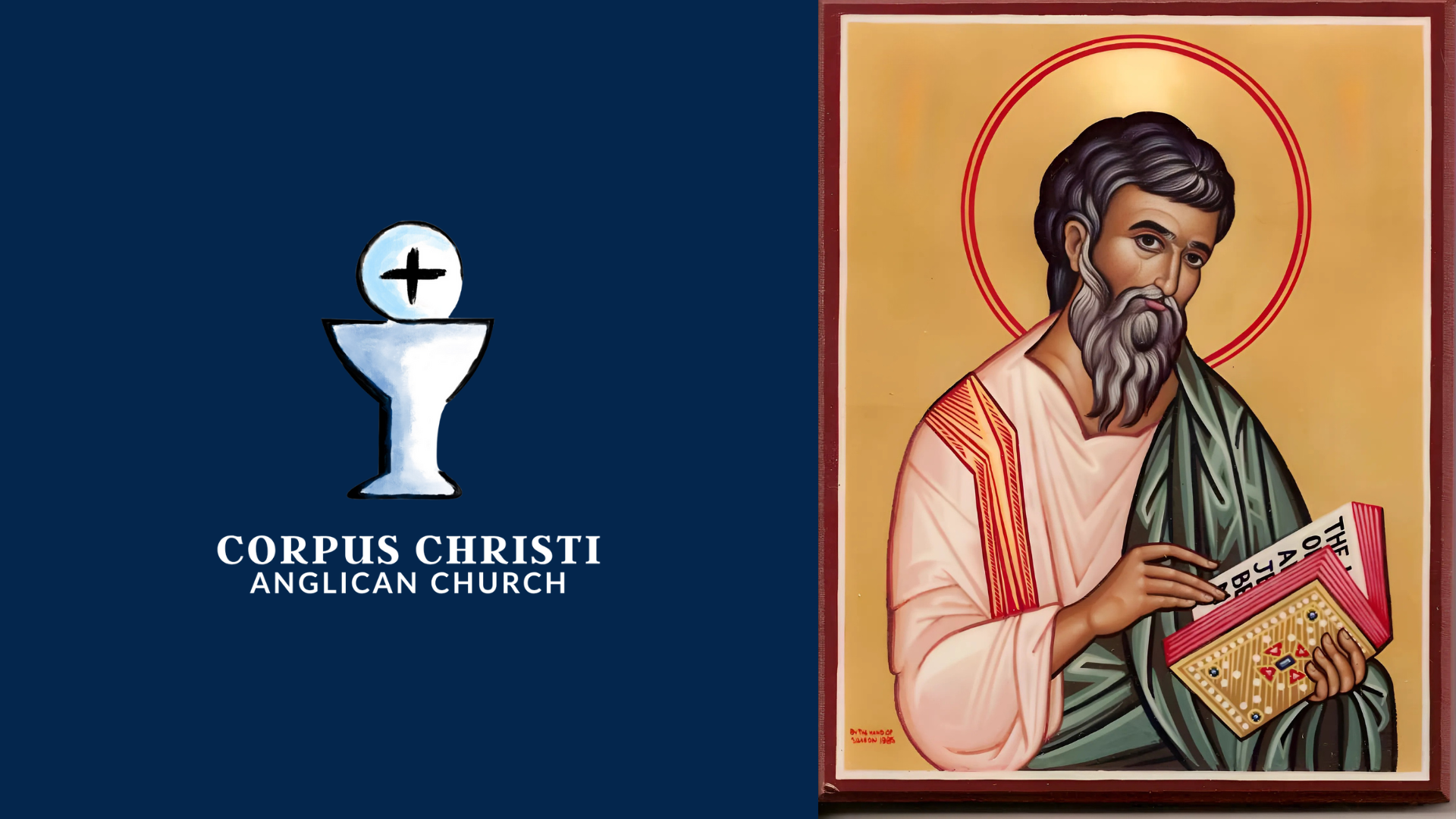
Feast of St. Matthew: Where Mercy Meets What Seems Irredeemable
TranscriptioN
Good morning again, my friends. It is good to see you this morning. It's great to be with you on this feast day of St. Matthew. I'm so glad that you're here.
If you're new or visiting, sometimes we have a—well, we have a season called Ordinary Time, and we wear green, and it's a long time. And so whenever a feast day shows up on a Sunday, I love to take it and see what the Lord might give us out of whatever saint it is that day that we celebrate.
I was really grateful for the life and example of St. Matthew this morning as we celebrate what Jesus did in calling this person to follow him. He is one of the twelve disciples of Jesus, of those who followed Jesus for his three years of ministry before Jesus was crucified and rose from the dead. And Matthew is this really polarizing character in the story, because he introduces real complexity to what is otherwise a pretty tidy religious system in Jesus's day. Jesus confronts the Pharisees with a parable as they're talking about, you know, “Why does your teacher eat with tax collectors and sinners?” He gives them some parables.
One is about not putting new wine in an old wineskin, right? The old wineskin was useful as it helped the wine develop, but now that the wine's been fermented, if you put new wine into that old wineskin that's already been expanded, it'll break. It's not useful anymore. He tells them a parable about crying at a wedding, and there's—you know—tears are at a funeral.
Tears of sorrow are very appropriate in a funeral as you grieve what's lost. It points to the things you deeply care about, but it would be sort of in misalignment with what's happening in the joy of a wedding to have tears of sorrow, perhaps. But for the sake of argument, in Jesus's case, it would be. His point in these parables is not that you can find an exception, but that something new is happening.
He's telling them a story alongside what's happening. Something new is taking place, and Matthew is a stress test on the theological system of those that he's talking to. Can their theology contain Matthew? What do you do with this sinner, this tax collector? And so Jesus is—Matthew becomes—a stress test.
Can this hold Matthew? And all of us expand our theology over time. It's not a bad thing at all. I was remembering back a long time ago, at least over a decade and a half ago. I was in college, and my Greek professor—somebody in the class had asked about a famous pastor and their version, interpretation of a text—and my professor used to do these funny power stances where he put his leg up on the desk like this, you know, and lean forward and he goes, “Ah, yes, that pastor. If he's ever right, it's always for the wrong reasons.” I remember that moment, and I thought, oh wow, because that pastor that he's talking about had a lot of influence on me when I was a young Christian as a teenager. And I realized that as time went on, he was absolutely right. The things that I had learned didn't stand up to the complexities that I was running into as I learned more about the world around me, as I learned more about God's Word, and about the nature of humanity.
I would say that in those years, I went through a bit of a deconstruction process myself to ask, you know, what is the system I hold? Can it hold the weight of human suffering that I'm understanding to be around me? Can it hold the weight of academic rigor? Can it hold up women as equal image-bearers of God as men? Can it offer me something from the Bible that's better than just legalistic behavior change? And can it do more than blame psychosomatic problems on sin as some blanket category? Can my theology bear the weight of those things? And back then, the answer was no. The old wineskin was failing. And so, you know, I went through my own deconstruction-reconstruction process as I was thinking through this in community, in a church.
And, you know, what do we do when we are confronted with the complexity of the world around us? How do we look at the theological system that we've constructed and ask, can it bear the weight of what I'm experiencing right now? Today's feast, St. Matthew, I would invite us to think about as an invitation to engage with complexity, to name complexity, and to lean on Jesus, who is there with you in the complexity, because he's able to hold space for the brokenness around us more than we can. And he leads us in offering mercy that we didn't even know we needed. And so today's feast day is a great invitation to explore complexity, holding hands with Jesus as he's present with us.
St. Matthew is going to frustrate some people to no end. He's going to frustrate their system, the things that they care deeply about. But if they would walk with Jesus for what they don't yet understand, they would see in St. Matthew something beautiful as Jesus is doing something new.
And so, as we look at St. Matthew, this tax collector, let me pray for us:
“In the name of God, the Father, the Son, and the Holy Spirit, amen. Lord, give us understanding to know you, diligence to seek you, wisdom to find you, and faithfulness that may finally embrace you. Amen.”
Jesus's ministry today is in Capernaum. It's in Galilee, which is like the northern part of Israel, to the west of the Sea of Galilee. He's in Capernaum, and he's among the Jews there, and he's already called some fishermen to come and follow him. Fishermen are unimpressive, but they're not controversial. They're not a threat to anyone's system. They're just not like the dream team that you'd want to pick if you were trying to be an influencer. But he picks some fishermen to follow him, and now he calls Matthew in chapter 9 to come follow him in his Galilean ministry. And Matthew—or Levi is his other name—he is going to be potentially offensive.
Imagine if you are Simon the Zealot, who is a patriot for the Jews, and you are all about getting rid of Roman authority, and now Jesus says, “I'm gonna bring somebody who collects taxes for Rome into my entourage.” You are not going to meet that well, potentially. So in Capernaum, tax collectors would be responsible for collecting a variety of taxes that Herod Antipas was going to levy on the region, and they had to meet their quotas to pay somebody above them who needed to meet their quotas.
And as a tax collector on the bottom of the totem pole, it would have been really common to extort money. Why is that? Because not only did you have to collect what was owed, but think about the cost of your labor, your travel—and you need to—and you want to have a certain lifestyle. And so if you charge extra fees for your work, that is totally legal to do in this culture. And so it is very common for tax collectors to extort other people, because it is legal and part of the system.
It's expected. It is not virtuous or good, but this is why tax collectors and sinners get lumped into the same boat. So even if you're one of the good ones, you are still amongst this unclean group of tax collectors and sinners. You, by definition, are disobedient to God's law, and nobody wants to be around you.
You're the bad guy. And so the Pharisees were encouraging distance from these kinds of people, and Matthew, the tax collector, is our test case. They don't want anything to do with him or his friends.
Their posture is to stay ritually clean. Let's preserve what we have. We want God to bless us. Let's keep the law. A lot of those things aren't bad, right? But it's the disposition of isolation from the sinners that Jesus is going to challenge. Jesus's challenge—if I were to summarize it in like a quote—it would be: What if someone could change? What if? What if we see them in need of healing rather than in need of being shunned or dehumanized? What if? So the problem is one of disposition and understanding the grace of God.
And that's not even an option that they had entertained for themselves. No—instead, they wanted to be isolated and keep pure and clean, away from these people who are violating God's law. And so Matthew, you can imagine, has developed probably a complex of sorts.
You know, he's believed narratives about himself that others have told him. So I would imagine there's a level of self-hatred that he feels, because others have given him narratives that he has now believed. And when Jesus calls, he follows, because he wants to see what's going to happen.
I wonder if there might have been some hope in his heart that he would be free of the self-hatred that he was experiencing, or wondering if there were better narratives for his life than just, You'll never amount to anything more than this. You're not welcome here. All these sorts of things.
And so something new is happening. And in longing for something better, he takes the next step, which is to walk with Jesus wherever Jesus is going to take him. So Matthew then hosts a dinner.
And we have this imagery of reclining. They're sort of like lying down, sitting next to each other, having dinner. And imagining this scenario, you know, Jesus honors Matthew by coming to his house and having dinner with Matthew's friends, which, as you would expect, are these sinners and tax collectors.
This group of shunned individuals, socially. And I wonder if Jesus's other disciples felt really awkward at this point. They're in there having dinner with these people.
And again, I can imagine Simon the Zealot going, These people don't love Judaism. Why would I ever sit down and have dinner with these people? And these fishermen are like, Oh, I remember that guy. He was the guy who's collecting extra taxes when I hauled in that load last Thursday.
And so now they're sitting down having dinner, being reintroduced to one another as human beings and, you know, fellow followers of Jesus—potentially, people who are going to consist of the kingdom of God. And so Jesus hears this pejorative question from the Pharisees: Why is it that your teacher—you know, that's pejorative right there—your teacher's over there eating with tax collectors and sinners?
And instead of getting insecure and defensive, feeling some kind of way and responding out of his insecurity, notice the clarity in Jesus's vision. Jesus doesn't change. His ethics don't change. He knows exactly why he is among the sinners and the tax collectors, and he is so unanxious about this accusation. He says, “Those who are well have no need of a physician, but those who are sick.” And so there's something beautiful in that tension here.
We read in the New Testament passage in 2nd Timothy: there are all kinds of classes of people who are going to be disobedient to what God has intended for creation, and welcoming into staying that way is not good for them, and it's not part of the kingdom of God. But Jesus recognizes that people are sick, and he doesn't long for them to stay that way. It's a big welcome, and it's an invitation to something new.
And so, but at the same time, his disposition and posture is one of welcome and invitation. And so he sees what is broken, he sees what's sick, and he doesn't turn his back to them. And that's what's different in the Pharisees.
So there's a difference between judgment and condemnation, and people get this wrong all the time at a popular level. When our English translations quote Jesus saying, “Do not judge,” that's not what that word means. It means do not condemn, which is a totally different thing.
And a better translation would be for Jesus to say, “Don't condemn.” So when I go to the doctor, I want the doctor to make a judgment about what is ailing me. I want them to rightly discern the problem and name it accurately so that we can fix it. I can go get the right medication.
So Jesus calls these people sick, not to condemn them, not to turn his back and say, You're out, you're on your own, I'm only gonna be with these people. But he invites them to a deeper life than they can personally imagine for themselves. And that's the generous invitation. By judging them, what he's actually inviting them into is to rid themselves of self-condemnation and the false narratives that other people have put on them. There's a grace in his judgment, because others have heaped condemnation on their shoulders, and that often turns into self-condemnation.
And so you're welcoming people in, creating the context for naming what's broken accurately, and staying in relationship with others and with Jesus so that he can heal what's sick and broken. We're not the ones who heal people, right? We're not the ones who are responsible for their healing. That's what Jesus does.
And so we have to be careful that we're not standing in the way of what Jesus wants to do in somebody, and so we need to stay in relationship as far as is possible and healthy and good. And the reality is none of us are perfect, but being able to name things accurately and with the compassion of Jesus so that the outcome is that Jesus heals somebody—that takes a lot of time and trust and care and very secure relationships and community to get to that point. But what's important here, though, is that while the Pharisees are building this intricate house to bring people into to adorn the beauty of God, Jesus is creating a front porch to invite his awkward neighbors over.
And that's really important. This is a great paradigm for ministry. I was thinking back to the height of COVID, when our son was a newborn. We used to sit on our front porch all the time, and as our neighbors were passing by, we were longing for friendships, and we would invite them to hang out on our lawn, get to know them, let our son crawl around in the grass. Now only a handful of those neighbors actually made it inside the door, and even less of those made it to our kitchen table. But without the front porch, nobody would have made it to dinner with us.
And so the Pharisees had set the most beautiful table. They'd spent no time on building a front porch. And God calls us as a church to think well about both.
So I want to encourage us—and this is something I'm doing as well—pray about those places of the spiritual house. We think a lot about what happens here with our volunteering and our strategy and things, but how do we create the front porch where people not just see us, but where they get to know us, where they begin to trust that Jesus is good because they've had an encounter with us? And then as they do that, they have a longing to come in and sit and have dinner in the house with us.
And so if the Eucharist celebration together in this and being involved intimately in community is the banquet that's before them that's going to feed their souls as they come to learn and name their brokenness in community and learn to anticipate God's grace here, then what are the steps that we need to take to help people get there? I don't have an answer, but I've started with baseball. And so for each of us it's a different place, right? Like where is it that we're rubbing shoulders? I had somebody in the snack shack yesterday ask me about the Trinity. I don't know what it is for you, but how are we creating front porches?
There is a guiding principle here in Jesus's ministry, which brings clarity to how we prioritize God's Word with the complexities of society and our own stories. We heard a lot about obeying God's Word, listening to God's Word, those who are disobedient to it, and the question becomes, what is the guiding principle? In Proverbs it was the fear of the Lord being the beginning of wisdom. And here in the gospel texts it seems to be mercy that is the guiding principle for applying God's law to the complexity around us. God didn't give Israel a covenant in order to just make sacrifices.
That's not why. He gave the covenant so that Israel would come to know the loving-kindness of God in covenant relationship to him as their king. And then in knowing the goodness of God's rule and reign as king, other nations around them would see the goodness of their God and their relationship to him, and then they might long to be a society that is under the rule and reign of God with this compelling picture of God's love and his faithfulness.
And that's why Jesus in this passage quotes Hosea 6:6 where he says, “I desire mercy and not sacrifice.” It's a critique of the priorities of the Pharisees. Not that they're applying what their law is wrong, but they're misprioritizing what is first and foremost, which is the covenant faithfulness of God.
And so Jesus is like one of the Old Testament prophets here, calling out people for following these externals of the law while neglecting the guiding principles of justice and mercy and the mercy of God. So there are people who cannot come to the table. Like there is some element of that.
We heard it in the New Testament, and I'll give just one example from a long time ago. I had been working at a church. I met a guy at Starbucks. We got into a conversation. He wanted to come visit our church. I knew he was part of another religion that was not good, but I said, “You are welcome to come and visit.”
He would visit every time and bring pamphlets so that at the end of the service you could talk to all of our people to get them to join a cult. So we had to have a conversation, right? This is, you know, one example of someone who is not welcome to the table. We need to keep him on the front porch.
There are persons who, for a variety of reasons, are unsafe in a community, right? Whether this is abuse or something else. So we have to be wise, right? Not all people get the same level of vulnerability and trust. That's not wise. So it's okay for some to stay on the front porch.
I think that's really different than the person who has developed unhelpful addictions to cope with the harm they've experienced, or people who are at some place of deconstruction or questioning for reasons, you know, that vary person to person. Jesus was unanxious about this kind of person, about St. Matthew. He was clear, though, about what was broken, and he was kind in his invitation to healing and wholeness, which, by the way, Matthew wanted. Matthew longed for this, and he was unwavering in his mission to call people into what God has made them to be. And so Matthew is a stress test on the capacity of the Pharisees' system to knowing the mercy of God, and Jesus is essentially giving them a new container to hold it in.
So St. Matthew would live the rest of his life following Jesus. After the resurrection, he goes far and wide. There are multiple traditions. One tradition says he went to Africa and was martyred there. Another tradition says that he went to Persia, where he was stabbed to death.
There's a lot of different historical traditions around what happened to him, but at least one of them is that he wrote down the gospel of Matthew so that we could have the good news of Jesus and what it means to follow him. And he wanted the Jews to understand that Jesus is the fulfillment of their scriptures. So if you look at the genealogy in chapter one, or if you see the over 50 quotations in the gospel of Matthew, all of these are pointing the Jews back to their scriptures to show them that Jesus is the fulfillment of it. And this is the gift that Matthew gave to us as one of the eyewitnesses of Jesus's life and teaching.
So Matthew went from having no vision for his life, from others speaking condemnation over him, to being able to tell the story of Jesus that we are still telling today in the 21st century. And this is our invitation as well. As we tell the story of Jesus, we are reminded that he is among the sinners and the tax collectors, and he has found us, and he invites us to a different kind of life.
And as we learn to grow in faith, hope, and love together, let's pray that we could be a people who embody the welcome of Jesus as well, so that we can see the kingdom of God grow around us. In the name of the Father, the Son, and the Holy Spirit. Amen.
Transcribed by TurboScribe.ai. Edited using ChatGPT.