Uncovering God’s Kingdom Where Chaos Seems to Reign
cONTENT
Introduction
Good morning everyone. I’m Fr. Morgan Reed, the Vicar here at Corpus Christi Anglican Church. Today’s passage is the apocalypse as told by Jesus. In English, we use the word apocalyptic almost synonymously with destruction. For example, “the devastation of the city looked apocalyptic”, or people joke about a zombie apocalypse.
This doesn’t do justice to how Christians have used this word historically. Apocalypse means “revealing” or “uncovering” and apocalyptic literature was hopeful for the Christian because it demonstrated the slow unfolding of the victory of God over chaos and the victory of God’s people over death and evil. I think of it a bit like a movie. There are some shows or movies where at the beginning we see a snapshot of how the story will end. The rest of the movie is about showing you the process of how it got there. Apocalyptic literature is a bit like this.
We know the end: “For the Lamb at the center of the throne will be their shepherd; he will lead them to springs of living water. And God will wipe away every tear from their eyes.”[1] We know now that what awaits us is the great day where the unjust encounter God’s judgment and the righteous will be brought into the fullness of new creation where they experience God’s inexhaustible divine life and presence which they’ve only known in part now. It can be easy to lose hope as we watch the world and people around us devolve into chaos, or to see the wicked prosper. I wonder how many times we’ve said “I can’t even” or “I have no words for this” in a given week. Perhaps it feels incalculable and so we compartmentalize the “I can’t evens” and the “I have no words” moments right now with hope that someday Jesus will make things better. Jesus, in our passage today, gives us a glimpse of what is coming in order to reorient us when the present reality is chaos.
As we look at this passage together, let me pray for us:
“In the name of God, the Father, the Son, and the Holy Spirit, amen. Lord, may the words of my mouth and the meditation of my heart be always acceptable in your sight, O Lord, my Rock and my Redeemer. Amen.”
A. (21:5-11) Apocalyptic stability: non-anxious people
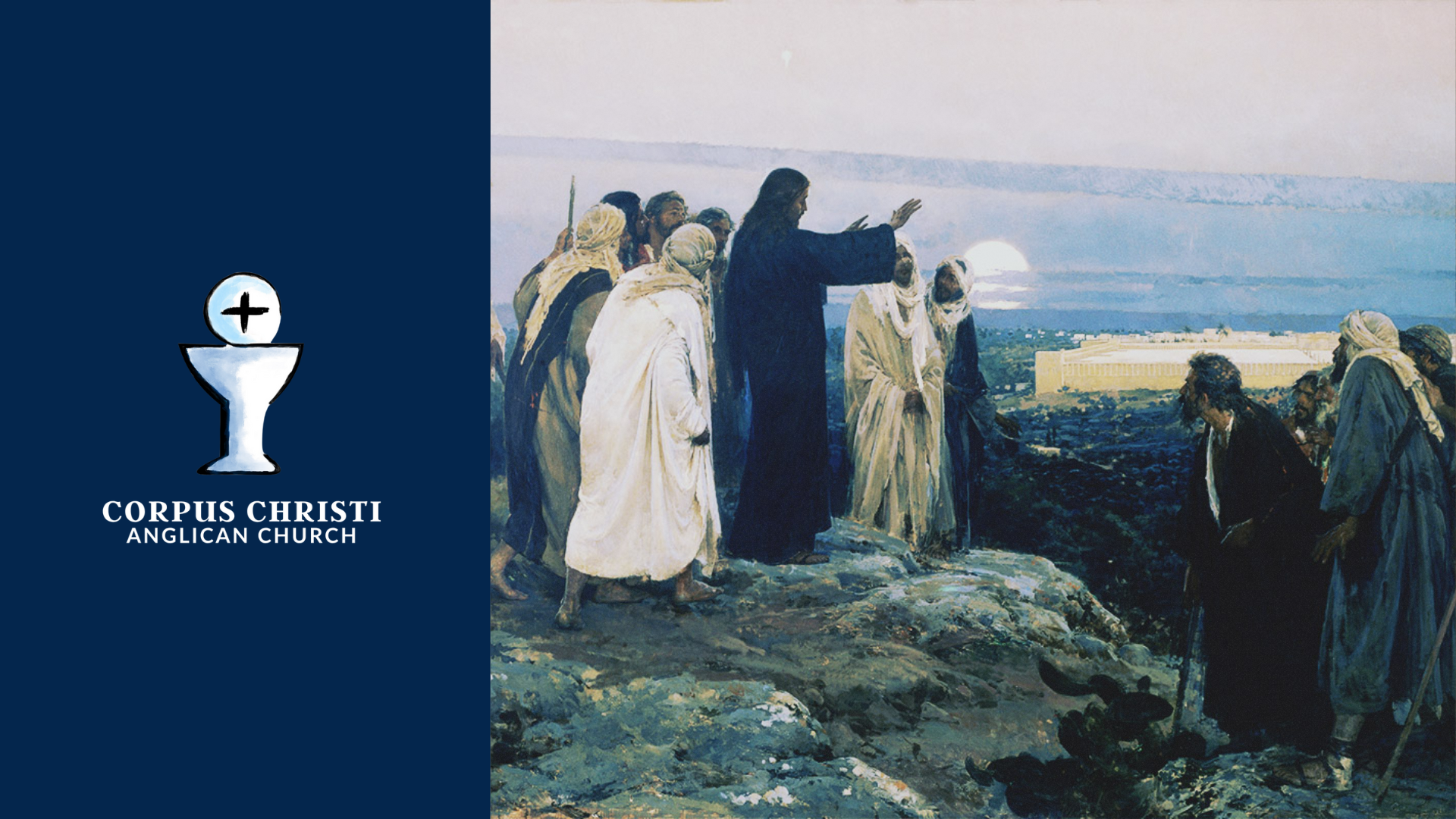
The first point I take from Jesus’ apocalypse is that hope in Christ creates stability and a people who are non-anxious. Second, because of our apocalyptic hope, we should live soberly and endure so that we experience salvation. Let’s look at the first point: apocalyptic hope creates stability and a people who are non-anxious. In Luke 21:5-11, Jesus is with his disciples and while Luke’s Gospel doesn’t tell us where the dialogue is happening, Mark and Matthew place this dialogue on the Mount of Olives. In Mark’s Gospel, those with Jesus are identified as Peter, James, John, and Andrew — This passage is often called the Olivet discourse.
They admired how the temple was adorned with beautiful stones and gifts dedicated to God. This had been the building project of Herod the Great, who had built up the temple significantly after it’s destruction as part of a national reconstruction program. Jesus is basically telling them not to get too excited because it’s just temporary.
Feel the gravity of that for a second. One of the things my son and I love to do is ride our bikes into DC, ride by the reflecting pool, and then head into the WWII memorial and stick our feet in the water. While we are sitting there, it is amazing to look up and to be surrounded by all the monuments which ground us in the history of what it means to be American. Imagine someone sitting next to us who looks at us at that moment and says something like “Yea, don’t be too impressed. This is all going to go away someday. They are just a bunch of stones.” You would probably scoot a bit further away from this person.
I would imagine that this is a little bit of the angst that the disciples are feeling as Jesus begins talking about the temple being destroyed. But since they know Zech 14, they also know that if the destruction of Jerusalem is coming, then then the Lord will come from the Mount of Olives and conquer and reign from Jerusalem over the whole earth. Destruction is the anticipation of salvation and those two things, in their minds, are not separated by a great length of time. Their question makes sense: When are the events that bring about the temple’s destruction going to take place? And are there going to be signs that this will be the case?
Jesus answers their question in a reality that was true for them and is still true today. There will be people who will come claiming that they’re the Messiah, or at least that they are your only hope for salvation. Don’t believe them. There will be wars, insurrections, scandals, and human sin will seem to reign corporately, individually, and systemically. There will be natural disasters, famines, plagues, earthquakes, and more. These will be signs that creation is groaning, the same creation that has hope that “...it will be liberated from its bondage to decay and brought into the freedom and glory of the children of God.”[2]
The apocalypse of Jesus is the stabilizing and reorienting vision we need. The depravity of others and the calamities of the earth are the slow revealing of the glorious plan of God to make all things new. You and I, like the Psalmist can still praise God for his goodness and complain to him when what our experience does not meet the standard of what we expect of his character and faithfulness.
There are wounds where God brings healing; and each time there are moments of redemption, we see God’s kingdom breaking in now as a foretaste of what is to come: healing, answered prayer, the ability to be reconciled, the ability to walk out of dysfunction, a move towards God’s love for you and others, a deep sense of God’s nearness. Rather than running from the suffering toward those who promise us salvation, we run to the God who frees us from the ultimate captivity that creation itself longs to be freed from. The apocalypse, or revealing, of God’s plan in Christ, is the foundation of a church that is reflective and non-anxious.
B. (21:12-18) Apocalyptic hope: Live soberly, endure, and be saved
Second, the apocalypse of Jesus is our hope, which calls us to live soberly and endure if we want to see God’s salvation. As a reminder, when we’re talking about salvation, we aren’t talking in categories of ultimate heaven or hell. In the time of Jesus they are discussing a present evil age and an age to come. The present evil age is filled with human bondage to sin and rebellion and its effects on creation. The age to come is the one where God rules over all things. These two ages overlap and interlock. Christ inaugurates the new age in his ministry. In the church we see the new age break in now through the work of God as a taste of what will be the end of the story where God does ultimately shepherd His people, lead them to streams of water, and wipe away every tear from their eyes.
The word “saved” then would refer to something more like deliverance from bondage to the ruler of the present evil age to be delivered into the kingdom of the Beloved Son. It is a healing from the chaos within. It is the overturning of the brokenness we have brought about in ourselves and others. It is the supernatural work of redemption in the places of wounding and brokenness we have deemed unredeemable. And all of this is to the aim that we join creation in the renewal of Jesus’ work of new creation. The end of all these things is to grow perfectly in a knowledge of God’s love, to join God in His very life. The deliverance now is a revealing, or apocalypse of what is to come.
In verses 12-17 Jesus tells his disciples of the persecution that they will undergo as they follow him. In the book of Acts you have Christians being killed for following Jesus. The book of Revelation itself, even after Jerusalem and the temple had been destroyed, is an apocalyptic hope for those churches mentioned in the first few chapters who are undergoing trial both inside and outside the church. Jesus was teaching his disciples ahead of time that the destruction of the temple was a promise of Christ’s return, but it wasn’t a guarantee that ultimate rescue would happen right away. God would uphold them in the interim, even giving them the words necessary, but they weren’t to be surprised when opposition came because of the name of Jesus Christ.
Jesus says “By your endurance you will gain your souls.” When Jesus talks about souls, he means something like their most very human selves. If you and I, like the disciples, want to discover who we are in this new age, as sons and daughters of Christ our King, then our endurance in trial will be the apocalypse, the unfolding of God’s plan for who we truly are. To do anything less is to become less human and less than fully ourselves. As this revelation unfolds, we can hold onto hope that what Jesus has started, he will complete and that the road to following Jesus might be long and complicated, but it leads to that place where the good shepherd restores our very being and wipes away every tear from our eyes.
Conclusion
I was encouraged last week by an old homily by John Keble that mentioned two important mysteries at work. There is a mystery of iniquity where the enemy of humanity is at work to ruin humankind and creation. Yet there is another mystery, which is the mystery of godliness in which God is at work in Christ to save and deliver humankind and all creation![3] The apocalyptic hope is discovering when the mystery of godliness clashes with and overcomes the mystery of iniquity. So while the apocalypse of Jesus, the revealing, might feel strange, it is beautiful. As God’s plan unfolds in unexpected ways, we ought to follow the disciples in being non-anxious. We do not need to run to false saviors and idols who promise only a shadow of salvation. We can provide relief in the disasters without having to explain every calamity since we know that every hardship is one more aching groan in the process of the birth of new creation. We know the end of the story and so we can join in prayerful reflection and hope that by enduring we will come to know the love of God in Christ more deeply and that we will be delivered from wayward affections, disordered desires, the wounds of human brokenness, and will become more fully ourselves as sons and daughters of God. We pray that the Lord will come soon, but in the waiting, continue to follow where he leads, knowing that one day we will all come to the one who leads us to still waters, restores us, and will wipe every tear from our eyes.
Let me pray for us:
Most loving Father, you will us to give thanks for all things, to dread nothing but the loss of you, and to cast all our care on the One who cares for us. Preserve us from faithless fears and worldly anxieties, and grant that no clouds of this mortal life may hide from us the light of that love which is immortal, and which you have manifested unto us in your Son, Jesus Christ our Lord. Amen.
[1] Rev. 9:17
[2] Rom 8:21.
[3] John Keble, https://archive.org/details/sermonsacademica00keblrich/page/104/mode/2up