Job to Jesus - Undeserved Suffering
cONTENT
Introduction
Let’s focus on today’s Old Testament lesson:
23 ‘O that my words were written down!
O that they were inscribed in a book!
24 O that with an iron pen and with lead
they were engraved on a rock for ever!
25 For I know that my Redeemer lives,
and that at the last he will stand upon the earth;
26 and after my skin has been thus destroyed,
then in my flesh I shall see God,
27a whom I shall see on my side,
and my eyes shall behold, and not another.
This is the climax of an amazing Hebrew poem on the subject of Undeserved Suffering. The last three verses are found in the series of anthems that are read or sung at the beginning of every service for the Burial of the Dead in our Book of Common Prayer.
BCP p. 249
Prayer
I want to address three themes, which together embrace the whole message of the Bible. I am not going to cite specific texts, but if you’ll give me your email address, I’ll send you the full text of this sermon with references, each of which is worthy of careful reading and reflection. These themes are:
Undeserved suffering
Crucifixion and resurrection, and
Voluntary self-sacrifice
Undeserved Suffering
One of the results of modern communications is that we have more information than we can bear. And “news,” by definition, is bad news: Wars, famine, epidemics, storms, earthquakes, crime, economic failure, demographic collapse.
Sometimes we can ignore these things. They happen mostly to other people. But the most difficult suffering to face is the suffering of the innocent, or of “good people,” whose suffering is not the result of their own ignorance, foolishness, or mistakes. That has sometimes happened to us, or to members of our family, or some close friends. If God is “good,” how could He allow a world in which there is so much, terrible, suffering.
The Book of Job is a word-picture of exactly this question. He has lost his business, his children, and his health. In pain and exasperation, Job’s wife cries out, Curse God and die!”
Job 2:9
Some of us have friends or family members, who used to believe in God, who have had experiences like this, and now say they are “atheists.” How can a good God allow such suffering; especially when it has the dimension of genocide - the deliberate destruction of millions of people for no reason other than the “wrong political orientation, the wrong ethnic identity or the wrong economic class”…
Job 3:1-31:40, 38:1-42:6
Crucifixion and Resurrection
As the Apostle Paul, that amazing Pharisee, reflected on the history of his people, Israel, and what God did in the Crucifixion and Resurrection of Jesus, he saw a parallel between the experience of his people over the centuries and the process whereby a child grows up and becomes an adult. His letters to the young churches in his care were full of references to the importance of growing up, such as “when we were children, [we] were enslaved to the elementary principles of the world. But when the fullness of time had come, God sent forth his Son, born of woman, born under the law, to redeem those who were under the law, so that we might receive adoption as sons.”
Galatians 4:3-5
Paul speaks of “growing up” as a transition from being a slave in the tribe to the status of an adult member of the extended family by being adopted (a transition familiar to both Jews and Romans). We see the Sacrament of Baptism as an adoption ceremony, a transition in the status and character of the individual, made possible by Jesus’ death and resurrection (grace). (Adult baptism is the norm.) BCP p.169 A simple definition of “growing up” is making the transition from total self-centeredness to sacrificially serving others. What does that transition look like?
Hebrews 1:10-11, 6:1-5 Luke 9:23-24
Crucifixion
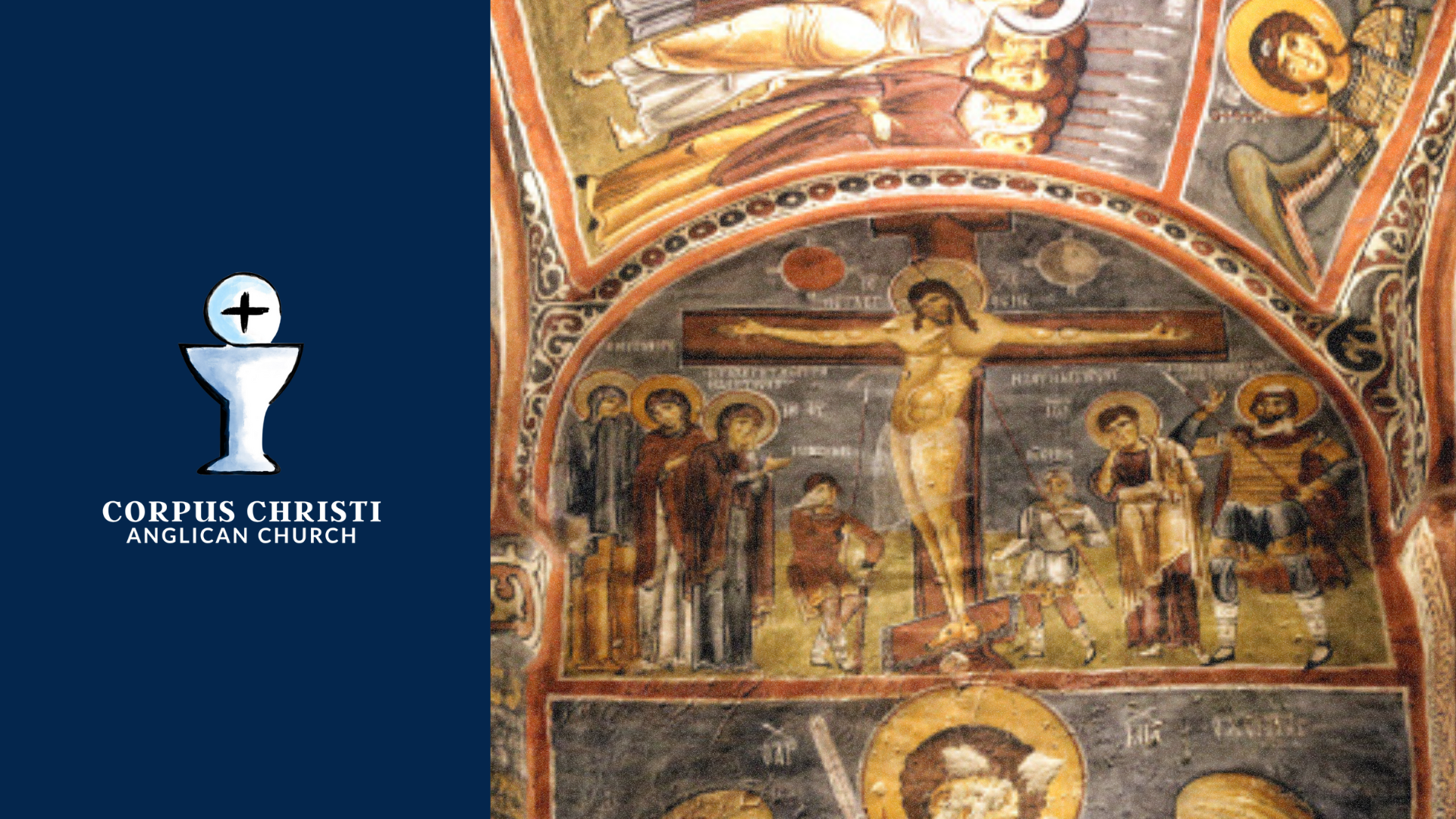
That’s what Jesus was talking about when he said, “If anyone would come after me, let him deny himself and take up his cross daily and follow me. For whoever would save his life will lose it, but whoever loses his life for my sake will save it.” What does daily crucifixion look like? It is a mirror of the entire process by which Jesus intentionally went to his death outside the walls of Jerusalem: grief, anger, humiliation, suffering, dereliction.
As Jesus approached Jerusalem the last time, he looked down on the city and wept. He had spent three years trying to teach the people of Jerusalem his way of dealing with the Romans, but in their mind the only way of liberation was through violence. Sometimes our efforts to communicate the Good News of the Kingdom appear to fall on deaf ears…
Luke 19:441-44
When Jesus entered the Temple he was furious with the money-changers who were desecrating this sacred place for their financial gain. Sometimes our anger is the motivation for positive change.
Matthew 21:12-13
In their attempt to undercut Jesus’ authority with the common people, the Romans deliberately humiliated him publicly, by portraying him as a false king, and by torturing him to death in public. Sometimes we may be derided for claiming to represent Jesus.
Matthew 27:27-31; 32-44
And on the cross, Jesus felt he had been abandoned, not only by his friends, but by God himself. Sometimes we may feel terribly alone.
Matthew 27:45-47
Resurrection
God’s mighty act, Jesus’ vindication. This public event marked the completion of his mission, the inauguration of the New Creation - the Kingdom of God; the beginning of a new stage in history, in which the practice of voluntary self-sacrifice begins to transform human culture and the whole historical process.
Matthew 28:1-10; Colossian 2:8-15; Revelation 21:5-6
Voluntary self-sacrifice
The transition from “this evil age” to “the coming age;” from childhood to adulthood; from serving oneself to sacrificially serving others (the meaning of “love”). We are in both “this evil age” and “the coming age,” at the present time, both grown up and immature, at the same time.
Colossians 1:9-14, 24-28
A note about the word “sacrifice:” It does not mean a bloody, primitive ritual. It means “getting your priorities in order, preferably in accordance with the directions of the Holy spirit.”
And just a note on the word, “evil.” In the biblical context there are two types of “evil,” the evil of immaturity, of accident and mistake, and malice, “the dark power,” that works to corrupt or destroy God’s good creation. In the Lord’s Prayer, the word “evil” can carry both meaning, both our tendency to harm or destroy ourselves, or “the evil one,” the seemingly autonomous dark power tending to destroy the good creation.
Summary
The message of the Bible can be seen as the combination of three themes:
1 Undeserved suffering
2 Crucifixion and resurrection, and
3 Voluntary self-sacrifice
Conclusion
Stand firm. Trust God. Listen for his directions. The “age to come” has already begun.
Glory to God whose power, working in us, can do infinitely more than we can ask or imagine: Glory to him from generation to generation in the Church, and in Christ Jesus for ever and ever. Amen.
EPHESIANS 3:20-21
BCP p. 26