All Saints’ Sunday: The Help of God and the Nearness of the Kingdom
TranscriptioN
Well, good morning again, everybody. It is good to see you this morning on our All Saints Sunday. This morning, I put the marker in the wrong page, and I read the right passage from the wrong Gospel. So actually, if you have your Bible, go to Luke chapter 6, which is also the Beatitudes, but I'm gonna be preaching from the Lukan version of the Beatitudes this morning. But I wanted you to get it all. So you got both Gospels. We're all about the synoptics here, so, you know, thank you for listening to both and dealing with both Gospels this morning.
So, as we get started, I know that there are many of you for whom this is your first All Saints Sunday because you've come in from other traditions, and so I'm so glad that you get to experience this feast day. It is one of my favorites in the church's calendar. For those of you who don't know me and are new and visiting, I'm Father Morgan Reed. I'm the vicar here, and I'm really glad you're here. Afterwards, please stop me and say hello, or I'll try and find you and say hello. I would love to get to know you, but thank you for being here this morning.
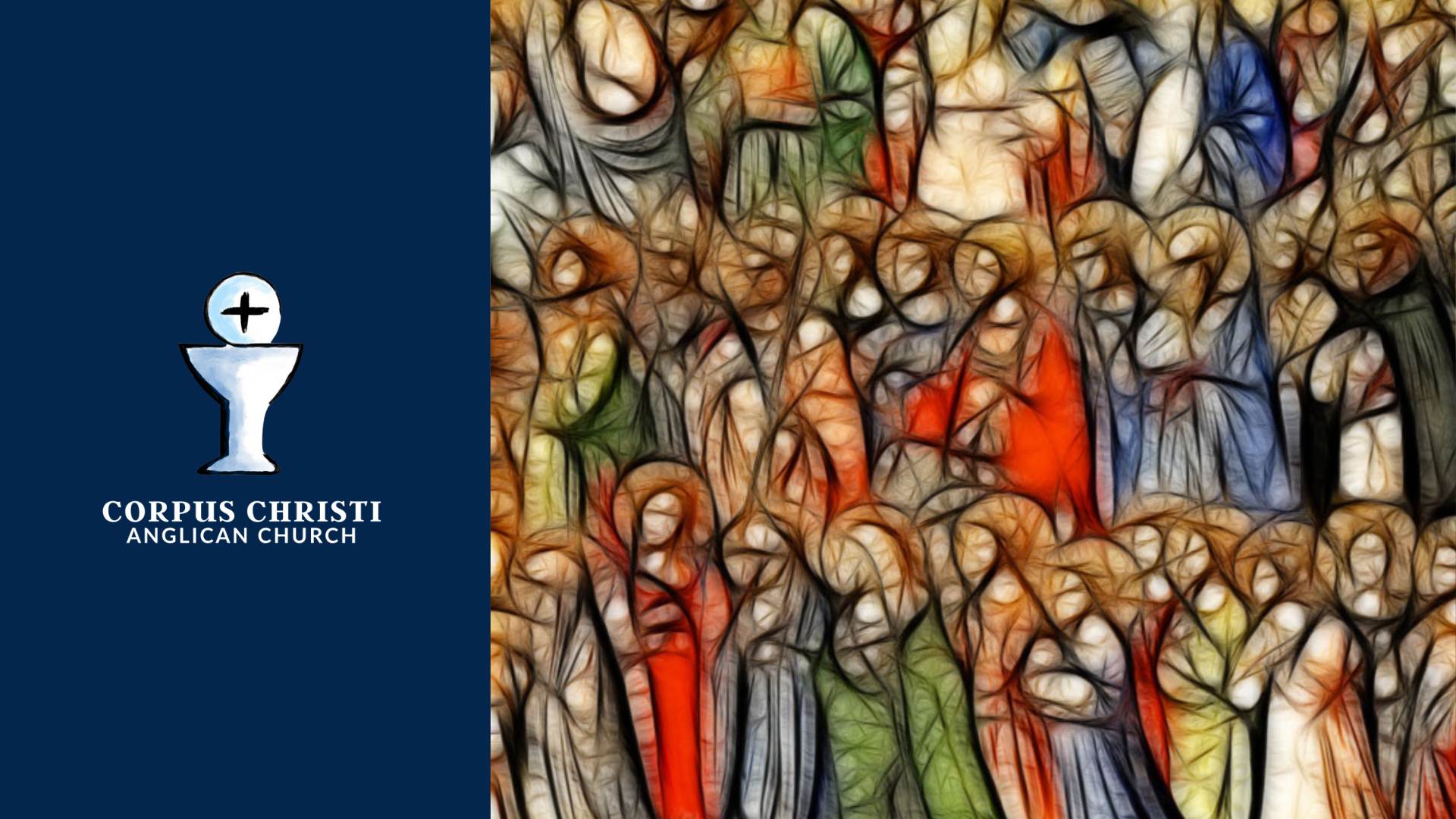
This day reminds us of those who have gone before us—those that we remember and those that we may not remember. And so I was telling somebody one of the things I love about All Saints Day, and I chose this art intentionally because there are so many saints for whom we don't know the names and faces of, and they are part of our journey whether we realize it or not, and this day calls attention to that very fact.
And if you look in our Book of Common Prayer, which is what we use in our liturgy, there are different reasons why somebody might be commemorated as a saint. There are those who are remembered as martyrs—those who gave their lives for the testimony of Jesus Christ. There are missionaries or evangelists, people who have pioneered a place for the gospel among those who haven't heard it yet or experienced the grace of God. There are pastors, people who show us the shepherding care of Jesus. There are teachers of the faith, also called doctors of the church—people who brought clarity to really complex topics in really complex times. There are monastics or religious people we commemorate for their deep lives of prayer, the deep well from which we draw all the time, and their intentionality. There are ecumenists—people who worked toward the unity of the body of Christ among disparate parts of the church around the world. And there are reformers of the church, people who either saw corruption in the church or something that needed to be changed, and they worked toward changing the church, moving it toward holiness and the holiness of God. And there are, finally, in our Book of Common Prayer, renewers of society—people who show us the goodness of Jesus and the profound examples of God's justice and mercy in their lives and what they call people to in the societies in which they lived.
All of these categories of people show us something of the goodness of the work of God in the person and life of Jesus Christ. And so these people form the roadmap as we are figuring out how to live out God's ideal for creation, how to live out God's plan for us as we become more like Jesus. All of these people who have gone before us become a roadmap for that.
And so the Beatitudes are commonly read on All Saints Sunday in the church. Essentially, what Jesus is teaching in these passages is that those who would follow him—his kingdom is seen best in the lives of those who know that they need God's help the most. His kingdom is seen best in the lives of those who know that they need God's help the most.
And as we look at this passage, let me pray for us.
“In the name of God, the Father, the Son, and the Holy Spirit. Amen. God, the maker and redeemer of all believers, grant to the faithful departed the unsearchable benefits of the passion of your Son, that on the day of his appearing they may be manifested as your children, through Jesus Christ our Lord, who lives and reigns with you and the Holy Spirit, one God, now and forever. Amen.”
Well first, just to name what's different in Luke's gospel than in Matthew's. In Matthew's, it's all about blessed, blessed, blessed. I think there's nine categories of those who are blessed. In St. Luke's gospel, there's only four. And he has counterpoints of the four opposite categories who are accursed or woe to those. He says, blessed are you and woe to you, in four different categories. And so if you have your Bible, again, I encourage you to look at Luke 6. But in Luke's account, Jesus frames the Sermon on the Mount with those four blessings and woes.
It feels a little bit like if you read Psalm 1, and it begins blessed is the person who does not, stance it, etc. And then later on it says, and not so the wicked. So there's this blessing and cursing in Psalm 1, and when that's taken together with Psalm 2, the kind of function is like the doorways by which we enter into the Psalter.
It's the wisdom by which one enters into the life that the Psalter is painting a picture of. And so similarly here, the Beatitudes are like the doors that help us enter into the portrait of life in the kingdom of God.
And so first, I want to look at these blessed ones. It's a little different than Psalm 1, because these aren't commands. As though Jesus is saying, you know, you should aim to be poor, that should be your goal, or you should aim to be sad or weeping, or aim to be hungry, or aim to be hated by people. Those aren't goals.
They're not in and of themselves virtuous, so that if you're like, well yeah, everyone hates me, I must be doing something right. It's not, that is not a good indicator that you are necessarily following Jesus. But the reality is, as you do follow Jesus, and you become more holy, more like him, the reality is, you follow him into his death and resurrection.
And so suffering will be inevitable. But in Christ, suffering is meaningful. But suffering will be a reality.
And so when we think of the poor, the sorrowful, the hungry, the despised, those who have this very real bodily sense that there is a need, there is something going wrong, that the awareness of something wrong attunes us to the spiritual realities that we are in need of God's divine help. So what's true in the body is true in the soul as we follow Jesus.
And when you think of the audience Jesus is preaching to, these are the people longing for the kingdom of God, and they're not the well-off, they're not the well-fed. These are the people who are are looking for a Messiah to come and restore all things. And so these very much are the people Jesus is talking to, and so we will find ourselves in those places when we follow him as well. And when you do, when you find yourself knowing your own need for good companionship to be taken care of as you're following Jesus, then what he's saying is consider yourselves fortunate, consider yourselves blessed. That's the sense of what blessed means here. Consider yourselves fortunate when that happens.
In Eugene Peterson, he's a famous pastor who passed away a while back, but in his biography he was saying that when he translated the Message Bible, he originally wanted to, instead of Makarios here being blessed, he wanted to translate it lucky, because that's the sort of sense of like, “Hey, consider yourselves lucky if you find yourselves in this place.”
And his editor wisely said, “That's a terrible idea. No evangelical publisher is going to give you the time of day if you put lucky in your Bible translation.” So he wisely took that part out. But the point is still true, this idea that when you find yourselves in need as you're following Jesus of material resource, of friends, of food even, of finding comfort, then count yourselves fortunate when those situations come. It's really countercultural, and the reason why is because at those moments when you're attuned to the need of the body, you're closer to seeing God's kingdom than when you weren't aware of your need.
I remember some time ago, a few years back, I was getting food for our family, and I was holding our son who at the time was probably three, and I was holding him in one arm and the food in the other, and there was a curb that I was walking down to get to the car, and that curb was bigger than I had expected it to be, and so I have these terrible rubber band ankles, and when I stepped off this curb, my ankle just went out from under me and popped. It was the most horrible feeling, and I fell to my knees, somehow by the grace of God did not drop either my child or the Chipotle, but I get back. I had to drive home with my left foot and then go to the hospital and get x-rays, and I had indeed fractured a bone in my ankle. It was a terrible feeling, and I get up the next morning, and I look at my foot, and the whole bottom of my foot had turned black, and I thought, oh no. So I call a friend who knows more than I know about these things, and I said, “Here's what's happening.” And they said, “Oh that's great. That means you're on the process of healing.” But there is no way. This is so ugly. That can't be what healing looks like. Why is this good news that my ankle is so awful, and I hated that healing looked like that for the next few weeks, but you know I was thinking of this phrase like, blessed is that sprained ankle whose foot was bruised profusely because it was in the ugliness of that foot that I knew that healing was at hand.
It would be worse if I hadn't. The worst cuts are when you don't bleed initially, because you know that bad things are coming after that, but you know, think of it now in the spiritual realm, like poverty, sadness, hunger, exclusion for the sake of following Jesus and being faithful in the kingdom of God. These aren't the goal necessarily, but they are sometimes an inevitable reality for the one who's following Jesus, because we don't get to lavish ourselves with all the comforts of the world all the time, and so when those things come as we follow Jesus, those, when we're attuned to them and recognize them, those can be the very holy moments where we see the signs of God's nearness as we're following Jesus, and when we follow him, sometimes things are gonna get really difficult.
I hardly have to tell any of you that, but when they do, Jesus is encouraging us to count ourselves amongst the fortunate, amongst the blessed, because we're actually in a long line of people who have gone before us, who have suffered in the likeness of Jesus, who are among the fortunate, and because their hope for seeing the kingdom is our hope as well. It's countercultural today as it was back then, because back then, seeing somebody well-off was a sign of divine favor and prosperity. We haven't moved that far in our culture either, and so we look at our own society, we might have alternate beatitudes, or we would think, you know, blessed or fortunate are those who find themselves at ease because they've worked really hard to earn what they've got.
Blessed are those who achieve everything they wanted, no matter who they had to hurt in the process. Blessed are those who attain some amount of celebrity, those who benefit economically off the backs of the poor, those who avoid suffering because God must be pleased with them. Blessed are those who don't acknowledge the reality of their own mortality, but instead they're allowed and they can whip up a frenzy and get people to surround them with their ideas, and they must be showing us a sign of God's favor if they can draw a Jesus is calling us to follow him in our experience of suffering the loss of all things in order to see the realities of the kingdom come in our lives, because he's bringing about the realities of the kingdom through a people who are following him into his death and his resurrection, but the precursor to resurrection is death. And so, the need of our body attunes us to the need of our souls as we're following Jesus. And when we recognize that need for God where things aren't as we expected them to be or hope they would be, then we can count ourselves fortunate in those moments because we are intimately closer to seeing the realities of Jesus's nearness where his kingdom is coming and where he is good.
And so in contrast to the blessed, the fortunate, Jesus gives us the four categories of woe, you know, like not like “whoa”, but like woe to you, right? These are, in my Old Testament class we used to joke about these being called the woe-ricles, because you have the oracles of blessing and you have the woe oracles of cursing. Like these are like somebody lamenting the loss of something. It's I wish, like if you're at a funeral, it's almost like, “I wish this person had done it differently;” like there's a deep-seated woe about the state of the individual. And that language in the Old Testament was associated with funerary rites. And so, when we think of the woes in this passage in Luke, he says woe to the rich, woe to the well-fed, woe to those who laugh now, and those who are influential and well thought of. Now there's nothing inherently sinful about any of those things.
If you find yourself well-off, money is a tool, right? It's not a name. And again, just as none of those other things were aims of virtue, poverty, hunger, etc., none of these things are aims of vice, or are a result of vice necessarily. There's nothing inherently sinful about being well-fed or well-known, but what he's saying is if you find yourselves in a state where this is your constant reality, it's something you've aimed for, it's something you look for, it's something that takes up a lot of mental load in your life, and your life is then as a result of that characterized by satisfaction and ease, fame, the kind of laughter that you might associate with like toxic positivity, where you're ignoring the realities of how hard things are, then woe to you, is what he's saying.
You're at a complete disadvantage in that state from seeing God's kingdom come, because the shallow veneer of the view of God's kingdom is obscuring your vision for the love of God and for the real purpose of creation and why you're here. And so, this is the person who believes that they actually have no need of God's help, because they've arranged their lives in such a way that their body can't indicate to them anymore their need for God's help. And as a result, they're desensitized from the breaking in of God's kingdom in their lives. They run past it. They don't acknowledge it. They can't see it. Material success isn't always kingdom success, and we often get that confused.
So Jesus warns those who are listening to him, he would warn us as well, that in Israel's history there were this group of people who find themselves in that state constantly, and people thought well of them.
And does any of the older kids here, do you know who he calls those people in Israel? Or adults? Anybody want to guess? What? They're within Israel, yeah. The people who like would be well fed, well taken care of, all that. Anybody want to guess? Caroline. Close.
The Old Testament equivalent, false prophets. So he says, “Yeah, if you find yourselves amongst these, you're in good company with the false prophets of old, of Israel.”
And so, you know, so if you find, to find ourselves amongst those people, the curse, those who have, those who are in the woe category, when you find yourself there, you're overlooking what's broken for the sake of keeping up appearances. That's what is kind of at the root of the problem here. We're ignoring what's gone wrong to make sure that we can project a picture of what feels totally right. There's a false sense of peace, a false sense of tranquility, and you know what? We're culturally primed for that.
So imagine seeing a happy family photo on social media, maybe for the holidays, but then discovering that in that happy family photo, there was a day-long process of tears, and moaning, and groaning, and weeping, and gnashing of teeth, and protests of, I don't love you anymore, and all the sorts of things that go into a happy family photo. The photo is a curated facade. It's an aspirational reality, and sometimes, by the grace of God, it does actually become, you know, an ontological reality, but sometimes those family photos, they just mascot all that process that was going into this, tells us nothing of the conflict involved, and it's not a bad thing, it's the reality that we're in, but I'm starting to say that we're primed for this.
I remember seeing on social media a friend of mine from Bible College who had posted a really happy photo of him and his wife, and then like a month and a half later, it was taken down, and I found out that they were at the time almost separated, and they were going through a divorce.
The curated reality was just this veneer, and it had no substance behind it, and it's so easy to do that with our lives, and how we project ourselves on the internet, and then that trains us for how we do it with one another, and so this is a permission to be undone, right? This is a permission to take down the veneer and the facade.
The one in these Beatitudes who is cursed, he's cursed because they're keeping up appearances without the actual health and divine, they're keeping up appearances of health and divine prosperity without any of the substance of the reality of the kingdom of God, and so Jesus is setting up these blessings and the curses as these categories, like a doorway entering into a vision of the kingdom of God, which is to follow him in his example, and so he's going to go on for chapters in the Sermon on the Mount to show how the disciples can understand the world rightly when they learn to love as God loves, and we're not going to get into all that, but this is where he goes. If you want to understand the world as it is, learn to love the world as God loves it, which is entered into by this category of blessings and curses, and so one author says this about loving the way that God loves. He describes it as glorious, uproarious, absurd generosity.
Think of the best thing that you can do for the worst person, and then go ahead and do it. Think of what you'd really like someone to do for you, and then go do it for them. Think of the people to whom you are tempted to be nasty, and then lavish generosity on them instead.
So Jesus isn't just giving them a list of do's and don'ts in this passage. What he's giving them is a helpful picture of the subversion of the brokenness of the world by death and resurrection as they follow him. And so, as Christians, I'm going to use some of the language from St. Augustine of Hippo. He talks about “We're to hate the fault that's in the world by loving its true nature as God intended it to be”, which I find helpful as we learn to love as God loves in this uproarious, absurd kind of generosity and mercifulness.
Then we start to see the world as it is and hate the fault and the brokenness while loving it for the ways that God has intended it to be. And so Jesus, as we close, he is inviting us to follow him in this long procession of people who have gone before us for centuries. And each of us has been uniquely made with our unique stories, and we have a unique story to tell about the grace and the mercy of God in our lives and of his kingdom, as we're learning what it means to follow him. And so, when we follow our Lord, we do so into that death and resurrection that Jesus experienced, knowing the goodness that Jesus is with us.
The suffering is purposeful in order to make the world right again, to order what's been disordered. And so, when you're following Jesus, those moments of suffering aren't something to be passed over, but there's something to remind us that we are in need of God's help. His kingdom's seen best when we're most aware of our need for God's help.
And so, we can be encouraged in our time of need that that's when Jesus is closest to us, that he's pleased with us as we're following him. That this isn't his judgment to castigate us in the realm that we've done something wrong, but there is something for us of his goodness in this hardship. And that we can count ourselves then fortunate in those moments to be primed to see his kingdom, just as those who have gone before us, because those who have experienced his death and resurrection in life, their ultimate hope is our ultimate hope as well, as we look for a better country of which the Saints show us.
So as we close this morning, let me pray again this call for us from the Feast of All Saints.
“Almighty God, you have knit together your elect in one communion and fellowship in the mystical body of your Son. Give us grace so to follow your blessed Saints in all virtuous and godly living, that we may come to those ineffable joys that you have prepared for those who truly love you, through Jesus Christ our Lord, who with you and the Holy Spirit lives and reigns, one God, in glory everlasting. Amen.”
Transcribed by TurboScribe.ai. Edited using ChatGPT.