
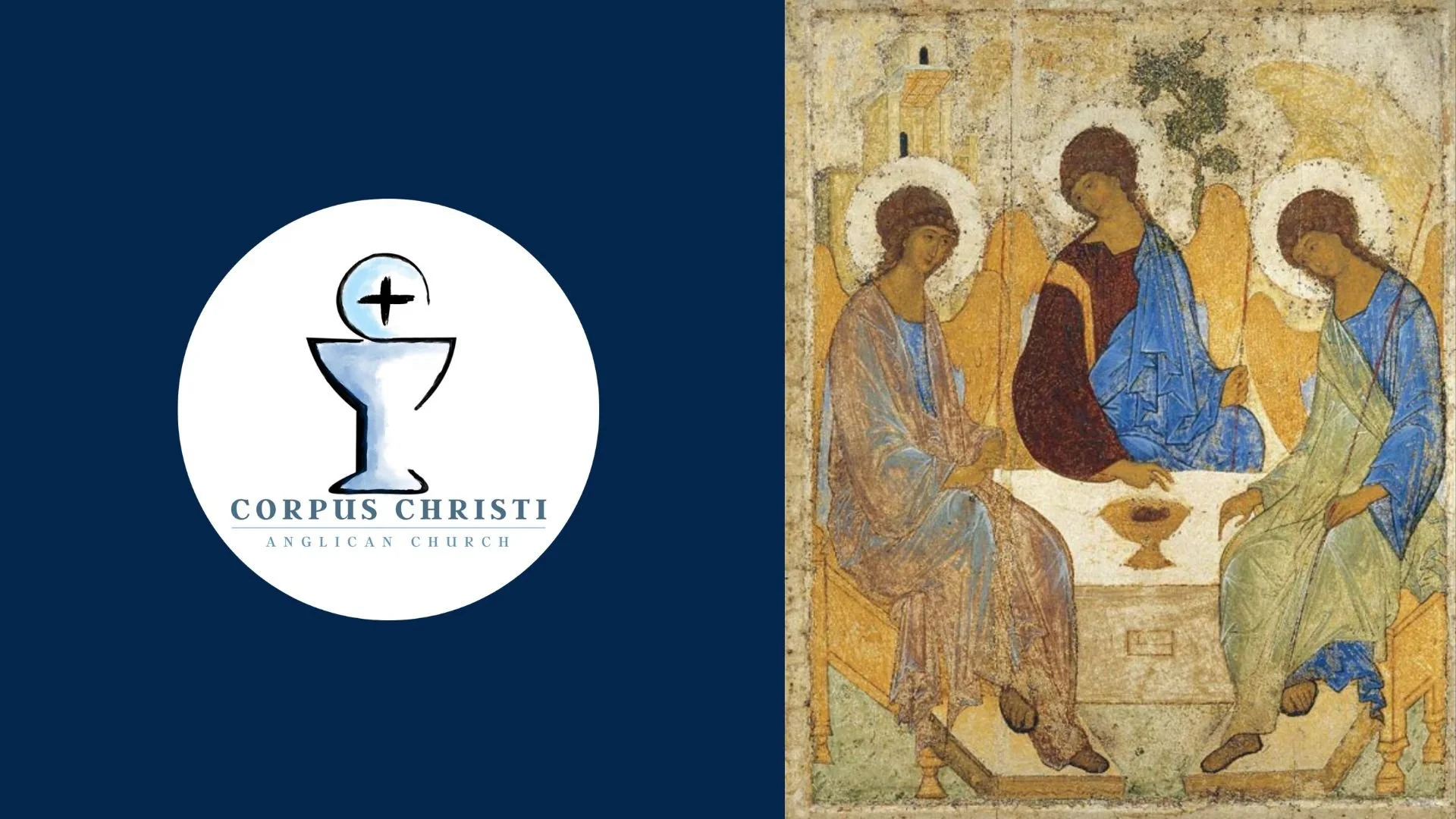
Trinity Sunday: Adore the Inexplicable Trinity
TranscriptioN
“In the name of the Father and of the Son and of the Holy Spirit, let us pray.
Almighty and everlasting God, you have given to us your servant's grace by the confession of a true faith to acknowledge the glory of the eternal Trinity and in the power of your divine majesty to worship the unity. Keep us steadfast in this faith and worship and bring us at last to see you in your one and eternal glory. O Father, who with the Son and the Holy Spirit live and reign one God forever and ever. Amen.” Well, on every Trinity Sunday, we take a courageous foray into trying to explain and understand the Holy Trinity, the inexplainable and the incomprehensible doctrine by which we live. The Trinitarian God is a basic teaching, a creed that is learned and accepted by us as Christians, the foundational way for us to relate to God and his ability to relate fully to us.
The Father is God, the Son is God, the Holy Spirit is God, a monotheistic God, one almighty God who exists in three distinct persons, co-equal, co-eternal, and co-powerful. Each person, 100% God. The Bible tells us that the Father, Son, and the Holy Spirit are distinct persons.
For example, since the Father sent the Son into the world, he cannot be the same person as the Son. In the same way, the Son returned to the Father, and the Father and the Son sent the Holy Spirit into the world. The Holy Spirit is distinct from the Father and the Son.
St. Augustine made seven brief statements in his explanation of the Trinity. The Father is God, the Son is God, the Holy Spirit is God, the Father is not the Son, the Son is not the Holy Spirit, and finally, there is only one God. Now I'm going to take us on a little road that's not exactly part of our Trinity celebration, but I think it helps to demystify something that I always thought of as orthodox as a Christian.
So we'll look at the book of Deuteronomy and the Old Testament, and we hear what is known as the Shema. The Shema is Israel's declaration of God as one God. It is considered the most essential declaration of the Jewish faith.
Hear Israel, the Lord is our God, the Lord is one. Now I think there is a praise song, and you know, hear oh Israel, the Lord our God is one God. Well, the Shema was Israel's declaration that they were a monotheistic people, unlike many of their neighbors who believed in and worshipped many gods.
But here's the thing, they did not want to surrender their unique covenant with God, and Israel often saw itself as representing the side of God that stood against her adversaries. There's a big difference between our creeds and the Shema. The Shema does not define God as a single essence or more than one person present as God.
Now let's look at some other ways we and others have tried to explain the Trinity. You've probably used them. I have.
But they try to explain, but they really can't. You might have heard some comparisons to things to help you understand or explain to someone else. The three distinctive persons who share one substance.
That's the key word there, substance. So have you ever heard about the three slices of pie? Same pie. Okay.
Cherry pie, apple pie, three slices. Okay. The egg, shell, white, and yolk.
Okay, it's one egg. Okay. The apple, skin, flesh, and seeds.
Now three really common ones, and they're pretty popular, I think, as I hear them a lot. The three properties of the same element, H2O, water. Liquid, vapor, and solid, ice.
Water can exist in three different states, but here's the key, not all at the same time. It is either liquid, or it's steam, or it's solid. But God the Father, God the Son, and God the Holy Spirit all coexist in the same essence at the same time.
Okay, get your brain around that. The Father did not cease to exist in heaven, while Jesus the Son was active on earth. Okay, here's one that I thought was pretty good.
The triangle. One form with three distinct sides, and three inside angles. The problem with the triangle is similar, but it's different.
Here are three parts within the one. However, each part is not a full expression of the one. One side of the triangle is just that, one side.
The side is not a full triangle. However, the Bible tells us that God the Father is fully God, not just a part of God. The same is true for the Son and the Spirit.
The 39 articles of religion state there is one but one living and true God, everlasting, without body, parts, or passions. The unity of the Godhead or the Trinity exists of three distinct persons who are equally God, united in their common substance, power, and eternity. All analogies fall short and are insufficient in different ways.
They're mistaken ideas that are trying to explain something that is inexplicable. Analogies of the Trinity are seeking to help us understand the very nature of God. They are all bad analogies because they're materialistic.
They interpret God's being in terms of material that makes up God, but there is no material that makes up God. God is immaterial. There is nothing we can point to that he's made of.
Unfortunately, mistaken analogies can result in mistaken knowledge of God. Since our faith rests on our growing knowledge and love of God, we need to use our limited but faithful understanding of God in the way we communicate the doctrine of the Trinity. I found one commentator this week, he was tongue-in-cheek about it all, but I thought it was good.
I think what's confusing to some pastors is the mistaken notion that teaching the doctrine of the Trinity means explaining how God is three in one. By contrast, the Apostles' Creed and the Nicene Creed, which are the two most important confessions of our faith, that teach the doctrine of the Trinity, never even use the word three. They say nothing about how God is three in one.
Rather, they teach that God is Father, Son, and Holy Spirit all at once. He says, if you want to, you can count to three, but it's hardly essential, and in fact, you'll understand the doctrine better if you forget about counting. Now, having said all that about comparisons, I'd like to share one that I found actually found a little bit helpful.
The Trinity is gravity, a force we can't see or touch, much less explain. We know it's there because we can see its effects. It keeps us on the ground.
It makes objects fall. We can't live without it. Just like gravity, the Trinity is an essential part of our reality.
None of us have gravity. It has us, but without gravity, we would have nothing. Without the Trinity, we would not be able to have a relationship with God.
The fact that the Trinity is in full-time, always-on relationship with itself means that the Trinity is capable of having a relationship with us. The Trinitarian God wants us to know him as fully as we are known. In the end, we dispense with our analogies and numbers and thoughts about having complete understanding of what the Trinity is, and we agree to accept divine majesty that is inexplicable and beyond our human understanding.
Nevertheless, it's the basic doctrine of our belief, based on something we cannot see or understand or explain. One of my favorites for me, and one of the clearest pictures for me of the mystery of the Trinity, is portrayed in Scripture in Genesis 1, 1 to 3, where the three are named. In the beginning, God, the Father, created the heavens and the earth, and the Spirit of God, the Holy Spirit, was hovering over the face of the waters, and God, Jesus, the Word, spoke, let there be light, and there was light.
God is understood in Genesis to have created everything, even before creation. God, as a community of love between Father, Son, and Holy Spirit, but not out of loneliness, out of the eternal, unending circle of love between God, Father, Son, and God, the Holy Spirit. The Trinity is an enigma.
Our human minds just can't fathom this, but whether we understand it, or believe it, or not, it's the Holy Spirit who approaches us even before we understand, or believe. It is the Holy Spirit that opens up our spirit to his spirit, and allows us to believe something beyond our understanding, or even our awareness. This is prevenient grace of God, the grace that, through the Holy Spirit, prepares our hearts to receive God, the Father, and God, the Son.
St. Augustine emphasized that humans are unable to initiate their own salvation, or to respond to God's grace without prior divine action. The wonder of our faith is in the divine initiative of a loving God, our Father in heaven. He is the spiritual wind that we feel and can't see.
He's the wind that opens our spiritual cells to the persons of God, the Father, and God, the Son. It is his initiation that brings with him blessings that are ours, through faith in the Trinity. Blessings, the possibility of eternal salvation, the living water and bread of life in the Eucharist, spiritual growth and insight as we read the Scriptures, the fellowship of believers, God's power at work in us, in our weakness, God's living presence in our lives, making eternity something that begins right now, right here on earth.
Please pray with me. Now to him who is able to keep you from stumbling and resent you blameless before the presence of his Lord with great joy, to the only God, our Savior, through Jesus Christ our Lord, be glory, majesty, demendent, and authority before all time, now and forever. Amen.
Transcribed byTurboScribe.ai. Edited by the Vicar.