
Pentecost: Called and Equipped for the Work of Jesus
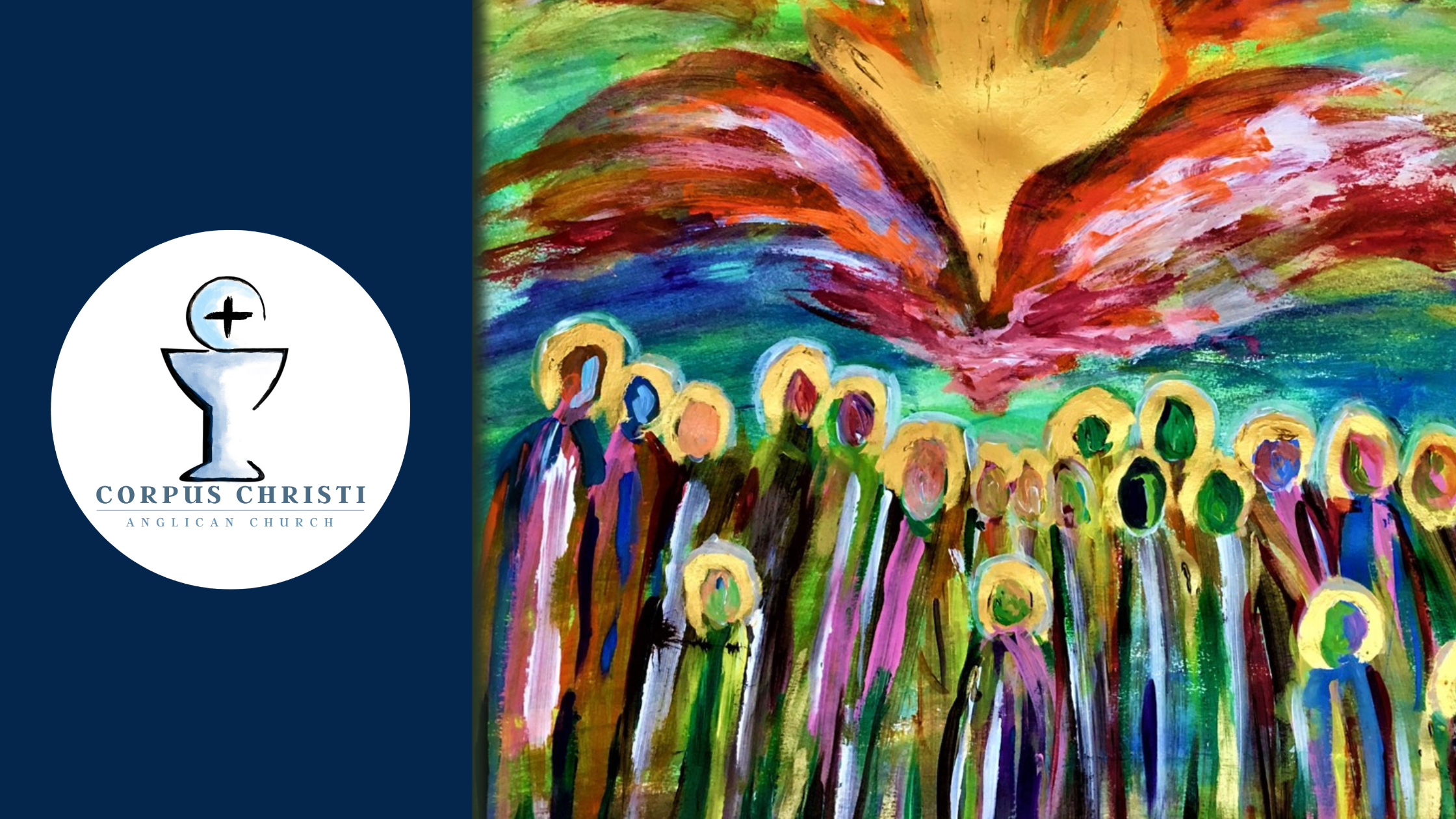
This weekend we celebrated Pentecost! We were outside at Pohick Bay with no sound equipment. This is why the preacher is preaching a bit louder than normal. Please excuse our sound issues.
TranscriptioN
Well, good morning again everybody. It is good to be with you this morning. Happy Pentecost. For those of you who are new or visiting this morning, I'm Father Morgan Reed.
I'm the vicar here at Corpus Christi Anglican Church. This isn't our normal location, so we get to do this once a year and we're thankful to be able to be here in this covered area and that it's not too hot today. This is a really important day in the church calendar.
It reminds us that Jesus Christ reigns as King and that he has equipped us to carry on what he's doing in the world through the power of the Holy Spirit. It's only through the Holy Spirit that the church becomes the church, the people of God, and this day reminds us that we need help to carry on this commission that Jesus Christ gives us. So as we look together at Acts 2 this morning, let me pray for us.
In the name of God, the Father, the Son, and the Holy Spirit. Amen. Holy Spirit, breath of God and fire of love, we cannot pray without your aid.
Kindle us, in us, the fire of your love and illumine with your light, illumine us with your light, that with a steadfast will and holy thoughts we may approach the Father in spirit and in truth, through Jesus Christ our Lord, who reigns with you and the Father in eternal union. Amen. Well, let's look.
We're gonna look at two things. We're gonna look at the commissioning and how the disciples are equipped to carry on the ministry. So let's look first at the commissioning of the disciples of Jesus.
After Jesus ascended, there's a large group of his disciples that are waiting in a room together and they're praying until the Feast of Pentecost. It's helpful to know a bit about what this feast is. So in this feast in the Old Testament, it's a feast that started with celebrating something out of the harvest, 50 days after Passover.
The farmers would take the sheeps from their crop, from their wheat, and they would offer it to God. In some ways it was a sign of gratitude for what God had provided, but it's also a prayer that the rest of the crop would be successfully brought in that year. And then it took on new meaning as the people of God are delivered from Egypt and they celebrate the Passover together.
And then this feast, if Passover commemorates the event of Yahweh becoming king and delivering his people, 50 days later Pentecost or Shavuot is the festival that celebrates God's giving of the law on Mount Sinai, equipping the people for how to live out life as his people. And according to Jewish tradition, it was 50 days after Passover that Moses had gone up on Mount Sinai to receive the law, which is God's covenant with his people. And that mighty act of God of coming down on Sinai is something called a theophany.
It's a vision of God where God's power and his presence show up very visibly. And so Pentecost then becomes both a praise and thanksgiving as a feast of what God has done to act on our behalf in history, giving his people a way of life. But it's also a prayer that they would carry out his purposes and will as he's called and equipped them to do.
And today's passage that was so beautifully read is no less of a theophany than what happened on Mount Sinai. It reminded me of a couple years ago. Two years ago I was sitting in our house and I heard some giant explosion happen.
And I was praying it wasn't in our house. It wasn't. But then it did shake the house. And I did what any good millennial would do. I got on the internet. I said, Dear Google, what was that explosion near my house? And I found out that it turns out two F-16s had just launched from Andrews Air Force Base near the house to intercept a private plane that had entered and violated U.S. government airspace.
So that explosion that I heard was the sound of those two F-16s breaking the sound barrier over the DMV and causing a sonic boom. And so the mighty rushing wind that we hear about in the Book of Acts seemed to have the same impact on the crowd as the sonic boom in the DMV. But they did not have internet back then.
And so these Jewish pilgrims who had come from all over the place were wondering what had just happened. And so they come to this house where the disciples were praying. And in this Sinai-like theophany, instead of the twelve tribes of Israel, God had commissioned twelve apostles.
Instead of the Mosaic Covenant, the Holy Spirit is poured out on these disciples to shape a community together, doing life together under the rule and reign of Jesus, showing his love to the world. So Pentecost, again, becomes this thanksgiving for God giving us the Holy Spirit. And it's also a prayer that we would live out this life in the Spirit to discover God's kingdom here and now.
We're called to carry on the works of Jesus, and then we're commissioned to do so through the presence and the power of the Holy Spirit, God himself, who is given to us. So that's the commission. Now let's look at the ways that he leads us into new life.
When God had done this miraculous work, some of the crowd had marveled, some were astounded, and then some rationalized it away and they created false narratives about what they just experienced. And that's a paradigm for what would be the case as the apostles continue on their mission. It's still a paradigm today when people are confronted with the good news of Jesus.
So the people recognize they're hearing this news about Jesus in their own language. And some said, these men must be drunk. Because imagine if you speak Parthian and you hear Egyptian, it sounds like gibberish, right? So this is their conclusion.
This can't be something of God. This has to be these people are drunk. They write off what they can't understand as being from drunkenness, explaining it away with falsehoods, not just because they can't understand it, but because they're unwilling to accept it. So we might get a mighty rushing wind here too. I'm excited for that. Thank God for a covered area.
So Peter stands up to address the crowd and he assures them they haven't even had their morning prayers yet, which means they haven't even eaten yet. There's no way they can be drunk yet with wine. So Peter gives us in this passage an amazing message from the book of Joel, which I know is highest on everyone's reading list.
So he's in the book of Joel and he tells them in the last days God is gonna pour out his Spirit on all flesh. And the Jews of his day are looking for the day of the Lord to come when God would put his King on the throne and where God would reign over his enemies. Peter is functionally saying here that Jesus has ascended, he's become King, and you and I are in the last days right now.
And in these last days we're called to be delivered to the kingdom of God, where the Holy Spirit brings heaven into our earthly reality to begin to taste the redemption now that's ultimately going to come for all things when Jesus comes ultimately to rule and reign and return. And the nations here that are mentioned in the book of Acts are really important. The Roman Emperor back in Peter's day and the Apostles day, he had set himself up as a divine figure.
And when he brought peace to the Empire, he called it the gospel, he called it the good news of the Roman Empire, but it was a good news that came through violence. This was a shadow of true peace. And it was maintained nationally through violence, through corruption, and through coercion.
So St. Luke is now framing this passage to show the rule and the reign of King Jesus as a counter gospel to the Roman gospel, a true good news against the backdrop of the Roman Empire. Let's just sit and listen to this for a second. This is glorious, isn't it? Just want to name it because I see you looking around.
Thanks be to God. But don't miss this. There's a second century church father reading this passage and he says this, “Christ's name is extended everywhere, believed everywhere, worshipped everywhere, reigning everywhere, adored everywhere, conferred equally everywhere upon all. No king with him finds greater favor, no barbarian lesser joy, no dignities or pedigrees enjoy any distinction of merit. To all he is equal, to all he is king, to all he is judge, to all he is God and Lord.” What he's saying, in other words, is this radical renewal of all kinds of real ordinary people is a testimony to the power of the Lord Jesus Christ and the work of the Holy Spirit.
The kingdom is here and Jesus will reign over all. We see it breaking in now. God hasn't started with the most influential to bring about this kingdom.
He hasn't started with those who are most outwardly pious and religious or well-off. God's dream team is filled with really ordinary people, misfits and sinners because wherever the Holy Spirit is, as one church father says, “clay becomes gold.” And so you and I, when we were baptized, we were filled with this same Holy Spirit to put God's works on display as he transforms our hearts individually and calls us to witness to the world.
Peter names what's true and then he invites people into these last days with him, you and I. And what this means is that we need to prioritize listening to the Holy Spirit who's been placed in our hearts. The Holy Spirit is the one who calls us to repentance, who comforts us, who invites us into wondering at new creation, and who miraculously transforms the stuff of our earthly life into the stuff of the heavenly reality. And what he can do in bread and wine and water, he can do with our broken family relationships, the responsibilities that weigh really heavy on our hearts, the daily meals we prepare and invite others into our household, the monies that we steward, the things that we hold on to that are broken.
If he can restore creation, he can restore in us what's been broken and what's been ravaged by the fall. And so there's a final exhortation in verse 21. This is for the crowd to trust in Jesus.
Peter says, everyone who calls on the name of the Lord will be saved. And he's quoting again from Joel 2 and in this passage he is referring to Jesus. There's a Jewish tradition that whenever you see the name Yahweh, it was interesting to hear Yahweh in Tagalog.
That's how they decided to translate the divine name from Hebrew. Whenever you see that name in Hebrew, in Judaism you read the word Adonai out loud. You don't read Yahweh, it's considered blasphemous.
So even today if you read a Jewish document they'll put G - D for God. It's a way of keeping the holy name holy. And so this comes into Greek speaking Judaism when they did their translation work of the Old Testament.
They translated, they come across the name Yahweh and they would translate it Kyrios, which means Lord. Like if you've ever heard us say Kyrie Eleison, Christe Eleison, Kyrie Eleison, Lord have mercy, Christ have mercy. The word Kyrios just means Lord, Master.
And it's a generic word, but when the Jews read Joel 2 in Greek, originally they would think this is Yahweh, the God of Israel. That's the object of our faith. And so when Peter quotes it now, there's something new happening.
He intends for people to understand this as a reference to Jesus. Kyrios, Jesus is Lord. This is new and it puts Jesus on the same level as the God of Israel and that's going to be what he's going to prove for the rest of the chapter that we didn't read today.
When Peter's discussing salvation in this text, he's thinking in terms of deliverance from this present evil age and all of its brokenness and sin. He's assuming that Jesus rules over heaven and earth and then trusting in the name of Jesus brings in each of you and me the outpouring of the Holy Spirit to be delivered from this present darkness. And the Holy Spirit then brings heaven to earth in our lives.
He frees us from the powers of sin and death and comforts us in our afflictions and he redeems the suffering that we've gone through because he is working out in our lives what he's also working out cosmically, which is new creation. And that's why later the crowd is going to say, Peter what should we do? And his answer is to be baptized in the name of Christ so that their sins might be forgiven and then they'll receive the gift of the Holy Spirit. Today we get to do that.
We get to celebrate this with Andrew and I'm so excited. Today we celebrate this in Andrew's life. The stuff of the world that's been part of his journey is taken away because the Holy Spirit uses water and the prayers of the church to bring heaven into this young man's life.
And he's going to be filled with God's presence and power in the Spirit to live a life that shows the world what God can do through Christ in a very ordinary person that lives under the rule and the reign of King Jesus. And you and I get to renew our baptismal vows with him. And we are reminded that we are a community that God has built and we're reminded of what God has done in us and what God is doing in us and the promise of what he will do in us.
And so we're all being saved. All of us are in process of being delivered. This is why the church is so important. The Spirit fills us as we continue the church's rhythms that we find in the book of Acts, chapter 2 actually, about continuing in the teaching, the breaking of bread, the fellowship, and the prayers. So the Spirit brings heaven to bear on our earthly realities. He creates a community that serves as a witness to the power of Jesus's resurrection.
The Holy Spirit is in the business of daily theophanies. Sometimes those theophanies are obvious where God really shows up and there is no question. Sometimes they're more subtle, but whether obvious or subtle, today we remember that God has called and equipped us to become the body of Christ together through the power of the Holy Spirit.
Let me pray for us. Almighty God, on this day, through the outpouring of the Holy Spirit, you revealed the way of eternal life to every race and nation. Pour out this gift anew that by the preaching of the gospel your salvation may reach to the ends of the earth.
Through Jesus Christ our Lord, who lives and reigns with you in the unity of the Holy Spirit, one God, forever and ever. Amen.
Transcribed byTurboScribe.ai. Edited by the author.