SERMONS
Archive
- October 2026
- September 2026
- August 2026
- July 2026
- June 2026
- May 2026
- April 2026
- March 2026
- February 2026
- January 2026
- December 2025
- November 2025
- October 2025
- September 2025
- August 2025
- July 2025
- June 2025
- May 2025
- April 2025
- March 2025
- February 2025
- January 2025
- December 2024
- November 2024
- October 2024
- September 2024
- August 2024
- July 2024
- June 2024
- May 2024
- April 2024
- March 2024
- February 2024
- January 2024
- December 2023
- November 2023
- October 2023
- September 2023
- August 2023
- July 2023
- June 2023
- May 2023
- April 2023
- March 2023
- February 2023
- January 2023
- December 2022
- November 2022
- October 2022
- September 2022
- August 2022
- July 2022
- June 2022
- May 2022
- April 2022
- March 2022
- February 2022
- January 2022
- December 2021
- November 2021
- October 2021
- September 2021
- August 2021
- July 2021
- June 2021
- May 2021
- April 2021
- March 2021
- February 2021
- January 2021
- December 2020
- November 2020
- October 2020
- September 2020
- August 2020

Gratitude for God’s Grace as An Act of Worship
TranscriptioN
I want to invite the Reverend Susan Rockwell to come forward. Reverend Susan's a chaplain in our diocese, and she and her family call Corpus Christi home. So thank you for sharing the word with us this morning.
Let us pray.
“Heavenly Father, I ask you to take my mind and use it to proclaim your word. Take my lips and speak your truth through them. Open the ears of all who listen, that they may hear only your word, and set our hearts on fire with love for you. In the name of the Father, Son, and the Holy Spirit. Amen.”
Well, this is the first time I ever wrote a title, and the funny thing is, you know, Morgan goes and say, “What's the title of your sermon?” I never have one, but I have one today, and this is what I hope I reach: Gratitude for God's grace as an act of worship.
Okay, so this morning I'm going to make a survey of a couple of the lectionary texts for today, and I want to spend time with you focusing on gratitude. It's similar to praise, but gratitude needs the engagement of our mind. It's a decision to be grateful. Praise, I think, is an exuberant, emotional outburst.
I can enthusiastically praise God as I'm driving into a beautiful sunrise, and quite often I break out into a hymn, and it's usually When Morning Gilds the Skies, My Heart Awakening Cries, May Jesus Christ Be Praised. It's just wonderful—the sunrise, the hymn. It's often, and I'm driving into a hymn of praise for the magnificent colors of a sunset. At those times, I usually break out into Praise My Soul, the King of Heaven. So for me, praise is more automatic, but gratitude for me requires thought. For me, it takes reflection—blessing, an answered prayer, an unexpected pleasant encounter with a stranger’s smile, a kind word from the checker in Walmart who is obviously having a stressful day, but she's still able to be pleasant. All through the day, little things make me grateful.
As I was thinking of gratitude versus praise, I was wondering if I was trying to strain at a gnat and swallow a camel. But I thought a lot about gratitude this week, and I've tried to make a point within the context of three of our lectionary scriptures appointed for the day: Psalm 113, Ruth (that also includes chapters 2, 3, and 4), and Luke's Gospel describing the story of ten lepers who were healed by Jesus as he was on his way to Jerusalem.
Starting in Ruth 1, I read several commentaries on Ruth 1:1–19. These verses seemed to be focused on Naomi and her grief. Her husband had died; her two sons also subsequently died. She was inconsolable in spite of her daughter-in-law Ruth, her faithful and loving companion. In fact, her grief made her so bitter, she even changed her name from Naomi, which means “sweet” or “pleasant,” to Mara, which means “bitter.”
She said, “I went out from Bethlehem full, but the Lord has brought me back to Bethlehem empty. Why do you call me Naomi, since the Lord has witnessed against me and the Almighty has afflicted me?” Naomi wanted more than anything to be alone in her grief and bitterness.
She urged Ruth and her other daughters-in-law repeatedly to go back to Moab. At this point, Ruth shared her lovely, poem-like speech with Naomi—a poem that we know is often read at weddings: “Do not urge me to leave you or turn back from following you. For where you go, I will go, and where you lodge, I will lodge. Your people shall be my people, and your God, my God.” And after hearing this, Naomi said no more.
Because I was mining in the Scriptures for evidence of gratitude, I went deeper into the book of Ruth to find verses that shouted, “Thank you, God.” There are many. I'll just list a few.
Even though Naomi was grieving and feeling abandoned by God, he still graciously guided them back to Bethlehem in time for the beginning of barley harvest during the famine in Moab. Naomi's grief expressed itself in bitterness and sadness, and in spite of that bitter heaviness, God's grace sustained Ruth as she continued to be with Naomi and love her.
If you've ever been with someone who's grieving, it's hard work to just be, and to listen, and to love that person. It's hard work. Naomi had a kinsman of her husband, Elimelech, a man of great wealth, of the family of Elimelech, whose name was Boaz. Then Boaz said to his servant in charge of the reapers, “Whose young woman is this?” The servant replied, “She is the young Moabite woman who returned with Naomi from the land of Moab.” And Ruth said, “Please, let me glean and gather after the reapers among the sheaves.” Working behind the scenes, God had placed Boaz in a position of authority to oversee the welfare of Ruth and Naomi.
We can see it clearly in this text—the way God works behind the scenes. He does the same thing in all lives. If we happen to observe and connect the events that transpired, we can clearly see God at work right in front of us.
An old-time Southern evangelist used to say, “Even when God's not working, God is working.” And I was talking about working behind the scenes—we don't see God working behind the scenes.
Some are content with feeling Christian feelings—with feeling love for God, with loving God's word, with feeling love for his people. But what do we do? We regret that God didn't just feel his love for us. Instead, “For God so loved the world,” he put his love into action and gave his only begotten Son. This is not a new Scripture to us.
Psalms 113 and 118 are called Egyptian Hallel. I didn’t know either, but Hallel is the root word of our “Hallelujah.” They’re songs of praise and thanksgiving recited on major Jewish holidays—Passover, Sukkot—to remember Israel's deliverance from Egypt and his blessings throughout the year. Psalm 113 was most likely recited by Jesus and his disciples when they celebrated the Passover that night before his betrayal and arrest. “Who is like the Lord our God, who is enthroned on high, who humbles himself to behold the things that are in heaven and on earth?”
We might not realize it, but we praise and thank God for his condescending grace. Grace from a caring, loving God who comes from the highest heaven to help the humblest of the earth. One commentator said, “God's loftiness can never be absolutely measured unless this condescension is taken into account. And this condescension can never be sufficiently wondered at unless his loftiness is felt.”
We have this grace as part of being his creation—the sun, the rain, water, air, moon, stars, vegetation, animal and ocean life, beauty all around us everywhere. Everywhere we look. Even our next breaths and heartbeats come from this condescending grace in his creation of mankind.
As his beloved children, we see his grace in all our circumstances, often before we know there's a need or before we even think to ask. In the person of Jesus Christ, God made the ultimate in condescending grace by coming down to our level to save all mankind. Even when we were dead in trespasses, he made us alive together with Christ—by grace you have been saved—and raised us up together and made us sit together in the heavenly places in Christ Jesus. He deserves our highest praise and never-ending gratitude. As those who bear his name, we are never at a loss for words.
Now, not necessarily last but least, I'm going to turn to the Gospel of Luke. And I'm going to read an article sent to a pastor some years ago. It might be a stretch to make a comparison to Luke 17—that was my hard work. But I desire to explore gratitude, and I also enjoy a good music story.
So this is how it happened. On January 12, 2007, a cold January morning, a man hoping for donations stationed himself at a metro subway station in Washington, D.C. Wearing street clothes and a baseball cap, he played his violin with the violin case open on the pavement in front of him.
Subway musicians at rush hour are very commonly seen by regular metro riders. Most people, as usual, were in a hurry and probably didn't notice that this musician was playing music by Johann Sebastian Bach with incredible skill for around 45 minutes until rush hour was over and the crowd thinned.
It's estimated that more than 1,000 people normally walk by on their way to the train at any metro station. Only a handful of people normally stop to listen to subway musicians. They’re hoping for donations. Some of them are judged to be panhandlers, and mostly they’re ignored—not worthy of notice. There really are so many of them. When the violinist finished playing, he packed everything up and walked away. No one noticed. No one applauded. No one thanked him for the beautiful music he had just played.
At the end of rush hour, he had made $32.17. But I didn’t see that this story was about money. No one had recognized him. No one knew that three days earlier he had sold out a concert with the Boston Symphony Orchestra, where the tickets in 2007 went for about $120. No one knew he was playing the Gibson Stradivarius worth millions of dollars. No one knew it was concert violinist Joshua Bell, who had debuted at Carnegie Hall at the age of 17. No one knew that in concert season 2025–2026, Joshua Bell concert tickets at Lincoln Center would go for between $300 and $900.
Full disclosure requires that this natural event was an experiment. It was a setup to see what reaction there would be to this subway musician. And it was an experiment that was meant to expose the easily distracted, self-focused, unobservant, ungrateful side of the human heart. I think that was a little unfair, but it made a good story. And I could easily see myself as a distracted, self-focused, unobservant, ungrateful person—especially if I were running late to catch my train. I would be easily set up.
What is the observer Luke showing us about distraction, self-focus, and ingratitude in his story? I think most of us understand the death sentence of leprosy in the ancient Middle East. Lepers were ordered to be at least 50 yards away from everyone. It was a highly contagious bacterial disease with no known cure, causing severe nerve damage and large sores, leading to crippling deformities and paralysis.
In fact, it wasn’t until the late 1800s that the bacterium causing leprosy was discovered by a Norwegian physician, Gerhard Hansen, making it possible to develop medications and other treatments. Today, the disease has been named after Dr. Hansen and is called Hansen’s disease. It’s now curable and mostly eradicated in Western countries where there’s improved sanitation, nutrition, and antibiotics.
In Jesus’ time, lepers were isolated and feared—with good reason. There was only one possibility for a cure: divine intervention. Here are ten lepers who just happened to be in the vicinity of Jesus. When they recognized him as a rabbi and possibly a healer, their loud shouts of “Help! Heal us! Jesus, Master, have mercy on us!” were unmistakable and clearly heard by everyone. When Jesus heard them, his words were, “Show yourselves to the priests.” Jesus did not classify them as Jew, Samaritan, poor, rich, young, old, saved, or unsaved. He saw their extreme need and was moved to compassion, to grant them the mercy that comes from his never-ending grace. As the ten were walking along to find a priest, they noticed—they calmly walked along—they began to notice that the leprosy scars and the signs of leprosy were going away.
I can’t imagine that they kept calmly walking along. I’m sure they were jumping around and praising God. Well, maybe not praising God, but they were jumping for joy. And all the ten were healed. But like our metro subway riders, nine of them apparently had a more important task—of being declared healed and cleansed. Surely they must have been ecstatic to see that they were finally healed from an incurable disease like leprosy.
But these nine apparently kept going. Like the subway riders, they were self-focused, hurried, and distracted, and not thinking of gratitude for something that was so extraordinary, miraculous, glorious. One of the ten stopped, turned back, and began praising and thanking God for his healing. When he reached Jesus, he fell on his knees at Jesus’ feet, thanking him over and over again. He recognized that God was at work when Jesus noticed and healed hurts and brokenness that were not noticed by others. He understood that to thank Jesus is to glorify God. That gratitude is faith that makes us well. It makes all Jesus’ work of healing and restoration—to respond in gratitude to Jesus is to thank and glorify God. Jesus asks, “Were not ten healed? But the nine—where are they? Was no one found who had returned to give glory to God except this unappealing, unwelcome foreigner and outsider, the Samaritan?” which is the way the Jews thought about their neighbors in Samaria. And he said to him, “Stand up; go. Your faith has saved you.” We might remember that only one leper was saved.
The parts of us that are hidden deeply in ourselves—where we may least want them to be seen and most need them to be touched—Jesus, who is not afraid, does not mind meeting us in those places. It may be that if we recognize him there, we’ll find in him that deep—we’ll find, in that deepest sense, a new awareness of the grateful love that saves us and makes us well.
As for D.C. metro riders, there is, of course, real blessing in slowing down a little, beginning to allow God to show us beauty in ordinary things and miracles right in front of us, like a Chaconne by a master violinist on a subway station platform.
Transcribed by TurboScribe.ai. Edited using ChatGPT.
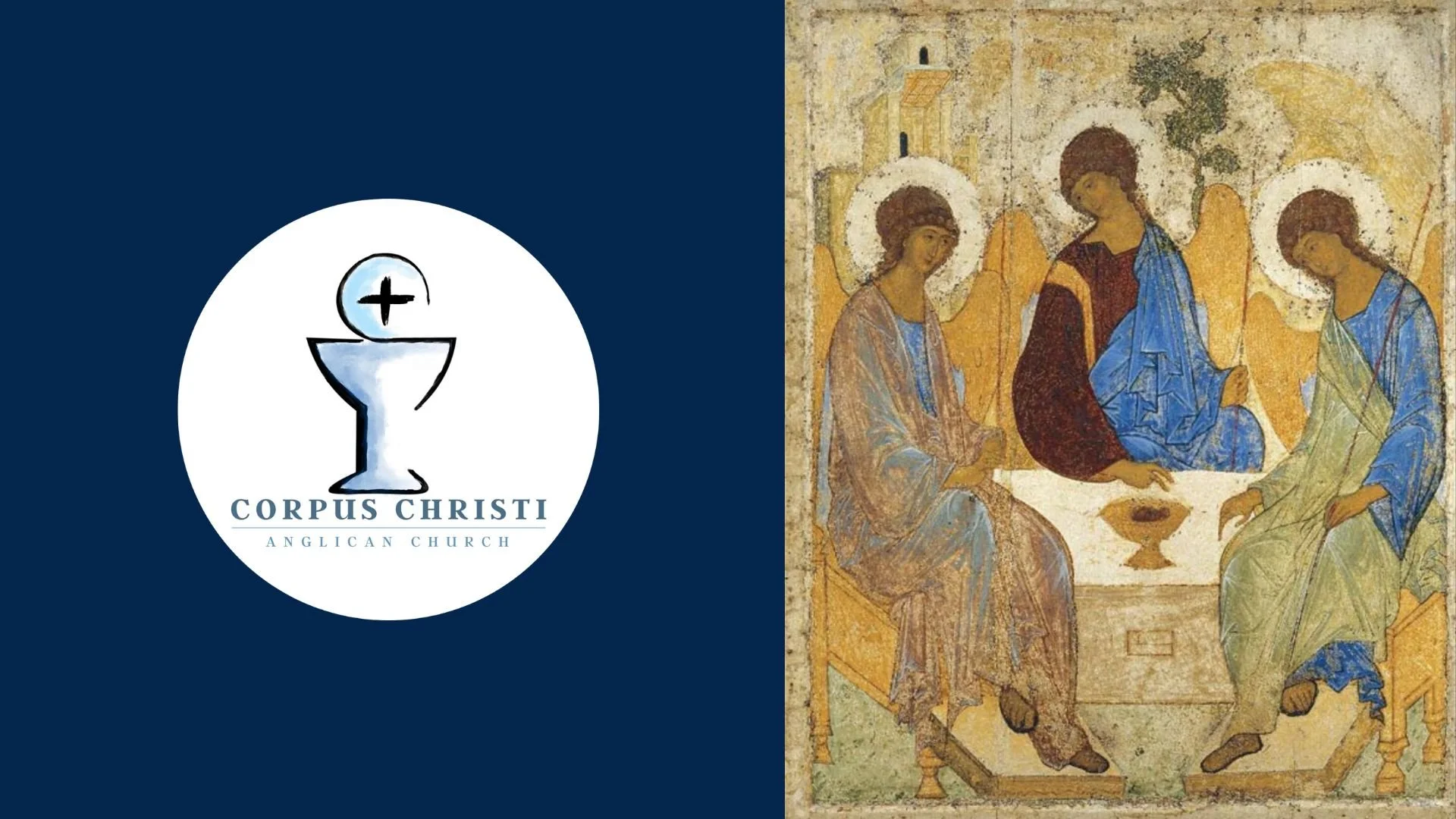
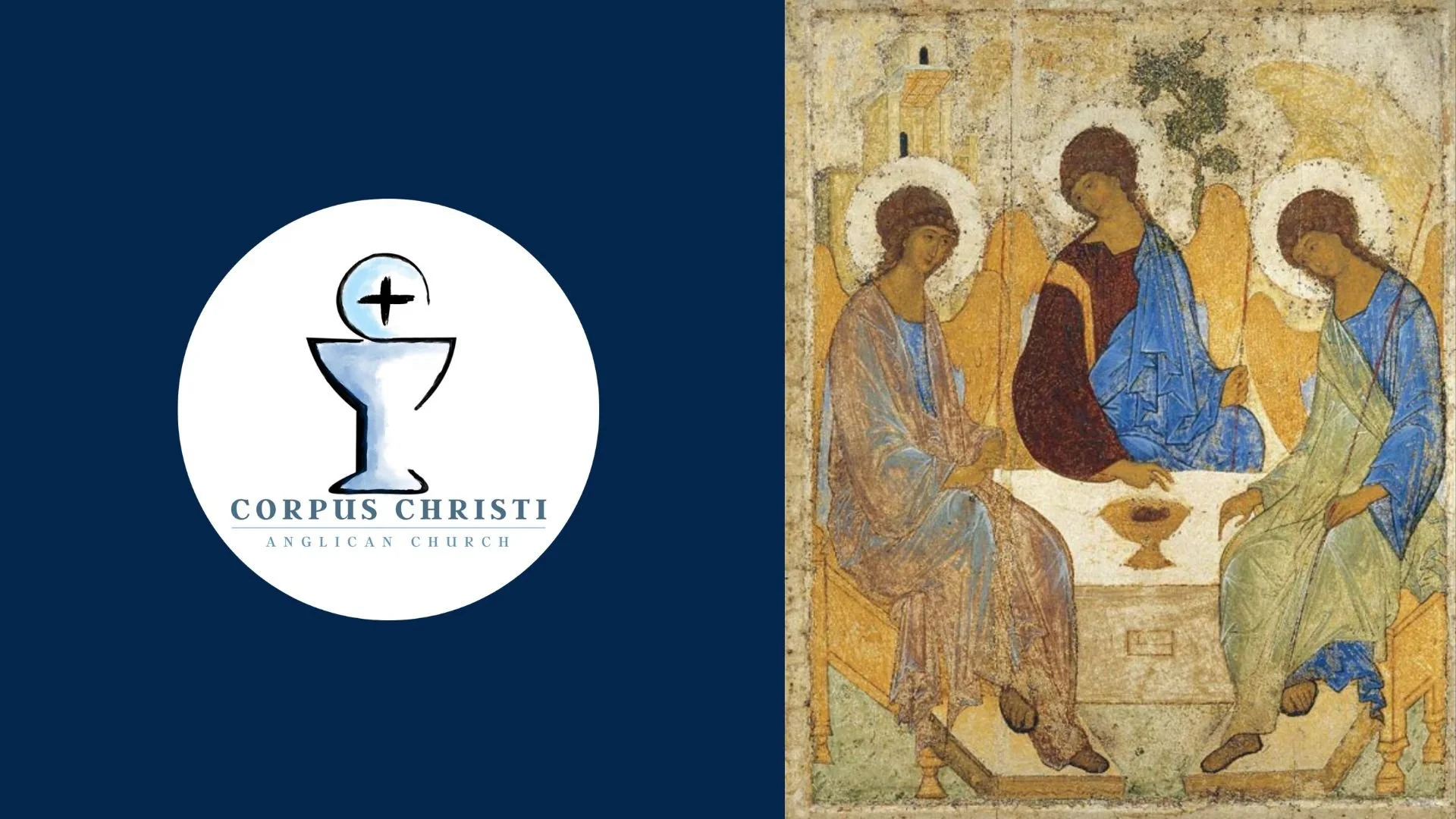
Trinity Sunday: Adore the Inexplicable Trinity
TranscriptioN
“In the name of the Father and of the Son and of the Holy Spirit, let us pray.
Almighty and everlasting God, you have given to us your servant's grace by the confession of a true faith to acknowledge the glory of the eternal Trinity and in the power of your divine majesty to worship the unity. Keep us steadfast in this faith and worship and bring us at last to see you in your one and eternal glory. O Father, who with the Son and the Holy Spirit live and reign one God forever and ever. Amen.” Well, on every Trinity Sunday, we take a courageous foray into trying to explain and understand the Holy Trinity, the inexplainable and the incomprehensible doctrine by which we live. The Trinitarian God is a basic teaching, a creed that is learned and accepted by us as Christians, the foundational way for us to relate to God and his ability to relate fully to us.
The Father is God, the Son is God, the Holy Spirit is God, a monotheistic God, one almighty God who exists in three distinct persons, co-equal, co-eternal, and co-powerful. Each person, 100% God. The Bible tells us that the Father, Son, and the Holy Spirit are distinct persons.
For example, since the Father sent the Son into the world, he cannot be the same person as the Son. In the same way, the Son returned to the Father, and the Father and the Son sent the Holy Spirit into the world. The Holy Spirit is distinct from the Father and the Son.
St. Augustine made seven brief statements in his explanation of the Trinity. The Father is God, the Son is God, the Holy Spirit is God, the Father is not the Son, the Son is not the Holy Spirit, and finally, there is only one God. Now I'm going to take us on a little road that's not exactly part of our Trinity celebration, but I think it helps to demystify something that I always thought of as orthodox as a Christian.
So we'll look at the book of Deuteronomy and the Old Testament, and we hear what is known as the Shema. The Shema is Israel's declaration of God as one God. It is considered the most essential declaration of the Jewish faith.
Hear Israel, the Lord is our God, the Lord is one. Now I think there is a praise song, and you know, hear oh Israel, the Lord our God is one God. Well, the Shema was Israel's declaration that they were a monotheistic people, unlike many of their neighbors who believed in and worshipped many gods.
But here's the thing, they did not want to surrender their unique covenant with God, and Israel often saw itself as representing the side of God that stood against her adversaries. There's a big difference between our creeds and the Shema. The Shema does not define God as a single essence or more than one person present as God.
Now let's look at some other ways we and others have tried to explain the Trinity. You've probably used them. I have.
But they try to explain, but they really can't. You might have heard some comparisons to things to help you understand or explain to someone else. The three distinctive persons who share one substance.
That's the key word there, substance. So have you ever heard about the three slices of pie? Same pie. Okay.
Cherry pie, apple pie, three slices. Okay. The egg, shell, white, and yolk.
Okay, it's one egg. Okay. The apple, skin, flesh, and seeds.
Now three really common ones, and they're pretty popular, I think, as I hear them a lot. The three properties of the same element, H2O, water. Liquid, vapor, and solid, ice.
Water can exist in three different states, but here's the key, not all at the same time. It is either liquid, or it's steam, or it's solid. But God the Father, God the Son, and God the Holy Spirit all coexist in the same essence at the same time.
Okay, get your brain around that. The Father did not cease to exist in heaven, while Jesus the Son was active on earth. Okay, here's one that I thought was pretty good.
The triangle. One form with three distinct sides, and three inside angles. The problem with the triangle is similar, but it's different.
Here are three parts within the one. However, each part is not a full expression of the one. One side of the triangle is just that, one side.
The side is not a full triangle. However, the Bible tells us that God the Father is fully God, not just a part of God. The same is true for the Son and the Spirit.
The 39 articles of religion state there is one but one living and true God, everlasting, without body, parts, or passions. The unity of the Godhead or the Trinity exists of three distinct persons who are equally God, united in their common substance, power, and eternity. All analogies fall short and are insufficient in different ways.
They're mistaken ideas that are trying to explain something that is inexplicable. Analogies of the Trinity are seeking to help us understand the very nature of God. They are all bad analogies because they're materialistic.
They interpret God's being in terms of material that makes up God, but there is no material that makes up God. God is immaterial. There is nothing we can point to that he's made of.
Unfortunately, mistaken analogies can result in mistaken knowledge of God. Since our faith rests on our growing knowledge and love of God, we need to use our limited but faithful understanding of God in the way we communicate the doctrine of the Trinity. I found one commentator this week, he was tongue-in-cheek about it all, but I thought it was good.
I think what's confusing to some pastors is the mistaken notion that teaching the doctrine of the Trinity means explaining how God is three in one. By contrast, the Apostles' Creed and the Nicene Creed, which are the two most important confessions of our faith, that teach the doctrine of the Trinity, never even use the word three. They say nothing about how God is three in one.
Rather, they teach that God is Father, Son, and Holy Spirit all at once. He says, if you want to, you can count to three, but it's hardly essential, and in fact, you'll understand the doctrine better if you forget about counting. Now, having said all that about comparisons, I'd like to share one that I found actually found a little bit helpful.
The Trinity is gravity, a force we can't see or touch, much less explain. We know it's there because we can see its effects. It keeps us on the ground.
It makes objects fall. We can't live without it. Just like gravity, the Trinity is an essential part of our reality.
None of us have gravity. It has us, but without gravity, we would have nothing. Without the Trinity, we would not be able to have a relationship with God.
The fact that the Trinity is in full-time, always-on relationship with itself means that the Trinity is capable of having a relationship with us. The Trinitarian God wants us to know him as fully as we are known. In the end, we dispense with our analogies and numbers and thoughts about having complete understanding of what the Trinity is, and we agree to accept divine majesty that is inexplicable and beyond our human understanding.
Nevertheless, it's the basic doctrine of our belief, based on something we cannot see or understand or explain. One of my favorites for me, and one of the clearest pictures for me of the mystery of the Trinity, is portrayed in Scripture in Genesis 1, 1 to 3, where the three are named. In the beginning, God, the Father, created the heavens and the earth, and the Spirit of God, the Holy Spirit, was hovering over the face of the waters, and God, Jesus, the Word, spoke, let there be light, and there was light.
God is understood in Genesis to have created everything, even before creation. God, as a community of love between Father, Son, and Holy Spirit, but not out of loneliness, out of the eternal, unending circle of love between God, Father, Son, and God, the Holy Spirit. The Trinity is an enigma.
Our human minds just can't fathom this, but whether we understand it, or believe it, or not, it's the Holy Spirit who approaches us even before we understand, or believe. It is the Holy Spirit that opens up our spirit to his spirit, and allows us to believe something beyond our understanding, or even our awareness. This is prevenient grace of God, the grace that, through the Holy Spirit, prepares our hearts to receive God, the Father, and God, the Son.
St. Augustine emphasized that humans are unable to initiate their own salvation, or to respond to God's grace without prior divine action. The wonder of our faith is in the divine initiative of a loving God, our Father in heaven. He is the spiritual wind that we feel and can't see.
He's the wind that opens our spiritual cells to the persons of God, the Father, and God, the Son. It is his initiation that brings with him blessings that are ours, through faith in the Trinity. Blessings, the possibility of eternal salvation, the living water and bread of life in the Eucharist, spiritual growth and insight as we read the Scriptures, the fellowship of believers, God's power at work in us, in our weakness, God's living presence in our lives, making eternity something that begins right now, right here on earth.
Please pray with me. Now to him who is able to keep you from stumbling and resent you blameless before the presence of his Lord with great joy, to the only God, our Savior, through Jesus Christ our Lord, be glory, majesty, demendent, and authority before all time, now and forever. Amen.
Transcribed byTurboScribe.ai. Edited by the Vicar.
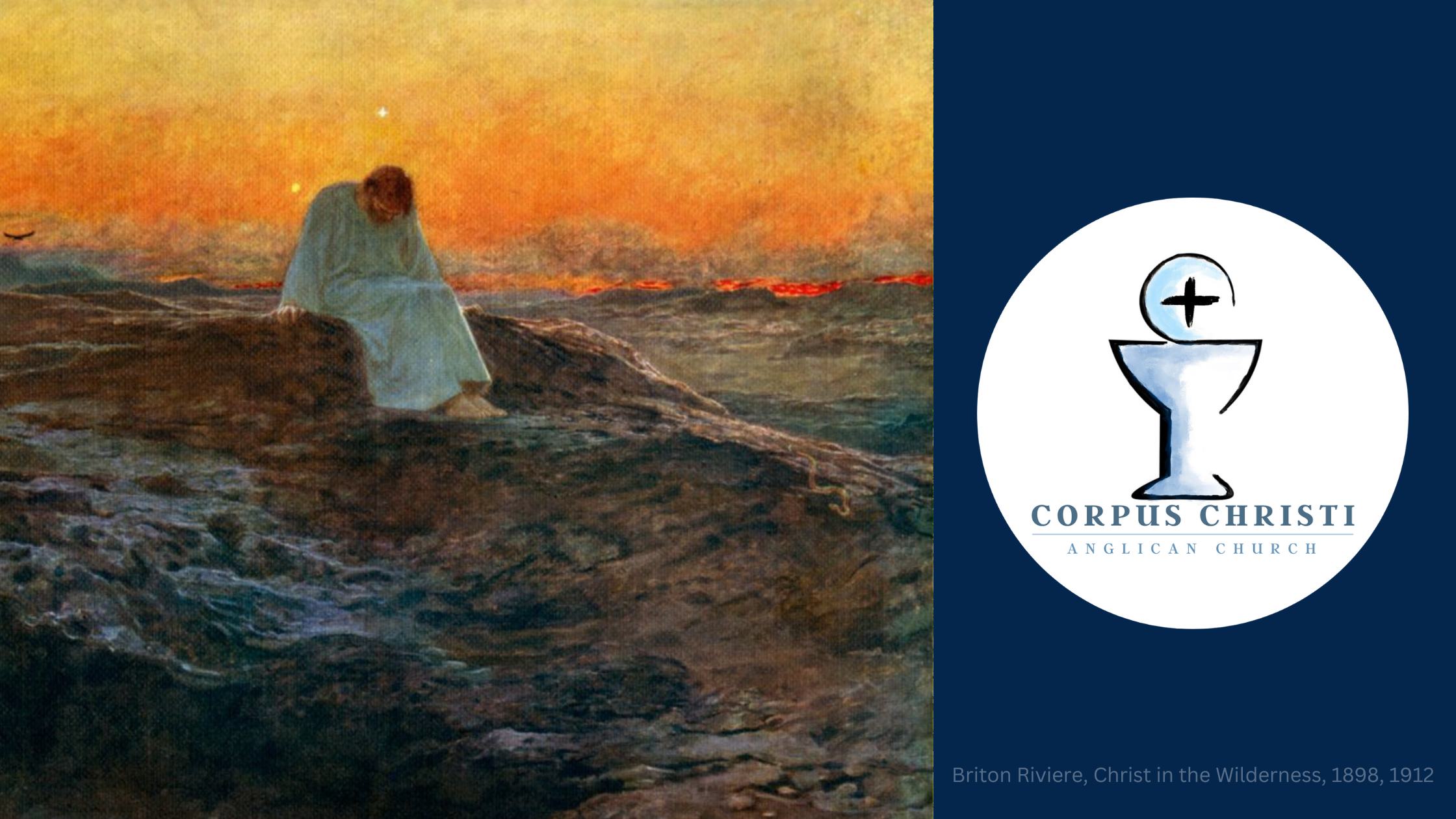
Lent 1: Following Jesus through Trials and Temptations
TranscriptioN
In the name of the Father, of the Son, and of the Holy Spirit, Amen.
Please pray with me. “O God, by whom the meek are guided in judgment and light rises up in darkness for the godly, grant us in all our doubts and uncertainties the grace to ask what you would have us do, that spirit of wisdom may save us from all false choices, that in your light we may see light, and in your straight path we may not stumble. Through Jesus Christ our Lord, Amen.”
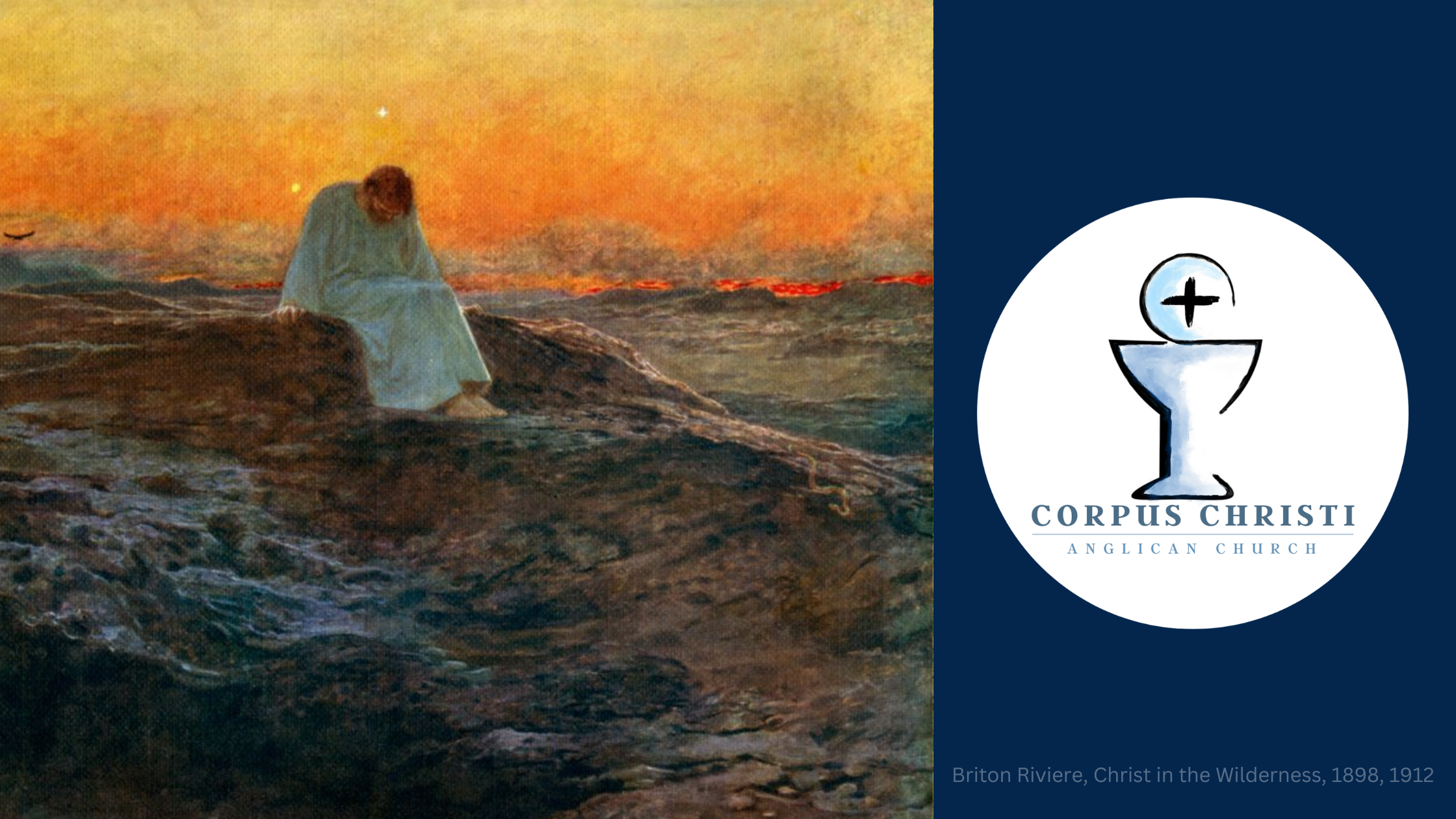
The temptation of Jesus by Satan in the wilderness is a very well-known narrative. Most of us can relate the story, and like a lot of stories in Scripture, it can almost become too familiar with many repetitions. The main point of the narrative of Jesus' temptations is to demonstrate how the Lord, God of all creation, deals with temptation in light of his humanity.
It clearly demonstrates the victory of Jesus Christ over the power and cunning of the enemy, and perfect man who overcomes temptations after 40 days of being alone, tired, weakened, and hungry. What personal meaning is there for us in this Scripture? If Scripture is given to us as a model for a manual, for my K-12, I did that very well, for living godly lives, how does Jesus, who is perfect God and also perfect man, overcoming Satan's temptations? How can that help us? It's actually a question I've asked myself. I'm not God.
I'm not a perfect person. To be honest, I'm not equal to the task, and neither are you. It's too easy for us to fall into temptations. There's so many, and the enemy knows each one very well. As the enemy of our souls, he unfairly waits for us to be alone, tired, weakened, or hungry. He shines his light on those moments of weakness and skillfully pokes at our old familiar habits, patterns that are so easy to fall into, painful past experiences that may have shaped or traumatized us and caused us to relive those painful memories at the worst times, family behaviors that are ingrained, many of which we thought we had addressed and overcome.
But unlike Jesus, we are too easily tempted. We are actually low-hanging fruit for the enemy. Our temptations are for sure. We pray for the mind of Christ in all things, but there are times when unexpected events at home or surprising conflict with family members, especially it seems on Sunday mornings, when we hope to be more heavenly minded, we are the opposite. I don't know about your family situation, but sometimes the worst arguments and sometimes even the worst language have erupted on the way to church. I'm making a confession here.
And there sits the enemy, gloating in triumph, gloating over our failure. While we try to summon God's grace to cover our bad behavior, our out-of-control emotions, and our failed resolve to resist temptation, before we arrive at the church door. No wonder Jesus included temptations in his model prayer for us. As you look at the wilderness temptations of Christ, you may notice that Satan offered him things that were already his, manifested in his father's perfect way and timing. Satan tempted Jesus with those things that have already been given him. First, Jesus was the bread of life, our spiritual food, necessary to our daily spiritual nourishment as we live out our lives in Christ.
Secondly, God's process for salvation was already perfect in Jesus. His father's glory and his authority and power over sin and death had been established by his father. Jesus was blessed by a vision of his father's glory manifested in him at his baptism. Finally, Jesus was already in possession of God's glory and the kingdoms of the world. He was alive in God's purpose and power and he knew there were no earthly shortcuts to God's perfect time and plan. Looking past the 40-day wilderness experience, Jesus experienced his greatest temptation.
Again, as fully man, he was tempted to the limits of his humanity. Tempted to turn away from the purpose of his father's mission, which was to endure severe punishment, beatings, a sense of utter rejection, and the unimaginable pain and shame of the crucifixion. And Luke says it this way, Father, if you are willing, remove this cup from me, yet not my will but yours be done.
In his anguish, he prayed more earnestly and his sweat became like great drops of blood falling down on the ground. We experience so-called mountaintop experiences where the Holy Spirit has covered us with overwhelming joy and reassurance of his love. We at those times experience a taste of God's glory.
In that moment, it seems endless. So frequently, it's followed by a series of personal disappointments, a crisis, a family blow-up. Is there a connection between these two experiences and our sense that maybe we should prepare for a discord to follow these mountaintop experiences? To be so far from that joy of the Lord that we wonder if we really experienced it.
Hebrews reminds us to keep our eyes on the joy before us and continually remind yourself of what is at stake. Think about your family, your calling, and Jesus who gave up everything for you. Have you experienced an unmistakable and exhilarating call of God, followed by an extended time in the wilderness? Understand that the waiting and the prolonged delay are part of the fulfillment of God's call.
This is a hard one, especially if the call is clear, but the plan, according to Christian lecturer Oswald Chambers, is haphazard. Sadly, the purpose of God has for us will most likely require a time of extended patience. God needs to know that we trust him and his plan and process without the temptation to figure it out on our own what it is or what we need to do to help God.
God, make it happen. Wilderness seasons her heart and unless we know what is at stake, we may be tempted to give up. Oswald Chambers, again in the book of his lectures, my utmost for his highest, told his students one of the greatest strains in life is the strain of waiting for God and with it the temptation to rush ahead of God's timing and his plan.
So how can we overcome the temptation before us and stand firm with our eyes fixed on Jesus? Another place to look is to recall Satan's approach in the garden. His soothing voice asked a question, created doubt in our first parents, and if I were to do this the way I want to, I would hiss on every single S word because he was a snake and I believe that he said things like, did God really mean that in this beautiful lush garden created especially for you to enjoy? He has told you not to eat the fruit of this tree. Doesn't he want to let you make your own decisions about your own lives? This is original sin.
How many times are we tempted to take control of our lives as if we have better answers than God? I've heard statements like this. I seriously doubt that God understands quantum physics, the complexities of genetics, and the depths of the human genome, the Ryman hypothesis, the Goldbach conjecture, and the Hodge conjecture, which are some of the hardest math problems in the world. On the wall of one of the restrooms at MIT was another different kind of statement and it was this, and God said, followed by a complex mathematical problem, and there was light.
The devil's wilderness temptation of Jesus began with the word if, also tempting to sow seeds of doubt, but unlike Adam and Eve, Satan was trying to negotiate with the one who created all that was created, including quantum physics and the most complex mathematical problems. Over 20 years after the original publication of the human genome, the number of protein coding genes is stabilizing around 19,500. Even with a complete gene annotation of a finished genome, we will have only one example of the human gene catalog, and that will not apply to all humans.
It's endless. I call it inner space. We can't count stars.
Jesus can also count all of the genes in the genome. If you are the Son of God, if you then worship me, if you are the Son of God, as if being human, weary, lonely, weakened, and hungry, Jesus would be easily fooled. No, he endured so that we could know him in the wildernesses of our lives.
We are not God, and to be certain, we know it. Jesus places us in situations where we do not have a clue, so that his power and his authority take over. I imagine him saying to me, honey, just sit down and let me be God in your life, and when you're tempted to mess things up.
So I find it to be a law that when I want to do what is good, evil lies close at hand. For I delight in the law of God in my inmost self, but I see in my members another law at war with the law of my mind, making me captive to the law of sin that dwells in my members. Wretched man that I am, who will rescue me from this body of death, thanks be to God, through Jesus Christ, our Lord.
Let us pray. Gracious and holy Father, please give us intellect to understand you, reason to discern you, diligence to seek you, wisdom to find you, a spirit to know you, a heart to meditate upon you, ears to hear you, eyes to see you, a tongue that proclaims you, a way of life pleasing to you, patience to wait for you, and perseverance to look for you. Grant us your holy presence and life everlasting. Amen.
Transcribed by TurboScribe.ai. Go Unlimited to remove this message.




Sunday after the Ascension: Jesus is Reigning Over All
Most of the sermon was written by the Rev. Susan Rockwell, but was delivered by Fr. Morgan Reed with her permission.
Most of the sermon was written by the Rev. Susan Rockwell, but was delivered by Fr. Morgan Reed with her permission.