
SERMONS
Archive
- October 2026
- September 2026
- August 2026
- July 2026
- June 2026
- May 2026
- April 2026
- March 2026
- February 2026
- January 2026
- December 2025
- November 2025
- October 2025
- September 2025
- August 2025
- July 2025
- June 2025
- May 2025
- April 2025
- March 2025
- February 2025
- January 2025
- December 2024
- November 2024
- October 2024
- September 2024
- August 2024
- July 2024
- June 2024
- May 2024
- April 2024
- March 2024
- February 2024
- January 2024
- December 2023
- November 2023
- October 2023
- September 2023
- August 2023
- July 2023
- June 2023
- May 2023
- April 2023
- March 2023
- February 2023
- January 2023
- December 2022
- November 2022
- October 2022
- September 2022
- August 2022
- July 2022
- June 2022
- May 2022
- April 2022
- March 2022
- February 2022
- January 2022
- December 2021
- November 2021
- October 2021
- September 2021
- August 2021
- July 2021
- June 2021
- May 2021
- April 2021
- March 2021
- February 2021
- January 2021
- December 2020
- November 2020
- October 2020
- September 2020
- August 2020
Lent 5 (Passion Sunday): The Veiled Glory in the Way of the Cross
TranscriptioN
Well, good morning again everybody. It is good to see you this morning. I am delighted to be with you on this fifth Sunday of Lent. As I mentioned before, this is Passion Tide, and during our weekly emails that come out on Wednesdays, if you don't get those, let me know and I'll make sure you get them.
I tried to put a little article on what is Passion Tide, these two weeks of which one is Holy Week, this short two-week season where we shroud the crosses and the icons and it focuses our gaze on the road to Jesus's crucifixion and the glory that will later be revealed but right now is veiled. In our Gospel passage today, we encounter leaders who have forgotten that they had a delegated authority. These are the chief priests and the scribes.
They wanted to hold on to control for themselves of speaking for God through an authority that they thought belonged to them, and it's an easy trap to fall into because power is intoxicating and the idea that Jesus might just be the Messiah threatens to undo the thing they're trying to hold on to. Our passages today encourage us that God's marvelous works of redemption would be done through humility and through the power of what's going to happen on the cross. And so we involve ourselves in the work of Jesus's ministry, this kingdom that is here and to come, when we bear fruits of repentance and when we invite other people to come and taste and see the goodness of the Lord along with us.
And as we look at our passages this morning, let me pray for us. “In the name of God, the Father, the Son, and the Holy Spirit. Amen. Lord, may the words of my mouth and the meditation of my heart be always acceptable in your sight, O Lord, my rock and my Redeemer. Amen.”
The Parable
So today's parable from Jesus, we find him teaching in the temple courts, and his authority had been questioned by the religious leaders, the chief priests and the scribes, and Jesus is now teaching them through a parable about a vineyard.
A man planted a vineyard, who represents God in the story, and the vineyard itself represents the state of blessing and peace and rest for the people of God. And in this vineyard that the man plants, the vineyard is going to bear fruits. The vineyard owner has tenant farmers that he lets tend the vineyard and cultivate the fruit, do the hiring and firing, etc.
There's a delegated authority to steward the vineyard, and he sends a servant to go collect the produce from the tenants, and then they send him off empty-handed. The tenants of the vineyard have a delegated authority to collect the produce, but it actually belongs to the owner of the vineyard. So the tenants beat this servant, and then they send them back empty-handed.
The owner then sends a second servant to go and collect the produce. They beat, and then it adds, and they insult the second servant, so it's a little bit of the same but more, and they send this second servant back empty-handed. A third servant comes, and he's sent by the vineyard owner, and it's worse.
He's cast out, and he's harmed violently. The word where it says wounded in our translation is the word we get trauma in English. It's a Greek word trauma.
It's wounding, and so you can think of this person having been left wounded and traumatized from the experience of going to collect the fruit for the vineyard owner. The idea here is that God, as we heard really well read by Janet in the book of Isaiah, God has been forming a people for his glory and praise, right? They've gone into subjugation over and over again, and God has freed them and liberated them over and over again, but what he's doing ultimately is forming a people for his praise and his glory to live under his kingship, and so God has continually over and over again sent his messengers, the prophets, to once again call them back to covenant renewal and faithfulness, but those who have this delegated authority, the religious leaders, come from a long line of leaders in history who are under the delusion that they held on to control for themselves and that they spoke for God, despite the fact that their hearts were actually quite far from him, and then they turned the people's hearts away, and the result is that the owner of the vineyard did not receive the fruit of the vineyard. So finally, in this parable that Jesus tells, the owner sends his son.
There's no greater authority than if the father were to actually go himself. Certainly they're going to respect my son, and so the vineyard tenants come up with this absurd plan that, you know, if we kill the son, maybe we can inherit the vineyard. That's ridiculous, right? That makes no logical sense.
That's what you're supposed to feel when you hear Jesus tell this parable. That's illogical, it's nonsensical, and that's the point. So these people, these people with a delegated authority, the tenants, tenant farmers, they have no real authority over the vineyard.
Even if they were to kill that son, it's not like they would have authority over it, and they don't have any right to the fruit that comes from it. So at the time, Jesus speaks this parable in the temple, and the specifics at this point are veiled. They're unclear.
People don't know that he is going to go to a Roman cross to die yet. The story hasn't unfolded, and so this is a good, helpful parable for this Passion Sunday, where we have the crosses and the icons veiled, because we've got glimpses of the story, but we don't have the fullness of what's going to happen yet. The plan of God is veiled, and it's going to be made clear.
So the tenants in this parable, they take the son, they take him outside the vineyard, and they kill him. And in response, the vineyard owner is going to come, and he's going to destroy the tenant farmers, and he's going to give that vineyard to other people. And so Jesus asks the scribes and the Pharisees, what do you think of such a parable? How does that strike you? And they use this phrase that you find in Paul, may it never be! Right? And so it was sort of obfuscated in the ESV a little bit, but the idea is like, may it not be so! We don't want this to be the case.
And so Jesus then, he says, okay, well what do you think about this psalm? What does it mean? Psalm 118. How would you interpret it? Psalm 118 addresses a nation that's been rejected. It addresses a king that's been rejected before the nations, but the psalm reassures the people that the rejected people are going to have an exalted position before God, that the rejected King will have an exalted position before God.
And Psalm 118 comes to its fullest expression in the person and work of Jesus. And that's why as St. Luke is writing the gospel in the book of Acts, Psalm 118 is actually peppered throughout Luke's gospel at really key points, because he's interpreting it through the lens of Jesus's ministry. And so the imagery now moves from the vineyard in the parable to a construction yard in Psalm 118.
Building yards, builders yards, were where people would find the stones they needed to make their buildings. And once the project is near completion, the image here is of finding the stone that would finish off the building, the cornerstone, that it would, it was perfect to finish this off. But the idea here is that this stone that was perfectly ready to cap off the building had been rejected by the builders in Psalm 118.
So the workers, which here symbolized the scribes and the Jewish leaders, they might cast off Jesus as unimportant now, but he is going to come to be honored and vindicated as the Lord's Messiah. There is a timeline to the end of their delegated authority, because his needs to take over. And that's what Psalm 118 is talking about.
And I think what's neat is I was reading several of the church fathers about this passage. They often connect this with Daniel chapter 2. And in Daniel chapter 2, if you'll remember, there is a rock cut out of a mountain. And this rock is going to destroy the clay feet of the statue, which represents the kingdoms of the world.
And then it says in Daniel 2, the stone that struck the statue became a great mountain and filled the whole earth. And so they're bringing together this beautiful imagery of the stone, the cornerstone of Psalm 118, and the rock out of the mountain in Daniel chapter 2. And that connection works together to talk about, then, the rejection of Israel's leaders, because Jesus himself is going to be the true authority. He is King. He is Lord. Their authority is delegated. It is not theirs.
And they find themselves in a long line of authorities who misappropriate delegated authority as though it's their own. But his rule and reign as king is going to fill the whole earth. His rule and reign of new creation.
And so how do we join the work of the vineyard and cultivate fruits from this vineyard? There's three things I want to think about with us this morning.
Avoiding False Securities
We involve ourselves in the work of tending to the vineyard and offering the fruits to God by avoiding false securities. The chief priests and the scribes, they understand the implication of the And as a result, at the end, it says they want to lay hands on him, but they fear the crowds.
They're afraid of the people. And it's a good reminder for all of us, whether one holds public office or ecclesiastical office, that all authority in heaven and on earth is the Lord's and it is not ours. Whatever authority or responsibility we have, it is a delegated authority.
We're just stewards who are tenant farmers in the vineyard of God. And so if you're a parent, it's also a good reminder as a parent that your children belong to the Lord. Ultimately, they don't belong to us, which is really hard, right? And if you're an employer, your employees don't belong to you.
These people belong to the Lord, not even to our company. If you hold public office or ecclesiastical office, your responsibility is to uphold the welfare of people, not to hold on to power by coercing constituents or gaining favor amongst your side. All authority in heaven and on earth belongs to the Lord.
But the taste of it can be so intoxicating. And so it's a good reminder that power in and of itself can be used for good, as long as we understand that we have a delegated authority. But power can turn into evil when it outpaces our character and we don't live a life of virtue and understand that our end is to the glory and praise of God.
And that is the kind of power that will corrupt us and those around us. And so the religious leaders of Jesus's day, they had forgotten that. It's easy to forget how our responsibilities and our stations, our callings, the platforms that we have, are our stewardships.
They're platforms for the work of God, the miracles of God that he does in the human heart. And they're not marks of status in the kingdom. That's really important.
Cultivating in the way of Jesus
So Jesus is calling us to offer the fruit of the vineyard to the Lord, that all things belong to him. And this is done by cultivating the work in the same way that Jesus does. Joining the work of Jesus is a work of sowing with tears.
We read one of my favorite psalms today, Psalm 126. This is a pilgrim psalm where there's a leader leading up a group of pilgrims to Jerusalem. And the theme of God making streams in the desert is something that came up both in the psalm and in the Old Testament reading, if you were listening.
It's a common theme. This renewal that people anticipate is God making streams in the desert. It's an analogy for the hope that people have that God will give them new life.
And so the psalmist prays that those who would sow in tears would reap with shouts of joy. That those who go about weeping and bearing seed for sowing would come again with joy, shouldering their sheaves. And so similarly we read in St. Paul in chapter 3 of Philippians that he wants to know Christ and the power of his resurrection, but notice it's not empty triumphalism.
He says, and I want to know the sharing of his sufferings being made like him in his death. So the means of the power of the kingdom and the authority of the kingdom is the work of it is done through the means of the way that Jesus cultivated the work of the kingdom, which is to know the resurrection through the sufferings that led to the cross. So the hard work of weeping over the ways that we in our world is broken will return a harvest of beautiful praise to the Lord.
Because God's at work in us. Like it's easy to take the easy road and manipulate people for our own ends, to not care about them, to be unreflective, to be dismissive or callous to the needs of other people, or disadvantage other people to our own benefit. That would be the easy road.
It's easier to do those things than to recognize the places where we've been wounded, where we might have wounded others, to do the hard work of giving language to those things, teasing out those implications, and tearfully asking God for his grace, and to die to those places that are unbecoming of his life and glory. The ways that we've tried to hold on to control in our delegated authority as though it were ours to hold on to. We're really good at trying to curate our own narratives and control our image to other people.
And so Passion Sunday invites you to be undone before others. It invites the church to be undone with one another. If you feel like you're a mess, you're in the right place with the right people.
Thanks be to God. And so Passion Sunday invites us to the tearful cultivation of the heart in repentance, to let God have his authority and not take it on ourselves, to walk the way of the cross with Jesus, even though the glory might be veiled so thickly right now that we just can't see it. And we're involved in this marvelous work of God of redemption, and we involve ourselves in it when we bear fruits that are in keeping with repentance, when we invite other people to come and taste and see the Lord's goodness with us.
Bearing fruit through command and promise
So third, bearing fruit through love and desire, God would eventually rip away the authority from the tenant farmers to cultivate that vineyard, and then he would give that delegated authority to others, which has in it, in this parable, a veiled reference to the new covenant and the inclusion of unexpected people, tax collectors, sinners, Samaritans, and even as far as the Gentiles, right? This has in it this veiled expectation that God will give the vineyard to others. And one church father said about this vineyard being given to the apostles after the Jewish leaders, he says, they are sowing the seeds of piety to Christ in the hearts of believers and making the nations entrusted to their care into beautiful vineyards in the sight of God. That is the apostolic work, and it's the same one that we're called into as well.
And so what seemed like a catastrophic tragedy on the hill of Golgotha at the cross and the rejection of the Messiah was actually in the plan of God the means by which cosmic renewal would begin. There's the thing that brings the kingdom. And so there are so many subtle distractions that are seeking our attention, and lies, and the disorder, the things that we love, and the things that we desire.
If you think about the chief priests and the scribes, there were a thousand subtle shifts and decisions that these leaders made to make authority their ultimate goal. They didn't get into leadership to hold on to inappropriate authority. There were a thousand subtle shifts and decisions that brought them to that point.
And so on this fifth Sunday of Lent, we remember that it's God who brings into order the unruly wills and affections of sinners. Because we find ourselves in that place often where we've made lots of decisions and choices and things have happened to us that make our affections and desires feel unwieldy and unruly, and we trust in this God who brings them back into order. And so we need God's help to do what the poet prays for, which is to love what he commands, and to actually desire what he promises.
God commands a life that is committed to his lordship and kingship, his rule and reign, to love him and our neighbor, and ultimately to be formed for his praise, as we read in the Old Testament today. And he promises new creation. That's his promise to us, and it is an alternative amongst many false alternatives that are before us that may look attractive, but he offers us new creation in his kingdom.
But we need his help to ask for the desire for what he promises. And this passage is a great reminder to ask God for help, to love the things that he commands when that's really hard to do in the minute everyday moments of the things that we walk through, and to desire what he promises when we just can't see it because we're crowded out by all the things that are in front of us, and all the things that we're hoping for which may be slightly under the standard of the kingdom of God. And it's a good reminder that this delegated authority involves not just the glory of the resurrection, but also sharing in the sufferings and the humility of Jesus.
Conclusion
So the path of the kingdom is paved with the tears of cross-bearing saints that go before us. The glory might be veiled right now, but we're called to cultivate a field of repentance, to hand God a harvest of praise. So there's hope today as well, because he's the one who makes streams in the desert. He makes a way in the wilderness. This is the God that we serve. And he's the one who gives us this vineyard.
He's done all that he needs to to prepare the soil, to tend it, and we are these tenant farmers on the land who give him what is rightfully his amongst our households, our labors, our stations and offices, our children, the relationships he's put as our stewardship, so that by the end of it all, in him, our hearts are fixed where true joys are to be found. Let me pray for us. Almighty God, you alone can bring into order the unruly wills and affections of sinners.
Grant your people grace to love what you command and to desire what you promise, that among the swift and varied changes of this world, our hearts may surely there be fixed where true joys are to be found. Through Jesus Christ our Lord, who lives and reigns with you and the Holy Spirit, one God, now and forever.
Transcribed by TurboScribe.ai. Edited by the Author

Lent 4: The Parable of the Compassionate Father

TranscriptioN
Well, good morning again, everybody. It is good to see you this morning. I'm Father Morgan Reed, the vicar here at Corpus Christi Anglican Church, and you've come on one of the two rose-colored Sundays this morning. This is Laetera Sunday, which is kind of like Gaudete Sunday during Advent.
The word Laetera is a command, meaning to rejoice, and we wear a rose to signal that this season of Lent is coming close to its end. So next week will be Passion Sunday. We'll have the crosses and the icons veiled, and then we'll enter into Holy Week.
So we are nearing the end of Lent. And today's gospel passage is beautiful. In some ways it's been an undercurrent of all of the weeks of Lent. I haven't made it explicit, but the compassion of God is the foundation of repentance. And so today it is explicit in our passage. It is often called the parable of the prodigal son, and so today some have argued that actually it should be the parable of the running father, and I like that.
We have two pictures of two brothers here, a younger brother and an older brother, two different kinds of pictures of rebellion, and the father here is pictured as being this compassionate father who addresses them both in their unique ways. And so this passage is an encouragement to people who feel like they're not worthy of God's love. It's an encouragement to those who are listening who would have been tax collectors and known that they were considered sinners by the religious elite.
It's an encouragement for you and for me, because we often find ourselves in the place of the child who's run far. And so it also offers a challenge to the self-righteous, the older brother, and to those who are sitting and feeling satisfied in their own sense of righteousness and worth before God. And most important though, no matter where you are in that spectrum this morning, it offers us a glimpse into the compassionate character of the God who loves us.
That's the most important thing to take away from this parable. Our New Testament passage this morning that we read from St. Paul talks about us being ambassadors of reconciliation, where we're the ones who are showing the world what it means to be reconciled to God and those who are inviting others into the same. And so this parable is actually left intentionally open, but if we could fill it in, we would be the ones who are reconciled and who are inviting people to the party, so to speak.
And whether we're running, whether we're self-righteous, the Father is inviting us into new life. And this invitation, and his invitation into his compassion, is what we are called to invite other people into. So I want to just look at the parable this morning.
The First Son
The first son, the younger son, I want to look at and the father's reaction to him. Jesus is opening this parable with this son who is asking his father to share his share of the inheritance right now, which is equivalent to wishing that his dad was dead, right? Because normally you don't get the inheritance until your parent dies, and so it's insulting. He's asking his dad to sever his relationship with him, to take ownership of property, which he's going to then liquidate for cash and go off somewhere and spend that cash.
So he would rather have cash and the inheritance now than a relationship with his dad, his brother, and the rest of his family. The son takes the land and the property, and he does exactly that. He sells it off for cash, he takes that cash, he goes off into a far country with cash in hand, severed from his relationship with his family, and he wanders off and he spends everything on carnal pleasures.
And then a famine comes, and so he's left without food, without money, without any connections, and he looks to a local pig farmer, which if you're Jewish, this would make you unclean. And so he's at his lowest point, but not quite his lowest point, because now he's envious of pigs. He's saying, if I could just eat what they're eating, I'd be okay.
But he's not even allowed to eat what they're eating. So now he's hit rock bottom. He sees how low he's fallen, and it says that he came to himself, and he remembers that his father's day laborers have it better than he does at this moment, so he's not asking to be a son again.
He decides, I'm gonna go to return to my father and repent, and maybe he'll just hire me as a day laborer. All he's carrying with him is his own awareness and sense that he needs help. Without knowing the type of response that he's going to encounter, he goes back to his father, because anything is better than where he's at at the moment.
And Jesus says, while he was still far off, his father saw him, and his father was filled with compassion. He ran, and he put his arms around him, and he kissed him. So think about this. When the father sees his son far off in the distance, he knows there's been a change of heart. The father runs after him, which is a very potentially embarrassing posture. It's not something becoming of a father.
Lots of commentators point out that it's a little bit embarrassing to show this man sort of girding up his loins and running after his son. It's a boyish behavior that his dad is doing, but his dad, his compassion compels him to run. And so he meets him, and he embraces him, and he kisses him before the son even says a word to him.
If we think about what he should have done in their culture, the father should have cut him off. He should have rebuked the son, but that's not the character of the father that is in this story. And so what strikes me is that the father's compassion in this story comes to the son before the son even says a word.
Like the son has his confession all prepared, but the compassion of the father meets the son before the son even gets a word out. And it shows us something about the character of God, that God sees the deep intention of the heart, and often his compassion meets us before the words of confession even exit our lips. And that's amazing.
And so this is meant to be an encouragement for those who are listening, like the tax collectors, those who think, gosh, you know what, I've missed the boat. Like I am not worthy of God's love. I'm not worthy of being a part of this community.
Everyone hates me. Like this is for them. God sees the intention of their heart before any confession leaves their lips. And if you think of these individuals, they have a whole lifetime of dysfunction, trauma, bad decisions, false narratives that they've held on to, misplaced trust in unsafe people and relationships, other parts of their lives that form complex stories that make them what they are now, which other people would describe them and give them the label tax collector and sinner. But these are images of God, made in, you know, people made in God's image. But they're starting to believe these stories for themselves.
And it's easy to see them as they hear the story from Jesus, how they would identify themselves with this son who squandered all of his wealth. And maybe they're wondering things like, what do I have to say to get God to love me again? What do I need to do or say to be accepted amongst my family again? What do I need to do or give up to earn God's love because I've squandered it? How do I get rid of this nagging sense of guilt in my heart? And the answer from this story is to just do the simple task of turning towards God with nothing but your own awareness that you're in need of his help. That's the very first thing.
And then what happens is God comes to meet you with his compassion, to fall on you and embrace you and kiss you before the lips ever utter a confession. And his kiss and his embrace come and meet you before a word comes out. And so this is such a hopeful passage.
And you can see why this is something that people often cling to. It is good news. We should turn from false hopes and narratives that are unhelpful, dysfunctions that are part of our story, the multitudes of poor decisions we may have made, the sinful dispositions, the longing for autonomy from God.
We should turn and look to God. Repent. That's what turn means. We should repent of those things. Turn towards God with just the recognition that we need his help. And then he comes to meet us with his compassion.
It's like one of the call acts say in the prayer book, God is always more ready to hear than we are to pray. It's one of my favorite sentences. God is more ready to hear than we are to pray.
He is more ready to lavish his compassion on you than you are to turn. So it doesn't take much. Praise God.
The Second Son
And so we've seen the younger son, we've seen the father's compassion, and now let's look at the older son because he's also a very important character in this story. The father has been overjoyed at the younger son's return. It's a taste of the resurrection.
Kind of reminds me of like why we're wearing rose today. It's a little taste of resurrection before we get to Easter in a few weeks. And this son of mine, he says, was dead and now he is alive. And now we're introduced to the older son. The father had begun this celebration of the son he returned. They're having a party.
There's music. There's dancing. They've killed the fatted calf, which is now part of the English vernacular, right? This is a very exciting time.
And the older brother is out working in the field. Nothing wrong with that. It's just what he's been doing every day since his brother left.
And he hears this music and he hears this dancing and he's wondering what's going on and he hears that his brother has come home and now his father is throwing a party to celebrate his brother, who is really not his brother in his heart anymore. Now imagine the older brother's internal dialogue with me for a second. Again, this is from the Gospel of Morgan. It's totally apocryphal, but in my mind's eye, this is where his heart is, right? What do you mean that he came home? He should know better than to come back. He should stay where he was. He sold off the family's property.
He rejected us. He rejected me as his brother. Who does he think he is to come back after doing all of that? Why would my dad throw him a party? He's not worthy of a party.
He's never thrown me a party. I'm here day in and day out. I'm working hard to support this family and I'm not going to support any of this. It's not fair. I've worked way too hard. I've sacrificed too much.
And the pain of my so-called brother is just too much for me to come inside. And so notice that the father meets the older brother and he says, why don't you come in? He is beckoning the older son to come in and to celebrate. And it says in verse 28 that the father comes out and he pleads with his older son to come in.
He pleads with him. He's begging him, please come in and rejoice with what is happening. The father has compassion to meet both of his sons where they're at in their different places, their unique places.
I was reading a commentary on this passage and it had reminded me of a story of something in my own story that reminded me of this parable. I was working at a church serving and we had a cleanup day at a local stream and we had gotten our boots on. We got our trash bags and our gloves and we were walking through this stream along the hills.
It was pretty muddy and I was just looking for trash. Like I was going up and down these hills, going across the water, looking for little pieces of trash that I could put in this trash bag. And I was looking for garbage step after step.
My eyes were down. I was focused. I was going to clean this stream and then when we were done, I threw away the trash bags and then I stepped down and I watched as kids were enjoying the stream.
They were throwing rocks in it and I couldn't be helped but just be stunned at how beautiful the scenery was. I had missed it as I was looking for trash. I was sitting there going, wow, thank you Lord.
Like I got to be a part of the beauty of this place that kids get to enjoy. But I totally missed the creek's beauty for the sake of the garbage that I was focused on. And that's a bit of what's happening here.
The older brother is missing the greater picture of the compassion of the father because his fixation is on the brother's sins, his rejection, his own pain, and his own shame. And so if his father can have this kind of compassion on the younger brother, the good news is that the father can have this kind of compassion on the older brother as well. And that's the larger picture that he's missing.
Sometimes God does grant to some people more material success than their character can handle. And as a result of that, we find people joining the prodigal son. That success leads to walking away from God because that person forgets their need from him.
They come under the illusion and delusion that I can do this myself. Look, I've done all this stuff and I'm doing it well. God must be blessing it.
And I think of people who have really public platforms, who are way too young, or their character is just not ready for the responsibility of it. Like the money, the success, the fame, they often turn out to be their downfall in the end. Hitting the lowest point is often what draws people to repentance, to turning.
It doesn't have to be. Thanks be to God when it's not, but it often is hitting that lowest point. And so the joy of repentance is found here in the Father's words.
We had to celebrate. It was a compulsion that we couldn't not celebrate. We had to do it because this brother of yours was dead and now he has come back to life.
He was lost and now he is found. There is a joy in the kingdom over this little resurrection. And there's a parable about the kingdom of God.
It's an invitation to those who know their their sense of need and who are drawing near to Jesus. It is good news for those of us who know that we have need and long for the compassion of God. For those who struggle with envy like the older brother, who sit in self-righteousness judging others with a sense of superiority, this is also an invitation to the gospel to come to the table and to rejoice with God's new work of creation in those that we have deemed so unworthy.
And so this story, if you'll notice, it's intentionally left open. And it's done so for you and I to imagine who we are in this story. Are we the younger son? Are we the older son? Are we something else? It's left open for us.
All of us have reasons for why it's difficult to repent, to turn towards God, why it's hard for us to express our need to accept the compassion of God. But this story compels us to look to the Father and to discover his compassionate embrace over and over again. And if somebody else's actions have resulted in resentment and shame, the kind that has distanced us from God, part of our healing is to long for the repentance of those people that we can't imagine God would love.
And for God's compassion to do a work of new creation in them. I think another part of healing is to join the banquet by taking part in the community life of the church. The Eucharist reminds us of this every week, where we sit together, we stand together, we sing together in this gallery of portraits of prodigal children.
And as you see the image of God restored in one another, you see a little bit of a taste of the resurrection in the lives of those that you're sitting next to. You have all been dead and you have been raised to life, and you get to see this weekend and week out, maybe more than weekend and week out, if you take the opportunity to get to know each other over coffee or a meal. This is the opportunity to build that muscle memory of rejoicing over the work of God's compassion in other people, so that you can see what God can do in your own heart and life.
And so we need to long for the Father's joy in finding the dead come to life. And on this Laetare Sunday, let's rejoice in the compassion of God that's found in Jesus Christ, who came to bring the dead back to life. As our New Testament passage reminded us this morning, in Christ the old things have passed away and all things have become new.
And so you and I are ambassadors of the kingdom of God, ambassadors of Christ, and we've been entrusted with this good news of reconciliation, like the prodigal son, like the older son, who, you know, if the story had ended the way I wanted to, he said, okay, I'm going to see what you can do in this prodigal son of yours. In Jesus forgiveness of sins is possible, and new creation is the reality, and reconciliation with God that we all enter into through the death and the resurrection of Jesus. And so in Christ our wounds are redeemed, and we're restored to life.
And so are we the older brother today, or are we the younger brother? Part of this Lent, what we need to do is take some time to ponder what God's compassion might look like in our own repentance, and why we find it so hard to turn to God and to accept his compassionate embrace. That helps us avoid the besetting sins of the younger brother, but also ask to discover God's compassion, and what it might look like for those who we wish weren't actually part of our life and our story. And that's really hard, and it's also the beginning of healing, and it keeps us from the besetting sin of pride that's found in the older brother, and envy.
And with whichever brother you identify with this morning, remember ultimately that this is a parable about the Father and his compassion, that God longs to come and meet you with a compassionate embrace before the words of confession ever exit your lips. Let me pray for us. O Lord our God, accept the fervent prayers of your people.
In the multitude of your mercies, look with compassion upon us and all who turn to you for help, because you are gracious, O lover of souls. And to you we give glory, Father, Son, and Holy Spirit, now and forever. Amen.
Transcribed by TurboScribe.ai. Edited by the Author.

Lent 3: Restless Hearts and Roadblocks to Repentance

TranscriptioN
I am so grateful to be with you this morning on this third Sunday of Lent. I'm the vicar here at Corpus Christi Anglican Church, Father Morgan Reed, and it is good to be with you. As I think about the third Sunday of Lent, it's an interesting Sunday because it's far enough away from the beginning of Lent that the initial excitement that was in Lent has sort of worn off, but we're also still kind of far away from Holy Week. We're right there in the middle, but that is often where I find life is lived, right? We find ourselves in the place where the shininess of new things has worn off.
We're just kind of in the middle, and the things that we're really hoping for might seem far away, like they're unapproachable right now, and we find ourselves often in this place where we are perpetually in the third week of Lent. In our prayer book this morning, we prayed this call-act that if I'm allowed to have a favorite call-act, it is my favorite call-act in this third Sunday of Lent, that it reminds us of the ways that our hearts are restless until they find rest in God. It's a quote from St. Augustine, and we carry on in that restlessness quite often.
It reminds us that our rest is found in a person, not in answers that we so often seek, but in the person and work of Jesus Christ. And I was thinking about my own childhood this week. I have these vague memories of our grandparents driving down from Oregon.
We lived in California, and so they didn't come often, but when they did, you know, you'd look out the window in anticipation of grandparents coming to visit. I'd have these butterflies in my stomach, waiting with a nervous kind of energy. You know, you've seen children in that place of excited, waiting for something to happen, but you know, as a child, prolonged excitement for too long turns to despair really quickly.
What if they're never really gonna come? You know, and so that nervous excitement turns to angst and anxiety and despair pretty quickly. The nervousness and that restlessness might cause weird behaviors, like all of a sudden as a kid, I start pulling out toys I haven't played with in a long, long time, but I need to get my mind off of the fact that I'm anxious about them coming. I start doing meaningless tasks to get my mind off the fact that my heart is restless.
Until I see that vehicle drive up in the driveway, grandma and grandpa come out of the car, until my body is hugged by theirs, my body is restless, my mind is racing, my decisions might be sporadic or illogical, and then entering the arms of that grandparent becomes the thing that settles my body down into a state of rest. It's not enough to know when they're coming, and if you were to say, oh they'll be here in an hour, well that might as well be tomorrow, right? But just the presence of them satisfies all the restlessness of my little body. And you know, it's difficult, or it's sweet actually, when it's a kid in that scenario, and it's a very specific situation, it's sweet to watch that excitement, and then to find them finding rest in the thing they were longing for.
It's troubling and it's difficult when that state of anxiety and restlessness is the constant state of the human heart. It's troubling, it's distressing, and it's common that that is the constant state of the human heart. And it's a state of restlessness that when we're in it we create false narratives, and we start to believe things that aren't true out of anxiety or out of fear, keeping ourselves from being present to life as it is in front of us.
We distract ourselves with things to not be present to the anxiety that we're feeling. We fill our times with things that keep us from dealing perhaps with the real pain of something that's happening, or some urgent task in asking God for his mercy, and it is grace in our real need. Today's passages all have something to do with the compassion of God.
They all have something to do with the restlessness of the human heart, and they introduce this idea that there are barriers that we put up to repentance. Turning from these false narratives of anxiety and fear, the things that we've created in that space, the meaningless tasks, to turning towards the Lord where we find rest for our souls. What are these barriers? And all these passages have something to do with the restlessness of the human heart, the compassion of God, those barriers that we put up to repentance.
As we look at our passages this morning, let me pray for us. “In the name of God, the Father, the Son, and the Holy Spirit. Amen. Lord, may the words of my mouth and the meditation of my heart be always acceptable in your sight, O Lord, my rock and my Redeemer. Amen.”
The Compassion of God and the Old Testament Creed
Before we get into the the other two parts, the restlessness and the longing and the the barriers, let's talk about the compassion of God. We'll do a little bit of biblical theology this morning. And so even though in Judaism there aren't recognized creeds, per se, at least there weren't in Jesus's day, there is something of the name and the character of God that functioned like a creed throughout the Old Testament. We get a glimpse of it today in our Old Testament passage, which was read for us in the book of Exodus, where God reveals his name.
A few chapters later, in chapter 34, Moses is inscribing the law on the tablets, and God will make a declaration to Moses. God will say, God proclaims his name to Moses, and as he passes by Moses, what he says is, Yahweh, Yahweh, a God merciful and gracious, slow to anger and abounding in steadfast love and faithfulness. That phrase, the character of God, becomes like a creed in the Old Testament.
The Lord, the Lord, Yahweh, Yahweh, a God merciful and gracious, slow to anger, abounding in steadfast love and faithfulness. And that declaration about God and his name functioned like a creed throughout the entirety of the Old Testament, in all the ways that Israel will be formed. And we read it again in Psalm 103 this morning.
We said it together. The prayer book has it as, the Lord is full of compassion and mercy, long-suffering, and of great goodness. This becomes a source of their poetic prayers in the book of Psalms, and it becomes the foundation for Israel to repent. Why can they expect God to respond when they turn from their sins? It's because of this idea, this creed of who God is. If there's any hope for repentance, it's because God is merciful, and he's full of compassion. So later on, as Israel moves along its history, we get into the book of Joel, where they haven't gone into exile yet, but they have gone into sin.
They've rebelled against God, and the prophet says to them, this famous verse, rend your hearts and not your garments. You may have heard that before. “Rend your hearts and not your garments, and return to Yahweh your God, because he is merciful and compassionate, slow to anger, and abounding in steadfast love.” And then this addition, “and he relents from calamity.” So there's like a little addition to this creed as they move along. And after the people are exiled, they do eventually go into Babylon in exile, but God promises that they will return, and after several generations, God brings them back to the land under the Persian Empire.
And Nehemiah, the book of Nehemiah, is a reflection on God's faithfulness during that period. Nehemiah says in chapter 9, verse 17, as he reflects on Israel's history, and “they refused to obey, and did not remember your wonders which you did with them. And they stiffened their necks, and they raised up a leader to return to their slavery in Egypt. And you, oh God, are ready to forgive, merciful and compassionate, long-suffering, and abounding in steadfast love.” And the addition, “and you will not forsake them.” And so I love that how this creed functions as like a drumbeat throughout the history of Israel's experience with its covenant God.
And I like how every part of their life together, there's a little bit of an addition, an expansion, a teasing out of the implications for each subsequent generation as they reflect on their relationship with their Creator and their King. So by the time that people have become so disobedient, that they find themselves functionally putting themselves back into bondage in Egypt, God's compassion is the foundation for bringing them back. And the reason why God delivers them, and he's willing to relent from disaster and not forsake them, is because of who he is.
His own reputation and his name is at stake. He is the compassionate and merciful God, long-suffering and abounding in steadfast love. And so that creedal foundation forms the background for the foundation of the work and the person of Jesus Christ.
It helps us to understand what Israel is processing as they look forward to the Messiah coming. It's because of who God is that we understand the ministry of the Messiah better. So Jesus comes as a new Moses to bring a new covenant and a new kingdom which delivers people out of a bondage that's far deeper than just enslavement to Egypt.
Roadblocks to Repentance
And with all of that in our background today, we get to the gospel reading which brings us to an encounter with Jesus preaching in the northern part of Israel in Galilee. As Jesus is preaching, there are some people who come and they ask him about this local tragedy. We actually don't know the exact events that are described there other than what's in the text, but it seems like what happened is there's a crowd of Galileans who are worshippers, they're Jews, they're going to Jerusalem to offer their worship.
Pontius Pilate, a Roman governor over the area, has them executed as they are coming to Jerusalem to offer their worship. And from what we know of Josephus, that is consistent with Pontius Pilate's character. He tests the Jews quite often, and this is exactly in line with the kind of thing that he would do.
So you can imagine that as they ask this question of Jesus, part of the question might be, you know, Jesus is somebody who is leading a group of Galilean pilgrims to Jerusalem. Are you not also worried that this might be your fate as well? That might be a question in their minds. Maybe, you know, as they start to believe that Jesus is the Messiah, they're asking this question because they're really hoping that as Jesus makes his way to Jerusalem, that vengeance will happen, and that the enemies that had done this to these Galilean Jews will be crushed, and that God's name will be vanquished, and that the names of these people who were martyred will be vanquished.
And they're wondering also, you know, these are questions they might be, that different people might be holding in their heads. The one that presents itself, the one that Jesus addresses is, so Jesus, were these Galileans maybe more sinful than other people? Is that why they ended up going to Jerusalem and getting killed? They really want answers. They want answers for the pain that their hearts are feeling over these people they probably knew, or at least they knew their families.
And it makes total sense that they would want answers, but that search for answers is leading them astray and distracting them from the interior work of the kingdom of God that Jesus is coming to do. Jesus is going to use this opportunity to invite them into repentance, to turn from one thing, to go to to the kingdom of God, to think differently about the kingdom that he's preaching. Jesus is not going to go to Jerusalem just to overthrow the unjust Roman authorities.
That is way too small of a vision of the kingdom of God. But this might be on their minds, and so he's expanding their vision for what the kingdom will be. His kingdom isn't won through the sword.
And these were not worse sinners than others. He makes that very clear. Their suffering is not an indication that they were worse sinners than other Galilean Jews.
In fact, the focus on the trying to find the answers is for why these people died under cruel human injustice is actually a distraction. Now what that doesn't mean, or I should say it this way, it is good, and it would have been culturally appropriate and right to mourn, to grieve, even to lament, right, how much of the Bible is written in the form of lamentation. But know that God's promising his presence among them.
He's not promising answers to why the suffering has happened. And so their search for answers and the causes for the pain might distract them from the answer for which their hearts are longing for, which is God's very presence among them. And to seek for answers rather than to seek for rest in Jesus's presence is going to contribute to the restlessness of the human heart, and that can start to distort our views of what God's doing inside of us and what he's doing around us and what the work of the kingdom is.
And so Jesus brings up another disaster that the crowd may have in their minds. So that was one. This disaster that they had just brought up was a disaster that happened under human injustice. Another one was a natural disaster, and he brings this up for the crowd to ponder. There's a tower of Siloam, which is part of Jerusalem, and it seems to have crumbled and those within it all died, about 18 people. Everybody knows about this story.
And Jesus assures them again, this isn't because the people who were in the tower are worse sinners than other peoples. Not so. But injustice and natural disasters should be something that reminds us of our urgency to search our hearts and amend our lives.
So he sort of says, I'm not going to give you answers to this, but I want you to see those things and note the urgency of repentance, that we need his presence, and to note the restlessness in our hearts and to find rest in God. You know, we should often be careful not to place blame and causes on people's suffering. That's not helpful.
But these things, when they happen, they become a marker of repentance, that God is asking us to look inwardly and what is he doing in our hearts? How is he rightly ordering our disordered lives? And so these people were thinking that they could overthrow an earthly empirical power by the sword. They too were on shaky ground, like this shaky tower, and at the risk of all their theological edifices falling and crumbling beneath their feet. And so they should repent, and they should turn to the Lord, who, like our Old Testament biblical theology today, reminds us is compassionate and gracious, long-suffering and abounding in love.
This is the God Jesus is calling them to come back to, and he follows this up with a parable about a fig tree. There's three years this fig tree has not produced fruit, and so the gardener, the owner of the vineyard, is wondering, it's using up the soil and the nutrients, let's just tear it up and get rid of it. And the gardener says, the vine dresser says, well before you do that, let me try something, let me dig around it, let me clear the soil a little bit, add some nutrients, amend it, and then we'll give it some more time.
And if in a year it doesn't produce anything, then it can be destroyed. And then that's one parable. He continues the logic of this parable into a real-life scenario, so not just a parable, there's this woman who has been bent over in pain for 18 years. Eighteen years! And those Jesus is calling to repentance now, he's being backed up by a miracle that he's about to do. What he's showing them is the freedom that exists in the kingdom of God.
He is about to deliver this woman from a bondage that, well, she was probably very aware that she had, but maybe the crowds weren't aware that she had. And those whom Jesus called to repent, you know, they're the ones saying, why would you do this on the Sabbath? And he calls them out for it and says, you know, you're happy to unshackle and untie your animals on the Sabbath and to bring them to water. This woman on the Sabbath has been feathered to the kingdom of darkness, and I am unfettering her on the Sabbath.
There is no better ministry on the Sabbath than to free people from the kingdom of darkness. And so he calls these people out as hypocrites, and before we're quick to point the finger at them, I would remind us that often we are hypocrites too. This is where Jesus, you know, says, look at your own heart, and he calls them to repentance.
So this passage calls us to look inwardly, it calls us to look at the systems, the structures, the rhythms, and the habits that maybe we've set up or that we're a part of that perpetuate spiritual bondage or keep us bound from experiencing the freedom in the kingdom of God, or other people as well. And it challenges us not to obsessively look for answers to the causes of suffering, but to invite people into the presence of the one who heals. I often think of that as our evangelism ministry.
We are creating context to invite people into the presence of the God who loves them, and the one who heals them and wants to deliver them from the kingdom of darkness. And so repentance, then, is about turning away from our bondage to the kingdom of darkness right now to claim that freedom that Jesus has delivered us into through his death and resurrection. And the things that kept Jesus' hearers from pursuing repentance was this fear, maybe, that Jesus was probably less powerful than the empirical powers and the Roman authorities.
It was scrupulous searching for answers to questions that they were incapable of answering. And so that, for me, is I was thinking about the things that were keeping the crowds from asking the questions about what to repent of, what to turn from to enter the kingdom of heaven. What is the thing that keeps us from repentance? Another way I think of that is what things are keeping us from seeing the world as God sees it, and from learning to love the things that God loves.
What do we need to turn from? What keeps us from that? During the season of Lent, one of the books that I love, that I pick up quite often, is a book called St. Augustine's Prayer Book. It's a nice prayer supplement to the Book of Common Prayer, and in it they have something called an examen. And in the examen, it walks through the seven deadly sins that are part of the church's tradition, and it teases out some of the implications of those.
And I want to read you a little bit of one so you can see kind of how granular this gets. Under the sin of greed, there's this subcategory. So it has subcategories of these things.
One of them is domination, and under domination it says, “…seeking to use or control others for our own ends or needs, overprotection of children or other dependents, refusal to correct them for fear of losing affection, insistence that they conform to our ideal…” You get the point. These are all things that as you hear that you go, yeah, I've probably done that maybe this week, maybe this morning.
And so, you know, I find this examen such a helpful tool to get down to the granular of saying, Jesus, what keeps me from seeing your kingdom come on earth as it is in heaven? What keeps me from repenting? What keeps me from loving the things that you love? And these seven deadly sins are not often at the forefront of my imagination or teasing them out. So I find it helpful during Lent to make a habit of getting down to the granular details. It's kind of like driving a car where the window gets slowly dirtier and dirtier, and we are in the the yellow dust season where eventually our cars will be covered with a thick film of pollen, you know, and you look through your window and there's just a yellow haze and you can't see quite so clearly.
And so the examen I find is kind of like shooting a bunch of windshield wiper fluid onto the window for God to just take the windshield wipers and clear off that layer of dust and pollen. You and I, we need God's help. And because over time the distractions of the world, the distortions of the world, our disordered loves start to twist the affections of our hearts, and our hearts become restless until they find rest in God.
Conclusion
And so the examination is kind of like a recalibration. And so if you're not familiar with those deadly sins, I'll read them out to you. They are pride, anger, envy, greed, gluttony, lust, and sloth. So each of those you can think about as some sort of, you know, demonic agent, or in the church tradition they call them a passion. They try to bind us to the kingdom of darkness through self-deception or deception from outside, creating false narratives when our hearts are restless. And we cling to these things for security and safety.
And to frame it in other words from our colleague today, like each of those sins becomes something that creates a restlessness in the human heart. And so when the initial moments of excitement from the beginning of life with Jesus start to fade, before we can see the hope of the things that are to come, we find ourselves in the middle. Right now, in this place of restlessness, this almost perpetual third week of Lent, and we are restless.
And so in this third week, the thing that will help us is honesty, vulnerability with God about the things that have become disordered, consistency in coming to Jesus, and looking for the so that Jesus becomes the person who reintroduces us to this God who is merciful and gracious, who's slow to anger, who is abounding in steadfast love. And it's in the person of Jesus, in his presence, that not in the answers of why suffering persists, but in Jesus's presence, Jesus himself, who is given for us, that we find the rest that our hearts are longing for. And so today is this call to trust Jesus, to join in his divine life, and it's in his presence that he teaches us to love what he loves.
Let me pray for us. Heavenly Father, you have made us for yourself, and our hearts are restless until they rest in you. Look with compassion upon the heartfelt desires of your servants, and purify our disordered affections, that we may behold your eternal glory in the face of Jesus Christ, who lives and reigns with you in the Holy Spirit, one God, forever and ever.
Transcribed by TurboScribe.ai. Edited by the Author.

Lent 2: The Narrow Door and the Fundamentals of Following Jesus

TranscriptioN
Good morning again everybody. It is great to see you. As I mentioned before, if you're new or visiting, I'm Father Morgan Reed. I'm the vicar here at Corpus Christi Anglican Church and it is a joy to be with you this morning on the second Sunday of Lent, this season of 40 days where we follow the path of Jesus to the cross and then into Easter and to his resurrection.
Today's passage is a really interesting one. It comes from the Gospel of St. Luke, which we are in this year, and it's an example of Jesus helping people ask the right questions. In our household right now, if you were to ask our son what was good this week, he would say, we started baseball.
This is baseball season in the Reed household. And one of the things that I was experiencing this week reminded me of the passage. You know, as the kids jump on the field, you know, they want to, they are wondering, and they might even say, like, when am I gonna be like CJ Abrams or whoever their favorite player is? They jump on, like, when am I gonna be that good where everyone's gonna watch me in the stadium, you know? And so part of my job as the coach is to bless the good desire they have and to say, “I love that you want to do that. And also, let's start with the fundamentals. How do you hold a ball? Because that's where we're at. How do you hold a ball? How do you throw a ball? Which foot do you step with? How do you hold a bat? How do you swing a bat? You know, all of these sorts of things.”
What is a run? What is an out? How do I score points in baseball? And so don't focus on what you are eventually gonna look like. Start today in learning the fundamentals. And that's a bit of what this passage feels like to me from the Gospel. Jesus reframes a question that the disciples have about the kingdom of God and what it's gonna look like. The question shouldn't be about who is going to be in the kingdom or how many people are gonna be there. The question should be, how do you enter the kingdom of God right now? What are the fundamentals of God's kingdom and life in Christ? And so the kingdom of God comes through following Jesus, which is often more difficult than we would like to think, and it encompasses more than we often imagine.
But these are the fundamentals following Jesus. And so Jesus in this passage is going to take down a few misconceptions about what the kingdom of God and what that's going to look like, and he's gonna fill their imaginations for what the kingdom of God will become, and maybe perhaps the not-so-intuitive way one enters it. As we look at this passage from St. Luke's Gospel, let me pray for us, “In the name of God, the Father, the Son, and the Holy Spirit. Amen. Lord, may the words of my mouth and the meditation of my heart be always acceptable in your sight. Oh Lord, my rock and my Redeemer. Amen.
Proximity to Jesus is not enough
The first idea that Jesus is going to dismantle this morning is that proximity and ethnicity connects people meaningfully to the kingdom of God. Proximity and ethnicity connect people meaningfully to the kingdom of God.
This is the first thing Jesus will deconstruct. Jesus has been going from village to village in the northern region of Galilee, teaching about the kingdom of God through parables. It's like a mustard seed. It's like finding a coin, etc. And as people hear him teach, it's easy to imagine that they're wondering, well, what is the kingdom going to look like? How is it going to go from going from village to village, whipping up excitement about the Messiah being here in these little Galilean towns, to something big enough to overthrow the Roman occupation? How are we going to get there? This is what's on people's minds. And how does, when Jesus is teaching things like loving your neighbor, forgiving other people, repenting of your sins, giving towards the poor, learning from them, how do those sort of ethical demands in the New Covenant contribute to the expansion of the kingdom of God? This is sort of baffling because they're expecting something militaristic, something to overthrow the pagan Gentiles who are lording it over them.
This isn't what people expected. And so somebody, as Jesus is going along teaching, they raise the question, Lord, is it the case that only a few people are going to be saved? Like, are only a few people going to make it into this kingdom? And the problem with that question is that it's focusing on people's perceptions of what the kingdom of God is going to look like, and it's not focusing on the fundamentals, on the process of how to enter the kingdom. And so Jesus tells this parable to get their mind off of, what's it going to look like? Into, why don't you worry about how to get there first? And his parable is about a rich man who is throwing this banquet.
All are invited. Eventually, though, the door is going to be shut. And after the door is shut, those who are on the outside are going to be banging on the door, and they're going to be asking to be let into this banquet, and the reply is going to be, I don't know where you come from.
And then notice that their response to this is, well, you ate and you drank with us. We know you. We listened to you as you taught in our streets. And so in other words, they've opened up their homes to the ministry of Jesus. They've potentially eaten with him and drank with him. They've listened to him as he's been preaching.
But then it says that they're going to be cast out as evildoers and look on as Abraham, Isaac, and Jacob and the prophets are all present at the banquet in the kingdom of God. This is a parable about the kingdom. For them, what this means is that being a Galilean Jew is a privilege, but that is not a guaranteed entrance into the kingdom.
They can't rely on being a Galilean Jew to enter the messianic kingdom. Hearing and dining with Jesus is a privilege, but hearing and dining with Jesus is not a guaranteed entrance into the kingdom of God. In other words, being Jesus' disciple adjacent is not the same as being a follower of Jesus.
And so similarly, we can't just set the kingdom of God to the side and say, I'll get to that in the future. Eventually, we'll look at that. Right now, I need to chase these personal dreams and aspirations, a certain vision of life.
And then eventually, once that stuff is settled, then I have time for following Jesus in the kingdom. Instead, our aspirations, our hopes, even our contentments, our longings, all these things need to be framed first by entry into the kingdom of God and following Jesus. And we can see the kingdom right now.
This is one of the amazing things that comes out of this parable. The kingdom of heaven is not something far out there eventually that will come. It is something that we can participate in right now. So the kingdom of God is in your midst. This is what Jesus comes to bring. And every day, the everyday stuff of life then becomes an invitation to participate in the kingdom or to run from the kingdom, no matter how small or significant.
And so I do want to do a quick aside here because of my own background and I would imagine some people in the room too. If you've grown up in certain evangelical circles, you would probably think of the kingdom of God in terms of a future heaven or hell, right? And so if you're thinking that, you're hearing that, then this can sound scary because it's like, well, does that mean that I have to do a lot of good things in order to get to heaven? And that's not what Jesus is addressing. He's not talking about the kingdom in terms of a future heaven and future hell here.
The kingdom of God, as he's presenting it, is this present reality. The kingdom of God is here. It's now.
It was inaugurated at his baptism and it will be made certain in his resurrection. And so, you know, I can affirm and actually I should say there what he's getting at in this parable is the urgency with which we pursue the kingdom. The urgency.
It's not something we put off till later and I would say that whenever we read parables, we always have to be careful not to try and make a one-to-one correspondence with every single detail of the parable. There's a main thrust of the parable and in this parable, it's the urgency by which you see the everyday stuff as the materials of the kingdom of God. So I can affirm Jesus's words when he says, strive to enter through the narrow gate.
And he's not suggesting that your moral and your ethical actions are the determining factors of whether you are in or out with regards to eternal fellowship with God or eternal separation from God. Instead, the kingdom of God, especially when we're in the Gospels. Again, the Jews then are thinking of heaven as God's domain, earth as human domain, but God's domain can overlap and intersect with the human's domain.
This is why we can pray, Lord may your kingdom come, your will be done on earth as it is in heaven, not will be in heaven. And so, strive to enter the narrow gate. And instead, we're thinking of the kingdom of God here as a new creation reality that Jesus inaugurated at his baptism and then he brings to reality, realizes it in his resurrection and his ascension where he reigns as king.
And so, we await for the fullness of that to come again. There's a word for that they use in CGS a lot called parousia. And we await the fullness of Jesus coming back to bring the full reality of the kingdom.
But the reality is that the kingdom is present now and we get to see glimpses of it in this earthly life. And so, Jesus's parable might be framed in really extreme terms and that's because it's a parable. And so, we've got to be careful not to limit the one-to-one correspondence to each aspect of the parable.
The main thrust is the urgency by which we are longing to see God's kingdom come in our world right now. His point is that today is the day to prepare your life to encounter God's presence. Today is the day, not tomorrow, not next month. Today is the day to prepare your heart to encounter Jesus's presence. To trust him and follow him as your Lord. And so, here's why I think entering the kingdom of God can be so difficult.
There's a couple of reasons and this isn't an exhaustive list. But it involves carving out time to ask for God's help. To realize that we're actually dependent on God's help. It involves cultivating rhythms of recognizing the little moments of the everyday stuff of life. To bless God for the things that he brings. To bless him for his presence among us.
To bless the good desires of other people, even when they're ugly towards us. It involves blessing our own good desires, even when we find something disordered in our own heart and in our own life. So, it's not enough to just know a bunch about Jesus.
That would be to be Jesus follower adjacent. It's not enough to just know a bunch of things about Jesus. We have to respond with trust in Jesus.
And it's really hard work to trust that Jesus is Lord and that I'm not. That's hard work. And to accept his love and grace. To be transformed by it. To humbly seek to repent of the things that have gone wrong. And to actually expect that God will show up with mercy and grace.
Because I'd rather beat myself up over it and take that into my own hands. To reflect on the goodness of the kingdom. These are good things and they're really hard things. Because it involves Jesus being Lord and not me. And so, it's way more than just a future heaven or hell. This is learning to trust in Jesus right now.
And to practice the fundamentals of the kingdom. Don't worry about how many are going to be there. What shape it's going to look like. What oppositional powers are going to be overthrown. Focus on the fundamentals right now.
Jews and Gentiles will comprise the banquet
So, Jesus has deconstructed this idea that proximity and ethnicity are meaningfully connecting people to the kingdom of God.
Now, he's going to open their hearts and their minds to how great the kingdom of God will be. Because it's often more than we can imagine. Those who heard Jesus thought that the kingdom was just for the Jews.
As the children of Abraham. We had read this passage of the promise to Abraham this morning. And this is how they're interpreting the kingdom through that grid of Genesis 15.
And even within that group of Jews who will enter the kingdom, they're expecting a subgroup. Which the Old Testament prophets would call the remnant leader. So, they're wondering how big this remnant is going to be.
And in the parable, it's interesting, Jesus says, actually as those who are outside the door and are knocking, the reality is there will be people coming into this final banquet who come from the north, the south, the east, and the west. And this is the prefiguring of God bringing in all kinds of peoples and nations into the people of God. To make them a holy nation.
A kingdom of priests to serve the Lord. And so, the kingdom of God starts really small in the earthly ministry of Jesus. He's just going from village to village.
Telling people about the kingdom of God in these little towns in Galilee. But, there's an overarching picture. As people's hearts are turned towards Jesus, as Lord, as they're doing the hard work of repentance, God is saving a people from every tongue, tribe, and nation to the ends of the earth.
One household, one village at a time. And so, each one of us in our neighborhoods, in our households, our workplaces, the cities in which we live, we're all called to be these outposts of the kingdom of God in this life. Where we are just sojourning together as pilgrims, making our way home to the presence of the Lord.
The kingdom of God doesn't move forward through billboards, through Bible tracts, through political posturing, or social media platforms. Although God can use the worst kinds of missionaries. It becomes realized in our lives first. And then, as we seek to live this life in dependence on God, under the Lordship of Christ, that is what makes Jesus's Lordship compelling to other people. It's like the collect today that we prayed. “Lord, you know that we have no power in ourselves to help ourselves. Keep us both outwardly in our bodies and inwardly in our souls.” We are in need of God's help. We are dependent on the God who loves us.
And as the grace of God comes to you, and God's presence as your good shepherd and loving King comes to you and transforms your heart in the daily work of repentance and transformation, then in relationships, and as we learn to love God in community, we join more deeply in the loving life of our Creator. And then, as that happens, these are the fundamentals, as that happens, people are compelled by the goodness, the truth, and the beauty of the kingdom of God, so that the gospel becomes good news. Because it needs to be transformative first in the lives of those who are proclaiming this good news that Jesus is King.
And so, the kingdom of God, it moves one life at a time, one household at a time, and then you and I are part of that larger story that God is telling and will be telling of bringing people in from the north, the south, the east, and the west. But it's not by major movements, it is one life at a time, one household at a time, one neighborhood at a time.
Jesus’ road to Jerusalem is the roadmap for how to enter this banquet.
So, Jesus has first deconstructed the idea that proximity and ethnicity meaningfully connect people to the kingdom of God, and now he's filling their imaginations for the greatness of the kingdom and what it will be in a way that is surprising to them.
And then finally, in our passage today, Jesus is going to connect his death in Jerusalem to being the means by which one attains the kingdom of God. And this is where we leave the parable. We get into something else here.
There are some concerned Pharisees who come to Jesus while he's preaching in Galilee, and they give him this news that Herod Antipas wants to kill him. Herod would rather silence any political uprising or threat of instability than to come with curiosity to find out what Jesus is about. And so this sets up a clash between the kingdom of God and his Messiah and the kingdoms of the earth, which is here mitigated through a Roman puppet, Herod, as he is keeping several of the Jewish leaders in his back pocket to make sure that he's procuring peace through violence and power.
And so this isn't going to be the way of Jesus, as these two kingdoms are set against one another. And Jesus's comment is incredibly ironic. He tells the Pharisees, don't worry about it, because of something that you should know.
You know, he says, I can't be killed outside Jerusalem, as you should know, which is, again, in their minds, Jerusalem is the center of political and religious power, because Jerusalem is the place where prophets are killed. Jerusalem is the place where prophets are killed. It's incredibly ironic.
And what's interesting, then, is this frames the growth of the kingdom. The kingdom of God grows not by circumventing the suffering, but going straight into it. There is a meaningful suffering that he will go through on behalf of all those who will follow God's kingdom.
And this is the way of the kingdom that he's setting an example of. And we're called to victory by the same means. Jesus isn't going to rule an earthly kingdom through violence like Herod.
He's going to conquer and have victory over death itself by means of the cross. And so he sets us an example to follow that any growth we can talk about in the kingdom is done by this means, not by the means of people like Herod. So we take up our cross daily, and we follow Jesus.
And those who will lose their life for the sake of the gospel will discover the true life of the kingdom of God, life in God's presence. Those who, like our New Testament passage this morning was talking about, allow their appetites and lusts for power, their aspirations to guide their life, and never discover life in the kingdom of God. And so this Lent, this is an invitation to do the hard work of seeking the kingdom first and foremost.
This means recognizing and discerning what bits of our networking or our aspirations, our strategizing, come from worldly appetites or lusts for power versus a desire to discover the goodness and love of Jesus as Lord, and as Lord over the lives of others in his goodness. It requires examining how you and I spend our time throughout the week, looking at our calendars with intention, examining how we spend our time, examining how we spend our money and give of our resources. Are we in constant survival mode, or is there intention, thoughtfulness with the ability to edit the things that won't facilitate rhythms of God's presence.
Lent is an invitation. It's not a condemnation, so don't hear me say this is a condemnation, but it's an invitation to ask God for his help, because without God's help, I should say, we were reminded in the collect, we need God's help, and so it's good to start by asking for God's help to do these things. This season invites us into a prayerful intentionality with how we pursue God with the everyday stuff of life in his kingdom, and so today is the day, as the parable says, not tomorrow, not next week, sometime later in life.
Conclusion
Today is the day to follow Jesus and to ask for his help in discovering the kingdom of God where new life begins, and the everyday stuff that you put your hands to, that you put your mind to. It's more difficult than we would like to think to follow Jesus and to accept his lordship and not my own, and it encompasses far more than we would imagine, but following Jesus fills our everyday moments with the goodness and the purposes of the kingdom of God, and it invites the interweaving of our stories with the story of the redeemed people of God that God's been telling from this promise of Abraham that we read to now, and so this Lent, let's recognize and discern the disordered aspirations that we have, or attachments, or appetites, and learn to no longer be led by them. Let's carve out time to cultivate rhythms where we're seeking God's presence in our everyday stuff, where we can learn and join with God and discover his presence where he is Lord in all of these things, and then discover the goodness of God's love in our new life in him one moment at a time.
Let me pray for us. “Go before us, O Lord, in all of our doings, with your most gracious favor, and further us with your continual help, that in all our works begun, continued, and ended in you, we may glorify your holy name, and finally, through your mercy, obtain everlasting life, through Jesus Christ our Lord. Amen.”
Transcribed by TurboScribe.ai. Edited by the author.
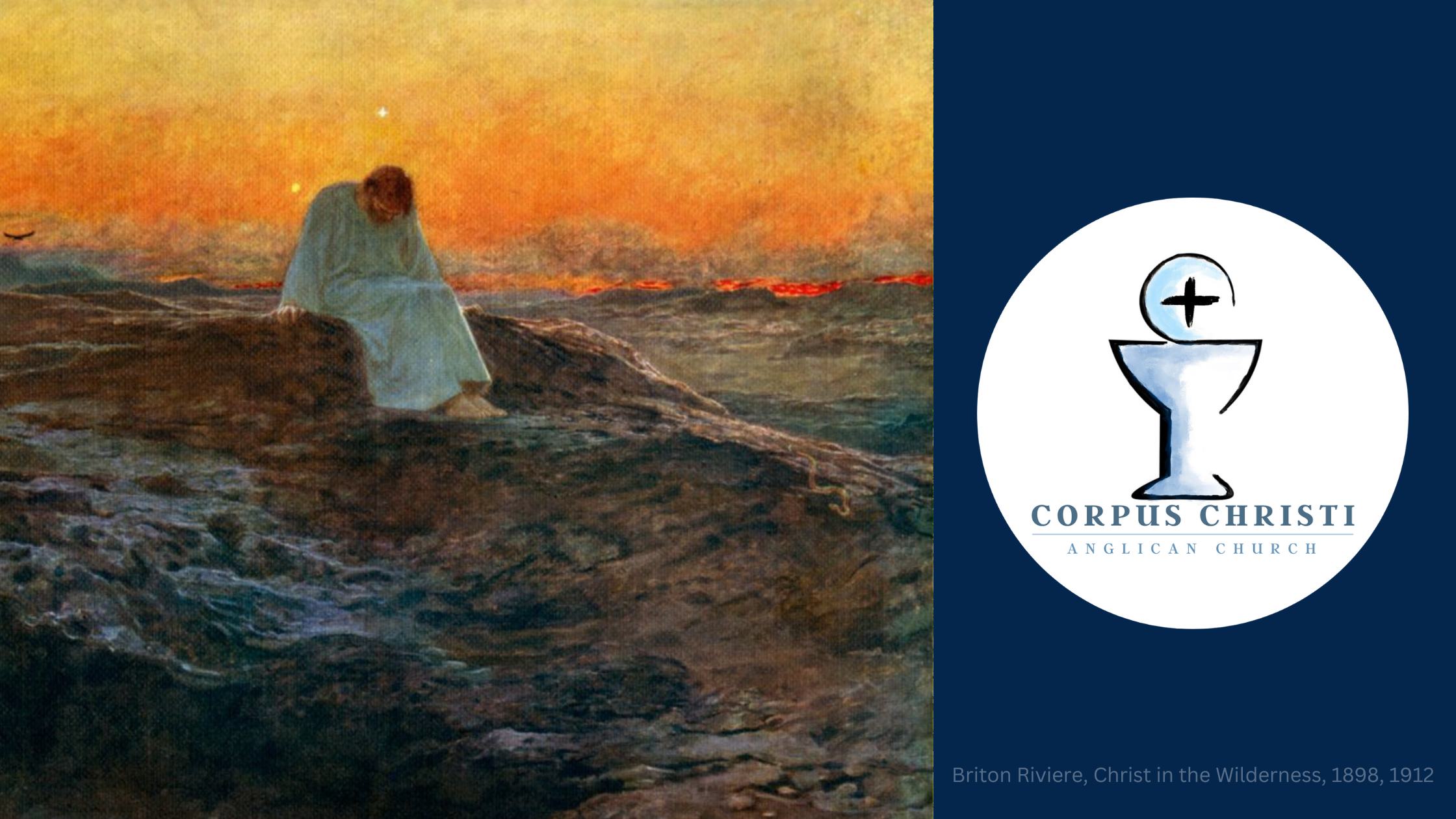
Lent 1: Following Jesus through Trials and Temptations
TranscriptioN
In the name of the Father, of the Son, and of the Holy Spirit, Amen.
Please pray with me. “O God, by whom the meek are guided in judgment and light rises up in darkness for the godly, grant us in all our doubts and uncertainties the grace to ask what you would have us do, that spirit of wisdom may save us from all false choices, that in your light we may see light, and in your straight path we may not stumble. Through Jesus Christ our Lord, Amen.”
The temptation of Jesus by Satan in the wilderness is a very well-known narrative. Most of us can relate the story, and like a lot of stories in Scripture, it can almost become too familiar with many repetitions. The main point of the narrative of Jesus' temptations is to demonstrate how the Lord, God of all creation, deals with temptation in light of his humanity.
It clearly demonstrates the victory of Jesus Christ over the power and cunning of the enemy, and perfect man who overcomes temptations after 40 days of being alone, tired, weakened, and hungry. What personal meaning is there for us in this Scripture? If Scripture is given to us as a model for a manual, for my K-12, I did that very well, for living godly lives, how does Jesus, who is perfect God and also perfect man, overcoming Satan's temptations? How can that help us? It's actually a question I've asked myself. I'm not God.
I'm not a perfect person. To be honest, I'm not equal to the task, and neither are you. It's too easy for us to fall into temptations. There's so many, and the enemy knows each one very well. As the enemy of our souls, he unfairly waits for us to be alone, tired, weakened, or hungry. He shines his light on those moments of weakness and skillfully pokes at our old familiar habits, patterns that are so easy to fall into, painful past experiences that may have shaped or traumatized us and caused us to relive those painful memories at the worst times, family behaviors that are ingrained, many of which we thought we had addressed and overcome.
But unlike Jesus, we are too easily tempted. We are actually low-hanging fruit for the enemy. Our temptations are for sure. We pray for the mind of Christ in all things, but there are times when unexpected events at home or surprising conflict with family members, especially it seems on Sunday mornings, when we hope to be more heavenly minded, we are the opposite. I don't know about your family situation, but sometimes the worst arguments and sometimes even the worst language have erupted on the way to church. I'm making a confession here.
And there sits the enemy, gloating in triumph, gloating over our failure. While we try to summon God's grace to cover our bad behavior, our out-of-control emotions, and our failed resolve to resist temptation, before we arrive at the church door. No wonder Jesus included temptations in his model prayer for us. As you look at the wilderness temptations of Christ, you may notice that Satan offered him things that were already his, manifested in his father's perfect way and timing. Satan tempted Jesus with those things that have already been given him. First, Jesus was the bread of life, our spiritual food, necessary to our daily spiritual nourishment as we live out our lives in Christ.
Secondly, God's process for salvation was already perfect in Jesus. His father's glory and his authority and power over sin and death had been established by his father. Jesus was blessed by a vision of his father's glory manifested in him at his baptism. Finally, Jesus was already in possession of God's glory and the kingdoms of the world. He was alive in God's purpose and power and he knew there were no earthly shortcuts to God's perfect time and plan. Looking past the 40-day wilderness experience, Jesus experienced his greatest temptation.
Again, as fully man, he was tempted to the limits of his humanity. Tempted to turn away from the purpose of his father's mission, which was to endure severe punishment, beatings, a sense of utter rejection, and the unimaginable pain and shame of the crucifixion. And Luke says it this way, Father, if you are willing, remove this cup from me, yet not my will but yours be done.
In his anguish, he prayed more earnestly and his sweat became like great drops of blood falling down on the ground. We experience so-called mountaintop experiences where the Holy Spirit has covered us with overwhelming joy and reassurance of his love. We at those times experience a taste of God's glory.
In that moment, it seems endless. So frequently, it's followed by a series of personal disappointments, a crisis, a family blow-up. Is there a connection between these two experiences and our sense that maybe we should prepare for a discord to follow these mountaintop experiences? To be so far from that joy of the Lord that we wonder if we really experienced it.
Hebrews reminds us to keep our eyes on the joy before us and continually remind yourself of what is at stake. Think about your family, your calling, and Jesus who gave up everything for you. Have you experienced an unmistakable and exhilarating call of God, followed by an extended time in the wilderness? Understand that the waiting and the prolonged delay are part of the fulfillment of God's call.
This is a hard one, especially if the call is clear, but the plan, according to Christian lecturer Oswald Chambers, is haphazard. Sadly, the purpose of God has for us will most likely require a time of extended patience. God needs to know that we trust him and his plan and process without the temptation to figure it out on our own what it is or what we need to do to help God.
God, make it happen. Wilderness seasons her heart and unless we know what is at stake, we may be tempted to give up. Oswald Chambers, again in the book of his lectures, my utmost for his highest, told his students one of the greatest strains in life is the strain of waiting for God and with it the temptation to rush ahead of God's timing and his plan.
So how can we overcome the temptation before us and stand firm with our eyes fixed on Jesus? Another place to look is to recall Satan's approach in the garden. His soothing voice asked a question, created doubt in our first parents, and if I were to do this the way I want to, I would hiss on every single S word because he was a snake and I believe that he said things like, did God really mean that in this beautiful lush garden created especially for you to enjoy? He has told you not to eat the fruit of this tree. Doesn't he want to let you make your own decisions about your own lives? This is original sin.
How many times are we tempted to take control of our lives as if we have better answers than God? I've heard statements like this. I seriously doubt that God understands quantum physics, the complexities of genetics, and the depths of the human genome, the Ryman hypothesis, the Goldbach conjecture, and the Hodge conjecture, which are some of the hardest math problems in the world. On the wall of one of the restrooms at MIT was another different kind of statement and it was this, and God said, followed by a complex mathematical problem, and there was light.
The devil's wilderness temptation of Jesus began with the word if, also tempting to sow seeds of doubt, but unlike Adam and Eve, Satan was trying to negotiate with the one who created all that was created, including quantum physics and the most complex mathematical problems. Over 20 years after the original publication of the human genome, the number of protein coding genes is stabilizing around 19,500. Even with a complete gene annotation of a finished genome, we will have only one example of the human gene catalog, and that will not apply to all humans.
It's endless. I call it inner space. We can't count stars.
Jesus can also count all of the genes in the genome. If you are the Son of God, if you then worship me, if you are the Son of God, as if being human, weary, lonely, weakened, and hungry, Jesus would be easily fooled. No, he endured so that we could know him in the wildernesses of our lives.
We are not God, and to be certain, we know it. Jesus places us in situations where we do not have a clue, so that his power and his authority take over. I imagine him saying to me, honey, just sit down and let me be God in your life, and when you're tempted to mess things up.
So I find it to be a law that when I want to do what is good, evil lies close at hand. For I delight in the law of God in my inmost self, but I see in my members another law at war with the law of my mind, making me captive to the law of sin that dwells in my members. Wretched man that I am, who will rescue me from this body of death, thanks be to God, through Jesus Christ, our Lord.
Let us pray. Gracious and holy Father, please give us intellect to understand you, reason to discern you, diligence to seek you, wisdom to find you, a spirit to know you, a heart to meditate upon you, ears to hear you, eyes to see you, a tongue that proclaims you, a way of life pleasing to you, patience to wait for you, and perseverance to look for you. Grant us your holy presence and life everlasting. Amen.
Transcribed by TurboScribe.ai. Go Unlimited to remove this message.

Ash Wednesday: Eliminating Self-Deception and Prioritizing the Kingdom

Transcription
Well, good evening again everybody. Thank you so much for being here tonight. Thank you for making the drive. I know the weather was a little challenging and a lot of you are coming from work, so thank you for making time to begin Lent together with your church community.
I'm the vicar here at Corpus Christi Anglican Church, and this is a season that reorients our priorities to the priorities of the kingdom of God. Lent is a season that helps us peel off all the layers of self-deception that we have started to build over time, to do the hard work of naming the truth and then asking for God's help and mercy because he's more ready to give that to us than we are to ask for it. And so as we consider getting our priorities straight, I want to look at three parts of this passage.
First, keeping good rhythms. Second, be honest about where self-deception lies. And third, framing your earthly life in light of the life of God's kingdom. And so as we look at this passage, Matthew chapter 6 tonight, let me pray for us. In the name of God, the Father, the Son, and the Holy Spirit. Amen.
Lord, may the words of my mouth and the meditation of my heart be always acceptable in your sight, O Lord, my rock and my Redeemer. Amen.
Keep Good Rhythms
Well first, keep good rhythms. Keep good rhythms. In the passage today, Jesus mentions almsgiving, fasting, and prayer. And it's assumed that these pious Jews, his followers, are going to have these rhythms.
He's not exhorting them to start doing them as though they're not. They are already doing them, having these rhythms of almsgiving, fasting, and prayer. These are the rhythms that recalibrate God's people to God's covenant faithfulness when God is their king.
So giving towards the plight of the poor is an invitation to the justice of God's kingdom where the wrongs are going to be made right. And that's what we're giving towards as we give to the Lord. Prayer is this invitation to commune with the God of heaven, to get clarity on what his love is and what his will looks like, so that as we pray every day, his will might be perfectly done on earth as it is in heaven.
And then fasting is this invitation to depend on our Creator. It doesn't always mean food, but for them it often did. For us it often does. And it's this invitation to depend on our good Creator to examine all the ways that our appetites, our wills, and desires lead us and guide us rather than the God who loves us. And so the church, even in the earliest centuries, continues these habits in the new covenant where Jesus is king to recalibrate life to what it looks like to return to the covenant where we live under the kingship of our Lord Jesus. And so when we fast, pray, and give alms, we're invited into dependence, justice, and love that frames our earthly life in light of heaven.
And if you haven't realized this yet, you will, that living in northern Virginia can feel frenetic. Yes, I know that's surprising. And sprints are fine.
If you do a 50-yard dash, it might be doable. But you can't sustain that pace for years and for decades. And so Lent invites us, helpfully, to just stop and slow down, cultivate rhythms that are this wholly upsetting of our sprinting pace.
Changing your evening routine, maybe waking up earlier, how you do a meal, perhaps intentionally skipping a meal for the sake of prayer, changing a diet like going vegan, carving out part of your budget to support God's work in your neighborhood or in the church or around the world, using prayer tools like the examine or other prayer tools. All of these things contribute in new ways to a wholly unsettling to push us off our frenetic pace, to disorient us so that we're reoriented to the kingdom of God where Jesus is Lord. Lent is a wholly unsettling, so we need to keep good rhythms.
Be honest about self-deception
Second, we need to be honest about where self-deception has filled our hearts. Jesus had warned his followers about the motives that they were doing for prayer and for almsgiving and fasting. And it's not wrong to be noticed by others.
It's not like if you see somebody with a cross of ash on their forehead during the day that they're somehow disobeying Jesus. It's about motivation. What is the aim and the goal of practicing piety before the Lord and the outward actions that are associated with that? Wanting to be noticed fuels self-deception.
If you're wanting to be noticed for how holy you are, you are fueling self-deception. It reminds me of gardening because we were doing some gardening yesterday, and there are a lot of plants that I've tried to plant along our fence, and they all die. Even ones I thought would do just fine, like thyme, have died along our fence.
And now what's happening that is killing those plants? It's Virginia clay, my arch-nemesis. And so, besides English ivy, that's my other arch-nemesis. So I have two arch-nemeses, but Virginia clay. So unless I spend some time amending the soil, you know, what's underneath the surface is going to continue to kill whatever I put there. Doesn't matter how nice that plant is, it's eventually going to die. We don't want to have the kind of spirituality that signals our piety to other people, but what it's actually doing is fostering a kind of death inside of us in our interior life.
And so what have we allowed to calcify in our inner life that needs to be broken up and amended? I can't answer that question for you. It's a question to ponder during Lent. What have we allowed to calcify in our inner life that needs to be broken up and amended? Have we begun to believe false narratives that we've created about other people, about ourselves, about God? Are we making decisions, communicating out of a place of fear, allowing our external circumstances to guide our decisions? But we need to let our prayers, each of our gifts, each thing that we give up or take on in this season with new rhythms, each of those things is contributing to the breaking up of the hard soil of our inner life.
And so we do these things all with intention to break up what is hard underneath. And so don't be afraid to look undone before other people. This is a season to remind each other that you are a mess. I mean, we are a mess. All of us are a mess. We are like that unfinished wall that is sitting there that is completely undone. That is all of us. We are a mess. This is a season to acknowledge it, embrace it, and give comfort to one another that it is okay to be a mess together in community.
Acknowledging our mess in community is actually the beginning of rightly ordering your interior life under the rule and the reign of King Jesus, who, as I said, and as the colic says, he is more ready to hear than we are to pray. And I love that collect.
Adopting Kingdom Priorities
So we looked at keeping good rhythms. We looked at eliminating self-deception. Finally, let's look at adopting kingdom priorities. Jesus ends this passage with this reminder that where your treasure is, that's where your heart's going to be also.
Heaven is God's realm. So heaven's God's realm where he abides and where his will is done perfectly. It's not something ethereal out there.
It's an alternate sphere that overlaps and interlocks with the age that we're in now. The age to come, the age we're in now, heaven and earth overlap and interlock. And that's important because what that means is that there's the possibility that we get glimpses of heaven in our day in and day out experience right now.
And it's not all something just to be looked forward to in eternity. And that's important because Jesus, what he does in his earthly life and in his death and resurrection and in his ascension on high, is he breaks into this age into the realm of the earth with the realm of heaven. And we see heaven meeting earth in the person of Jesus.
And so in Lent we make extra space to ask God to break into our realm again. And then to give us glimpses of what things will ultimately be when Christ is in all and over all and all things are in him. And so it's not an invitation to be so heavenly minded that you're of no earthly good.
Let me say that again. This is not an invitation to be so heavenly minded that you're of no earthly good. Instead, it's an invitation to prioritize your earthly life around God's priorities.
We learn to love our enemies even when we publicly or privately disagree with them so that we learn God's love for them and for us. And so that ultimately they learn it as well. We abide with Christ.
We endure disappointments. We endure unmet expectations and sufferings not as things that are distracting us or taking us away from the will of God, but as those things that are, in accepting them, they are meaningfully part of God's forming us into the image of Christ. And so we take, we make time and we allot our resources to love and serve those who are the least, the lost, the forgotten, because in God's kingdom those are the ones to be honored as divine image bearers.
And this is the reality of heaven breaking into earth. Prioritizing God's kingdom has ethical implications both personally and publicly, and we don't do things to be seen by other people because we want God to break in through our layers of self-deception and to form us into the image of his Son. So in conclusion, this passage has three important points.
Keep good rhythms. Break through the hardened layers of self-deception and adopt God's kingdom priorities. This is the invitation of Lent, to keep good rhythms.
Break through self-deception and adopt God's kingdom priorities. And so tonight you're gonna receive a bit of ash on your forehead, and it's in the shape of a cross, the Lord being our helper. I'll do my best.
The ash reminds us that each of us one day will die, which is really hard to think about. The reality is like in our culture they have built habits to avoid remembering death, and so Ash Wednesday cuts through the culture's self-deception to remind us to make things right with God and right with others as there is still time. And the shape of the cross reminds us that there is hope for us, that Christ has defeated death, and that God loves the dust that we are.
God hates nothing that he has made, as our collect says tonight, but God longs for our forgiveness, and he longs to grant us his mercy. And so tonight invites us into a whole season of repentance and renewal as we start to break up that hard soil and begin to rightly order our interior life once again.
Transcribed by TurboScribe.ai. Edited by the author.

Transfiguration: A Vision of the Glory of Jesus for the Valley of Demons to Come
Transcription
Well, good morning again everybody. It is good to see you. I'm Father Morgan Reed. I'm the vicar here at Corpus Christi Anglican Church. If you haven't heard the term vicar before, it's because we Anglicans have great terms for things. And so I am like the equivalent of a senior pastor of a mission church that's still in formation. And as we are growing, those titles change, but that's what they call me in the Anglican world.
It is great to be with you this morning. And this, as I mentioned before, is the final Sunday of the season of Epiphany, where we focus, as a whole season, on the glory of Jesus Christ, this loving rule and dominion of God that is over all the nations, that comes through the person and work of Jesus Christ as our King. And today, this Sunday, focuses our attention specifically on the glory of Jesus in the transfiguration of our Lord on the mountain.
We don't know which mountain, perhaps Mount Tabor, but we don't exactly know which mountain it was. Up to this point, Jesus' disciples, they've been receiving bits and pieces of information and seeing glimpses of something of the kingdom of God. They've been hearing about it from Jesus, and now they're putting it together.
And this moment is putting it together in a way that's going to prepare them for the valley that Jesus is about to enter, and the valleys that they themselves are about to enter. It's interesting that in the Gospels where this story is recorded, each gospel writer always follows up this story with the boy who is possessed by a demon that only Jesus can heal. And so, you know, it's helpful for them.
The glory of the transfiguration is preparing them for a valley of demons that they're about to face. It's preparing them and preparing Jesus in some ways for the valley that he's about to enter into as he goes down to Jerusalem, the place where he'll be crucified. And so you can see as we end the Epiphany season why this focus is so helpful to bookend the glory of God in the season of Epiphany, but then to begin our time of Lent together this week.
And like Jesus's disciples, you and I are putting the pieces together slowly. We are often vacillating somewhere in between incredible, meaningful encounters with the God who loves us, the joy of sitting in his presence, and moments of failure, panic, disappointment, and feeling like God is woefully distant. Somewhere in between there on any given day we are vacillating, right? And so we don't often understand those things that Jesus is preparing us for in those moments between the radiant glory of God and the valley of demons.
But the best posture to adopt as we vacillate between those things is a posture of listening to the Son. Listening to the Son of God. As we open ourselves up to what God is doing in his kingdom work, and as we focus on the glory of God here in the Transfiguration, there are three things that I want to think about this morning.
First, Jesus prepares us for what we will face. He does. Jesus will prepare us for what we will face. Second, Jesus is present on the mountain, but He's also present in the valley. Jesus is present on the mountain. He's also present in the valley. And third, God invites us to listen. Those are the three things I want to think about this morning.
Jesus prepares us for what we will face
So let's look at how Jesus prepares us for what we're going to face. Jesus takes his disciples up to a mountain to pray. This is something they do a lot. And while Jesus is praying, something not common happens. Jesus's appearance, the appearance of his face changes into something other. His clothes become dazzling white, and then two men appear with Jesus, Moses and Elijah.
Why Moses and Elijah? We aren't 100% sure, but perhaps it's something to the effect that as prophets in the Old Testament, Moses shows us something of the prophetic office that Jesus is going to come to occupy. And Elijah is, as a prophet, a portrayal of Israel's hope in the future, in the Eschaton. And so Jesus is talking with those who he is going to fulfill their ministries, both looking backwards and looking forwards.
And so the disciples get to hear this dialogue. They're kind of like in and out. They're really tired. They're not totally asleep, but they come to be alert when this happens. They see Jesus with these two prophets, and in this dialogue that's happening, Moses and Elijah are speaking to Jesus about his departure that he's about to accomplish at Jerusalem. And that word departure is really important.
This doesn't come across in English, but if you're reading it in Greek, the term that they're using is ἐξοδόν. Does that sound like something? “Exodus”. Yes, exactly. It's a very loaded term. And so in this passage, those who are listening would have totally been conjuring up images of Israel's exodus in the past, and looking forward to the deliverance in the end, where the kingdom of God is fully established. And so the disciples, as they're listening, images of the exodus of God's people are being conjured up in their minds.
And I think New Testament scholars are right to point out, some will say that it's not just Jesus's death, but this is actually truncating the entirety of his salvific ministry. His death, his resurrection, his ascension on high where he reigns as king, and his coming again, which in Catechesis of the Good Shepherd, they like to throw around the term παρουσία quite a bit. That's his coming again to establish all things in the fullness of God's glory where Jesus reigns as king.
All of that together is the exodus that we're talking about. This is the departure that's about to begin at Jerusalem and be fulfilled in his coming again. And so up to this point, if you think of what the disciples have been going through, they've been hearing bits and pieces about the kingdom of God through all these enigmatic parables that Jesus has been teaching. He's mentioned his death in somewhat veiled terms, it seems to confuse them, and he's said these elusive commandments to take up your cross and follow me. Well, what does that mean? He hasn't yet been crucified. They're putting the pieces together without the full picture.
And so these are all pieces of the larger picture of God's kingdom story that they'll come to understand, but they definitely don't yet. Jesus here is giving them this sufficient glimpse of the plan of God's kingdom that will sustain them in those moments where things just don't go according to plan. Like, Jesus, I did not think this was how your kingdom was going to come.
Is your kingdom even coming? Whatever those moments are, this glimpse is supposed to sustain them when those things that don't fit in the plan will happen to them, which they will. And so Jesus, you know, when tragedy strikes and things don't turn out the ways that they thought they would, they need this vision. When they watch their Lord being crucified, this moment of glory on the mountain was meant to remind them that that tragedy of their crucified Messiah is actually part of a cosmic exodus from the kingdom of darkness, where we're all enslaved to the powers of sin and death, to the kingdom of darkness, that this cosmic exodus of God is being brought about through this crucified Messiah.
And God often gives us glimpses of the story that he's telling, if we would pay attention to them. But it does take work to recall those stories in your life. I remember a particularly challenging season in my own story, where I was wondering, as a clergy person, have I made the right decision? I'm sure other pastors have thought that at times. I'm sure maybe in your work you've thought, have I really made the right decision? And in my story, it was there was people, not at this church, none of you, there were people that were making my life really challenging, and it was really hard to the point where I thought, maybe I've just chosen the wrong thing. I should go back to Starbucks. And maybe, but you know, maybe you've had similar doubts in the course of your work, too.
These hardships. And in those moments, what I did was I looked back and I asked, God, where are the sort of mountaintop glory experiences that I can look at where I actually knew you were present? I hang on to those moments and recount them of where was God present that led me up to this point? Because I didn't do this on my own. I didn't just like will myself into this.
Quite frankly, the church wouldn't have okayed my ordination had I done that. But the thing is, I needed those moments to look back on and go, if God has been present before, I know he's still present right now, even if I'm not in the same state of joy that I was in those moments. That was a season of the Valley of Demons for me, and I know that several of you have gone through your own seasons of the Valley of Demons, and perhaps you're in one at the moment.
And so in those times, it's really important to remember the glory of God, keep a short list of the experiences where you know God has been close. Because there are moments where God is present, but his closeness and his presence may not feel tangible.
Jesus is present on the mountain, but He's also present in the valley
And so we've looked at how these moments of glory, they're preparatory. They're preparing us for a season of the Valley of Demons, for what's coming. And then second, I want to look at that Jesus is present, whether it's in the dazzling white clothing on the top of the mountain, or it's in the Valley of shrieking Demons. Whether you're here or here, Jesus is present.
It's that long obedience to Jesus through the ups and the downs that the redemptive story of God is being shown. And so these high moments prepare us for the low moments, but it's in looking back on those highs and lows that we piece together the story of the kingdom of God that he's telling in our story. And so we might be tempted to think that when we have arrived up here, that we've hit all that there is.
Like, I've arrived. Whether we're in the high or the low, Jesus is present. And so we need to hold on to those moments as preparatory.
We think often, like, I remember hearing as people were doing their Bible studies, you know, I had a really great time with the Lord this morning, and that's awesome, but not every day is like that, right? Or I came to worship and I didn't get anything out of it today, right? But the reality is there are highs, there are lows, and it's in this long obedience between the highs and the lows that we piece together the story of God's redemption. And even when there are lows where we don't feel his presence, we know he is there, and these things, these rhythms, are feeding us despite the fact that we may not feel his presence so closely. So we get to the text, and just as Elijah and Moses were about to leave, Peter says, “Master, it is good for us to be here. Let's make three dwellings, one for you, one for Moses, and one for Elijah.” And then it says, “…Not knowing what he had said.” Like, imagine, he didn't know what he was really saying in that moment.
And so Peter was asking them to celebrate a Jewish festival, the Feast of Booths. And the Feast of Booths celebrates God's redemption of Israel, bringing them out of Egypt in the Exodus, and it anticipates God's ultimate deliverance of his people. Peter recognized that that was a significant moment that they were in, and, you know, he didn't know the significance of the moment that he was in.
Maybe he wanted to prolong that moment to get more information about the kingdom of God. Maybe he thought, it's about to come now, right? You can imagine having a crucified Messiah is not in their plans. And so you can imagine, if you see Moses and Elijah talking with Jesus, and he looks very different, you think, this is the time, I'm ready, you know.
And so we should celebrate the Feast of Booths. I'm not sure what that would accomplish. I'm not sure he knew what that would accomplish. But he didn't know what else to say in that moment. He's just overtaken with the glory that he is seeing. But he doesn't know what he's asking for.
And so experiencing that moment of the radiance of the glory of God was preparation for all the things that Peter was about to go into, into the future encounters with the kingdom of darkness, in ways that he had no clue about. And again, I find comfort there, because we we can prop up moments of joy like that, moments where we know God is so present as somehow being the standard for how life should always be. It is so easy to go there, or to say, I'm not healthy spiritually unless I am there.
And you know, so again, you might wonder if as I'm reading the scripture, doing the daily office, you know, if I'm not feeling anything, am I doing this right? Is there something wrong with me? But again, of all the days that Jesus went to pray, we only have one transfiguration recorded. And so I find comfort in that, that our habits of prayer, our habits of being in community, being formed in community, when you don't feel it, being carried along by the community, and hoping somebody else is feeling something that day, whatever state you're in, these are all formative and feeding us, even when they're not memorable, right? There's an analogy that comes from a couple authors about food. I can't, I have a bad memory anyways, but I can't tell you more than ten meals I've had, probably, because they were memorable, but I needed all those meals to feed me.
And so worship functions like this. Even in the unmemorable times of worship, I am being fed, and I may only remember ten of those, right? Or something like that, but I need them all to feed my soul. And so we should thank God for those deep moments where God's presence and abiding in God's presence are filled with this consolation of Jesus's good presence being so real to us.
And don't worry when he's not. You can take comfort that sometimes you're in those moments where he is present, but his presence is sometimes more difficult to experience. And those moments where he has been really present are a preparation for those moments where he doesn't feel present.
And so name those moments, write them down, keep them close, that he feels so real. And then sometimes name those moments where he doesn't feel like he's really present. Because as you piece those things together, you're starting to piece together the story of redemption that God's telling in your life.
God invites us to listen to his son
So we looked at how he prepares us for the things we're gonna face. We've seen that Jesus is present, whether it's on the dazzling, in dazzling clothes on the mountain or in the valley of shrieking demons. And finally, as we live out life in the kingdom of God, God invites us to listen to his son.
I'm not good at listening, so this was really helpful for me. After Peter utters his saying, there's a cloud that overshadows them. This is something like the theophany that we talked about where Moses's face is shining, the cloud of God, the Shekinah, the glory of God, overshadowing the people and bringing them out of the wilderness.
This cloud that reminds them of something of the Exodus, overshadows them and says this is my son, my chosen one, listen to him. If you remember back to January 8th, at the beginning of our Epiphany season, I preached on the baptism of the Lord that day. It's the day where we celebrate his baptism and that really kicks off our Epiphany season.
And now this language that was at his baptism of my son, my chosen, brings together two really important passages. Psalm 2, which is kingly coronation language, and Isaiah 42, which is the chosen servant, and the songs of Isaiah are being brought together in the person of Jesus. So the one who will redeem Israel, the one who will bring them out, the one who will be king over all, is brought together in Jesus at his baptism, and bookending our Epiphany season is brought together here at the Transfiguration.
And so Epiphany is bookended by those important statements. The heavenly voice tells us about Jesus's kingship over all things, that as the beginning of his ministry, again to remind the disciples of that same truth that Jesus is Lord, he's king, they're going to need to know this as he goes down into the valley. He's the one who's going to bring redemption to Israel.
He's the one that's going to carry out the fullness of God's kingdom and justice, and reign over all nations, and overthrow the kingdom of sin and death. And that the crucifixion is not a deterrent from that plan, but actually part of it. And so very importantly, this voice from heaven says, listen to him.
And as a result of that, it says they kept silent, and they didn't tell anybody what they'd seen until a lot later. And at some point, they will come to talk about it, since it's written in the Gospels, but they needed to know that they could listen to Jesus and trust him as king, because the thing that was going to happen next did not look like they expected it to happen. This was not supposed to be God's plan for the Messiah, that he would be crucified by, you know, pagan powers in the city of Jerusalem.
This was not part of our plan, and they needed to be able to trust him. And so Jesus continually disappoints his disciples with unmet expectations about what God's kingdom is going to look like, as they move from the Mount of Transfiguration on Mount Tabor to the crucifixion at the hill of Golgotha. Somewhere between those two mountains, they're going to experience a lot of disappointment.
And they need to know that Jesus says, and what he does will guide them for continuing the work of the kingdom of God. When Jesus rises from the dead, they'll begin to tease out and connect these dots of the revelation on the mountain with the rest of his ministry. But between these two mountains, between Mount Tabor and the hill of Golgotha, they really are at God's mercy in their unmet expectations, and having to listen to the voice of the Son.
And so it's a good reminder that you and I, we are all in these moments where we vacillate between being on the mountain, where Jesus feels so good, so present, so powerful, to moments where we wonder if we've messed things up beyond Jesus's ability to fix them. If we're being punished for something outside of the boundaries of God's love. Like, I have messed up so bad that not even God could love me.
Just feeling like we're stuck, like there's nothing that's going to budge in our lives, and we can't understand why God doesn't seem to answer our prayers, or why his presence feels so far from us. Somewhere in between those two things, we're often going back and forth. And so whatever he's bringing us through, this command is to us as well.
Listen to the Son. He's trustworthy. He knows what he's doing. He gives us the moments of glory as preparation for the moments where his glory is hidden. Begin to name those things that hurt to God. Tell him what hurts, so that our hearts are open to healing, rather than closed off in a defensive posture.
We need to look for the face of Christ in other people. Yes, when they bring us joy, but also when they drive us crazy, and even when they offend us. We need to discover the face of Jesus in them. We can go on a walk, and we can look at the kind gestures of God in the world around us. That's often my help. I love in the spring to just watch the plants grow on the mountainside and the creek to flow, and to know that I had nothing to do with it.
It's really helpful. The specifics of what you do to listen to the Son are sort of secondary. Keep the daily office.
Keep your prayer rhythms. We're going to talk about fasting, almsgiving, and prayer during Lent. These are all good rhythms. But the main thing is that we're moving towards the love of God. And we're moving towards loving what God loves in whatever we are doing. That's listening to the Son.
We don't pursue the kingdom through military might or worshiping power. We experience the lordship of Jesus and the kingdom of God by just stopping, breathing, and listening to the voice of Jesus. And so rather than doing what I would normally do and ending my sermon with more words, what I want to do today is have almost two minutes of silence, which is going to feel a little awkward.
And that's okay. And in those two minutes of silence, I want to invite you to pray about two questions. Jesus, where are you today? So sort of in that question, think back on the day, on the week.
Where is Jesus present? Even in those moments where you may not have felt present. And then, Jesus, what are you saying today? Jesus, where are you today? Jesus, what are you saying today? So I invite you, in the next two minutes, let's just be silent. Jesus, where are you today? Jesus, what are you saying today? And I'll conclude us with an amen.
[Silence]
Amen.
Transcribed by TurboScribe.ai. Edited by the author.

Missionaries of God’s Kingdom
Transcription
Today is World Mission Sunday, and we have just heard four wonderful texts; but I'm going to focus on just one verse from the Gospel for today:
As the Father has sent me, so I send you.
But before I get into the sermon, I would like to conduct a very brief survey. On the first one, I would just like a show of hands.
So first question - Would any of you who are missionaries, please raise your hand. Okay, one, two, three, four, five, six, seven. Some are not quite sure whether they're missionaries or not, but that's okay.
Now the second two questions, just answer it in your own mind. This is not a quiz and there will be no grades on this. So second question - Who was the first missionary in the Bible? Make a mental note. Who was the first missionary?
And the second of these two questions was - Who was the supreme missionary mentioned in the Bible? Okay, you've got those in your mental notebook. Here we go.
1. Well, of course, I'm sure you all, or almost all of you, noted that the first missionary was Father Abraham. He obeyed God's instructions and he didn't know where he was going, and I think that's a good point. It's important to know that. Just because you've been given orders by the Lord, it doesn't mean you know exactly what's going to happen next. In fact, that's part of the fun, although it's part of the danger as well.
Around 1900 BC - the archaeologists are able to give us this rough date for the time of Abraham. He's not a figment of somebody's imagination, but he was a real person and he lived in the real world of his time. His ancestors were migrants, probably from the ancient urban culture of Sumer (and I'm resisting talking about this because I think Sumer is fascinating. Anyway, ask me about that privately if you wish.) So, his ancestors came from Sumer.
The point is that they were not primitive nomads. They were sophisticated city people from what was at that time a high civilization. And his father was called to leave the city of Ur in southern Mesopotamia and ended up at Haran; yes, in what is Syria today. And it was there that Abraham heard the call to "go from your country and your kindred and your father's house to the land that I will show you, and I will make of you a great nation, and I will bless you and make your name great so that you will be a blessing. I will bless those who bless you, and him who honors you I will honor, and him who dishonors you I will curse. And in you (and this is really the punchline here) in you all the families of the earth shall be blessed." (Genesis 12:1-3)
Wow, that's weird. So, equally weird, Abraham obeyed. He went as the Lord had told him. If you want the rest of the story, you're gonna have to open the Bible yourself and read Genesis chapter 12 and following.
God had promised Abraham that he would have many descendants, but not until late in his life did he finally have a son by his wife Sarah. And then, this terrible story, completely opposite to Abraham's expectations - God told him to sacrifice his son Isaac, who at that time was probably in his early teens. Abraham was on the verge of carrying out the sacrifice when at the very last minute God provided an animal in place of Isaac.
This to us is a very strange story. I have struggled with it for years, but I think I understand now what was going on. In the culture in which Abraham lived, people understood that the promise to Abraham was the making of a covenant-relationship between God and Abraham, a long-term promise of absolute trust.
Some of my friends have criticized me in the past for always talking about covenant, but I don't think you can talk about it too much, because we really need to get a hold of it. A covenant is a promise between two parties which is absolute and it's for life - it's long-term. And this is the bit that some slow-witted people like Steve Arpee didn't get:
A covenant relationship in the ancient world was always sealed with a sacrifice. Why? What was the point of it? We know that in many ancient cultures sacrifices were rituals intended somehow to manipulate the supernatural powers; but that wasn't what was going on here. What was going on was the making of a covenant-relationship, and the sacrifice was a way of affirming one's promise.
The sacrifice was a way of affirming one's promise, declaring in a visible way that everything the two parties owned was committed to keeping the promise. The sacrifice is a visible way of demonstrating that everything that was in the power of each party was owned by the two parties, was committed to keeping that promise. So the sacrifice was really important, it wasn't hocus-pocus. It wasn't an attempt to manipulate the spiritual powers, but it was a way of saying "I am in this totally."
"Everything that I am and all that I have" is represented by the beast that's offered in the sacrifice and is committed to this relationship. So this is huge. By being willing to sacrifice his son, Abraham showed that he trusted God to keep his promise, even though that looked impossible if Isaac were dead.
How's that for a terrible test? Abraham trusted God to keep his covenant promise, and God saw Abraham's obedience as Abraham's keeping his side of the covenant promise. That is what righteousness means. (Now this is a pet peeve of mine, I shouldn't go off on this, but people tend to think that righteousness is something that we attain by being good boys and girls and doing everything that the rules say. No way, that is not what righteousness means in the biblical context. It means covenant faithfulness.) So God saw Abraham's obedience as his righteousness, that is to say not that he was morally pure, but that he was keeping the terms of the covenant relationship.
So that is the kind of righteousness that has been given to us. If you hadn't noticed, none of us is morally perfect and couldn't get there if we tried. But we are called to be faithful to our promises made in our baptism (which we were going through again last Sunday) to keep our covenant promises.
Okay, so the first missionary was Father Abraham, because the Lord said, "Go and I will be with you and I will show you where to go." And this was a really tricky injunction, but Abraham obeyed and he went. He had been sent, and so we can see him as the first missionary in the biblical story.
2. All right, the second question was, who was the supreme missionary in the scriptures? Well, obviously, Jesus is the supreme missionary. The Father had sent him to do the Father's work in this world. So we can all nod to that. But the world needs to know what we mean by Jesus having been sent by the Father. And we need to know, we need to be able to say, who is Jesus? Now, I'm getting into deep water here. Some of this is pretty straightforward, but just hold onto your seats here.
Who is Jesus?
1. The teachers of the church declare that he is "fully God and fully man." In terms of our way of thinking, at least this simple person, that is an impossible affirmation. We cannot, with our rational minds, see how any person can be fully God and fully man. What in the world, quite literally, are we talking about? We'll just put that aside for a minute. You can struggle. We can talk about this later or for the rest of your life. It's really, it's really important to get a hold of this affirmation.
2. Okay, secondly, in biblical language, we acknowledge that Jesus is the Messiah. Now, in a sense, this is the easy one, because you all know that Messiah means "the Anointed One," which is the title of the King of Israel.
And God had made promises to David and to the people of Israel that his realm would eventually encompass all of the nations. So, oh, some of us think it's really important to recover the political theology of the Bible. And so I really like this, because this is a political concept, and we need to take it seriously as such. So Jesus is the true King of the whole human race, the Lord of this whole planet. And if you follow this out to it's logical application, he is Lord of the whole universe.
This is a subject I think that's been ignored in much of our histories, or at least the language of our readings of history. But I have been reading a little bit about the history of Israel in the Middle Ages, and there were many messiahs. There were wars and revolutions that were precipitated by these Jews who claimed to be the Messiah. But they all just brought destruction and disappointment on the people that followed them. So there have been false messiahs. And actually, if we stretch our vocabulary a little bit, we can see that not only were there false Jewish messiahs, there are all kinds of false messiahs - false claimants to our obedience in the historical process, some maybe not so far away.
3.Another title, which for those of us who have lived in the Islamic world, really is very important. And I think it's important for all of us, and that is the term related to Jesus of "Son of God."
People get all tangled up in biology. This title has nothing to do with biology. In fact, it comes out of the history of the Roman Empire. You all know this amazing general by the name of Julius Caesar, who went on a rampage in Gaul, among other places, and was assassinated for his troubles. But sometime after that event, the Senate of Rome elevated Julius Caesar to the rank of God, or a god. So Julius Caesar was deified by the Roman Senate.
And again, unless you paid a little attention to Roman history, you wouldn't know that. But it's very important because Julius Caesar had an adopted son. And when Julius Caesar's successor was sought by the Senate, they elected a man (Gaius Octavius) whose title was Augustus Caesar, who was in fact the Roman emperor presiding in the whole Mediterranean world at the time of Jesus' birth. So "Son of God" was the title of Augustus Caesar as the adopted son of Julius Caesar who had been deified by the Senate. Now in terms of vocabulary, I think this is of huge importance. Augustus Caesar actually brought peace, order, and prosperity to the Roman Empire. And he was not shy about saying, "I alone did this." And he put up great big stone billboards with the announcement of all the wonderful things that he had done to bring peace and prosperity to the whole ancient world - his announcement of what he had done to bless all of humanity.
You know what's coming? What was the title of that announcement? What was it called? It was called good news. Yes, the good news was about what Augustus Caesar, the son of God, had achieved. And yes, the Greek word, of course, was euangelion, which is translated "gospel." The word is a way of proclaiming the achievement, the role, the power, and the honor of the son of God. It's not talking about biology. If you're concerned about the biology, that's another subject. But that was not the issue for the church in these early centuries. Some people get tripped up in that title. But it's only if you take the title "son of God" as referring to biology.
We need to be able to say who Jesus is in a way that can make sense to the world around us. Boy, is this a toughie. But there's no escape from it is we are to give witness to the covenant-relationship to which we have committed ourselves. We need to be able to explain to people, when they ask us, who Jesus is. The first thing I think that is necessary is to say that if Jesus is indeed fully God and fully man, we are - what do we say, "we're beyond our pay grade." We're into a realm of knowledge and of vocabulary for which we are incompetent. So I think there's a need for very deep humility. We do the best we can to use the words we have, but we have to do it with fear and trembling, knowing that our words are so easily misunderstood. So anyway, that doesn't excuse us.
We still have to do what we can to talk about Jesus, to affirm his divinity, and to affirm his humanity. There's a phrase by an English poet of the 18th century, "to err is human and to forgive is divine." Well, that's good poetry and it has a certain amount of pastoral application, but that is not the definition of what it means to be human. But you all know what it means to be human, of course. What it means to be truly human is defined very succinctly in the book of Genesis. It's to be made in the image of God.
Our character is to reflect the character of the creator of the universe. That's what it means to be human. And we need to be clear on that, fellow-students, and there will be a test. In fact, the rest of your life is the test. What does it really mean to be human? But if we talk about Jesus the human, it's not all that easy. And I wish I could just step down here and let Morgan sort this out, but I'm on the spot here.
Okay, first thing, Jesus is fully human, but he is not a rebel against God. And this is what the word sin means. It means, hey, I hear you claim to be God, sir, but I really want to be God. I understand that you really are the owner of everything, including me and everything that I have, but I want to be the owner. This desire on our part is the essence of sin. It's wanting to be owners and in charge of our world, at any cost.
So, Jesus reflects the father's character and he is, in that sense, fully human, but he never evidenced any rebellion against the father. In fact, he was clearly, deeply united with the Lord of the universe, with the master of all things, whom he call "daddy", Abba. "Father" is too formal a term in English, but we don't have the right language that correlates with the Aramaic at this point.
Furthermore, Jesus clearly had the father's authority to carry out the father's plans for the whole creation. And this is something else that we need to be really clear about. I have to confess, in regard to our theological ancestors, many of whom were pagans, that we tend to have been sucked in by the pagan and Greek misunderstanding of reality - seeing the material world as bad and the intellectual or spiritual world as good, and therefore that "salvation" or "success" was a matter of escaping from the suffering of this world and being liberated to go to "heaven," wherever that was, where everything would be peachy keen.
That is really a pagan idea. It's Greek in formulation, but a lot of our theological heritage in Western Europe has gotten sucked in by that, and we don't understand that God's project is not an escape scheme from this world, but that he has created this world, this world is good, and that he wants us to be partners with him in dealing with this world. And this process, New Creation, (the word doesn't get a lot of emphasis in the New Testament, but it's there, and it's very deep) and that is that the project that God began when he brought this planet into existence and created the human race - his project is ongoing, and it has not been curtailed by human rebellion.
What God has done in the ministry of Jesus, and particularly in his death and resurrection, is to overcome the powers and principalities of this world, who want to mess everything up, who are not wanting to cooperate with God's plan for his creation. So Jesus, Emmanuel, "God with us," came in person to bring this project forward. One theologian calls Jesus' ministry, in fact, the divine revolution against the dark powers of this world. And this is what Jesus is doing to bring God the Father's creation project to completion.
He was sent to complete the creation process that had been begun "in the beginning." It is not a mistake that the fourth gospel starts with the same words as Genesis, because the point is that in the ministry of Jesus, the creation is being brought to its completion. How is that working? I mean, you can look around and say, hey, this isn't going very well, Lord.
3. And this comes around to the missionary's job description, so I hope you're all taking notes, because this is you and me. This is us. Jesus said, as the Father has sent me, so I send you. We are all sent. We are all missionaries.
(a) So what is our role, each one of us, whatever our age? First of all, we are Jesus' friends.
We're not merely servants. The word in Greek, in the New Testament, is doulos, for slave. We are not slaves. We are friends. So we are Jesus' friends. He wants us as partners in carrying forward his mission, to complete the creation.
And of course, we are being created in the process ourselves.
(Oh, I can't resist this. This is a, I don't know what to call it. It's not a metaphor, but it's a word puzzle, you might say, which you are free to ignore, but I just can't, I can't control myself here: We need to be very clear here, The church of God does not have a mission. The God of mission has a church, okay? You got this? I expect you to get this right in writing when the quiz comes around. The Church of God does not have a mission. The God of mission has a church.)
So first, we are friends of Jesus. He takes us into his confidence. He's told us what he is doing, and he invites us to be partners. We act as a partner.
What's kind of a partner?
(b) So we are called to be stewards.
Now, a steward is a person who has the authority of the owner, but he is not the owner. He is a particular kind of partner. A steward is a person who has the authority of the owner, but he is not the owner. He is a particular kind of partner. We act in Jesus' name.
That is, we act with the authority of Jesus. And this is kind of scary. I think it's more than kind of, but our role is to be the presence of Jesus in the world, day by day, wherever we are, in the workplace, in our homes, in our towns.
We have his authority. So we need to know what that is and what it looks like and how we are called to exercise it.
(c) And then thirdly, as I mentioned, we are revolutionaries.
This is a big subject. And as members of the people of God, a shorthand for this is to say that our roles shift back and forth. Sometimes they are to submit to the powers and principalities, and sometimes they are to subvert.
And how do you know what you're supposed to be doing? Well, that's where we have to remember that the Holy Spirit is the primary agent in all of our obedience and all of our relationships. And we need to learn how to listen to the Holy Spirit. And as Morgan would tell you, there are at least three if not four ways we have to listen.
In the silence of our inner life, in our prayers, we have to listen. And that includes, by the way, dreams. Some of our dreams are just plain crazy. But sometimes God speaks to us through our dreams. We need to learn and get the help to understand how God may be speaking to us through our dreams.
God speaks to us when we are struggling with problems. So problems precipitate creativity in our lives. So just because you're having a hard time, don't think that's bad necessarily. It may be difficult. But it is when we are faced by problems that we have to be open to finding something new. And very often, God speaks to us in this situation when we are looking and asking, then he speaks to us.
And he speaks to us through the scriptures, of course. And that's one of the reasons why we're here and why we need people who are scholars to help us with our reading of the scriptures.
And I almost said most of all, because this is closest to my heart, God speaks to us through each other in the body of Christ. And when we've got some brilliant idea or some wild strategy for moving forward, we'd better talk with our brothers and sisters in Christ. And they will say, "OK, right on. Go for it. We'll pray for you." Or they will say, "you're out of your skull and look at it this way." So we need the checks and balances of our own community. But God is speaking to us all the time, or wanting to, if only, we will pay attention
Now, I'm going to read this sentence twice, because this is part of the exam.
The purpose of a congregation is to equip and support each baptized person for our job in the everyday world as Jesus' partners in his New Creation project.
In closing, I'm going to give you a closing survey, rather than a summary, as such:
So first question, who was the first missionary in the Bible, everybody?
Abraham. Yes.Who was the supreme missionary mentioned in the Bible? Jesus. Yes.
And would any of you who are missionaries, please raise your hand. Okay, that's pretty good (strong majority). Some of us, it takes a while to get this sorted out.
And I heard the voice of the Lord saying, whom shall I send and who will go for us? Then I said, here I am, send me. Amen.

The Glory of Jesus in Learning to Love our Enemies
Transcription
Well, good morning, my friends. It is good to see you this morning. I'm Father Morgan Reed. I'm the vicar here at Corpus Christi Anglican Church.
And today it is a joy to be with you. I love Sundays where we celebrate baptisms together. One of the joys of celebrating baptisms is it reminds us of what God calls us into in our own baptism. And so this morning is we make vows and promises together and support Joshua and Grace in their vows and promises. Take a moment to remind yourself that this is God's call on your life as well this morning. We are in the season of Epiphany together, which is a season that focuses our attention on the glory of Jesus as it goes out to the nations.
And today's gospel passage is from what's commonly called the Sermon on the Mount. And today I actually did something that I've never done before and I've heard of other people doing it, which is I actually prepared a sermon on the verses after the ones we read today. So I'm gonna talk about how this Sermon on the Mount goes into where we didn't yet get to in the passage, which is verses 27 through 38, where Jesus is going to make this claim about, you know, love those who hate you and pray for those who persecute you or who mistreat you and to forgive those who mistreat you and who hate you.
And this radical love that we're gonna find in the Sermon on the Mount is part of the glory of Jesus going out into the nations. And in Jesus one of the things that the Sermon on the Mount calls us to is to reflect the mercy and the love and the grace of God. And the radical showing of that mercy, grace, and love are to be done because what we're actually doing in that and what the Holy Spirit has empowered us to do is to show the very nature and character of God himself.
And this is what we do, that what God empowers us to do when we're baptized and given the Holy Spirit. And this happens through loving our enemies, through blessing those who curse us, for praying for those who mistreat us. And so this call in the Sermon on the Mount is to continue the the ministry of Jesus by putting God's glory on display to the nations through a radical love, a love which shows the very nature of the mercy and character and grace of God himself.
Loving our Enemies
In a world that has been broken by sin, by disordered attachments and loves, this is our call to proclaim the glory of Jesus through this radical kind of love. The first thing Jesus calls us to, in verse 27, if you have your Bibles, this is Luke chapter 6, Jesus calls us to love our enemies. These commands are written in the context of religious persecution.
These are people who are being called into the way of Jesus, into living in the kingdom, and they're going to experience opposition as a result of living life following Jesus. And so they're called to carry on the good news of Jesus in their lives, and they're going to encounter people who are going to set themselves as enemies against them. This isn't referring to people who undergo natural consequences for doing what's unethical or wrong.
This is about people whose conduct is honorable, it's Christ-like, and then as a result of that, they suffer. And if we're to love our enemies, one of the challenging things is to pinpoint what an enemy actually is. I know sometimes we're like, well, we shouldn't have enemies, but the reality is, if you've lived any time on the earth, you know enemies present themselves, right? And so, I remember back when I was, before I was ordained, probably over 10 years ago at this point, we lived in Chicago, and I was working at a coffee shop, and I had a manager who was fantastic.
We really gelled, we clicked, he used to give me stuff to do that would help benefit the coffee shop, and just trusted me. And as a manager, it was great, because I, you know, it was, if there ever were room for improvement, and there was, of course, but he would couch it in gratitude. He says, I'm grateful for these things.
There's this area that we need to work on, but also, I'm so grateful for the ways that you pour yourself out into this. Well, he left, and then somebody else came in. There was a new manager who came in, and she had been, she had had managerial experience elsewhere, but not in this industry, and that made it challenging.
So I was often met by her with criticism, not gratitude, and if I'm honest, I didn't take it that well. I didn't look forward to seeing her. I tried to avoid her, and I really kept our conversations short.
I didn't want to give her anything, and one day when she was there working with me, her boyfriend had come in, and she took a break and sat at a table with her boyfriend, and I overheard their conversation as I was cleaning, and she was starting to tell her boyfriend all of her frustrations and her insecurities, some of which were related to work, some of which weren't, and it kind of broke my heart a little bit because I realized, oh, she's actually a human being, and so as I listened to those insecurities flowing out, I realized all the bravado, all the posturing that I was experiencing were all ways of her masking her deep sense of insecurity, and that gave me a lot of compassion, and so what I did as a result, as I worked with her, I started to actually name for her the things that she was doing well. You did this well, just reminding her, right, because if she's feeling insecure, it's helpful to remind her that there are things that she does well, and what's neat is it really improved the working relationship. By the time we left Chicago, we actually were friends, and she knew that I was a Christian, and so my prayer is that that relationship was something that marks her story in some way, that she understands the love of God more because of having known me.
Now, not everything goes that well. I shared sort of a nice story. I could have shared ones that don't go as well because there's some times where we just can't break through somebody's insecurities, and the animosity towards us and the contempt just won't go away.
Now, was she my enemy? Well, in one sense, yes, and in another sense, no. She made my life miserable. I didn't want to go to work, but this passage in the Sermon on the Mount would exhort me to stay sensitive to what causes somebody to become my enemy.
It's more interesting to ask what makes her inimical to me, not is she an enemy or not, and the reason why is St. Paul says that our enemy is not flesh and blood. He talks about spiritual forces, principalities, and powers that are spiritual and real, but they're not flesh and blood, and so because of that, people, you know, when they're not fully themselves because of their sin and their brokenness, we will experience them as our enemies, but it's up to Christ's followers to love people and things for what they truly are and what they can truly become while simultaneously praying for the healing for the ways that people have become distorted by the enemy that is actually the enemy. St. Augustine says it this way. He says, “Therefore we're both prohibited from loving in this command what the world itself loves, and we're commanded to love it in what the world hates. Namely, the handiwork of God and the various comforts of his goodness. We are prohibited from loving the fault in it and are commanded to love its nature. The world loves the fault in itself and hates its nature. So we rightly love and hate it, although it perversely loves and hates itself.” Now, it's a little confusing. What he means by that is that people in their very nature are image bearers of God, and so we are called to love them for who they are and what God wants to make them into, what he is bringing them into in their salvation in Christ. Not for the ways that they are broken. We recognize that this is not their nature, to obscure the divine image in themselves.
And so this is the way that we love our enemies, to love what is truly them. And so when people lash out at you, when they make your life harder, which is going to happen when they activate something deep in you and you're feeling a response because of something in your past, we can recognize in our bodies the discomfort of experiencing something in that moment of the kingdom of darkness and not just of them. And so we can ascribe the harm then to spiritual forces of wickedness that are warring against us and they're warring against the person that we're perceiving as our enemy.
That's trying to cause us harm. And in doing that, in recognizing that, we set ourselves up to love the image of God in somebody while at the same time hating the very things that are not part of their God given nature and what God's making them into. And so it could be a friend.
It could be a relative, a family member, could be your spouse at times. It could be a child. It could be a co-worker.
All of these can present themselves at any point as your enemy. But ontologically, in all reality, they are just distorted image bearers of God in that moment. And so the command is to love your enemy because, and what's at stake? Because that's the very thing that God does. And so we're showing this radical love as we are sharing what the nature of God is like.
Do Good to those who Hate You
So second, Jesus calls us to do good to those who hate us. Doing good is the extension of love. It's this conscious choice not to take vengeance into our own hands, but to relinquish vengeance into God's hands while taking the initiative to actually do good for somebody when they are absolutely undeserving or unaware of what's actually good. Now, I do want to give a caveat, though, as I was thinking about this passage. Sometimes doing good to others will result in them being angry at you.
This is not people pleasing. For example, if you've escaped an abusive situation, doing good to somebody does not mean going back to an abusive situation or allowing somebody to overstep appropriate boundaries when they've been abusive or unhealthy. That is not good.
It's not doing good to them. It's not doing good to yourself. Sometimes doing good to somebody involves setting and holding firm boundaries that you've established even when they don't want them.
And that's OK. Remember that by doing good, we're extending love. What we're aiming for is the restoring of God's image in that person through the work of Jesus Christ.
So good boundaries can allow us to have space to love that person well without getting caught in systems that run healthy of sin and abuse. And it's good for that other person, whether or not they're realizing it in that moment. And so with that caveat, Jesus calls us to do good to those who hate us.
And part of doing good is to remain sensitive and vulnerable. It's really hard to do because sometimes we can feel like things are going so well. I don't want to feel vulnerable.
That's scary. And I get that. I remember early on in pastoral ministry, somebody giving me the advice to grow thick skin as a pastor. People are going to come at you with this, that, or the other thing. You just need to learn to grow a thick skin. But the reality is, the more I read scripture, I actually don't think that's the way of Jesus.
I don't think growing a thick skin is the answer. And because when you grow a thick skin, whether or not you're a pastor, this is for all of us. Growing a thick skin, it keeps us from being tender, keeps us from being vulnerable, keeps us from empathy and seeing the hurt and the need that others have. Many of us are going to be the objects of scorn. We're going to be the objects of other people's transference as they're working through their issues. We're going to be the objects of their projection.
And they don't understand why they're so mad at us. And it's something that we can't fix. Perhaps like a spouse is feeling out of control. And then the other partner comes in and doesn't tune in well to what their spouse is doing. But they make a bunch of demands about how the house should look or whatever. And that spouse is going to be met likely with and become the receptacle of a litany of frustrations from the other spouse.
And if somebody is discontent with parts of their life and then you say the wrong thing, it doesn't matter if you're married, if you're co-workers, just roommates, whatever. If something is going wrong and you come in at the wrong time and you say the wrong thing, you may have just triggered something. They're getting activated.
They don't understand what's going on in their body. And they lash out and you become the object of their contempt and scorn in that moment. You know, it happens with sermons, too. I hate to say that, but it just happens. Right? There's going to be moments where you become the object of somebody else's contempt.
Now, the answer is not to ignore it. The answer is not to grow a thick skin and let it roll off and ignore it. But the answer is to stay grounded in the confidence of who you are in Jesus.
What has God made you to be? And as you come with that confidence, then coming to that other person with sensitivity to their experience, you can then re-engage with curiosity and kindness for that other person because of the confidence of who you are in Christ. And that is to do good to others who hate you, to engage them with this curiosity and kindness, to actually seek for the image of God in that person. To seek for the face of God when they themselves have forgotten that they actually bear in themselves something, the image of their creator, and then to show up with kindness and the kindness of God in the face of their contempt. This is to do good to those who hate you.
Bless those who Curse You and Pray for those who Mistreat You
So loving our enemies, doing good to those who hate us. And finally, I want to look at blessing those who curse us and praying for those who mistreat us. Now, the ESV that we read today, I think, well, we didn't read it because I told you we read the passage before where I was thinking we were going. But the passage in the ESV, if you were to read it, it has the word “abuse”. I don't think that's really helpful as a translation.
And they got it from the old NRSV, the old RSV. The better translation here is “mistreat”. Bless those who mistreat you. And that's what the new NRSV has. And it's costly and it's courageous to bless people who curse you. And following Jesus as Lord means that no earthly authority, no political party, no governmental structure, no institution is going to 100 percent follow the kingdom of God into these systems that we're called, whether it's your family, government, work, church, any human institution in which you are called into.
We're called to be truth tellers as we follow Jesus in the kingdom way. With Jesus as Lord, we tell the truth. And now this is bound up, bound to make us the object of contempt with somebody, to be truth tellers amidst institutions.
You're going to become the object of contempt and cursing for other people because of breaking norms that are there, because of exposing evils within institutions, shining light on unhealthy systems. Whatever it is, some of you in your 20s and 30s are finally discovering the unhealthy systems of family as you shine a light on it. It's common for you to become the object of your family's scorn as you get healthy.
And it is so easy, then, to want to revile in return. But this passage calls us to bless and to pray. Ridding ourselves of contempt as we begin to pray for the salvation of others begins the process of our own internal healing salvation and our own internal rightly ordering of our internal life.
And that involves rightly naming the wrongs of other people. It involves accurately describing the impacts of other people's wrongdoing and then praying for God to deliver those people from the bonds of the kingdom of darkness. The things that have made them become contemptuous of you.
And this is where forgiveness begins. We're relinquishing the right to take vengeance into our own hands. We recognize that this person is made in the image of God and that God actually loves this person despite their sin and their brokenness.
And that begins our prayers for them. And it allows us to bless who God has made them to be and the good desires that God has put in their hearts while also recognizing and naming the brokenness that all of their distorted affections and desires have caused. And so don't dismiss somebody's wickedness.
On the one hand, that is not forgiveness. Do not dismiss their wickedness. But at the same time, don't let somebody else's contempt breed contempt in you.
Conclusion
Jesus has called us to share his glory to the nations. This is what the season of Epiphany is all about. And we do so here in a radical love, which he calls us to in the Sermon on the Mount, through loving our enemies, through doing good to those who hate us, through blessing those who curse us, and for praying for those who mistreat us.
And so we are those as Christians who risk, who pray, who bless, who name the truth and who forgive other people while at the same time holding good boundaries. We love other people in the face of their brokenness because this this is the kind of love that God shows to each one of us. And for those of us who have died and risen with Christ, those of us who have been baptized into him and his death and his resurrection, this is the radical love that shows God's love to the world, the world that that longs to see the glory in the face of Jesus Christ.
Let me pray for us. Almighty God, you sent your son, Jesus Christ, to reconcile the world to yourself. We praise and bless you for those whom you have sent in the power of the spirit to preach the gospel to all nations.
We thank you that in all parts of the earth, a community of love has been gathered together by their prayers and labors and that in every place your servants call upon your name for the kingdom and the power and the glory are yours forever and ever. Amen.
Transcribed by TurboScribe.ai. Edited by the author.

Jesus’ Best in Our Worst
Transcription
Good morning again everybody. It is good to see you this morning. I love seeing your smiles. It is good to be with you in worship and community this morning.
Regardless of the week you've had coming in, it is good and formative to be together. So thank you for making time to be here with your church this morning. If you're new here or visiting, we're glad you're here as well. I'm Father Morgan Reed. I'm the vicar at Corpus Christi Anglican Church. If you're new to Anglicanism, it's like a senior pastor of a mission church. And that's what I am here, and we are delighted to have you with us.
Today in our Gospels, we are looking at the calling of the disciples. And so we've been talking about the glory of God through Epiphany. Now that glory is going to go forth through these who Jesus will choose as his disciples to carry on the kingdom work. And whether or not they knew it, these disciples, their lives, their stories, their vocations, were setting them up in unique ways to bring their unique gifts to bear on the age to come, the kingdom of God. And they were doing so in the midst of an empire that was not eager to know the love of the Messiah.
There was this clash of good news messages, Gospels. One of those being, we have no king but Caesar. One of those being, we have no king but Christ. And in the midst of that tension, the disciples are being called, these fishermen, to proclaim the good news of the kingdom of God where Jesus is Lord. And so the followers of Jesus are called to hold out the glory of Jesus in the midst of really challenging circumstances. And this is what the apostles are called to.
And how can they do this? I love this passage today. It is such an encouragement. How are they able to carry the glory of Jesus out in the midst of really challenging circumstances in an empire that's not necessarily friendly to them? That's what we're going to look at this morning. And what they're going to learn is that Jesus brings people into an encounter with himself often when they're at their worst. And then they're going to learn that Jesus can do far more than they expect of him. And then when they're confronted with their own finitude as human beings, then they're going to come to know the power of Jesus working in them to do more in them and through them than they could have imagined.
And I think that you and I this morning are in need of such an encouragement as we follow Jesus in seasons of real instability. As we look at our passage this morning, let me pray for us. “In the name of God, the Father, the Son, and the Holy Spirit. Amen. Almighty God, from whom all thoughts of truth and peace proceed, kindle, we pray, in the hearts of all people, the true love of peace. And guide with your pure and peaceable wisdom those who take counsel for the nations of the earth, that in tranquility your kingdom may go forward till the earth is filled with the knowledge of your love, through Jesus Christ, our Lord. Amen.”
Jesus meets us in our worst
Well first, I want to look at this first point that I brought up, that Jesus meets people often when they're at their worst. Jesus meets them when they're at their worst. Chapter 5 of St. Luke's Gospel is what we read today. Jesus comes to the lake of Gennesaret, which is also called the Sea of Galilee. It's in the northern part of Israel. It's about 18 by 14 square mile, yeah, square miles. And it serves as a popular freshwater fishing location.
And when he shows up to the Sea of Galilee, there's a crowd that's gathered. They're gathered there to hear him teach. And the crowd is growing. And because it's growing, they need to be able to hear him. And that area provides a natural amphitheater, so he has to go out a little from the shore to utilize the natural resources around him to create an amphitheater so that everybody can hear. And so he sees these two boats that are by the lake that he needs, and he decides that he needs one of them to go out onto the lake.
Well, the fishermen are not in those boats. They're out of the boats, and they're cleaning all of their nets. They've just, it's morning time now. They've spent all night fishing, which is the best time for them to catch a hole. And so Jesus decides on one of these boats to be taken out to the sea a little ways to be able to preach. And this boat belongs to Simon, who's going to eventually be renamed as Peter. And Simon here is not at his best. You can believe it. He's really, really tired.
He spent all night fishing. Show of hands, how many of you have pulled an all-nighter in college? Right? This is, you, Peter spent an all-nighter, and he has not caught anything to show for it. You can imagine how useless he is at this point, and how frustrated and tired and probably deflated he's feeling.
He is not at his best, probably just wants to go to sleep. But in his tiredness, when he's not at his best, he still welcomes Jesus in. And I wonder, with Peter and Simon, if a lot of us are not feeling at our best this morning, as you came in here today. This passage is for you. It's an encouragement. The instability of these past few weeks have been really exhausting.
I know because I'm fielding texts, emails, and prayer requests all the time. People are worried about their jobs. They're worried about the immigration statuses of family and friends. They're worried about the takeover of government systems and processes by the wrong people, that we might break democracy in irreversible ways, that people around the world are going to suffer and die because of freezing and cutting aid. People are afraid of economic impact, on what imposing tariffs on allies means, what the diplomatic fallout of this is going to be. And that's just to name a few things that might be causing fear for some people this morning.
And a lot of these things do impact people in our church because you work for government agencies, or you work for NGOs that serve other people around the world. And so I'm hearing an understandable fear about what is happening right now. Things that make us feel like we're just not in our best.
Right? And that's okay. And if all that wasn't enough, life still continues to march on. And you have your daily responsibilities, the things that you need to do, making repair in relationships that are broken, keeping it together with your spouse, if you have one, maintaining your own mental and physical health.
And in this scenario, in this, you know, current situation, for some of you have kids, caring for your kids, maintaining a sense of security for them, and dealing with the challenges that they present day in and day out. Being present to all the different people that you need to be present to, and your different spheres of life. How do we maintain all of those things? And the reality is, if we were to look back on human history, there is never been a time where heaven has been on earth that we can point to one nation state and go, that was the kingdom of God.
You know, we just want to be like that. We've never seen it yet. There has never been a nation state that has exemplified the ideals of the kingdom of God. And so, you know, I want to name what feels so hard for a lot of people today as they're walking in. What are the things that make us feel like, man, I am just not at my best right now. And the reminder to us this morning, that this is the setup to encounter Jesus.
That when you're not feeling at your best, let your heart and your body be reminded that this is the place where Jesus sees you, where he knows you, where he deeply loves you, even when you're feeling like you're at your worst. And so when we can learn to name the things that are broken before Jesus, then what we're also doing is naming the very thing where we are, we're place where we're longing for God's love and grace to be poured in and change, change our hearts. So when we're in our worst, that's when we're often most ready to encounter Jesus.
Jesus can do more than we expect
And then second, Jesus can do way more than we often expect him to be able to do. Jesus says to Simon, put out into the deep water and let down your nets for a catch. Can you imagine Peter cleaning his nets tired? And Jesus says, can you get back in the boat, push it out in the water? And also, can you put your nets down too for another catch? You know, it's like it's a very truncated dialogue in the gospel.
So I wrote my own. Jesus says, let down your nets.
And Peter says, “really? We've been at this all night. I am exhausted. I'm tired. I'm hungry. All I want to do is sleep.
Jesus: “I know I get it. And I'm so sorry that you are tired and hungry. Let down your nets.”
Peter: “ We know how to fish. We've been at this all night. We know the right time to go out. You're a carpenter. This is my thing. Do you think that you know how to do my job better than I do? “
Jesus: “Totally get it. You're an expert fisherman. I understand that. And yes, I actually do know more about your job than you do. I know more about you than you do. Put those nets down.”
Peter: “OK, whatever. I'm going to do it. I will let down the nets.”
All right. Now, I know that that is apocryphal from the gospel of Morgan. This is not the actual dialogue that happened. But man, isn't that our internal dialogue? I mean, that is my internal dialogue. Whenever Jesus tells me to act in faith, we find ourselves really frustrated. We find ourselves in the place of being overwhelmed.
And then when Jesus reveals something to us that's broken, that's in need of his grace, we're quick to say, Jesus, don't touch that. You don't know what you're doing. I know how to fix this. Or at least I know people who do. And we strategize and we try to figure out who can help us fix this thing or a plan to get better or things to avoid it. People or activities that we can find or pleasures to keep us from addressing the very thing that Jesus says, I want to touch that and heal that thing in you.
And so Jesus invites us in all of our doubts, in those places of frustration and uncertainty, when we're definitely feeling like, you know, I'm just not at my best today, to set down the nets in faith so that we can see what he can actually do. And when they obeyed, those nets became so full that they were starting to break. And so Simon, when he sees that, he looks at Jesus and says, go away from me, Lord, I am a sinful man.
And that confession of Peter at this point, sorry, I keep saying Simon and Peter, you know who I mean. So Simon, as he confesses this, it highlights now how attuned he is to the fact that Jesus is the son of God, that he's bringing the kingdom and that he himself is unworthy. He's realized who he is and who Jesus is.
And it was at this moment where he's rightly esteeming his own unworthiness before Jesus, that he is now ready to receive exactly what Jesus wants to do in him, the grace of Jesus to be poured in him to continue the work of Jesus. He has to get to this point if he is going to be a vessel worthy of the gospel of the kingdom. And so when Peter is at his lowest, Jesus is ready to reveal himself to him.
And then that is a comfort to you and to us, to all of us this morning. If you feel like you've made a real mess of things this morning, if you feel like there's not any hope, like you are just feeling really undone, overwhelmed, if things outside your control are feeling completely overwhelming, then the posture that this text invites us into is to say, Jesus, I don't get it. And honestly, sometimes I wonder if you actually get it. But I really want to be surprised by you today. And so I will let down my net. Jesus, I don't get it. I don't know if you get it. But at your word, I'm going to take that next step and let down the net. This is the posture when we feel overwhelmed.
And this is the step of faith that leads to new beginnings for us. It opens up to us the God who brings abundance out of these places of emotional and physical scarcity. This is Jesus whose kingdom is transforming a people, individuals and corporately that if we ask, where is the kingdom of God? You're seeing it in a community that's being transformed by him, whether or not the empire is Christian, pagan, in peace or in crisis.
The kingdom of God goes forth in a community of people. And so these small moments of faith are where we learn how frail we are and how powerful God is. And we learn all the meager training that we've had up to this point. And our experience and our life circumstances are all the training to understand that our life has far more significance for the kingdom of God than we would have imagined before. And so when we're at our worst, Jesus comes to meet us. Second, we looked at how Jesus can do more than we would have imagined.
Jesus calls us to more than we expect of ourselves
And finally, Jesus calls us into more than we often expect of ourselves. Jesus calls Peter and James and John to come and to catch people. And they're going to go gather people into God's boat of salvation, where people are going to be delivered into the kingdom of God, where Jesus is Lord. And so they leave everything behind at this point to follow Jesus, which is a huge step of faith. And we read today two passages that were really important for this. Judges, where we heard about one of the judges confronting the Midianites, Gideon, and 1 Corinthians 15, where Paul calls himself the least of the apostles.
And those passages remind us that the kingdom of God doesn't go forward through our constructed worthiness or the image that we would like people, that we would curate on social media for people to experience our holiness or our worthiness. This is not how it goes forward. But through the honest, frail brokenness of our stories, people who are longing to see Jesus at work, who are willing to prioritize God's kingdom, first and foremost, above all things, in our brokenness. N.T. Wright says it this way. He says, “When Jesus calls, he really does demand everything of us. There are no bystanders in God's kingdom. And this is because he has plans in store for us and the world that we live in that surpass what we would have dreamt of.”
And so what God has brought you through up to this point, your circumstances, the things that have been really hard, what God has brought you through up to this point are the beginning of your story. Your places of brokenness are the unique places of redemption that are going to form the compelling stories that draw people into the love of God in the kingdom of God.
Your story, your life has a role to play in the kingdom of God. Your vocation, your skills, your proclivities, the relationships you have, the stories that form you. When these things are submitted to this disposition of, Lord, if you say so, I'll let down my nets.
Then we're ready to see how Jesus can take our frailty and our brokenness and do more in us and through us than we would have ever imagined or dreamt of.
Conclusion
And so as a recap, thinking about this passage, it teaches us three really important principles about life in the kingdom of God, a life of following Jesus. First, that we are ready to see Jesus when we are at our worst. I hope that's an encouragement for you this morning. Second, it teaches us that Jesus can do more than we can imagine. And third, that Jesus can do more in us and through us than we could have expected of ourselves.
And I know that these are fraught days. For a lot of people, these are really destabilizing days, whether or not it's the circumstances outside or not, or just the internal ones. There are a lot of things that destabilize us. Continue in these days to do your daily prayers, right? It's like that World War II poster, keep calm and carry on. Keep calm and pray the daily office. You know, keep praying your daily prayers.
Regulate yourselves when you feel emotionally out of control. Take care of your bodies, they're really important. Your bodies are the means by which you come into the kingdom, and so take care of those bodies.
Take each day to admit to Jesus those things that feel broken. Where do I not feel at my best today? And then ask him for what the next step of faith is. What is the next right thing to do, Jesus, when I am not feeling myself today? Your days are going to be filled with moments and glimpses of the kingdom of God and Jesus's power, but we need to search for them prayerfully with intention, in the midst of things feeling pretty chaotic.
And so my prayer for us is that may God give us the grace to prioritize his kingdom first and above all when we're not feeling totally ourselves. Let me pray for us this morning. “O God, you made us in your own image, and you have redeemed us through your son, Jesus Christ. Look with compassion on the whole human family. Take away the arrogance and the hatred that infect our hearts. Break down the walls that separate us, unite us in bonds of love, and work through our struggle and confusion to accomplish your purposes on earth. That in your good time, all nations and races may serve you in harmony around your heavenly throne. Through Jesus Christ, our Lord. Amen.”
Transcribed by TurboScribe.ai. Edited by the author.