Proper 15: Derailments and the Path to Grace
Introduction
Good morning friends. It is wonderful to be with you. I’m Fr. Morgan Reed, the Vicar here at Corpus Christi Anglican Church. In our passage today, Jesus has an encounter with a Gentile woman. The way Jesus talks to this woman sounds potentially rude, possibly even racist, but it is neither. His intent was not to exclude the Canaanite woman, but to draw her into deeper life in the kingdom of God.
Kids sermon
I want to invite the kids up with me for our kids sermon.
Anyone here ever heard of grafting? What is it?
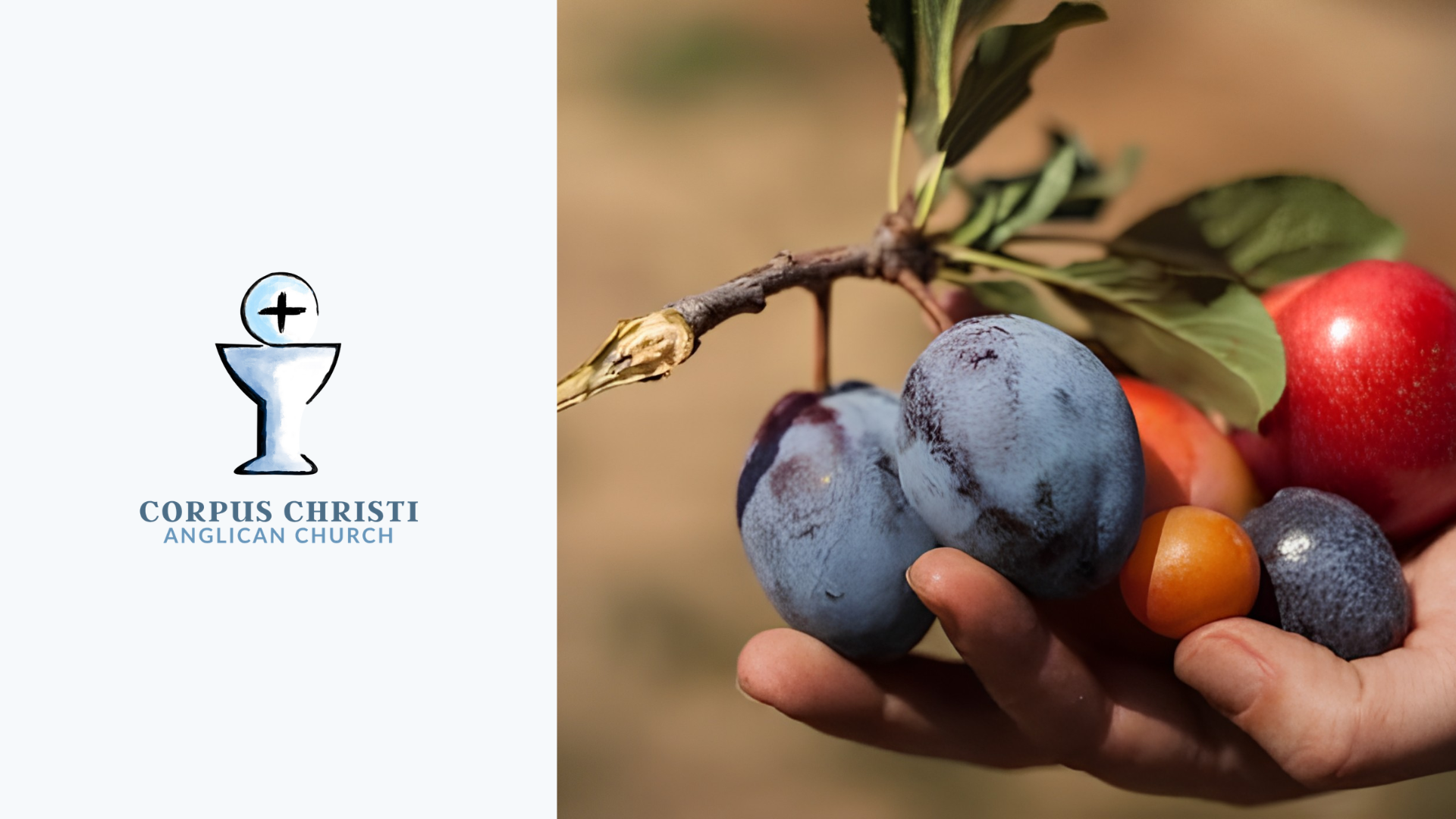
I happen to have everything we are going to need for it here. [Show them how to do it]. It doesn’t work with every tree, but it will work with trees of the same family, like stone fruits: cherries, apricots, plums, etc...anything with a pit. Someone actually created a tree of 40 fruits in New York to preserve some older and more rare varietals of stone fruit that had been grown in North America before we depended on supermarkets so much.[1]
When you graft things in, nutrients are taken from the roots of the original tree, come up through the original stump, and then produce new fruit. St. Paul talks about this today in our Romans passage. God’s people had by and large been rejecting Jesus as the Messiah and the result of this was that God was cutting off the original branches in order to graft in new branches, nourished by the same root system. We get to hear about that today in our gospel passage. The good news for us is that God saved Israel in order to save all the nations and you and I are a part of that work. Through faith in Jesus, we are grafted in and given life to live out God’s love for the good of the world around us. You and I are a part of what God is doing and he loves you.
Please pray with me: “Dear God...thank you...for loving us...and for Jesus...who died and rose again...to give us new life...thank you...for making us...into a new people...amen.”
• Jesus is interrupted during his retreat — Interruptions are the ministry (21-23)
Our passage begins with Jesus leaving the place where he was to go to the district of Tyre and Sidon. The Gentile regions were not on his calendar for preaching. He is going away to be with his disciples: away from the crowds and away from the opposition. The time of rest comes to an end when a distraught woman comes to him and his disciples.
The text says she is a Canaanite. Canaanite is not an ethnic term in Jesus’ day. Canaanite is an historic and theological identity as an enemy of God’s people. And yet, this woman, when something deeply troubling happens in her life, has the internal sense that she can come to this Jewish Messiah.
Her daughter is tormented by a demon, she is beside herself with fear, and she knows enough about Judaism to recognize Jesus could help. She calls out, “Have mercy on me, Lord, Son of David...” She seems to have come to understood that if this Judean Messiah comes, then his deliverance means mercy for the nations. A Canaanite woman receiving the mercy of God would present a compelling case that God’s kingdom for his people would be for the good of all people. It would be a kingdom entered into by faith and not merely family lineage.
But the strange thing is, in this case, her pleas are met with silence from Jesus and annoyance by the disciples. He doesn’t answer her at all. I see the silence of Jesus here not rejection, but an invitation to clarify her longing. The Canaanite woman reminds me not to pass too quickly over what I might perceive as difficult distractions, inconveniences, and annoyances. The disciples may have perceived her as derailing them from God’s real work, but she and her daughter were God’s work. The things that might feel like a distraction from the work, if we would pay attention to God’s work in them, will invite us to a deeper vision of the kingdom of God.
• Israel’s salvation was meant to be for the good of the world (24-28)
Jesus is silent and the disciples are annoyed. They believe he can heal, but they don’t believe this person is worth their time. This will become an opportunity for a mercy that would stretch their imaginations for what the kingdom of God would be. Israel’s salvation was supposed to mean the salvation of the nations around them. This was the vision of the Old Testament as well. Isaiah 56, which we read today, speaks of foreigners, “And the foreigners who join themselves to the LORD, to minister to him, to love the name of the LORD, and to be his servants, all who keep the sabbath, and do not profane it, and hold fast my covenant—these I will bring to my holy mountain and make them joyful in my house of prayer...”[2]
St. Paul in our passage in Romans 11 talks about a tree that natural branches were broken off of and wild olives were grafted in. St. Paul’s warning to the Romans is that the natural branches, the Jewish people, had seemingly rejected the Messiah; not all of them of course, but its not like a majority were following Jesus. And God is then said to have broken off the natural branches to graft in the Gentiles who would now be nourished by the same trunk and root system: one tree, one people, to carry on the call to Israel in this new covenant. The Old Covenant must be held in honor as something that nourishes and flows into the New Covenant, it is not a dismantling of the old covenant for a new gentile religion.
Jesus knows that salvation will come to the Gentiles from his Scriptures, and I think he is drawing this reality out of the situation with some pointed statements for the woman. He says “I was sent only to the lost sheep of the house of Israel.” His statement ratchets up the intensity and she kneels before him and says “Lord, help me.” He says, “It is not fair to take the children’s food and throw it to the dogs.” This is not at all flattering, in fact it feels quite cruel, but the point isn’t to insult or shame her, it is to test her grasp of what her ask really involves.
It kind of reminds me of a coach who might say “Do you want to win today?” And the team says “yes”. Then he says “I don’t believe you.” So they yell “yes” even louder. Then the coach might say “Go run a mile, get back here and do 20 push ups and show me how much you want to win.” So the team does it. He isn’t disbelieving them or discouraging them, he is teasing out the intensity of their longing — Do they know what they are asking for and what it will take to get there? The test proves to the suppliant how much they want what they’re asking for.
The woman cleverly turns Jesus’ statement on its head and says that even the dogs eat crumbs that fall from the master’s table.[3] She understands the implication that the Jews are the children of God and that the Gentiles are not. And yet, she has the humility to say that she too needs nourished by the hand of the God of the Jews. She articulates the fact that the deliverance of Israel was meant for the deliverance of all. This woman has come with a good desire, faith, and the resolve to wrestle with God. And the result is that Jesus says, “Woman, great is your faith! Let it be done as you wish.” And the daughter was healed instantly.[4] The qualifier of great faith is said of no one else by Jesus except this woman. Perhaps this is why one writer in the church’s history calls her the mother of the Gentiles.[5]
Good desire, faith, and a resolve to wrestle with God over his promises and your reality is great faith. I’m grateful that this was included for us as a prayer in our Eucharist liturgy: “We are not worthy so much as to gather up the crumbs under your table, but you are the same Lord whose character is always to have mercy.” One person told me once that they hated this part and they refused to say it because it sounded like groveling; however, remember the context of the woman’s words. What she confesses is that she is in need of God’s merciful help and wrestles with God in dialogue because the things he promised and the things she’s experiencing are not aligned. We too come to God with the desire for goodness, faith in God’s work, and the disposition to wrestle with God’s promises and our current realities. The prayer draws out the intensity of our longing rather than making us cower in groveling shame. As a community, we need to continue to welcome one another into our lives, showing hospitality and love to the end that we grow by wrestling with God with one another. Who feels outside to you this morning? And what would it look like to open our lives to those who feel other and discover the mystery of the kingdom? Jesus’ disposition is invitation, even if on the surface today it felt like rejection.
Conclusion:
Today’s passages remind us that God is saving a people for the good of others. The things that might feel like frustrating distractions and bumps on the path might just be the very things that God uses to bring about his kingdom work if we are attentive to them. This passage reminds us that as we pay attention to the kingdom, we come like this mother of the Gentiles with a faith that produces good for others, a great faith that is persistent and wrestles, and a faith that humbly sees our need for God’s help.
Let us pray:
O God of unchangeable power and eternal light: Look favorably on your whole Church, that wonderful and sacred mystery; by the effectual working of your providence, carry out in tranquility the plan of salvation; let the whole world see and know that things which were cast down are being raised up, and things which had grown old are being made new, and that all things are being brought to their perfection by him through whom all things were made, your Son Jesus Christ our Lord; who lives and reigns with you, in the unity of the Holy Spirit, one God, for ever and ever. Amen.
[1] https://www.samvanaken.com/tree-of-40-fruit-2
[2] Isa 56:6-7.
[3] Matthew 15:27
[4] Matthew 15:28
[5] Epiphanius the Latin: Manlio Simonetti, ed., Matthew 14-28 (Ancient Christian Commentary on Scripture; Downers Grove, IL: IVP, 2002), 27.