Proper 14: God Sits Enthroned Over the Chaos
Intro:
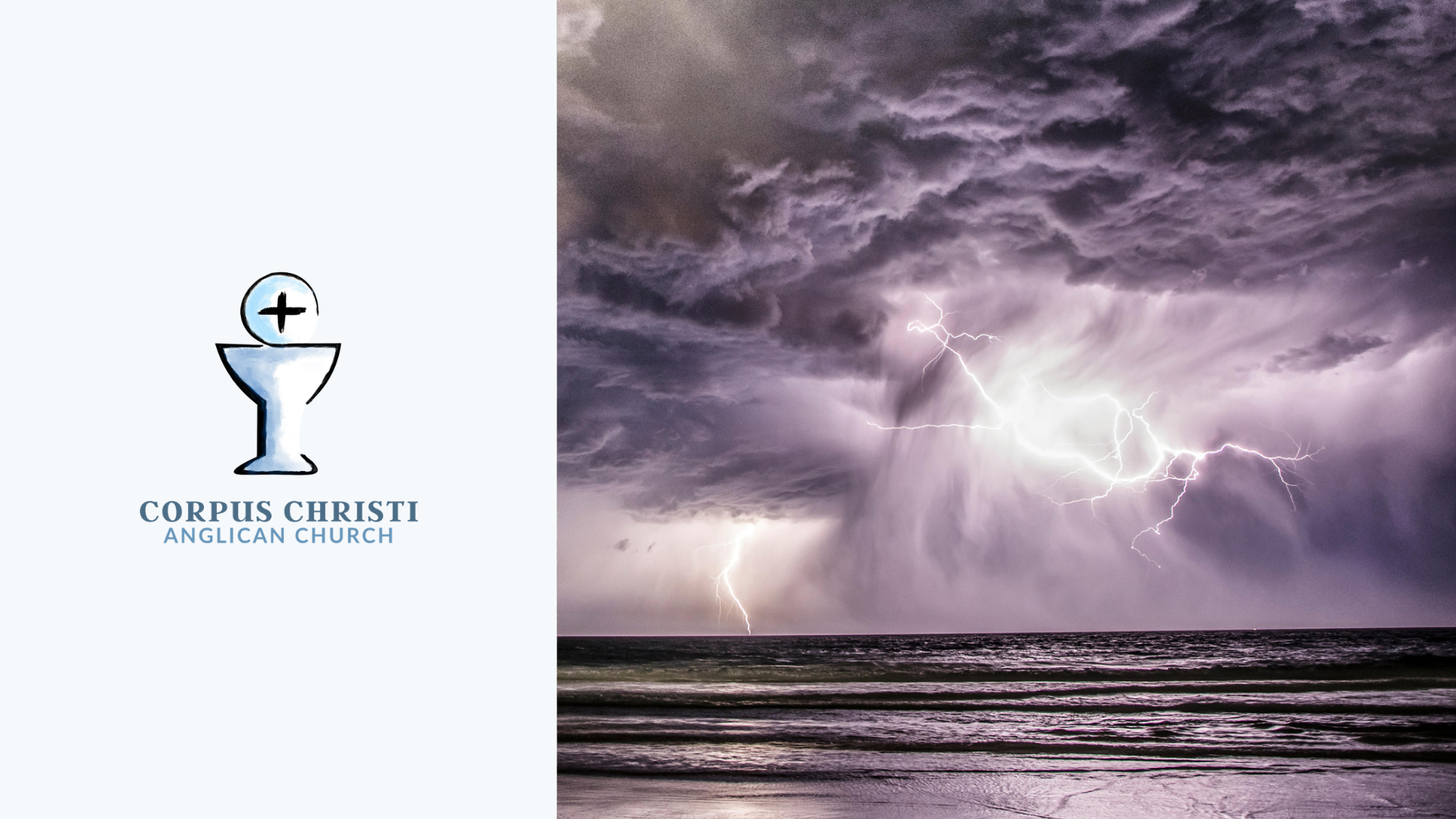
Good morning friends. It is so great to be back with you. It was good to have a time to rest up and recuperate. I’m so glad that you got to meet my friends, Fr. David Griffin, two weeks ago, and Fr. TJ Ono, last week. Thank you for welcoming them. They really enjoyed being with you. This week I wanted to look at our Psalm passage together. Psalm 29, which we prayed together today, presents God’s kingship as terrifying thunderstorm and beautiful comfort. God will not let his work and fame be challenged by any lesser idea, god, or person who promises salvation. He will ultimately subdue chaos, and give his people the strength and peace they need for transform and to see His Kingdom come. As we look at Psalm 29, I want to invite the kids to come up.
Kids sermon:
How many of you have drink coasters in your home? Why do you have them?
When Ashley and I were first married we lived in Chicago in a little apartment. As a housewarming gift we received some coffee coasters from a local Christian bookstore. They had this black, glossy finish, with words like “faith”, “hope”, “love”, etc. The funny thing is, the more we put hot cups on them, the more scratched up they got. The damage continued as the plastic coating on the top began to start peeling. I scraped at one of them a bit more and realized that the veneer of faith, hope, and love, was only held on there with the plastic seal. I scraped it off to reveal a beautiful painted chicken underneath. Ha! Once this seal came off it never got scratched up again. Someone had taken a perfectly good coffee coaster and cheaply pasted a christian veneer on the outside. The hot cup’s heat would not be outdone by the plastic coating.
Today’s Psalm portrays God as a thunderstorm, destroying all kinds of things that people are tempted to worship or the things their false gods needed to use to survive: cheap finishes thrown onto what we really need. God’s voice shows up in this poem 7 times like peals of thunder and the idea is that God is never ultimately unresponsive. He will make his voice known and his plan will be accomplished. Sometimes we get off track and go down the wrong path because we love the wrong things too much, or someone tells us lies about ourselves or the world around us and we believe it. And because of these things we find ourselves overwhelmed by the chaos of bad outcomes even with all our good intentions, the weight of lies we have to keep up and keep track of, and the discouragement we might feel when we try to become good and virtuous when unhealthy people around us might call it ignorant, uncool, or shameful. But despite the chaos, God shows up and reminds us that he loves us, and the pain of getting rid of the wrong things will give way to God producing good things in us. Ultimately, he is conquering the chaos of sin and death in this world and in our lives. My constant hot cups of coffee would burn away the veneer of “nice Christian sayings” to reveal something more stable, good, and lasting. God too will show up, and when he does, what is ultimately good and beautiful will be made known. Would you please pray with me:
“Dear God...when we are scared...we can trust in you...take away the things...we trust in...that are not...worthy of you...and make us more like Jesus...Thank you...for your love for us...Amen.”
1. God will be over all and in all (1-9)
In Psalm 28, the Psalmist demanded that God not remain silent. Psalm 29 answers back with the voice of YHWH showing up 7 times. [Psalm 28:1]. The BCP and other english versions tone down what’s happening by translating the addressees as “the mighty” or “mighty ones”; however, these are deities, literally sons of the gods! This phrase shows up in Scripture in a number of places to refer to deities, dead heroes, and other things that are supernatural. [This comes from the language of the divine council of YHWH. See Gen 6:2,4; Job 1:6; 2:2; Job 38:7; Ps 89:7; Deut 32:8.] Israel would eventually come to be truly monotheistic, but at least in this point in its history, the people are at best, henotheistic, believing that YHWH is the supreme God, but that other gods like Amun, Hadad, and Baal still exist. This is precisely why the prophets rise up all the time to tell them to put away their idols!
The themes of this Psalm are set against the backdrop the theology of the Baal myths in popular Ugaritic, or Canaanite, theology: Baal was the Canaanite storm god who rides on the clouds, who clutches lightning. It is Baal that is worshiped in order to bring rain and given thanks when the rain comes for the flourishing of the harvest. In Psalm 29, Baal is just another worshiper in YHWH’s heavenly worship, “Ascribe to YHWH, you sons of gods, ascribe to YHWH glory and strength. Ascribe to YHWH the glory that is due his name. Bow down to YHWH in holy splendor.” This Psalm invites us into the both the beauty and the holiness of YHWH as king. The world that God made has been filled with sin and destruction, but God will restore it and God’s people would do well to pay attention to God’s ongoing work of re-creation both in worship and in the phenomena of nature.
God was victorious over the floodwaters of primeval chaos in the creation of the world and Psalm 29 invites us to reimagine this victory through the imagery of a thunderstorm. The thunderstorm sweeps in from the Mediterranean over northern Canaan. God will not remain silent. His voice is referred to seven times in this poem, like thunder-peals showing God’s absolute power and presence as an answer to the supposed silence. The voice breaks the cedars of Lebanon. These trees were needed by the gods to build the houses in which they dwell. YHWH is unconcerned about this. The lightning scares off the animals and makes the mountains quake. The storm moves from northern Canaan south into the wilderness. God’s power rules even over the vast wastelands where demons dwell, lands which long ago forgot humanity and humanity long ago left it behind. In the places long forgotten where demons seem to dwell and retain power, God is at work to subdue the chaos, if we would listen for his voice.
This passage challenges us to pay attention to the work of God in worship and in creation. What gets in the way of discovering the kingdom is often our own busyness, the false narratives we hold to in order to sustain that busyness, and the gods of money and power that we often unwittingly worship. One time I was on a hike with Cole and it was the time of Spring where the Virginia peepers were croaking incessantly. We heard them, but as we kept moving, the sound went away. They were still there, but they were hiding. Eventually we stopped walking and just listened. There they were again. We stopped and paid attention and their loud peeps reminded us that they were still alive and strong. God is the one who subdues the anti-creation forces that war against us. Jesus did it in his death and resurrection, and has given the Spirit to continue the kingdom work which destroys our false pretenses, wayward affections, and the gods we’ve created. His glorious thundering presence isn’t one ultimately of destruction, but a life-giving force of goodness, subduing that which is set against our healing. The Spirit is at work, we don’t have to manifest it or create it, we just have to pay attention to it.
2. God is kind and his goal is to grant strength and peace to his people.
The final thunder-peal of verse 9 moves us back to God’s throne-room where all cry “Glory”! God’s kingship has a goal, which is that his strength and peace are present and put on display in his people.
A good question to sit with is this “Today, or in this season of our life, what causes us the most emotional and spiritual turbulence?” Is this the anxiety about a new grade or new school in a few weeks? Is this the death of a loved one or a chronic health issue? Is this an unresolvable conflict in a relationship or the painful disappointment or realizing our life is half over and we wished we’d accomplished more? Is this the worrying dehumanization we see in political discourse or the current affairs we are reading in the news? There are many so-called solutions and false gods we might be tempted to run to for help, but what we will discover in them is actually chaos; they are anti-creation, and something that makes us less human as image-bearers of the divine king.
The Gospel passage today gives us an incarnate picture of this God. Peter walks out onto the water at the command of Jesus in a storm. [Matt 14:22-23]. Jesus is unaffected by the turbulence and chaos and Peter joins him. Peter takes his sight off Jesus for a moment and starts to sink. Jesus is undeterred by the storm on the sea or by the storm inside Peter. Instead, he reaches down in compassion and lifts him up out of the chaos. He reminds Peter of his lack of faith and asks why he doubted, but this does not deter him from rescue. Peter is lifted out of the chaos and when they get into the boat, the storm ceases. Jesus is YHWH who subdues the chaos: the chaos out there and the chaos in here.
Conclusion
The God at work in creation, who orders the chaos, is the God who provides the strength and peace his people need. He is also the God who looks at us with compassion, and reminds us that despite our times of inner chaos and doubt, our desire to be rescued is enough and he will reach out his hand and calm the storm outside and within. We, of all people, should be the most calm, unaffected, and differentiated because we pay attention to and worship the thunderous and mighty God whose voice breaks the cedars and stills the waters of chaos. When your senses get dull, take up Psalm 29 and let it be your prayer to help you see, feel, hear, know, and sense the God who subdues chaos, rules over all, and in whom all things will be made new.
Let us pray:
“Almighty God, our strong tower of defense in time of trouble: We offer you praise and heartfelt thanks for our deliverance from the dangers which lately surrounded us and for your gracious gift of peace. We confess that your goodness alone has preserved us; and we ask you still to continue your mercies toward us, that we may always know and acknowledge you as our Savior and mighty Deliverer; through Jesus Christ our Lord. Amen.”