
Palm Sunday: New Life and the Next Step of Obedience
TranscriptioN
Well, welcome to this Holy Week at Corpus Christi Anglican Church. It is always striking to me how fast everything shifts. We hear in one moment the crowds who are shouting with joy for the King who's coming, and we get to celebrate with them, deliver us, Hosanna.
And then we hear how the rest of the week goes in the same service. Jesus is arrested. He's brought up on false charges. He's rejected by the people. He's hung on a cross among thieves. And this week, we're going to walk the way of the cross together.
And why do we do this? Our New Testament reading told us, Philippians 2, where St. Paul says we're supposed to take on the mind of Christ. And then he walks through what that means, how Jesus considered equality with God something not to be held on to, but he took the form of a slave and being made in the likeness of humankind, he was obedient to the point of death, even death on a cross. So to walk the way of the cross, the way that paves the way for the resurrection, is to learn the mind of Christ, which we need to take up.
People had wanted a king to overthrow their empire through violence, to establish a new order through the sword, to be victorious. This isn't the mind of Christ. Through death on the cross, Jesus would defeat the kingdom of darkness that had bound the world to sin and to death.
And Palm Sunday reminds us that God wants to bring new life to his people, new life with himself, and that the road to get there involves this everyday obedience, through both these moments of celebration and through the times of suffering, where we feel like there are forces that are warring and oppressing against our souls. And it's in that obedience that we discover, in this everyday obedience, the mind of Christ as we walk with him on the way to the cross. And it's in doing that that we find the cross to be the way of life and peace, as our collect prayed for us.
So I want to look together at Luke chapter 19 that we read outside. Jesus is entering into Jerusalem. Jesus is leading a group of pilgrims from Jericho up to Jerusalem for the Passover festival. And as they make their way from Jericho, they're going from 840-some-odd feet below sea level, up a long, hot, dusty, mountainous road under the beating sun towards the city of Jerusalem. It's a really long trek. And as they make their way up, they get to the towns of Bethany and Bethpage near Jerusalem.
And they're just across the Kidron Valley. After that long journey, they're at the place where they get their first glimpse of Jerusalem off in the distance. And as they near the town, Jesus asks two of his disciples to go into the village to find a cult that's never been ridden before and to untie it and bring it to him.
The disciples don't know the larger picture of what's going on. They don't ask him why he wants them to do that. They just do it. Jesus is setting events in motion that they don't yet understand. And I'm not sure their hearts could even handle it, to be honest. But it's this ordinary faithfulness and the simple things Jesus is commanding, the next right thing to do that brings about God's plan in a way that they can't begin to comprehend.
And Palm Sunday then reminds us that God brings these new creation realities. He orchestrates things to bring about his cosmic renewal along a road of ordinary daily faithfulness. And so in those moments, we're usually not given the larger picture of what God's doing.
We just do the next right thing that he asks us to do. And Palm Sunday reminds us that the larger picture is our redemption that God's bringing about for us. It is life with God. It's new creation where Jesus is king. But God, I think in his kindness, only gives us the next right thing to do, the next right thing to desire, because the larger picture of how to get there is often too much for our hearts to bear. So the disciples do what Jesus asks.
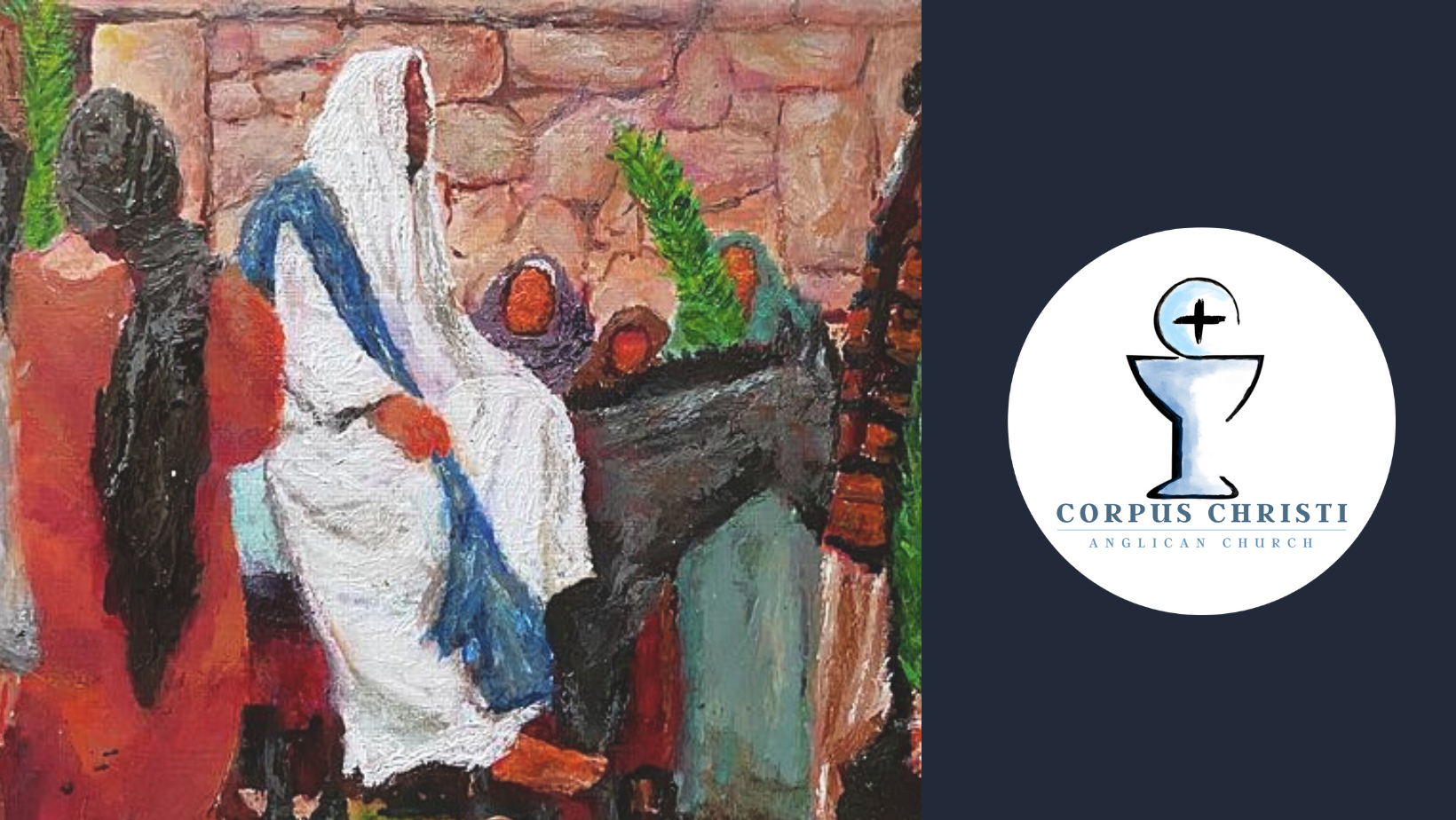
They bring him a colt. And those who are following Jesus, they place their clothes onto this donkey as a makeshift attempt at a saddle for Jesus. The image of Jesus riding in on a donkey into the city is one of hope. It's one of longing that the people have. And it would have certainly stirred up their imaginations for this Old Testament passage in Zechariah 9:9, where the prophet says, “Rejoice greatly, O daughter Zion. Shout aloud, O daughter Jerusalem. Lo, your king is coming to you. Triumphant and victorious is he. Humble and riding on a donkey, on a colt, the foal of a donkey.”
This is in the back of everyone's imagination. And the people are seeing this Davidic ruler come in on this donkey into Jerusalem. And they put their clothes down in front of them. They put palm branches in front of him, in front of him, rolling out the red carpet for their king who is coming. And this king would drive out the evil empire that was over them, so they thought. He would destroy their enemies.
He would overturn injustice. He would bring them back to God, this physical liberation, the spiritual renewal. All their hopes are in this king who is riding on a donkey.
Last week I had mentioned Psalm 118, which is a really important psalm peppered throughout St. Luke's Gospel at key points. And last week it was a reminder to the chief priests and scribes, as Jesus is already in Jerusalem, we're actually going back in time this week, that the cornerstone that the builders rejected would become the chief cornerstone. That's Psalm 118.
It was a rebuke to the unfaithful leaders in Israel. This week, Psalm 118 is used again, leading up to Jesus's entry into Jerusalem. And it's a psalm about explaining Jesus's kingship. The people here believe that Jesus is the anointed king. And St. Luke makes that clear as he quotes Psalm 118 and alludes to it. And he does so by calling him the king who is coming.
And St. Luke's Gospel doesn't mention the hosannas. Interestingly, the other gospels do. But the hosannas are actually part of this original psalm, Psalm 118. Hosanna is just a transliterated word in English. Originally it was transliterated into Greek, but it comes from Hebrew. It's a phrase, actually. It's a prayer. Hoshiana, which means like, “deliver us”. It's a command.
Lord, deliver us. Hoshiana (הושׁיע נא). And so it's this prayer that we actually pray, hoshiana (הושׁיע נא), every single week when we celebrate the Eucharist.
It's a reminder that Jesus alone can deliver. Jesus alone can save. From the various things that war against our soul, that war against the image of God in us, us becoming fully alive in him.
And so adults and children, in the passage this morning, joined in these chants for this royal procession. Hosanna, blessed is the king who's coming. People were singing songs of praise for a victory that went much deeper than any of them actually understood.
At the same time, there was this group of religious leaders, the Pharisees, who were not the same as the Sadducees. These ones were sowing seeds of doubt that were more insidious than they were probably aware of. They were the group that helped implement faithfulness to the Torah, that's a good thing, for a people that were dispersed.
And as such, they had a certain authority among the people to adjudicate the meaning of scripture, to make decisions about how to apply law to life. And what makes them nervous is that if Jesus really is the king, then their power is gone. They have to hand it over to him as Lord.
And it's like they're saying, it's fine to have someone overthrow secular authorities like Rome, we are all about that, as long as I get to keep my little fiefdom. I don't want to give up control. But the problem is, Jesus is king.
And if he's king, then he is Lord of all. And that's really hard for us sometimes, just like the Pharisees. It's often easier to cling to what's familiar, what we feel like we have control over, some nostalgic memory, no matter how broken it is, than to risk going into the unknown, where we trust that Jesus is Lord, and where the things that feel really hard might actually be redemptive for us.
And so this movement from the triumphal entry into the passion narrative invites us to look at our own desires, what faithfulness looks like when expectations go unmet, when we're really disappointed at how things have turned out, and what trust looks like when brokenness and nostalgia feel safer for us than stepping into what's unknown for the sake of experiencing new creation in the resurrection. It's fun and exciting to get whipped up into the frenzy of the crowd, to lay down your palms and to join the celebration when things are good, but what are we going to do when things don't turn out as we hoped they would? And so the Pharisees look like they want people to follow God, but at the end of the day, they'd rather have a broken fiefdom where they are Lord, than the kingdom of God, which is unknown to them, where Jesus is Lord of all. And the kingship of Jesus is won, as we've said at several points today, through the road to the cross.
His throne was a cross. And those who are going to take up the mind of Christ, that are called to follow Jesus in his sufferings, trusting what feels terrifying and unknown, are still going to be filled with the presence of Christ as we go into those places. What feels like shame can be acknowledged, and it will eventually be redeemed.
What is an upset or unmet expectation, a small death of sorts, is actually the road to life with God, and it is not an accidental blip along the way. Are we going to be those who follow Jesus only when we feel like it, when it's exciting, when we're swept up with the emotion of the crowd? Are we going to walk with him when it is difficult on the way to the cross? Will we hold so tightly onto the parts of our life, people in our life, those little moments of nostalgia, no matter how broken but comfortable? Or are we going to recognize Jesus as King of kings and Lord of lords and entrust ourselves to him, even though it feels costly to walk into what's unknown? This is the question posed to us on Palm Sunday. If God were to give us a glimpse of the totality of our story and our journey of our lives, we probably couldn't handle the load of it.
It would be too much. If you're talking to a five or a six-year-old, it would be completely inappropriate as you enter some sort of scenario with them to enumerate all the ways it could go wrong and all the ways that they might suffer as they grow up and move into years and years ahead. It's too much for their little hearts to handle.
So what do we do? We fill their hearts with truth. The truth of what is true around them, whether or not they feel it. And we tell them what is next.
We tell them a little bit of what to anticipate, but not the greater narrative of what could be. We remind them of what they can do, what might feel new, what might feel scary, and we help them take the next step forward. We don't need to give them more to be fearful about in the future.
Some kids are good enough at figuring that out themselves, and many of us are too. And so we help them hold on to what's true and good and just take the next right step forward. And Poem Sunday reminds us that the larger picture is our redemption and it's our life with God.
But God in his kindness doesn't give us the full glimpse of how we are going to get there because it's too much for our hearts to handle. He just gives us the next right thing to do, the next right thing to desire, because the greater picture might be too much for us. So as we enter Holy Week together, I want to encourage us to consider whether we find ourselves like the crowds or the religious leaders or vacillating between either one on any given day.
How does following Jesus feel difficult, terrifying, or threatening to our sense of control? What do we need to hand over to him, to his control? And will we still follow him into the next step of faithfulness as he leads us into the hard places that we never wanted to go? As we prayed in our collect together, I think that this is the way of the cross where we discover that the cross is the way of life and peace. That phrase has always been challenging and mystifying to me, that the way of the cross would be the way of life and peace. The way of the cross is the place of life and peace because that's where Jesus' presence is found.
We don't always have answers, but we do have his presence. And the cross is the means by which he disarms the kingdom of darkness and the means by which he is Lord of all. And so this Holy Week, I want to invite us to take up the mind of Christ together to discover the love of God in the way of the cross so that we might find it none other than the way of life and peace.
Let me pray for us. “Almighty God, whose son went not up to joy, but first he suffered pain. And entered not into glory before he was crucified. Mercifully grant that we, walking in the way of the cross, may find it none other than the way of life and peace. Through Jesus Christ, our Lord. Amen.
Transcribed byTurboScribe.ai. Edited by the Author.