
SERMONS
Archive
- September 2026
- August 2026
- July 2026
- June 2026
- May 2026
- April 2026
- March 2026
- February 2026
- January 2026
- December 2025
- November 2025
- October 2025
- September 2025
- August 2025
- July 2025
- June 2025
- May 2025
- April 2025
- March 2025
- February 2025
- January 2025
- December 2024
- November 2024
- October 2024
- September 2024
- August 2024
- July 2024
- June 2024
- May 2024
- April 2024
- March 2024
- February 2024
- January 2024
- December 2023
- November 2023
- October 2023
- September 2023
- August 2023
- July 2023
- June 2023
- May 2023
- April 2023
- March 2023
- February 2023
- January 2023
- December 2022
- November 2022
- October 2022
- September 2022
- August 2022
- July 2022
- June 2022
- May 2022
- April 2022
- March 2022
- February 2022
- January 2022
- December 2021
- November 2021
- October 2021
- September 2021
- August 2021
- July 2021
- June 2021
- May 2021
- April 2021
- March 2021
- February 2021
- January 2021
- December 2020
- November 2020
- October 2020
- September 2020
- August 2020

Ash Wednesday: Eliminating Self-Deception and Prioritizing the Kingdom

Transcription
Well, good evening again everybody. Thank you so much for being here tonight. Thank you for making the drive. I know the weather was a little challenging and a lot of you are coming from work, so thank you for making time to begin Lent together with your church community.
I'm the vicar here at Corpus Christi Anglican Church, and this is a season that reorients our priorities to the priorities of the kingdom of God. Lent is a season that helps us peel off all the layers of self-deception that we have started to build over time, to do the hard work of naming the truth and then asking for God's help and mercy because he's more ready to give that to us than we are to ask for it. And so as we consider getting our priorities straight, I want to look at three parts of this passage.
First, keeping good rhythms. Second, be honest about where self-deception lies. And third, framing your earthly life in light of the life of God's kingdom. And so as we look at this passage, Matthew chapter 6 tonight, let me pray for us. In the name of God, the Father, the Son, and the Holy Spirit. Amen.
Lord, may the words of my mouth and the meditation of my heart be always acceptable in your sight, O Lord, my rock and my Redeemer. Amen.
Keep Good Rhythms
Well first, keep good rhythms. Keep good rhythms. In the passage today, Jesus mentions almsgiving, fasting, and prayer. And it's assumed that these pious Jews, his followers, are going to have these rhythms.
He's not exhorting them to start doing them as though they're not. They are already doing them, having these rhythms of almsgiving, fasting, and prayer. These are the rhythms that recalibrate God's people to God's covenant faithfulness when God is their king.
So giving towards the plight of the poor is an invitation to the justice of God's kingdom where the wrongs are going to be made right. And that's what we're giving towards as we give to the Lord. Prayer is this invitation to commune with the God of heaven, to get clarity on what his love is and what his will looks like, so that as we pray every day, his will might be perfectly done on earth as it is in heaven.
And then fasting is this invitation to depend on our Creator. It doesn't always mean food, but for them it often did. For us it often does. And it's this invitation to depend on our good Creator to examine all the ways that our appetites, our wills, and desires lead us and guide us rather than the God who loves us. And so the church, even in the earliest centuries, continues these habits in the new covenant where Jesus is king to recalibrate life to what it looks like to return to the covenant where we live under the kingship of our Lord Jesus. And so when we fast, pray, and give alms, we're invited into dependence, justice, and love that frames our earthly life in light of heaven.
And if you haven't realized this yet, you will, that living in northern Virginia can feel frenetic. Yes, I know that's surprising. And sprints are fine.
If you do a 50-yard dash, it might be doable. But you can't sustain that pace for years and for decades. And so Lent invites us, helpfully, to just stop and slow down, cultivate rhythms that are this wholly upsetting of our sprinting pace.
Changing your evening routine, maybe waking up earlier, how you do a meal, perhaps intentionally skipping a meal for the sake of prayer, changing a diet like going vegan, carving out part of your budget to support God's work in your neighborhood or in the church or around the world, using prayer tools like the examine or other prayer tools. All of these things contribute in new ways to a wholly unsettling to push us off our frenetic pace, to disorient us so that we're reoriented to the kingdom of God where Jesus is Lord. Lent is a wholly unsettling, so we need to keep good rhythms.
Be honest about self-deception
Second, we need to be honest about where self-deception has filled our hearts. Jesus had warned his followers about the motives that they were doing for prayer and for almsgiving and fasting. And it's not wrong to be noticed by others.
It's not like if you see somebody with a cross of ash on their forehead during the day that they're somehow disobeying Jesus. It's about motivation. What is the aim and the goal of practicing piety before the Lord and the outward actions that are associated with that? Wanting to be noticed fuels self-deception.
If you're wanting to be noticed for how holy you are, you are fueling self-deception. It reminds me of gardening because we were doing some gardening yesterday, and there are a lot of plants that I've tried to plant along our fence, and they all die. Even ones I thought would do just fine, like thyme, have died along our fence.
And now what's happening that is killing those plants? It's Virginia clay, my arch-nemesis. And so, besides English ivy, that's my other arch-nemesis. So I have two arch-nemeses, but Virginia clay. So unless I spend some time amending the soil, you know, what's underneath the surface is going to continue to kill whatever I put there. Doesn't matter how nice that plant is, it's eventually going to die. We don't want to have the kind of spirituality that signals our piety to other people, but what it's actually doing is fostering a kind of death inside of us in our interior life.
And so what have we allowed to calcify in our inner life that needs to be broken up and amended? I can't answer that question for you. It's a question to ponder during Lent. What have we allowed to calcify in our inner life that needs to be broken up and amended? Have we begun to believe false narratives that we've created about other people, about ourselves, about God? Are we making decisions, communicating out of a place of fear, allowing our external circumstances to guide our decisions? But we need to let our prayers, each of our gifts, each thing that we give up or take on in this season with new rhythms, each of those things is contributing to the breaking up of the hard soil of our inner life.
And so we do these things all with intention to break up what is hard underneath. And so don't be afraid to look undone before other people. This is a season to remind each other that you are a mess. I mean, we are a mess. All of us are a mess. We are like that unfinished wall that is sitting there that is completely undone. That is all of us. We are a mess. This is a season to acknowledge it, embrace it, and give comfort to one another that it is okay to be a mess together in community.
Acknowledging our mess in community is actually the beginning of rightly ordering your interior life under the rule and the reign of King Jesus, who, as I said, and as the colic says, he is more ready to hear than we are to pray. And I love that collect.
Adopting Kingdom Priorities
So we looked at keeping good rhythms. We looked at eliminating self-deception. Finally, let's look at adopting kingdom priorities. Jesus ends this passage with this reminder that where your treasure is, that's where your heart's going to be also.
Heaven is God's realm. So heaven's God's realm where he abides and where his will is done perfectly. It's not something ethereal out there.
It's an alternate sphere that overlaps and interlocks with the age that we're in now. The age to come, the age we're in now, heaven and earth overlap and interlock. And that's important because what that means is that there's the possibility that we get glimpses of heaven in our day in and day out experience right now.
And it's not all something just to be looked forward to in eternity. And that's important because Jesus, what he does in his earthly life and in his death and resurrection and in his ascension on high, is he breaks into this age into the realm of the earth with the realm of heaven. And we see heaven meeting earth in the person of Jesus.
And so in Lent we make extra space to ask God to break into our realm again. And then to give us glimpses of what things will ultimately be when Christ is in all and over all and all things are in him. And so it's not an invitation to be so heavenly minded that you're of no earthly good.
Let me say that again. This is not an invitation to be so heavenly minded that you're of no earthly good. Instead, it's an invitation to prioritize your earthly life around God's priorities.
We learn to love our enemies even when we publicly or privately disagree with them so that we learn God's love for them and for us. And so that ultimately they learn it as well. We abide with Christ.
We endure disappointments. We endure unmet expectations and sufferings not as things that are distracting us or taking us away from the will of God, but as those things that are, in accepting them, they are meaningfully part of God's forming us into the image of Christ. And so we take, we make time and we allot our resources to love and serve those who are the least, the lost, the forgotten, because in God's kingdom those are the ones to be honored as divine image bearers.
And this is the reality of heaven breaking into earth. Prioritizing God's kingdom has ethical implications both personally and publicly, and we don't do things to be seen by other people because we want God to break in through our layers of self-deception and to form us into the image of his Son. So in conclusion, this passage has three important points.
Keep good rhythms. Break through the hardened layers of self-deception and adopt God's kingdom priorities. This is the invitation of Lent, to keep good rhythms.
Break through self-deception and adopt God's kingdom priorities. And so tonight you're gonna receive a bit of ash on your forehead, and it's in the shape of a cross, the Lord being our helper. I'll do my best.
The ash reminds us that each of us one day will die, which is really hard to think about. The reality is like in our culture they have built habits to avoid remembering death, and so Ash Wednesday cuts through the culture's self-deception to remind us to make things right with God and right with others as there is still time. And the shape of the cross reminds us that there is hope for us, that Christ has defeated death, and that God loves the dust that we are.
God hates nothing that he has made, as our collect says tonight, but God longs for our forgiveness, and he longs to grant us his mercy. And so tonight invites us into a whole season of repentance and renewal as we start to break up that hard soil and begin to rightly order our interior life once again.
Transcribed by TurboScribe.ai. Edited by the author.

Transfiguration: A Vision of the Glory of Jesus for the Valley of Demons to Come
Transcription
Well, good morning again everybody. It is good to see you. I'm Father Morgan Reed. I'm the vicar here at Corpus Christi Anglican Church. If you haven't heard the term vicar before, it's because we Anglicans have great terms for things. And so I am like the equivalent of a senior pastor of a mission church that's still in formation. And as we are growing, those titles change, but that's what they call me in the Anglican world.
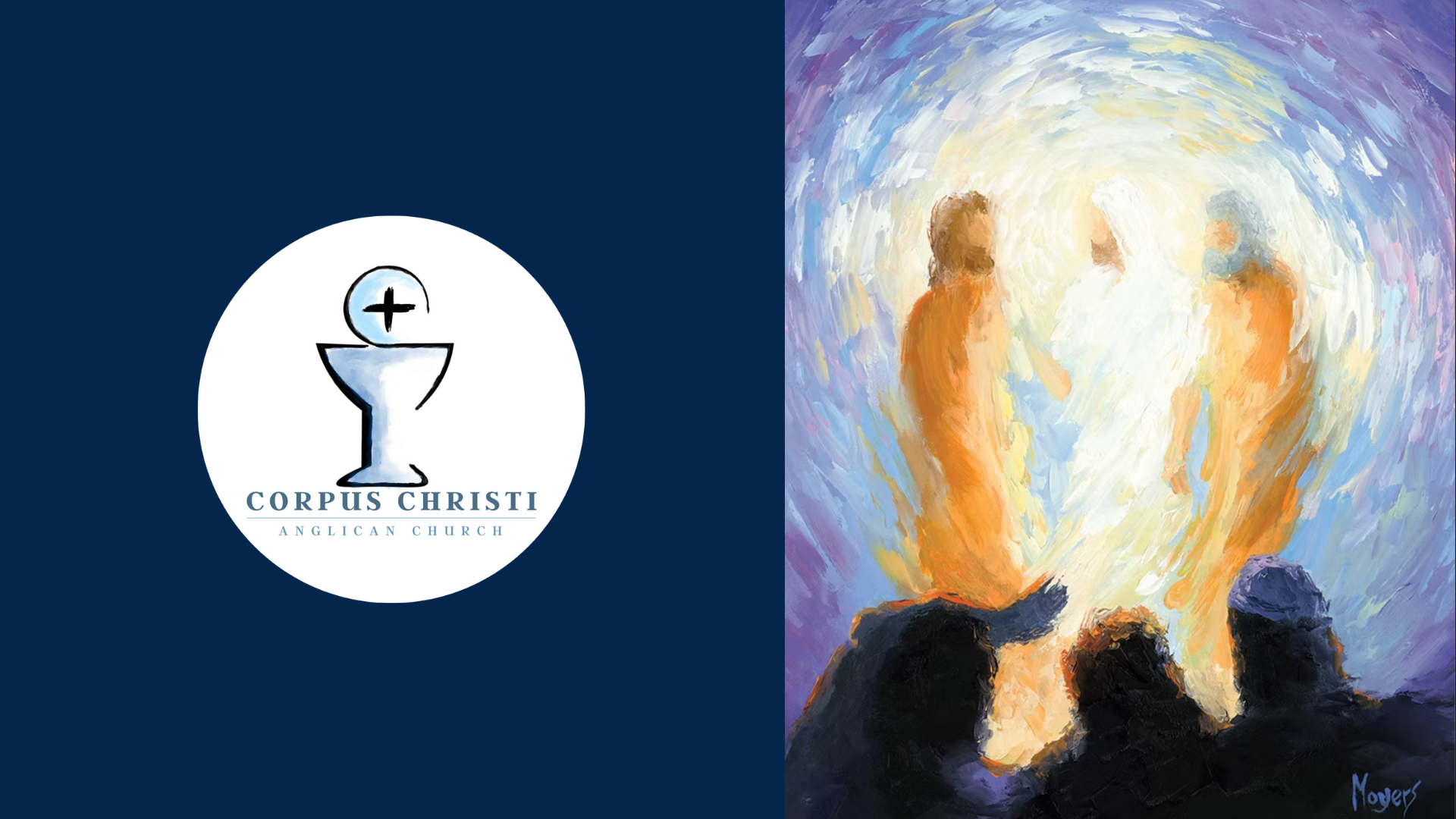
It is great to be with you this morning. And this, as I mentioned before, is the final Sunday of the season of Epiphany, where we focus, as a whole season, on the glory of Jesus Christ, this loving rule and dominion of God that is over all the nations, that comes through the person and work of Jesus Christ as our King. And today, this Sunday, focuses our attention specifically on the glory of Jesus in the transfiguration of our Lord on the mountain.
We don't know which mountain, perhaps Mount Tabor, but we don't exactly know which mountain it was. Up to this point, Jesus' disciples, they've been receiving bits and pieces of information and seeing glimpses of something of the kingdom of God. They've been hearing about it from Jesus, and now they're putting it together.
And this moment is putting it together in a way that's going to prepare them for the valley that Jesus is about to enter, and the valleys that they themselves are about to enter. It's interesting that in the Gospels where this story is recorded, each gospel writer always follows up this story with the boy who is possessed by a demon that only Jesus can heal. And so, you know, it's helpful for them.
The glory of the transfiguration is preparing them for a valley of demons that they're about to face. It's preparing them and preparing Jesus in some ways for the valley that he's about to enter into as he goes down to Jerusalem, the place where he'll be crucified. And so you can see as we end the Epiphany season why this focus is so helpful to bookend the glory of God in the season of Epiphany, but then to begin our time of Lent together this week.
And like Jesus's disciples, you and I are putting the pieces together slowly. We are often vacillating somewhere in between incredible, meaningful encounters with the God who loves us, the joy of sitting in his presence, and moments of failure, panic, disappointment, and feeling like God is woefully distant. Somewhere in between there on any given day we are vacillating, right? And so we don't often understand those things that Jesus is preparing us for in those moments between the radiant glory of God and the valley of demons.
But the best posture to adopt as we vacillate between those things is a posture of listening to the Son. Listening to the Son of God. As we open ourselves up to what God is doing in his kingdom work, and as we focus on the glory of God here in the Transfiguration, there are three things that I want to think about this morning.
First, Jesus prepares us for what we will face. He does. Jesus will prepare us for what we will face. Second, Jesus is present on the mountain, but He's also present in the valley. Jesus is present on the mountain. He's also present in the valley. And third, God invites us to listen. Those are the three things I want to think about this morning.
Jesus prepares us for what we will face
So let's look at how Jesus prepares us for what we're going to face. Jesus takes his disciples up to a mountain to pray. This is something they do a lot. And while Jesus is praying, something not common happens. Jesus's appearance, the appearance of his face changes into something other. His clothes become dazzling white, and then two men appear with Jesus, Moses and Elijah.
Why Moses and Elijah? We aren't 100% sure, but perhaps it's something to the effect that as prophets in the Old Testament, Moses shows us something of the prophetic office that Jesus is going to come to occupy. And Elijah is, as a prophet, a portrayal of Israel's hope in the future, in the Eschaton. And so Jesus is talking with those who he is going to fulfill their ministries, both looking backwards and looking forwards.
And so the disciples get to hear this dialogue. They're kind of like in and out. They're really tired. They're not totally asleep, but they come to be alert when this happens. They see Jesus with these two prophets, and in this dialogue that's happening, Moses and Elijah are speaking to Jesus about his departure that he's about to accomplish at Jerusalem. And that word departure is really important.
This doesn't come across in English, but if you're reading it in Greek, the term that they're using is ἐξοδόν. Does that sound like something? “Exodus”. Yes, exactly. It's a very loaded term. And so in this passage, those who are listening would have totally been conjuring up images of Israel's exodus in the past, and looking forward to the deliverance in the end, where the kingdom of God is fully established. And so the disciples, as they're listening, images of the exodus of God's people are being conjured up in their minds.
And I think New Testament scholars are right to point out, some will say that it's not just Jesus's death, but this is actually truncating the entirety of his salvific ministry. His death, his resurrection, his ascension on high where he reigns as king, and his coming again, which in Catechesis of the Good Shepherd, they like to throw around the term παρουσία quite a bit. That's his coming again to establish all things in the fullness of God's glory where Jesus reigns as king.
All of that together is the exodus that we're talking about. This is the departure that's about to begin at Jerusalem and be fulfilled in his coming again. And so up to this point, if you think of what the disciples have been going through, they've been hearing bits and pieces about the kingdom of God through all these enigmatic parables that Jesus has been teaching. He's mentioned his death in somewhat veiled terms, it seems to confuse them, and he's said these elusive commandments to take up your cross and follow me. Well, what does that mean? He hasn't yet been crucified. They're putting the pieces together without the full picture.
And so these are all pieces of the larger picture of God's kingdom story that they'll come to understand, but they definitely don't yet. Jesus here is giving them this sufficient glimpse of the plan of God's kingdom that will sustain them in those moments where things just don't go according to plan. Like, Jesus, I did not think this was how your kingdom was going to come.
Is your kingdom even coming? Whatever those moments are, this glimpse is supposed to sustain them when those things that don't fit in the plan will happen to them, which they will. And so Jesus, you know, when tragedy strikes and things don't turn out the ways that they thought they would, they need this vision. When they watch their Lord being crucified, this moment of glory on the mountain was meant to remind them that that tragedy of their crucified Messiah is actually part of a cosmic exodus from the kingdom of darkness, where we're all enslaved to the powers of sin and death, to the kingdom of darkness, that this cosmic exodus of God is being brought about through this crucified Messiah.
And God often gives us glimpses of the story that he's telling, if we would pay attention to them. But it does take work to recall those stories in your life. I remember a particularly challenging season in my own story, where I was wondering, as a clergy person, have I made the right decision? I'm sure other pastors have thought that at times. I'm sure maybe in your work you've thought, have I really made the right decision? And in my story, it was there was people, not at this church, none of you, there were people that were making my life really challenging, and it was really hard to the point where I thought, maybe I've just chosen the wrong thing. I should go back to Starbucks. And maybe, but you know, maybe you've had similar doubts in the course of your work, too.
These hardships. And in those moments, what I did was I looked back and I asked, God, where are the sort of mountaintop glory experiences that I can look at where I actually knew you were present? I hang on to those moments and recount them of where was God present that led me up to this point? Because I didn't do this on my own. I didn't just like will myself into this.
Quite frankly, the church wouldn't have okayed my ordination had I done that. But the thing is, I needed those moments to look back on and go, if God has been present before, I know he's still present right now, even if I'm not in the same state of joy that I was in those moments. That was a season of the Valley of Demons for me, and I know that several of you have gone through your own seasons of the Valley of Demons, and perhaps you're in one at the moment.
And so in those times, it's really important to remember the glory of God, keep a short list of the experiences where you know God has been close. Because there are moments where God is present, but his closeness and his presence may not feel tangible.
Jesus is present on the mountain, but He's also present in the valley
And so we've looked at how these moments of glory, they're preparatory. They're preparing us for a season of the Valley of Demons, for what's coming. And then second, I want to look at that Jesus is present, whether it's in the dazzling white clothing on the top of the mountain, or it's in the Valley of shrieking Demons. Whether you're here or here, Jesus is present.
It's that long obedience to Jesus through the ups and the downs that the redemptive story of God is being shown. And so these high moments prepare us for the low moments, but it's in looking back on those highs and lows that we piece together the story of the kingdom of God that he's telling in our story. And so we might be tempted to think that when we have arrived up here, that we've hit all that there is.
Like, I've arrived. Whether we're in the high or the low, Jesus is present. And so we need to hold on to those moments as preparatory.
We think often, like, I remember hearing as people were doing their Bible studies, you know, I had a really great time with the Lord this morning, and that's awesome, but not every day is like that, right? Or I came to worship and I didn't get anything out of it today, right? But the reality is there are highs, there are lows, and it's in this long obedience between the highs and the lows that we piece together the story of God's redemption. And even when there are lows where we don't feel his presence, we know he is there, and these things, these rhythms, are feeding us despite the fact that we may not feel his presence so closely. So we get to the text, and just as Elijah and Moses were about to leave, Peter says, “Master, it is good for us to be here. Let's make three dwellings, one for you, one for Moses, and one for Elijah.” And then it says, “…Not knowing what he had said.” Like, imagine, he didn't know what he was really saying in that moment.
And so Peter was asking them to celebrate a Jewish festival, the Feast of Booths. And the Feast of Booths celebrates God's redemption of Israel, bringing them out of Egypt in the Exodus, and it anticipates God's ultimate deliverance of his people. Peter recognized that that was a significant moment that they were in, and, you know, he didn't know the significance of the moment that he was in.
Maybe he wanted to prolong that moment to get more information about the kingdom of God. Maybe he thought, it's about to come now, right? You can imagine having a crucified Messiah is not in their plans. And so you can imagine, if you see Moses and Elijah talking with Jesus, and he looks very different, you think, this is the time, I'm ready, you know.
And so we should celebrate the Feast of Booths. I'm not sure what that would accomplish. I'm not sure he knew what that would accomplish. But he didn't know what else to say in that moment. He's just overtaken with the glory that he is seeing. But he doesn't know what he's asking for.
And so experiencing that moment of the radiance of the glory of God was preparation for all the things that Peter was about to go into, into the future encounters with the kingdom of darkness, in ways that he had no clue about. And again, I find comfort there, because we we can prop up moments of joy like that, moments where we know God is so present as somehow being the standard for how life should always be. It is so easy to go there, or to say, I'm not healthy spiritually unless I am there.
And you know, so again, you might wonder if as I'm reading the scripture, doing the daily office, you know, if I'm not feeling anything, am I doing this right? Is there something wrong with me? But again, of all the days that Jesus went to pray, we only have one transfiguration recorded. And so I find comfort in that, that our habits of prayer, our habits of being in community, being formed in community, when you don't feel it, being carried along by the community, and hoping somebody else is feeling something that day, whatever state you're in, these are all formative and feeding us, even when they're not memorable, right? There's an analogy that comes from a couple authors about food. I can't, I have a bad memory anyways, but I can't tell you more than ten meals I've had, probably, because they were memorable, but I needed all those meals to feed me.
And so worship functions like this. Even in the unmemorable times of worship, I am being fed, and I may only remember ten of those, right? Or something like that, but I need them all to feed my soul. And so we should thank God for those deep moments where God's presence and abiding in God's presence are filled with this consolation of Jesus's good presence being so real to us.
And don't worry when he's not. You can take comfort that sometimes you're in those moments where he is present, but his presence is sometimes more difficult to experience. And those moments where he has been really present are a preparation for those moments where he doesn't feel present.
And so name those moments, write them down, keep them close, that he feels so real. And then sometimes name those moments where he doesn't feel like he's really present. Because as you piece those things together, you're starting to piece together the story of redemption that God's telling in your life.
God invites us to listen to his son
So we looked at how he prepares us for the things we're gonna face. We've seen that Jesus is present, whether it's on the dazzling, in dazzling clothes on the mountain or in the valley of shrieking demons. And finally, as we live out life in the kingdom of God, God invites us to listen to his son.
I'm not good at listening, so this was really helpful for me. After Peter utters his saying, there's a cloud that overshadows them. This is something like the theophany that we talked about where Moses's face is shining, the cloud of God, the Shekinah, the glory of God, overshadowing the people and bringing them out of the wilderness.
This cloud that reminds them of something of the Exodus, overshadows them and says this is my son, my chosen one, listen to him. If you remember back to January 8th, at the beginning of our Epiphany season, I preached on the baptism of the Lord that day. It's the day where we celebrate his baptism and that really kicks off our Epiphany season.
And now this language that was at his baptism of my son, my chosen, brings together two really important passages. Psalm 2, which is kingly coronation language, and Isaiah 42, which is the chosen servant, and the songs of Isaiah are being brought together in the person of Jesus. So the one who will redeem Israel, the one who will bring them out, the one who will be king over all, is brought together in Jesus at his baptism, and bookending our Epiphany season is brought together here at the Transfiguration.
And so Epiphany is bookended by those important statements. The heavenly voice tells us about Jesus's kingship over all things, that as the beginning of his ministry, again to remind the disciples of that same truth that Jesus is Lord, he's king, they're going to need to know this as he goes down into the valley. He's the one who's going to bring redemption to Israel.
He's the one that's going to carry out the fullness of God's kingdom and justice, and reign over all nations, and overthrow the kingdom of sin and death. And that the crucifixion is not a deterrent from that plan, but actually part of it. And so very importantly, this voice from heaven says, listen to him.
And as a result of that, it says they kept silent, and they didn't tell anybody what they'd seen until a lot later. And at some point, they will come to talk about it, since it's written in the Gospels, but they needed to know that they could listen to Jesus and trust him as king, because the thing that was going to happen next did not look like they expected it to happen. This was not supposed to be God's plan for the Messiah, that he would be crucified by, you know, pagan powers in the city of Jerusalem.
This was not part of our plan, and they needed to be able to trust him. And so Jesus continually disappoints his disciples with unmet expectations about what God's kingdom is going to look like, as they move from the Mount of Transfiguration on Mount Tabor to the crucifixion at the hill of Golgotha. Somewhere between those two mountains, they're going to experience a lot of disappointment.
And they need to know that Jesus says, and what he does will guide them for continuing the work of the kingdom of God. When Jesus rises from the dead, they'll begin to tease out and connect these dots of the revelation on the mountain with the rest of his ministry. But between these two mountains, between Mount Tabor and the hill of Golgotha, they really are at God's mercy in their unmet expectations, and having to listen to the voice of the Son.
And so it's a good reminder that you and I, we are all in these moments where we vacillate between being on the mountain, where Jesus feels so good, so present, so powerful, to moments where we wonder if we've messed things up beyond Jesus's ability to fix them. If we're being punished for something outside of the boundaries of God's love. Like, I have messed up so bad that not even God could love me.
Just feeling like we're stuck, like there's nothing that's going to budge in our lives, and we can't understand why God doesn't seem to answer our prayers, or why his presence feels so far from us. Somewhere in between those two things, we're often going back and forth. And so whatever he's bringing us through, this command is to us as well.
Listen to the Son. He's trustworthy. He knows what he's doing. He gives us the moments of glory as preparation for the moments where his glory is hidden. Begin to name those things that hurt to God. Tell him what hurts, so that our hearts are open to healing, rather than closed off in a defensive posture.
We need to look for the face of Christ in other people. Yes, when they bring us joy, but also when they drive us crazy, and even when they offend us. We need to discover the face of Jesus in them. We can go on a walk, and we can look at the kind gestures of God in the world around us. That's often my help. I love in the spring to just watch the plants grow on the mountainside and the creek to flow, and to know that I had nothing to do with it.
It's really helpful. The specifics of what you do to listen to the Son are sort of secondary. Keep the daily office.
Keep your prayer rhythms. We're going to talk about fasting, almsgiving, and prayer during Lent. These are all good rhythms. But the main thing is that we're moving towards the love of God. And we're moving towards loving what God loves in whatever we are doing. That's listening to the Son.
We don't pursue the kingdom through military might or worshiping power. We experience the lordship of Jesus and the kingdom of God by just stopping, breathing, and listening to the voice of Jesus. And so rather than doing what I would normally do and ending my sermon with more words, what I want to do today is have almost two minutes of silence, which is going to feel a little awkward.
And that's okay. And in those two minutes of silence, I want to invite you to pray about two questions. Jesus, where are you today? So sort of in that question, think back on the day, on the week.
Where is Jesus present? Even in those moments where you may not have felt present. And then, Jesus, what are you saying today? Jesus, where are you today? Jesus, what are you saying today? So I invite you, in the next two minutes, let's just be silent. Jesus, where are you today? Jesus, what are you saying today? And I'll conclude us with an amen.
[Silence]
Amen.
Transcribed by TurboScribe.ai. Edited by the author.

Missionaries of God’s Kingdom
Transcription
Today is World Mission Sunday, and we have just heard four wonderful texts; but I'm going to focus on just one verse from the Gospel for today:
As the Father has sent me, so I send you.
But before I get into the sermon, I would like to conduct a very brief survey. On the first one, I would just like a show of hands.
So first question - Would any of you who are missionaries, please raise your hand. Okay, one, two, three, four, five, six, seven. Some are not quite sure whether they're missionaries or not, but that's okay.
Now the second two questions, just answer it in your own mind. This is not a quiz and there will be no grades on this. So second question - Who was the first missionary in the Bible? Make a mental note. Who was the first missionary?
And the second of these two questions was - Who was the supreme missionary mentioned in the Bible? Okay, you've got those in your mental notebook. Here we go.
1. Well, of course, I'm sure you all, or almost all of you, noted that the first missionary was Father Abraham. He obeyed God's instructions and he didn't know where he was going, and I think that's a good point. It's important to know that. Just because you've been given orders by the Lord, it doesn't mean you know exactly what's going to happen next. In fact, that's part of the fun, although it's part of the danger as well.
Around 1900 BC - the archaeologists are able to give us this rough date for the time of Abraham. He's not a figment of somebody's imagination, but he was a real person and he lived in the real world of his time. His ancestors were migrants, probably from the ancient urban culture of Sumer (and I'm resisting talking about this because I think Sumer is fascinating. Anyway, ask me about that privately if you wish.) So, his ancestors came from Sumer.
The point is that they were not primitive nomads. They were sophisticated city people from what was at that time a high civilization. And his father was called to leave the city of Ur in southern Mesopotamia and ended up at Haran; yes, in what is Syria today. And it was there that Abraham heard the call to "go from your country and your kindred and your father's house to the land that I will show you, and I will make of you a great nation, and I will bless you and make your name great so that you will be a blessing. I will bless those who bless you, and him who honors you I will honor, and him who dishonors you I will curse. And in you (and this is really the punchline here) in you all the families of the earth shall be blessed." (Genesis 12:1-3)
Wow, that's weird. So, equally weird, Abraham obeyed. He went as the Lord had told him. If you want the rest of the story, you're gonna have to open the Bible yourself and read Genesis chapter 12 and following.
God had promised Abraham that he would have many descendants, but not until late in his life did he finally have a son by his wife Sarah. And then, this terrible story, completely opposite to Abraham's expectations - God told him to sacrifice his son Isaac, who at that time was probably in his early teens. Abraham was on the verge of carrying out the sacrifice when at the very last minute God provided an animal in place of Isaac.
This to us is a very strange story. I have struggled with it for years, but I think I understand now what was going on. In the culture in which Abraham lived, people understood that the promise to Abraham was the making of a covenant-relationship between God and Abraham, a long-term promise of absolute trust.
Some of my friends have criticized me in the past for always talking about covenant, but I don't think you can talk about it too much, because we really need to get a hold of it. A covenant is a promise between two parties which is absolute and it's for life - it's long-term. And this is the bit that some slow-witted people like Steve Arpee didn't get:
A covenant relationship in the ancient world was always sealed with a sacrifice. Why? What was the point of it? We know that in many ancient cultures sacrifices were rituals intended somehow to manipulate the supernatural powers; but that wasn't what was going on here. What was going on was the making of a covenant-relationship, and the sacrifice was a way of affirming one's promise.
The sacrifice was a way of affirming one's promise, declaring in a visible way that everything the two parties owned was committed to keeping the promise. The sacrifice is a visible way of demonstrating that everything that was in the power of each party was owned by the two parties, was committed to keeping that promise. So the sacrifice was really important, it wasn't hocus-pocus. It wasn't an attempt to manipulate the spiritual powers, but it was a way of saying "I am in this totally."
"Everything that I am and all that I have" is represented by the beast that's offered in the sacrifice and is committed to this relationship. So this is huge. By being willing to sacrifice his son, Abraham showed that he trusted God to keep his promise, even though that looked impossible if Isaac were dead.
How's that for a terrible test? Abraham trusted God to keep his covenant promise, and God saw Abraham's obedience as Abraham's keeping his side of the covenant promise. That is what righteousness means. (Now this is a pet peeve of mine, I shouldn't go off on this, but people tend to think that righteousness is something that we attain by being good boys and girls and doing everything that the rules say. No way, that is not what righteousness means in the biblical context. It means covenant faithfulness.) So God saw Abraham's obedience as his righteousness, that is to say not that he was morally pure, but that he was keeping the terms of the covenant relationship.
So that is the kind of righteousness that has been given to us. If you hadn't noticed, none of us is morally perfect and couldn't get there if we tried. But we are called to be faithful to our promises made in our baptism (which we were going through again last Sunday) to keep our covenant promises.
Okay, so the first missionary was Father Abraham, because the Lord said, "Go and I will be with you and I will show you where to go." And this was a really tricky injunction, but Abraham obeyed and he went. He had been sent, and so we can see him as the first missionary in the biblical story.
2. All right, the second question was, who was the supreme missionary in the scriptures? Well, obviously, Jesus is the supreme missionary. The Father had sent him to do the Father's work in this world. So we can all nod to that. But the world needs to know what we mean by Jesus having been sent by the Father. And we need to know, we need to be able to say, who is Jesus? Now, I'm getting into deep water here. Some of this is pretty straightforward, but just hold onto your seats here.
Who is Jesus?
1. The teachers of the church declare that he is "fully God and fully man." In terms of our way of thinking, at least this simple person, that is an impossible affirmation. We cannot, with our rational minds, see how any person can be fully God and fully man. What in the world, quite literally, are we talking about? We'll just put that aside for a minute. You can struggle. We can talk about this later or for the rest of your life. It's really, it's really important to get a hold of this affirmation.
2. Okay, secondly, in biblical language, we acknowledge that Jesus is the Messiah. Now, in a sense, this is the easy one, because you all know that Messiah means "the Anointed One," which is the title of the King of Israel.
And God had made promises to David and to the people of Israel that his realm would eventually encompass all of the nations. So, oh, some of us think it's really important to recover the political theology of the Bible. And so I really like this, because this is a political concept, and we need to take it seriously as such. So Jesus is the true King of the whole human race, the Lord of this whole planet. And if you follow this out to it's logical application, he is Lord of the whole universe.
This is a subject I think that's been ignored in much of our histories, or at least the language of our readings of history. But I have been reading a little bit about the history of Israel in the Middle Ages, and there were many messiahs. There were wars and revolutions that were precipitated by these Jews who claimed to be the Messiah. But they all just brought destruction and disappointment on the people that followed them. So there have been false messiahs. And actually, if we stretch our vocabulary a little bit, we can see that not only were there false Jewish messiahs, there are all kinds of false messiahs - false claimants to our obedience in the historical process, some maybe not so far away.
3.Another title, which for those of us who have lived in the Islamic world, really is very important. And I think it's important for all of us, and that is the term related to Jesus of "Son of God."
People get all tangled up in biology. This title has nothing to do with biology. In fact, it comes out of the history of the Roman Empire. You all know this amazing general by the name of Julius Caesar, who went on a rampage in Gaul, among other places, and was assassinated for his troubles. But sometime after that event, the Senate of Rome elevated Julius Caesar to the rank of God, or a god. So Julius Caesar was deified by the Roman Senate.
And again, unless you paid a little attention to Roman history, you wouldn't know that. But it's very important because Julius Caesar had an adopted son. And when Julius Caesar's successor was sought by the Senate, they elected a man (Gaius Octavius) whose title was Augustus Caesar, who was in fact the Roman emperor presiding in the whole Mediterranean world at the time of Jesus' birth. So "Son of God" was the title of Augustus Caesar as the adopted son of Julius Caesar who had been deified by the Senate. Now in terms of vocabulary, I think this is of huge importance. Augustus Caesar actually brought peace, order, and prosperity to the Roman Empire. And he was not shy about saying, "I alone did this." And he put up great big stone billboards with the announcement of all the wonderful things that he had done to bring peace and prosperity to the whole ancient world - his announcement of what he had done to bless all of humanity.
You know what's coming? What was the title of that announcement? What was it called? It was called good news. Yes, the good news was about what Augustus Caesar, the son of God, had achieved. And yes, the Greek word, of course, was euangelion, which is translated "gospel." The word is a way of proclaiming the achievement, the role, the power, and the honor of the son of God. It's not talking about biology. If you're concerned about the biology, that's another subject. But that was not the issue for the church in these early centuries. Some people get tripped up in that title. But it's only if you take the title "son of God" as referring to biology.
We need to be able to say who Jesus is in a way that can make sense to the world around us. Boy, is this a toughie. But there's no escape from it is we are to give witness to the covenant-relationship to which we have committed ourselves. We need to be able to explain to people, when they ask us, who Jesus is. The first thing I think that is necessary is to say that if Jesus is indeed fully God and fully man, we are - what do we say, "we're beyond our pay grade." We're into a realm of knowledge and of vocabulary for which we are incompetent. So I think there's a need for very deep humility. We do the best we can to use the words we have, but we have to do it with fear and trembling, knowing that our words are so easily misunderstood. So anyway, that doesn't excuse us.
We still have to do what we can to talk about Jesus, to affirm his divinity, and to affirm his humanity. There's a phrase by an English poet of the 18th century, "to err is human and to forgive is divine." Well, that's good poetry and it has a certain amount of pastoral application, but that is not the definition of what it means to be human. But you all know what it means to be human, of course. What it means to be truly human is defined very succinctly in the book of Genesis. It's to be made in the image of God.
Our character is to reflect the character of the creator of the universe. That's what it means to be human. And we need to be clear on that, fellow-students, and there will be a test. In fact, the rest of your life is the test. What does it really mean to be human? But if we talk about Jesus the human, it's not all that easy. And I wish I could just step down here and let Morgan sort this out, but I'm on the spot here.
Okay, first thing, Jesus is fully human, but he is not a rebel against God. And this is what the word sin means. It means, hey, I hear you claim to be God, sir, but I really want to be God. I understand that you really are the owner of everything, including me and everything that I have, but I want to be the owner. This desire on our part is the essence of sin. It's wanting to be owners and in charge of our world, at any cost.
So, Jesus reflects the father's character and he is, in that sense, fully human, but he never evidenced any rebellion against the father. In fact, he was clearly, deeply united with the Lord of the universe, with the master of all things, whom he call "daddy", Abba. "Father" is too formal a term in English, but we don't have the right language that correlates with the Aramaic at this point.
Furthermore, Jesus clearly had the father's authority to carry out the father's plans for the whole creation. And this is something else that we need to be really clear about. I have to confess, in regard to our theological ancestors, many of whom were pagans, that we tend to have been sucked in by the pagan and Greek misunderstanding of reality - seeing the material world as bad and the intellectual or spiritual world as good, and therefore that "salvation" or "success" was a matter of escaping from the suffering of this world and being liberated to go to "heaven," wherever that was, where everything would be peachy keen.
That is really a pagan idea. It's Greek in formulation, but a lot of our theological heritage in Western Europe has gotten sucked in by that, and we don't understand that God's project is not an escape scheme from this world, but that he has created this world, this world is good, and that he wants us to be partners with him in dealing with this world. And this process, New Creation, (the word doesn't get a lot of emphasis in the New Testament, but it's there, and it's very deep) and that is that the project that God began when he brought this planet into existence and created the human race - his project is ongoing, and it has not been curtailed by human rebellion.
What God has done in the ministry of Jesus, and particularly in his death and resurrection, is to overcome the powers and principalities of this world, who want to mess everything up, who are not wanting to cooperate with God's plan for his creation. So Jesus, Emmanuel, "God with us," came in person to bring this project forward. One theologian calls Jesus' ministry, in fact, the divine revolution against the dark powers of this world. And this is what Jesus is doing to bring God the Father's creation project to completion.
He was sent to complete the creation process that had been begun "in the beginning." It is not a mistake that the fourth gospel starts with the same words as Genesis, because the point is that in the ministry of Jesus, the creation is being brought to its completion. How is that working? I mean, you can look around and say, hey, this isn't going very well, Lord.
3. And this comes around to the missionary's job description, so I hope you're all taking notes, because this is you and me. This is us. Jesus said, as the Father has sent me, so I send you. We are all sent. We are all missionaries.
(a) So what is our role, each one of us, whatever our age? First of all, we are Jesus' friends.
We're not merely servants. The word in Greek, in the New Testament, is doulos, for slave. We are not slaves. We are friends. So we are Jesus' friends. He wants us as partners in carrying forward his mission, to complete the creation.
And of course, we are being created in the process ourselves.
(Oh, I can't resist this. This is a, I don't know what to call it. It's not a metaphor, but it's a word puzzle, you might say, which you are free to ignore, but I just can't, I can't control myself here: We need to be very clear here, The church of God does not have a mission. The God of mission has a church, okay? You got this? I expect you to get this right in writing when the quiz comes around. The Church of God does not have a mission. The God of mission has a church.)
So first, we are friends of Jesus. He takes us into his confidence. He's told us what he is doing, and he invites us to be partners. We act as a partner.
What's kind of a partner?
(b) So we are called to be stewards.
Now, a steward is a person who has the authority of the owner, but he is not the owner. He is a particular kind of partner. A steward is a person who has the authority of the owner, but he is not the owner. He is a particular kind of partner. We act in Jesus' name.
That is, we act with the authority of Jesus. And this is kind of scary. I think it's more than kind of, but our role is to be the presence of Jesus in the world, day by day, wherever we are, in the workplace, in our homes, in our towns.
We have his authority. So we need to know what that is and what it looks like and how we are called to exercise it.
(c) And then thirdly, as I mentioned, we are revolutionaries.
This is a big subject. And as members of the people of God, a shorthand for this is to say that our roles shift back and forth. Sometimes they are to submit to the powers and principalities, and sometimes they are to subvert.
And how do you know what you're supposed to be doing? Well, that's where we have to remember that the Holy Spirit is the primary agent in all of our obedience and all of our relationships. And we need to learn how to listen to the Holy Spirit. And as Morgan would tell you, there are at least three if not four ways we have to listen.
In the silence of our inner life, in our prayers, we have to listen. And that includes, by the way, dreams. Some of our dreams are just plain crazy. But sometimes God speaks to us through our dreams. We need to learn and get the help to understand how God may be speaking to us through our dreams.
God speaks to us when we are struggling with problems. So problems precipitate creativity in our lives. So just because you're having a hard time, don't think that's bad necessarily. It may be difficult. But it is when we are faced by problems that we have to be open to finding something new. And very often, God speaks to us in this situation when we are looking and asking, then he speaks to us.
And he speaks to us through the scriptures, of course. And that's one of the reasons why we're here and why we need people who are scholars to help us with our reading of the scriptures.
And I almost said most of all, because this is closest to my heart, God speaks to us through each other in the body of Christ. And when we've got some brilliant idea or some wild strategy for moving forward, we'd better talk with our brothers and sisters in Christ. And they will say, "OK, right on. Go for it. We'll pray for you." Or they will say, "you're out of your skull and look at it this way." So we need the checks and balances of our own community. But God is speaking to us all the time, or wanting to, if only, we will pay attention
Now, I'm going to read this sentence twice, because this is part of the exam.
The purpose of a congregation is to equip and support each baptized person for our job in the everyday world as Jesus' partners in his New Creation project.
In closing, I'm going to give you a closing survey, rather than a summary, as such:
So first question, who was the first missionary in the Bible, everybody?
Abraham. Yes.Who was the supreme missionary mentioned in the Bible? Jesus. Yes.
And would any of you who are missionaries, please raise your hand. Okay, that's pretty good (strong majority). Some of us, it takes a while to get this sorted out.
And I heard the voice of the Lord saying, whom shall I send and who will go for us? Then I said, here I am, send me. Amen.

The Glory of Jesus in Learning to Love our Enemies
Transcription
Well, good morning, my friends. It is good to see you this morning. I'm Father Morgan Reed. I'm the vicar here at Corpus Christi Anglican Church.
And today it is a joy to be with you. I love Sundays where we celebrate baptisms together. One of the joys of celebrating baptisms is it reminds us of what God calls us into in our own baptism. And so this morning is we make vows and promises together and support Joshua and Grace in their vows and promises. Take a moment to remind yourself that this is God's call on your life as well this morning. We are in the season of Epiphany together, which is a season that focuses our attention on the glory of Jesus as it goes out to the nations.
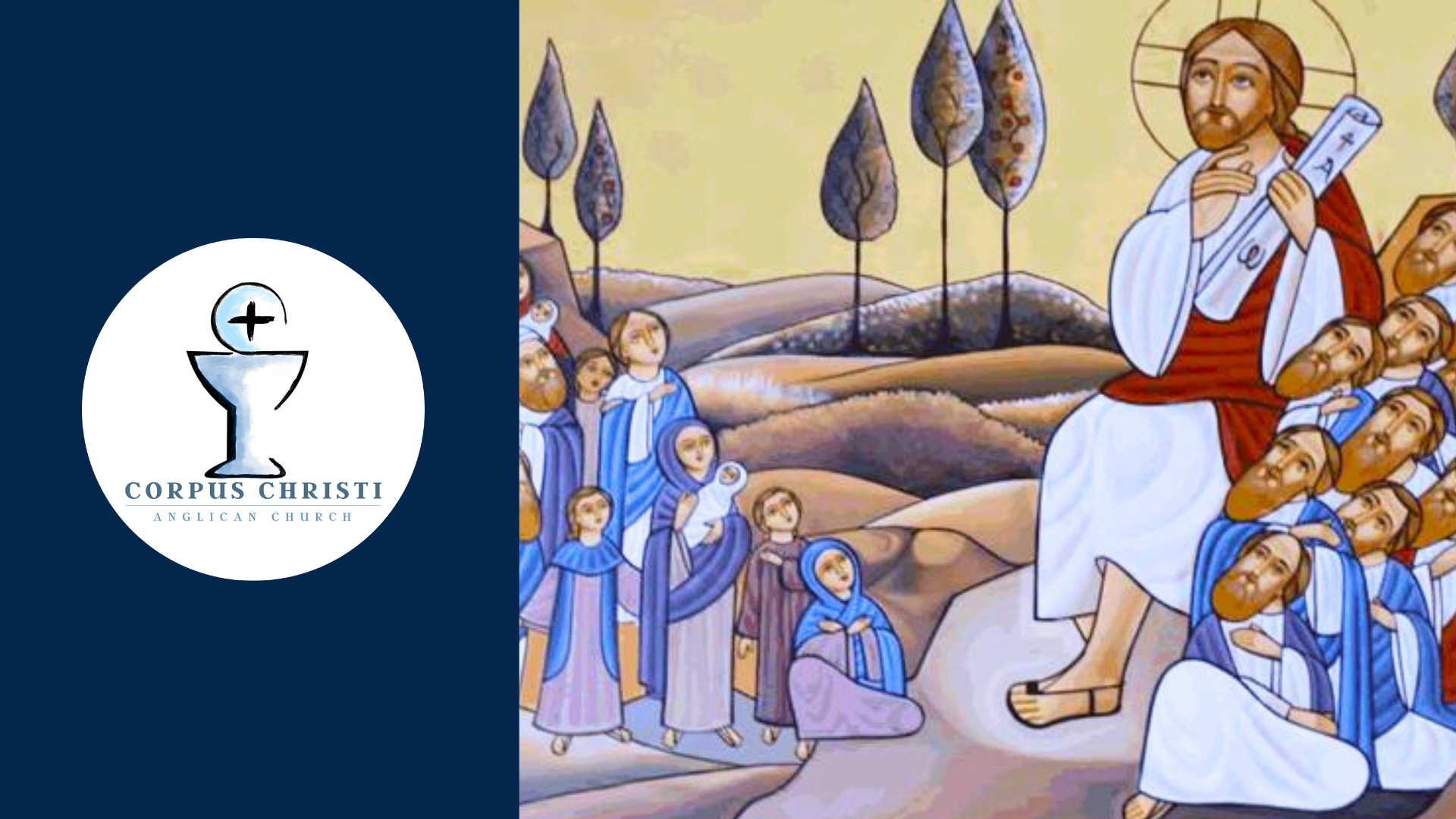
And today's gospel passage is from what's commonly called the Sermon on the Mount. And today I actually did something that I've never done before and I've heard of other people doing it, which is I actually prepared a sermon on the verses after the ones we read today. So I'm gonna talk about how this Sermon on the Mount goes into where we didn't yet get to in the passage, which is verses 27 through 38, where Jesus is going to make this claim about, you know, love those who hate you and pray for those who persecute you or who mistreat you and to forgive those who mistreat you and who hate you.
And this radical love that we're gonna find in the Sermon on the Mount is part of the glory of Jesus going out into the nations. And in Jesus one of the things that the Sermon on the Mount calls us to is to reflect the mercy and the love and the grace of God. And the radical showing of that mercy, grace, and love are to be done because what we're actually doing in that and what the Holy Spirit has empowered us to do is to show the very nature and character of God himself.
And this is what we do, that what God empowers us to do when we're baptized and given the Holy Spirit. And this happens through loving our enemies, through blessing those who curse us, for praying for those who mistreat us. And so this call in the Sermon on the Mount is to continue the the ministry of Jesus by putting God's glory on display to the nations through a radical love, a love which shows the very nature of the mercy and character and grace of God himself.
Loving our Enemies
In a world that has been broken by sin, by disordered attachments and loves, this is our call to proclaim the glory of Jesus through this radical kind of love. The first thing Jesus calls us to, in verse 27, if you have your Bibles, this is Luke chapter 6, Jesus calls us to love our enemies. These commands are written in the context of religious persecution.
These are people who are being called into the way of Jesus, into living in the kingdom, and they're going to experience opposition as a result of living life following Jesus. And so they're called to carry on the good news of Jesus in their lives, and they're going to encounter people who are going to set themselves as enemies against them. This isn't referring to people who undergo natural consequences for doing what's unethical or wrong.
This is about people whose conduct is honorable, it's Christ-like, and then as a result of that, they suffer. And if we're to love our enemies, one of the challenging things is to pinpoint what an enemy actually is. I know sometimes we're like, well, we shouldn't have enemies, but the reality is, if you've lived any time on the earth, you know enemies present themselves, right? And so, I remember back when I was, before I was ordained, probably over 10 years ago at this point, we lived in Chicago, and I was working at a coffee shop, and I had a manager who was fantastic.
We really gelled, we clicked, he used to give me stuff to do that would help benefit the coffee shop, and just trusted me. And as a manager, it was great, because I, you know, it was, if there ever were room for improvement, and there was, of course, but he would couch it in gratitude. He says, I'm grateful for these things.
There's this area that we need to work on, but also, I'm so grateful for the ways that you pour yourself out into this. Well, he left, and then somebody else came in. There was a new manager who came in, and she had been, she had had managerial experience elsewhere, but not in this industry, and that made it challenging.
So I was often met by her with criticism, not gratitude, and if I'm honest, I didn't take it that well. I didn't look forward to seeing her. I tried to avoid her, and I really kept our conversations short.
I didn't want to give her anything, and one day when she was there working with me, her boyfriend had come in, and she took a break and sat at a table with her boyfriend, and I overheard their conversation as I was cleaning, and she was starting to tell her boyfriend all of her frustrations and her insecurities, some of which were related to work, some of which weren't, and it kind of broke my heart a little bit because I realized, oh, she's actually a human being, and so as I listened to those insecurities flowing out, I realized all the bravado, all the posturing that I was experiencing were all ways of her masking her deep sense of insecurity, and that gave me a lot of compassion, and so what I did as a result, as I worked with her, I started to actually name for her the things that she was doing well. You did this well, just reminding her, right, because if she's feeling insecure, it's helpful to remind her that there are things that she does well, and what's neat is it really improved the working relationship. By the time we left Chicago, we actually were friends, and she knew that I was a Christian, and so my prayer is that that relationship was something that marks her story in some way, that she understands the love of God more because of having known me.
Now, not everything goes that well. I shared sort of a nice story. I could have shared ones that don't go as well because there's some times where we just can't break through somebody's insecurities, and the animosity towards us and the contempt just won't go away.
Now, was she my enemy? Well, in one sense, yes, and in another sense, no. She made my life miserable. I didn't want to go to work, but this passage in the Sermon on the Mount would exhort me to stay sensitive to what causes somebody to become my enemy.
It's more interesting to ask what makes her inimical to me, not is she an enemy or not, and the reason why is St. Paul says that our enemy is not flesh and blood. He talks about spiritual forces, principalities, and powers that are spiritual and real, but they're not flesh and blood, and so because of that, people, you know, when they're not fully themselves because of their sin and their brokenness, we will experience them as our enemies, but it's up to Christ's followers to love people and things for what they truly are and what they can truly become while simultaneously praying for the healing for the ways that people have become distorted by the enemy that is actually the enemy. St. Augustine says it this way. He says, “Therefore we're both prohibited from loving in this command what the world itself loves, and we're commanded to love it in what the world hates. Namely, the handiwork of God and the various comforts of his goodness. We are prohibited from loving the fault in it and are commanded to love its nature. The world loves the fault in itself and hates its nature. So we rightly love and hate it, although it perversely loves and hates itself.” Now, it's a little confusing. What he means by that is that people in their very nature are image bearers of God, and so we are called to love them for who they are and what God wants to make them into, what he is bringing them into in their salvation in Christ. Not for the ways that they are broken. We recognize that this is not their nature, to obscure the divine image in themselves.
And so this is the way that we love our enemies, to love what is truly them. And so when people lash out at you, when they make your life harder, which is going to happen when they activate something deep in you and you're feeling a response because of something in your past, we can recognize in our bodies the discomfort of experiencing something in that moment of the kingdom of darkness and not just of them. And so we can ascribe the harm then to spiritual forces of wickedness that are warring against us and they're warring against the person that we're perceiving as our enemy.
That's trying to cause us harm. And in doing that, in recognizing that, we set ourselves up to love the image of God in somebody while at the same time hating the very things that are not part of their God given nature and what God's making them into. And so it could be a friend.
It could be a relative, a family member, could be your spouse at times. It could be a child. It could be a co-worker.
All of these can present themselves at any point as your enemy. But ontologically, in all reality, they are just distorted image bearers of God in that moment. And so the command is to love your enemy because, and what's at stake? Because that's the very thing that God does. And so we're showing this radical love as we are sharing what the nature of God is like.
Do Good to those who Hate You
So second, Jesus calls us to do good to those who hate us. Doing good is the extension of love. It's this conscious choice not to take vengeance into our own hands, but to relinquish vengeance into God's hands while taking the initiative to actually do good for somebody when they are absolutely undeserving or unaware of what's actually good. Now, I do want to give a caveat, though, as I was thinking about this passage. Sometimes doing good to others will result in them being angry at you.
This is not people pleasing. For example, if you've escaped an abusive situation, doing good to somebody does not mean going back to an abusive situation or allowing somebody to overstep appropriate boundaries when they've been abusive or unhealthy. That is not good.
It's not doing good to them. It's not doing good to yourself. Sometimes doing good to somebody involves setting and holding firm boundaries that you've established even when they don't want them.
And that's OK. Remember that by doing good, we're extending love. What we're aiming for is the restoring of God's image in that person through the work of Jesus Christ.
So good boundaries can allow us to have space to love that person well without getting caught in systems that run healthy of sin and abuse. And it's good for that other person, whether or not they're realizing it in that moment. And so with that caveat, Jesus calls us to do good to those who hate us.
And part of doing good is to remain sensitive and vulnerable. It's really hard to do because sometimes we can feel like things are going so well. I don't want to feel vulnerable.
That's scary. And I get that. I remember early on in pastoral ministry, somebody giving me the advice to grow thick skin as a pastor. People are going to come at you with this, that, or the other thing. You just need to learn to grow a thick skin. But the reality is, the more I read scripture, I actually don't think that's the way of Jesus.
I don't think growing a thick skin is the answer. And because when you grow a thick skin, whether or not you're a pastor, this is for all of us. Growing a thick skin, it keeps us from being tender, keeps us from being vulnerable, keeps us from empathy and seeing the hurt and the need that others have. Many of us are going to be the objects of scorn. We're going to be the objects of other people's transference as they're working through their issues. We're going to be the objects of their projection.
And they don't understand why they're so mad at us. And it's something that we can't fix. Perhaps like a spouse is feeling out of control. And then the other partner comes in and doesn't tune in well to what their spouse is doing. But they make a bunch of demands about how the house should look or whatever. And that spouse is going to be met likely with and become the receptacle of a litany of frustrations from the other spouse.
And if somebody is discontent with parts of their life and then you say the wrong thing, it doesn't matter if you're married, if you're co-workers, just roommates, whatever. If something is going wrong and you come in at the wrong time and you say the wrong thing, you may have just triggered something. They're getting activated.
They don't understand what's going on in their body. And they lash out and you become the object of their contempt and scorn in that moment. You know, it happens with sermons, too. I hate to say that, but it just happens. Right? There's going to be moments where you become the object of somebody else's contempt.
Now, the answer is not to ignore it. The answer is not to grow a thick skin and let it roll off and ignore it. But the answer is to stay grounded in the confidence of who you are in Jesus.
What has God made you to be? And as you come with that confidence, then coming to that other person with sensitivity to their experience, you can then re-engage with curiosity and kindness for that other person because of the confidence of who you are in Christ. And that is to do good to others who hate you, to engage them with this curiosity and kindness, to actually seek for the image of God in that person. To seek for the face of God when they themselves have forgotten that they actually bear in themselves something, the image of their creator, and then to show up with kindness and the kindness of God in the face of their contempt. This is to do good to those who hate you.
Bless those who Curse You and Pray for those who Mistreat You
So loving our enemies, doing good to those who hate us. And finally, I want to look at blessing those who curse us and praying for those who mistreat us. Now, the ESV that we read today, I think, well, we didn't read it because I told you we read the passage before where I was thinking we were going. But the passage in the ESV, if you were to read it, it has the word “abuse”. I don't think that's really helpful as a translation.
And they got it from the old NRSV, the old RSV. The better translation here is “mistreat”. Bless those who mistreat you. And that's what the new NRSV has. And it's costly and it's courageous to bless people who curse you. And following Jesus as Lord means that no earthly authority, no political party, no governmental structure, no institution is going to 100 percent follow the kingdom of God into these systems that we're called, whether it's your family, government, work, church, any human institution in which you are called into.
We're called to be truth tellers as we follow Jesus in the kingdom way. With Jesus as Lord, we tell the truth. And now this is bound up, bound to make us the object of contempt with somebody, to be truth tellers amidst institutions.
You're going to become the object of contempt and cursing for other people because of breaking norms that are there, because of exposing evils within institutions, shining light on unhealthy systems. Whatever it is, some of you in your 20s and 30s are finally discovering the unhealthy systems of family as you shine a light on it. It's common for you to become the object of your family's scorn as you get healthy.
And it is so easy, then, to want to revile in return. But this passage calls us to bless and to pray. Ridding ourselves of contempt as we begin to pray for the salvation of others begins the process of our own internal healing salvation and our own internal rightly ordering of our internal life.
And that involves rightly naming the wrongs of other people. It involves accurately describing the impacts of other people's wrongdoing and then praying for God to deliver those people from the bonds of the kingdom of darkness. The things that have made them become contemptuous of you.
And this is where forgiveness begins. We're relinquishing the right to take vengeance into our own hands. We recognize that this person is made in the image of God and that God actually loves this person despite their sin and their brokenness.
And that begins our prayers for them. And it allows us to bless who God has made them to be and the good desires that God has put in their hearts while also recognizing and naming the brokenness that all of their distorted affections and desires have caused. And so don't dismiss somebody's wickedness.
On the one hand, that is not forgiveness. Do not dismiss their wickedness. But at the same time, don't let somebody else's contempt breed contempt in you.
Conclusion
Jesus has called us to share his glory to the nations. This is what the season of Epiphany is all about. And we do so here in a radical love, which he calls us to in the Sermon on the Mount, through loving our enemies, through doing good to those who hate us, through blessing those who curse us, and for praying for those who mistreat us.
And so we are those as Christians who risk, who pray, who bless, who name the truth and who forgive other people while at the same time holding good boundaries. We love other people in the face of their brokenness because this this is the kind of love that God shows to each one of us. And for those of us who have died and risen with Christ, those of us who have been baptized into him and his death and his resurrection, this is the radical love that shows God's love to the world, the world that that longs to see the glory in the face of Jesus Christ.
Let me pray for us. Almighty God, you sent your son, Jesus Christ, to reconcile the world to yourself. We praise and bless you for those whom you have sent in the power of the spirit to preach the gospel to all nations.
We thank you that in all parts of the earth, a community of love has been gathered together by their prayers and labors and that in every place your servants call upon your name for the kingdom and the power and the glory are yours forever and ever. Amen.
Transcribed by TurboScribe.ai. Edited by the author.

Jesus’ Best in Our Worst
Transcription
Good morning again everybody. It is good to see you this morning. I love seeing your smiles. It is good to be with you in worship and community this morning.
Regardless of the week you've had coming in, it is good and formative to be together. So thank you for making time to be here with your church this morning. If you're new here or visiting, we're glad you're here as well. I'm Father Morgan Reed. I'm the vicar at Corpus Christi Anglican Church. If you're new to Anglicanism, it's like a senior pastor of a mission church. And that's what I am here, and we are delighted to have you with us.
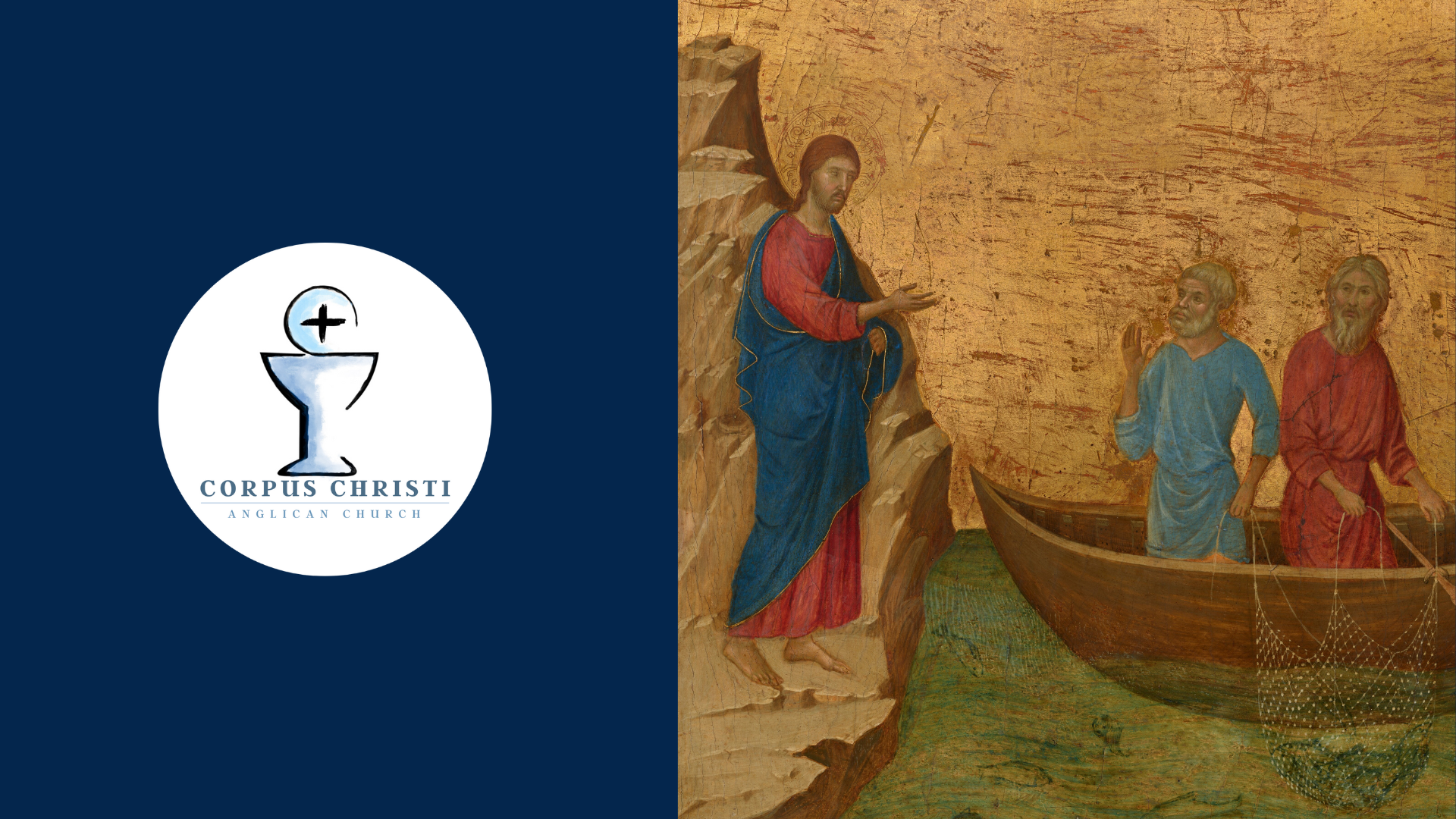
Today in our Gospels, we are looking at the calling of the disciples. And so we've been talking about the glory of God through Epiphany. Now that glory is going to go forth through these who Jesus will choose as his disciples to carry on the kingdom work. And whether or not they knew it, these disciples, their lives, their stories, their vocations, were setting them up in unique ways to bring their unique gifts to bear on the age to come, the kingdom of God. And they were doing so in the midst of an empire that was not eager to know the love of the Messiah.
There was this clash of good news messages, Gospels. One of those being, we have no king but Caesar. One of those being, we have no king but Christ. And in the midst of that tension, the disciples are being called, these fishermen, to proclaim the good news of the kingdom of God where Jesus is Lord. And so the followers of Jesus are called to hold out the glory of Jesus in the midst of really challenging circumstances. And this is what the apostles are called to.
And how can they do this? I love this passage today. It is such an encouragement. How are they able to carry the glory of Jesus out in the midst of really challenging circumstances in an empire that's not necessarily friendly to them? That's what we're going to look at this morning. And what they're going to learn is that Jesus brings people into an encounter with himself often when they're at their worst. And then they're going to learn that Jesus can do far more than they expect of him. And then when they're confronted with their own finitude as human beings, then they're going to come to know the power of Jesus working in them to do more in them and through them than they could have imagined.
And I think that you and I this morning are in need of such an encouragement as we follow Jesus in seasons of real instability. As we look at our passage this morning, let me pray for us. “In the name of God, the Father, the Son, and the Holy Spirit. Amen. Almighty God, from whom all thoughts of truth and peace proceed, kindle, we pray, in the hearts of all people, the true love of peace. And guide with your pure and peaceable wisdom those who take counsel for the nations of the earth, that in tranquility your kingdom may go forward till the earth is filled with the knowledge of your love, through Jesus Christ, our Lord. Amen.”
Jesus meets us in our worst
Well first, I want to look at this first point that I brought up, that Jesus meets people often when they're at their worst. Jesus meets them when they're at their worst. Chapter 5 of St. Luke's Gospel is what we read today. Jesus comes to the lake of Gennesaret, which is also called the Sea of Galilee. It's in the northern part of Israel. It's about 18 by 14 square mile, yeah, square miles. And it serves as a popular freshwater fishing location.
And when he shows up to the Sea of Galilee, there's a crowd that's gathered. They're gathered there to hear him teach. And the crowd is growing. And because it's growing, they need to be able to hear him. And that area provides a natural amphitheater, so he has to go out a little from the shore to utilize the natural resources around him to create an amphitheater so that everybody can hear. And so he sees these two boats that are by the lake that he needs, and he decides that he needs one of them to go out onto the lake.
Well, the fishermen are not in those boats. They're out of the boats, and they're cleaning all of their nets. They've just, it's morning time now. They've spent all night fishing, which is the best time for them to catch a hole. And so Jesus decides on one of these boats to be taken out to the sea a little ways to be able to preach. And this boat belongs to Simon, who's going to eventually be renamed as Peter. And Simon here is not at his best. You can believe it. He's really, really tired.
He spent all night fishing. Show of hands, how many of you have pulled an all-nighter in college? Right? This is, you, Peter spent an all-nighter, and he has not caught anything to show for it. You can imagine how useless he is at this point, and how frustrated and tired and probably deflated he's feeling.
He is not at his best, probably just wants to go to sleep. But in his tiredness, when he's not at his best, he still welcomes Jesus in. And I wonder, with Peter and Simon, if a lot of us are not feeling at our best this morning, as you came in here today. This passage is for you. It's an encouragement. The instability of these past few weeks have been really exhausting.
I know because I'm fielding texts, emails, and prayer requests all the time. People are worried about their jobs. They're worried about the immigration statuses of family and friends. They're worried about the takeover of government systems and processes by the wrong people, that we might break democracy in irreversible ways, that people around the world are going to suffer and die because of freezing and cutting aid. People are afraid of economic impact, on what imposing tariffs on allies means, what the diplomatic fallout of this is going to be. And that's just to name a few things that might be causing fear for some people this morning.
And a lot of these things do impact people in our church because you work for government agencies, or you work for NGOs that serve other people around the world. And so I'm hearing an understandable fear about what is happening right now. Things that make us feel like we're just not in our best.
Right? And that's okay. And if all that wasn't enough, life still continues to march on. And you have your daily responsibilities, the things that you need to do, making repair in relationships that are broken, keeping it together with your spouse, if you have one, maintaining your own mental and physical health.
And in this scenario, in this, you know, current situation, for some of you have kids, caring for your kids, maintaining a sense of security for them, and dealing with the challenges that they present day in and day out. Being present to all the different people that you need to be present to, and your different spheres of life. How do we maintain all of those things? And the reality is, if we were to look back on human history, there is never been a time where heaven has been on earth that we can point to one nation state and go, that was the kingdom of God.
You know, we just want to be like that. We've never seen it yet. There has never been a nation state that has exemplified the ideals of the kingdom of God. And so, you know, I want to name what feels so hard for a lot of people today as they're walking in. What are the things that make us feel like, man, I am just not at my best right now. And the reminder to us this morning, that this is the setup to encounter Jesus.
That when you're not feeling at your best, let your heart and your body be reminded that this is the place where Jesus sees you, where he knows you, where he deeply loves you, even when you're feeling like you're at your worst. And so when we can learn to name the things that are broken before Jesus, then what we're also doing is naming the very thing where we are, we're place where we're longing for God's love and grace to be poured in and change, change our hearts. So when we're in our worst, that's when we're often most ready to encounter Jesus.
Jesus can do more than we expect
And then second, Jesus can do way more than we often expect him to be able to do. Jesus says to Simon, put out into the deep water and let down your nets for a catch. Can you imagine Peter cleaning his nets tired? And Jesus says, can you get back in the boat, push it out in the water? And also, can you put your nets down too for another catch? You know, it's like it's a very truncated dialogue in the gospel.
So I wrote my own. Jesus says, let down your nets.
And Peter says, “really? We've been at this all night. I am exhausted. I'm tired. I'm hungry. All I want to do is sleep.
Jesus: “I know I get it. And I'm so sorry that you are tired and hungry. Let down your nets.”
Peter: “ We know how to fish. We've been at this all night. We know the right time to go out. You're a carpenter. This is my thing. Do you think that you know how to do my job better than I do? “
Jesus: “Totally get it. You're an expert fisherman. I understand that. And yes, I actually do know more about your job than you do. I know more about you than you do. Put those nets down.”
Peter: “OK, whatever. I'm going to do it. I will let down the nets.”
All right. Now, I know that that is apocryphal from the gospel of Morgan. This is not the actual dialogue that happened. But man, isn't that our internal dialogue? I mean, that is my internal dialogue. Whenever Jesus tells me to act in faith, we find ourselves really frustrated. We find ourselves in the place of being overwhelmed.
And then when Jesus reveals something to us that's broken, that's in need of his grace, we're quick to say, Jesus, don't touch that. You don't know what you're doing. I know how to fix this. Or at least I know people who do. And we strategize and we try to figure out who can help us fix this thing or a plan to get better or things to avoid it. People or activities that we can find or pleasures to keep us from addressing the very thing that Jesus says, I want to touch that and heal that thing in you.
And so Jesus invites us in all of our doubts, in those places of frustration and uncertainty, when we're definitely feeling like, you know, I'm just not at my best today, to set down the nets in faith so that we can see what he can actually do. And when they obeyed, those nets became so full that they were starting to break. And so Simon, when he sees that, he looks at Jesus and says, go away from me, Lord, I am a sinful man.
And that confession of Peter at this point, sorry, I keep saying Simon and Peter, you know who I mean. So Simon, as he confesses this, it highlights now how attuned he is to the fact that Jesus is the son of God, that he's bringing the kingdom and that he himself is unworthy. He's realized who he is and who Jesus is.
And it was at this moment where he's rightly esteeming his own unworthiness before Jesus, that he is now ready to receive exactly what Jesus wants to do in him, the grace of Jesus to be poured in him to continue the work of Jesus. He has to get to this point if he is going to be a vessel worthy of the gospel of the kingdom. And so when Peter is at his lowest, Jesus is ready to reveal himself to him.
And then that is a comfort to you and to us, to all of us this morning. If you feel like you've made a real mess of things this morning, if you feel like there's not any hope, like you are just feeling really undone, overwhelmed, if things outside your control are feeling completely overwhelming, then the posture that this text invites us into is to say, Jesus, I don't get it. And honestly, sometimes I wonder if you actually get it. But I really want to be surprised by you today. And so I will let down my net. Jesus, I don't get it. I don't know if you get it. But at your word, I'm going to take that next step and let down the net. This is the posture when we feel overwhelmed.
And this is the step of faith that leads to new beginnings for us. It opens up to us the God who brings abundance out of these places of emotional and physical scarcity. This is Jesus whose kingdom is transforming a people, individuals and corporately that if we ask, where is the kingdom of God? You're seeing it in a community that's being transformed by him, whether or not the empire is Christian, pagan, in peace or in crisis.
The kingdom of God goes forth in a community of people. And so these small moments of faith are where we learn how frail we are and how powerful God is. And we learn all the meager training that we've had up to this point. And our experience and our life circumstances are all the training to understand that our life has far more significance for the kingdom of God than we would have imagined before. And so when we're at our worst, Jesus comes to meet us. Second, we looked at how Jesus can do more than we would have imagined.
Jesus calls us to more than we expect of ourselves
And finally, Jesus calls us into more than we often expect of ourselves. Jesus calls Peter and James and John to come and to catch people. And they're going to go gather people into God's boat of salvation, where people are going to be delivered into the kingdom of God, where Jesus is Lord. And so they leave everything behind at this point to follow Jesus, which is a huge step of faith. And we read today two passages that were really important for this. Judges, where we heard about one of the judges confronting the Midianites, Gideon, and 1 Corinthians 15, where Paul calls himself the least of the apostles.
And those passages remind us that the kingdom of God doesn't go forward through our constructed worthiness or the image that we would like people, that we would curate on social media for people to experience our holiness or our worthiness. This is not how it goes forward. But through the honest, frail brokenness of our stories, people who are longing to see Jesus at work, who are willing to prioritize God's kingdom, first and foremost, above all things, in our brokenness. N.T. Wright says it this way. He says, “When Jesus calls, he really does demand everything of us. There are no bystanders in God's kingdom. And this is because he has plans in store for us and the world that we live in that surpass what we would have dreamt of.”
And so what God has brought you through up to this point, your circumstances, the things that have been really hard, what God has brought you through up to this point are the beginning of your story. Your places of brokenness are the unique places of redemption that are going to form the compelling stories that draw people into the love of God in the kingdom of God.
Your story, your life has a role to play in the kingdom of God. Your vocation, your skills, your proclivities, the relationships you have, the stories that form you. When these things are submitted to this disposition of, Lord, if you say so, I'll let down my nets.
Then we're ready to see how Jesus can take our frailty and our brokenness and do more in us and through us than we would have ever imagined or dreamt of.
Conclusion
And so as a recap, thinking about this passage, it teaches us three really important principles about life in the kingdom of God, a life of following Jesus. First, that we are ready to see Jesus when we are at our worst. I hope that's an encouragement for you this morning. Second, it teaches us that Jesus can do more than we can imagine. And third, that Jesus can do more in us and through us than we could have expected of ourselves.
And I know that these are fraught days. For a lot of people, these are really destabilizing days, whether or not it's the circumstances outside or not, or just the internal ones. There are a lot of things that destabilize us. Continue in these days to do your daily prayers, right? It's like that World War II poster, keep calm and carry on. Keep calm and pray the daily office. You know, keep praying your daily prayers.
Regulate yourselves when you feel emotionally out of control. Take care of your bodies, they're really important. Your bodies are the means by which you come into the kingdom, and so take care of those bodies.
Take each day to admit to Jesus those things that feel broken. Where do I not feel at my best today? And then ask him for what the next step of faith is. What is the next right thing to do, Jesus, when I am not feeling myself today? Your days are going to be filled with moments and glimpses of the kingdom of God and Jesus's power, but we need to search for them prayerfully with intention, in the midst of things feeling pretty chaotic.
And so my prayer for us is that may God give us the grace to prioritize his kingdom first and above all when we're not feeling totally ourselves. Let me pray for us this morning. “O God, you made us in your own image, and you have redeemed us through your son, Jesus Christ. Look with compassion on the whole human family. Take away the arrogance and the hatred that infect our hearts. Break down the walls that separate us, unite us in bonds of love, and work through our struggle and confusion to accomplish your purposes on earth. That in your good time, all nations and races may serve you in harmony around your heavenly throne. Through Jesus Christ, our Lord. Amen.”
Transcribed by TurboScribe.ai. Edited by the author.

Candlemas: The Glory of Jesus in Ordinary Faithfulness
Transcription
Well, good morning everybody. It is good to see you this morning. I'm Father Morgan Reed. I'm the vicar here at Corpus Christi Anglican Church and February 2nd marks a very special day in the church's calendar.
It usually occurs not on a Sunday, so we haven't often, we haven't been able to do it yet, but this we'll start doing this in the future on February 2nd. Today it's on a Sunday, so we get to celebrate, it's called Candlemas, or the Feast of the Presentation of Christ into the temple. And this passage that we read today concludes the infancy narratives in the Gospel of St. Luke.
If you remember, in the last several weeks, we're going now backwards chronologically, we've started Epiphany the first Sunday talking about the baptism of Jesus, so he was already an adult, and then after that we talked about him changing the water into wine, his first miracle in Cana of Galilee, and then last week we saw his glory going from synagogue to synagogue as he taught. And so now we're going back in time, back to the infancy narratives, and this passage today brings us to an encounter with the glory of Jesus that Mary and Joseph are going to experience at the temple with Simeon and Anna. And as we look at these passages this morning, let me pray for us.
“In the name of God, the Father, the Son, and the Holy Spirit. Amen. Lord, may the words of my mouth and the meditation of my heart be always acceptable in your sight. Oh Lord, my rock and redeemer. Amen.”
We're going to look at this passage through the lens of Mary and Joseph, through the lens of Simeon, and through the lens of Anna. So those are sort of my three points this morning, and through them all we're going to see about what it looks like to live a life of faith when things feel really uncertain. In today's gospel, we find people waiting for the glory of the Messiah. They're waiting, Joseph and Mary, Simeon and Anna, and Mary and Joseph show us this example of a devout couple, a couple who is following the law as it prescribes.
Mary and Joseph
They come to the temple to do three important things. First, for Mary's ritual purification after childbirth, so it's about 40 days after her son is born, for the presentation of the firstborn to the Lord, and for the dedication of the firstborn to the Lord's service. All these things are sort of wrapped up summarily in St. Luke's Gospel.
They come and they offer two turtle doves, which is according to the law, but it shows us that they are among the working class and the poorer in their culture. They can't afford to offer a lamb or a bull, and it's actually quite un-extraordinary what they're doing. They are just being faithful Jews, following the law.
They have had extraordinary encounters surrounding the birth of their son Jesus, but this particular thing that they're doing is quite un-extraordinary, and I find a lot of comfort in that because they're about to experience something amazing that God is bringing together and orchestrating, but from their perspective, they're just carrying on in the un-extraordinary, being faithful with the next thing God's called them to do, and the presence of God is making its way into the temple through this child who is being carried along by faithful parents who are doing something completely ordinary. When we think of the glory of Jesus coming to meet us, day in and day out, it reminds me that the glory of God comes through very common vessels and very ordinary encounters in your walk of faith, in my walk of faith. Sometimes people can look for signs of God's blessings in really big things, like if everything is going right, then God must be blessing what I'm doing.
You might hear someone say, well this bad thing didn't happen to me, so God must be pleased with me for what I'm doing, and that person who's experiencing failure must not be experiencing God's blessing, or they might say this good thing happened to me, so God has to be blessing me. But instead, the story of Mary and Joseph here reminds us that God's glory is often discovered among those small, seemingly insignificant acts of faithfulness that we take, and the outcomes are sort of out of our hands, as it were. Carving out time to pray, carving out time for intention and meditation to be honest about how we're feeling, doing something for a spouse without them having to ask you to do it, making time to invite other people over.
These are small rhythms of intentional faithfulness that as we encounter the image of God in other people, these reveal to us the glory of Jesus. This is the soil. The intentional rhythms are the soil for the revealing of the glory of Jesus.
And in the last two months, I've been listening to a few books, one on parenting, the other one on marriage, and then I've been reading one on friendship, because it is so easy to occupy my mind with things that I can't change, right? And maybe some of you are in that space too, where you've spent the week and your mental load has been occupied with things that are out of your control, right? But I want to see Jesus in the everyday stuff of my life. So, not that I want to stick my head in the sand, but I want to spend an equal amount of time on these things, these everyday moments that I can control, living out life with Jesus in the everyday stuff of the household, the neighborhood, the place that I live, our church. And the things that I can control are familial relationships and friendships, and I can have an effect in those places.
So, we need to discover the glory of Jesus in small places that are just very common places. We need to be surprised by Jesus in those ordinary spaces, those everyday faithfulness encounters of just walking and doing the next good thing, just like Mary and Joseph are in this story.
Simeon
So, this is Mary and Joseph, and then the camera changes, right? If you can picture like a movie, the camera is now changing to another person, to a man named Simeon. And Simeon, according to tradition, is an old man and a priest. We don't really have that in the gospel text, and that's not the point. The point is, this is a devout man who is living in the city, who is looking and longing for the Messiah to come and bring the redemption of Israel.
Jesus had already been testified about earlier in that chapter by shepherds in the wilderness, and now he's going to be testified about in the city and in the epicenter of religious power. Jesus has the witness of those in the country, and now he's going to receive the testimony of the devout Jews who are in the city of Jerusalem. So, the Holy Spirit reveals to Simeon that he will not die before he sees the hope of the Messiah.
And so, then it says the Holy Spirit guided Simeon to the temple. I'm not sure what that looked like, but Simeon has this habit of, you know, being a part of temple life. He's described as a devout and a just man.
And so, Simeon meets Mary and Joseph and Jesus, either in the temple of the women or the temple of the Gentiles, sorry, the court of the women or the court of the Gentiles, somewhere in the temple complex. He meets them. We don't know where, but as he encounters them, God is clearly orchestrating this moment from behind the scenes.
And then, when Simeon speaks, he speaks Isaiah chapter 60, with the light and the glory that are being brought together that describe the goodness of God's kingship over all the nations. And it's really important, in light coming to the nations, this is going to be one of the important themes in the ministry of Jesus, and this is where it first shows up in the Gospel of Saint Luke, that the light of Jesus going to the nations starts right here in Simeon's song. It's connected to this universal reign of the kingdom of God that is going to include the Gentiles, and that's what's new here.
You have, in the infancy narratives, you have these songs, the song of Mary, the song of the angels, the song of Simeon, and we'll get to the song of Anna. Each of those progressively reveals something about the nature of the saving work of the Messiah. And now that Simeon has seen Jesus, he can give up his post. He can rest. He's done. He's seen it.
He's seen God's promise fulfilled in his sight. And he adds what's interesting in this song, which we say every day in evening prayer, he adds this note of suffering in the song, and it's really interesting. So I can imagine Mary and Joseph, they're smiling with delight.
Yes, yes, you know, blessed be the Lord God of Israel. Oh wait, that's the morning prayer one, sorry, the evening prayer one. You know, as he's, you know, the light to enlighten the Gentiles and the glory of your people Israel, and their faces are beaming with joy, like, yes, we are seeing God's goodness here.
And then he says, and a sword will pierce your own soul too. Whoa, right? This is the first moment where there's this introduction of the ministry of the Messiah will involve some level of grief and suffering, but they're not sure the fullness of what that means yet. And I would imagine Mary and Joseph's facial expressions change in that moment.
And so now, the grief of anticipated pain is going to sit side-by-side with the joy that she's feeling about her son. And maybe, just maybe, you've been in a place like that, and maybe you're in a place this morning where grief about some sort of anticipated pain and suffering is with you. And in Mary's example, take note of her example here, she is somebody who we find that grief and hope sit next to each other for decades, right? This is 40 days into her child's birth, you know, being born.
There's 30 plus more years to go. Grief and hope are going to sit side-by-side for decades throughout the life of her son. And in that daily space between grief and hope, she does the next good thing as an act of faith, that famous, be it to me Lord according to your word.
She gives us an example of faith in that space between hope and grief. The next good thing as we're longing for the glory of God's kingdom to show up. And so we're called to follow her example.
Simeon has similarly cultivated a life of everyday faithfulness in anticipating the work of the Messiah, and he's led by God to meet these ordinary parents as yet another witness with the angels and with the shepherds of what this child's ministry is going to be. And so I've been thinking about the significance of what does it mean to end our days with this prayer of the song of Simeon, Lord now let your servant depart in peace, according to your word. Whether it's comp line or daily evening prayer, this ends our prayer every day.
And so what does that mean for us? Well, this prayer offers us an opportunity to discover the glory of Jesus in the everyday, moment-by-moment conversations and encounters that you guys are going to have every single day. It does that first. It also affirms that Jesus is present in all those things, and it invites us to rest.
I mean, when you hear Simeon sing this song, there's this profound sense that the work of God is in God's hands, and he can rest in this quiet confidence and stillness that God is going to be the one to carry out his work and his plan. And so this song invites us into a quiet rest with quiet confidence. And our bodies and our souls need that rest, and so this is why I love having this as a daily prayer.
Our bodies need this daily reminder. There are days when you and I are enraptured by joy upon joy, and there are days where we're finding the glory of God in that joy, and there are days where you and I are struck by grief, and there are days that we just live in the ordinary somewhere in between. There are days that we undergo this pain that pierced Mary's heart as well.
But Simeon invites us to frame things differently, to frame gladness and grief under the umbrella of God's glory going forth through Jesus as he shines his light on the nations. So as we live in that space between hope and grief, we live out the next good thing to the looking for the glory of God which is going forth to the nations as we take the next step of faithfulness in God's kingdom.
Anna
So we've seen God come in surprising glory in the faithful lives of Joseph and Mary and Simeon, and now the camera is going to change yet again, and we encounter a prophet, a woman named Anna.
Anna is introduced as this prophet who is from the tribe of Asher, which is one of the northern ten tribes, and there's some debate about how old she is. You know, it's common in those days for women to get married in their mid to late teens, and so if she had been married somewhere around 16-ish, then her husband would have died by the time she was 23. So she was probably a widow from her mid-20s, and so it's possible that she's somewhere now in her early to mid-90s or even in her early hundreds, but she has spent all that time in the station of widowhood.
People know who she is. She's been in the temple every day. She is a pinnacle of the example of female piety, and she represents the voices of the women in Jerusalem in the city who are longing for the hope of the Messiah, and Anna has been looking for the redemption of Israel, which comes and brings in the new age of the messianic king, and this is going to be a major theme in the gospel, this coming kingdom.
The Venerable Bede, one of our saints in the English tradition, says something really important here. He says, “What needs to be mentioned too, is that deservedly both sexes hurried to meet him, offering congratulations, since he appeared as Redeemer of both.” So Jesus would be the redeemer of man and of woman. He would be the redeemer of Jew and Gentile, of pious city dwellers, and of common herdsmen in the wilderness.
Jesus is the hope and the redeemer for all people, and when people find their rest in the lordship of Jesus and his reign as king, they do so in a way that takes full account of who they are and the uniqueness of where they've come from, and so Anna invites us to be very curious about what the redemption of Jesus looks like in groups of people who aren't always given the most prominent voices. Women have to be heard and held in honor. Children and elderly must be heard and held in honor.
Ethnic, linguistic minorities have to be able to tell their stories, and those lives must be honored, and so the poor must have a voice in honor. So Anna hears one group of people, a representative of one group who is looking for the redemption of Jesus. She invites us to reflect on whose voices I think feel under- represented in the church.
Now think with me again about the infancy narratives. Angels, shepherds, a just and devout city-dwelling man, a pious Jewish woman prophet who is a city dweller. These are all giving unique voice and testimony to the work, the hope, the consolation of Israel in the ministry of Jesus, and so the kingdom of God is going to be lived out, and it's going to look very unique and different in the different vocations and stations of life, sexes, families of origin, subcultures, stories, and all of these things creating a tapestry in the church that's depicting this narrative of the glory of God and how the light of Jesus is going into the nations, through our neighborhoods, through our households, through our individual lives, and so as the glory of Jesus goes forth, take notice of it in the everyday stuff of life and the lives of the other people that you're encountering with a disposition of curiosity to learn more about the global picture of redemption that God's portraying.
Conclusion
So in conclusion, today's passage calls us to join Mary and Joseph and Simeon and Anna to live out faithful anticipation of God's coming kingdom in the midst of the everyday encounters that you and I have in our routines, and Mary and Joseph remind us to carry on in obedience, one good next step at a time, even though we don't fully understand the significance of what we're holding in our hands. Simeon reminds us to find rest and quiet confidence in the God who's going to carry out his plan, even though there will be times of grief and gladness. Anna reminds us to value Jesus's redemption and the unique stations and stories of others in the kingdom of God, and just as we all were carrying in our candles this morning, singing about the light of Christ, let's remember this day, candle-ness, that this day calls us to carry the light of Christ in everyday faithfulness to the world around us that is longing to know the light and love of our Lord.
Let me pray for us. “O God, our Father, source of all light, today you reveal to the aged Simeon your light, which enlightens the nations. Fill our hearts with the light of faith, that we who have borne our candles may walk in the path of goodness and come to the light that shines forever.
Your Son, Jesus Christ our Lord. Amen.”
Transcribed by TurboScribe.ai. Edited by the author.

The Glory of Jesus in New-Creation Community

Transcription
Well, good morning again everybody. It is good to be with you this morning. As I mentioned earlier, I'm Father Morgan Reed. I'm the vicar here at Corpus Christi Anglican Church.
We are in the season of Epiphany, which focuses our attention on the glory of God, which is moving to the nations and the neighborhoods around us. And today in St. Luke's Gospel, we are experiencing the glory of Jesus as it moves through the synagogues throughout Galilee. And here in the passage this morning, we have Jesus, whereas before when we focused on his baptism a few weeks ago, the Father is declaring the glory of Jesus over him for all to hear.
Now we have Jesus's self-reflection, his own declaration of his own glory, as he is anointed and understands his own anointing by the Holy Spirit in bringing about the Messianic Kingdom. And so as we look at our passages this morning from Nehemiah, the Psalms, 1st Corinthians, and our Gospel, let me pray for us. “In the name of God, the Father, the Son, and the Holy Spirit. Amen. Lord, may the words of my mouth and the meditation of my heart be always acceptable in your sight. O Lord, my rock and my Redeemer.”
Amen. Well, the ministry of Jesus in this passage is one of bringing about the New Age, the age that was to come that everyone was looking forward to, bringing about the kingdom of God through a community of people. And one of the implications from this passage is that the church becomes the society of the New Age.
It's a community where we experience the kingdom, where wrongs are to be made right, where the downcast are to be lifted up, where the wounded are to be healed, and where the poor and the marginalized are to be dignified and held in honor in community. And all of this is the continuation of the work of Jesus, revealing his glory to the nations through his works. This is what the church is called to.
And it's really important for the church, then, to view itself as a society of new creation. But in order to view itself as a society of new creation, we need constant recalibration. And by recalibration, I mean the daily process of repentance and conversion of heart, turning from all of our disordered and worldly attachments to turning towards the way of Jesus.
We need that daily to recalibrate ourselves to the way of Jesus. And I think our passage today calls us to join in those crowds who were sitting in the synagogue watching Jesus. They were fixed on him, as our passage said. We're to join those crowds in wondering attentively at the works of Jesus. And as we think about wondering attentively at the works of Jesus, we want to look at three things. First, Jesus's self-understanding from this passage.
Second is the ministry of the servant in Isaiah. And third, the resulting posture the church ought to take based on Jesus's self-understanding. So first, let's, I want to look a little bit both at the ministry of Jesus, but also the history of the synagogue, because I think that's helpful as we think about this passage.
Jesus and the Synagogue
We read something really interesting in the Old Testament. We read from the book of Nehemiah, where the exiles have returned from Babylon, and they're hearing the law of God being read to them for the first time in a long time. And there's only one problem, though. After 70 years of being in exile, most of the generations have forgotten Hebrew. And in fact, the younger generations may have never learned it, because in this time period, in the Persian period, Aramaic became the lingua franca. Everyone spoke, read Aramaic, not Hebrew.
And so groups of men are going through, according to the passage that Father Steven read for us, as they're going through, they're interpreting the Hebrew for the crowds to understand. I can't remember what English word was used there, but the idea is probably something like translating, and maybe with a little bit of exposition in there, too. But the fact of the matter is, they're making it accessible for people by taking Hebrew, which nobody understood, translating it into Aramaic, and slowly explaining it as they went along.
And so scholars think that that, not that particular event, but the Persian period becomes the origin of what is later known as the synagogue. It wasn't anything formal back in that time, but groups of people are starting to share a common life together, and they're living out the covenant of the Torah in decentralized ways, and that will eventually grow up into a more robust system by the time of Jesus. That was a way over simplification of 400 years, but just so that you have an idea of kind of the trajectory of these things, there's no temple at this point, they're hearing the law read away from the temple, they have to figure out how do we live this out when the temple is not central to our lives? And so by the time you get to Jesus's day and age, Pharisaic Judaism and the synagogue is what gains the most traction for living out the the life of the covenant of Moses.
Pharisees being the ones who established the rules and the norms for the synagogue, which just means assembly, but it had boundaries to it. There was a liturgy that usually consisted of recitation of various prayers, a reading from Torah, a reading from the prophets, instructions in the readings, read Aramaic there, you know, translating into Aramaic, and then a benediction, which actually if you're familiar with the daily prayer life of the Anglican tradition, it's very similar, and there's a reason for that. The Jewish synagogue and the daily office will, there's a common thread there.
And so Jesus opens the scroll when he's in the synagogue, and it happens to be Isaiah 61. Now anybody remember two weeks ago, if you were here to celebrate the baptism of Jesus, what servant song did God proclaim over Jesus at his baptism? Anybody remember? Yeah, there you go, Isaiah 42, good memory. So God proclaims over Jesus the anointing of this servant, Jesus.
Now you have also the Spirit of the Lord is upon me. So Jesus is reading this passage, which is another servant song in the book of Isaiah. There are several of these. There's this question in Jesus's day, who do these apply to? Is it the prophet? Is it a messianic figure? Is it the people of Israel? Is it all of them? And Jesus is here understanding them as himself. And so he's saying the Spirit of the Lord is upon me, and then what's going to follow is how Jesus understands the nature of his own messianic ministry. He's going to dictate the terms of what this is going to look like based on Isaiah 61.
So he's reading the servant song with an understanding that this is what the Lord has called him to do, and the last time we heard about the anointing of the Lord was at the baptism. And Jesus began his public ministry here after the baptism and after being tempted by the devil in the wilderness. We come to this part of the book of Luke where Jesus is going synagogue to synagogue in the northern region of Galilee.
That's where the ministry of bringing the kingdom seems to begin, and he's going throughout Galilee calling people to turn to the kingdom of God. He's the one who's going to bring this new age, this new covenant, and fulfill all these servant songs in the book of Isaiah that point towards the redemption of God's people, and this is exactly what they're looking for. They're looking for the judgment of injustice, the renewing of creation.
And Jesus says, “I am the one who will bring this about.” We didn't read the later part of this passage, which will show that there are some who will reject the message of Jesus, his words and his works, in contempt and thinking about, well, we know we've known this kid since he was born, you know, how can this kid be the one who's going to bring all these things about when he preaches in Nazareth? But instead of joining those, I think this text calls us to join the crowds who are watching with attentiveness and waiting on the ministry of the Messiah to come, dignifying the image and honoring the image of Jesus and other people with compassion, following the way of Jesus. We begin by listening to who Jesus says he is. That's what this passage calls us to, to join the crowds and listen to what Jesus, who Jesus says he is.
The Ministry of Jesus in the Servant Song
So secondly, we got to pay attention to the ministry of Jesus. It's a society of new creation that Jesus is forming. That's what the church is, a society of new creation. Jesus says that his ministry is to proclaim good news to the poor, to proclaim liberty to the captives, to recover sight to the blind, to set at liberty those who are oppressed, and then to proclaim the year of the Lord's favor. And what this does is those who are in the synagogue now who are listening, this puts them in the place of being the poor that are mentioned in Isaiah 61.
And why the poor? Those who are economically impoverished, they know that they have need generally. And what we find in the Gospels is that those who are among the poor have a more positive response to the ministry of Jesus than those who don't think that they have need. And so the poor, economically, point us to the fact that we all have the need for the ministry of the Messiah.
All of us, whether we're economically well-off or not, this is why we dignify the poor in community as a reminder that all of us are in need of the redemption that Jesus brings and the deliverance that Christ wants to bring in us. Jesus is bringing individual transformation through a society of new creation. So it's not just about one narrow sense of justice, it is about individual transformation, but it's also about both.
And I think there's a New Testament scholar named Darrell Bock, he brings these things together in a really helpful way. And I'll read the quote from him. He says, “…It's significant that the poor get singled out as a particularly appropriate audience for the gospel. The outsider often related to Jesus's message the best. The church is certainly called to minister to such people and to do so with a sensitivity to their plight and poverty, since a major ethical call for the church is that Christians are to meet one another's needs and to love their neighbors as the church expresses its love concretely to all.” I was, as I was thinking about this text today, one of the things I had thought about and think about how fast this church changes over.
Some of you may not remember a family that was in our church about three years ago. There was a family that visited our church back when we were at our old location. And during the passing of the peace, the father in this family came up to me and said, Sir, I want to be baptized. And then as I talked to him, he wanted the whole family to be baptized. It's the first and only time that's ever happened to me at the passing of the peace. It was an incredible moment.
And the family had come here from India and they were seeking political asylum because they had been threatened by death by their Hindu family. And so their request to be baptized led to one of the most deeply effective journeys for me, and I think in a lot of ways for the whole church, because you all walked with this family through their immigration process, providing needs, through the process of walking them through baptism and confirmation. You helped them with job hunting and medical expenses, provided them resources and even vehicles to help them get to their jobs and medical appointments.
And their ministry among us was incredible because there was a joy and a warmth with which they welcomed people. And some of you said on your, well, I'm thinking of somebody's testimony that this man welcomed them on their first day and they just felt incredibly welcomed, like his joy was palatable. And watching them grow in Jesus and understand more of the gospel and what Jesus can do for them was such a renewing experience for me. And if you knew them, I'm sure that was a renewing experience for you. And it made me so sad when they moved. I'm still sad about it.
But that season, when I think about it, you know, for the year and a half or so they were here, yeah, I was so proud to be a part of this church at that time because all of you worked together and you gave me a great example of what the holistic transformation of Jesus could look like in community, right? There was the spiritual need of new life, and there were also these other needs that the community came around them and served them in a holistic way, and it made me so proud to be a part of this church. And so Corpus Christi Anglican Church, when you think of this name, Corpus Christi meaning the body of Christ, it's inherently communal. And so it should always be a place where those who are other are brought into loving community and known and are knowing others, where they're honored and where they're dignified and they experience the redeeming love of Jesus in one another.
And what this reminds us of, and as I think about this for myself, as we think about the ministry of Jesus and the servant song of Isaiah, all of us then are the blind. Like, we are all unaware at times of our spiritual need. We are all the poor who are spiritually lacking and we need the abundant life of Christ in the kingdom of God. We are all held captive to disordered affections and attachments of the world, and we all need freedom from them. We are all the downtrodden, we are all the oppressed who need liberation from the outside forces that are all warring against our souls. And so as we experience the work of Jesus in community, we're filled to the brim with mercy and compassion for all of our neighbors who find themselves in the same place spiritually and socioeconomically.
Think of your neighbors, who lives next to you, who lives a few doors down, right? Think of that person. And this is how the glory of Jesus, the dominion, the loving rule and reign of Jesus, and his fame and reputation as king go into the world through our neighborhoods. That's what I love the season of Epiphany, because it focuses us on how Jesus's glory goes to the nations and in the embodiedness of nations.
I'm always reminded that the nations are in my neighborhood, and this is true for you as well. And so the glory of Jesus goes to those that we know and that we love and to those that we don't know, but we shovel their sidewalk during a snowstorm. This is, you know, the potential of the glory of Jesus going to the nations and where Jesus is made famous as king.
The Disposition of the Church
And it goes forward in a community that's bound by the love of Christ, who, like the crowds today, are looking attentively at the works of Jesus, who are dignifying and honoring the image of Jesus in one another, who then are continuing this work of raising the downcast, bringing freedom from bondage, bringing the truth of God to light with nuance and with compassion in a world that's shrouded in the darkness of lies and half-truths. And so we've seen Jesus's self-understanding of his anointed ministry, how that work of Jesus is carried out in new creation society, and finally, because you and I are anointed to carry on this ministry, we ought to have a disposition as a church of wonder and attentiveness at the work of Jesus. When Jesus died for us and when he rose again, he ascended to reign on high, and he took captivity captive, and he gave his spirit to the church, which has anointed you and I to carry on the work of new creation in New Covenant community.
So we're a society of new creation. And so imagine with me that Corpus Christi Anglican Church now is an embassy of God's kingdom where people find community and they find the healing that Jesus promised in our passage today in loving community. And so to continue this work, I think that we need to join, as I've said before, the disposition of those crowds and the faithful disciples of Jesus.
There are going to be those who reject Jesus, but we want to be among those who have our gaze fixed on Jesus, saying, teach me more, I want to understand this. There's a wonder, there's a curiosity about the works and the words of Jesus. And it's that disposition of wonder that I think recalibrates us.
It's kind of what repentance is, saying, Jesus, what is it I ought to be doing? And where are the disordered attachments that I've given myself to? And help me turn to you, I need your grace. This is the recalibration. So in your formation groups, as you guys meet together during the week with each other, you know, asking and wondering with one another about where you see Jesus in each other's lives.
And if you're not in a formation group or beyond the formation group, as you go and you get coffee together and you sit, or if you don't like coffee, tea, or something else, when you go hang out together, you know, asking yourself, what is the Spirit saying through the life and the ministry of this person, this image of God that I am sitting across the table from? And most challenging, in your child's tantrums and joys and delights, you know, in all of those moments, as you look at your child, looking and listening for blessing those good desires that God has placed into your child's heart, where do you see the image of God? Where are you learning of the image of God in your child, in the joys and in the sorrows? And making a habit of looking for that. Those short prayers are really helpful. I don't know if you've heard of breath prayers, but “Lord Jesus Christ, have mercy on me, a sinner,” is a really helpful prayer in the midst of a tantrum, as you're trying to look for the image of God.
That's a freebie. And so, yeah, so we want to look for and listen for the ministry of Jesus in daily prayer, in the Scriptures and in your conversations with those who bear God's image, always holding them up with profound dignity and honor, because you're anticipating to find something of Jesus in that person. And, you know, I'll be the first to admit that there are some times where some people are quite undignified, if not offensive and hurtful, but even seeking the image of God in those people allows us to have a healthy amount of separation and compassion for who they are longing to be, and a longing for their freedom from their disordered attachments in this world, while remaining healthy and separated from those things.
Conclusion
But our gospel today, in conclusion, it invites us to join with those who are hearing the teachings of Jesus, who are recognizing our bondage and our spiritual poverty, as we long for Jesus to redeem and restore our brokenness by his power. And so this passage calls us to continue on the ministry of Jesus, to continue on the kingdom of God by dignifying the poor, the downcast, the stranger, those who are in bondage and who seek for Jesus to bring them new life in New Covenant community, even before they know they are longing for it. And finally, this passage today calls us to listen attentively to the voice of Jesus, and to carry on with this disposition of wonder about what Jesus is about, and what he's doing in you, in this community, and through this community.
And so as we close, I want to close with a prayer for us that shows up a couple times in our liturgical year. It's a prayer for the Universal Church from our occasional prayers, but I want to pray it for us this morning. Oh God of unchangeable power and eternal light, look favorably on your whole church, that wonderful and sacred mystery.
By the effectual working of your providence, carry out in tranquility the plan of salvation. Let the whole world see and know that things which were cast down are being raised up, and things which had grown old are being made new, and that all things are being brought to their perfection by him through whom all things were made, your Son Jesus Christ our Lord, who lives and reigns with you in the unity of the Holy Spirit, one God forever and ever.
Transcribed by TurboScribe.ai. Edited by the author.

A Lifelong Journey of Seeing Christ
Transcription
Well, good morning and happy snow day. Supposedly. Rain day, shall we say. Maybe snow day. I just got back from Western Pennsylvania where it was snowing every day except for yesterday. I'm Chip Webb and I'm a member of Corpus Christi who serves the senior warden. And before I begin, let us pray.
“O Lord, may the words of my mouth and the meditations of all your people's hearts be acceptable in your sight. O Lord, our Rock and our Redeemer. Amen.”
Well, today is the second Sunday in a special season of the church's life. What season is it? Epiphany. Happy Epiphany, everyone. Now, Epiphany gets less attention than a lot of other seasons of the church's year like Advent and Lent. Yet Epiphany is still very important. And I'd like our youth and younger ones to help us all out with some matters.
Now, adults, you're not allowed to give them any clues. First, what story do we most remember during Epiphany? We Three Kings. There we go.
The coming of the Magi to pay homage to Jesus. And we talked about that in youth group last week a little, didn't we? Okay, a little bit of a tougher question. What sense of our five senses do we perhaps most associate with Epiphany?
Yes. Sight. Sight, yes.
Our eyes, right? Can anyone explain that a little bit more in the sense of how did sight apply to the Magi we just talked about? Yes. Okay. They saw a star and they followed it, right? We Three Kings following yonder star.
And what happened when they got there to their destination with sight? Yes. Okay, they gave their gifts, good. And what did they see? Jesus.
[Child voice: Baby Jesus]
Now, maybe, maybe not. Because King Herod was seeking kids two years old and under, he might have been a bit older. He might have been up to two years. We don't know for certain. Okay, one more semi-difficult question. This is a harder one.
What characteristic of God do we particularly associate with Epiphany? I'll give you a hint, it's five letters. Sorry, what did you say? Glory. Yes, good, Cole.
Good, good, good. It's His glory. Epiphany is associated with seeing God's glory. Well, thank you, youth and younger. Now, I'd like to throw out a question to everyone, including youth, younger ones, and adults. What does it mean when we say that we have had an Epiphany? Yes.
New idea, new understanding, Spike? A realization, yes. New idea, new understanding, realization, and insight can be any of those. Something that gives us a new way of looking at things, and that potentially changes our lives, right? And today our Gospel passage invites us to consider a story that might be well known to many of us, but that might be a bit of a mystery to us.
The Wedding at Cana. The story seems straightforward enough, right? Jesus attends a wedding at Cana and turns water into wine. Simple.
It seems pretty straightforward in terms of the events it recites, and as a miracle, it doesn't seem particularly flashy or even important. Like, it's not as important as, say, giving sight to the eyes of a blind man, right? So if you're like me, you've often wondered why exactly this is in the Gospel of John, and why this is a sign like the Apostle says it is, as we heard when Father Morgan read the Scripture. Does anyone else ever wonder these things? Okay.
On top of this, the Church has long associated this Gospel passage with the season of Epiphany. In her book, Epiphany, the Season of Glory, Anglican author Fleming Rutledge points out that the Church connected it with this season, “from the earliest centuries”. Fascinating, right? So as it turns out, this story has a lot more to it than is evident at first glance.
There are quite a few implications for us as Christians journeying through the season of Epiphany, and a good argument can be made that there are almost bottomless depths to it. It has a lot to say to us about seeing over the course of our Christian lives, and how that seeing can uncommonly transform us. And so let's examine in detail some of the implications of this story for us as individual disciples, and then briefly consider the implications for us as part of the one holy Catholic and Apostolic Church.
Let's begin by looking at the individual disciples mentioned in verses 2 and 11, and the context of the wedding. Were the disciples his twelve apostles, or were they a larger group? The text does not specify, but from the context of John, and reading back in John chapter 1, we are probably only talking about Andrew, Peter, Philip, and Nathaniel. The gospel presents them as the first disciples to follow Jesus.
Biblical scholar Ben Witherington notes in his commentary on this chapter that at this time, judging from various references in chapters 1 through 3 of the gospel, Jesus probably was still living with his family and making journeys to visit John the Baptist at the Jordan, but he most likely had not yet launched out on his own in ministry. If that is indeed the case, he probably just had this small group of four disciples at the time of the wedding. And when are we told that the wedding took place in verse 1? Anyone remember? Spike? On the third day.
Now, back to youth and our younger kids again. Can you think of any special significance that we as Christians place on the third day? Yes? He rose from the dead. You get the prize.
Yes, the third day is the day of Jesus's resurrection, and in his book, the fourth gospel, Roman Catholic scholar Louis Boyer argues that, “…It is hard not to see in the detail of the third day a reminder of the resurrection, particularly in the early church where this expression could not fail to call up that idea.” Now, that doesn't mean that the resurrection is being specifically referenced. John, after all, is chronicling an event that took place before the resurrection. Nevertheless, John's use of the phrase the third day would have caused an echo of the resurrection to ring in his first century reader's ears. Now, hold on to that idea and we'll come back to it in a bit. At the wedding, one or more of the disciples, because we have the account here, must have noticed Mary, Jesus's mother, approach her son.
So let's try to put ourselves hypothetically in the place of a disciple observing this interchange in the events that follow. They have no wine, she says in verse 4. Now, wedding feasts at the time lasted several days, so you know living in the first century that running out of wine during weddings is not uncommon, nor is it unexpected. Various reasons have been proposed for why the wine ran out in this case, one of them being that Jesus and his disciples were last-minute additions to the wedding guest list, so there was not enough for everyone.
Another one is that Jesus and his disciples had not, due to their poverty, brought the fair share of wine expected of all wedding guests during that age. Now, maybe one of those reasons is correct or maybe not. Scholars don't know, the texts don't tell us.
But what we, putting ourselves back in the shoes of a disciple at that time, next see and hear as recorded in verse 5 is that Jesus responds as if this statement, they have no wine, were a request made of him. And he says, woman, what does this have to do with me? My hour has not yet come. Now to our 21st century ears, the word woman seems surprisingly generic and perhaps even dismissive, but to our disciple that would not be the case.
The word had no such negative associations with it. While it wasn't necessarily an affectionate term, it wasn't a harsh one either. For that reason, some Bible translations use phrases such as dear woman instead of just woman.
Nevertheless, as a 1st century disciple, we would find it unusual for a son to use it with his mother, and Jesus uses it again with Mary during her one other appearance in the gospel at the foot of the cross when Jesus says, woman, behold your son in chapter 19. That's an interesting point in and of itself, that the appearances of Mary bracket the gospel, but that's something we really don't have time to consider today. But there's a mystery there about Jesus using the word woman, and Christians with different understandings of Jesus and Mary over the centuries have come to varying conclusions about it.
But there is general agreement among scholars that Jesus is working to distance himself from Mary, not as a son rebelling against his mother, or as a son trying to evade his family responsibilities and ties, but in the sense of separating his mission from the demands of other people, including, but not limited to, his own mother. Who does Jesus listen to and obey, according to other passages throughout John's gospel? Anyone? Yes? The Holy Spirit? Okay, but more specifically, another. Yes? God.
God the Father. My Father is always working, etc., etc., etc. So the hour has not yet come for him to fully start his ministry, some scholars say. Others believe that the hour that Jesus mentions is the hour of his suffering and glorification, that's a nice epiphany word, on the cross. Since Jesus uses the word hour in that sense in chapter 12. But whether Jesus is speaking of the beginning or the end of his earthly ministry, he is speaking of his mission.
Now regardless of Jesus's intent about the hour, our no-doubt perplexed disciple observing this event next hears the Jesus's mother say, do whatever he tells you to servants responsible for making the wedding run smoothly. And then, perhaps to his astonishment, either immediately or a while later, he sees Jesus address them, telling them to fill six stone purification jars with water. As a first century Jew, you know that the purification jars are used for rituals to be used in following the law, including the washing of hands to keep yourself from being unclean.
And the servants do fill the purification jars, perhaps a little too eagerly from our disciples point of view, for they fill them to the brim, that is to the point where they're almost spilling over. And you hear Jesus then tell them to take some of the water to the master of the feast, who is essentially the chief steward supervising the other stewards. And either with your own eyes and ears, or from talking to the servants later, you find out that the master has commended the bridegroom, who is ultimately responsible for much of the details of the wedding, for bringing out the best wine toward the end of the wedding.
Wait a minute, you saw Jesus tell the servants to fill the jar with water, but now the chief steward said there was wine, and not only was there wine, but wine of the highest quality. Your mind is blown, and as a result, you and the other disciples who have either seen these events as well, or who hear about them from you in all your astonishment, “believe in him.” Verse 11, believe in Jesus.
It's not, importantly enough, that you haven't believed in him already, since you believed in him enough to follow him and come to this wedding. But whatever believing in Jesus in verse 11 means, you are coming to a deeper belief, and whether you realize it at this point, or you come to realize it in retrospect, you are seeing Jesus display his glory. Wow, I don't know about you, but my mind is blown.
Just putting myself in that perspective. So let's unpack this a little more for us as 21st century disciples of Jesus, in terms of what this means for us as individuals. First, if we are Christians, then we are followers of Christ, right? And unlike our first century disciple, we live after the time of Jesus' incarnation, after his birth, which we celebrate in the Christmas season, after his life, including the three-year ministry that was just beginning at the time of the wedding in Cana, and after his death on the cross, which was his supreme glorification when he was lifted up, and to paraphrase our Book of Common Prayer, stretched out his arms on the hard wood of the cross so that all peoples could look to him and be saved.
We are some of the ones of whom John wrote, blessed are those who have not seen and yet believed, in chapter 20 of this Gospel. And yet for all of our differences with first century followers of Jesus, I'd like to suggest that there are at least three similarities we share with them. Number one, Jesus is mysterious. We are not watching the events of the wedding of Cana, but how Jesus acts is, if we're honest, no less perplexing for us at times than it would have been for one of his first century disciples or apostles. We are not always sure of how to take his words in Scripture, and other Christians throughout the century, and scholars as well, have not always been certain either. No one can fully define or comprehend the real presence of Jesus in the Eucharist.
And when it comes to following Jesus, we don't always understand how Jesus leads us, or even if he has led us to a particular place. Sometimes the words of the late singer- songwriter Rich Mullins in the song Hard to Get fit our lives very well. “I can't see how you're leading me unless you've led me here, to where I'm lost enough to let myself be led.” Jesus's incomprehensibility is a normal part of the Christian life. To put it in epiphany type language, it's hard to see Jesus some of the time, isn't it? That's part of why we need the Church. The Church ties us to our brothers and sisters in Christ who have lived throughout prior ages, who live during this current time as in this room, and who will live in the future.
We most interact, those of us who come to Corpus Christi regularly, with those we know at Corpus Christi most likely, or maybe people at our jobs as well, if we had no Christians there. But the wisdom of those who have gone before us have been left to us in the scriptures, in the Church's tradition, and in their writings. So we can better adapt to the mysterious ways of Jesus.
And that mystery extends, of course, to the other members of the Holy Trinity, God the Father and God the Holy Spirit, by interacting with other Christians. Remember, too, that those who have passed on as Christians are alive. They are not dead. A thin veil separates them from us, even though we do not see them. See again. So Jesus is mysterious.
Number two, another similarity. Believing in Jesus is a process, not a one-time event marked by many stages. As much as some of our Christian traditions like to emphasize a moment-in-time conversion, as Father Morgan has said many times, we have regular, even daily conversions.
Just as Andrew, Peter, Philip, and Nathaniel had believed in a certain sense before coming to Cana, then believed in a greater sense due to Jesus's miracle at Cana, and would come to believe even more over time, so it is with us. Uncommon transformation is not a one-and-done process. Discipleship does not involve standing at one fixed point in our spiritual lives.
Becoming Christ-like is not something at which we arrive. This last week I attended a class at Trinity Anglican Seminary on employing the wisdom of the Church Fathers in Christian education. One of the things the instructors said that stood out to me is that when we leave this life and are with Christ, we undoubtedly still will be growing in Christ-likeness.
Now I know that idea is controversial, it runs contrary to many Christians' beliefs, but at least for the moment hypothetically entertain that idea. What does it mean for you? For me? If we adopt the perspective that growing and becoming like Jesus is a never-ending process, not only in this life, but in the life to come. What implications might that have for us now? Are there some things with which we struggle that we want to continue to resist, but maybe we can give ourselves more grace when we fail? Does such a longer period of time for growth show us that the love of God for us stretches out longer and further than we might imagine? The fact that believing in Jesus is a process might just be an incredible benefit for us.
So, Jesus is mysterious, believing in Jesus is a process, and number three, as the season of Epiphany reminds us, we will have catapults in our life, epiphanies, that God gives us by his grace. While Jesus is often mysterious, and while believing in Jesus in some senses is a never-ending event, God nevertheless will give us events when, like the first disciples, we learn to see Jesus better, and that provides great boons in our Christian life. Speaking personally, after I committed to following Jesus as Lord when I was 18, while I didn't always consciously formulate it this way, I pretty much thought that being a Christian essentially meant being a good American.
If I just basically got things together, gave up my interest in science fiction, fantasy, Dungeons & Dragons, and rock music, and if I was a thousand times less self-focused and more inclined to help others, particularly my parents, plus I acted as a good citizen, I would be hitting close to the mark of what Jesus wanted from me. That was what I had picked up over the years that following Jesus meant. Boy, was I wrong.
It's not that some of those things weren't good, although in retrospect I probably wouldn't have destroyed my rock albums, but following Jesus proved to be so much more of a matter of a greatly needed heart transplant than making those external adjustments that I was way off the mark in my expectations. When God gave me epiphanies, or as I call them, catapults in my Christian life, they dealt with far more serious issues and happened over time. For example, reparenting so that I truly saw God my Father.
Later, truly experiencing God's love and understanding to a much greater degree his love for everyone, and also pursuing a sense of calling. And regarding seeing Jesus's glory, as many of you know, the biggest event that I can share regards how God preserved both my life and my faith amidst six health crises over a two and a half month period in 2021. It was through that time that I really came to know Jesus as strong in a way I had never known previously, and that has changed my life.
Those are some of my catapults in brief, and I'm happy to share more details personally or in other settings, but what is your story? Each one of us undoubtedly has had or will have unique epiphanies. For some, these realizations and insights will be noticeable and perhaps sometimes even dramatic. For others, they will happen, but it might be hard or take a long time to recognize them as having occurred, because their impact upon us might be real but imperceptible. But take heart. Regardless of whether they are easily identifiable or not, those epiphanies result in figurative resurrections in our hearts that enable us to become more like Jesus. Well, those three items are for us as individuals, and they are enough to show us how we undergo a lifelong process of learning to see Jesus.
Very briefly, I'll just mention that for the church corporately, the wedding at Cana shows how Jesus is superior to the Jewish law, and it also provides something of a picture of the marriage of Christ and the church. Our Old Testament reading from Isaiah 62 also spoke to that. Fleming Rutledge additionally points out that the 1928 Book of Common Prayer marriage liturgy specifically recognizes Jesus's blessing of the wedding at Cana as a reason for the church's blessing of marriage.
Now, those points that I just mentioned could take up an additional sermon, but for both individual Christians and the church corporate, there is an end, a telos, to which we are moving, and of which the season of epiphany gives us a partial picture. Does anyone know what it is? It's what Christians traditionally call the beatific vision, seeing God, seeing Jesus face to face. Our journeys in this life of wrestling with the mystery of Jesus, undergoing the process of believing in Jesus, and experiencing epiphanies that help us to see Jesus substantially better, really just contribute to the larger journey of coming to see God and Jesus face to face.
And to close, I'd like to quote part of a song called Arrive by the band MyEpic. I call the band members Baptists in love with the beatific vision, which is an unusual combination. As much as possible, quiet your thoughts and place yourself in the lyric, reflecting on the future reality of reaching your life's goal using the metaphor of a ship journey.
Listen for the epiphany applications related to sight and glory in these lyrics. Experience the momentum of this journey as described in God's love for you. Let's take a moment just to pause before I start to read this.
“Any day now, I will leave the seas behind, and I, I will find you. I don't know yet what I'll see when I arrive, but I, I will be with you. All my hopes rest on the day when I see these tides align, realign. I'll keep my eyes on the horizon and my course set until then. When your new dawn outshines the old one, I'll be looking up, looking up, I'll be looking up, looking up. I'll leave my ship then and run the waves as they're rising up, rising up, I'll be rising up, rising up. And behold, you who know I could yet bear, nor any mind yet conceive, and I'll take hold of you there, and then let go of belief. Somehow, made new, I'll be like you. A song begins without an end. Beloved, behold forever.” Let me slowly repeat those last lines again and think of Jesus as saying the last three words to you with all of his glorious heart. A song begins without an end.
“Beloved, behold forever.” In the name of the Father and of the Son and of the Holy Spirit, amen.
Transcribed by TurboScribe.ai. Edited by the Vicar.

The Glory of God in a Life Transformed by Jesus
Transcription
It's good to see you this morning. I'm Father Morgan Reed, the vicar here at Corpus Christi Anglican Church and on Monday we celebrated Epiphany. So we had our twelfth night party last week. The 6th of January is Epiphany, or if you're familiar with the Eastern Orthodox tradition, they call it Theophany. In the Western tradition we begin the season thinking about the celebration of the Magi, the wise men who come to visit Jesus, the child in Bethlehem, who is king of the Jews and the hope for the nations. And then in the eastern part of the church, rather than focusing on the Magi, they tend to focus on the celebration of the baptism of Jesus as the foundation for this season.
But the point, whether it's east or west, is that the glory of Jesus Christ is going forth to the nations and that's what this season is all about. And so you know as far back as you go in church history they were celebrating the baptism of Jesus in this season. And so we do that in the West on the first Sunday of Epiphany, also called within the octave, the eight days of Epiphany. We celebrate Jesus's baptism today. We have a day set apart for that. And as we look together at our gospel text this morning, let me pray for us. “In the name of God, the Father, the Son, and the Holy Spirit. Amen. Lord, may the words of my mouth and the meditation of my heart be always acceptable in your sight, O Lord, my rock and Redeemer. Amen.”
The Baptism of Jesus affirms Jesus’S anointing as the Servant
Well, Isaiah 42 was our Old Testament reading this morning. It's a famous passage in the Old Testament. It's one of what's called the servant songs of Isaiah. There are these passages scattered all throughout the book of Isaiah that talk about a servant who will come, who would deliver the people from exile, who would deliver the people from their sins, who will heal the people, who will restore them and make all things new. And in the book of Isaiah, there's actually quite a bit of ambiguity about who that servant is.
Is it a Gentile pagan king like King Cyrus? Is it a future messianic ruler? Is it the prophet himself? Is it the remnant, the people of God? Or is it all of the above? There's quite a lot of ambiguity in the book of Isaiah about who this servant is. But we read this passage today in Isaiah 42, and it said, Here is my servant whom I uphold, my chosen, in whom my soul delights. I have put my spirit upon him.
He will bring forth justice to the nations. When we get later on in the season of Epiphany, I'll talk about how the call on Jesus as the servant gets democratized to the people of God as the remnant. So there is this, I think Steven Myles talked about this when he preached prophetic, what was the word you used? Foreshadowing? Sort of like mountaintops where it's, you see this much of it, but there's something behind it, there's something behind it, right? So there is a sense in which it's the prophet, it's Jesus, it's the people themselves who follow Jesus.
And in Luke chapter 3, the connection is made between this prophet, the servant song in Isaiah, and the person of Jesus. We start with the ministry of John the Baptist. And John had been proclaiming the kingdom of God, and the people wondered, which makes sense, is John the Messiah? He's going around proclaiming the kingdom of God, he seems to have a messianic style ministry, he's calling the people to repentance, and John assures them, no, I am NOT the Messiah, there is somebody coming after me who is going to come and bring justice to the nations. It's not me. And then John gets put in prison at the hand of Herod for his testimony against Herod's unrighteousness, his illicit marriage, etc. And interestingly, when you read the Gospel of Luke, the other Gospels, when they talk about it, John's present at the baptism.
In this account, the summary of John's ministry happens when Herod puts him to death, and then it talks about the baptism of Jesus without mentioning that John was actually there. So it sounds like Jesus is just there being baptized, but we know John was there. There is a literary reason why I think St. Luke is doing that, and that's because he's trying to show that at the baptism of Jesus, this is God's work alone.
This is God's work alone to declare Jesus the Messiah, to justify his ministry in front of people, to anoint him as the servant. This is God's work alone. And the text says that all the people had been baptized, and then Jesus was baptized, and while Jesus was praying, the heavens were opened up, and then the Holy Spirit came down on him in bodily form, in something like a dove, and a voice came down from heaven, saying, “this is my beloved Son. With you…” or sorry, it says, “you are my beloved Son. With you I am well pleased.” And so the Spirit that had overshadowed Mary in the conception, the miraculous conception of Jesus, is the same Spirit that's now anointing this adult man to carry out the ministry of the servant that had been prophesied about in the Old Testament, that it had pointed to.
And the Father's declaration about Jesus's ministry is coronation language. Psalm 2:7, which talks about, “kiss the Son lest he be angry and you perish in the way.” Psalm 2:7 is all about God's coming King; sort of opens the Psalter in a unique way, thinking about kingship, and that passage, Psalm 2:7, is brought together with Isaiah 42 in God's quotation. So you have the language of coronation, the language of the anointing of the servant being brought together in the baptism of Jesus. And so heaven endorses Jesus as the Messianic King.
It's not that Jesus is becoming the Messiah at his baptism, that was an early heresy, so I'm not saying that. What I am saying is that Jesus's ministry as the Messiah is being legitimated here by heaven's testimony. And so in reflecting on this moment in the book of Acts, which is also written by St. Luke, and we read it, Ivory read it for us today, in the book of Acts, Peter the Apostle reflects on this moment, and he says, how God anointed Jesus of Nazareth with the Holy Spirit and with power. “How he went about doing good and healing all that were oppressed by the devil, for God was with him.” So Jesus has this ministry of healing, and doing good, and freeing people from the power of sin and darkness, and the kingdom of evil, and that good rule and reign of the kingship of Jesus is inaugurated here at his baptism. And that's the thing that we celebrate in the baptism of Jesus, and it's the thing that continues on in and through the church, which is Jesus's body.
So the kingdom ministry inaugurated at Jesus's baptism is furthered, continued, solidified in his death, and in his resurrection, and his ascension, and the giving of the Holy Spirit to the church. And so the glory of Jesus in the work of the kingdom is now carried on by you and by me, who have been given the Holy Spirit, who have joined him in his death and in his resurrection through our own baptism. And so the glory of God, which is a shorthand for the dominion of love, the rule and the reign of God's kingdom, and his self-revelation to his people, his presence, that glory continues to be made visible in the lives of you and I, who are being transformed by the grace of God.
The Baptism of Jesus begins the kingdom that will be manifest in our lives
If you ask, how is the glory of God continuing to show itself more and more in the world, it's through the testimony of the lives that are being changed by the grace of Jesus. And so the baptism of Jesus frames our baptism as well. And I love this quotation, there's a church father named St. Maximus of Turin, I'm sure you've all heard of him, and he's in the fifth century, one of the things, he was a student of Ambrose of Milan, one of the things that he says in thinking about the baptism of Jesus is this, “when someone wishes to be baptized in the name of the Lord, it is not so much the water of this world that covers him, but the water of Christ that purifies him. Yet the Savior willed to be baptized for this reason, not that he might cleanse himself, but that he might cleanse the waters for our sake.” What do you do when the maker of the universe is holier than the font by which he's being baptized, right? He is sanctifying creation in this moment. So at the baptism of Jesus, creation experiences the inauguration of the kingdom of God, it experiences new creation, so that every time someone is baptized, the Spirit that anointed Jesus now anoints you and I as followers of Jesus to carry on the revelation and the glory of Jesus into the world.
And that is the power of our baptism. And so when somebody is born into a family, you can think of it this way, when someone's born into a human family, there's a sense in which they carry on roles, responsibilities, and the reputation of that family more and more through time. When the child's a baby, there's not a lot of expectation that they're going to reflect the reputation of that family, but as that child grows, there is.
So as a child grows, none of you have experienced this, but hypothetically if, you know, that child smacks another child on the playground, then the parent has this internal sense of, that is not a value in our household, and I need to instill this value that the the household code must be seen, understood, and named for that child. You know, no kid of mine is going to do that. There's this internal sense of the reputation of the household is at stake, you know, for right or wrong.
We have our own internal work we need to do, but the point is, as the child gets older, the reputation of the household kind of sits on the shoulders a little bit of that child, and the parent then disciplines or sets boundaries for that child to help them internalize the household code, the household values. And as the child gets older, they carry on that reputation of their household with them when they meet teachers or friends. You know something of the household when you meet that child, whether good or ill, right? And the stories that form them become part of their story as they start their own households.
And, you know, whatever they make of their own households, someday something of their stories of their family of origin affects how they think about things, how they speak, and how they react to things. This is why it's good news that baptism is a new birth. Baptism brings us into the family, the household of God, as adopted children. Romans 6:4, St. Paul says this, “Therefore we've been buried with him, with Christ, by baptism into death, so that just as Christ was raised from the dead by the glory of the Father, so we too might walk in newness of life.” We share in the death and the resurrection of Jesus in our baptism. And that's good news.
So in our baptism, we are made not only adopted children, we are made citizens of the kingdom of God. We experience new creation, and it's a reality that we live into. And we carry on then, when we're baptized, we carry on the ministry of making the glory of Jesus known to the world around us, as we experience the grace of God more and more for ourselves.
And we make that grace of God, the glory of Christ, known to our friends, our relatives, our acquaintances, our neighbors, and our co-workers. All those people experience something of the glory of God in our lives that are being transformed. So carrying on the glory of Jesus requires us to listen to the Spirit, and to see the Spirit's work in us, and to grow in an awareness in the ways that we're broken, which is really hard work.
There are undercurrents of our family history, and there are stories of our lives that influence our speech, our thoughts, our reactions to things in ways that we may or may not be aware of, and as we become aware of them, we will come to see that some of those things may reflect the glory of the image of God in us, and some of those really don't.
Maybe you've experienced this as well, but making known the glory of Jesus means that we are growing in living out the entire counsel of Scripture, from its commands to love, to its demands for justice, to its commands to serve and care for the poor and the marginalized, to its demands for humility and having the mind of Christ, to its requirements for having the right use of speech and the right use of creation, all of these things. To know the mind of Christ, and to know the whole counsel of Scripture, takes a long time. I mean, you might even say it takes a lifetime. In fact, you should say it takes a lifetime. To know the entire counsel of Scripture takes a lifetime. And to know the brokenness and the ways that the image of God in us has been stained and marred by the effects of sin takes a long time. In fact, it takes a lifetime. And so you have these parallel tracks of things that take a lifetime of work.
Knowing the full counsel of God and the grace of Christ, knowing how deeply broken we are, and wanting and desiring the redemption of Jesus in those places. Those are parallel tracks that run together. And I thought it would be helpful, as I was thinking about accepting the grace of Christ, to share something of my own story.
Something that I'm constantly working on. Okay, and this may not actually be surprising to those of you who know me pretty closely, but I can look back on a series of events in my life. And I'm not going to name all of them, but just thinking about a few of them. I was thinking of my son who is about in kindergarten. I was thinking back to being able to read in kindergarten. I was thinking back to playing sports in middle and high school. Thinking back to playing guitar, leading music in my youth group, then in my church. Starting a PhD, building a Syriac website, even planting a church. I mean, if I think back to all those events in my life, to be honest, there is a besetting sin of pride.
They're all good things to do, right? If I look back, I can say, gosh, you know, I really did want the welfare of others. I did want people to experience Jesus. I did do something because I genuinely enjoyed it and I experienced the goodness of God in those things. And then there's also this little voice that says, you have to do it better than other people. So I'm just being vulnerable with you. This is my besetting sin.
You have other ones. But there's a good desire in that to do something well. And there's also this mixed motivation to be the absolute best. So if I'm honest, you know, part of my own brokenness is that I internally feel like I have to be the absolute best at something or else it's not worth doing. Somebody had said this at the men's breakfast. You if something's worth doing, it's worth doing poorly. That is true. And I cannot internally get myself there. I want to so bad. And I can't point to a particular story that I look back to and go, oh, yeah, from that moment on, I had this internal sense about myself.
But I can tell you that internally, this is a pattern that I can look back on. And so part of accepting God's grace in my own life has been the discipline of accepting failure and love at the same time. I can accept failure and I can accept love, but those two things don't go together for me naturally. And because what I often internally think is, I am only as loved as my last success, my last sermon, my last whatever it is. So this is the internal voice that just sort of sits under the surface for me — in the Tradition, we would call this a besetting sin. Whether it's parenting and the way I discipline or provide good boundaries or whether this is my vocation or something that I'm called to do or accomplish, I am constantly reminding myself that even if I fail at this thing, I'm still loved. Right? This is a really, some of you are going, man, why is this so hard? It is hard for me. And so, you know, and it may not even be failure, but I may not even, I may not do something as well as somebody else. And I have to sit with going, okay, somebody else did that better and I'm still loved and I'm okay.
And that's God's grace. And so, you know, failure then becomes, if I were to accept the grace of God in those spaces, it would become a place where I could repair a relationship with somebody where I've broken it or where God may be calling me to pivot and do something different with full confidence that he'll provide. But God's grace is there in those places, if I'm curious enough to find it.
But what often happens with our besetting sins is we sit and we stew in self-contempt or we isolate ourselves in the loneliness of shame and say, I am, I am not going to be curious. I don't have the energy for that. I am a failure. I will isolate myself or I will hate myself because it's easier to do that than to sit with curiosity about where God's grace might be in those places of our insecurity. But maybe I'm alone in that. So my baptism and my anointing, you know, they call me, they beckon me, they compel me to search for God's grace in failure.
And so I don't know if I'm, I don't think I'm ever going to be done working on that. I think this will be a lifetime track for me, but it's a reality that accepting grace and love in perceived failure, this is important. That's going to be the place where transformation happens and where the glory of Jesus is going to be made known to other people. And so now that I've shared that with you, I want to ask you as you consider this, what is that place for you?
What is that place where if you were to accept the grace of God with curiosity, where transformation would happen and where the glory of Jesus would be made known in your life? Living out the glory of Jesus is a lifelong work of exploration, of repentance, and of dependence on the grace of God. But to live that out day in and day out will make the glory of Jesus made known to your friends and to your relatives, to your acquaintances, to your neighbors, and to your co-workers, which is all the nations. So in this season of Epiphany, consider how the picture of the glory of Christ is being depicted in your story.
Conclusion
How is that being depicted in your life for others? How is your unique story presenting the grace of Jesus? And the season of Epiphany focuses our attention on God's revealing of his good and his loving and his just rule and reign to the ends of the earth in the person of Jesus. We often don't know what the word glory means, but when you hear glory, think as a shorthand the good, loving, rule, and reign of the King Jesus and his revelation of that. That is the glory of Jesus.
Remember your baptism. This is a season to remember that. This is a day to remember your baptism. For those of you who haven't yet been baptized, consider your own story. Continue to think about it, because when you are baptized, what you can look forward to is that the Spirit will anoint you for this work of carrying on the glory of Christ with you wherever you go. And so may we all continue to do that hard work of repentance together in community and individually as we are learning God's Word to us and the ways that our brokenness needs to be redeemed, those parallel tracks.
And as we live into the grace of Christ, our transformation becomes the means by which the glory of Jesus is going to be made known to others. Let me pray for us. Eternal Father, at the baptism of Jesus, you revealed him to be your Son, and your Holy Spirit descended upon him like a dove.
Grant that we who are born again by water in the Spirit may be faithful as your adopted children, through Jesus Christ our Lord, who lives and reigns with you in the Holy Spirit, one God, now and forever. Amen.
Transcribed by TurboScribe.ai. Edited by the author.

12th Day of Christmas: Rewarding Rachel's Work of Lamentation

Transcription
It is good to be with you today. I'm so excited that the snow decided to wait until 11 o'clock tonight so that we didn't have to change our plans this morning. It is good to be with you on this 12th day of Christmas, and as I mentioned before, this is the final day of Christmas. If you're not used to the Anglican tradition or Catholic, we have 12 days. It's a whole season. And so today's gospel passage is about Jesus being brought into the temple, presented in the temple, and actually we're gonna have a whole feast day for that on February 2nd, which this year occurs on a Sunday. It's called Candlemas, and I'll introduce you to that as it gets closer. We'll have a procession with candles. It's going to be a delight.
So I'm not going to preach out of our gospel passage today, because I'm going to do it in a few weeks. So I wanted to spend some time this morning in our Jeremiah passage. This is a passage that might be unfamiliar to you, and as we look at Jeremiah chapter 31, let me pray for us. “In the name of God, the Father, the Son, and the Holy Spirit. Amen. Lord, may the words of my mouth and the meditation of my heart be always acceptable in your sight, O Lord, my rock and my Redeemer. Amen.”
It was back a decade ago, it's hard to believe, in 2015. I was a pastoral intern. Before I was ordained, I was working at a church, and the priest I was working under gave me a really challenging assignment. There was a family in the church that sadly experienced a stillbirth, and the priest that I was working for had asked me to find a liturgy that she could pray through with this family. The loss of pregnancy and infertility are not things we often talk about from the front. They're very painful, and they're also very common, and they're very grief-worthy. And this, as an intern, was my introduction to how common these things are in the church. And I was looking through all kinds of liturgical resources to try and find something to help this priest pray with this family in a way that wasn't going to bypass their suffering, that would enter the depths of grief with them, but also that would point them to the real hope that was in Jesus, our Christ who has suffered with us, who suffered for us.
And as I looked through different liturgies, it was interesting what passage came up over and over again surrounding birth issues, and that is Jeremiah chapter 31. It was a verse that we didn't read this morning. It was one verse afterward, verse 15, and it says, “Thus says the Lord, a voice is heard in Ramah, lamentation and bitter weeping. Rachel is weeping for her children. She refuses to be comforted for her children because they are no more.” And I have come to love that passage over the last ten years.
There are two images of God in our passage today in Jeremiah that are meant to be a hope for the grieving, which ties in really well to the gospel in Christmas. The hope for Israel in this passage comes from two images that are mentioned explicitly, one that we can infer by extension. And again, this fits with the gospel, the good news of Christmas, which, you know, Christ entered into the darkness, the light of the world to bring new creation.
And so God in Jeremiah 31, he's pictured first as a shepherd, and then he's also pictured as a bereft mother, and I'll explain that later. And by extension, this is mentioned implicitly, he's pictured as a gatherer. So these three images form the good news in Jeremiah chapter 31. And so if you have ever felt excluded, like if people really knew you, they wouldn't like you, if you don't really feel like you belong, this passage is an encouragement for you. If you've ever experienced deep loss and deep grief, this passage is hope that your grief is meaningful, that it is a productive kind of grief. And so this passage is an encouragement to all of us in one way or another, and it shows that our God is the God who pursues the broken, and he pursues the scattered to bring them home.
God as Shepherd
First, God is a shepherd. In the history of Israel, you may not be familiar with how these things shook out. Israel had split into two kingdoms, the North and the South, and in the South, some of the older kids, if you know the answer to this, do you know what two tribes comprised the South? Hmm. Yeah, exactly, Judah and Benjamin, which had two different mothers, historically, in the book of Genesis. And the northern ten tribes were all the others. And the northern tribes came to be referred to by the most famous tribe among them, which is Ephraim.
And interestingly, Ephraim's grandmother is actually Benjamin's mother. I should have put a chart up there for that. Anyhow, so Ephraim is a shorthand way of referring to the northern kingdom of Israel, and I don't know if you heard this during the reading today, there was a lot of mention of Ephraim in the text, which is weird, because Jeremiah is prophesying in the South. And Jeremiah is prophesying at a time where the northern kingdom had already been exiled a hundred years before he was actually prophesying. Or sorry, I should say it this way, they were exiled, and a hundred years later, the South would be exiled. And in between those two exiles, Jeremiah is prophesying God's Word to the southern kingdom in Jerusalem, to the religious institution, the seat of power.
And his ministry would be a very polarizing one. It would often be a ministry of rejection, wherein his call was really to solidify the hardness of people's hearts. And interestingly, there's these alternations between oracles of judgment and oracles of salvation. Today is a happy one, it is an oracle of salvation. And so what's interesting in this passage is, rather than being a condemnation for all the injustices the South is doing, it's this joyful exhortation to the remnant in the South who is going to follow the Lord faithfully. It's this oracle of salvation reminding them to trust the Lord no matter what, because the God who has scattered is going to be the one who will gather them in.
And so we read verses 7 through 14 today, we didn't quite get to verse 15, and this exhortation to the South is to rejoice and sing. And surprisingly, it's not rejoice and sing because the South is going to be okay, but it's because God is going to rescue the northern kingdom, which is surprising. And again, that's indicated in verse 9, where it says, for I have become a father to Israel, not Judah, Israel, and Ephraim is my firstborn.
So God is referring to the North. God didn't take delight in the destruction and the exile of those northern ten tribes, and God is reminding them that he hasn't forgotten them. The rescue of the North is good news for the South, even if in reality the way this plays out is the salvation of the Samaritans in the book of Acts, but that's for epiphany.
So, well, let me connect the dots there. The northern kingdom becomes what is later the Samaritans when you read the New Testament, and God's salvation extends to those who were forgotten by those who are calling themselves Jews in the South. Verse 10 says that the one who has scattered Israel is going to gather them in as a shepherd does the flock.
And Jesus, in his incarnation, has come to deliver all people, which means those who are easily forgotten by others. Again, in Jesus's day, you could read the Samaritans there, but again, by extension, all of those that we so we so easily forget. And this encourages me to delight in God's work in other people. As you hear about the testimonies of God's faithfulness in other people, remind yourself that if God is at work in this or that person, he's at work in me also, and in us. So if you've ever felt like you just don't belong, like, you know, if people really got to know you, then they wouldn't like you. If you don't know exactly where you fit, this passage is an encouragement for you, and my suspicion is that probably everybody in the room at some point, right? Because imposter syndrome just kind of sits under the surface for everybody, and especially in northern Virginia, maybe even more than most other places.
And the good news is that God longs to save those who feel forgotten, that he brings in those who are scattered into his flock to bring them home. He longs to bring his people safe and secure into his flock in Christ. And so we've seen God is a shepherd, and then now I want to look at a surprising image that God is like a bereft mother in this passage.
God as Bereft Mother
Our passage, again, stopped at verse 14, but if we were to go on to verse 15, we would hear that famous verse that I quoted before. “Thus says the Lord, a voice is heard in Ramah, lamentation and bitter weeping. Rachel is weeping for her children. She refuses to be comforted for her children because they are no more.” Now, Rachel was Jacob's favorite wife. If you go back to the book of Genesis, he had two wives and two servants of those two wives. And so the tribes of Israel were populated by four different women, and part of the reason for this is the favorite wife could not have children while the other ones were populating these tribes. It's sort of like an arms race of procreation, it's very bizarre to read. And so Rachel is Jacob's favorite wife in the book of Genesis, and she had been childless, and eventually though, God blesses her with the birth of Joseph, who the rest of the book of Genesis will talk about at length.
And then she gives birth to Benjamin. So remember when I talked about Benjamin was the other tribe in the south? So she has one child who will comprise the north, one child who will be part of the south. And Joseph, importantly, was the father to two half-tribes. Extra points for anybody who knows the half-tribes of the north. Any guesses? One of them is like a city in Virginia. Yeah, Manasseh, good.
Manasseh, if you didn't put that together. Yeah, and Ephraim. Ephraim and Manasseh, these two half-tribes. Ephraim, the more famous of the two, becomes the sort of moniker, the symbol of the northern kingdom. And again, Rachel is Jacob's favorite wife. She's the mother now of the preeminent northern tribes. And it's thought that when she died, she was buried in a tomb at Ramah, which is north of Jerusalem, southern part of the northern kingdom. And this city would have had a good vantage point when the people are taken off from Ramah. You could see them being carted off.
And so what this passage is picturing is Rachel weeping from her grave as she sees her children being taken from her. And so you can see why, when you read this passage, it is such a poignant and helpful text. When thinking about, in the past, how the church has used this historically, both for the death of children, there's lots of homilies on that topic, and for the loss of pregnancy. And you can see why this text is so helpful for this. In fact, you may not be aware of this, but our fourth day of Christmas is actually honors the holy innocents, those infants who were killed in Bethlehem by King Herod. This is sort of the dark underside of the Christmas story, right? And so, but these these children are dying for the sake of Christ without consent to it, and without having actually seen the Messiah.
And in reflecting on that terrible scene, Matthew, the gospel writer, quotes Jeremiah 31, verse 15, about Rachel's voice being heard in Ramah, and her wailing and lamentation and weeping for her children. And so you hear the echoes of this over and over again, and there is good news in Jeremiah 31 as well. On the flip side of this passage, God is moved by the lamentation of Rachel. God is moved by the repentance of Ephraim, and who confesses, Ephraim confesses his sins in the text. And God comforts Rachel, and he tells her that she doesn't need to keep on weeping, she doesn't need to keep crying, because, and this is a really important phrase, there will be a reward for her work of grief. There will be a reward for her work of grief. That's verse 16. Ephraim will be brought back from the land of the enemy. And the text, really interestingly, connects the sorrow of Rachel with the sorrow of God's heart in verse 20.
God says it this way, “Is Ephraim my dear son? Is he the child that I delight in?” The implied answer is yes. “As often as I speak against him, I still remember him. Therefore, I am deeply moved for him. I will surely have mercy upon him.” And so God mirrors the emotional state of the bereft mother and is moved to action, and that's often not a symbol or an image that we associate with the heart of God, but I do think it is so helpful because it is so real and so human. And so when our loss and grief feels like it's too much, we can trust in a God who knows the deep loss of a bereft mother, and we trust that, like this passage, he honors the work of grief.
And he honors the work of grief, eventually restoring what was lost, maybe not in the way that we would have anticipated, but does, in fact, honor the work of grief. And so God is pictured as a shepherd. God is pictured here as a bereft mother longing for the child that she loves.
And the good news, and why I love that this passage occurs in the last day of Christmas, is that when you go back to the prophets, it's the word of the Lord in Isaiah 40 that is speaking to the exiles that says, comfort, comfort my people, says the Lord your God. And the voice of the Lord, the word of the Lord is who is bringing the exiles back. And when we read John 1, which we read last week, we find that the word is incarnate.
The word takes on human flesh to bring God's people home. And so the shepherd the bereft mother longs to bring back her wayward children. And that is why also God, both implicitly and explicitly in this text, is called a gatherer. Here, like a shepherd, but more than that. So God is the one who has scattered them. God is the one who will bring them in and gather them back.
God as Gatherer
And so that goes beyond just the Northern Kingdom, who potentially is forgotten, to include all Gentiles, which is good news for us. We were the ones who potentially would have been forgotten, except that God is the one who gathers us into his flock. Even to the most forgotten of Gentiles, or those who are sort of in between Jew and Gentile, like the Samaritans had been in Jesus's day.
And so whoever becomes excluded, whoever becomes made other, the good news is for them. That God is gathering them in, and that their joy is our joy, as we see God's work in their hearts. And that reminds me of a very early Eucharistic liturgy. There's this really beautiful document called the Didache. It was written in the second century, the teaching of the Twelve Apostles, and it probably has roots of tradition that go back to the time of the Apostles themselves. And it gives us one of the earliest Eucharistic prayers in the church.
And the prayer that the celebrant prays over the bread is this, we thank you, our Father, for the life and the knowledge which you made known to us, through Jesus your servant, to you be glory forever. Even as this broken bread was scattered over the hills, and was gathered together, and became one, so let your church be gathered together from the ends of the earth into your kingdom. And so here the Eucharist itself, the celebration of the Eucharist together in the church, recalls God's gathering together of a people into one body in Christ.
So our gospel passage was about Jesus's presentation into the temple. And we hear Zechariah's song, which is also in the daily office, daily prayer. So some of you pray that every day, and it probably threw you off when I read it from the ESV, because you've probably heard it from the the BCP.
And you know, that passage, Zechariah's song, and Anna's song, help us connect God's saving work that he's doing in Jeremiah 31 with the person of Jesus. Zechariah says, my eyes have seen your salvation, which you have prepared in the sight of all nations, a light for revelation to the Gentiles, and the glory of your people Israel. And so Jesus is the means by which God is bringing the least, the lost, and the forgotten into one body in Christ, to the praise of his glory, which is what we read about in the book of Ephesians today.
Conclusion
And we're going to talk a lot about the glory of God in the weeks that are coming up, because that really is what the season of Epiphany is all about, as the glory of God moves to the Gentiles, to the ends of the earth. But here, as we end the Christmas season together, we have this beautiful good news, that God longs for his people to turn to him like a shepherd who is gathering his wayward sheep, to turn to them like a mother who is desirous of her lost child. And from the Didache, that God is like a harvester who is gathering grain in from the mountains to bring it together into one bread.
And so your loss is not too deep for God to know your grief. That's one of the encouragements. And that he will honor the work of grief. If you have ever felt like you don't belong, like if people really knew you that they wouldn't like you, that you're sort of on the fringes all the time, that you're unworthy of God's love unless you can really prove yourself, this passage from Jeremiah is an encouragement for you this morning. And so may we be a church where these things are true, where we reflect God's love for all people, where people find a home. May we be a church where people experience God's care for the grieving, where the work of grief is honored and given back with honor.
And that this would be a church where people are desiring to bring the scattered into one community in Christ, in the church. Let me pray for us. “Oh God, who wonderfully created and yet more wonderfully restored the dignity of human nature, grant that we may share the divine life of him who humbled himself to share our humanity, your son Jesus Christ our Lord, who lives and reigns with you in the unity of the Holy Spirit, one God forever and ever. Amen.”
Transcribed byTurboScribe.ai. Edited by the author.