SERMONS
Archive
- October 2026
- September 2026
- August 2026
- July 2026
- June 2026
- May 2026
- April 2026
- March 2026
- February 2026
- January 2026
- December 2025
- November 2025
- October 2025
- September 2025
- August 2025
- July 2025
- June 2025
- May 2025
- April 2025
- March 2025
- February 2025
- January 2025
- December 2024
- November 2024
- October 2024
- September 2024
- August 2024
- July 2024
- June 2024
- May 2024
- April 2024
- March 2024
- February 2024
- January 2024
- December 2023
- November 2023
- October 2023
- September 2023
- August 2023
- July 2023
- June 2023
- May 2023
- April 2023
- March 2023
- February 2023
- January 2023
- December 2022
- November 2022
- October 2022
- September 2022
- August 2022
- July 2022
- June 2022
- May 2022
- April 2022
- March 2022
- February 2022
- January 2022
- December 2021
- November 2021
- October 2021
- September 2021
- August 2021
- July 2021
- June 2021
- May 2021
- April 2021
- March 2021
- February 2021
- January 2021
- December 2020
- November 2020
- October 2020
- September 2020
- August 2020

Christ the King: The Son of Man - Cosmic Sovereign
Transcription
Daniel is living among the exiles in Babylon. And it would have been very easy for them to say, "Well, we're away from home. Now we don't know who we are, and we're cut off from our God." But Ezekiel and Daniel are saying, "No way, children. God is king, and he is still with us, and he is in charge:"
I saw in the night visions, and behold, with the clouds of heaven, there came one like a Son of Man. And he came to the Ancient of Days, and was presented before him. And to him was given dominion, and glory, and a kingdom that all peoples, nations, and languages should serve him. His dominion is an everlasting dominion, which shall not pass away. And his kingdom, one that shall not be destroyed.
In the ordinary use of the Old Testament, the expression Son of Man simply means "a human being." However, when Jesus uses this expression to refer to himself, he clearly has this passage from Daniel 7 in mind. Jesus' use of this phrase is cited 90 times all together, in all four Gospels. Jesus was very cagey about how he spoke to these Galilean fishermen. He wanted to tell them as clearly as he could who he was, and what he was doing, and what he expected of them.
So if he used the phrase, Son of Man, the title, in referring to himself, they could just say, "Oh, well, he's saying just like, "a man like one of you." It would have just gone over their heads. But you would think that since Jesus kept using this term, and if you saw how he spoke this way in context, you would realize he was talking about the vision of Daniel in chapter 7.
If we are to understand how Jesus was using this title, Son of Man, in teaching his disciples, and therefore, his understanding of the phrase, the Kingdom of God, which we are keenly interested in understanding, we need to understand the meaning of these words in the Jewish world in which Jesus lived. We need to travel back in time, and we need to hear the words of the Bible in context, and be very careful about not thinking that the words, as we read them in the text, mean the same thing as they do to us today, because for the most part, we are totally out of it, in today's culture.
So this sermon has two parts, and you'll be relieved to know that I 1
left almost everything out of the first part. We are in a culture that has lost its memory. I'm so embarrassed that so many of our contemporaries have no understanding, not only of American history, which is just a moment in time, but of the history of Israel, which is the story of God's struggling, very patiently, over millennia, to communicate with us, his human creatures.
Part 1: So anyway, I'm just going to hit two points in Part 1. It's not the whole history of Israel, but just two key points, which are the context of today's reflections. And then Part 2 is three suggestions on how this applies to us and is important for us to take to heart, in order to know what God is saying to us today.
You remember the history of Israel, starting with good old Abe and coming up through the Exodus and that amazing character Moses, and then the kingdom established under David. And things ticked along for a couple hundred years, which is as much history as we Americans are aware of. And then the superpowers closed in on the land of the Eastern Mediterranean, because it was just really a connecting link between Mesopotamia and Egypt. Everybody wanted to get their traffic through there without being harassed by the local population. First of all, in around 700 BC, the Assyrians, who were a particularly well-organized country militarily and very brutal, rolled in and wiped out the northern kingdom of the Jews, which is called historically, Israel. And as far as we know, when we talk about the lost 10 tribes of Israel, they were indeed, lost. That is what often happened when one people conquered another. Usually all the military men were killed, and the women and children were enslaved - and so the people lost their identity. As far as we know, that's what happened to the lost 10 tribes of Israel.
On the other hand, by an act of God the Judeans said, the Assyrians' siege of Jerusalem fell apart and the Assyrian army went home. It was another 100 years before the Babylonians came rolling in. And they had no patience with the little kingdom of Judah. They marched in. They destroyed Jerusalem, including Solomon's temple. And they took all of the elite people and a lot of the skilled craftsmen into exile in Babylon.
But you knew that. So this is the setting of today's texts. The first text, which is really important, and not only historically, because it's important for us, is Jeremiah. Jeremiah chapter 29. And you know who Jeremiah was. He was a prophet in Jerusalem. And he went through this whole hell of international political negotiations. The Judean king thought that if he had an alliance with the king of Egypt, that he would send funds and advanced weaponry and everything would be OK. But it didn't work that way. And so Jerusalem got wiped out.
Jeremiah was there through the whole of it. And he was treated very badly, which is normal operating procedure, again, for prophets. If you don't like what somebody's saying to you, then you have to cancel them one way or another. They did their best to cancel Jeremiah. They dropped him into a pit and left him there to starve. But a friend pulled him out. Once the exiles were settled in Babylon, Jeremiah sent them a letter. And this is the key. This is the heart of that letter:
These are the words of the letter that Jeremiah the prophet sent from Jerusalem to the surviving elders of the exiles and to the priests, the prophets, and all the people whom Nebuchadnezzar had taken into exile from Jerusalem to Babylon. And thus says the Lord of hosts. Build houses and live in them. Plant gardens and eat their produce. Take wives and have sons and daughters. Multiply there and do not decrease, but seek the welfare of the city where I have sent you into exile.
Do you hear that? "Seek the welfare of the city where I have sent you into exile." This is the action from Ezekiel's vision of the throne on wheels. "And pray to the Lord on its behalf." Pray to the Lord on behalf of the Babylonians who just messed us up totally and for its welfare. "For in its welfare, you will find your welfare." That is an amazingly revolutionary, positive approach towards the people who just destroyed your country. Can you imagine? I would call that very practical forgiveness. So what Jeremiah is saying is, "Don't conform, don't accept the lifestyle of the Babylonians, but work for their welfare."
Normally, if you're present in a hostile group of people, you want to be comfortable. And the best way to be comfortable is to speak the same way, act the same way, wear the same clothes, and kind of just melt in. Isn't that what we normally want to do? But Jeremiah is saying, "Don't do that. Don't get too comfortable. I want you to flourish. But retain your identity." "Remember who you are. Remember my purpose," says Yahweh. "Remember what my purpose is for you, my holy people." Don't forget who you are and what your mission is.
And related to this is a deep, dark concept which I hesitate to mention. Most preachers probably don't even think about it, or are too prudent, or cowardly, to mention it to the congregation: And that is, that adversity calls forth creativity. Adversity evokes creativity. If we're too comfortable, if we're fat and sassy and everything's going just smoothly (I'm speaking of myself), then we're not open to the new thing that the Lord has in mind. My tendency is just to sit back and go to sleep. I mean, everything is peachy keen. And I have heard people say, after this recent election, "Oh, I'm looking forward to the time where things settle down and I can just be comfortable again."
No, children. Don't expect to be comfortable if the hand of the Lord is on you. Was it in last Sunday's epistle, one of the verses in there that went skidding by, was, "It's a terrible thing to fall into the hands of the living God." And the Jews would say, "That the truth!" But that's what we've signed up for, guys. So when things get tough, what do they say, "When the going get tough, the tough get going?" And that's another way of saying that adversity evokes creativity. So when you've got a problem, don't hang your head and say, "Oh, this is terrible." You say, "Oh, OK, Lord, what are you saying to me? What do you want me to do?"
What is the creative, imaginative thing that I can do that will bring blessing not only to me and my household, but also to the world around me? So this is what's going on among the exiles in Babylon. And hence this strange idea, that the hardships, the calamity that has happened to them is the context of God's blessing! Now, put that in your pipe and smoke it, if you're upset about the recent election.
So Daniel's vision, and this is Number 2 in Part 1, and I'm almost done with this part, is of a son of man, a human person, is enthroned in the presence of the Creator of the Universe. And to him is given the imperial heritage of the Davidic monarchy, which is rule over the whole creation, and that this sovereignty has already been established and has already begun in the death and resurrection of Jesus and the outpouring of the Holy Spirit. And if you all read your history, boys, and those of you who are a little bit older than (12-year old) Levi, for example, Tom Holland's book, Dominion, is a very good glimpse into the history of Western Europe -- how a few stubborn, dedicated people have changed the culture of Europe and the British Isles.
We all take this historical transformation for granted right now, and so does the world around us. Most of our compatriots don't know where it came from. The Kingdom of God has already started transforming human life on this planet, and not only in the West, but also globally. We need to be aware of it, and pay attention, and listen for the voice of God, because he's got a job for every one of us to do, in case you hadn't noticed. And I'm sure most of you have been listening, and you know what God wants you to be doing at this point. He is at work changing the way human beings live.
So here is Part 2: The three suggestions that we can draw from these readings that are important for our life here today. OK, number one: Jesus, in his last conversation with the disciples, well, the disciples are present, but Jesus is talking with that poor guy we know as Pontius Pilate. And Pilate is trying to figure out who this prophet is, because he's obviously not broken any rules, but he's a very dangerous character.
And Pilate is trying to figure this out, and he's saying, "Are you a king?" And Jesus is saying, "king" is your word. And then Jesus is trying to be really right up front, and he says, "My kingdom is not from this world." And if we knew the Greek - it's very hard to translate it simply into English. The ESV has done the best it could by translating the same Greek phrase two different ways. First of all, it has Jesus saying, "My kingdom is not of this world. And then the second time (it's the same phrase), Jesus says, "My kingdom is not from this world." And this is hugely important. What he is saying is that kingship or leadership in our experience comes through the exertion of deceit and violence. And that is just taken for granted. ("The first casualty in war," as Winston Churchill said, "is the truth." And Churchill, of all people, was brilliant at using deception in multiplying the strategic advantages of the Allied troops.)
However, Jesus' way, God's way, of establishing his authority in the historical process, is not the way we think it's done. The assumption of people is that might makes right. Or to put it in other terms, if your army wins and defeats your enemy, that is a demonstration that God is on your side -- if people are still thinking about God. I'll get to that in a minute. Most ancient cultures, and I would say probably most cultures today still, assume that theology and politics can't be separated. And so if your side wins, that's because you're the best, and you have divine approval. You're top dog. But Jesus is saying, "Yes, I have absolute, ultimate, eternal authority. But it is not based on deceit and violence." And boy, is that hard for us to understand.
OK, second thing. The vision of Daniel became a historic reality with the resurrection and ascension of Jesus. We rational people need to pay attention to the historical evidence, both in the New Testament and in the historical process, for the reality of Jesus' resurrection. The scholars, and I'm thinking particularly of Tom Wright, make it very clear that the historical foundation for the acceptance of the assertion that Jesus was raised from the dead is more powerful than most of the historical data that we have on any other person in history.
So pay attention. The old temple, and I talked a little bit about this last Sunday - the function of the old temple, the temple in Jerusalem, was that it would be the meeting place of heaven and earth. It was understood that God had two places, heaven and earth. And his intention, as represented by the Garden of Eden, was that these go together. In His plan, where God lives is where we live. That's what God wants. He wants us to dwell in relationship with him, be at home with Him. And we screwed that up when we told Him to get lost. Adam said, in effect, "I'm going to do this my way." (We're not blaming this on Eve in particular. I mean, we're all in this conspiracy together.) And so God said, "Well, I'm sorry about that. But you're out of here, children. And we've got some work to do."
This is the whole story of the scriptures. But what Israel longed for was to reconnect with the presence of God. And that was the function of the Jerusalem temple. The Judeans believed that through a system of sacrifice, a place could be created between heaven (that is, a place where God is) and earth (and that is where we are). And that we could be in relationship with the Creator of the Universe through the process of sacrifice, especially, in the Jerusalem temple. And as I mentioned last week, when the temple was destroyed, Jesus said this was a good thing, because he wanted his people to understand that he is the Temple.
We're in a difficult position, we Americans or we Westerners, because we assume that God is out of business, that God is dead, or that we don't need Him. And our culture is completely at sea. We don't know who we are or where we're going. If there is no God and if he does not rule, then we have no basis for knowing the difference between right and wrong. There is no foundation for morality, if God is not taken seriously. There is no purpose for our lives. How many of our young people live in terrible despair because they don't know what they're here for or what the purpose of their lives is, or what they should expect for the future.
Third, our mission, which we accepted at our baptism and which we reaffirm whenever we celebrate the Eucharist or recite the Creed -- our mission is to be the means by which all people may discover who they truly are and what God's purpose for them is, for us all. And it is to make our life together the reality of the way of the life of the Kingdom of God, by communicating the message of the Kingdom by word and action:
Oh God, you have made of one blood all the peoples of the earth and sent your blessed son to preach peace to those who are far off and to those who are near. Grant that people everywhere may seek after you and find you. Bring the nations into your fold. Pour out the spirit upon all flesh and hasten the coming of your kingdom through Jesus Christ, our Lord. Amen.**
_______________________________
**The recording of this sermon was converted online from mp3 format to text by https://turboscribe.ai/ and edited by the author.
The Destruction of the Temple: A Time of Trouble
Transcription
We've just heard a very strange reading from the Gospel According to Mark. The subject is the destruction of the Jerusalem Temple in AD 70 during the first Jewish-Roman War. That's 40 years after the death and resurrection of Jesus. Why should the destruction of the Jerusalem Temple be important for us today?
We need to remember that the Bible is about more than our personal way of life, although it certainly has to do with that, or whether there is life for us beyond death. Some of us are particularly interested about that question in a very practical sense. As Janet loves to say, we have already passed our sell-by date. But these questions belong to a larger context, and it's a context that we may be reluctant or not equipped to deal with. A number of people that we know have chosen they don't want to think about these things. These questions are too complicated to work through, and they're too anxiety-producing. Who cares anyway? However, we who read the scriptures and take them seriously, know how important the whole flow of history is, because it is in this context that the creator of the universe speaks to us and enables us to manage living in the present time, and to look forward towards the future with confidence. And of course the biblical word for that is hope.
Our hope is not wishy-washy. It is our sure confidence that God keeps his promises, and that even when things get really rough, we can deal with it; because we know that the hand of the Lord is in all of these things. So as we, at this point in our history, are wondering what in the world is going to happen in the next four years, and some of us may be quite anxious on this subject, so we need to look at these things and try to see today's texts, in particular, in relationship to what God is doing on this planet in the historical process.
So to grasp the significance of today's reading from the Gospel, we need to remember the story of the Jews from the Exodus, at least, right up to the Roman occupation of the land of the Jews. What we're looking at is the time when a young Galilean rabbi summoned a small group of fishermen to follow him and to learn from him.
In order to understand today's reading, we have to go back to the first verses of Mark. By the way, the order of Sunday readings in our Book of Common Prayer was reorganized around the 1960s. The editors could see that the list of readings for Advent season was too short; and yet the sequence was very important, and so what they did was to change the Lectionary so that there are at least these two weeks' readings before the beginning of Advent, which in fact are Advent readings. They're intended to get us ready for Advent.
Last week the Gospel text was about the poor woman making an offering at the temple, and that doesn't seem to have anything to do with Advent; so suddenly, wham, here we are, and even this reading is suddenly dropped on us out of the sky, so to speak, and we don't know what was going on with Jesus and the disciples right before it. So I'm going to try very quickly to fill that in. Actually, the first part of my sermon today is just trying to get us in the historical context, and then I will have a very compressed three points, which of course you will remember.
So Jesus is with his disciples. This is his last visit to Jerusalem, and he's been trying to tell the disciples that he's facing arrest and his own death and his resurrection. He's trying to prepare them for this, but as we noted a few weeks ago, the disciples are a little bit slow. (That's why I feel so comfortable with them.) They couldn't really understand what he was talking about. But they still had their own preconceptions, which were very powerful; and are represented by the reading from Daniel.
Daniel was a Jewish prophet of the exile living in Babylon, and he was talking to the Jewish exiles in Babylonia and saying, "Hang on, guys. This is all within God's plan, and it's going to come out all right in a time and a time and a half of time." I don't really understand that chronology. Anyway, it's a long time, and whatever it is, the Jews had been waiting for about 500 to 600 years by the time Jesus showed up in Galilee. Waiting a long time is certainly not anything we Americans do very well. If I'm looking forward to something happening, I want it to happen right now, and you tell me I have to wait 600 years, forget it. That's never in my book. At least, I won't be here in 600 years. But Daniel gave this message to the exiles, and they took it very seriously, generation after generation after generation. This was a very powerful promise.
And so by the time Jesus and this bunch of simple fishermen turn up, and Jesus is trying to prepare them for this astounding event that is about to take place, the Jews have been waiting literally for many generations, 500 to 600 years, and they are on tiptoes because they believe that the time has come and that God is going to act again. "He's done it before. He'll do it again. He got us out of Egypt. He gave us King David, and he established the Kingdom of Israel; and then those Greeks came in and messed up everything, but we fixed them because the Maccabees rose up, these guerrilla fighters, and much to their surprise, not to mention the surprise to the Greeks, they were successful in driving the Greeks out of Judea. And their kingdom lasted, I think, almost 200 years.
They did some amazing things, and I have to not digress here because I get so excited about what the Hasmoneans, that's what the Maccabean dynasty is called, accomplished during these 200 years. For example, they invented the synagogue during this time. And they kept the faith of Israel alive. They did it by starting transferring the teaching responsibility of the temple to the synagogues.
The temple was still there, and it had been rebuilt, but they transferred some of that teaching of the temple scholars to the synagogue because the Jews had forgotten how to speak Hebrew, not to mention most were just peasants. They couldn't read or write, but what happened was that the Hasmoneans created public education for ordinary people in the context of the synagogue. And so these people learned how to read Hebrew, and the point of this was that the Hasmoneans knew that if this kingdom was going to hold together, they had to know where they came from-- they had to know about the Exodus, and they had to know the law of Moses.
So they needed the Torah, which is both narrative and law, and this was absolutely basic. So, in spite of the Greeks, and thanks to the Hasmoneans, the Jews still knew who they were, and were eagerly looking forward to the time that God would act to restore the kingdom to Israel. And that meant, by Jesus' time, getting rid of the Romans. Some of us are descended from the Romans, so I mean no offense; but if you were a Jew, you didn't have any patience with the Romans, and you looked forward to a mighty act of God which would take the form of a military action, and would throw out the Romans. And Jesus was trying to tell them it's not going to happen that way, but something huge is about to happen.
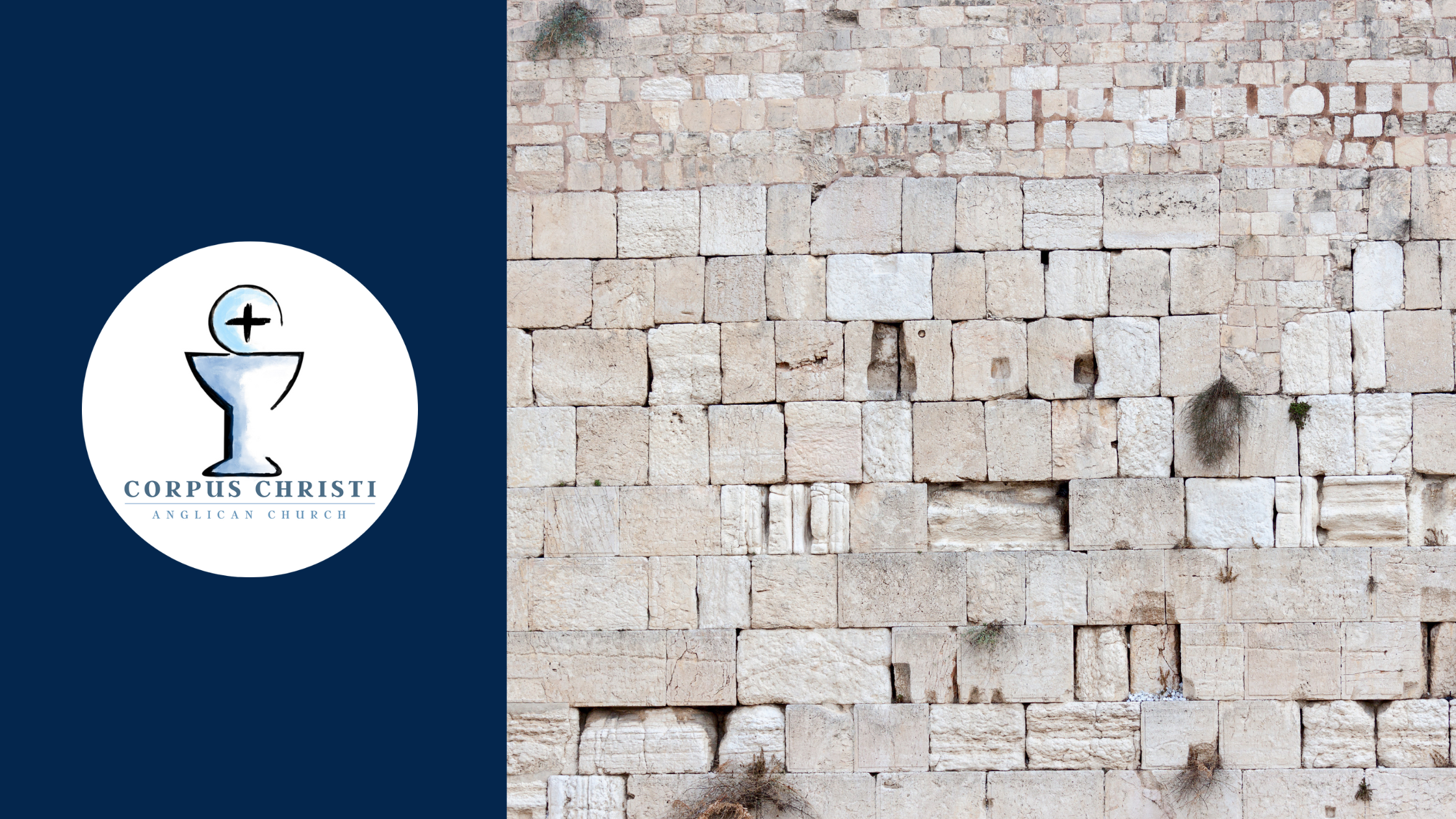
So I've got to back up a couple of verses to the beginning of chapter 13 in Mark, and it starts like this: As Jesus came out of the temple, one of the disciples said to him, "Look teacher, what wonderful stones and what wonderful buildings!" Have any of you ever been to the Wailing Wall in Jerusalem? Yeah, well, those are just the foundation stones, but they are huge, I mean one of the stones is about the size of, well, almost of the back wall here, and those are just the foundation stones.
And the second temple that Herod had built was really a stupendous building, and so all of the Jews were very proud of this second temple, and they said, "look teacher, what wonderful stones and what wonderful buildings," and Jesus said to them, "do you see these great buildings? There will not be left here one stone upon another that will not be thrown down." Oh boy, what a downer. It was as though, and try to picture this for yourself, it was as though Jesus had led us into Washington D.C. to the Mall, and said, "hey, look up there at Capitol Hill," and said, "do you see that magnificent building? There will not be left here one stone upon another that will not be thrown down."
How would we feel? Oh no, that building represents everything that is important to us, our common story, the ideas that shape our way of life, the experiences that fill the memories of our families going back many generations. One of us cries out, "I had five ancestors on the Mayflower in 1620. They were Puritans and wanted to create a society based on the Protestant Reformation and English common law." A second one of us said, "my great-grandfather was a French Calvinist, a Huguenot who came to America in 1760 to escape persecuton and begin a new life." And then a third said, "my father was sent to America as a 12-year-old to escape the ethnic cleansing of Armenians that began in Turkey in 1895." And if you thought about your own family histories, you could probably remember family stories that go back to when your people came to this country first, and what the cost and the reason for their migration was.
When Jesus warned his disciples that the temple would be destroyed in the near future, they would have reacted the same way as we would when confronted by the possible destruction of everything that we hold most precious to us in this country. But the people of Israel had lost their way. They had forgotten their covenant with God, the foundation of their national life. They assumed, like all the other nations, that peace and prosperity could be achieved through war. After all, as I have already said, they had been through a number of encounters with imperial powers which involved, sooner or later, some form of warfare. And they had come through it, and the nation had been established.
So, it was entirely plausible that the nation would expect that if they rose and rebelled against the Romans, against all odds... You know, the Romans were the superpower of the day. They were amazingly well organized as a military power. So, having listened to Daniel and the other prophets, the Jews were sure that at the right time God would act, and they believed that they would be victorious.
During the time that Jesus was walking in Galilee and visiting Jerusalem, the disciples believed the time for the deliverance of Israel was near. Most of the Jewish people believed that this was the time, and this was the state of expectancy that Jesus was addressing in his teaching. But he was really struggling to get these dear people to understand what he was talking about.
When Jesus stood on the Mount of Olives as he and the disciples were approaching Jerusalem that last time -- You know, the Mount of Olives is about the same level or higher than the city of Jerusalem. So, they were on the top of the Mount of Olives looking across the valley to the city. And Jesus was looking down with the other men, and he lamented, "Oh, Jerusalem, Jerusalem, the city that kills the prophets and stones those who are sent to it, how often would I have gathered your children together as a hen gathers her brood under her wings, but you were not willing." One of the most sad events that is recalled in the Gospels.
And then Jesus began to say to them, "See that no one leads you astray. Many, many will come in my name saying, I am he, and they will lead many astray. And when you hear of wars and rumors of wars, do not be alarmed. This must take place, but the end is not yet. Nation will rise against nation and kingdom against kingdom, there will be earthquakes in various places. There will be famines, but these are but the beginning of the birth pangs. But be on your guard, for they will deliver you over to councils and you will be beaten in synagogues, and you will stand before governors and kings for my sake to bear witness before them. And the gospel must first be proclaimed to all nations."
This is where today's reading begins -- in case you're wondering, that's the background, that's the context. And maybe today's reading will begin to make sense if we understand this high sense of expectancy. Jesus struggled to get the disciples to understand what the situation meant. And so then the account in the Gospel of Mark goes on. "But when you see the abomination of desolation standing where it ought not to be, let the reader understand."
I hope you understand because I shouldn't take the time to unpack that right now. It's interesting historically, but the point is, it's a sign that things are really going to pop. "Then let those who are in Judea flee to the mountains." Jesus continued: If anyone says to you, look, here is the Christ, or look, there he is, do not believe it. For false prophets will arise and perform signs and wonders to lead astray, if possible. But be on guard, I have told you things beforehand." Okay, this is just the preface. So how does all this apply to our situation today?
This text is not about the literal end of the world. Some people read it that way and that causes profound confusion. It does not mean what we mean by "the end of the world." It doesn't mean that history will stop or that the planet will dissolve into dust. That's not what it means; but it does mean that the world as we know it, our way of life, everything that's familiar to us, everything that's important to us, will come to an end. That's what Jesus is saying.
So just to try to get a hold of this -- This is the start of the three points here. (1) The first is the symbolism of the temple. What does the temple mean to the Jews? (2) The second is what is Jesus' advice if we find ourselves in a time of trouble, in a situation that looks like imminent catastrophe? (3) And then the bottom line, the good news, and get a hold of this, everyone, Jesus is the temple. If you're paying attention, that's the bottom line. But that's kind of a weird way of talking about it. Okay, first of all, the symbolism of the temple.
(1) The temple, the Jewish temple is the symbol of national identity and unity. Okay? This is huge. Sounds something like the Capitol building, huh? And it's the repository of the national constitution. And, of course, what is the repository of the national constitution of the Kingdom of Israel? Of course, it's the Ark of the Covenant. And you know what's in the Ark of the Covenant? It's a big box covered with wonderful golden decoration. And inside are scrolls. And, the stone tablets on which the 10 words were written on Mount Sinai. But that wasn't all. There were two more things. There was also Aaron's staff. I had forgotten that. I didn't know that until I looked it up in the words of All Wisdom, the Wikipedia. But I did know that the fourth thing in there was a bowl of manna.
So these were the symbols, the objects that were associated with the events that both gave the people of Israel their freedom and their identity and their way of life. So it was huge. It was the national constitution. It was what gave their life meaning and shape. And the key point here, and I can't go into detail on this, is that the sacrificial system, (I'm just struggling afresh with the whole concept of sacrifice) but besides being a national symbol, the temple was a place of periodic, regular sacrifices.
The point of the sacrifices was, through the sacrifices, a place was made in human life where both heaven and earth overlapped and intersected. This is where heaven, which is where God is, and earth, which is where we are, where they overlap and intersect.
And, of course, God's purpose in his creation is that these two, heaven and earth, should be together. But because of our willfulness, there's been a gap created. And God's purpose, what he's doing in the historical process, is to close that gap and get his human creatures back together with himself. And that was what the temple represented, the meeting place of heaven and earth.
(2) Point number two, dealing with imminent catastrophe. When it looks like everything's going down the drain, how do we react? Well, actually, Jesus says, if it's really serious, get going. Get out! And that's what most of the church in Jerusalem did when the war with the Romans was imminent. They got out of town. And that was good advice. It sounded like something they told me in seminary. And that was, "Choose which hill you want to die on. You can't fight all the battles." There are times where you just take a powder. You just get out. However, that's not normal operating procedure for us.
We are not to chicken out. We are not to stick our heads in the sand. We are to stand and be good stewards. That is the situation in which most of us find ourselves today. Our calling is to listen for the guidance of the Holy Spirit and to do what he is telling us to do in our particular situation, even though it's costly for us and may look as though it's futile. That's what Jesus is telling us to do. So the options are escape or stewardship. And the basic message is, don't chicken out, guys. Hang in there. OK.
(3) Jesus is the real Temple, but he is not only the place where heaven and earth overlap and interlock, but Jesus' resurrection is the beginning of the New Creation. And we've already heard a bit about this, but we really need to get this in our heads. I don't know about you, but I am a child of the Protestant Reformation and, in particular, Calvinism, which I respect and appreciate. However, as Calvinism has come down to this generation, it looks like merely an escape mechanism. That is, if you believe the right thing and do the right things, your ticket is punched and you can be sure you will go to heaven when you kick the bucket. And that's all that matters. And I would say, well, that matters, but that's not all that matters.
This is the point. God has created this amazing planet and has brought these strange and wonderful creatures (us) into existence, and he's not given up on us. God does not make junk. That's a basic biblical principle. I hope you all got that. And he has started this process, and he's going to bring it to completion in spite of the powers and principalities and all of the forces that want to spoil God's plan.
So we are experiencing the birth pangs of the New Creation. And not only was it mentioned, in today's gospel -- Paul picks that up in Romans. He talks about the sufferings of the present age as the birth pangs of creation. And that is what our suffering looks like. So let's bring all of this in line. Let's pray together this wonderful prayer from our Book of Common Prayer:
Almighty God, who hast given us this good land for our heritage:
We humbly beseech thee that we may always prove ourselves a people mindful of thy favor and glad to do thy will. Bless our land with honorable industry, sound learning, and pure conduct. Save us from violence, discord, and confusion; from pride and arrogance, and from every evil way. Defend our liberties, and fashion into one united people the multitudes brought hither out of many kindreds and tongues. Endue with the spirit of wisdom those to whom, in thy Name, we entrust the authority of government, that there may be justice and peace at home, and that, through obedience to thy law, we may show forth thy praise among the nations of the earth. In the time of prosperity, fill our hearts with thankfulness, and in the day of trouble, suffer not our trust in thee to fail; all of which we ask through Jesus Christ our Lord. Amen.**
_______________________________
**The recording of this sermon was converted online from mp3 format to text by https://turboscribe.ai/ and edited by the author.