SERMONS

Steven Myles Ivory Casten Steven Myles Ivory Casten

Third Sunday of Easter


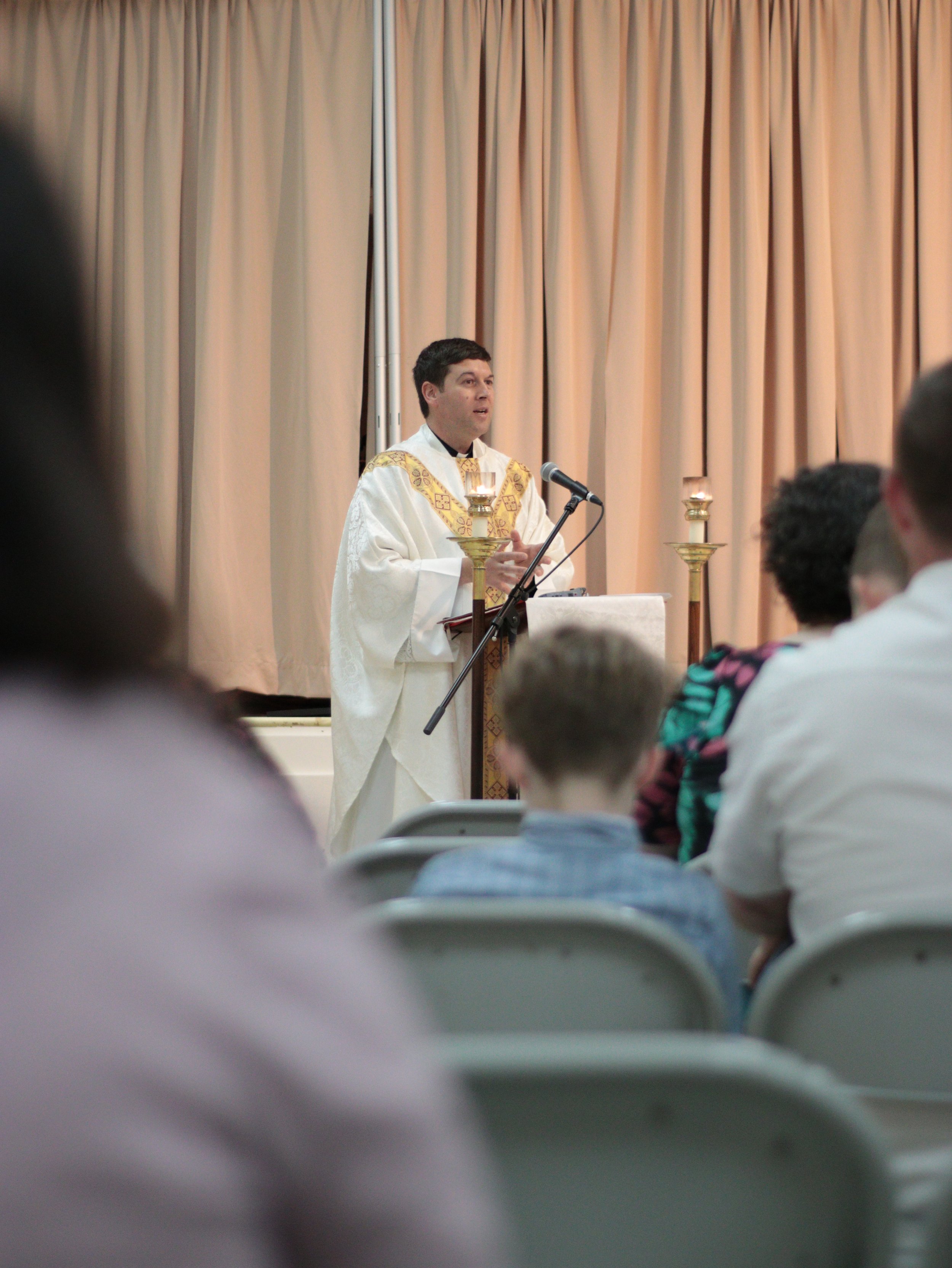
Good morning, everyone. It’s nice to see you all this fine day.  My name is Steven Myles, I am a member here at Corpus Christi Anglican Church.  So, if you are new or visiting with us today, I am not the person you would normally see in this space.  Father Morgan Reed, the beloved Vicar of our church, has invited me to speak today, which just so happens to be the 3rd Sunday of Easter. 

Several years ago – after I graduated college, I had the incredible privilege of working in the Nuba Mountains of Sudan.  During that time, I worked with a relief organization that was tasked with rebuilding churches, physical church structures, that had been targeted and destroyed during the 70-year civil war.  After our team had completed all the church reconstruction in one geographic area, we would send out a scout into an unknown area, and that scout would go from village to village and collect the histories of these areas and based upon that information our organization could then identify the next villages eligible for physical church reconstruction.  For a period of time, I was one of these scouts and – I can tell you – I will never forget the stories that I got to hear.  The life of these people was so different from my own, one of the key differences I noticed was the way the Nubians were inextricably intertwined with their cattle.  Let me give you a sense of what I mean by that - There was no school in most villages, so the young boys were in charge of shepherding the cows out to find pasture and water and protecting them from threats.  While out in the fields, the young men would drink the cow’s milk to put on muscle mass and they would wrestle, wrestling was the national sport, so they would wrestle which allowed them to establish their place in the social hierarchy of their village.  They would also use the cattle urine to dye their hair a vivid orange color, and they would burn the cattle dung for heat at night and use the ash from those dung fires to cover their bodies in ash and that would repel mosquitoes, because malaria was a real threat in this part of the world.  And every so often they would come into town, for celebrations and weddings, and they would dance, the most incredible dances, and they would actually hold their arms imitating the position of their favorite cow’s horns, because every cow had varying degrees of value based on their horns orientation, coloring and patterns on their hide – hopefully you kind of get the picture - their lives, in a sense, revolved around their cows.  And all the while these young men were out in the fields living a shepherd’s life they had plenty of time to dream, and what do young men dream about – women – let’s be honest, they dream about women but specifically how they would raise the dowry price for a wife.  The average dowry, or the price a man would have to pay to his future father in-law for his wife, was between 50-400 cows and the vast majority of people didn’t have hundreds of cows, and that usually meant these young shepherds would form a group and would raid neighboring villages of different tribes.  So the history of this people is one of perpetual violence unfortunately, perpetual cattle raids.  It was common knowledge that you could tell where a man was headed based on the spear he was carrying, there was a spear for fishing a spear for hunting and a distinct spear for battle.  So I would sit in these churches of mud walls and a grass roof, or sometimes just a few logs under the shade of a large mango tree and write down the histories of these villages.  And the recurring theme I picked up on, was raiding other tribes for their cattle and then being raided in revenge, raiding and being raided, until one day light skinned men showed up– Arabs from the North- showed up with machine guns and tanks and the villagers would fight them with their spears, and when the Arabs left they got on with life as usual.  For most of the villages I interviewed, that was the extent of their experience of the 70-year civil war in their country – just 1 or 2 brief encounters.  Men and women lived their whole lives, raised families, built homes and communities but were otherwise completely detached from the broader context – this war that was going on around them.  It was a battle over which government would rule the country, the fight over which laws would be instituted upon their land and they were mostly disengaged.  I don’t think that is unique to the Nubian people though– is it?  Certainly their situation is unique, and their day to day looks vastly different from ours, but as men and women on this Earth, we share the same tendencies.  This propensity to trod along from one day to the next, and casually fall into the patterns of the world or the culture around us and all the while remain detached, oblivious or too pre-occupied to engage with the overarching struggles that surround us.  So as we approach today’s passage, I ask that you would join me in praying that we could hear the voice of God calling out to us who are so prone to wander.

OPENING PRAYER:

The grass withers, the flower fades, but Your word O Lord will stand forever.

Lord the word that goes out from Your mouth; it shall not return to You empty,
but it shall accomplish that which you purpose, and shall succeed in the thing for which You sent it.  Father God clinging to that truth we ask You to speak to us this morning, that Your Word may accomplish that which is needed in each of us - in Christ’s Name.  Amen.

SERMON:

Before we jump in - I find it helpful to provide a rough outline of what the next few minutes are going to look like.  First, I want to establish where we are in the church calendar and understand the context behind the Easter season.  Then we take a close look at our gospel passage from today’s lectionary in Luke 24 and these 2 men on the road to Emmaus.  And finally I want to make the connection of how we sitting here today fit into this story – the story of Easter.

Because– when we take a step back, friends, collectively we are all a part of one story.  The story of God and who He is, and how He endeavors to communicate and relate to us– that is the greatest story there will ever be.  And to tie it back to my work in Nuba, I believe that is the battle that is ongoing and enveloping us all-whether we recognize it or not.  This battle for the truth of who God is.  Bear with me here, I’m going to start pretty far out and abstract and then slowly tighten our focus and zoom in.  Now, a lot of people take exception with how God has chosen to reveal Himself.  The most common refrain throughout all human history is mankind saying, “if God is real, why doesn’t He just show me who he is?”  Seems fair - But have you ever stopped and given that question any thought?  How should an infinite God convey to finite creatures the breadth of who He is.  Would just one look really do it?  From what I can observe and from what Scripture teaches me, God is unchangeable, He is a constant, from eternity past to eternity future He is. 

Because God is a constant, He is unchanging, He reveals Himself in A consistent and repetitious manner.  All throughout Scripture, we can trace these story lines of God revealing His character, from one generation to the next.  He reveals Himself as Holy, as a King, as a Father as a shepherd - metaphors that we can relate to.  And the absolute beauty of God’s word is the congruity or the uniformity of these revelations – each of these nuggets of truth in the Bible were recorded by different men or women, from different time periods different geographic locations, and the purpose of their writings were wildly different, some men wrote poetry about God, some recorded history, some transcribed prophecy, but despite all those variables taken together the whole of Scripture conveys the nature of an infinite God just viewed from different perspectives.  The season we call Easter, is one example of God, slowly and methodically, leaving a trail of compounding evidence which not only reveal his character but His plan of redemption for mankind.   So let’s look closely at Easter - In order to understand, we have to go back to the Jewish traditions before Jesus, there is the holiday of Passover, this commemorates the night, 3500 years ago in Egypt, Jews had to slaughter a lamb and wipe the blood of that animal on their doorposts.  In faith, the families who obeyed these instructions were saved, and the spirit of death passed over their homes.  The very next Sunday after the Passover, there is a ceremony the feast of first fruits, where a priest will collect a sheaf or bundle of wheat, the best and most perfect bunch of wheat, and he raises it up before God and thanks God and ask that the rest of the harvest would be just as good.  From that Feast of First Fruits there is a period of 50 days which ended in another Feast.  That final feast of weeks signifies ten commandments and God’s covenant with Moses.  I want to make sure you are still with me – that was a lot of words.  What I am trying to highlight – is the pattern?  There is a 1 to 1 direct connection between those ancient traditions, and our Easter season – and they all occur during the same stretch of the calendar – roughly March to May.  The pattern begins with death, few days later a raising up, a period of fifty days, and the institution of a new covenant.  Death, raising up, 50 days, and a new covenant.  So let’s make those 1 to 1 connections to really drive this home - For thousands of years Jews, before Jesus, had an annual holiday where they remembered the day a lamb was slaughtered so that they could live, and fast-forward to Jesus’ time it’s on that very same day the Lamb of God, Jesus Christ, died to save the world.  Back to the Jewish traditions, three days after the Passover, the priest would lift up the perfect grain offering, fast forward to Jesus’ time and three days after his burial Jesus was raised from the dead.  Then a period of 50 days and the mark of a new covenant with the giving of the law and now a period of 50 days and the mark of the new covenant with the giving of the Holy Spirit at Pentecost.   

I don’t know what you imagined it would look like, I don’t know what you think it should like, but this pattern is God is trying, desperately trying to reveal to us, the collective us of mankind, who He is.  He is not distant, He is not far off, aloof or indifferent.  He has been engaged during this whole arc of history and He is engaged here and now.  Regardless of what time in history you were born, whether it was before Jesus, during the life of Jesus, or after His resurrection.  God has been using this same stretch of the calendar - 50 some days from March to May– for thousands of years to capture our attention.  To the Jews it was Passover and the Feasts and to us it is Easter – but the purpose of these traditions remains consistent and that is to break up our day to day and focus our minds and affections on God’s plan of redemption for mankind. 

You guys with me still – that was a lot.   That’s why I don’t do this for a living.  So that was part one, we’ve set the stage with the significance of the Easter season, and all the careful meticulous effort God has crafted into its messaging. 

So now, the second part of toady’s message, we can turn our attention to the passage in Luke 24, and I’m hoping with this context established we can better understand the dialogue that is going on between Jesus and these 2 men on the road to Emmaus.  To quickly set the stage, this is one of a dozen or so instances where Jesus appears to people after His resurrection.  We pick it up in verse 13 Cleopas and his friend are on a short 7 mile walk, downhill and to the West, from Jerusalem to Emmaus.  And these men are discussing the latest events in Jerusalem, but verse 16 indicates that their eyes were kept from noticing that the stranger who joins them was actually Jesus.  And as they are walking and talking with this stranger, the stranger inquires in v.17 “what is this conversation you are having?”  And it’s pretty palpable right, the incredulousness of Cleopas, his incredulity in verse 18 when he answers and says, “Are you the only visitor in Jerusalem who doesn’t know what has happened in these days?”  But Jesus’ interest is in hearing if these men have picked up on this sequence of clues, so he invites their explanation by saying “What things?”  And here I can imagine Cleopas and his friend launching into the story with excitement in their voices, finishing each other’s sentences and maybe adding details that the other neglected, in verse 19 they say “There was a man, Jesus of Nazareth, a prophet, mighty in deed and word before God and man.”  And slowly their excitement fades, and their voices drop because they inform the stranger that – v.20 “Our chief priests and rulers delivered him up to be crucified, we had hoped he was the one to redeem Israel, but it has now been 3 days since he died.  Women we knew went to his tomb this morning, but they did not see his body”

            Jesus’ response in v.25 might come as a bit of a surprise – it pretty cutting, “O foolish ones - slow of heart to believe”.  It’s important to distinguish that when Jesus calls these men fools, He is not making a judgement on their intellectual capabilities, he is not calling them stupid.  In scripture the term fool has a very specific definition, it’s an indictment against the aspect of our humanity that rejects wisdom and despises instruction. “O foolish ones - slow of heart to believe” Psalms tells us that “It is a fool that says in his heart, there is no God”.  And every one of us have played that fool – but why? From the time our parents ate of that forbidden fruit we have been cursed to believe that the biggest obstacle, the biggest barrier to what we perceive to be our own joy and happiness is God’s law.  So we want to do away with it, we want to be free we want the autonomy to do whatever we want to do and not what He commands us to do.  The deepest most pernicious bias of all human inclination is this bias against our blessed Creator Himself.  We are “Foolish ones – slow of heart to believe.”

            Thanks be to God that He understands us and He is patient with us.  Jesus, recognizes that these men are unaware of the situation of the context they have missed that this the unveiling of God’s plan which has been in motion for thousands of years.  So in v. 27 it tells us that, “beginning with Moses and all the Prophets, Jesus explained to them what was said in all the Scriptures concerning himself.”  And I can only imagine how riveting that must have been, to listen to the author Himself explain the intention and the nuance behind each piece of His story.  So he points to the law and the prophets, the poetry and the wisdom books, and he reveals how those writings are proclaiming Jesus as the Messiah – the one the Jews have been waiting for, the one who will save mankind.  Not only were the events of the last few days foretold, but the events of the last few days were necessary, v.26 Jesus says it “was necessary that the Christ should suffer these things.”  Because without the shedding of blood there is no remission of sins.

            But still that’s not enough - is it.  All the facts and information can be laid out in the most compelling fashion.  Men can have all the knowledge there is, and yet it will not penetrate into their day to day lives.  We will remain undeterred, we will remain indifferent, information is not enough to change a man’s heart.  So in v. 32 we hear the men remark, “did not our hearts burn within us while he talked with us on the road.”  And this my friends is a gift of God.  These men described there interaction with God as a fire burning within them, and similarly the prophet Jeremiah records his experience as a fire shut up in my bones, and the only way I can try to explain this is that when we truly hear the voice of the eternal God, it resonates with the part of us that is also eternal, our own soul and it produces a visceral response.  The history that before appeared to be just a coincidence, the man we walked with who appeared to be just a stranger.  We recognize its not just a coincidence, we recognize its not just a stranger. We see that it is God who has walked with us these many, and it is His voice calling out to us. “Do you see me?  Do you see who I am?  Do you see my love for you in this great plan I have made?  Will you not repent and turn back to me?”

            In closing, I want to quickly read from our passage in Psalms 116– the author writes “What shall I render to the Lord for all his benefits to me?”  Surely this Easter season is a period of joy and thanksgiving.  It is a time to celebrate and remember the grace of God through Jesus Christ His Son.  And what a privilege to live during these days, where we can look back and connect the dots to see God’s mighty arm moving through history.  It’s said we need to be reminded more than we need to be instructed and my hope this morning we are reminded of God’s faithfulness and how He has been using the Easter season for thousands of years to break up people’s day-to day and to call them back to Himself.  As we approach the altar here to receive the elements, the body and blood of Christ, let us remember the second part of Psalm 116, the author answers his own question “What shall I render to the Lord for all his benefits to me?  I will lift up the cup of salvation, and call on the name of the Lord.”  If God has your attention this morning, call out to Him, He is near.  If you don’t know what to say, there are people after the service who would love to pray with you.  Happy Easter my Friends – He is Risen!  He is Risen indeed!

 
Read More
Fr. Morgan Reed Ivory Casten Fr. Morgan Reed Ivory Casten

Second Sunday of Easter: How We Build Matters

Audio Block
Double-click here to upload or link to a .mp3. Learn more
 

Introduction

         Good morning dear friends. Happy second week of Easter.

         Just this last week I was working from my office when I heard a knock on the window. One of the preschoolers, who is friends with our son, wanted to tell me something. I opened the window and she said, “Morgan, we are building a track to run on but we need sticks to make the track.” She had only found one, and she knew that my son and I like to hike, so she assumed I would know where to find sticks. I encouraged her to look under the trees. She found some sticks, set up her race track, and she and her friends ran and enjoyed running in the beautiful Springtime sun. Some days I really long for the times where my greatest challenge in a day would be where to find sticks to make an imaginary racetrack. But as time goes on, life gets more complex, we are given more responsibility, and we have to make harder decisions. If that weren’t challenging enough, we live in a world on this side of Eden, where people continue to walk along ancient, broken pathways, apart from God, cloaked in darkness and deception, looking for a way home.

         It’s into this brokenness that Jesus enters our humanity to deliver us from sin and death. This deliverance wasn’t just for the wealthy who could buy their way out of trouble, or the intellectually superior who could rationalize their way out or the darkness. This gospel of king Jesus came to every man, woman and child; slave and free; Jew and Gentile. But as people began to follow this resurrected Lord, it began to put them on a collision course with the ways their families, subcultures, neighborhoods, and nations were impacted and influenced by the kingdom of darkness. There is a risk of exclusion for the follower of Jesus as they hold out what is ultimately good in the face of deception. This was the experience of the early Christians to whom the letter of 1 Peter is addressed. What this letter shows us is that God is building a new family in Christ for a new hope where trials become a strange gift that burns away and purifies our distractions, clarifies our mission, and helps us hold out the goodness of Christ for the world. As we look at the beginning of this letter, let me pray for us.

         “In the name of God, the Father, the Son, and the Holy Spirit, Amen. Lord, may the words of my mouth and the meditation of our hearts be always acceptable in your sight, O Lord, our Rock and our Redeemer, Amen.”


1. The resurrected Christ has begun a new family of hope (3-5).

         The resurrected Christ has established a new family. Peter had been set up as a leader among the apostles, an ambassador of Jesus for the church. He served for a time in Jerusalem, but this letter is written a few decades later, probably just prior to Nero’s persecutions which would bring Peter to his death in the mid-60s. The church is about 30 years old at this point and Peter commissioned this letter to be written down and circulated by his ministry partner, Silvanus. He writes from Rome, which identifies with Babylon of old. He is in a pagan  city, part of a pagan empire and is aware that he is a pilgrim and not at home. He writes as an exile to others who are exiled, whom he calls the Diaspora (1:2) who are in various cities in Asia Minor, which is in Modern-day Turkey.

         The Christians he writes to are likely Gentiles that were converts to Judaism, then came to believe in Jesus as the Jewish Messiah. They would come to be persecuted by both Jew and Gentile as a result.[1] These were not influential and wealthy people. Peter even mentions slaves and women, who would have been expected to worship the household gods of the father of the family. These Christians, who were following Jesus, though they weren’t highly influential or of high status, were a part of the new Israel, the people of God, those whom God had called and set apart to make his glory known!

         It’s these people, of which also are you and me, that have been born anew by the resurrection of Jesus Christ. We are all looking for the promised land together as exiles in a foreign land. The church is at its best when it becomes a community that provides refuge for the vulnerable rather than those who misuse power. I can appreciate this. It is hard to build the kind of performance that will attract and maintain the  presence of high profile individuals in a church. Some churches try; but for me, the most fulfilling moments of ministry have been with individuals or in smaller groups: coming to your homes for a house blessing, or visiting you with communion in the hospital, or sitting with you in the office and hearing your stories and praying with you, or hearing your confession. I love seeing the church enter into this with one another: creating a meal train so that you can bless one another with your cooking and your presence to one another, the ways you open your homes to one another for hospitality — including Formation Groups, watching the BBQ team smoke a brisket for the church, weeping with one another in prayer, encouraging one another, having vulnerable and sometimes hard and honest conversations, and making repair with one another when harm has been done or relational rupture occurs. This is what creates a stable outpost of the kingdom when the culture continues to shift and change. It is a gift to see this church become such an outpost of the kingdom of heaven, a divine family which provides comfort for the vulnerable and that provides an appropriate amount of discomfort for those who are far too at-home in this world.

         How one builds the household of God matters. We can say the right words to articulate a great goal, but if the means to getting there are not the way of Jesus then we have missed it. The goal of the church is not to do something, but to become something. “Success”, then, is measured by how one experiences Christ when they meet us rather than average Sunday attendance. If the pastor or leaders are abusing power, or if the church’s activism is divorced from the theology of the church, or if a church focuses all its efforts on issues of secondary or tertiary theological importance while being divorced from seeing the kingdom come in the neighborhood, or neighborhoods, around her, then how is she a community of hope where the resurrected Jesus is made known as a comfort for the vulnerable? 1 Peter reminds us to slow down and consider how we build.


2. Trials are a strange gift of purification and opportunity (6-9).

         We have seen first that the resurrected Christ has begun a new family. This is the family we need to feel “at home” in our pilgrimage in this world. Second, trials are inevitable, but they are also a strange gift. St. Peter helps the church avoid two extremes: attempting to overthrow the Pagan culture through political violence, and viewing the ethical demands of the Gospel as inconsequential and capitulating to culture. Because the church seeks to engage the world with the transforming love of Christ, they will experience some amount of persecution and trial as they hold out the goodness of the Gospel of Christ in a world content with its self-deception.

         This reminds me of a quote from one of the apostolic fathers, the Epistle of Diognetus, which says, “...They live in their own countries, but only as nonresidents; they participate in everything as citizens, and endure everything as foreigners. Every foreign country is their fatherland, and every fatherland is foreign...”[2] The text also describes the ways that Christians safeguard their allegiance to Jesus by refusing to use their bodies and creation for disordered purposes. It says “They marry, like everyone else, and have children, but they do not expose their offspring. They share their food, but not their wives.”[3]  In other words, Christians bless what is good and walk with others as far as they can without doing harm to themselves or others as image-bearers of God. Jesus ate with sinners, but did not join their sin. He held out the goodness of the kingdom and invited them in. Those who follow Jesus will walk with their neighbors as far as they can, but will have to draw the line of shared culture somewhere. And when a follower of Jesus puts up a boundary, they risk exclusion and persecution.

         Peter’s audience became scapegoats for the ills of the area. In their day, the refusal to worship the local gods may have been seen as the reason for a lack of prosperity in a village, so it would be easy to lay any misfortune on the shoulders of the Christians in the village. But this suffering, Peter says, is hopeful. Suffering brings clarity to our mission as followers of Jesus and purifies us from what distracts us. This doesn’t mean we delight in the suffering itself, but it does mean that entering trial well reminds us that redemption is coming. It also invites the community of Jesus to come and support us in trial as family.

         It means ultimately that we live with integrity as people whose guiding principle is the life, death, resurrection, ascension, and return of Jesus. Nothing else deserves our ultimate allegiance other than king Jesus. We have responsibilities to our church, our country, our earthly family, and our neighbors, but everything is rightly ordered by the guiding principle of Jesus’ life, death resurrection, ascension, and his coming again — The Gospel.

         I don’t want to cheapen the persecution of these Christians by comparing religious persecution to the stripping of privilege or inconvenience. I remember a discussion once of America taking away tax benefits from clergy and churches. Would that strip away of some of our privileges as Christians? Yes. Inconvenient? Yes. Is it persecution? No. Babylon is going to Babylon and Rome is going to Rome.  

         There will be times where allegiance to Jesus puts us at odds with our community and leads us to exclusion. Be mindful that exclusion does not occur because of an indignant or combative spirit. Come with curiosity about someone’s story. Ask good questions, present gospel convictions with clarity, but in a way that allows others to experience the discomfort of contractions in a disordered world. Spirit-led, compassionate questions hold out the goodness of the kingdom and they don’t merely win an argument. Go slow, be patient, and be compassionately un-anxious like Jesus if they refuse to change. There may come a time when one has to risk losing a job, face legal challenges, or upset someone close to them because of their ultimate allegiance to Jesus. The hope in 1 Peter is that in the church you are part of a privileged community because it is a saved community. As we fulfill the god-given task of announcing the good news of Christ, the church becomes the ark of salvation where deliverance is found and we will experience the tender compassion of the Good Shepherd.


Conclusion

          Jesus in his resurrection has created a new family. As we show forth in our lives what we profess by our faith, we may experience some amount of persecution, or exclusion because Christians will be those who welcome other sojourners and invite them to follow Jesus too. Be encouraged if you don’t feel “at home” right now. We are those who feel like foreigners in our homeland and at home in foreign lands. We invite people to come as they are and to be changed by the power of Jesus. May those who long to be comfortable, gain power, garner influence, and be at-home in this world, find the church to be a community where they are disquieted and made to know that this world is our place of pilgrimage to discover Jesus. May the church become that place where those afflicted because of following Jesus find life and comfort from their new family in the outpost of the kingdom of God.

         Let us pray:

Almighty and everlasting God, who in the Paschal mystery established the new covenant of reconciliation: Grant that all who have been reborn into the fellowship of Christ’s Body may show forth in their lives what they profess by their faith; through Jesus Christ our Lord, who lives and reigns with you and the Holy Spirit, one God, for ever and ever. Amen.


[1]                Scot McKnight, 1 Peter (The NIV Application Commentary; Grand Rapids, MI: Zondervan Publishing House, 1996), 23.

[2]                Epistle of Diognetus, 5.4-5.

[3]                Ibid., 5.6-7.

 
Read More