
Introduction
Good morning friends. It is great to be with you this morning. Back in 2016, Ashley and I were living in Arlington, VA and in January that year there was a large snow storm that dumped over 2ft of snow in a 24 hour period. It was so much snow that they just gave up and waited for a day to even begin plowing. When we’d lived in Chicago we would have been prepared for this, but unfortunately we had moved here via Dallas and we had gotten rid of a lot of the winter boots and long underwear. Some friends invited us over for a bowl of chili, which sounded amazing.
They only lived about a 7 minute walk up a hill, but it was not seven minutes that day. We were ill-prepared. We were in our normal shoes and we tried using saran wrap around our shoes and our legs to keep the snow from soaking us. It didn’t work. We started walking out the door and it seemed like every step we took the snow would go up to our waste. It took 40 minutes and I have never been so sweaty, wet, cold, and so sore. We got there, ate our chili, and just slept over. Having snow pants, bibs, and boots would have made all the difference. We were not prepared.
Today’s parable from Jesus is about preparing for the kingdom of God when Jesus comes and ultimately makes all things new. We don’t know when he will come. Are we prepared for the long wait? And how are we preparing? These are the questions before us in the text this morning. We have to always be preparing and not grow slack on the job. It’s in preparing in the long season of waiting that we grow in the maturity and readiness to sit at the banquet of God.
Let me pray for us as we look at the text together, “In the name of God, the Father, the Son, and the Holy Spirit, Amen. Lord, may the words of my mouth and the meditation of our hearts be always acceptable in your sight, O Lord, our rock and our redeemer. Amen.
I. The Parable
In our culture, it is most often the case that the wedding ceremony happens in one day during the daytime. Perhaps the reception goes into the early morning hours, but we are looking at a different cultural practice in Jesus’ day. There is more we don’t know than what we do, but from the parable we can deduce several practices. The wedding ceremony involves the whole village and lasts at least two days. The wedding ceremony goes into the night and perhaps into the early morning.
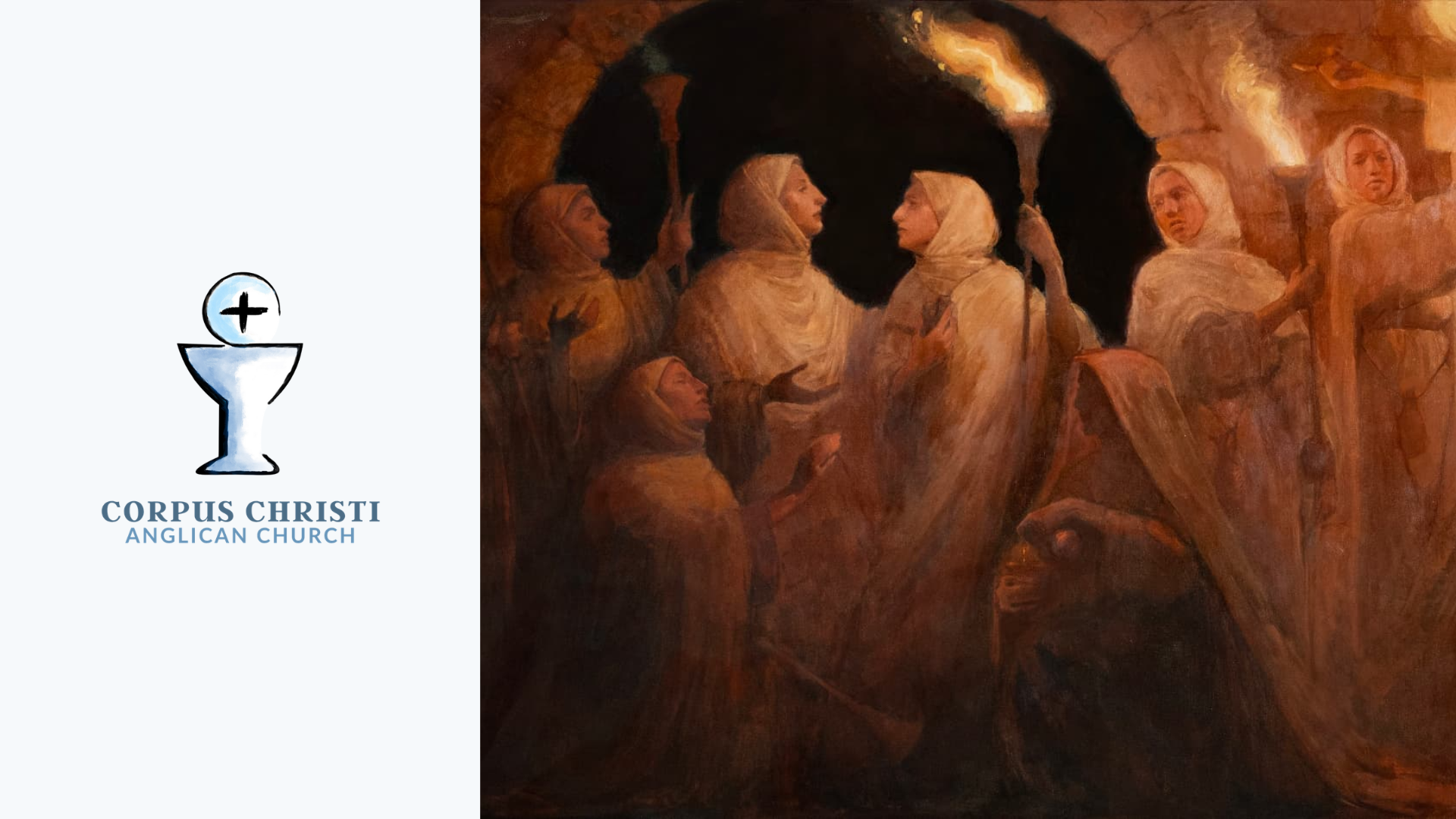
The groom and several of his close friends are all making their way across town to the house of the bride where she will be taken and brought to his family home where a crowd is waiting for them and will join in a great marriage feast. Part of the procession involves a group of young, unmarried women from the village who are part of this procession, escorting the groom to to the banquet in a torch-lit procession in the night. Their torches, made with linens soaked in olive oil, and lit. Some of the women took enough oil to get them to the bride’s house and to get to the banquet. Some of the young women, realizing that the bridegroom might get delayed, which is very common in a wedding scenario, brought extra flasks of oil so that if the groom was delayed they would be prepared to trim their torches, put more oil on them, and keep going. It’s like if we have a battery operated light and we remember to bring extra batteries with us.
All of the young women fall asleep and at some point in the middle of the night, in an instant, there is a shout “Look, here is the groom!” The girls who have extra oil light their lamps and follow the groom. Those who do not have oil go out and ask the other girls for oil, which isn’t possible in the parable. Then they go and try to buy some. While they’re trying to buy it, the groom comes and they miss the procession. They make their way to the banquet and knock on the door. The groom opens it, they ask if they can come and his reply to them is “I do not know you.” Of course he knows them. It’s a small village and they’re in the wedding party. This isn’t about acquaintance, but about association. This isn’t a real-life scenario, it is in stark imagery because it is a parable, and the point is to join the banquet. How do we get there? We prepare for a long wait.
Following Jesus involves personal preparation, patience for what he is producing in us while we wait for his coming, and personal responsibility for our growth.
II. Prepare for a long wait and don’t rely on others’ preparation
The parable challenges us to prepare for a long wait. We don’t know when Jesus will come. This parable invites us to be strategic and to cultivate a life of responsiveness to the will of God. When Christ comes back he isn’t sitting there with a clipboard, tallying up how much we “accomplished to move forward the kingdom of God.” He won’t say, “you gave in to evil and made a complete shipwreck of your life, but wow, I’m so grateful for the way you built edifices in my name” or “you resembled nothing of my love and grace, but thanks for keeping my kingdom projects afloat with your charitable giving.” He is more interested in who we are becoming than the impact of our accomplishments.
Preparation is cultivating holiness so that what happens to us forms Christ in us. There is a heuristic play between doing and becoming. We need peace and stillness, prayer, time in Scripture, authentic friendships, Sabbath rest, counsel from those further along, and challenge. We need seasons of joy and consolation where God is deeply present. We also need times of desolation where a sense of God’s absence forces us to work to discover his presence, however faint it is, in the discomfort of our disorientation. We need to discover the face of God in our neighbors, who may or may not have means, who may or may not speak our heart language. We need to create space to reflect on what feels broken and where we long for the power of Jesus’ resurrection to come make things new.
I want to encourage all of us, at various levels of specificity, to create for ourselves a rule of life to help us prepare while we wait for Jesus to come and make all things new. If you haven’t heard of this concept, it comes from ancient monks and the idea is you’re creating something like a spiritual trellis for the Lord to grow you. Consider your life constraints and think about what rhythms of rest/sabbath, prayer, friendships, physical activity, and family rhythms you need to cultivate a life of preparation for the kingdom. We want our doing to flow from who we are becoming in the Lord. The Spirit is making us more like Christ in this preparation.
III. Take responsibility for your own maturation.
The parable also exhorts us to take responsibility for our own maturation process. Accept the difficulty of waiting and find Jesus in it rather than blaming others or trying to find a way out of waiting. There is a reason people don’t prepare for the kingdom and they are often not conscious of it.
It is really easy to tell people what to believe and how to act. It is easy to paint a picture of saintliness and virtue. What I’m more interested in is what gets in the way of us becoming that holy image-bearing humans that God has made us to be. If we are going to take personal responsibility, trusting that God’s grace is greater than our sin, then we must name why we have come to our places of brokenness. This involves looking at our stories, the coping strategies that keep us safe, and our patterns of numbing out to keep us from dealing with what hurts. What are we hiding from others that we would like to hide from God and even ourselves? Jesus is the great physician who longs to heal our wounds, but we have to let him.
I have been reading a helpful new book by Dr. Chuck DeGroat, called Who You’re Becoming: The Slow and Courageous Work of Cultivating Character in a Narcissistic Age. I am tired of impotent models of discipleship that pump us full of intellectual knowledge about history and the Bible without life transformation. I want to figure out the systemic problems that keep us from holiness and from Jesus’ person and character being formed in us: Generational trauma, complex trauma, the inability to forgive, attachment strategies, overreactions, the seemingly automatic ways we turn to the same patterns of brokenness over and over again. What does it mean to rewire broken neural pathways so that we unconsciously walk towards what is holy, just, good, and God-delighting? That is what I’m interested in.
DeGroat brings up this great example in his book, explaining that when fruit ripens naturally, a slow and transformative process happens by which what is hard and bitter becomes soft, sweet, and nourishing. With modern science we have figured out ways to pick fruit early and to force-ripen fruits with artificial gases. The problem is that this less mature fruit lacks taste and death. It is a performative ripening. We need a long-road to maturity that can sustain a long wait in a dark night. The women in the parable who did not prepare expect instant results. Give us oil; let us in. Change does not happen instantly and we cannot ride the coattails of others’ preparation. We have to do our own work. The ways we prepare and are tested produce the slow ripening of the sons and daughters of God so that they produce the complexity and sweetness of the garden of Eden.
As a church community, we have a beautiful gift in our intergenerationality. Those of you who are further along teach me so much about the sweetness of maturing slowly. I hope that those of us who have been walking with Christ for several decades can do this for those who are beginning the journey with Christ in this community, no matter their age. Be mentors and guides for each other about the healing work of Jesus. Help each other prepare well for the Lord’s coming. Do the hard work of discovering what keeps us from Christ being formed in us and then ask God for his healing grace. You don’t have to be an expert on holiness to help others. As someone on the healing journey, be an encouragement for someone else.
Conclusion
Live a life of preparing for a long night to be ready when the shout of “the groom is coming!” rings through the night air. Live intentionally, cultivating rhythms that allow the Spirit to work in us and mature us in Christ. Consider a rule of life. Look for the often unconscious places that keep us from drawing close to the love of God, enter in with curiosity and compassion for the younger you, and give the Lord what feels so so broken because he is the great physician who longs to heal you.
Let us pray again the collect for today:
O God, whose blessed Son came into the world that he might destroy the works of the devil and make us children of God and heirs of eternal life: Grant that, having this hope, we may purify ourselves as he is pure; that, when he comes again with power and great glory, we may be made like him in his eternal and glorious kingdom; where he lives and reigns with you and the Holy Spirit, one God, for ever and ever. Amen.