Proper 11: Patience for the Good Work of God
Introduction
Good morning friends. It is great to see you this morning. This morning’s passage from the Gospel is another agricultural metaphor, but with quite a different purpose than the parable of the soils, which was the Gospel passage last week. This week highlights God’s kindness, mercy, and his patience as he invites people into life in the kingdom of God. The way to discover a good spiritual harvest in this passage is through patience to look for what is ultimately good and beautiful versus what is ultimately harmful. I want to invite the kids down now for our kids sermon.
1) Kids Sermon
Hey everyone. I know that we have talked a lot about plants lately. I have one more to consider today and then I’ll move off of plants when I get back from vacation.
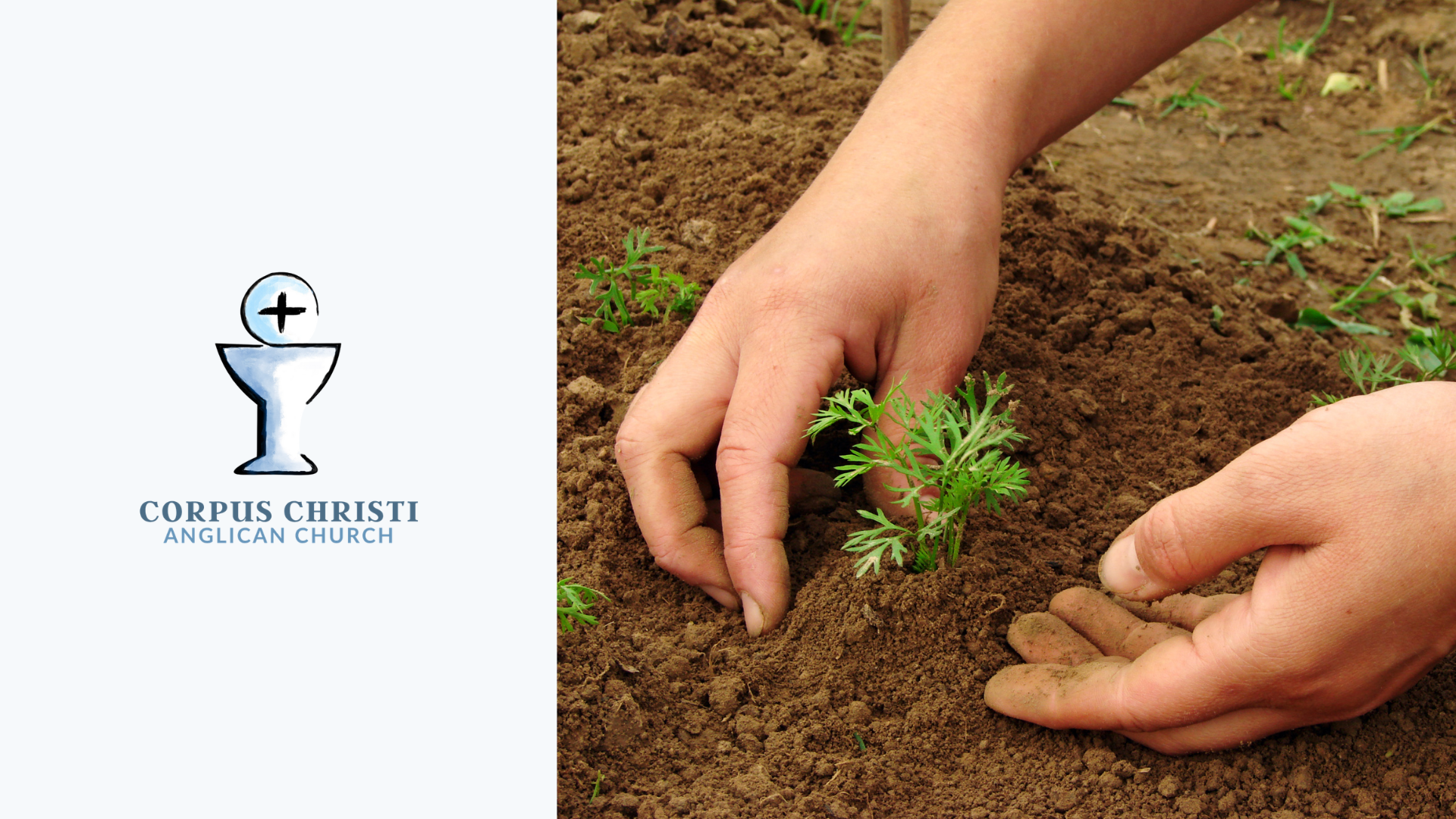
I want you to look up at the screen with me. Does anyone know what seedlings we might be looking at here? [Let them answer] On the left, the one with the finger, this is a common carrot. Once it is fully grown, you can pull it out of the ground, wash it, and eat it. The one in the middle is wild carrot, or Queen Anne’s Lace. It is mildly toxic. But the one on the right is called Hog Weed, or poison hemlock. It looks deceptively like a carrot, and it’s related to it, but every part of that plant is poisonous. Can you imagine being a farmer who sells their carrots to the market to make a living, and have someone mess with your crop? Imagine that in the middle of the night someone came in and took seeds from poison hemlock and queen anne’s lace after you had just finished sowing your carrot seeds and then the queen anne’s lace and hemlock both grew in with your carrots. That would be absolutely devastating!
What if, after about a month, the farmer notices that not all the plants are the same? What is the risk if they start pulling things at that point? That’s right! They might pull out the actual carrots with the other things. This means the farmer will lose money. If the farmer would wait, they will be able to figure it out. Queen Anne’s lace will flower after about 2-3 months. Poison hemlock and carrots both take over a year to go to flower. But in that time, the poison hemlock stems will start to turn purple and the leaves will become big and broad. The farmer’s patience will pay off. If they can wait 6 months to a year, they can eradicate the wrong plants so that their harvest can still be plentiful.
We often want things to go our way right now. But it is through patience, in waiting, that God is at work. Sometimes we go through really difficult things and we just wish God would make them better already. Jesus’ disciples felt that way too. Would the kingdom just come already!?! Jesus is reminding them, and us, of God’s kindness and our need for patience. God is at work even when we don’t understand it in ways we may never fully be aware of. What we perceive as slowness is God’s kindness at work, drawing people to himself. And because God is at work, we need to trust Him even when things didn’t go how we thought they would. The disciples of Jesus were to look to Jesus in their waiting and keep growing in their relationship with him. This is the same call for each one of us as well. Please pray with me: “Dear God...thank you...for your mercy...you give good gifts...and when we don’t understand...all that is happening...we know you are working...for our good...thank you...that you are with us...and that you love us. Amen.”
2) God’s Patience is Merciful (cf. OT and Psalm) (vv 24-30 and the other parables afterward)
In today’s parable about the kingdom of God, Jesus tells us about someone who sows good seed in a field, but then when everyone is sleeping, an enemy comes and sows weeds. These are not just any weeds, but they are likely darnel, which looks exactly like wheat until the heads of the grain form. If darnel gets mixed in with the wheat, it will ruin someone’s crop. Even though it looks like wheat, darnel is actually toxic and can make you quite sick.
The slaves of the household, understandably, want to pluck it, but the problem is that in trying to get rid of the darnel they risk losing some of the wheat crop as well. Instead, the master says to let the two grow up together. Essentially, once they mature, they will see exactly which is which. Then the reapers will be called and will separate the wheat from the darnel and store the pile of wheat in the barn. They will take the pile of darnel to be burned.
The slaves’ question is helpful in understanding why Jesus tells the parable. They say “Master, did you not sow good seed in your field? Where then, did these weeds come from?”[1] It gets to deeper human questions: “Why did you put this cruel person in my life?” Or “Why do tyrants still rule over people?” Or, “Why do good, hard working people, get exploited?” Or “How could you allow me to go through that awful situation in which I was so harmed?” Or even, “Why can’t I be healed?” These are good questions that God is big enough to hold for us.
Jesus isn’t providing answers for the “why”, but acknowledges the real and spiritual reality that the Lord, which he laters refers to as the Son of Man as a way to refer to himself, has planted good things. God gives good gifts and makes things good. When creation is described in Genesis it is described as good. In the Syriac translation of the Old Testament they translated it with a word that has semantic overlap between good and beautiful. I like thinking about what God does for us and in us as ultimately good and beautiful.
But that beauty is always growing up next to things cruel and destructive. The enemy of humanity sows counterfeit and toxic weeds next to good wheat. That which is most subtly wrong, what might even appear beautiful at first, is the most diabolically wrong because it is the enemy of what is truly beautiful. These weeds can be people who look like they’ve got it all together, but to try to imitate them is to bring about death. The weeds might be that we should defy our aging and changing bodies to pursue vain beauty. They might be messages about how we should be doing more, or that we should be better off by this point. These might be subtle messages that promise the kingdom and salvation, but don’t ultimately produce the freedom promised. We can see this on a grand scale with leaders who lie and make up problems that don’t exist so that they alone can fix them in order to stoke fear and anger and garner support.
We can see it in good desires gone awry — which is also diabolically subtle. For example, it is a good desire to have children; it would be harmful to desire children in order to fight a culture war or have someone to take care of your needs. It is good to desire a relationship with others, but not at the price of cutting off part of yourself to please them. Good desires misapplied fall short of what is truly good and beautiful. It is a good desire to see God’s kingdom, but the subtly diabolical lie is that it must happen right now in my time and by my power. This is fear and power that circumvents the patience necessary to see God at work.
This passage speaks directly to fear. The disciples may wonder if this is the time to take up arms and fight for the kingdom. There were certainly militaristic groups of Jews at the ready for it! If we take up arms at every injustice we will live in constant fear and exhaustion, and miss the opportunity to see what God does in his patience. There are several times in the Old Testament where God is called the one who is long-suffering and patient, showing mercy and compassion, etc. His character functions like a creed that forms the foundation for the covenant he made with his people. His compassion, mercy, and patience are the guiding principle of his working. He ultimately wants renewal through repentance, and not destruction and separation.
3) God’s glory will be revealed in renewed humanity (cf. Romans 8) (vv 34-43)
While the central theme of this parable is patience, the other part is that there is hope for the renewal of mankind. What God plants is truly good and beautiful. When Jesus explains the parable he says that the one who sows the good seed is the Son of Man, an allusion to God’s restorative work in Daniel 12. Patience is necessary to hang on long enough to see God’s mercy at work. God won’t ultimately let evil win, nor will his work be rushed by us. I do often wish that God would work on my schedule, but transformation is often slow, happening at the speed of restored relationships. God leads with mercy. He is a kind parent. NT Wright says this beautifully: “God is not a sadistic monster who would happily consign most of his beloved, image-bearing creatures to eternal fire. But there are equal and opposite caricatures we should also beware of. God is not an indulgent grandparent determined to spoil the youngsters rotten by letting them do whatever they like and still giving them sweets at the end of the day. We must refuse the second just as firmly as the first.”[2] We can come to our patient God who longs to meet us with his mercy and transformation. He sows good things and his nature is to love his good creation.
Conclusion
Today’s passage is an encouragement for us to discern God’s beautiful and good work with patience. Sometimes things or people spring up who are opposed to what is ultimately good and beautiful. Rather than being immediately reactive, we need to be prayerfully responsive. This requires patience and trust to see what the Lord will do. At the same time, be aware of subtly diabolical work in this world that is set on destroying the good work of God. The best way to expose what is good and beautiful versus what is subtly destructive is stay prayerfully aware of the work of Jesus. In the hard work of patiently enduring and looking for Jesus, God is slowly transforming us into a people who gloriously bear his image.
Let us pray:
O God, you declare your almighty power chiefly in showing mercy and pity: Grant us the fullness of your grace, that we, running to obtain your promises, may become partakers of your heavenly treasure; through Jesus Christ our Lord, who lives and reigns with you and the Holy Spirit, one God, for ever and ever. Amen.
[1] Matt 13:27
[2] Tom Wright, Matthew for Everyone, Part 1: Chapters 1-15 (London: Society for Promoting Christian Knowledge, 2004), 173.