
Feast of Sts. Peter and Paul: The Kingdom Through Diverse Stories of Faithfulness
TranscriptioN
Good morning. My name is Steve Brooks. I serve as a vocational deacon at Restoration Anglican Church in Arlington, Virginia. As always, Morgan, it's an honor to be invited to serve your congregation.
The last time I was here was before Easter of last year, and for those of you who were here then, you may remember it that I preached on the bread of life, and I brought with me one of my very first homemade bread loaves from a sourdough starter I created for that sermon. Every month, I bake bread from that same starter, and as I work through the bread baking process, I pray for your congregation. With each loaf that I make and that I eat and that I share, I find great peace in it.
So please know that you all are never far away from my heart, or my stomach for that matter. It's really great to be with you again. So let's pray. “Holy Spirit come, bless this congregation and our time here this morning. O Lord, let the words of my mouth and the meditation of my heart be acceptable in your sight. O Lord, my rock and Redeemer. Amen.”
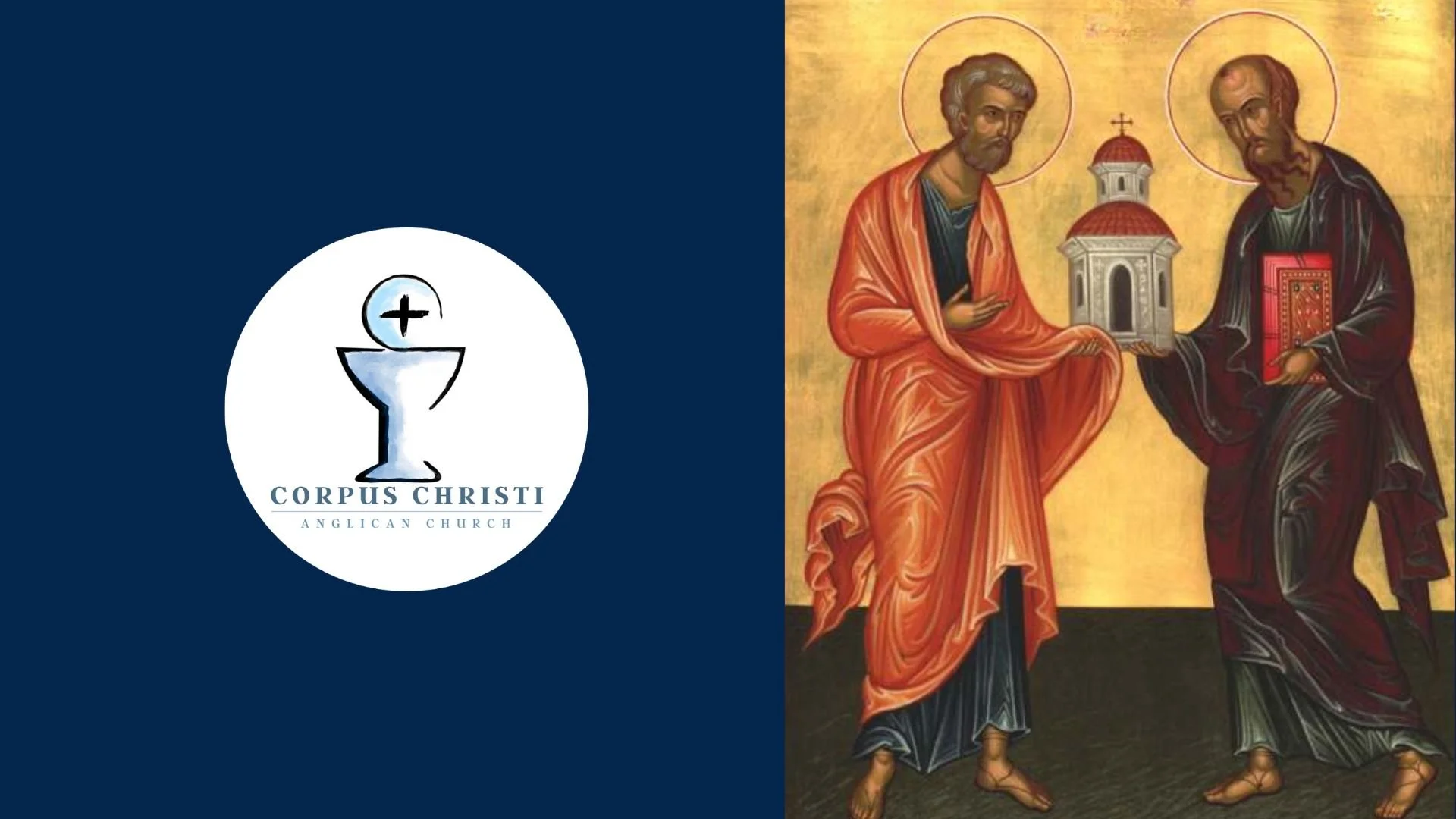
So today we observe the Feast of St. Peter and Paul, one of the oldest and most important feasts in the Christian liturgical calendar, especially in the Eastern Orthodox tradition. This remembrance on this day of June 29th, it stretches all the way back to the third or fourth century.
In history and tradition tell us that Saints Peter and Paul were martyred in Rome on June 29th. Not necessarily in the same year, but on the same date, sometime between the year 64 and 68 AD, under the brutality of Roman Emperor Nero. It is believed that the early church, early Roman Christians used this feast day to compete with and eventually supplant the pagan celebration surrounding the founding of Rome nearly 1,000 years earlier by brothers Romulus and Remus.
For early Christians, this date, June 29th, would mark the founding of the new Rome, the Christian Rome. Saints Peter and Paul are remembered today for their shared suffering and death for our Lord and Savior Jesus Christ. Yet their journeys to faith, their backgrounds, their behaviors are vastly different.
It's a miracle that the two men with such differences would come to share a day of remembrance and celebration in the church. Peter was a fisherman. Paul was a tent maker.
Peter was uneducated. Paul was a scholar, a Pharisee. Peter was impulsive, bold, and emotional.
Paul was zealous and driven and eventually patient. Peter was called to follow the living Jesus from the shores of Galilee, and Paul set out to destroy people like Peter until the resurrected Christ met and called him on the road to Damascus. In Acts 22, Luke recorded Paul recounting that mission.
Paul said that I persecuted the Christian movement to the death, building and delivering to prison both men and women. I journeyed toward Damascus to take those who were there and bring them in bonds to Jerusalem to be punished. Paul's journey from Jerusalem to now the oldest city in the world would change all of history.
It would change everything. Paul encountered the risen Christ. He experienced what may be the greatest conversion of all time.
Over the three days following Paul's encounter, he was blinded, he was born again, he was baptized, and completely transformed. His destructive passion was turned into devotion, and his new purpose would ultimately align perfectly with that of the Apostle Peter. These two men of different backgrounds would share a passionate faith and love for Jesus Christ.
Nothing, prison, torture, death, could keep either of them from proclaiming the good news. The Epistle and the Gospel readings this morning, they capture two very specific critical moments in the lives of these two men. The Gospel reading I just read a few minutes ago from John 21, it captures the very beginning, the exact moment that Jesus literally puts his faith in Peter by giving him responsibility to feed his sheep and shepherd the church
It's the beginning of Peter's ministry. When we read it out loud, which I did many times before the sermon, I felt like I was standing among the other disciples listening to a conversation that I wasn't necessarily supposed to hear. It's very personal.
Yet Jesus openly speaks so the others witness the transformational moment in Peter. In the Epistle reading from 2nd Timothy chapter 4, we are witness to the end of Paul's ministry. These are Paul's last known recorded words before he is killed by a murdering emperor.
Paul wrote this letter to ensure the continuity of his ministry, and he is literally handing off the baton over to Timothy. John 21 and 2nd Timothy 4 are two snapshots 30 years apart. One snapshot is of Peter, a man who had no idea what lies ahead for him because of his faith and love for Jesus.
And another man, Paul, knows his death is imminent, yet he is full of zeal to ensure that the good news of Jesus Christ is shared with the world. So as we dig into these two readings this morning, I'd like you to reflect on the two apostles. Who do you connect with most? What parts of their stories are like yours? And what do you hope for? What do you hope for in your own journey with Jesus Christ? So let's start with Paul's letter to Timothy.
Prior to his conversion, Paul was a zealous prosecutor of Christians and present at the stoning of Stephen, the first martyr for Christ. After his conversion, he spent three years in Arabia, he returned to Damascus, and later visited Jerusalem for the first time as a convert where he actually met Peter and James. Paul was called to be the apostle to the Gentiles.
He was set apart by the Holy Spirit and sent on three missionary journeys, and it's on his second journey in Asia Minor in Europe where he met Timothy in the city of Lystra. Paul suffered for Christ. He was arrested, imprisoned, beaten, shipwrecked.
All the while, he proclaimed the name of Jesus Christ as his Lord and Savior. By the time he wrote his second letter to Timothy, Paul was imprisoned in Rome for the second time. He was about 63 years old and facing execution.
So I love reading Paul. I find it so helpful how he gives so much detail in the salutation to whom he's writing, and then when he closes, we see all these people and the connections. In 1st Timothy chapter 1, Paul refers to Timothy as my true son in faith.
This language helps us understand Paul's connection and relationship to Timothy, and it frames the letter so we can read it with context and deeper understanding. 1st Timothy was written about three years before the second letter that we're reading today. And Paul's farewell discourse to the Ephesian elders in Acts chapter 20, it's famous for its comparison to the fell-weary discourse of Moses and Jesus, but these final words in chapter 4 are almost like Paul's last will and testament.
He's facing death, there's a sense of urgency, an unending spirit, and a passion for faith in Jesus. He was determined to leave this world by giving a clear and concise instruction to Timothy, his protege of about ten years, to continue this ministry. So in chapter 4 verse 1, Paul doesn't suggest a mission for Timothy.
In reality, it's a divine charge, a divine mandate directed to Timothy and to all who preach the gospel of Jesus Christ. Paul is imploring Timothy to be ready to preach both in and out of season, which means he should ground people in Scripture under all circumstances, whether they're hungry for it or not. He stresses that Timothy should be ready to preach whether it's convenient or not, and even when it is at great cost to himself.
Paul calls on Timothy to reprove, rebuke, and exhort. In other words, to correct error, call out sin, and encourage and strengthen those to whom he is preaching. The only way to approach this mandate is for Timothy to preach with patience, endurance, and wisdom.
And Paul's telling Timothy, take this baton, don't look back, and run. And it won't be easy. As a good mentor does, Paul was sharing his own experiences, and I'm sure praying that Timothy would get it.
He knew that Timothy needed a strong spiritual background of faith to follow Jesus and preach the good news, no matter the circumstance. In verse 3, Paul says, for the time is coming when people will not endure sound teaching, but having itching ears, they will accumulate for themselves teachers to soothe their own passions. Paul's warning rings true today.
Our culture, like that during Paul's time, often chases comfort over conviction. We seek messengers and messages that affirm rather than transform. We trade in truth for convenience. We live in a world dominated and shaped by consumerism, social media, and self-serving ideologies. The idols may have changed shape, but idolatry remains the same. In verse 6, Paul continues, and he says, I'm already being poured out as a drink offering, and the time of my departure has come.
This refers to the Jewish custom of pouring out wine at the base of the altar as part of the ritual sacrifice of the Lamb. Years earlier, Paul wrote to the Philippians about the possibility of his death, describing it the same way, as being poured out like a drink offering. At that point, it was a hypothetical statement.
Now, he writes to Timothy, it's the real deal. His death was imminent, and Timothy knew what he meant. A pastor named Kent Hughes wrote extensively about Paul's letters, and he said this about this section.
He said, it is clear that Paul did not think of himself as about to be executed, but rather as offering himself to God. From the time of his conversion, everything he had was given to God. His wealth, his body, his brilliance, his passion, his position, his reputation, all of his relationships, and his dreams.
For years, the red blood of his life had been spilling onto the altar. Now, all that remained was his life's breath, and he triumphantly gave that. In verses 7 and 8, it appears that Paul was almost declaring a victory of sorts, as he wrote to Timothy.
But I see it as Paul on his knees in prayer, telling Jesus, I did it. I lived it. I finished what began on the road to Damascus, Lord. I kept your faith in me. I stayed on the course that you laid out for me from the beginning of time. I finished the race.
I finished the race, Lord. I am done, but I'm not defeated. And I will await your return, Lord, to receive not a crown of glory or fame, but of righteousness.
And that crown of righteousness, Paul says here, is not only for himself, but it's for all who follow Jesus and long for his return. Imagine for a moment Timothy reading this letter when he gets it from his spiritual father, probably a little shaken. I know I would be.
It's emotional. It's urgent. It's holy and filled with the divine charge that he must accept. Paul doesn't say, good luck, son. Do the best you can. Hang in there.
He tells him to be faithful, stay sober-minded, endure the sufferings of following Jesus Christ, be steady, be steady, and finish the race like I have. I wonder if he ever got to see Paul again to talk about what he was being asked to do, to share his anxiety maybe, his worry, be affirmed that his faithfulness and love in Jesus would carry him. So let's pivot over for a few minutes over to John, John 21.
It's a different snapshot in time. It's about 35 years before Paul wrote Timothy, and in this moment, before ascending into heaven, Jesus is handing his baton off to Peter. So for lack of a better way to say this, Peter had a very complicated relationship with Jesus.
His walk with Christ has been a lot like mine over the past 44 years, and it may feel like yours too. Each of the four Gospels provide a unique facet of Simon Peter's calling by Jesus. In the Gospel of John, Andrew introduces his brother to Jesus.
Jesus says, you are Simon, son of John. You shall be called Cephas, which means Peter, which means the rock. In Matthew and Mark, we observe the immediacy of Peter's response to follow Jesus, and my favorite is in the Gospel of Luke.
We witness the awe of a miraculous catch of fish only because Peter obeyed Jesus's call to cast that net one last time, and after the fish were brought in, the nets would break apart. Peter, having great humility at that point, says, go away from me, Lord. I am a sinful man, and Jesus says back to him, do not be afraid.
From now on, you will be catching men. This is where Simon, now Peter, began his journey of faith with Jesus, in Jesus. So later in the story, you all know some of these, later in the storm on the Sea of Galilee, in faith, Peter steps out of a boat and walks on water to meet Jesus, and in his doubt, he sinks and is saved by our Lord.
As Peter's faith grows deeper, Jesus asks the question, who do you say that I am? Peter responds, you are the Christ, the Son of the Living God, and Jesus replies to Peter, you are Peter. On this rock, I will build my church. When Jesus predicts his own death later, Peter actually rebukes Jesus, and Jesus in turns rebukes him right back.
Peter heard the voice of God and saw Moses and Elijah when he witnessed the transfiguration, and he was terrified. The night of the Last Supper, Jesus tells Peter, truly I tell you this very night before the rooster crows, you will deny me three times. In protest, Peter claims, even if I must die with you, I will not deny you.
Just a little later, after his arrest, Jesus was being held in the high priest's home, and Peter, sitting by a small fire in the middle of the courtyard, was confronted three times that he knew Jesus, and three times he denied it, and then the rooster crowed. This blogger, this guy I was reading around on the internet, and I found this blogger, his name is John Van Wagner. He loves Jesus, and he wrote this about this scene.
He says, it was a terrible, horrifying night for Peter. Darkness, cold, flickering flames, distorted shadows on the walls of the courtyard, and then his denials three times. Peter collapsed under the pressure.
His self-reliance and self-confidence were shattered. All his promises, all his boasting, all his efforts to prevent this night from happening were blown away when Peter turned his back on his friend. To make it worse, and better, Jesus turned, singled out Peter, looking straight at him with a look that Peter will probably never forget.
It's as if Jesus was saying, Peter, do you remember what I said? All that I said? Don't forget that I also told you not to let your heart be troubled, to trust in the Father, and to trust in me. Implicit in this command is a promise, I will never leave you or forsake you. We all know how the story continues.
Jesus is crucified, he is buried, and he rose again. And Peter, who abandoned Jesus, is one of the first to see the empty tomb. While he believed Jesus was the Messiah, he misunderstood the mission of the Messiah.
He had the faith in Jesus, but not yet the faith of Jesus. The faith that is the source, the true source of hope. John sets the stage at the beginning of chapter 21.
It was night, seven disciples are fishing from a boat in the Sea of Galilee. It's a few weeks after Jesus was resurrected. They had already experienced the risen Christ two times.
They will again here. Just as day broke, Jesus stood at the shore of the lake, and he had already started a charcoal fire, cooking fish and baking bread. The disciples out on the water saw Jesus on the shore, but didn't know who it was, and he called out to them, cast your net on the right side.
And they did it. They caught a huge number of fish, 153 to be exact. And it was the Apostle John who realized it was Jesus on the shore, and he yells out, it's the Lord! And what did Peter do? He leaps out of the boat, and he swims ashore.
Jesus tells them to bring some of the fish they caught, and Peter, soaking wet, is the one to go back to the boat and haul that net in on his own. And the net was not torn. The unbroken net is a subtlety in the text here.
The net was not torn. Remember his first encounter with Jesus from the fishing boat? Simon Peter was obedient and cast the net, yet he didn't believe, he didn't have the faith of Jesus, and the net broke. This time, the net was not broken.
Something changed. A restoration of true and obedient faith is about to occur. And verse 15 takes us to the early morning quiet on the beach.
Seven disciples and Jesus stand next to a charcoal fire, much like the one Peter sat next two weeks earlier as he denied Christ. And Jesus spoke, calling Peter Simon, a reminder of who he was before he met Jesus, a reminder of his human weakness. Three times he said, Simon, do you love me? Simon, son of John, do you love me? Do you love me? This is a blunt, there is a blunt honesty in the Lord's questioning, but his words are quite affable.
Jesus matched each question with each denial, and Peter must have been confused and shaken that he would give the wrong response. And he answered three times, you know that I love you, Lord. You know that I love you.
You know that I love you. And each time Jesus said, feed my lambs, tend my sheep, feed my sheep. In front of all standing at the fire, Jesus displayed a deep love for the Apostle Peter.
These questions were words of healing, they were words of comfort, they were words of restoration and instruction. Peter's encounter with the risen Christ is a metamorphosis of faith, a transformation. Not only does Peter now have faith in Jesus, but he has the faith of Jesus Christ.
It's not a different kind of faith, but rather that characteristic of faith that Jesus exemplified. It is total and absolute trust and obedience to the Father, relying on him alone and no longer on himself. We witness here the beginning of Peter's new life in Christ.
His call is clear. Peter, the rock, is given authority by Jesus and ordination in its own right to feed and shepherd his flock and to share the gospel. Peter is anointed as the leader of Christ's chosen.
So the juxtaposition and connectedness of these two stories between Paul and Peter, for me it's beautiful. Paul was at the end of the journey, passing the torch so he could continue with Timothy, could continue what had been begun. Peter, on the other hand, was at the beginning of the new beginning.
He was handed a huge responsibility by Christ himself to leave the boat and become a shepherd. Although Jesus hinted during the seaside conversation at the very end, little did Peter know what trials and tribulations lay ahead for him. Little did he know that his life would end on a cross turned upside down in Rome, in the same city and around the same time as Saul of Tarsus.
Little did he know that Saul would become Paul, that they would both die for carrying the faith of Christ in their hearts and minds, sharing the same passion for Christ our Lord. I could have gotten up and given this sermon, which is part of one by St. Augustine. He makes it very simple.
He did a homily for the feast of St. Peter and Paul and he said this, not the whole homily, but they followed the truth, they professed the truth, they died for the truth. They followed, they professed, and they died for Jesus Christ. So our journeys with Christ are likely never going to match that of either of these apostles.
So I asked you, what do you hope for in your own faith and walk with Christ? What does that look like? Whether you're a young child and you're just starting to figure it out, or if you're in your last years, what does it look like to follow Jesus? So let's pray for that. Pray, you don't have to pray it out loud, but I'm going to pray for all of us and we'll pray for that specifically. Oh Lord Heavenly Father, God we give thanks for Peter and Paul, their differences, their love, their passion, and professing around the world of what you did.
Father, pray right now how for all of us, for you to call us into ways that we may have never thought. Ways for us to follow you, God give us some insight into that. Really, really, really, really, really love you Jesus.
God give us some insight, help all of us understand our call to follow you. In the name of Jesus we pray, amen.
Transcribed by TurboScribe.ai. Edited by the vicar.