SERMONS
Archive
- June 2026
- May 2026
- April 2026
- March 2026
- February 2026
- January 2026
- December 2025
- November 2025
- October 2025
- September 2025
- August 2025
- July 2025
- June 2025
- May 2025
- April 2025
- March 2025
- February 2025
- January 2025
- December 2024
- November 2024
- October 2024
- September 2024
- August 2024
- July 2024
- June 2024
- May 2024
- April 2024
- March 2024
- February 2024
- January 2024
- December 2023
- November 2023
- October 2023
- September 2023
- August 2023
- July 2023
- June 2023
- May 2023
- April 2023
- March 2023
- February 2023
- January 2023
- December 2022
- November 2022
- October 2022
- September 2022
- August 2022
- July 2022
- June 2022
- May 2022
- April 2022
- March 2022
- February 2022
- January 2022
- December 2021
- November 2021
- October 2021
- September 2021
- August 2021
- July 2021
- June 2021
- May 2021
- April 2021
- March 2021
- February 2021
- January 2021
- December 2020
- November 2020
- October 2020
- September 2020
- August 2020

Advent 4: Jesus in the Everyday Mess
Transcription
I'm Alexei Laushkin, a member here in on the vestry. Please pray with me. Gracious Father, as we approach you this fourth Sunday of Advent and our hearts are in preparation for this Christmastide, be with us and illuminate our hearts through your Spirit. In the name of Jesus, Amen. We're at the fourth Sunday of Advent and for many of us, mentally, we are in the Christmas season in our minds. Gifts wrapped, hopefully, family here or at least travel anticipated, hopefully, and all the pieces that go along with this season
Our scripture today talks about, in this fourth Sunday of Advent itself, our candle focuses on love, God's love for us in Jesus. In our scripture passages from Micah, the Psalms, Hebrews, and Luke, focuses on the meaning of Christ and many themes related to the fulfillment of God's promises to Israel and the foreshadowing thereof in this famous passage we have with Mary in the Magnificat. And one of the things that kind of animated my week and perhaps part of yours as well, is this idea of what does it mean perhaps to be Anglican.
So I was at a holiday party this week and we're talking to believers of different backgrounds and I was asked, well what does it mean? Corpus Christi, that sounds very interesting. And if you've been attending here for some time, were people set apart for uncommon prayer, right? Common prayer, uncommon transformation. What does it mean to be Anglican? And the question was, well does it mean that you have very stuffy services? That was the question that was asked to me.
I said, well no, it's not necessarily in the service type. But to be Anglican is to look back at the church's tradition and to think about what are the elements of the Christian life. Confession of sin, the partaking of the Eucharist, the disciplines and habits that cleanse our hearts and prepare us to live the Christian life.
And so one of the reasons that our tradition can have a C.S. Lewis, who many of you probably know, but the school my children attend is Charlotte Mason, also an Anglican. And our catechesis is a Good Shepherd, a Montessori type focus. It focuses on the person.
I said one of the reasons you can have a Charlotte Mason or a C.S. Lewis come from the Anglican tradition is they're really focused on the things that are uncommon for the Christian life and a remembrance of those things. So what are some of those things? What can we be thinking about as it relates to the season of life that we're in? When we look at our Micah passage, we see this focus on the restoration of the kingdom of God. Micah 5.3, therefore he shall give to them until that time when she who's in labor has brought forth, then the rest of his kindred shall return to the people of Israel.
And he shall stand and feed his flock in the strength of the Lord and the majesty of the name of the Lord his God, and they shall live secure. For now he shall be great to the ends of the earth, and he shall be the one of peace. And so in this sense of God relating to his people, there is this anticipation in this hope that God will return and restore the temple.
And what does it mean for the temple? Have any of you here been to Jerusalem? Just a little bit of, a few of you have been to Jerusalem. The temple system in Jerusalem was focused on a place, it's not like our sense of when we hear the word temple. When we hear the word temple, we might think, well it's just a really nice church, a really big church.
This may be one way we think about temples. Maybe it was a beautiful church, maybe like the National Cathedral, or perhaps the National Basilica in town. But that's not necessarily the role of the temple, which is this glorified place of just a nicer way to worship God.
No, in the temple system, you had a whole system of worship and sacrifice really for the remission of sin. And so you would come, there'd be various feast days, you would come to a place which was the Holy of Holies where God would dwell, in the sense that God being present and close to his people wasn't something that was easily thought about or thought on. And the people, you know, in this temple system, and if you think about the temple system itself, if you're a student of the Old Testament, this was foreshadowed in the tabernacle, foreshadowed further in the commandments given by God, in the sense that there are certain things that are required to bridge the relationship between God and man.
The temple system was meant to be a place where the restoration of true worship would happen between God and God's people. If you look at the sense of what Israel was asked to do, be a people set apart for the nations, be a people who exemplified the truth and the love of God to the least of these, right worship, what you quickly find is, in the Old Testament, something that you may find today, which is that God's people were not living up to the promise, right? And so you may come here today in the season of Advent, and you may look at religious people and religious institutions, and you may feel very similarly that God's people don't quite live up to that promise. So there's hypocrisy within the people of God.
There's hypocrisy, by the way, that they treat the least of these. They say one thing and maybe do another. There may be hypocrisy as it relates to, are they really that loving as a people? What does God do with this problem of religious people not living up to the way he has asked them to live? Well, throughout the Old Testament, because in Micah in particular, a disregard for the poor, disregard for the least of these, a profiting out of wealth, certainly in the prophet Jeremiah, the sense of the rich and the righteous doing many things with the temple, but their lives not reflecting a holiness of life, you were faced with this real reality of exile, meaning the temple is destroyed and the people of God are then put into exile.
And so a good chunk of the Old Testament writings about restoration, restoration of Messiah, is the sense that when will God restore his relationship, the temple, but also restore his love for his people in the sense of what the temple might mean for the nation. So when we're in the season of Advent and we're thinking about what is this meaning of Jesus's love that we have, what we have is a restoration of the temple in Jesus himself. What does that mean, a restoration of the temple in Jesus himself? Well, it means that when you discover the right relationship between God and his people, that the real focal point of that right relationship being made available to you is in Jesus himself and not necessarily in a temple system.
In other words, that gap between how we desire to live and God's ability to meet us in that desire is now placed in Christ. And this is a great miracle. This is a great cataclysmic change in our ability to approach God.
On a personal level, it's exemplified in profession of faith. So I grew up in a Christian household, meaning Christmas this time of year was probably one of the most magical times for me growing up. So I would tell, I'm an only child, I would tell my parents in Los Angeles, you know what we need to do? We need to go to midnight service.
Maybe you have kids like this. We go to midnight service and I want to hear all the songs because the songs of Christmas are joyful songs. This season is filled with the sense of joy.
And you can see even the world around us kind of reflects that joy in a way that's a bit unusual, in a way that's a bit magical. You'll see stores, I mean just right next to the church, we have a whole gas station, right, that plays Christmas songs. And you can turn on the radio and the lights go with the songs and there's a sense of joy and peace that's reflected in our culture that really isn't quite there in other parts of the year.
You'll have people who aren't necessarily people of faith or particularly religious who celebrate Christmas. You may have relatives for whom this is true. Christmas is this joyous time.
And for me, prior to confession of faith, Christmas was one of my favorite times of years. The songs were wonderful. There are songs that we would start playing.
I mean you even see it in the reflection of the culture of when do we start playing Christmas songs, right? But as in the Anglican tradition, we have this hopeful tension point, so we're not quite at Christmas, but it's because of the gift of what Jesus is as it relates to faith itself. So for me, by the time I'm 10, 11, 12, 13, 14, I would say that I had some experiences of God, a deep love of Christmas, but no real sense of the anchoring that faith can provide. The anchoring that it can provide.
What do I mean by anchoring? Because I realize part of when you talk about faith, it can be hard to potentially relate to if it's outside of your experiences. So I want to take a little bit of time about this in this extended meditation on Jesus and his significance in illuminating some of the scriptures as it relates to the temple. Well, one of the things that I think is easier to relate to if you have not had an experience of God is that, and even if you have, how to deepen that experience of God is a sense that when we love something, we tend to put a lot of focus and attention on it, right? So whether that is a spouse, whether that's a dating relationship, whether it's something that interests us, could even be a hobby, we put a lot of attention to it, right? It could be, for some, I know that it can even be gaming.
It takes a lot of different forms where we put our attention and where we put our time. And why do we do that, right? We even have the phrase in the culture, mindless scrolling, or we're going to have the Netflix binge. Well, what is that about? We're looking for something to either engage our interests or to help fulfill a need.
And part of what it means to have Jesus as the center of those things is that we're putting time and attention in with Jesus within our life circumstances. Well, that sounds really lovely, Alexei, but what does that mean? What does that look like? Well, I can narrate the last day and a half for me. So my household, I'm a father of five children, and we're now in the break season, so most of the gifts are ready.
But with our household, when we're on break, a lot of stuff can just kind of happen, right? Well, what do I mean by that? Well, you wake up early and one spouse didn't get any sleep. Why didn't they get any sleep? Doesn't sleep come naturally to a father of five? Well, no, not if your kid wakes up and has a nightmare or needs Tylenol or any number of things. So in this particular instance, it's Casey who didn't get the sleep, so I'm up early.
So what am I doing? Well, breakfast making. Okay, and then I'm thinking about the sermon, and then I'm thinking about preparation for that. And then what happens? Are kids just magically happy because it's break and it's time off? No, they're not.
They want to know what's going to happen today. And who's responsible for what's going to happen today? Well, in my household, it's the parent that has the energy, right? So that's me, right? So what am I going to do? Well, then you set aside plans. You're going to go outside, and hopefully it's going to be a nice little outing outside.
Was it a nice outing outside yesterday? No, it was really cold. The kids could only last about 10-15 minutes. So what is dad supposed to do? He's got a sermon tomorrow.
And then God's supposed to enter in. How's that all supposed to look, Alexi? These are nice words, but what does it look like? Well, for me, with my disciplines and love of Jesus, it was just a very short, Lord, have mercy. Lord, have mercy. Please help. We did some hot chocolate. We did dinner.
We played a board game of candy canes, which was a lot of fun. A lot of discipline, though, to get through that board game. And then it's the bedtime routine, right? And what's the bedtime routine? Is it just joyful and easy and peaceful? And where's Jesus? And where are all these disciplines in the bedtime routine when the kids are screaming? Well, it's another small prayer, Lord, have mercy.
Why is that prayer meaningful to me? Is it just to make me feel good? No, because in my teenage years, I had an experience with the living God, right? The living God. And maybe you've had these experiences in your life where the Lord comes to meet you and it's awe-inspiring. It's as wonderful as opening presents on Christmas morning, even more wonderful than that.
It's something you want to devote your whole life to, your whole interviews to. But if you're like people, going back to hypocrisy, our desire to do good, to orient towards God, to experience the grace of God, does not match the reality. Does not match the reality.
So we have to double, triple focus, be in a community where repentance and the communion, the Eucharist, which is not just a simple meal. It's the strengthening of our faith in encountering Jesus himself. It is a strengthening, if you're from this kind of background, it's a strengthening of the gift of the spirit in your heart so that you might be empowered.
But then you need reminders. So this morning I wake up going back to, what does this look like, Alexi, really? I wake up and I think, I'm gonna have lots of time to think about exactly what I want to say. Does that happen? No.
It's seven o'clock. After seven o'clock, people are sick. We're trying to figure out who's going to stay home.
Breakfast has to be made. What does this look like, Alexei? What does this faith look like? Well, worship. So I put on worship music so my heart can connect.
But honestly, you know, you end up feeling a lot of anxiety. You're running out of time. It's a car ride.
What do you do with the car ride? We're going listen to N.T. Wright, right? You listen to a little bit about these questions about the temple, what the temple means. And, oh, okay, but what does this faith look like, Alexi? Well, just before the sermon starts, I turn to Father Morgan. I say, well, what about water out of the Old Testament? Because that's where my headspace was.
And he encourages me to look it up. But there's no time, right? And so this sense of not having time is not a hindrance to the worship of God. It's not a hindrance to our orientation of what Jesus means in this love that we're asked for.
As our lives grow deeper in faith and as our lives become more complex, perhaps you're dealing with, your story is different than mine. Perhaps you're dealing with an illness at home. Perhaps you're dealing with severe loss.
Perhaps you're dealing with depression. Perhaps you're dealing with unmet expectations, financial concerns. All of these things can be difficult and weighty in a season that's supposed to be joyous.
However, seek ye first the kingdom of God is still the same. That God can come and meet us in our mess. That God can come and meet us in our dissatisfaction.
And when we encounter the Holy Spirit and we encounter this faith, our hearts are captivated by it. Our hearts are captivated by it. And our hearts are worshipful towards it.
And so what does this mean as it relates to the kingdom? Well, there's two songs that are lifted up before us. The one out of Luke for the Song of Mary and then another one that comes to mind is Exodus 15, the Song of Moses. What is the Song of Moses? Well, the Song of Moses is the song that happens when Israel escapes Egypt.
And he bursts out into worship, into thanksgiving. And it's a spontaneous praise of the Lord. And it makes sense.
I think if we were there and we had left Egypt and we had just escaped an army that was pursuing us, our hearts too would be prone to give thanks. And there are times in our lives where big things happen. Big, big things happen, even either collectively or money comes through when we didn't expect it or we were saved from something that seems just really difficult, an illness or I'm glad I wasn't there type moment for which our hearts give thanks.
But the Song of Mary is a different song. The Song of Mary is a different song. It's a very ordinary song.
It feels very much like it could come out of an Advent type season or a Christmas type season. What's happening? Mary is going to the hill country of Judea. And she is greeted by Elizabeth.
It's a family setting. And Elizabeth gives her this encouraging news. You know, she speaks in a loud voice, which if you're in a family gathering would definitely get your attention, would it not? If someone spoke to you in a loud voice.
And Elizabeth says, blessed are you among women and blessed is the child you will bear. But why am I so favored that the mother of my Lord should come to me? And I think we have a tendency sometimes to read the scriptures in religious words and almost think that we're like watching a play, maybe a great play out of Hamlet or Shakespeare. And we say to ourselves, of course that's what Elizabeth should say to Mary.
That just makes sense. It fits the beauty of the season. But that's not what's going on here, right? Elizabeth is saying something deeply personal to Mary.
With Elizabeth's words, Mary is experiencing a God moment, the kind we've been talking about, the kind Moses sings about, the kind I've been talking about just in the daily habits. And Mary breaks out into song over a very ordinary family encounter. It's ordinary and extraordinary.
It's ordinary in context. It's extraordinary in conviction. She is having a big God moment.
And Mary says, my soul glorifies the Lord and my spirit rejoices in God my Savior, for he has been mindful of the humble estate of his servant. From now on all generations will call me blessed, for the mighty one has done great things for me. Holy is his name.
His mercy extends to those who fear him from generation to generation. He has performed mighty deeds of his arms. He has scattered those who are proud in their inmost thoughts.
He has brought down rulers from their thrones, but he has lifted up the humble. He has filled the hungry of good things, but he has sent the rich away empty. He has helped his servant Israel, remembering to be merciful to Abraham and descendants forever, just as he promised our ancestors.
What an extraordinary response. It's related to the family context and it's beyond the family context. It's words for all time.
It is a profession of faith. Her faith that God had done great things for her, who was doing great things to the fulfillment, this fulfillment of longing. So what is happening in these verses? What does this have to do with temples and Advent and Christmas? Well, in these verses Mary is becoming a bridge from the Old Testament to the New Testament.
She is becoming a bridge as the mother of God, exemplifying what we will do in this age until the time of our passing, which is the true worship of God in our hearts. And these themes, I want you to notice, are not just themes about how wonderful it is that we have a connection with the living God. For me, one of the reasons I confess faith was the love of God was more real than the love I was experiencing on earth.
And so it was very compelling to me. It's extraordinarily compelling. And it captured my heart.
It made me want to read scripture right away. And if that's you today, meaning some version of that, go ahead and read the scripture. Talk to Father Morgan.
Approach people who can help walk with you in this journey and we'll be praying for you. But within that context, it's not just about good news for her personal soul, though that's there. Notice the good news for creation, the good news for creation, the good news for restoration.
He has lifted up the humble. He has filled the hungry with good things. He has sent the rich away empty.
This is a news of restoration that the right things would be, the wrong things would be made right. That those who are in destitute would experience freedom. That the worship of the Lord would be matched by the way the Lord's people lived.
That they would be righteous and kind. What does that look like practically? Well, one of the things the scripture teaches us and one of our challenges is to give to all those who ask of us, right? Give to those who ask. That's hard, isn't it? Give to those who ask.
Ooh, going to that grocery store, I've got a meal to prep. I don't know this person's background. Words of Jesus, judge not, least you be judged.
I'm saying exercise prudence, of course, but prudence should not get in the way of kindness and love. This is love, Advent Sunday. The restoration, right worship, planned giving and spontaneous ability to love people who are in need right before you, right? We are not asked to be so busy as a society and a culture that we don't live the Christian life back to the beginning.
The Anglican way of life and service walk us through all aspects of the life of the church so that we might remember we are in need of repentance. We are in need of community. We are in need of generosity.
All flowing from the living head, Jesus himself, that transform our hearts. Not that we would be some righteous people removed from the world, living lives that cannot be emulated, but instead that Jesus would come and enter into our mess, our absolute mess. Mess made because the world is not well ordered.
Our lives are not well ordered. But the love of God dispels fear and brings wholeness of life. That's what we celebrate on Christmas.
We celebrate in this Advent season that we don't have to triple and quadruple our efforts to get close to God, but instead that God has come to us in our mess and has met us. And we pray that that love would be so available in us and to those who are in need of connection and hope from the living God, that they too would have a Christmas miracle. What is the biggest miracle? Faith.
Faith that animates and dispels all the difficulty. And it's not because religious people are good or righteous or do the right thing. They often don't.
But they follow the one who can and does meet us in the mess. Let's pray. Gracious Father, we thank you for this Advent season.
We ask that you would meet us in extraordinary love. We thank you that you're so gracious, so kind, that in following this Christian life, it's not about effort, but about our response to spontaneous love, just as it was with Mary, exuberant love, overflowing. May that be part of our lives during this Christmas season. Amen.
Transcribed by TurboScribe.ai. Edited by the Vicar.

Advent 3 (Gaudete Sunday): The Hard Work of Joy in Waiting

Transcription
Good morning again. It is good to see you. If you're new or visiting this morning, I'm Father Morgan Reed, the vicar here at Corpus Christi Anglican Church. And as I mentioned earlier, this is called Gaudete Sunday, which means in Latin, rejoice.
And our passages all have something of joy in them, except perhaps the gospel. It's a fascinating one to have on a rejoice Sunday, you know, starting out with the good news of “you brood of vipers, who warned you to flee from the wrath to come?” It's very jarring, but this is indeed a day of rejoicing.
And in the passage that was read last week from John the Baptist preaching, he quoted from the book of Isaiah, where Isaiah is preaching comfort to the exiles. And so even in the midst of the impending coming of the kingdom, there is both judgment for those things that are wrong, but comfort for those who are following the Lord. And so this joy and this comfort come together in Gaudete Sunday.
There is comfort. And so as we look at this passage this morning from the gospel, let me pray for us. In the name of God, the Father, the Son, and the Holy Spirit. Amen. Lord, may the words of my mouth and the meditation of my heart be always acceptable in your sight, O Lord, my rock and my Redeemer. Amen.
Today's gospel passage highlights for us, and this Sunday in particular highlights for us in a special way, the ministry of John the Baptist. John continues the ministry of the Old Testament prophets like Isaiah and Jeremiah and those who have come before him. And he really is calling people in a real way to come out to the wilderness to hear about the good news of the kingdom of God.
And so this is where we find him. He is preaching that people need to be baptized, and in the baptism that he is offering, that they need to repent from their sins, to turn away from them, and receive forgiveness and prepare themselves to meet the Lord in the coming of the kingdom of God. So John is their advent guide. Advent in the first coming of the Messiah. That's what the word advent means. If you're not familiar, it means “coming”.
So John is their advent guide, preparing them to meet their King. And John is going to encourage them as they come out to the wilderness and they're baptized, to bear fruits that are worthy of repentance. And then he's going to encourage them today also to do their vocations with justice.
John's call to them is to join the work of Isaiah and to join his work as well in proclaiming the kingdom of God as they prepare themselves to meet the Lord. We often think of prophets as people who are just foretelling the future. That is one sense of what a prophet does.
But even more than that, prophets are truth-tellers. They're people who are calling people back to covenant life with God. They're calling the people of God back to the covenant life of God. They're calling people to live in integrity with the grace and the love of God that's been revealed. And so our call as well is to join the line of prophets like Isaiah and John the Baptist as truth-tellers who live with this knowledge that the Lord's coming is going to happen soon. And with the coming of the Lord comes both comfort and judgment.
And the people who have come to John are wondering, how do we be the kind of kingdom people where when the kingdom's revealed, it is a day of comfort for us? This is what Isaiah 40 says. Comfort, comfort my people, says the Lord. Prepare the way in the wilderness. Make the rough places smooth. You know; and so it's talking about preparing to meet the coming King. And they're asking, “how do we become those kinds of people? Because we think it's happening right now, and that you are this prophet like Isaiah helping us prepare.”
And there are two things that John is going to tell them to do in preparation: 1) Bear fruits worthy of repentance, 2) Live out their vocations justly.
Bear Fruits worthy of Repentance
And first, let's look at this, what does it mean to bear fruits worthy of repentance? There was a group that was coming out to meet John. The group of Jews. It was made up of lots of people. It was made up of soldiers. It was made up of tax collectors. And it was made up of people that their vocations aren't really named in this passage.
But there's lots of people who are coming out to the wilderness to see glimpses of the kingdom. And this was a people who were longing to see the mighty hand of God at work, like God had done in the past. They were longing to see God's hand bring justice and bring the kingdom.
And so they were coming out to see how they can prepare for the coming of the Messiah. One thing that John tells them is not to rely on their heritage. In that day, the average Jew knows that there is the coming of the judgment of the nations around them.
And they know that because they're of the seed of Abraham, or they think perhaps because they are of the seed of Abraham, that they're exempt from any of that judgment. And John's message to them was, your heritage is not good enough. That's not what God's after.
John's message to them is that they needed to avoid falling into the trap of wanting to see God's judgment on others without first exploring what God might want to do in transforming their own hearts. It's easy to rely on external signs around us to make sure that we're okay. You know, we sort of make check boxes, rather than doing what is admittedly harder work, which is to press into and admitting things that we've done wrong, or face the embarrassment of admitting that there's something that we don't know how to do.
But to do so is to search for the grace of God. Do we want to see God's hand, is the question, without hearing his voice? This is sort of, if I could summarize the question to the people, do you want to see God's hand without hearing his voice? And so joy, and this is the Sunday of joy, joy is really important in our walk with the Lord. It's one of those things that reminds, that the rose candle reminds us of. And one of the things that the rose candle reminds me of, which happens, there's two times we wear a rose in this, in the calendar. Anybody remember the other time? All right, so we're gonna have confirmation class in February and March. The other time we wear it is the fourth Sunday of Lent.
And so we, in the midst of our seasons of penitence and preparation, there is a Sunday to remind us that there is joy in the midst of penitence and preparation, and it reminds us that joy is hard-earned, that joy doesn't just come easily. It's hard work to name the things that we've done wrong, to recognize where we've had unhelpful thinking, to turn away from those things, because of the potential embarrassment involved, because of the potential humiliation involved. And sometimes it's really risky to make repair where we need to.
But to face that potential humiliation is to open ourselves up to the grace of God, and to realize his love more fully. And that opens us up to experience the joy of God more fully. And so the rose candle reminds me, you know, twice a year, that joy comes at the high cost of naming the truth, and then being willing to receive God's grace.
In her book, the Reverend Tish Warren, she has a book called Advent, and in that book she says, “In a culture where lying is rampant, where we instrumentalize relationships to our own ends, where we teem in self-justification and spin, where we minimize the faults of our own political and ideological tribe while exaggerating those of our opponents, where we share false information and gossip online, and embrace conspiracy theories, the church must recover a radical commitment to knowing and proclaiming truth.” That's her reflection on the particular collect from today. We're really good at creating false narratives to keep us feeling safe and okay, to keep us in false senses of security, and to keep us from looking at what is within our own hearts.
And sometimes, as I see the culture around us, I wonder if the spirit of anger at whatever those people are doing, name those people in your own heart, don't name them out loud, please, you know, the anger and the vehemence at whoever those people are is a form of dehumanizing that is a way of blame-shifting, that is a way of keeping us from seeing what God might do in our own hearts. We want God's wrath to come and to judge those unjust people, whoever they are, without any thought to, how are my own hearts aligned to injustice? Or how has my own heart been misaligned with God's goodness and love? And sometimes, keeping our focus on people out there keeps us from looking at what God wants to do in here. So joining the prophet Isaiah, joining the prophet John the Baptist, begins with the hard work of repentance in our hearts, which involves humanizing other people again and creating a culture of truth-telling.
These are part of the fruits of repentance. I was really encouraged a few weeks ago, the youth, we were selling Christmas trees and we were doing so to benefit the Ecumenical Community Housing Organization. It serves locally and they serve people who are experiencing housing insecurity, but they serve people who are experiencing insecurity in other ways as well.
And while we were out there, we had a great fire pit going, and two gentlemen came over from the Springfield Plaza and joined our fire pit, who probably were experiencing some level of housing insecurity. And so my, you know, child safety alarm bells are going off, and I'm just like making sure I'm keeping an eye on them. I was grateful to the adult leaders who did the same thing, and they kept a conversation going with these two.
It was very friendly and cordial, and what really impressed me was one of the youth came up to me and said, I wonder what we could do for them? And I was struck by that, and one of the things I said was, we don't have much to offer them now, but we could offer them pizza and hot chocolate. And so we did, so they had hot chocolate and stood around the fire and talked about all kinds of things with the adults. You know, it would have been really easy in that moment to content ourselves with the fact that we were selling Christmas trees to benefit an organization that would benefit them, to otherize those people and say, well, we don't have to deal with that, that's not our problem, that's that organization's problem, so we'll just help make money for the organization.
It was a reminder to me how often I need to repent of the ways that I'll use programs or systems to keep me at arm's distance from other people and dehumanizing them and making them “other”. And so I was really grateful for that youth. It was a very sweet and profound moment the other week.
We have to do the hard work of repentance to experience Jesus's coming as a comfort, and the day of the Lord will be a comfort for those who both want to see the hand of God and to hear the voice of God. Both things are true. So we've looked at what the fruit of repentance looks like, now let's consider our vocation.
Doing our Vocations with Justice
So this passage kind of covers two different things, and in our passage today we don't totally know who constitutes this nameless, faceless crowd, but we do know that there are tax collectors and there are soldiers, and these are the two groups mentioned. Both groups are the object of ire. They are hated in first century Judaism for different reasons.
The taxes were really complex in Roman Judea. There were different kinds of taxes that were collected, and different people in different ranks of tax collectors who would collect them. City rulers would lease the right for people to collect the taxes for them, and there was a bid for this that would either be done amongst a group or a rich individual, and that person had to pay the amount in advance.
So the result of that was that the tax collectors that went around collecting taxes had to not only collect the tax that Rome required, but then they also had to collect a surcharge in order to cover the cost of collecting those taxes. Now those tax collectors had freedom to make the surcharge, a lot of freedom to make whatever the surcharge they wanted it to be, and so both Jews and Gentiles hated tax collectors. And amongst the Jews they were cast out as robbers.
They were sort of exiled from society as thieves. And yet it's interesting that these are the ones who are coming to John the Baptist. You know, there's a feeling of isolation, probably a deep sense of shame about what they've done, or how they feel about themselves, and they're coming going, is the Messiah going to come and make this right? Like what do I need to do to enter into the goodness of that kingdom that I've been hoping for? The soldiers were likely Jewish people who were escorting the tax collectors to help them ensure that they were getting the taxes and safety.
We don't know much else about them. But I think it's interesting that John's response to them is not, well get out of your vocation, come with me into the desert, live this ascetic life, and let's proclaim the kingdom together. It's not what he does.
What he does is he says, live out the vocations that you're in, and do so in a way that is compassionate, loving, and fair to fellow humans. Don't take advantage of other people. Don't leave others destitute for your own gain.
You need to be content with what you have to look to meet others needs, rather than aggravate other people. So knowing that God's kingdom is coming changes the way that we live out our vocations. And it leaves us with a question, what do people learn about the kingdom of God by the way that we live out our vocational calling? It's a really interesting question to ponder.
As you think about how you live out your vocational calling, what does somebody learn about the justice, the compassion of God, about the kingdom of God from the way that you live out your vocation? And this passage encourages us not just to think about our vocations that God has called us into, but how we live them out. I was at the dentist a few weeks ago, and as often happens, I wear my collar when I do things like haircuts or go to the dentist, and it always makes for interesting conversation. So I met the dentist, and before they could like, you know, hold my mouth open, we had a conversation.
And so as we were talking, the dentist told me, hey, you know, obviously you're a pastor. Yep. If there's, you know, anybody in your congregation, people who are immigrants, or people who are just struggling with job insecurity, you know, just let me know.
“Let me know.” The idea is that what his implication was that there would be, you know, either heavily subsidized or free work done for somebody who definitely could not afford it. And I was struck by that spirit of generosity, by the way, this family practice was living out their professional vocation.
I don't know if they're Christians or not, but the generosity struck me, and their desire for the well-being of other people as people. So often when we look at our careers, we look at what we don't have yet. Where can we climb the ladder? How much more is there to climb? Am I upwardly immobile? All these sorts of things.
And, you know, part of living out our vocations with justice is developing a deep sense of contentment with where God has us in our vocation. And having that ability to have contentment, and to have a mentality of abundance, then to create the opportunities within our vocation for other people to flourish. So where do we need to learn contentment in our vocations right now? I know it's a, it might be tough for some of you in the moment to think about your own vocation and where God's called you.
And, by the way, vocation doesn't need to be monetized. Some of you have vocations that are not volunteer, voluntary, and is what you spend most of your time doing, that God has given you to do. And so where do we need to learn contentment in those vocations? Consider what God has called you to put your hand to do.
Consider the people who God has placed you in a relationship with. And those are often good indications of your vocational calling that you are in right now. And so these things, whether they make money or not, are part of your vocation.
If we had security and if we had contentment in the vocation that God called us into, it would solve so many problems. There wouldn't be these, you know, abuses of power or authority. There wouldn't be a need to dehumanize anybody else.
But we would recognize what God has given us, and we would use it to see the image of God in other people, to long for their flourishing as image bearers of our Creator. And then, when we look at our vocations, we wouldn't just be content in a job well done, but when we look on whether or not we've had success, we will look back and see the faces and hear the names of people whose lives have been touched by the thing that God has called us to do. So joining this ministry of John the Baptist and Isaiah, joining in this prophetic line, calls us to see our vocations as places where God's kingdom justice is experienced, where people see the kingdom done, in will and in deed and in word.
Conclusion
And so this third Sunday of Advent, Gaudete Sunday, it's a Sunday that recalls joy in the midst of all of our waiting, but it also reminds us that comfort and judgment go side-by-side when we talk about the imminent return of Christ, that that's supposed to be at the forefront of our thinking. And so our call is to enter into joy through the fruits of repentance, through the justice done in our vocations, through truth-telling. And so when we come to grips with where brokenness lies, we open ourselves up to the grace where we receive comfort in a new way forward in the kingdom of God.
And in all that God's called us to do, and with those whom God's put us in relationship, God is calling us to the work of restoring all the things that have been broken in the past, and he's calling us to do justice where there was only injustice and destruction before. So the joy that is in Gaudete Sunday is not a cheap joy. It is a hard-fought joy.
And it's a joy that we need, because life is hard, and we are in the waiting. We need Advent guides for what we are waiting for, which is Christ's coming. And so Jesus is going to come again, and it's in that preparation of truth-telling and doing justice that we find this coming of Christ to be comfort for our wearied and war-torn souls as we live out this life in God's faith and fear.
And we stand in the long line of prophets like Isaiah and John the Baptist who were looking for that great day of the Lord. And Jesus has come, and he's going to come again. And so we need to become this community of prophetic truth-tellers who are longing for the fruits of righteousness and justice in our lives.
So my prayer for us is that God would make us a community that longs to see both God's hand at work and to hear his voice, and that we would be a community who longs to see God's kingdom come in the vocations that God's called us to. As we close, I want to pray again that the collect that we prayed earlier for this third Sunday of Advent. O Lord Jesus Christ, you sent your messengers the prophets to preach repentance and to prepare the way for our salvation.
“Grant that the ministers and stewards of your mysteries may likewise make ready your way by turning the hearts of the disobedient toward the wisdom of the just. That at your second coming to judge the world we may be found a people acceptable in your sight. For with the Father and the Holy Spirit you live and reign one God now and forever. Amen.””
**Transcribed by TurboScribe.ai. and edited by the author.



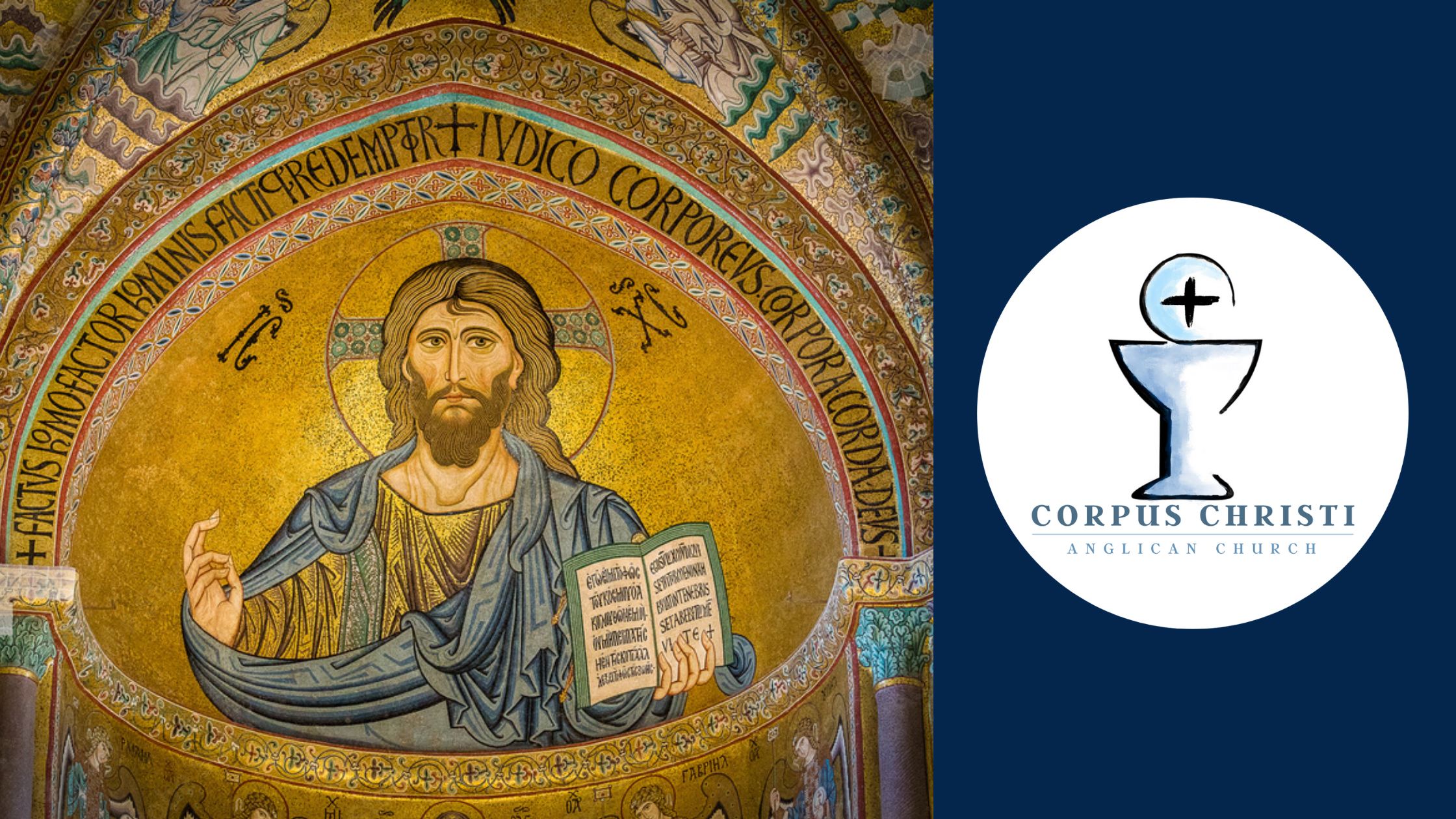
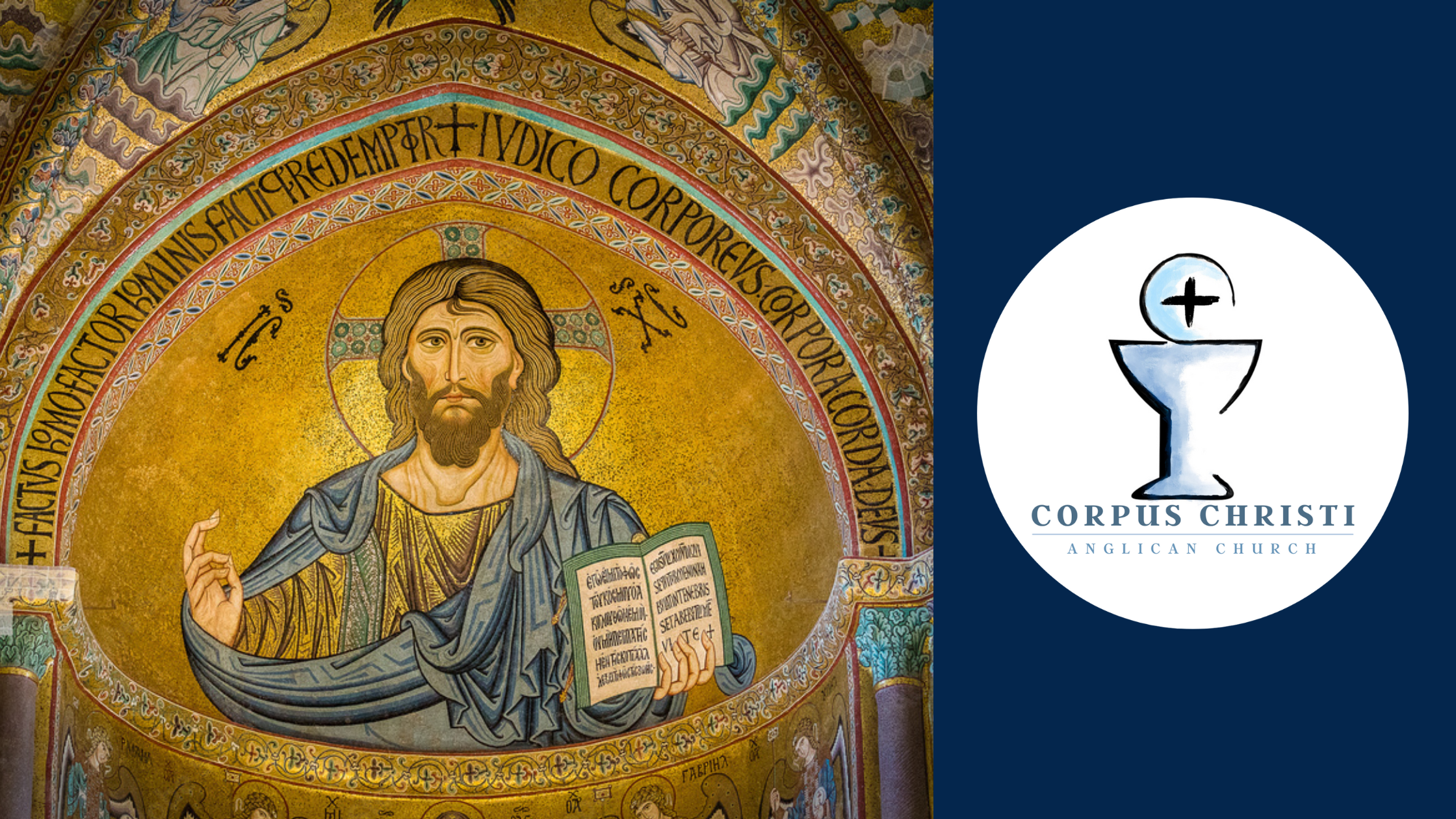
Christ the King: The Son of Man - Cosmic Sovereign
Transcription
Daniel is living among the exiles in Babylon. And it would have been very easy for them to say, "Well, we're away from home. Now we don't know who we are, and we're cut off from our God." But Ezekiel and Daniel are saying, "No way, children. God is king, and he is still with us, and he is in charge:"
I saw in the night visions, and behold, with the clouds of heaven, there came one like a Son of Man. And he came to the Ancient of Days, and was presented before him. And to him was given dominion, and glory, and a kingdom that all peoples, nations, and languages should serve him. His dominion is an everlasting dominion, which shall not pass away. And his kingdom, one that shall not be destroyed.
In the ordinary use of the Old Testament, the expression Son of Man simply means "a human being." However, when Jesus uses this expression to refer to himself, he clearly has this passage from Daniel 7 in mind. Jesus' use of this phrase is cited 90 times all together, in all four Gospels. Jesus was very cagey about how he spoke to these Galilean fishermen. He wanted to tell them as clearly as he could who he was, and what he was doing, and what he expected of them.
So if he used the phrase, Son of Man, the title, in referring to himself, they could just say, "Oh, well, he's saying just like, "a man like one of you." It would have just gone over their heads. But you would think that since Jesus kept using this term, and if you saw how he spoke this way in context, you would realize he was talking about the vision of Daniel in chapter 7.
If we are to understand how Jesus was using this title, Son of Man, in teaching his disciples, and therefore, his understanding of the phrase, the Kingdom of God, which we are keenly interested in understanding, we need to understand the meaning of these words in the Jewish world in which Jesus lived. We need to travel back in time, and we need to hear the words of the Bible in context, and be very careful about not thinking that the words, as we read them in the text, mean the same thing as they do to us today, because for the most part, we are totally out of it, in today's culture.
So this sermon has two parts, and you'll be relieved to know that I 1
left almost everything out of the first part. We are in a culture that has lost its memory. I'm so embarrassed that so many of our contemporaries have no understanding, not only of American history, which is just a moment in time, but of the history of Israel, which is the story of God's struggling, very patiently, over millennia, to communicate with us, his human creatures.
Part 1: So anyway, I'm just going to hit two points in Part 1. It's not the whole history of Israel, but just two key points, which are the context of today's reflections. And then Part 2 is three suggestions on how this applies to us and is important for us to take to heart, in order to know what God is saying to us today.
You remember the history of Israel, starting with good old Abe and coming up through the Exodus and that amazing character Moses, and then the kingdom established under David. And things ticked along for a couple hundred years, which is as much history as we Americans are aware of. And then the superpowers closed in on the land of the Eastern Mediterranean, because it was just really a connecting link between Mesopotamia and Egypt. Everybody wanted to get their traffic through there without being harassed by the local population. First of all, in around 700 BC, the Assyrians, who were a particularly well-organized country militarily and very brutal, rolled in and wiped out the northern kingdom of the Jews, which is called historically, Israel. And as far as we know, when we talk about the lost 10 tribes of Israel, they were indeed, lost. That is what often happened when one people conquered another. Usually all the military men were killed, and the women and children were enslaved - and so the people lost their identity. As far as we know, that's what happened to the lost 10 tribes of Israel.
On the other hand, by an act of God the Judeans said, the Assyrians' siege of Jerusalem fell apart and the Assyrian army went home. It was another 100 years before the Babylonians came rolling in. And they had no patience with the little kingdom of Judah. They marched in. They destroyed Jerusalem, including Solomon's temple. And they took all of the elite people and a lot of the skilled craftsmen into exile in Babylon.
But you knew that. So this is the setting of today's texts. The first text, which is really important, and not only historically, because it's important for us, is Jeremiah. Jeremiah chapter 29. And you know who Jeremiah was. He was a prophet in Jerusalem. And he went through this whole hell of international political negotiations. The Judean king thought that if he had an alliance with the king of Egypt, that he would send funds and advanced weaponry and everything would be OK. But it didn't work that way. And so Jerusalem got wiped out.
Jeremiah was there through the whole of it. And he was treated very badly, which is normal operating procedure, again, for prophets. If you don't like what somebody's saying to you, then you have to cancel them one way or another. They did their best to cancel Jeremiah. They dropped him into a pit and left him there to starve. But a friend pulled him out. Once the exiles were settled in Babylon, Jeremiah sent them a letter. And this is the key. This is the heart of that letter:
These are the words of the letter that Jeremiah the prophet sent from Jerusalem to the surviving elders of the exiles and to the priests, the prophets, and all the people whom Nebuchadnezzar had taken into exile from Jerusalem to Babylon. And thus says the Lord of hosts. Build houses and live in them. Plant gardens and eat their produce. Take wives and have sons and daughters. Multiply there and do not decrease, but seek the welfare of the city where I have sent you into exile.
Do you hear that? "Seek the welfare of the city where I have sent you into exile." This is the action from Ezekiel's vision of the throne on wheels. "And pray to the Lord on its behalf." Pray to the Lord on behalf of the Babylonians who just messed us up totally and for its welfare. "For in its welfare, you will find your welfare." That is an amazingly revolutionary, positive approach towards the people who just destroyed your country. Can you imagine? I would call that very practical forgiveness. So what Jeremiah is saying is, "Don't conform, don't accept the lifestyle of the Babylonians, but work for their welfare."
Normally, if you're present in a hostile group of people, you want to be comfortable. And the best way to be comfortable is to speak the same way, act the same way, wear the same clothes, and kind of just melt in. Isn't that what we normally want to do? But Jeremiah is saying, "Don't do that. Don't get too comfortable. I want you to flourish. But retain your identity." "Remember who you are. Remember my purpose," says Yahweh. "Remember what my purpose is for you, my holy people." Don't forget who you are and what your mission is.
And related to this is a deep, dark concept which I hesitate to mention. Most preachers probably don't even think about it, or are too prudent, or cowardly, to mention it to the congregation: And that is, that adversity calls forth creativity. Adversity evokes creativity. If we're too comfortable, if we're fat and sassy and everything's going just smoothly (I'm speaking of myself), then we're not open to the new thing that the Lord has in mind. My tendency is just to sit back and go to sleep. I mean, everything is peachy keen. And I have heard people say, after this recent election, "Oh, I'm looking forward to the time where things settle down and I can just be comfortable again."
No, children. Don't expect to be comfortable if the hand of the Lord is on you. Was it in last Sunday's epistle, one of the verses in there that went skidding by, was, "It's a terrible thing to fall into the hands of the living God." And the Jews would say, "That the truth!" But that's what we've signed up for, guys. So when things get tough, what do they say, "When the going get tough, the tough get going?" And that's another way of saying that adversity evokes creativity. So when you've got a problem, don't hang your head and say, "Oh, this is terrible." You say, "Oh, OK, Lord, what are you saying to me? What do you want me to do?"
What is the creative, imaginative thing that I can do that will bring blessing not only to me and my household, but also to the world around me? So this is what's going on among the exiles in Babylon. And hence this strange idea, that the hardships, the calamity that has happened to them is the context of God's blessing! Now, put that in your pipe and smoke it, if you're upset about the recent election.
So Daniel's vision, and this is Number 2 in Part 1, and I'm almost done with this part, is of a son of man, a human person, is enthroned in the presence of the Creator of the Universe. And to him is given the imperial heritage of the Davidic monarchy, which is rule over the whole creation, and that this sovereignty has already been established and has already begun in the death and resurrection of Jesus and the outpouring of the Holy Spirit. And if you all read your history, boys, and those of you who are a little bit older than (12-year old) Levi, for example, Tom Holland's book, Dominion, is a very good glimpse into the history of Western Europe -- how a few stubborn, dedicated people have changed the culture of Europe and the British Isles.
We all take this historical transformation for granted right now, and so does the world around us. Most of our compatriots don't know where it came from. The Kingdom of God has already started transforming human life on this planet, and not only in the West, but also globally. We need to be aware of it, and pay attention, and listen for the voice of God, because he's got a job for every one of us to do, in case you hadn't noticed. And I'm sure most of you have been listening, and you know what God wants you to be doing at this point. He is at work changing the way human beings live.
So here is Part 2: The three suggestions that we can draw from these readings that are important for our life here today. OK, number one: Jesus, in his last conversation with the disciples, well, the disciples are present, but Jesus is talking with that poor guy we know as Pontius Pilate. And Pilate is trying to figure out who this prophet is, because he's obviously not broken any rules, but he's a very dangerous character.
And Pilate is trying to figure this out, and he's saying, "Are you a king?" And Jesus is saying, "king" is your word. And then Jesus is trying to be really right up front, and he says, "My kingdom is not from this world." And if we knew the Greek - it's very hard to translate it simply into English. The ESV has done the best it could by translating the same Greek phrase two different ways. First of all, it has Jesus saying, "My kingdom is not of this world. And then the second time (it's the same phrase), Jesus says, "My kingdom is not from this world." And this is hugely important. What he is saying is that kingship or leadership in our experience comes through the exertion of deceit and violence. And that is just taken for granted. ("The first casualty in war," as Winston Churchill said, "is the truth." And Churchill, of all people, was brilliant at using deception in multiplying the strategic advantages of the Allied troops.)
However, Jesus' way, God's way, of establishing his authority in the historical process, is not the way we think it's done. The assumption of people is that might makes right. Or to put it in other terms, if your army wins and defeats your enemy, that is a demonstration that God is on your side -- if people are still thinking about God. I'll get to that in a minute. Most ancient cultures, and I would say probably most cultures today still, assume that theology and politics can't be separated. And so if your side wins, that's because you're the best, and you have divine approval. You're top dog. But Jesus is saying, "Yes, I have absolute, ultimate, eternal authority. But it is not based on deceit and violence." And boy, is that hard for us to understand.
OK, second thing. The vision of Daniel became a historic reality with the resurrection and ascension of Jesus. We rational people need to pay attention to the historical evidence, both in the New Testament and in the historical process, for the reality of Jesus' resurrection. The scholars, and I'm thinking particularly of Tom Wright, make it very clear that the historical foundation for the acceptance of the assertion that Jesus was raised from the dead is more powerful than most of the historical data that we have on any other person in history.
So pay attention. The old temple, and I talked a little bit about this last Sunday - the function of the old temple, the temple in Jerusalem, was that it would be the meeting place of heaven and earth. It was understood that God had two places, heaven and earth. And his intention, as represented by the Garden of Eden, was that these go together. In His plan, where God lives is where we live. That's what God wants. He wants us to dwell in relationship with him, be at home with Him. And we screwed that up when we told Him to get lost. Adam said, in effect, "I'm going to do this my way." (We're not blaming this on Eve in particular. I mean, we're all in this conspiracy together.) And so God said, "Well, I'm sorry about that. But you're out of here, children. And we've got some work to do."
This is the whole story of the scriptures. But what Israel longed for was to reconnect with the presence of God. And that was the function of the Jerusalem temple. The Judeans believed that through a system of sacrifice, a place could be created between heaven (that is, a place where God is) and earth (and that is where we are). And that we could be in relationship with the Creator of the Universe through the process of sacrifice, especially, in the Jerusalem temple. And as I mentioned last week, when the temple was destroyed, Jesus said this was a good thing, because he wanted his people to understand that he is the Temple.
We're in a difficult position, we Americans or we Westerners, because we assume that God is out of business, that God is dead, or that we don't need Him. And our culture is completely at sea. We don't know who we are or where we're going. If there is no God and if he does not rule, then we have no basis for knowing the difference between right and wrong. There is no foundation for morality, if God is not taken seriously. There is no purpose for our lives. How many of our young people live in terrible despair because they don't know what they're here for or what the purpose of their lives is, or what they should expect for the future.
Third, our mission, which we accepted at our baptism and which we reaffirm whenever we celebrate the Eucharist or recite the Creed -- our mission is to be the means by which all people may discover who they truly are and what God's purpose for them is, for us all. And it is to make our life together the reality of the way of the life of the Kingdom of God, by communicating the message of the Kingdom by word and action:
Oh God, you have made of one blood all the peoples of the earth and sent your blessed son to preach peace to those who are far off and to those who are near. Grant that people everywhere may seek after you and find you. Bring the nations into your fold. Pour out the spirit upon all flesh and hasten the coming of your kingdom through Jesus Christ, our Lord. Amen.**
_______________________________
**The recording of this sermon was converted online from mp3 format to text by https://turboscribe.ai/ and edited by the author.
The Destruction of the Temple: A Time of Trouble
Transcription
We've just heard a very strange reading from the Gospel According to Mark. The subject is the destruction of the Jerusalem Temple in AD 70 during the first Jewish-Roman War. That's 40 years after the death and resurrection of Jesus. Why should the destruction of the Jerusalem Temple be important for us today?
We need to remember that the Bible is about more than our personal way of life, although it certainly has to do with that, or whether there is life for us beyond death. Some of us are particularly interested about that question in a very practical sense. As Janet loves to say, we have already passed our sell-by date. But these questions belong to a larger context, and it's a context that we may be reluctant or not equipped to deal with. A number of people that we know have chosen they don't want to think about these things. These questions are too complicated to work through, and they're too anxiety-producing. Who cares anyway? However, we who read the scriptures and take them seriously, know how important the whole flow of history is, because it is in this context that the creator of the universe speaks to us and enables us to manage living in the present time, and to look forward towards the future with confidence. And of course the biblical word for that is hope.
Our hope is not wishy-washy. It is our sure confidence that God keeps his promises, and that even when things get really rough, we can deal with it; because we know that the hand of the Lord is in all of these things. So as we, at this point in our history, are wondering what in the world is going to happen in the next four years, and some of us may be quite anxious on this subject, so we need to look at these things and try to see today's texts, in particular, in relationship to what God is doing on this planet in the historical process.
So to grasp the significance of today's reading from the Gospel, we need to remember the story of the Jews from the Exodus, at least, right up to the Roman occupation of the land of the Jews. What we're looking at is the time when a young Galilean rabbi summoned a small group of fishermen to follow him and to learn from him.
In order to understand today's reading, we have to go back to the first verses of Mark. By the way, the order of Sunday readings in our Book of Common Prayer was reorganized around the 1960s. The editors could see that the list of readings for Advent season was too short; and yet the sequence was very important, and so what they did was to change the Lectionary so that there are at least these two weeks' readings before the beginning of Advent, which in fact are Advent readings. They're intended to get us ready for Advent.
Last week the Gospel text was about the poor woman making an offering at the temple, and that doesn't seem to have anything to do with Advent; so suddenly, wham, here we are, and even this reading is suddenly dropped on us out of the sky, so to speak, and we don't know what was going on with Jesus and the disciples right before it. So I'm going to try very quickly to fill that in. Actually, the first part of my sermon today is just trying to get us in the historical context, and then I will have a very compressed three points, which of course you will remember.
So Jesus is with his disciples. This is his last visit to Jerusalem, and he's been trying to tell the disciples that he's facing arrest and his own death and his resurrection. He's trying to prepare them for this, but as we noted a few weeks ago, the disciples are a little bit slow. (That's why I feel so comfortable with them.) They couldn't really understand what he was talking about. But they still had their own preconceptions, which were very powerful; and are represented by the reading from Daniel.
Daniel was a Jewish prophet of the exile living in Babylon, and he was talking to the Jewish exiles in Babylonia and saying, "Hang on, guys. This is all within God's plan, and it's going to come out all right in a time and a time and a half of time." I don't really understand that chronology. Anyway, it's a long time, and whatever it is, the Jews had been waiting for about 500 to 600 years by the time Jesus showed up in Galilee. Waiting a long time is certainly not anything we Americans do very well. If I'm looking forward to something happening, I want it to happen right now, and you tell me I have to wait 600 years, forget it. That's never in my book. At least, I won't be here in 600 years. But Daniel gave this message to the exiles, and they took it very seriously, generation after generation after generation. This was a very powerful promise.
And so by the time Jesus and this bunch of simple fishermen turn up, and Jesus is trying to prepare them for this astounding event that is about to take place, the Jews have been waiting literally for many generations, 500 to 600 years, and they are on tiptoes because they believe that the time has come and that God is going to act again. "He's done it before. He'll do it again. He got us out of Egypt. He gave us King David, and he established the Kingdom of Israel; and then those Greeks came in and messed up everything, but we fixed them because the Maccabees rose up, these guerrilla fighters, and much to their surprise, not to mention the surprise to the Greeks, they were successful in driving the Greeks out of Judea. And their kingdom lasted, I think, almost 200 years.
They did some amazing things, and I have to not digress here because I get so excited about what the Hasmoneans, that's what the Maccabean dynasty is called, accomplished during these 200 years. For example, they invented the synagogue during this time. And they kept the faith of Israel alive. They did it by starting transferring the teaching responsibility of the temple to the synagogues.
The temple was still there, and it had been rebuilt, but they transferred some of that teaching of the temple scholars to the synagogue because the Jews had forgotten how to speak Hebrew, not to mention most were just peasants. They couldn't read or write, but what happened was that the Hasmoneans created public education for ordinary people in the context of the synagogue. And so these people learned how to read Hebrew, and the point of this was that the Hasmoneans knew that if this kingdom was going to hold together, they had to know where they came from-- they had to know about the Exodus, and they had to know the law of Moses.
So they needed the Torah, which is both narrative and law, and this was absolutely basic. So, in spite of the Greeks, and thanks to the Hasmoneans, the Jews still knew who they were, and were eagerly looking forward to the time that God would act to restore the kingdom to Israel. And that meant, by Jesus' time, getting rid of the Romans. Some of us are descended from the Romans, so I mean no offense; but if you were a Jew, you didn't have any patience with the Romans, and you looked forward to a mighty act of God which would take the form of a military action, and would throw out the Romans. And Jesus was trying to tell them it's not going to happen that way, but something huge is about to happen.
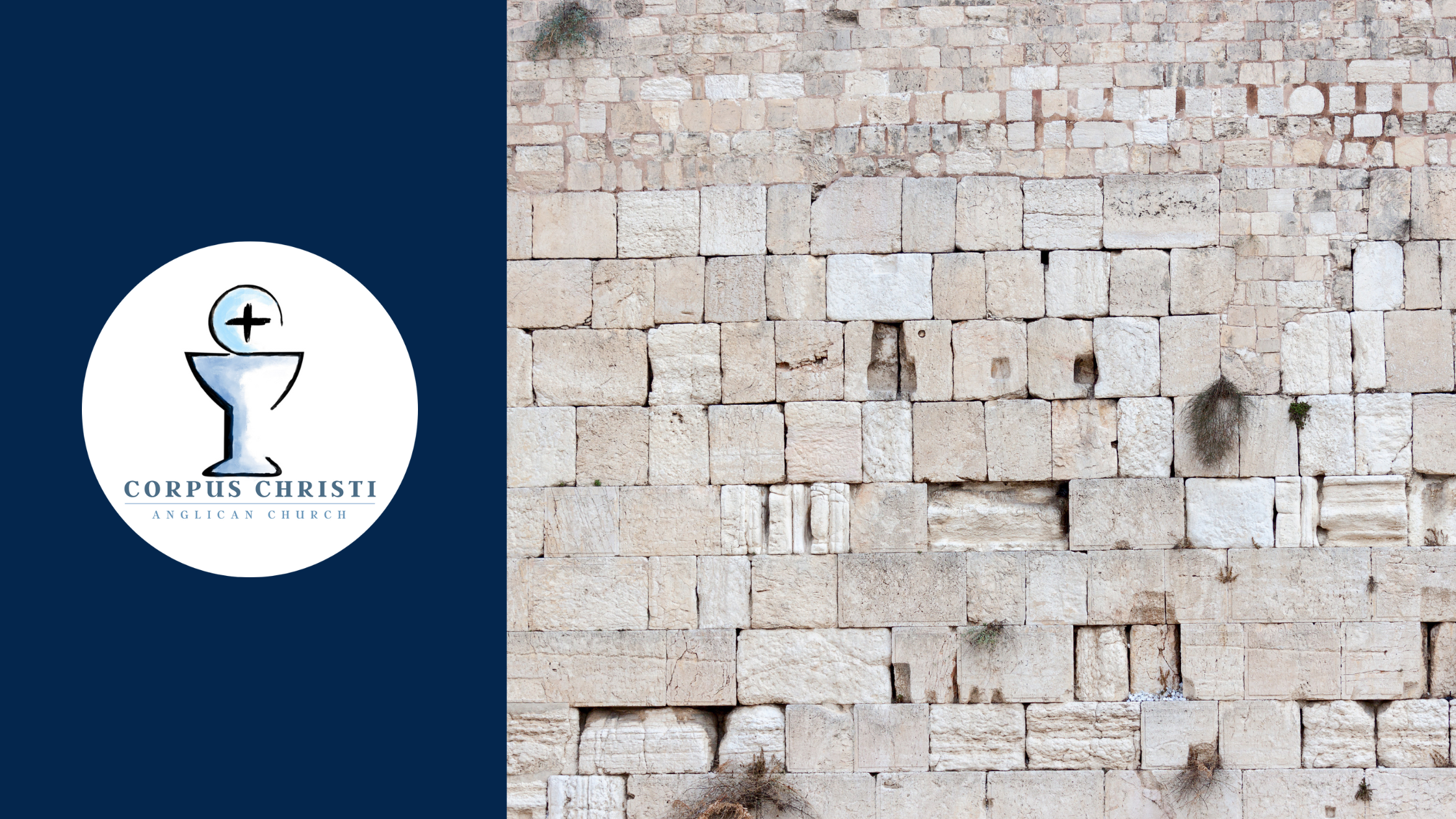
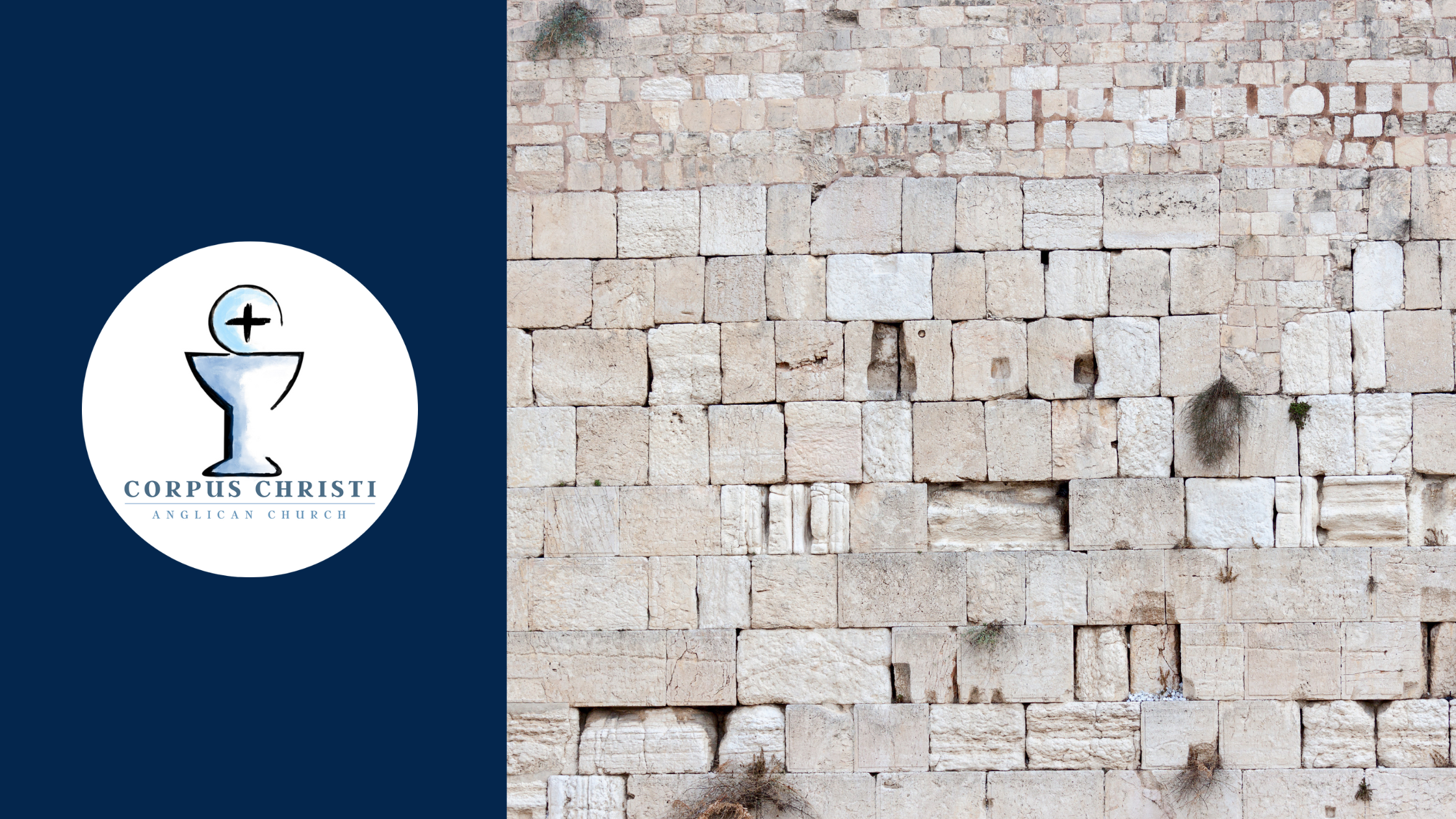
So I've got to back up a couple of verses to the beginning of chapter 13 in Mark, and it starts like this: As Jesus came out of the temple, one of the disciples said to him, "Look teacher, what wonderful stones and what wonderful buildings!" Have any of you ever been to the Wailing Wall in Jerusalem? Yeah, well, those are just the foundation stones, but they are huge, I mean one of the stones is about the size of, well, almost of the back wall here, and those are just the foundation stones.
And the second temple that Herod had built was really a stupendous building, and so all of the Jews were very proud of this second temple, and they said, "look teacher, what wonderful stones and what wonderful buildings," and Jesus said to them, "do you see these great buildings? There will not be left here one stone upon another that will not be thrown down." Oh boy, what a downer. It was as though, and try to picture this for yourself, it was as though Jesus had led us into Washington D.C. to the Mall, and said, "hey, look up there at Capitol Hill," and said, "do you see that magnificent building? There will not be left here one stone upon another that will not be thrown down."
How would we feel? Oh no, that building represents everything that is important to us, our common story, the ideas that shape our way of life, the experiences that fill the memories of our families going back many generations. One of us cries out, "I had five ancestors on the Mayflower in 1620. They were Puritans and wanted to create a society based on the Protestant Reformation and English common law." A second one of us said, "my great-grandfather was a French Calvinist, a Huguenot who came to America in 1760 to escape persecuton and begin a new life." And then a third said, "my father was sent to America as a 12-year-old to escape the ethnic cleansing of Armenians that began in Turkey in 1895." And if you thought about your own family histories, you could probably remember family stories that go back to when your people came to this country first, and what the cost and the reason for their migration was.
When Jesus warned his disciples that the temple would be destroyed in the near future, they would have reacted the same way as we would when confronted by the possible destruction of everything that we hold most precious to us in this country. But the people of Israel had lost their way. They had forgotten their covenant with God, the foundation of their national life. They assumed, like all the other nations, that peace and prosperity could be achieved through war. After all, as I have already said, they had been through a number of encounters with imperial powers which involved, sooner or later, some form of warfare. And they had come through it, and the nation had been established.
So, it was entirely plausible that the nation would expect that if they rose and rebelled against the Romans, against all odds... You know, the Romans were the superpower of the day. They were amazingly well organized as a military power. So, having listened to Daniel and the other prophets, the Jews were sure that at the right time God would act, and they believed that they would be victorious.
During the time that Jesus was walking in Galilee and visiting Jerusalem, the disciples believed the time for the deliverance of Israel was near. Most of the Jewish people believed that this was the time, and this was the state of expectancy that Jesus was addressing in his teaching. But he was really struggling to get these dear people to understand what he was talking about.
When Jesus stood on the Mount of Olives as he and the disciples were approaching Jerusalem that last time -- You know, the Mount of Olives is about the same level or higher than the city of Jerusalem. So, they were on the top of the Mount of Olives looking across the valley to the city. And Jesus was looking down with the other men, and he lamented, "Oh, Jerusalem, Jerusalem, the city that kills the prophets and stones those who are sent to it, how often would I have gathered your children together as a hen gathers her brood under her wings, but you were not willing." One of the most sad events that is recalled in the Gospels.
And then Jesus began to say to them, "See that no one leads you astray. Many, many will come in my name saying, I am he, and they will lead many astray. And when you hear of wars and rumors of wars, do not be alarmed. This must take place, but the end is not yet. Nation will rise against nation and kingdom against kingdom, there will be earthquakes in various places. There will be famines, but these are but the beginning of the birth pangs. But be on your guard, for they will deliver you over to councils and you will be beaten in synagogues, and you will stand before governors and kings for my sake to bear witness before them. And the gospel must first be proclaimed to all nations."
This is where today's reading begins -- in case you're wondering, that's the background, that's the context. And maybe today's reading will begin to make sense if we understand this high sense of expectancy. Jesus struggled to get the disciples to understand what the situation meant. And so then the account in the Gospel of Mark goes on. "But when you see the abomination of desolation standing where it ought not to be, let the reader understand."
I hope you understand because I shouldn't take the time to unpack that right now. It's interesting historically, but the point is, it's a sign that things are really going to pop. "Then let those who are in Judea flee to the mountains." Jesus continued: If anyone says to you, look, here is the Christ, or look, there he is, do not believe it. For false prophets will arise and perform signs and wonders to lead astray, if possible. But be on guard, I have told you things beforehand." Okay, this is just the preface. So how does all this apply to our situation today?
This text is not about the literal end of the world. Some people read it that way and that causes profound confusion. It does not mean what we mean by "the end of the world." It doesn't mean that history will stop or that the planet will dissolve into dust. That's not what it means; but it does mean that the world as we know it, our way of life, everything that's familiar to us, everything that's important to us, will come to an end. That's what Jesus is saying.
So just to try to get a hold of this -- This is the start of the three points here. (1) The first is the symbolism of the temple. What does the temple mean to the Jews? (2) The second is what is Jesus' advice if we find ourselves in a time of trouble, in a situation that looks like imminent catastrophe? (3) And then the bottom line, the good news, and get a hold of this, everyone, Jesus is the temple. If you're paying attention, that's the bottom line. But that's kind of a weird way of talking about it. Okay, first of all, the symbolism of the temple.
(1) The temple, the Jewish temple is the symbol of national identity and unity. Okay? This is huge. Sounds something like the Capitol building, huh? And it's the repository of the national constitution. And, of course, what is the repository of the national constitution of the Kingdom of Israel? Of course, it's the Ark of the Covenant. And you know what's in the Ark of the Covenant? It's a big box covered with wonderful golden decoration. And inside are scrolls. And, the stone tablets on which the 10 words were written on Mount Sinai. But that wasn't all. There were two more things. There was also Aaron's staff. I had forgotten that. I didn't know that until I looked it up in the words of All Wisdom, the Wikipedia. But I did know that the fourth thing in there was a bowl of manna.
So these were the symbols, the objects that were associated with the events that both gave the people of Israel their freedom and their identity and their way of life. So it was huge. It was the national constitution. It was what gave their life meaning and shape. And the key point here, and I can't go into detail on this, is that the sacrificial system, (I'm just struggling afresh with the whole concept of sacrifice) but besides being a national symbol, the temple was a place of periodic, regular sacrifices.
The point of the sacrifices was, through the sacrifices, a place was made in human life where both heaven and earth overlapped and intersected. This is where heaven, which is where God is, and earth, which is where we are, where they overlap and intersect.
And, of course, God's purpose in his creation is that these two, heaven and earth, should be together. But because of our willfulness, there's been a gap created. And God's purpose, what he's doing in the historical process, is to close that gap and get his human creatures back together with himself. And that was what the temple represented, the meeting place of heaven and earth.
(2) Point number two, dealing with imminent catastrophe. When it looks like everything's going down the drain, how do we react? Well, actually, Jesus says, if it's really serious, get going. Get out! And that's what most of the church in Jerusalem did when the war with the Romans was imminent. They got out of town. And that was good advice. It sounded like something they told me in seminary. And that was, "Choose which hill you want to die on. You can't fight all the battles." There are times where you just take a powder. You just get out. However, that's not normal operating procedure for us.
We are not to chicken out. We are not to stick our heads in the sand. We are to stand and be good stewards. That is the situation in which most of us find ourselves today. Our calling is to listen for the guidance of the Holy Spirit and to do what he is telling us to do in our particular situation, even though it's costly for us and may look as though it's futile. That's what Jesus is telling us to do. So the options are escape or stewardship. And the basic message is, don't chicken out, guys. Hang in there. OK.
(3) Jesus is the real Temple, but he is not only the place where heaven and earth overlap and interlock, but Jesus' resurrection is the beginning of the New Creation. And we've already heard a bit about this, but we really need to get this in our heads. I don't know about you, but I am a child of the Protestant Reformation and, in particular, Calvinism, which I respect and appreciate. However, as Calvinism has come down to this generation, it looks like merely an escape mechanism. That is, if you believe the right thing and do the right things, your ticket is punched and you can be sure you will go to heaven when you kick the bucket. And that's all that matters. And I would say, well, that matters, but that's not all that matters.
This is the point. God has created this amazing planet and has brought these strange and wonderful creatures (us) into existence, and he's not given up on us. God does not make junk. That's a basic biblical principle. I hope you all got that. And he has started this process, and he's going to bring it to completion in spite of the powers and principalities and all of the forces that want to spoil God's plan.
So we are experiencing the birth pangs of the New Creation. And not only was it mentioned, in today's gospel -- Paul picks that up in Romans. He talks about the sufferings of the present age as the birth pangs of creation. And that is what our suffering looks like. So let's bring all of this in line. Let's pray together this wonderful prayer from our Book of Common Prayer:
Almighty God, who hast given us this good land for our heritage:
We humbly beseech thee that we may always prove ourselves a people mindful of thy favor and glad to do thy will. Bless our land with honorable industry, sound learning, and pure conduct. Save us from violence, discord, and confusion; from pride and arrogance, and from every evil way. Defend our liberties, and fashion into one united people the multitudes brought hither out of many kindreds and tongues. Endue with the spirit of wisdom those to whom, in thy Name, we entrust the authority of government, that there may be justice and peace at home, and that, through obedience to thy law, we may show forth thy praise among the nations of the earth. In the time of prosperity, fill our hearts with thankfulness, and in the day of trouble, suffer not our trust in thee to fail; all of which we ask through Jesus Christ our Lord. Amen.**
_______________________________
**The recording of this sermon was converted online from mp3 format to text by https://turboscribe.ai/ and edited by the author.