SERMONS
Archive
- March 2026
- February 2026
- January 2026
- December 2025
- November 2025
- October 2025
- September 2025
- August 2025
- July 2025
- June 2025
- May 2025
- April 2025
- March 2025
- February 2025
- January 2025
- December 2024
- November 2024
- October 2024
- September 2024
- August 2024
- July 2024
- June 2024
- May 2024
- April 2024
- March 2024
- February 2024
- January 2024
- December 2023
- November 2023
- October 2023
- September 2023
- August 2023
- July 2023
- June 2023
- May 2023
- April 2023
- March 2023
- February 2023
- January 2023
- December 2022
- November 2022
- October 2022
- September 2022
- August 2022
- July 2022
- June 2022
- May 2022
- April 2022
- March 2022
- February 2022
- January 2022
- December 2021
- November 2021
- October 2021
- September 2021
- August 2021
- July 2021
- June 2021
- May 2021
- April 2021
- March 2021
- February 2021
- January 2021
- December 2020
- November 2020
- October 2020
- September 2020
- August 2020

First Sunday of Christmas: The Word Took Flesh to Bring us to Life

Transcription
Good morning. It is good to see you. Merry Christmas again to you.
As we look at our passage from the Gospel of St. John this morning, let me go ahead and begin with a word of prayer for us. “In the name of God, the Father, the Son, and the Holy Spirit. Amen. Lord, may the words of my mouth and the meditation of my heart be always acceptable in your sight. Oh Lord, my rock and Redeemer. Amen.”
Well, since we have lots of kiddos in the service this morning, I want to start with a question for the kiddos to test your Bible knowledge. I'm gonna say a phrase, and you can tell me where it's from. In the beginning. Anybody know? Any kids know? Yeah? Yep. What were you gonna say, Gregory? What? He made the earth. That's right. Cole? The light of God? Absolutely. That's great. Yeah, so in the beginning makes us think of creation.
And you know what? I'll be honest, it was sort of a trick question. Because in the beginning, God created the heavens and the earth as Genesis, but in the beginning was the Word as the beginning to the Gospel of John. And so when the early readers of this Gospel would have heard the beginning of this Gospel read, their minds would have gone back to the book of Genesis, which they would have also read in Greek at the time.
And it's interesting to have this passage in the Western tradition fall in the first Sunday in the Christmas season, because we're so used to thinking of the Christmas story as shepherds and, you know, possibly the Magi and Mary and Joseph going to Bethlehem, we don't often stop to think about the fact that the beginning of the Christmas story is actually back in creation itself. And that's what this text points us to this morning. We don't just have somebody who can deliver God's people from their sins, we have somebody who can make all things new, to make a new beginning.
Because this Word who makes all things new is in the beginning creating the world at the very beginning of creation. The Word who was God, who is God, has taken on flesh completely, so that humanity can fully participate in God's divine life. And so that's one of the pieces of good news of Christmas, is that God is not just delivering people from sin and death, he is delivering them into new creation life.
And there's this important point made about the good news from John 1. It's that by adding humanity, human nature, to God's divine nature, he raises up our humanity to his divine life. And I'll spell that out over the next few minutes. The prologue to John chapter 1, these first 18 verses, introduce us to the divine Word, this Word of God, this speech of God that doesn't diminish from God when it, you know, leaves the mouth of God.
But this Word has created the heavens and the earth, and he came to do a new work of creation in those who would believe in his name, according to verse 14. There was never a time when this Word was not. He was in the beginning with God, he was God, and we affirm that in the Nicene Creed when we say, he was eternally begotten of the Father. So yes, the Father begets the Son, but there's never any time where we can point to and say, that's when the divine Christ was born in his divinity. There was not a beginning, because there was no point at which the Word was not. That's why one of those, one of those things you just, you affirm, you don't try to explain.
Got people into trouble a lot over the last 2,000 years. So the addition, the math of the Incarnation, the addition here is that God took on human flesh, human nature, and that was something foreign to his essence. About 1,400 years ago, Pope Gregory the Great said it this way, “But we say that the Word was made flesh not by losing what he was, but by taking what he was not. For in the mystery of his Incarnation, the only begotten of the Father increased what was ours, but diminished not what was his.” And so in taking on human flesh, he never took the flesh off again. That's the mystery of the Incarnation.
He took on flesh, and he suffered unjustly in the flesh. He died in the flesh, he was crucified in the flesh, he was resurrected in the flesh, glorified in the flesh, and ascended on high in the flesh where he reigns as king. And so Jesus fully assumed humanity. He took it on himself. It's interesting that he didn't destroy flesh as something evil, which that seems to be an error that crops up cyclically over the last several millennia. Flesh is not evil.
Your body is not evil. He didn't come to destroy it. He raised it up to his divine life, the life of the Creator, which is the end for which all of us are made, the end of which all of us look, which is why in the Creed we talk about being raised in the body. And I think, as we think about this in a Christmas sense, it reframes salvation for us in a really helpful way. Sin is real, right? It doesn't take a rocket scientist to look at the world and know how broken it is. We can all acknowledge that sin is real, but let's begin with this other reality, that each person on the earth, every single person on this earth, bears in himself or herself the image of God, the image of their Creator.
You don't come under into the world under the hateful gaze of a vengeful God. No one comes into the world that way. The narrative is not that you're as bad as you could possibly be, or even that you were made bad. That is not the narrative that Scripture tells. When you were born into the world, regardless of who brought you into it, you were born under the loving gaze of a good Creator who loves you because you bore something of his image. And so people are fundamentally made good because they reflect their God.
They're made with good bodies that reflect the goodness of God's handiwork and his image. But what does sin do? Sin distorts what is good. Sin comes in and introduces something foreign and perverts that which is good, the goodness of creation. It distorts the good desires that good image bearers have. And so when somebody is bound up in sin, this brings us to a place of compassion. Whether someone is under generational sin, whether they're under systems of injustice or patterns of thinking or behavior, what they're doing is not just being as bad as they could possibly be.
Sin is distorting the good desires they have, the goodness of who they are, and moving them away from their identity as an icon of their God. And so salvation, then, it reframes salvation as not just forgiveness of sins, but God's realigning of our loves and our affections with his loves, and God's restoring of our nature and not our destruction. So salvation is actually becoming fully alive in Christ, becoming fully into the image that God has made us to be.
You become fully yourself when Jesus raises up your everyday stuff into the life of the kingdom of God, which he inaugurated at his baptism, and it is here and now, and we long for it to be in its fullness. And that involves entrusting ourselves to this Creator, and that's what John 114 is about. He came to bring life to those who would believe in his name and having faith in his name.
And so one way that people have thought about this in the past, the fathers of the church, like St. Basil the Great, they talk about a sword and fire, and it's not a perfect analogy, but I find it helpful. So the idea is that the fire burns bright hot, and you take a sword and you plunge it into the fire, and that sword begins to take on the properties of the fire, that the fire can communicate to the sword. And when the sword is taken out, the sword is no less a sword, and it's still a sword, but it's taken on the property of the fire, and it doesn't diminish the fire or the sword when that happens.
And so that's likened to what it's like to be in the life of the divine, to be in God's very life. What Christ is bringing us into, as we draw closer to Jesus, we are being forged in the fire of God's grace and his truth. And God is imparting to us something of his life, not destroying our nature, but making us fully human again in Jesus.
And so here is how that begins to change what transformation can look like when we think about discipleship. If you look at our website, one of the things I did in the last couple weeks, I changed our About Us page from being sort of a narrative about how we got started, to being more based on our vision and our values. Who are we? What do we care about here? And so it's got the vision statement, and then it's the core values that are under.
So when we talk about common people, common prayer for uncommon transformation, what I mean by that uncommon transformation is that we're not taking a one-size-fits-all approach to discipleship. It's not like ten steps to become more like Jesus. It's not that simple, because each of our stories are unique, and so two of our values are redeeming brokenness and then discovering God's story.
Those are on the website. And what this means is that we move at the pace of discovery when it comes to people plumbing the depths of their own stories and discovering God's story in theirs. We move at the pace of their stories. Discipleship is unique to each person, and so I'll give a hypothetical example, a hypothetical you. This isn't any of you, right? But your firstborn comes into the world, and they bring you so much joy, but you notice that every time that baby makes a mess, your anger just gets hot. Your voice raises whether you want it to or not.
You scold that little baby, you know, and you are breathing out little words of shame that you aren't even really aware that you're doing, and you really regret it afterwards. And you hope that the child's just gonna forget and move on, but man, it just happens every day, and you don't know why it's not getting better, and you can't recognize it before it happens. But you also think that apologizing makes you look weak as a parent, and you don't want your kid to think you're weak, so you're not gonna apologize either.
And so you're in this conundrum. Now kids, I'm gonna ask you an important question. This is a theological question. How does God view us when we make mistakes? Hmm. What do you think? How does God view us when we make mistakes? Anybody have an answer? Have you ever thought about that question before? I can see you guys commiserating over there. Somebody throw something out.
There aren't any. Yeah, you can have a collective answer. That's fine.
Yeah. A. God's really angry. B. God still loves you.
What do you guys think? Misha? Yeah, mistakes help us learn, don't they? Yeah, you can't learn without making mistakes. So that's right. Yeah, God loves us, has compassion on us, and mistakes are mistakes.
That's great. So the kids know this, and sometimes we forget it as adults, right? No, I mean the hypothetical person, not you or me. So we forget this, and we think that, you know, God gets angry and he wants to punish us when we make a mistake.
He's just waiting. It's tragic, really, and it's often because there's somebody in our lives that didn't teach us the right way to think about God and how he views us and how he views mistakes and learning, and that can affect the ways that we parent. It can affect the ways that we view relationships with one another, and man, if that hypothetical person had just begun to ask the question, I am noticing this in me, what is this? And then start to talk about it with other people in community to acknowledge that.
That would be the beginning to understanding this disordered anger and why they viewed apologizing as weak, which isn't objectively true, but why did they view it that way? And then seek help from others and from Christ, and so when that happens, that begins the hard work of discipleship, and that's what I mean of the uniqueness of somebody's story. You can't put a timeline on the healing of that, but that process has to happen with each person here in their own unique stories, and so that begins the hard work of discipleship transformation, and that's why it's not common to say it through our values. That is where we begin to redeem the brokenness, because we name the brokenness, and that's where we begin to discover God's story, because we find grace in the redemption, and so their good desire, their good desire for orderliness, this hypothetical person, needed to come secondary to their child's desire to discover things, right? They needed to rightly order their good desires, and so in that process of discovery, they find something of the divine joy in the story that God is telling in their life, and so they're being forged in the fire of divine love and divine life, and that's where God's grace is, and they themselves are not being destroyed at that point.
God is not destroying them. He is making them new, and they're becoming fully alive as a divine image bearer in Christ, and so Jesus assumed all of what we are so that we can be forged in the fire of his divine nature and God's divine life, and we can bask in the glow of the grace and the truth of God without losing who we are, but actually instead by becoming who we were meant to be, and that is the good news of Christmas from John chapter 1. It's by adding humanity to the divine nature that Jesus raises up our humanity to divine life. It's a theological concept that we don't often give attention to, but we ought to, because it infuses all of our daily stuff with the kingdom imagination, and we long for the day where the kingdom will be fully realized, where we fully enter into that divine life, but because our Savior came in the flesh, now the everyday stuff that you and I are going to go through has kingdom potential.
If we do Jesus' commandment to seek first the kingdom of God in all things, and so let's seek to know the grace and truth of God to become people fully alive in Jesus Christ. Let me pray for us. Oh God, you made us in your image, and you have redeemed us through your Son Jesus Christ.
Look with compassion on the whole human family. Take away the arrogance and hatred which infect our hearts. Break down the walls that separate us.
Unite us in bonds of love, and work through our struggle and confusion to accomplish your purposes on earth, that in your good time all nations and races may serve you in harmony around your heavenly throne, through Jesus Christ our Lord. Amen.
Transcribed byTurboScribe.ai. Edited by the author.

Christmas Eve: Joining in Wonder at the Redeemer of our Ruins

Transcription
Well, good evening again, everybody. It is good to be with you. I'm Father Morgan Reed. I'm the vicar here at Corpus Christi Anglican Church.
If you're new or visiting, we are delighted to have you here. Hopefully you can stay afterwards and join us for the cookie exchange as well. We heard from our passage tonight in Isaiah chapter 9 verse 2, the people who walked in darkness have seen a great light.
Those who lived in a land of darkness, on them the light has shined. It's a very famous Christmas passage. And this beautiful poem was written, surprisingly, against the backdrop of the Assyrian invasion.
Isaiah is prophesying to the southern kingdom about 700 years before the time of Jesus. And the Assyrians, who are under the reign of Tiglath-Pileser III, have swept through the Middle East. They have gone through what is today Iraq. They have gone through what is today Syria and Lebanon. And they have conquered the northern kingdom. And they're at the southern kingdom's border.
And so this, Judah's border, is under immense pressure. The people are terrified. And so this passage that Isaiah prophesies functions like a confession of hope for the generations to come. Not just the ones who are sitting underneath the darkness of Assyria, but for those who will come to sit in the darkness of Babylon when they go into exile. Those who will sit in the darkness of Greece. Those who will sit under the darkness of Roman occupation.
And out of darkness, light will shine forth. There is going to arise a divine ruler who is going to overthrow and undo all the unfaithful reigning kings, like Ahaz in the days of Isaiah, like Nebuchadnezzar over Babylon, like Alexander the Macedonian, or even Caesar Augustus, who is mentioned in our gospel text today. But it's not enough just to overthrow the unjust empires of the earth.
Because you and I are born into this broken family of humanity that binds itself over and over again to the kingdom of darkness, to the kingdom of sin and death. And we find ourselves longing for that same hope over and over again that the Jews in Isaiah's day were longing for as well. And the good news for them is the good news for us.
Unto us a child is born. Unto us a son is given. It's the good news of Christmas.
And I have two points for us this evening as we think about this passage. First, Jesus's good news to a people walking in darkness. And second, in him heaven and earth rejoice. So let me pray for us as we look at those two points. “In the name of God, the Father, the Son, and the Holy Spirit. Amen. Lord, may the words of my mouth and the meditation of my heart be always acceptable in your sight, O Lord, my rock and my Redeemer. Amen.”
Well, Jesus is good news for those who are walking in darkness. It was in the days of Caesar Augustus that everybody had to come to their places to be registered, and that brings Joseph and Mary to Bethlehem. And Mary comes to her time to give birth while they're staying at somebody else's house. And they're in part of the house where the animals stay.
So it's not an inn like we would think of a traditional hotel. They're at somebody's house, then the animals, there's a room for the animals to stay within the house too. They're in that room, because there wasn't room in the part where they would normally have guests.
And when the child is born, they swaddle him and they lay him in the place where the animals eat because it's soft. And it points to the humble means by which our Savior entered the world. He wasn't born to aristocrats in a to royalty in a palace.
I mean in one sense it was royalty, but not in a palace. He was born to this peasant girl, somebody who's seemingly unimportant, in somebody else's house and laid in a place where the animals feed. And so it speaks to the humility by which our Lord entered the world.
And this Prince of Peace was born into a world that wasn't just subject to Rome, but the world was subject to the kingdom of evil and darkness that binds all the nations to it. It's this kingdom of darkness that enslaves human hearts to shame, to sin, to autonomy, to rebellion against their Creator, and to the right good and beautiful use of creation. And to know the right good and beautiful things the way that things were made.
And so the surprise to everybody in in this gospel is that the Messiah didn't lead an armed rebellion to overthrow the Roman Authority. He wasn't leading a resistance in a way that they would have expected. Instead his weapon was the wood of the cross. And his death disarmed death and made a mockery of the kingdom of darkness. The hope for Isaiah's audience is our hope that a child is born to us and a son is given. We can't talk about the birth in the manger without also holding in tension the wood of the cross. Both things bookend Jesus' life and the resurrection. All of it is part of the incarnation to save a people. And so we've looked first at the good news for the people walking in darkness.
And second, heaven and earth rejoice in Christ. So the light came into the darkness. Angels burst forth out of the darkness, and the glory of God was shown to shepherds. And the angels speak comfort to them because whenever angels show up in the Bible people are terrified. And they're not these little cherubic little baby looking things. They have lots of wings and eyes and they're terrifying. So they see these visions of the angels and they're terrified. And the angels say, do not be afraid. For see I am bringing you good news of great joy for all the people.
To you is born this day in the city of David a Savior who is Messiah the Lord. So into the darkness heaven speaks out these thunderous cries of good news. Royalty of the line of David has been born. The anointed King who's going to reign over all things to put all things right to make all things new. This is the one who's ultimately going to defeat all the powers that are opposed to the kingdom of God so that we enter the life of new creation. And so Christmas invites us to join the wonder of the shepherds and running to discover Jesus.
It invites us to join the wonder of the shepherds and running to discover Jesus. There are so many things that we want to run to. We want to run to possessions that content us. We run to politicians that we think can make things better. We run to podcasts that can give us answers. We run to things that minimize our griefs. We run to screens or other things that distract us from being present to wonder at Christ in our everyday moments. But Christmas should actually invite us to discover where the light of Christ is being born in the darkest ruins of our lives to restore and redeem those places. We look for Jesus in that humble place and we see the beginning of the glory of the resurrection there.
I was thinking back to 2017 partly because I've been following what's happening with Syria and I was reading back to what happened in 2017 when the Islamic State was defeated. When Christians in Iraq, however many were left after the defeat of the Islamic State, were flocking to their churches for Christmas. It was a beautiful sight. I mean these had been beautiful edifices of worship that had been there for centuries and now they stood as these hollow testaments to what was once bombed-out shells. And there's a real resistance involved in Christians making the decision to be together to worship the Lord in his incarnation and to worship him as Lord filling all of those hollow edifices with the voices of saints and angels once again. And it reminds me that Jesus comes into the most broken places as Emmanuel.
He comes as God with us. The places that have come to feel the most broken, the most destitute, those can become the places where the light of Christ overcomes the darkness to shine the light of his glory most brightly. And so we come back to this phrase again that we opened our service with, a child is born to us, a son is given.
And we are reminded from Isaiah that the government will rest on his shoulders and he'll be named Wonderful Counselor, Mighty God, Everlasting Father, Prince of Peace. And as we celebrate the next 12 days of Christmas, let's press into what places feel dark or hollowed out or shells of what once was to run with wonder like the shepherds in discovering the light of Christ who was born for us to die for us, the light that is being born in those places. And in the places that we grieve, let's grieve with hope because those places that are war-torn and hollowed out and ravaged by the fall will eventually be where the light shines into the darkness, where broken ruins will ring out with songs of angels rejoicing to see God's glorious work of redemption.
Let me pray for us. “O God, by whom the meek are guided in judgment and light rises up in darkness for the godly. Grant in all our doubts and uncertainties the grace to ask what you would have us do. That the spirit of wisdom may save us from all false choices. That in your light we may see light. And in your straight path we may not stumble. Through Jesus Christ our Lord. Amen.
Transcribed by TurboScribe.ai. Edited by the author.

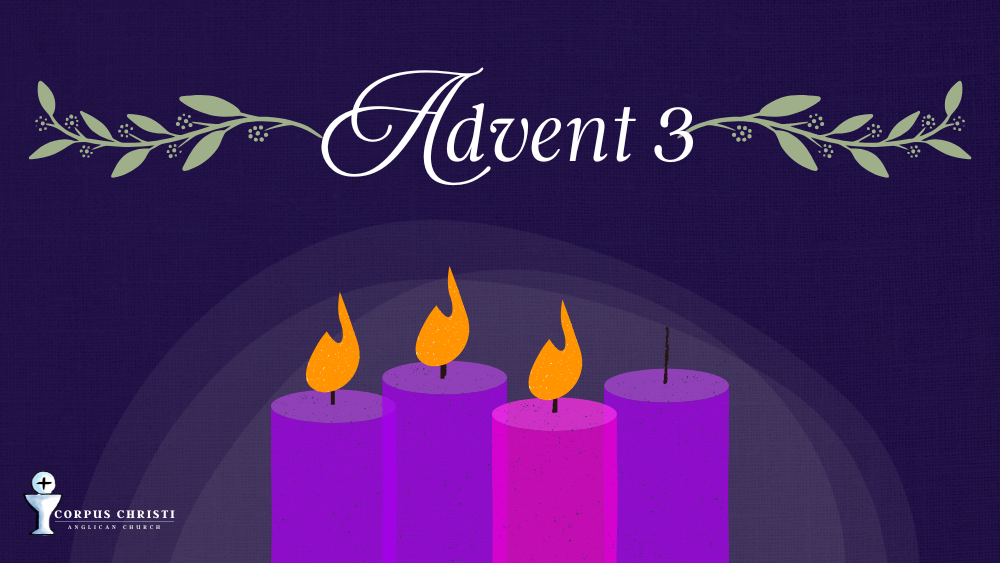
Advent 3 (Gaudete Sunday): The Hard Work of Joy in Waiting
Transcription
Good morning again. It is good to see you. If you're new or visiting this morning, I'm Father Morgan Reed, the vicar here at Corpus Christi Anglican Church. And as I mentioned earlier, this is called Gaudete Sunday, which means in Latin, rejoice.
And our passages all have something of joy in them, except perhaps the gospel. It's a fascinating one to have on a rejoice Sunday, you know, starting out with the good news of “you brood of vipers, who warned you to flee from the wrath to come?” It's very jarring, but this is indeed a day of rejoicing.
And in the passage that was read last week from John the Baptist preaching, he quoted from the book of Isaiah, where Isaiah is preaching comfort to the exiles. And so even in the midst of the impending coming of the kingdom, there is both judgment for those things that are wrong, but comfort for those who are following the Lord. And so this joy and this comfort come together in Gaudete Sunday.
There is comfort. And so as we look at this passage this morning from the gospel, let me pray for us. In the name of God, the Father, the Son, and the Holy Spirit. Amen. Lord, may the words of my mouth and the meditation of my heart be always acceptable in your sight, O Lord, my rock and my Redeemer. Amen.
Today's gospel passage highlights for us, and this Sunday in particular highlights for us in a special way, the ministry of John the Baptist. John continues the ministry of the Old Testament prophets like Isaiah and Jeremiah and those who have come before him. And he really is calling people in a real way to come out to the wilderness to hear about the good news of the kingdom of God.
And so this is where we find him. He is preaching that people need to be baptized, and in the baptism that he is offering, that they need to repent from their sins, to turn away from them, and receive forgiveness and prepare themselves to meet the Lord in the coming of the kingdom of God. So John is their advent guide. Advent in the first coming of the Messiah. That's what the word advent means. If you're not familiar, it means “coming”.
So John is their advent guide, preparing them to meet their King. And John is going to encourage them as they come out to the wilderness and they're baptized, to bear fruits that are worthy of repentance. And then he's going to encourage them today also to do their vocations with justice.
John's call to them is to join the work of Isaiah and to join his work as well in proclaiming the kingdom of God as they prepare themselves to meet the Lord. We often think of prophets as people who are just foretelling the future. That is one sense of what a prophet does.
But even more than that, prophets are truth-tellers. They're people who are calling people back to covenant life with God. They're calling the people of God back to the covenant life of God. They're calling people to live in integrity with the grace and the love of God that's been revealed. And so our call as well is to join the line of prophets like Isaiah and John the Baptist as truth-tellers who live with this knowledge that the Lord's coming is going to happen soon. And with the coming of the Lord comes both comfort and judgment.
And the people who have come to John are wondering, how do we be the kind of kingdom people where when the kingdom's revealed, it is a day of comfort for us? This is what Isaiah 40 says. Comfort, comfort my people, says the Lord. Prepare the way in the wilderness. Make the rough places smooth. You know; and so it's talking about preparing to meet the coming King. And they're asking, “how do we become those kinds of people? Because we think it's happening right now, and that you are this prophet like Isaiah helping us prepare.”
And there are two things that John is going to tell them to do in preparation: 1) Bear fruits worthy of repentance, 2) Live out their vocations justly.
Bear Fruits worthy of Repentance
And first, let's look at this, what does it mean to bear fruits worthy of repentance? There was a group that was coming out to meet John. The group of Jews. It was made up of lots of people. It was made up of soldiers. It was made up of tax collectors. And it was made up of people that their vocations aren't really named in this passage.
But there's lots of people who are coming out to the wilderness to see glimpses of the kingdom. And this was a people who were longing to see the mighty hand of God at work, like God had done in the past. They were longing to see God's hand bring justice and bring the kingdom.
And so they were coming out to see how they can prepare for the coming of the Messiah. One thing that John tells them is not to rely on their heritage. In that day, the average Jew knows that there is the coming of the judgment of the nations around them.
And they know that because they're of the seed of Abraham, or they think perhaps because they are of the seed of Abraham, that they're exempt from any of that judgment. And John's message to them was, your heritage is not good enough. That's not what God's after.
John's message to them is that they needed to avoid falling into the trap of wanting to see God's judgment on others without first exploring what God might want to do in transforming their own hearts. It's easy to rely on external signs around us to make sure that we're okay. You know, we sort of make check boxes, rather than doing what is admittedly harder work, which is to press into and admitting things that we've done wrong, or face the embarrassment of admitting that there's something that we don't know how to do.
But to do so is to search for the grace of God. Do we want to see God's hand, is the question, without hearing his voice? This is sort of, if I could summarize the question to the people, do you want to see God's hand without hearing his voice? And so joy, and this is the Sunday of joy, joy is really important in our walk with the Lord. It's one of those things that reminds, that the rose candle reminds us of. And one of the things that the rose candle reminds me of, which happens, there's two times we wear a rose in this, in the calendar. Anybody remember the other time? All right, so we're gonna have confirmation class in February and March. The other time we wear it is the fourth Sunday of Lent.
And so we, in the midst of our seasons of penitence and preparation, there is a Sunday to remind us that there is joy in the midst of penitence and preparation, and it reminds us that joy is hard-earned, that joy doesn't just come easily. It's hard work to name the things that we've done wrong, to recognize where we've had unhelpful thinking, to turn away from those things, because of the potential embarrassment involved, because of the potential humiliation involved. And sometimes it's really risky to make repair where we need to.
But to face that potential humiliation is to open ourselves up to the grace of God, and to realize his love more fully. And that opens us up to experience the joy of God more fully. And so the rose candle reminds me, you know, twice a year, that joy comes at the high cost of naming the truth, and then being willing to receive God's grace.
In her book, the Reverend Tish Warren, she has a book called Advent, and in that book she says, “In a culture where lying is rampant, where we instrumentalize relationships to our own ends, where we teem in self-justification and spin, where we minimize the faults of our own political and ideological tribe while exaggerating those of our opponents, where we share false information and gossip online, and embrace conspiracy theories, the church must recover a radical commitment to knowing and proclaiming truth.” That's her reflection on the particular collect from today. We're really good at creating false narratives to keep us feeling safe and okay, to keep us in false senses of security, and to keep us from looking at what is within our own hearts.
And sometimes, as I see the culture around us, I wonder if the spirit of anger at whatever those people are doing, name those people in your own heart, don't name them out loud, please, you know, the anger and the vehemence at whoever those people are is a form of dehumanizing that is a way of blame-shifting, that is a way of keeping us from seeing what God might do in our own hearts. We want God's wrath to come and to judge those unjust people, whoever they are, without any thought to, how are my own hearts aligned to injustice? Or how has my own heart been misaligned with God's goodness and love? And sometimes, keeping our focus on people out there keeps us from looking at what God wants to do in here. So joining the prophet Isaiah, joining the prophet John the Baptist, begins with the hard work of repentance in our hearts, which involves humanizing other people again and creating a culture of truth-telling.
These are part of the fruits of repentance. I was really encouraged a few weeks ago, the youth, we were selling Christmas trees and we were doing so to benefit the Ecumenical Community Housing Organization. It serves locally and they serve people who are experiencing housing insecurity, but they serve people who are experiencing insecurity in other ways as well.
And while we were out there, we had a great fire pit going, and two gentlemen came over from the Springfield Plaza and joined our fire pit, who probably were experiencing some level of housing insecurity. And so my, you know, child safety alarm bells are going off, and I'm just like making sure I'm keeping an eye on them. I was grateful to the adult leaders who did the same thing, and they kept a conversation going with these two.
It was very friendly and cordial, and what really impressed me was one of the youth came up to me and said, I wonder what we could do for them? And I was struck by that, and one of the things I said was, we don't have much to offer them now, but we could offer them pizza and hot chocolate. And so we did, so they had hot chocolate and stood around the fire and talked about all kinds of things with the adults. You know, it would have been really easy in that moment to content ourselves with the fact that we were selling Christmas trees to benefit an organization that would benefit them, to otherize those people and say, well, we don't have to deal with that, that's not our problem, that's that organization's problem, so we'll just help make money for the organization.
It was a reminder to me how often I need to repent of the ways that I'll use programs or systems to keep me at arm's distance from other people and dehumanizing them and making them “other”. And so I was really grateful for that youth. It was a very sweet and profound moment the other week.
We have to do the hard work of repentance to experience Jesus's coming as a comfort, and the day of the Lord will be a comfort for those who both want to see the hand of God and to hear the voice of God. Both things are true. So we've looked at what the fruit of repentance looks like, now let's consider our vocation.
Doing our Vocations with Justice
So this passage kind of covers two different things, and in our passage today we don't totally know who constitutes this nameless, faceless crowd, but we do know that there are tax collectors and there are soldiers, and these are the two groups mentioned. Both groups are the object of ire. They are hated in first century Judaism for different reasons.
The taxes were really complex in Roman Judea. There were different kinds of taxes that were collected, and different people in different ranks of tax collectors who would collect them. City rulers would lease the right for people to collect the taxes for them, and there was a bid for this that would either be done amongst a group or a rich individual, and that person had to pay the amount in advance.
So the result of that was that the tax collectors that went around collecting taxes had to not only collect the tax that Rome required, but then they also had to collect a surcharge in order to cover the cost of collecting those taxes. Now those tax collectors had freedom to make the surcharge, a lot of freedom to make whatever the surcharge they wanted it to be, and so both Jews and Gentiles hated tax collectors. And amongst the Jews they were cast out as robbers.
They were sort of exiled from society as thieves. And yet it's interesting that these are the ones who are coming to John the Baptist. You know, there's a feeling of isolation, probably a deep sense of shame about what they've done, or how they feel about themselves, and they're coming going, is the Messiah going to come and make this right? Like what do I need to do to enter into the goodness of that kingdom that I've been hoping for? The soldiers were likely Jewish people who were escorting the tax collectors to help them ensure that they were getting the taxes and safety.
We don't know much else about them. But I think it's interesting that John's response to them is not, well get out of your vocation, come with me into the desert, live this ascetic life, and let's proclaim the kingdom together. It's not what he does.
What he does is he says, live out the vocations that you're in, and do so in a way that is compassionate, loving, and fair to fellow humans. Don't take advantage of other people. Don't leave others destitute for your own gain.
You need to be content with what you have to look to meet others needs, rather than aggravate other people. So knowing that God's kingdom is coming changes the way that we live out our vocations. And it leaves us with a question, what do people learn about the kingdom of God by the way that we live out our vocational calling? It's a really interesting question to ponder.
As you think about how you live out your vocational calling, what does somebody learn about the justice, the compassion of God, about the kingdom of God from the way that you live out your vocation? And this passage encourages us not just to think about our vocations that God has called us into, but how we live them out. I was at the dentist a few weeks ago, and as often happens, I wear my collar when I do things like haircuts or go to the dentist, and it always makes for interesting conversation. So I met the dentist, and before they could like, you know, hold my mouth open, we had a conversation.
And so as we were talking, the dentist told me, hey, you know, obviously you're a pastor. Yep. If there's, you know, anybody in your congregation, people who are immigrants, or people who are just struggling with job insecurity, you know, just let me know.
“Let me know.” The idea is that what his implication was that there would be, you know, either heavily subsidized or free work done for somebody who definitely could not afford it. And I was struck by that spirit of generosity, by the way, this family practice was living out their professional vocation.
I don't know if they're Christians or not, but the generosity struck me, and their desire for the well-being of other people as people. So often when we look at our careers, we look at what we don't have yet. Where can we climb the ladder? How much more is there to climb? Am I upwardly immobile? All these sorts of things.
And, you know, part of living out our vocations with justice is developing a deep sense of contentment with where God has us in our vocation. And having that ability to have contentment, and to have a mentality of abundance, then to create the opportunities within our vocation for other people to flourish. So where do we need to learn contentment in our vocations right now? I know it's a, it might be tough for some of you in the moment to think about your own vocation and where God's called you.
And, by the way, vocation doesn't need to be monetized. Some of you have vocations that are not volunteer, voluntary, and is what you spend most of your time doing, that God has given you to do. And so where do we need to learn contentment in those vocations? Consider what God has called you to put your hand to do.
Consider the people who God has placed you in a relationship with. And those are often good indications of your vocational calling that you are in right now. And so these things, whether they make money or not, are part of your vocation.
If we had security and if we had contentment in the vocation that God called us into, it would solve so many problems. There wouldn't be these, you know, abuses of power or authority. There wouldn't be a need to dehumanize anybody else.
But we would recognize what God has given us, and we would use it to see the image of God in other people, to long for their flourishing as image bearers of our Creator. And then, when we look at our vocations, we wouldn't just be content in a job well done, but when we look on whether or not we've had success, we will look back and see the faces and hear the names of people whose lives have been touched by the thing that God has called us to do. So joining this ministry of John the Baptist and Isaiah, joining in this prophetic line, calls us to see our vocations as places where God's kingdom justice is experienced, where people see the kingdom done, in will and in deed and in word.
Conclusion
And so this third Sunday of Advent, Gaudete Sunday, it's a Sunday that recalls joy in the midst of all of our waiting, but it also reminds us that comfort and judgment go side-by-side when we talk about the imminent return of Christ, that that's supposed to be at the forefront of our thinking. And so our call is to enter into joy through the fruits of repentance, through the justice done in our vocations, through truth-telling. And so when we come to grips with where brokenness lies, we open ourselves up to the grace where we receive comfort in a new way forward in the kingdom of God.
And in all that God's called us to do, and with those whom God's put us in relationship, God is calling us to the work of restoring all the things that have been broken in the past, and he's calling us to do justice where there was only injustice and destruction before. So the joy that is in Gaudete Sunday is not a cheap joy. It is a hard-fought joy.
And it's a joy that we need, because life is hard, and we are in the waiting. We need Advent guides for what we are waiting for, which is Christ's coming. And so Jesus is going to come again, and it's in that preparation of truth-telling and doing justice that we find this coming of Christ to be comfort for our wearied and war-torn souls as we live out this life in God's faith and fear.
And we stand in the long line of prophets like Isaiah and John the Baptist who were looking for that great day of the Lord. And Jesus has come, and he's going to come again. And so we need to become this community of prophetic truth-tellers who are longing for the fruits of righteousness and justice in our lives.
So my prayer for us is that God would make us a community that longs to see both God's hand at work and to hear his voice, and that we would be a community who longs to see God's kingdom come in the vocations that God's called us to. As we close, I want to pray again that the collect that we prayed earlier for this third Sunday of Advent. O Lord Jesus Christ, you sent your messengers the prophets to preach repentance and to prepare the way for our salvation.
“Grant that the ministers and stewards of your mysteries may likewise make ready your way by turning the hearts of the disobedient toward the wisdom of the just. That at your second coming to judge the world we may be found a people acceptable in your sight. For with the Father and the Holy Spirit you live and reign one God now and forever. Amen.””
**Transcribed by TurboScribe.ai. and edited by the author.