SERMONS
Archive
- June 2026
- May 2026
- April 2026
- March 2026
- February 2026
- January 2026
- December 2025
- November 2025
- October 2025
- September 2025
- August 2025
- July 2025
- June 2025
- May 2025
- April 2025
- March 2025
- February 2025
- January 2025
- December 2024
- November 2024
- October 2024
- September 2024
- August 2024
- July 2024
- June 2024
- May 2024
- April 2024
- March 2024
- February 2024
- January 2024
- December 2023
- November 2023
- October 2023
- September 2023
- August 2023
- July 2023
- June 2023
- May 2023
- April 2023
- March 2023
- February 2023
- January 2023
- December 2022
- November 2022
- October 2022
- September 2022
- August 2022
- July 2022
- June 2022
- May 2022
- April 2022
- March 2022
- February 2022
- January 2022
- December 2021
- November 2021
- October 2021
- September 2021
- August 2021
- July 2021
- June 2021
- May 2021
- April 2021
- March 2021
- February 2021
- January 2021
- December 2020
- November 2020
- October 2020
- September 2020
- August 2020

Proper 7: Two Sources, Two Humanities: Grace Abounding
Romans 5:15b-19 NRSV
Many years ago, bottled water companies began emphasizing not the bottle, but the source.
Their message was simple:
if the source is pure, the water will be pure.
If the source is contaminated, everything downstream is affected.
We understand this instinctively.
In fact, modern history gives us sobering examples of it.
In 1993, the city of Milwaukee experienced a major water crisis when a single microscopic contaminant entered the municipal water supply. The result was catastrophic: over 400,000 people became ill, and dozens of deaths were linked to the outbreak. Ordinary households across an entire city were affected—not because of what they did at their taps, but because something had gone wrong upstream at the source.
Whether it is river, a reservoir, or an entire distribution system, the principle holds: when the source is compromised, everything downstream is affected.
Paul says the same thing about humanity in Romans 5.
Our problem is not merely that we make bad choices downstream. Something has gone wrong at the source.
One man's trespass (deliberate and conscious decision) unleashed sin and death into the human race. Adam is the source from which the river of fallen humanity flows.
But Paul immediately introduces another source. Through one man, Jesus Christ, grace has overflowed to many.
If Adam is the polluted river that carries death,
Christ is the living river that carries righteousness and life.
Romans 5 is the story of two sources, two rivers, and two humanities. EVERYONE IS A PART OF ONE OR OTHER. THERE’S NOT A 3RD OPTION
BTW. The question is: From which source are you drinking?
ARE YOU IN ADAM OR IN CHRIST?
And what Paul wants us to see is that while no one is unaffected:
What Jesus accomplished was far superior to what Adam started.
Adam’s sin affected all of us. He’s not merely a moral example. He is the headwaters of a fallen humanity. His act of rebellion does not stay contained. It spreads. It defines the condition of those who come after him.
Romans 5:12 says: “just as sin came into the world through one man, and death came through sin, and so death spread to all because all have sinned
Paul wants us to see that we are not merely people who commit sins (we do). Rather: We are people born into a broken stream.
Article IX of the Thirty-Nine Articles describes original sin as:
“The fault and corruption of the nature of every man naturally engendered of the offspring of Adam.”
This confronts modern assumptions of self-invention. Scripture says we are not morally neutral. We are born into a humanity already facing death.
It’s By God’s grace, along the way, that we see the truth of this lived out in our own everyday lives - as we honestly see ourselves in light of the holy holy holiness of God. In light of our inability. Our lack of desire to live his way.
That’s the effect of Adam - our inheritance expressing itself through us.
As Genesis tells us God gave incredible freedom and abundance in the Garden of Eden. And drew only one line don’t eat from the tree of the knowledge of good and evil for in the day in which you eat of it you will surely die.
And Adam deliberately crossed it.
I remember seeing this in one of my kids. We lived on “cut through” street. People used our street to quickly cut through from one busy road to another to save time on their commute and we didn’t have speed bumps to slow them down.
Our children were little - we gave them the abundance of the whole yard to play in - with only 1 condition - don’t go in the street . Don’t cross the curb. I watched one of kids repeatedly find her way to edge of the street. Looking at the curb. Observing the curb. Occasionally glancing over her shoulder to see if anyone was watching her looking at the curb. And then one day - you guessed it — she did it - she deliberately put her toe in the street.
It’s cute and funny - but there’s nothing unique about it.
That’s what ADAM - and Eve did. That’s what we all do because that’s now who we are. Like Adam we do what we want to do - thinking about ourselves.
But the Good news is that Jesus Christ, the Son God, came into the world of his creation. He’s called the second Adam. But as the Nicene creed and our Eucharist liturgy make clear:
For us and for our salvation he came down from heaven, was incarnate from the Holy Spirit and the Virgin Mary and was made man.
He doesn’t have Adam’s seed. Or Adams corruption in him.
He didn’t have to come into the world. He didn’t have to come incarnate. He did so because was thinking not thinking of himself. He was thinking of others?
He was thinking of you.
He lived from the delight of the heavenly Father’s love and for the heavenly Father’s glory. He had no sin of his own. He did not trespass. When he died on the cross it wasn’t for himself. It was for others. It was for you. And me. In our place. To undo what Adam did.
I love how CS Lewis captures this in the Lion the Witch and the wardrobe:
Aslan has died on the stone table and he has been raised from the dead. The Great Lion explains to the young girls Lucy and Susan who are marveling at his resurrection what he has done:
“When a willing victim who has committed no treachery was killed in a traitor’s place, the Table would crack and death itself would start working backward.”
Adam brought death and condemnation for all. Christ’s obedience has the power to overcome what Adam did. To bring justification and life
Romans 5:18 says: “just as one man’s (Adams) trespass led to condemnation for all, so one man’s (Jesus) act of righteousness leads to justification and life for all. 19 For just as through the one man’s (Adams’s) disobedience the many were made sinners, so through the one man’s (Jesus) obedience the many will be made righteous.”
They both consciously acted in ways that had huge ramifications/huge results.
But they are vastly different results.
Paul wants us to marvel in this: Paul wants us to marvel in GRACE.
V15 says: But the free gift is not like the trespass. For if the many died through the one man’s trespass, much more surely have the grace of God and the gift in the grace of the one man, Jesus Christ, abounded for the many.
V 17: If, because of the one man’s trespass, death reigned through that one, much more surely will those who receive the abundance of grace and the gift of righteousness reign in life through the one man, Jesus Christ.
If you are in Adam, and we are all born in Adam - you’re under the reign of death.
If you are in Christ, you are reborn and you will reign in life. All because Christ’s gift is greater than Adams’ sin.
Twice (5:15, 17) he says, “much more surely.” And that has to do with the abounding gift of grace.
Grace is: "divine love and protection bestowed freely upon mankind".
It’s vitally important that we live in and from the abounding of God. In the much more of grace.
Paul wants us to know that God’s grace and God’s provision for us isn’t random, haphazard or insufficient. According to the Bible, there’s always plenty. There’s always more than enough. There’s an overflow. In fact that’s what the word ADOUND means. An overflowing quantity
We come from Charleston. Our church was on an island. One side was ocean. The other side marsh and the intercostal waterway.
Whenever there was high tide during a super moon. The water would ABOUND. It becomes so full that the water encroaches on yards and creeps over roadways. Downtown Charleston floods because it’s built at sea level and water would fill the streets so that College of Charleston students could be seen kayaking through portions of the city.. That’s what it means to ABOUND.
Paul is saying that God’s grace and provision ABOUND to you through what Jesus has done for you.
Think about what God is like. God is gracious. He is lavish. He is intentional. He is a giver. John 3:16 says, “For God loved the world so much that he gave his Son…”
As Alan Redpath writes,
“When God gives grace, He does not reluctantly open a little finger and maintain a clenched fist full of gifts. God’s hands are nail-pierced hands and they are wide open. This fountain of grace is always pouring itself out with no limitation on heaven’s side at all.” Romans 8:32 says, “Since [God] did not spare even his own Son but gave him up for us all, won’t he also give us everything else?” (NLT)
You might wonder: To whom does grace ABOUND? The answer is: to the person who needs it most! In Romans 5:20 Paul writes: “But where sin abounded, grace abounded much more.” (NKJV)
Grace is needed most where sin exists and when trouble comes. Like a light in a cavern, God’s ABOUNDING grace becomes more brilliant in the midst of darkness.
When I came to Christ in College (when my baptism came alive in me through faith) - I saw my desperate need…..
The Question is will you receive this abounding grace. Will you drink from the stream of Christ?
And if you have - live daily drinking from the abound grace he has for you. From who he has remade you to be in Christ. With all that affords you… And off this to those around you…
Amazing grace story:
15 But the free gift is not like the trespass. For if the many died through the one man’s trespass, much more surely have the grace of God and the gift in the grace of the one man, Jesus Christ, abounded for the many. 16 And the gift is not like the effect of the one man’s sin. For the judgment following one trespass brought condemnation, but the gift following many trespasses brings justification. 17 If, because of the one man’s trespass, death reigned through that one, much more surely will those who receive the abundance of grace and the gift of righteousness reign in life through the one man, Jesus Christ.
18 Therefore just as one man’s trespass led to condemnation for all, so one man’s act of righteousness leads to justification and life for all. 19 For just as through the one man’s disobedience the many were made sinners, so through the one man’s obedience the many will be made righteous.
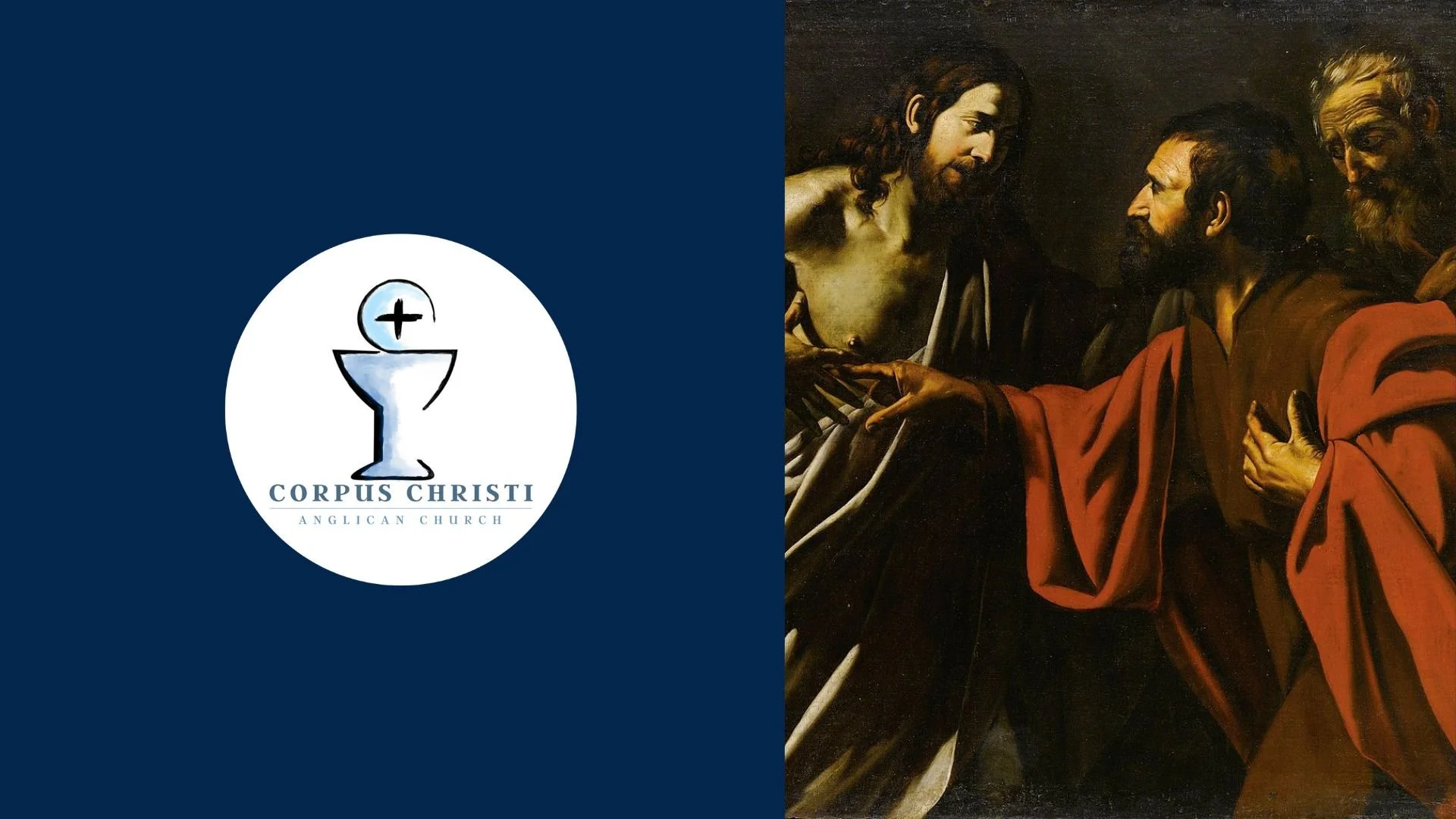
Second Sunday of Easter: When the Sad Comes Untrue
TranscriptioN
Well, it's a joy to be back with you again.
This is my third visit now to Corpus Christi, and you just keep getting bigger every time I'm here. It's like watching your children grow, right? They just get longer. It's like I can barely see the back of where you're seated.
A delight to be able to be here with you in Easter season this year and to celebrate our Lord's resurrection. Some of you are probably familiar with J.R.R. Tolkien's book, The Lord of the Rings. It is a favorite for many of us.
There's a wonderful scene that occurs toward the end of the book. It's Tolkien's depiction of hope and new life. It comes after the final battle, after the evil Lord Sauron has been defeated and the Ring of Power has been unmade.
The hobbits Frodo and Sam are now in the Houses of Healing, where their wounds are being tended to. Frodo has been basically out of it, and suddenly he wakes up. And when he opens his eyes, he sees there standing before him his friend Gandalf, whom Frodo had watched die in the mines of Moria, and he bursts out in shock and in joy.
He says, Gandalf, I thought you were dead, but then I thought I was dead. Is everything sad going to come untrue? What's happened in the world? And Gandalf says this, he says, a great shadow has departed, and then he laughed, and the sound was like music, like water in a parched land. And as he listened, the thought came to Sam that he had not heard laughter, the pure sound of merriment for days upon days without count.
Now as we come to our Gospel text this morning in John chapter 20, I want to focus basically on the first section, the first Easter evening, the evening of Christ's resurrection. There is not yet a sense within the gathered community of disciples that everything sad is coming untrue, or that a great shadow has passed. There isn't yet any laughter or merriment, but what there is is confusion because nobody had any categories for what was happening.
Nobody actually understood anything that Jesus had said about the fact that he would be killed and on the third day raised. There is probably disagreement because anxiety breeds that between people, and it's the disciples after all. And there's definitely fear.
In fact, the text tells us they are behind locked doors for fear of the Jewish leadership. And what we're going to see is four things in the text this morning. First, peace that will emerge in the midst of their anxiety and their fear. And second, that that peace is based upon proof. Third, that proof will lead to purpose. And fourth, that purpose requires God's power.
So peace, proof, purpose, and power. That's what we'll be seeing. So the context, you know, but we have to open it up because it helps us to allow our minds and our hearts to enter into the text, a text which many of us have heard many times, read many times, and the danger with being familiar with the text of scripture is if you're not careful, you just miss it all.
And so we remember the disciples are traumatized. Think about the past week. They have experienced the highest of highs and they have been whiplashed into the lowest of possible lows.
Just a week before they enter into Jerusalem to the shouts of hail, son of David, the Messiah, the King, the Anointed One, the Deliverer. They are on the highest of highs. And within days, what do they do? They deny him.
They abandon him. They betray him. They see him brutally tortured.
They see him executed on a cross between two thieves, like a common criminal, the one in whom they have placed all of their hope, all of their life. And they saw his mangled and lifeless and crushed body placed in Joseph's tomb. Now it's the third day.
It's the evening of the third day, and they're hearing crazy tales that he's alive. The women, as we heard last week, have encountered angels at the tomb who said to them, why are you looking for the living among the dead? He's not here. He's alive, just like he told you.
Don't you remember? And Mary Magdalene claims that she's actually seen him and spoken to him and heard him call her name. Peter and John have been in the empty tomb, and they have seen the grave clothes and this strange sight. Am I echoing? This strange sight of the grave cloth, the face cloth, folded neatly and tidily off to the side.
In the past few minutes, the two Emmaus Road disciples have returned, Cleopas and probably his wife. Usually you walk down the road with your wife when you're leaving from the Passover and going home. They've shown up saying, of all things, they've walked with Jesus, they've talked with Jesus, and he's done the greatest Bible study that has ever been known as he opens the scriptures and shows them how all the law and the prophets and the Psalms point to him.
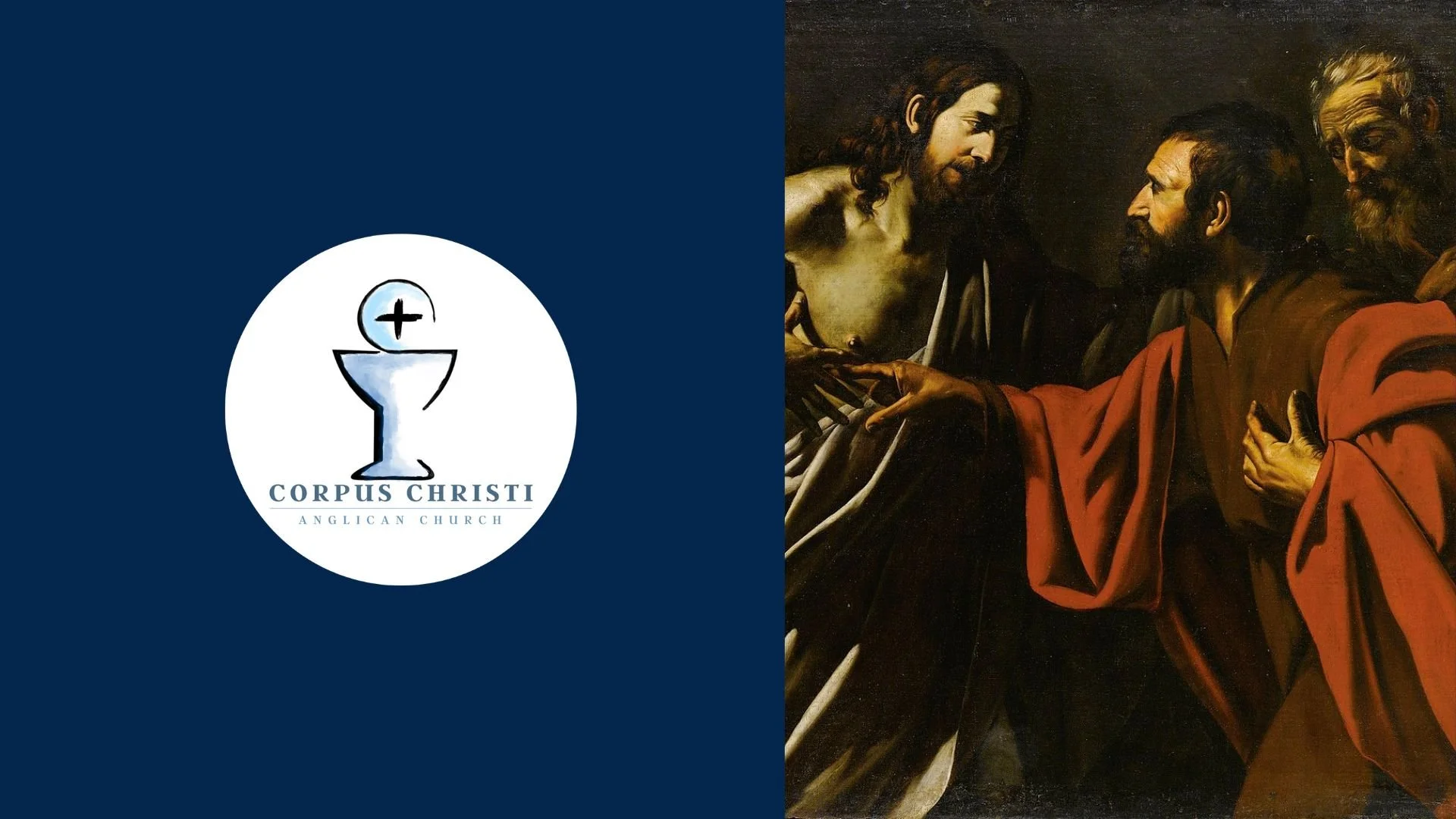
And then they have communion with him, and then he's gone. It doesn't make any sense. That's where our text picks up. In verse 19, on the evening of that first day of the week, the door is being locked where the disciples were for fear of the Jews. Jesus came, and he stood among them, and he said, peace be with you. Isn't it amazing that his first words are peace be with you? His first words to his gathered church, this motley crew of broken and traumatized and sinful people, people like me and perhaps like you, his first words were not you've done it this time.
How could you? There you go again. How dare you? Your sin is too great. You've gone too far.
Shame on you. No, he doesn't say anything at all like that. He says to them, peace be with you.
These are his first words. And in fact, he'll say it again in verse 21. And then he'll say the same thing eight days later to that good old doubter, Thomas, peace be with you.
The word is shalom. And in that culture, it is basically a very normal greeting. It's an everyday greeting, but it's also the kindest greeting that you could ever give.
We don't really have an equivalent in English. About as close as you might get is when somebody comes to your house, and you say, well, welcome. I'm glad you're here.
Make yourself comfortable. My house is your house. All that is mine is yours.
But shalom goes far beyond niceties or hospitality. It's far more comprehensive. It's as though he's saying all peace in every way and at all times be with you.
It's all encompassing fullness, wellness, blessing, provision, perfection, wholeness, prosperity, healing, restoration. There's no room for fear. I only want good for you.
That's what Jesus says in his first words to his gathered church. And the reason that he can say this to these fallen and faithless people is because it is peace that he has secured. His cross and his resurrection have established peace with God.
That's what he offers to those who believe. He died because of and for our sin. He was raised, as the scripture says, for our justification before God to show that what he has done in his life, in his death, through his resurrection, and then, as we'll see soon, and in his ascension, is sufficient.
It's enough. It's satisfied. The apostle Paul says this in Romans 5, verse 1, therefore being justified by faith, we have peace with God through our Lord Jesus Christ. Oh, it is such good news. It is such good news.
Now, I just want to ask this. Have you ever wondered what his voice sounded like when he said it? Did he boom, peace be with you? Some sort of thing you'd see out of Hollywood from the sky. Did he whisper timidly, peace be with you? It's not spooky Jesus. I think, actually, he probably laughed joyously as he said it.
I think Tolkien got it right when he wrote, and then Gandalf laughed, and the sound was like music or like water in a parched land. And as he listened, the thought came to Sam that he had not heard laughter, the pure sound of merriment for days. Do you hear that? The pure sound of merriment.
You ever seen a baby giggle, a little child laughing just hysterically, not burdened by all the things that burden the rest of us as we get older and stuff all that down and life beats up on us a bit? The pure sound of merriment. That's God. Do you know that's how our Lord sees you? With a pure sound of merriment.
When he looks on you, of course he sees your brokenness. Of course. He doesn't excuse our sin.
He's done something about it. But when we trust him, what do we receive in return? The pure sound of merriment. We receive peace with our God.
He sees us with love. He sees us with kindness, with affection. Yes, he'll correct us.
A good father does that. This is why grace is so amazing. Verse 20 says, then the disciples were glad when they saw the Lord.
See, in God's kingdom, peace and joy are closely linked together. And so the permission I like to give people, I don't know if I told you this last year, but I say it an awful lot. If at any point today your heart tells you you're happy, let your face know about it.
It'll encourage me and it'll also help you because you'll begin to integrate what's going on inside in your soul, with your body, in your spirit, with all of who you are. Verse 20 also says, then he showed them his hands and his side. And what's he doing? In the midst of offering peace, he's giving them proof.
You see, our peace is based upon proof. These nail-scarred hands. He really died. Lights out. He wasn't mostly dead. He was totally dead. And he really rose from the dead, not ethereally, not spiritually. He rose physically and bodily from the dead. Our faith is based on a historical fact.
There is a resurrected Christ. Jesus is the risen Lord, which is why you see this shift that starts to go on in what they call him. They call him Lord, Lord, Lord, Lord of heaven and earth, Lord of the living and the dead.
His physical body is really alive. Is there mystery? Yeah, of course there's mystery. You don't want a God that isn't mysterious.
It's part of why you celebrate the way you do. Your people who are craving the mystery of a God that's bigger than the pragmatism that we live in day in and day out, where everything is broken down to its smallest little bit. And anything larger than the idol of our own minds gets discarded as fanciful and idle.
Oh, there's mystery. Yes, there's mystery. His resurrected body is the same and it's different. Recognizable and yet also changed. He can come and he can go and lock doors and stones across tombs. Well, there are no obstacles for him.
The stone was rolled away for the women and the disciples, not for Jesus. He's giving them and us who read the account, we who have not seen, but who have believed the proof that everything sad is really coming untrue. You can trust him.
You can trust his words to you. You can trust your life to him. You can trust his character, his heart, his promises, your yesterday, your today, your forever more, your goodness, your badness, your successes, your failures, your sins.
He can handle them. And in the end, he will triumph. Make no mistake, death is not the last word for the person who trusts in our Lord Jesus Christ.
He is crucified and he is risen. Hallelujah. And that has to be shared with other people.
That's our purpose, to share good news of peace that's based upon proof of the crucified and risen Lord. That's what he tells them and us in verse 21. He says, peace be with you as the father has sent me, even so I'm sending you.
And this is incidentally John's version of the great commission. Matthew 28, Jesus says all authority in heaven and earth has been given to me. Therefore go and make disciples of all nations, baptizing them in the name of the father and of the son and of the Holy Spirit and teaching them to obey all that I have commanded you.
And surely, surely, surely I am with you to the very end of the ages. We are a people. That's what it is to be the church.
We're not called to be a holy huddle away from the world. To retreat to the safety of our gatherings and even the wonders of our worship on a Sunday morning is meant to equip us as we worship him, as we hear from the word, as we feed from the table so that we can be sent out into the world around us. We are called to go and do what Jesus did, to seek and to save those who are lost, to help others be reconciled, to have peace with Jesus, to have peace with the holy and the almighty holy God.
So we have peace that's based upon proof and that leads to purpose, but to fulfill God's purpose, please hear this, you need God's power. Verse 22, and when he said this, he breathed on them and said to them, receive the Holy Spirit. Now the Holy Spirit is going to be poured out in even greater measure about 50 days later on the day of Pentecost.
There are going to be witnesses in Judea, Samaria, Jerusalem, Judea, Samaria, to the ends of the earth. But for now, what we want to see is that the power of the Holy Spirit brings new life. Now I'm going to go back to another Christian favorite, C.S. Lewis, Lion, the Witch, and the Wardrobe.
It's funny how these books work themselves into Easter sermons. I think these men knew something. Aslan, the lion, who is Christ, has been killed on the stone table and has been raised.
He is alive and the first thing he does is he goes to the white witch's castle where her courtyard is full of stone statues, these good creatures whom the witch has cursed and turned into stone. They are lifeless, they are dead. And Aslan walks up to each of them and breathes life upon them, turning them from stone to flesh again.
It's a picture of recreation, it's a picture of resurrection. And what do they do? They sing and they dance and they rejoice and they shout the glories of the one who makes all things new. My question this morning would be this, has that happened to you? Have you been made new, not because you started a new leaf, but because Christ's life has entered into you because you've placed your faith in him? It doesn't have to be a huge emotional thing, but it has to be a very real thing.
How many of you know that you were born as a baby? You may not remember it, but you're pretty sure it happened. Well, hello, if in the natural, so also in the spiritual. God does not leave us wanting and wondering whether we have been born anew.
He's a good father and he will confirm to us, and how will you know you actually believe the stuff you say in the liturgy? You actually hear the word, and though you might struggle with doubts at some times, I'm your bishop, every now and then I struggle with my doubts. That's not anti-Christian, that's human. That's the already and the not yet.
But do you believe? Do you rest your life on him? Then you've been born anew by his spirit. You have life from above. We might say it this way, have the promises of your baptism come alive in you? And if not, ask him to.
If you believe, you can do it now. You can do it in a few moments along with our confirmands as they affirm their baptismal promises. And if this has happened to you, if you are living this life with Christ, are you fulfilling his purposes? That's not a guilt trip.
It's a question that we all have to ask ourselves just realistically, not heavy handedly, not because somehow you're going to earn something from God or lose something from God, but because you have a purpose. We have a purpose, but we need his power. Because Jesus says, apart from me, you can do nothing.
And I'm proof of that. And so ask him to increase his power in you so you can fulfill his purpose, which is to invite others to come and discover this incredible peace that's based upon proof of our crucified and resurrected Lord. And here's this, the world needs to know that everything sad is coming untrue, especially in the time in which we live.
Let's pray. The Lord, we thank you for your word. We thank you for your resurrection.
We thank you, Lord, your spirit is here amongst us and within us and around us. Lead us to Jesus, we pray. Open our hearts to new life.
Cleanse us of our sins. Call us to purpose. And we pray, Lord, give us your power to accomplish that which you ask us to do.
We ask these things in Jesus' name, our crucified and resurrected Lord. Amen.
Transcribed by TurboScribe.ai. Edited by the Vicar.