
SERMONS
Archive
- October 2026
- September 2026
- August 2026
- July 2026
- June 2026
- May 2026
- April 2026
- March 2026
- February 2026
- January 2026
- December 2025
- November 2025
- October 2025
- September 2025
- August 2025
- July 2025
- June 2025
- May 2025
- April 2025
- March 2025
- February 2025
- January 2025
- December 2024
- November 2024
- October 2024
- September 2024
- August 2024
- July 2024
- June 2024
- May 2024
- April 2024
- March 2024
- February 2024
- January 2024
- December 2023
- November 2023
- October 2023
- September 2023
- August 2023
- July 2023
- June 2023
- May 2023
- April 2023
- March 2023
- February 2023
- January 2023
- December 2022
- November 2022
- October 2022
- September 2022
- August 2022
- July 2022
- June 2022
- May 2022
- April 2022
- March 2022
- February 2022
- January 2022
- December 2021
- November 2021
- October 2021
- September 2021
- August 2021
- July 2021
- June 2021
- May 2021
- April 2021
- March 2021
- February 2021
- January 2021
- December 2020
- November 2020
- October 2020
- September 2020
- August 2020
Ascension Reflections on Building the Life of the Church
Good morning. I’m Alexei, a member here. Let’s pray together. Father, as we consider these words, help them to manifest in us a wellspring of life. Lord, we pray in the name of the Father, Son, and Holy Spirit. Amen.
Last sermon, if you were here or if you had a chance to listen for Ascension Day, Father Morgan covered, among other things, the expectations of the disciples in terms of what would come next and the meaning of adoration. We heard a very long, but good, example of Father Morgan’s love of coffee as it relates to adoration today. I am given similar texts, but I’m going to weave the text a bit differently in terms of what we covered today. I will cover the preview of what is to come with the children of God, us, our active pursuit of building and how and by what means, and what contrast these momentous days of Ascension leading up to Pentecost will look like. We’ll look at the spiritual elements of this building up of the body and consider the persecuted church out of our First Peter passage, and its practical application, and how that draws us from the smaller loves into the greater loves of the body of Christ. We will consider how to be in the world and not of it, holding the body and how to navigate the times we’re in, and will consider how we can claim a love for even our nation and pray for it, but how that is a secondary love to the love of the body of Christ and how those two loves are in relation to each other. First, I’m gonna start with a bit of a reflection from Alexander Schmemann.
So, for those of you who might be newer to the Anglican church or might be newer to liturgy, you might notice that every year we make a big deal of our liturgy. It really, in many ways, for those of us who practiced in the Anglican tradition for some years, starts at Advent and it moves all the way through Pentecost. But sometime in this part of the year, Easter to Pentecost, we kinda lose a little bit of its meaning, or it can seem that way. And so Schmemann, I think, gives us a way to think about liturgy and the importance of liturgy again. As a church where we read the Book of Common Prayer, we’re common people, and we’re seeking uncommon transformation, and part of that is the liturgy. Part of that is the liturgy of this day and going into Pentecost itself. So let’s hear Schmemann on these words. Alexander Schmemann, for those of you who don’t know, is an Orthodox teacher and protopresbyter.
“In the center of our liturgical life, in the very center of that time which we measure as year, we find the feast of Christ’s Resurrection. What is Resurrection? Resurrection is the appearance in this world, completely dominated by time and therefore by death, of a life that will have no end. The one who rose again from the dead does not die anymore. In this world of ours, not somewhere else, not in a world that we do not know at all, but in our world, there appeared one morning Someone who is beyond death and yet in our time. This meaning of Christ’s Resurrection, this great joy, is the central theme of Christianity and it has been preserved in its purity by the Orthodox Church. There is much truth expressed by those who say that the real central theme of Orthodoxy, the center of all its experience, the frame of reference of everything else, is the Resurrection of Christ.
The center, the day, that gives meaning to all days and therefore to all time, is that yearly commemoration of Christ’s Resurrection at Easter. This is always the end and the beginning. We are always living after Easter, and we are always going toward Easter. Easter is the earliest Christian feast. The whole tone and meaning of the liturgical life of the Church is contained in Easter, together with the subsequent fifty-day period, which culminates in the feast of Pentecost, the coming down of the Holy Spirit upon the Apostles. This unique Easter celebration is reflected every week in the Christian Sunday, which we call in Russian ‘Voskresenie’ (Resurrection Day). If only you would take some time to read the texts of Sunday Matins, you would realize, though it may seem strange to you, that every Sunday we have a little Easter. I say ‘little Easter,’ but it is really ‘Great Easter.’ Every week the Church comes to the same central experience: ‘Having seen Thy Resurrection...’ Every Saturday night, when the priest carries the Gospel from the altar to the center of the church, after he has read the Gospel of the Resurrection, the same fundamental fact of our Christian faith is proclaimed: Christ is risen! St. Paul says: ‘If Christ is not risen, then your faith is in vain.’ There is nothing else to believe. This is the real center, and it is only in reference to Easter as the end of all natural time and the beginning of the new time in which we as Christians have to live that we can understand the whole liturgical year. If you open a calendar, you will find all our Sundays are called Sundays after Pentecost, and Pentecost itself is fifty days after Easter. Pentecost is the fulfillment of Easter. Christ ascended into heaven and sent down His Holy Spirit. When He sent down His Holy Spirit into the world, a new society was instituted, a body of people whose life, though it remained of this world and was shared in its life, took on a new meaning. This new meaning comes directly from Christ’s Resurrection. We are no longer people who are living in time as in a meaningless process, which makes us first old and then ends in our disappearance. We are given not only a new meaning in life, but even death itself has acquired a new significance. In the Troparion at Easter we say, ‘He trampled down death by death.’ We do not say that He trampled down death by the Resurrection, but by death. A Christian still faces death as a decomposition of the body, as an end; yet in Christ, in the Church, because of Easter, because of Pentecost, death is no longer just the end, but it is the beginning also. It is not something meaningless which therefore gives a meaningless taste to all of life. Death means entering into the Easter of the Lord. This is the basic tone, the basic melody, of the liturgical year of the Christian Church.
“And the real content of the Church life is joy. We speak of feasts; the feast is the expression of the joyfulness of Christianity.
“The only real thing, especially in the child’s world, which the child accepts easily, is precisely joy. We have made our Christianity so adult, so serious, so sad, so solemn, that we have almost emptied it of that joy. Yet Christ Himself said, ‘Unless you become like children, you will not enter the Kingdom of God.’”
We reflect on Schmemann, and he’s pushing us into this idea that our Christian year is in these days, these high days of Easter, these days of the Ascension leading us into Pentecost. We can get into some of our passage. We look into John 17, which is where we started. I just wanna cover a few pieces out of the Gospel of John. It’s really, when we look at it, a bit—this is a combination of very serious and also a bit comical at the very end. So He’s taken up into heaven, and the comical part: they look up, and then two men are dressed and stand and say, “Why are you looking up?” That’s the comical part. “This same Jesus has been taken from you into heaven and will come back in the same way you’ve seen Him go into heaven.” And so then, as we continue into 12 and 13 and 14, we notice that what the apostles give themselves into is an intense focus on prayer coming into Pentecost. This is tied into the very essence of our Anglican way of life. Our Book of Common Prayer—prayer is the anchor of the waiting as part of our Christian life. It’s the anchor, but it’s also part of the building.
I’m gonna move us into Genesis 11 a little bit. The Ascension, in many ways, is a kind of bridge, is one of the Exodus bridges. OK, so in the book of Exodus, you’re leaving from Egypt and you’re crossing the Red Sea. Jesus, in a very literal way, is ascending to heaven, creating a bridge for us. Do you see that parallel? He’s creating a bridge for us, an Exodus bridge. Second thing is, in the Old Testament, you have the Exodus, you have the wilderness, then you eventually have the coming into the Promised Land after a severe sequence of things that culminates in the Old Testament in the temple, the temple itself and temple worship. In the New Testament, what this whole culminates into—Ascension as a start and Pentecost—is the temple of our own bodies, our own bodies, the Lord dwelling within us. You can see, then, the seriousness of our bodies and our actions and our acts in the epistles, how seriously we take what we do with our bodies, why this is now the place where the Spirit, God’s presence, dwells with us.
You can see these parallels here now both the Old Testament and New Testament are dealing with a human tendency that I want us to look at in Genesis 11 as we start thinking about what is the Ascension mean for our life as a Christian that’s the tower of Babel so what I’m doing here is I’m contrasting new Old Testament the New Testament what is the human condition? What is life apart from God actually look like what does the scriptures have to say about it if you can see the connection because this is the starting point of ours ascension to worship Genesis 11 the whole world had one language in a common speech as men moved east where they found a plane in Shinar and settled there they said to each other come let’s make bricks and bake and thoroughly. They use brick and instead of stone and for mortar and they said come let us build ours of the city with a tower that reaches to the heavens so that we may make a name for ourselves two things are going on here that I want to draw our attention to one. Is that notice of the tower of Babel we’re moving from the natural to things that man makes brick.
Do you see that the technological development were no longer using what God has given us, but we are selves are making the equivalent the equivalent of their day the iPhone AI you know these things are still alive in the sense of what man breaks a generation or two ago cars and airplanes. The making of the brick is not necessarily the challenge meaning what man makes a lol more than it’s a challenge of what you what you’re making in your life your personal life what you do with your time in your energies it’s the second part to make a name for ourselves to make a name for ourselves to put us first to put our ways first. Think about this to put our ways first, but we’ll still exploit the poor in the town in the Babel system and then if you look in the New Testament Babylon takes on the same kind of archetype. Egypt is another architect to make our name for ourselves, but we will not have justice to make a name for ourselves, but we will not reform our hearts for peace patients kind of self-control to make a name for ourselves, but to worship ourselves not to worship God.
The temple in the Old Testament is this place where you’re making sacrifices for sin in heaven and earth can then be in a place to make your to make it right with God, Jesus who’s made our way right with God ascend into heaven, and then gives us new tools, new tools for the body of Christ to move forward his patient kind of self-control. The new tools that are necessary to actually take conflict more slowly how many of you had conflict this week. Do you have conflict with anyone add conflict this week one way that the Ascension in the Christian life and the Holy Spirit dwelling in our temple in our bodies matter is it slows us down? It slows us down in a world that is wanting to speed us up.
Do you feel that how fast everything is how much your time is supposed to be taken up everything supposed to be on the quick the double quick and if you don’t have time, ask AI will give you the answer, right just slow us down but not to slow us down just to be slow. This is not even though it’s wonderful to be slow and it’s wonderful to have a relaxed life and to have a more peaceful life in a life where you have time to have time for yourself and to rest the point isn’t the slowness the point is the time to go back in prioritize, the Lord right think of the conflict you had this week if you have conflict this week or think of a difficulty you had this week if you didn’t have conflict, part of stepping back from the conflict from the difficulty from the distraction is not just for rest sake it’s to go back and seek for the Kingdom of God and of itself to slow down and then apply the Christian life to your circumstances, which can be difficult sometimes why can it be difficult because we wore against the world the flashing the devil there’s all these things that push for our time but again this is going back to living as Christians in our day-to-day and to be a sweet offering go into our Peter passage in for Peter.
It’s very interesting what we’re given and it’s interesting if you’re thinking about why did we have the particular readings that we had today the psalm if you noticed, it’s the Ascension verse did you see that in the Psalm he ascended into heaven, right it’s right there and then we also have the the John 17 prayer we end with and then we’ve already covered a little bit of the ax but in first Peter, it’s pretty interesting but love do not be surprised at the fiery ordeal that is taking place among you to test you as though something strange were happening to you, but rejoice and so far as you share Christ suffering many of us, not all of us but many of us in the Christian Weston in the United States were a bit removed for some of the suffering and not saying that we don’t suffer. Certainly people can look down on us for being very religious. Certainly people cannot think well of us for going committing our life to Christ that that does happen, but it’s a different degree then you will be jailed.
So I wanna talk about three examples of persecution that it is happening the church today and how that draws us back into a love for the body and then tie back into our Discipline so three examples of people that I’ve known and come across in the last year within my personal life involvement for Kingdom Mission Society. The persecuted church has been very important and certainly for the Anglican Church in North America. It is also very important.
First example I want to talk to you is something that probably was in the news today or this last two weeks he probably heard of Pastor Ezra Jin or maybe Jimmy Lai been persecuted in China in the last year. The Chinese government at last year and a half has made it illegal for you to not meet in the state sponsored church Pastor Ezra Jin had the largest online church in China. They reached probably 50,000 people a week and that also meant this is how a Chinese could go and get some of the online Bible apps right so they jail Pastor Ezra Jin in about a year and a half ago or last October less than that and 200 members of his church in the charges there are fraud why are the charges fraud well from the Chinese government‘s perspective they’re operating tithing and offerings apart from the state church therefore that’s the fraud he is kept in a place where he cannot talk to his family knowing the daughter who attends a sister church in the region he is kept the lawyers are harassed and threatened to their licenses be removed unless they drop the case and he it is unclear half and he’s given his diabetes medication. He is facing likely 7 to 10 years in prison in what is the story due for us well this story best for us were to pray for Pastor Ezra certainly to think about how we speak up or support the persecuted church but what happens when we start thinking about the prosecuted church as we realize that these are believers alive right now praying to God right we are tied with them in a fellowship right and that helps us. Yes pray for our love for our country, but also to pray for the global body.
Let me give you two more examples and will move into our clothes out of John 17. The second is the church in Syria. This is the church that at the start of the 20th century was 20% or more of the Syrian population it’s now down to 2%. It is eight different churches in Syria. The stories go that Christian communities are often harassed with bullhorns and threatens that they should convert to Islam it’s not the whole society that does this but some of the extremists so you can imagine being a church like ours suddenly being interrupted by a large bullhorn that’s the experience of our brothers and sisters saying convert to Islam. What happens is the man in the church will go and talk to the person and say please stop and they’ll make a report to the government to please stop but in one of these churches have three weeks after an incident like that there was a church Bonding right as we pray for our brothers and sisters in Syria in Iraq in Iran, who face this kind of intimidation is how I describe the Christian persecution in much of the Middle East today
Third one I wanna talk about is Christian prosecution in the Congo you would think well why the Congo it’s an 80% Christian nation. Why would they have Christian persecution in the Congo well, they’re having Isis affiliated groups who are going and asking are you Christian? Is your name Christian John that sounds like a Christian name convert otherwise I’ll cut your hand off. It’s really at that level, it’s very brutal. It’s very brutal and we think of our brothers and sisters in the Congo. These are very different types of places you know different types of the economies, different types of living, but we are united in this first Peter passage for them can’t suffer Price suffering or living Krise suffering. Do you see them until we get connected with the global body, even as we give things for God‘s blessings in the United States and then other parts of the Western world that we’re connected with the global body, and we know that these are not suffering as murderers of thieves or as criminals, right we know they’re suffering as Christians and so we pray for them we think about how to send relief and sad to send aid through the Anglican Church in North America. Does that quite well and we support our brothers and sisters who are in this place and we know that they’re deeply connected into our liturgy and then I’ll move to the John passage, we know out of the book of Revelation that they are in White right they are calling out. They are the martyrs and White and let’s make a connection of our liturgy. That’s the same White that you’re given in baptism right this is the connection for the liturgical life. This is one of the reasons that part of building the new city part of building the city of God on earth part of building up the church is where we’re turning it all around we’re not practicing injustice within the church. I’m not saying there’s a scene in the church there’s certainly is we’re turning it all around because God‘s doing the building so it’s slow sometimes God‘s doing the precious building in our lives think about your own growth and faith.
It’s a slow growth, but this is all enabled in part because of the new exodus because of the Ascension the feast day we’re celebrating today right let’s let’s final finish and John 17 so here it’s pretty incredible in the gospel of John. we’re given Jesus‘s prayer to God the father we are let in on a divine conversation. How amazing is this and here’s what he pray in 17. He talks about his time being here. He talks about being glorified and then at the end here at 17 he says 11, which is our remain you know I will remain in the world no longer, but they are still in the world and I’m coming to you. Holy father protect them by the power of your name the name you gave me so they may be one as we are one. He praise for the unity of the church the unity of the church that begins in our hearts, the unity of the church for the spirit dwells in our hearts and dwells in our conflicts the unity of the church that it matters what you do if your body it matters what you do if your time he prays for the temple that will go on forever in our own resurrection right and so it in Dallas each of us within incredible meaning Jesus does with incredible dignity CS Louis talks about you’re talking to strangers you may be having everlasting conversations conversations with eternal consequences in his writings so think about that as we had between now and as we go into Pentecost, we’re thinking about the meaning of these days the liturgy is what we’re given going back to Schmemann right from Easter to Easter from Easter to Pentecost. This is what we’re given until the next age to experience the simple joys of the Christian life where it’s not about ambition, it’s about having the Lord‘s business at mind always and having contentment joy from following the Lord always not in flashy moments and flashy careers so that can be fine if it’s present there it’s that you have your contentment somewhere else and that is what helps heal the restlessness. It’s been in the human spirit since the garden. Jesus is what helps heal this and says we think about Ascension as we head into Pentecost this week about the importance of time and your week and take the small steps if you haven’t opened up the book of common prayer if you haven’t done your scripture reading in a while use this week as a mini renewal week because I always find the Pentecost is sending season in my own walk-in lot, so think about that enter into the glory of this time whatever stage of life that you’re in and seek the Lord fully let’s pray vicious father we thank you for this ascension Sunday what enables through the waters adapt we asked that you would be with us and help us to renew our hearts even this day the name of the Father Son and Holy Spirit.
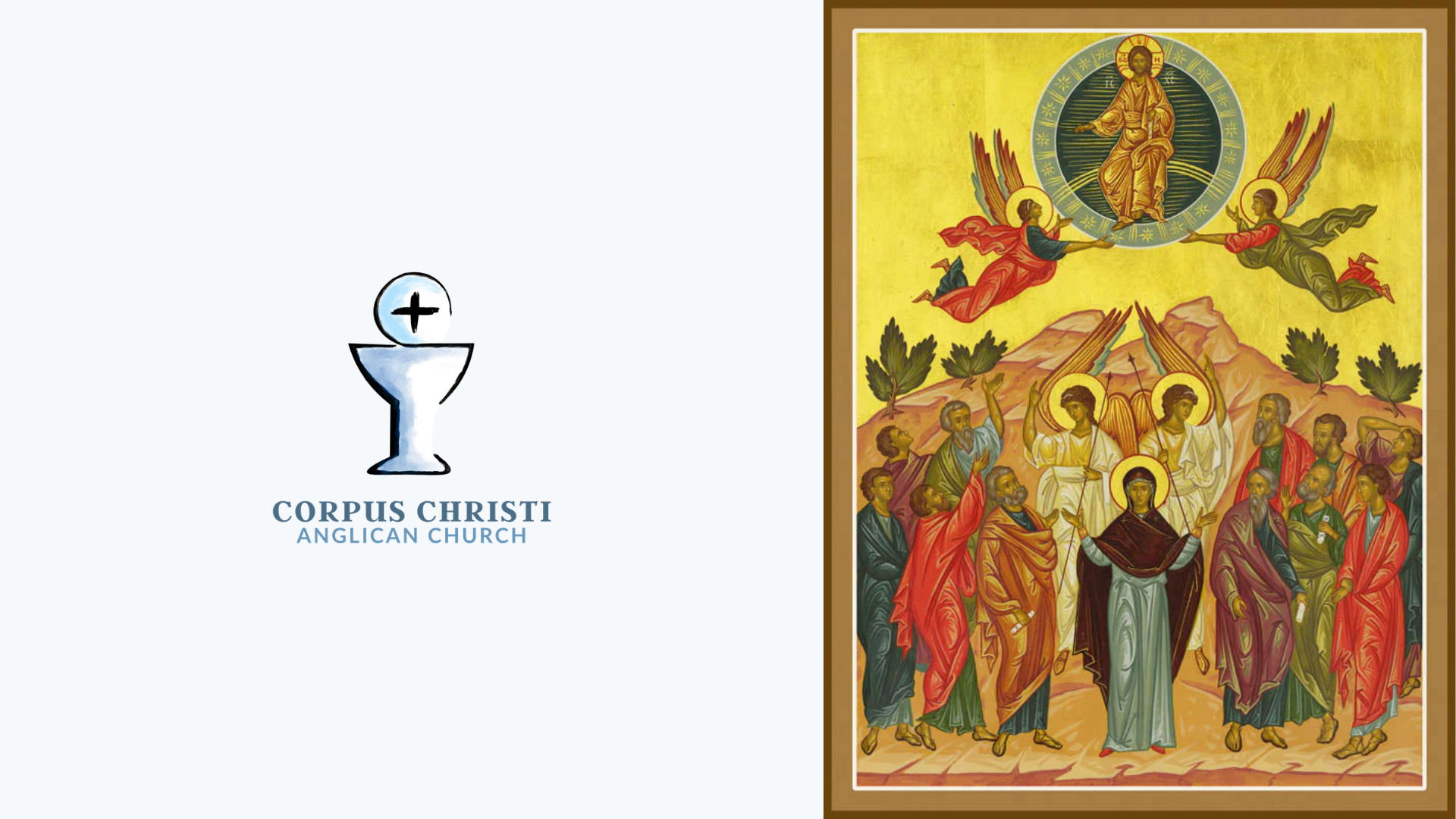
Ascension Day: Earth and Heaven Shall Be One
Introduction
Good evening friends. Thank you for coming tonight to the Feast of the Ascension of our Lord. The book of Acts is bookended by references to the kingdom of God. In Acts 1:3, Luke summarizes Jesus’ resurrection ministry of presenting himself alive, appearing to the disciples over the course of 40 days and speaking about the kingdom of God. Then at the end of the Book of Acts, Paul preaches in Rome and lived there two years. In verses 30-31, it says that he welcomed all who came to him, proclaiming the kingdom of God...” Everything that happens in the book of Acts then is bound up in this theme of God’s kingdom.
Everything in the world looked the same, but now was imbued with new creation significance. When Jesus ascends on high, he brings his humanity — what is earthly — into the abode of God. And he does this to bring the presence of God — what is heavenly — back into the abode of man by the Spirit so that heaven and earth are one. As we look at the Ascension in the book of Acts, let me pray for us.
In the name of God, the Father, the Son, and the Holy Spirit. Amen. Lord, may the words of my mouth, and the meditation of our hearts be always acceptable in your sight, O Lord, our Rock and our redeemer. Amen.
The Kingdom is being restored (cf. Dan 7), but not as you’d think
St. Luke opens the book of Acts with an address to a person, or at least a symbolic person, named Theophilus, meaning “Lover of God.” This is part two of the story of Jesus which really begins at the ascension. Jesus had told them to wait in Jerusalem for the Holy Spirit. Up to this point everyone had been baptized by John the Baptist’s baptism. They had joined in this movement of repentance and joined Jesus as Messiah to see God’s kingdom on earth. Jesus had made these mysterious promises about the promised Holy Spirit. This is the one who would indwell them and empower to live out God’s kingdom as this new covenant Israel under the Kingship of Jesus as the Lord’s Messiah.
In verse 6 we get to the heart of a very important question. The disciples ask “Is this now the time you will restore the kingdom?” They are thinking back to the prophecies in the Scripture about God riding in victoriously through the desert as in Isaiah 40 or the spirit of God rushing back into a restored temple in Jerusalem as in the book of Ezekiel. Or famously, the passage in Daniel 7 where a human, a Son of Man, rides in on the clouds and sits next to the Ancient of Days and reigns from God’s throne over the pagan nations who are symbolized by 4 beasts. They want an earthly king to destroy all the oppressors and usher in a reign of justice and peace where God and His Messiah reign from heaven’s throne.
Jesus doesn’t say “no, that will happen later.” His answer is more nuanced. He tells them essentially not to worry about the when because it is the wrong question. Also, they shouldn’t worry about the contours of how the kingdom will look. That is God’s business. It will eventually envelop everything, but it starts small — Remember the whole mustard seed parable. His answer to them is that they will receive power when the Holy Spirit has come upon them. Then after this happens they will be witnesses in Jerusalem, Judea, Samaria, and the ends of the earth. What this means is that the kingdom is here, and it is going to look different than they thought; it will start smaller than expected, but also more cosmic than they understood. The Spirit will fill them as the new temple and not a building. From that temple, the work of God will be made known as the nations encounter the place where heaven meets earth, which is the body of Christ, the Church!
Heaven is not just a place far off; it is the unseen realm of God, the “age to come” that overlaps and interlocks with this present evil age. Jesus, being fully God, enters into the present evil age, taking on the fullness of humanity to defeat sin and death. Then as he ascends to heaven in a resurrected body, he assumes, takes up, creation into the abode of God. This is the good news of the kingdom! The image of Daniel 7 is prominent in the ascension as Jesus’ ascension proclaims to the world that Jesus reigns over all earthly authorities. And from his reign on high he gives the Spirit to the Church. Now, God’s abode comes to bear on creation’s abode. Earth had been taken up into heaven and heaven is brought to earth; yes, the kingdom is here, but not as we would expect.
The disciples are called to be Spirit-filled witnesses to this kingdom. Their transformed lives, and those of their households and neighbors are the testimony that Jesus is King and his kingdom has come. This reminds me of a quote from C.S. Lewis in his Letters to Malcolm, “When the wind roars I don't just hear the roar; I "hear the wind." ...The distinction ought to become, and sometimes is, impossible; to receive it and to recognise its divine source are a single experience. This heavenly fruit is instantly redolent of the orchard where it grew. This sweet air whispers of the country from whence it blows. It is a message. We know we are being touched by a finger of that right hand at which there are pleasures for evermore. There need be no question of thanks or praise as a separate event, something done afterwards. To experience the tiny theophany is itself to adore. Gratitude exclaims, very properly: "How good of God to give me this." Adoration says: "What must be the quality of that Being whose far-off and momentary coruscations are like this!"”[1] It is because of this quote that the word coruscation entered my vocabulary, some instantiation of something that points me back to a cause or source. I will often joke about coffee being a coruscation of divine love.
And while I’m partially kidding, coffee actually serves as an excellent example. Coffee is a cherry, with two halves that make up its pit. It’s grown slowly at high elevation and once it is harvested, it goes through a process of stripping the fruit from the green pit. The easy way is to soak it in water, loosen the fruit, and then wash the fruit off. This is called wet-washing. It is cheap and fast, but you lose flavor. The other way is to dry it out in the sun then rake the fruits so that the fruit loosens and falls off the pits as its raked. This is the sun-dried method. It tastes much better, but is more labor intensive. Some beans have a natural deformity, called a peaberry, where instead of two halves of the pit, all the mass is concentrated into one little pit. This is about 5% of the beans. These are collected separately and roasted for sale as “peaberry” coffee. It is much more expensive. All that to say, I was with my old manager years ago and he got this special sun-dried, peaberry coffee from the mountains of costa rica. He brewed us a french press of it and I could smell strong floral notes and when I tasted it, the finish tasted like eating blueberries. What I was tasting wasn’t just coffee, I was sitting in the shade of a mountain jungle of Costa Rica. My senses were experiencing the land this beautiful bean came from. Gratitude says “Thank you Lord for the cup of coffee”. Adoration would say, “What is the nature of the soil, weather, surrounding plants, and countryside to produce this delicious cup of satisfaction and olfactory euphoria?” Gratitude for the kingdom is good, but adoration for the Spirit’s work is even better.
When the Holy Spirit is at work in the church we are not just experiencing a moment of divine power, we being reoriented to heaven breaking into our realm. Jesus reigns from on high and the Holy Spirit is the same one who makes us to reign with him and who brings that heavenly reign to bear on this broken earth. In the sweet moments of forgiveness and grace, of healing and restoration, of peace and joy, of the serenity of God’s presence in trial, the Spirit is reorienting us to the kingship of Jesus on earth where death is defeated and sin is no more.
Conclusion
As we celebrate our Lord’s ascension, we are called to be witnesses of the kingdom. This doesn’t mean we are taking up worldly weapons to bring about an earthly empire. Christ will ultimately be all in all and through all, but we shouldn’t concern ourselves with when that will happen. Jesus has ascended and the kingdom is here in ways we don’t often anticipate and that if we’d pay attention to, would point us to how his presence will ultimately fill this earth. Our call now is to be witnesses of the kingdom who name brokenness and grace. We need to be truth-tellers who can accurately and carefully diagnose brokenness and who can simultaneously point out the grace of God and how the kingdom of God is coming to bear upon our present reality by the power of the Holy Spirit. Jesus has ascended; he has brought creation into the abode of God and has brought the divine realm into creation’s abode. The good news of the Ascension is that Jesus reigns, the kingdom is here, and earth and heaven are being made one.
Let us pray:
O heavenly Father, you have filled the world with beauty: Open our eyes to behold your gracious hand in all your works; that, rejoicing in your whole creation, we may learn to serve you with gladness; for the sake of him through whom all things were made, your Son Jesus Christ our Lord. Amen.
[1] Letter 17.